
Revision Notes
Cambridge IGCSE Environmental Management (0680): Managing human population size – Revision Notes
Recall notes for Cambridge IGCSE 0680 sub-topic 7.3: five strategies for managing population size, their benefits and limitations, examples and a self-test.
- Subject
- Environmental Management
- Level
- IGCSE
- Topic
- Topic 7: Human population
- Author
- Marlbridge Academic Team
- Updated
- Reviewed by
- Azam Siddique (what this means)
Aligned to Cambridge IGCSE Environmental Management (0680), 2027-2029. Official specification .
Syllabus page (what it covers and how it is assessed): Cambridge IGCSE Environmental Management.
Syllabus points this page covers
0680
- 7.3 Managing human population size
Found an error? Report a correction.
Need help with this topic? Request a free trial class for IGCSE Environmental Management (0680).
Condensed recall for sub-topic 7.3 of Cambridge IGCSE Environmental Management (0680, 2027-2029). For full explanations, a worked example and a model answer, use the Managing human population size study guide.
What 7.3 asks
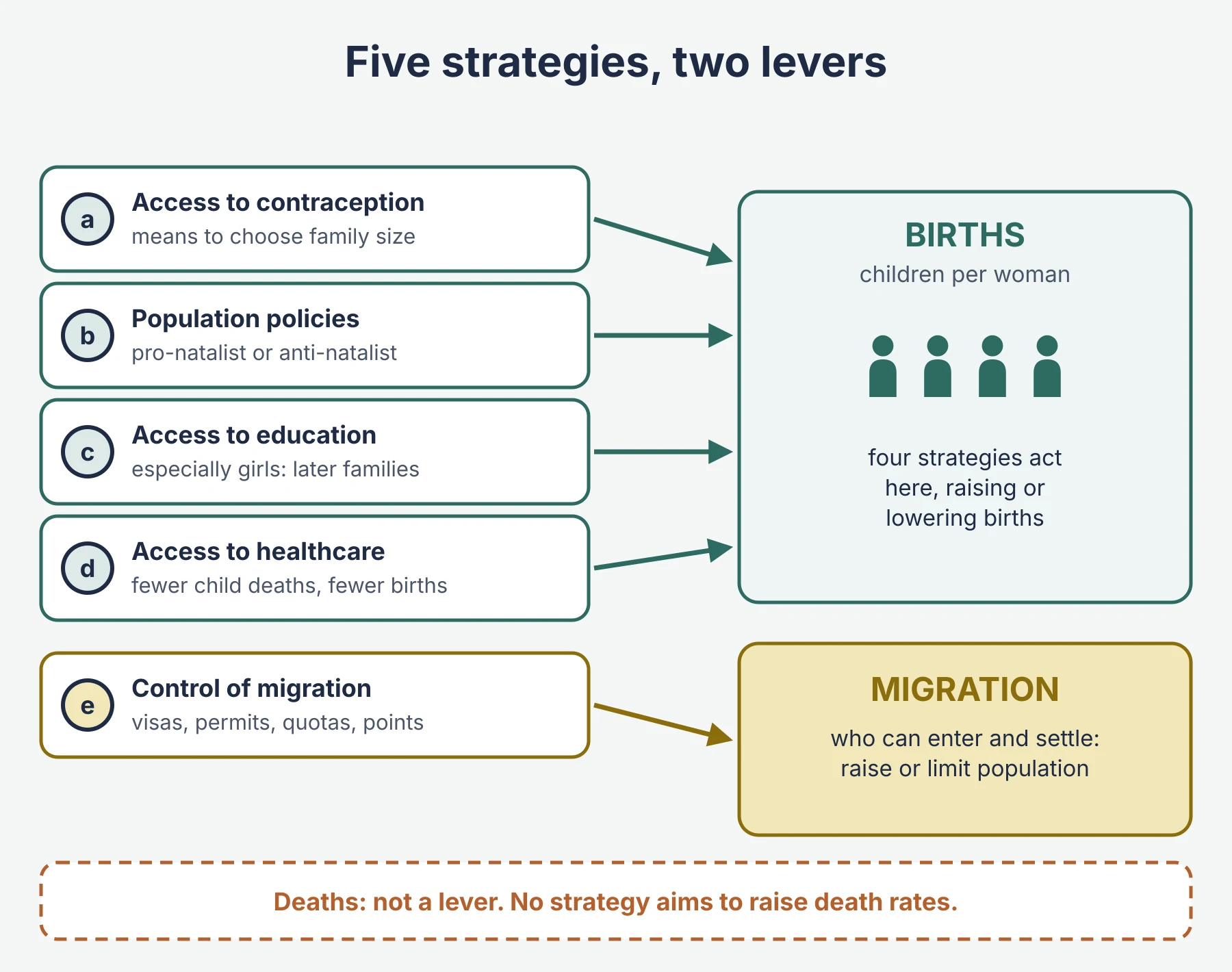
- 7.3.1 Describe five strategies: access to contraception; population policies (pro-natalist and anti-natalist); access to education; access to healthcare; control of migration.
- 7.3.2 Discuss their benefits and limitations.
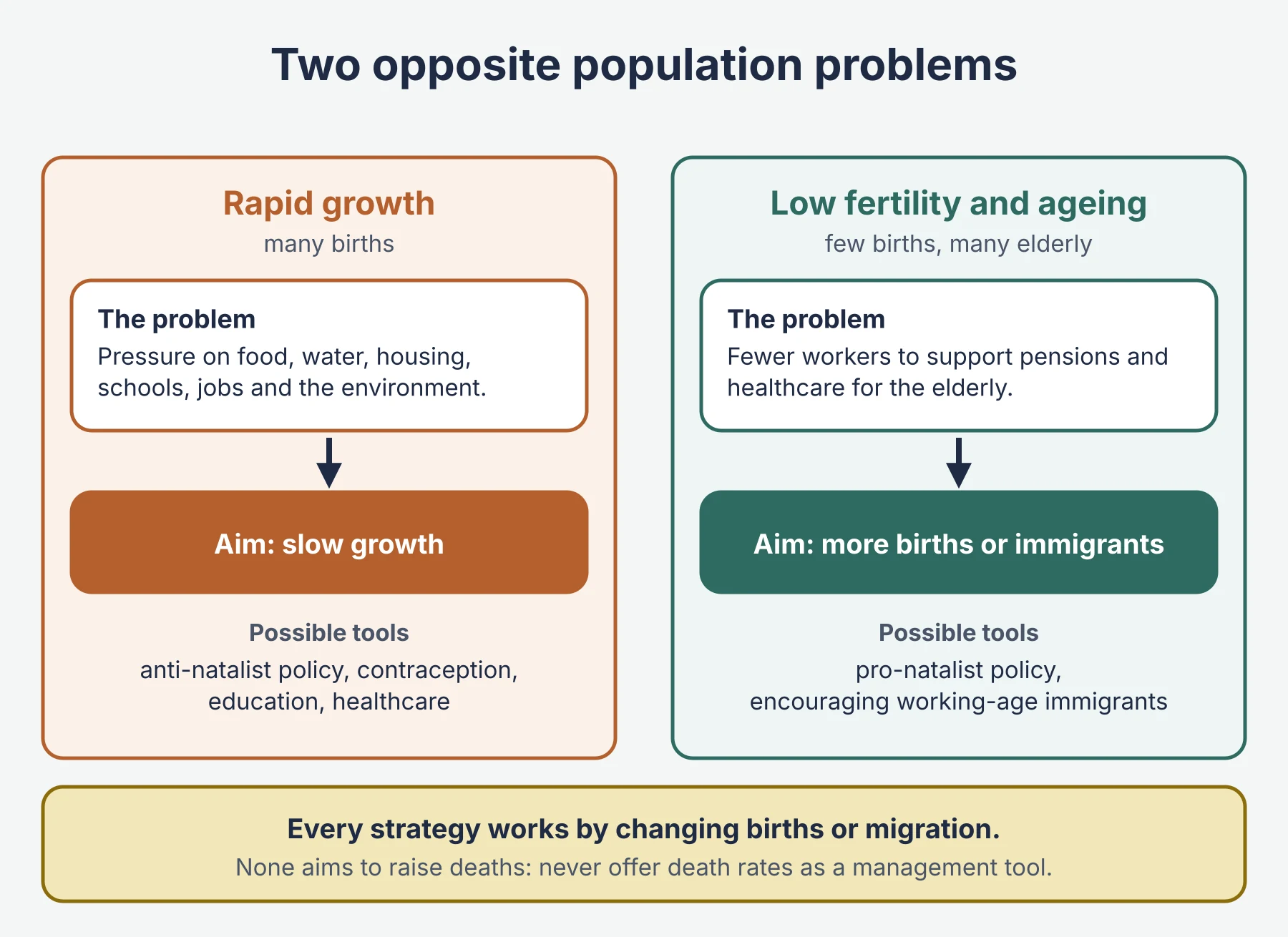
Two opposite problems
| Problem | Aim | Strategies that fit |
|---|---|---|
| Rapid growth, high fertility | Slow growth | Contraception, anti-natalist policy, education, healthcare, limiting immigration |
| Low fertility, ageing population | Maintain or raise population | Pro-natalist policy, encouraging working-age immigration |
All strategies act on births or migration, never on raising deaths.
The five strategies in summary
| Strategy | How it works | Benefit | Limitation |
|---|---|---|---|
| Access to contraception | Free or cheap contraceptives and family planning advice | Voluntary; cheap; spaces births, improving maternal health | Only works if people want fewer children; cultural or religious objections; hard to supply remote areas |
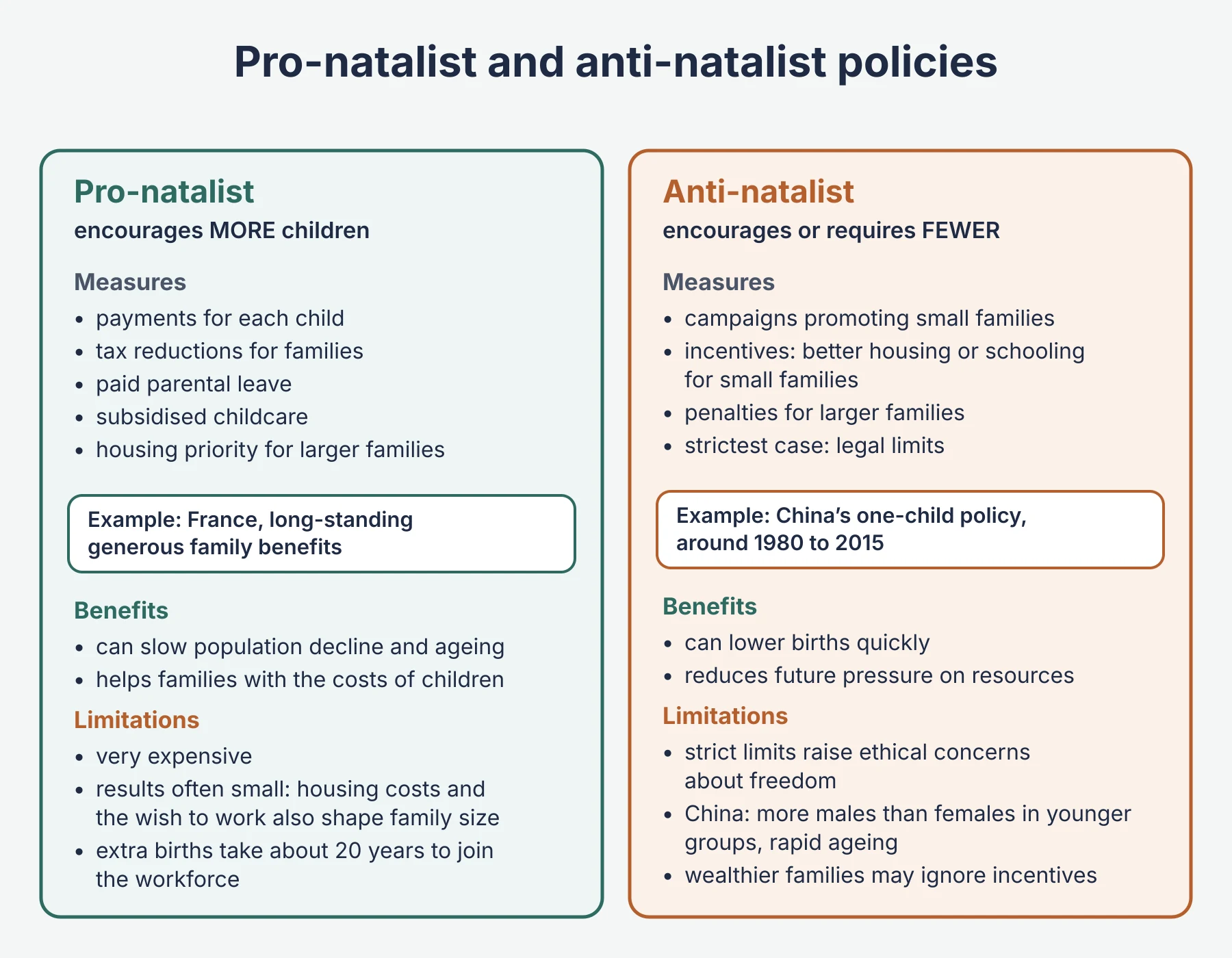
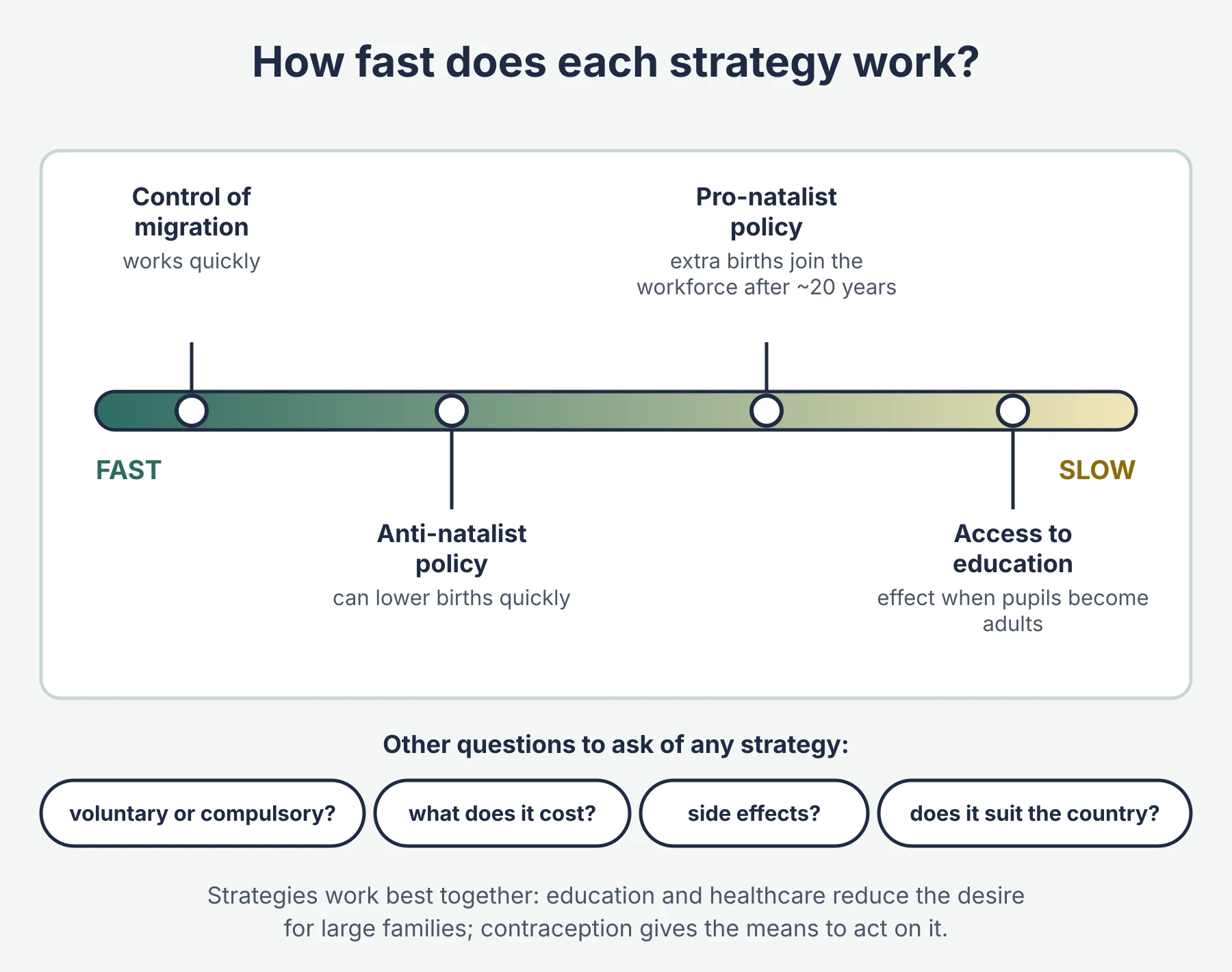
| Pro-natalist policy | Child payments, tax cuts, parental leave, childcare | Slows decline and ageing | Expensive; small effect; new births take about 20 years to reach working age |
| Anti-natalist policy | Small-family campaigns, incentives, penalties, legal limits | Can lower births quickly | Ethical concerns if compulsory; sex-ratio imbalance and ageing (China) |
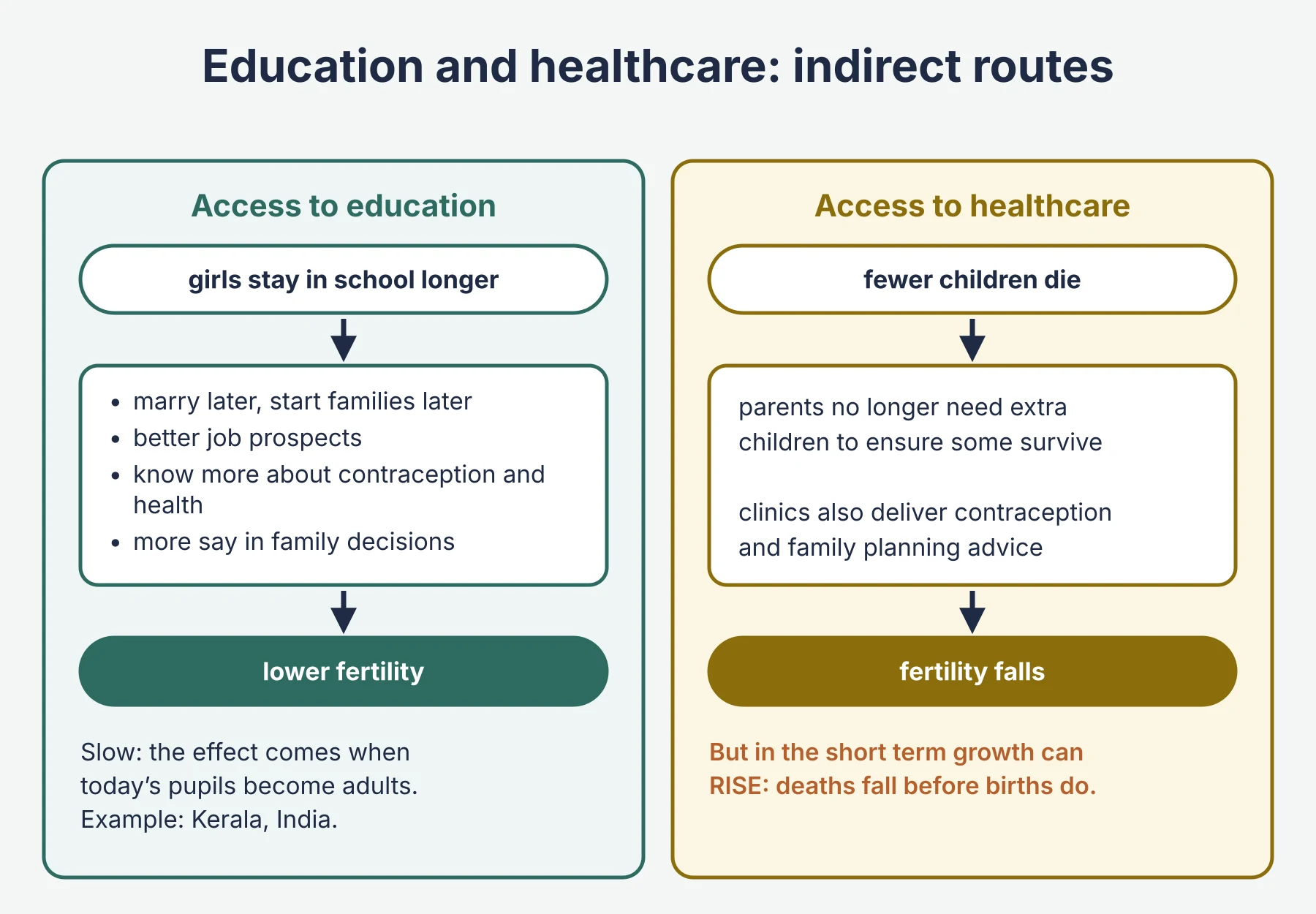
| Access to education | Keep children, especially girls, in school longer | Later marriage, better jobs, more contraceptive knowledge; boosts economy | Slow; cost of schools; families may need children’s labour |
| Access to healthcare | Clinics, vaccination, safe births, child care | Lower child deaths so parents choose fewer children; delivers family planning | Short-term rise in growth as deaths fall first; costly in rural areas |
| Control of migration | Visas, permits, quotas, points systems | Fast; targets skills; can raise or lower population | Labour shortages if strict; illegal migration; social tension; brain drain from origin |
Examples to use accurately
- China: one-child policy, introduced around 1980, ended in 2015. Lowered births; contributed to more males than females among younger people and rapid ageing.
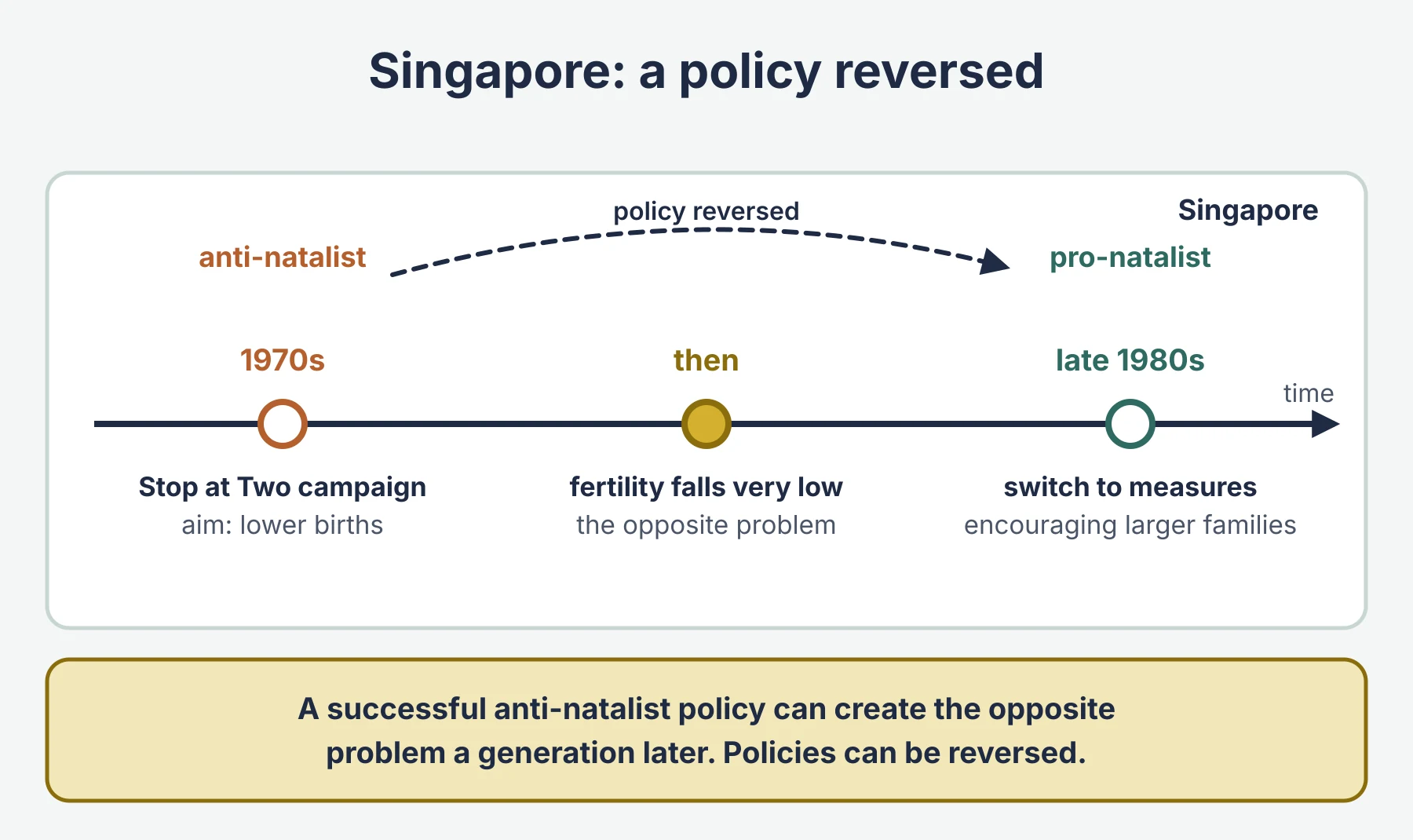
- Singapore: “Stop at Two” campaign in the 1970s (anti-natalist), then pro-natalist measures from the late 1980s as fertility fell very low.
- France: long-standing generous family benefits (pro-natalist).
- Kerala, India: often cited for high female literacy alongside low fertility (education).
- Canada: points-based system for skilled immigrants (control of migration).
Matching a strategy to a source
Read the source for the problem first. High fertility, a wide-based pyramid and pressure on schools point to slowing growth: contraception, education, healthcare or an anti-natalist policy. Very low fertility, a wide-topped pyramid and labour shortages point to a pro-natalist policy or encouraging working-age immigration. Quote one figure from the source to justify each choice.
Key terms
| Term | Meaning |
|---|---|
| Pro-natalist policy | Policy encouraging people to have more children |
| Anti-natalist policy | Policy encouraging or requiring people to have fewer children |
| Contraception | Methods used to prevent pregnancy |
| Family planning | Deciding the number and spacing of children, with advice and services |
| Fertility rate | Average number of children per woman |
| Replacement level | About 2.1 children per woman, roughly replacing each generation |
| Ageing population | Rising proportion of elderly people |
| Sex ratio | Number of males compared with females |
| Points-based system | Migration control scoring applicants on skills, age, language or job offers |
| Brain drain | Loss of skilled workers through emigration |
Evaluation checklist for any strategy
- Voluntary or compulsory?
- Fast or slow?
- Cheap or costly?
- Side effects?
- Suited to this country’s culture, wealth and problem?
Model judgement lines
- Education and healthcare change the desire for children; contraception provides the means; together they work best.
- Strict anti-natalist laws work fastest but at the greatest ethical and social cost.
- Pro-natalist payments are costly and slow; immigration fills labour gaps sooner.
- A policy that succeeds can create the opposite problem later, as Singapore found.
Exam traps
- Pro- and anti-natalist reversed.
- Healthcare claimed to reduce growth immediately.
- Migration control described only as restricting entry; it can also encourage immigration.
- China given as the answer to every policy question without discussing its drawbacks.
- Only benefits in a “discuss” answer.
- Ignoring the source: if the country is ageing, an anti-natalist recommendation makes no sense.
Self-test
- Define a pro-natalist policy.
- Define an anti-natalist policy.
- Give one benefit and one limitation of access to contraception.
- Explain how educating girls lowers the fertility rate.
- Why can improving healthcare raise population growth at first?
- How does healthcare lower fertility in the long term?
- Give two measures used in pro-natalist policies.
- Give two consequences of China’s one-child policy.
- What lesson does Singapore’s change of policy show?
- Give one way migration control can increase a population.
- Give one limitation of strict immigration control.
- Which strategy works fastest to change a country’s working population?
Answers: 1. A policy encouraging people to have more children. 2. A policy encouraging or requiring fewer children. 3. Voluntary and cheap; only works if people want fewer children (or cultural objections, or remote supply problems). 4. Educated women marry and start families later, have careers and know more about contraception. 5. Death rates fall before birth rates do, so the gap widens. 6. Fewer child deaths mean parents no longer need extra children; clinics provide family planning. 7. Any two: child payments; tax cuts; paid parental leave; subsidised childcare; housing priority. 8. More males than females among younger people; rapidly ageing population (accept lower births). 9. A successful anti-natalist policy can lead to very low fertility, needing the opposite policy later. 10. Encouraging working-age immigrants through work permits or points systems. 11. Labour shortages (or illegal migration continues). 12. Control of migration.
Next step
Use the Managing human population size practice questions to practise “discuss” answers.
Related resources
-
Revision notes
Cambridge IGCSE Environmental Management: Land — Revision Notes
Recall notes on soils and crop growth, food production and soil erosion for Topic 2 Land of Cambridge IGCSE Environmental Management 0680, 2027-2029 series.
Environmental Management · Cambridge · IGCSE
Revise topic -
Study guides
Cambridge IGCSE Environmental Management (0680): Human population – Study Guide
Population density, distribution and age structure, birth and death rates, natural increase, the demographic transition, and population management policies.
Environmental Management · Cambridge · IGCSE
Read guide -
Practice questions
Cambridge IGCSE Environmental Management: Human Population — Practice Questions (0680)
Exam-style questions with answers on density, pyramids, migration, urban growth and natalist policies for Cambridge IGCSE Environmental Management 0680.
Environmental Management · Cambridge · IGCSE
Try questions
Get free revision emails (optional)
Occasional emails with practice questions, worked explanations and links to free resources for the qualification and subjects you choose. No spam, and you can unsubscribe from any email. The free tools on this site never need an email.