
Study Guides
Cambridge IGCSE Environmental Management (0680): Managing human population size
Contraception, natalist policies, education, healthcare and migration control, with benefits and limitations, for Cambridge IGCSE 0680 sub-topic 7.3.
- Subject
- Environmental Management
- Level
- IGCSE
- Topic
- Topic 7: Human population
- Author
- Marlbridge Academic Team
- Updated
- Reviewed by
- Azam Siddique (what this means)
Aligned to Cambridge IGCSE Environmental Management (0680), 2027-2029. Official specification .
Syllabus page (what it covers and how it is assessed): Cambridge IGCSE Environmental Management.
Syllabus points this page covers
0680
- 7.3 Managing human population size
Found an error? Report a correction.
Need help with this topic? Request a free trial class for IGCSE Environmental Management (0680).
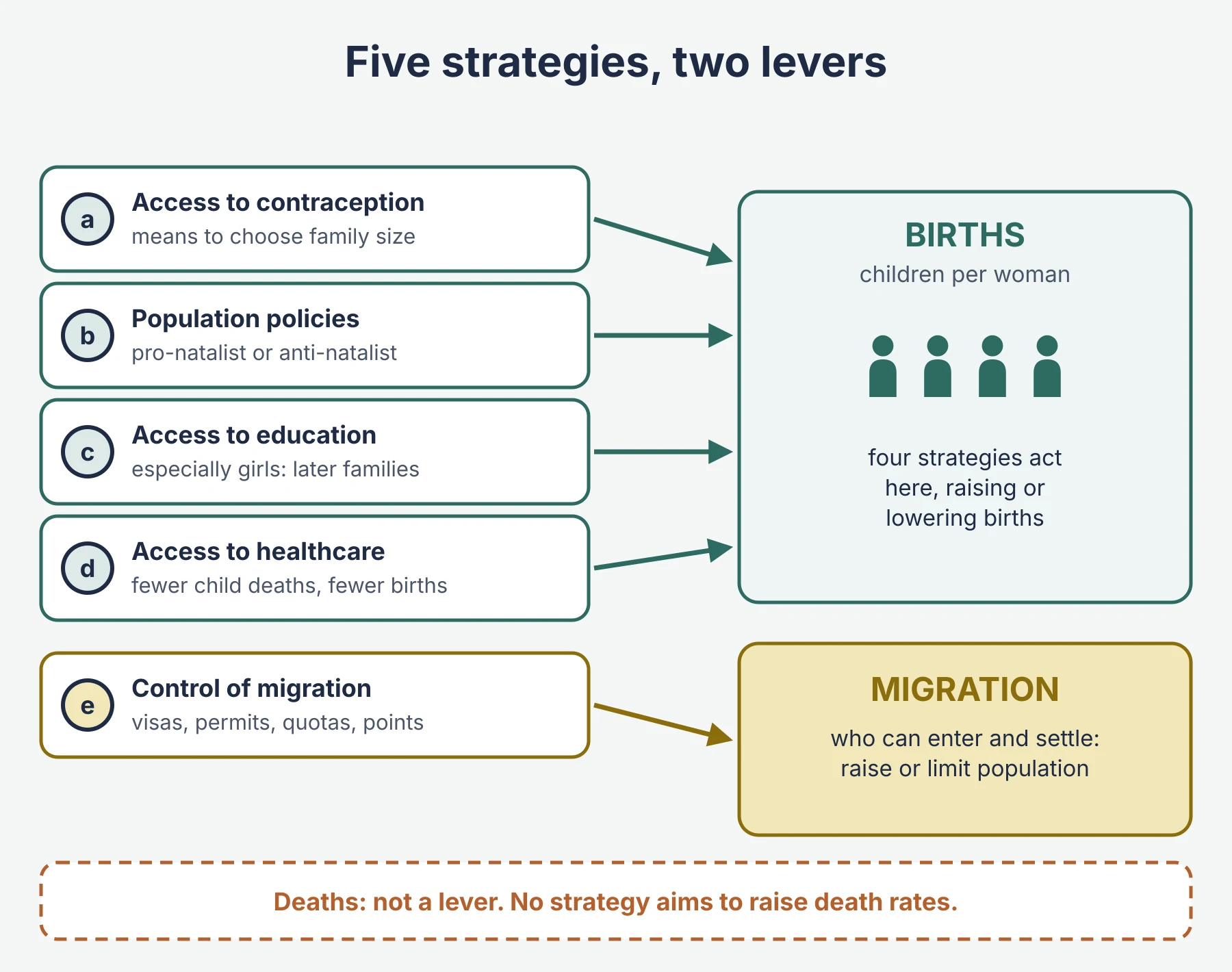
Sub-topic 7.3 of Cambridge IGCSE Environmental Management (0680, 2027-2029) asks how governments try to influence the size of their populations. It has two statements: describe five strategies (7.3.1) and discuss their benefits and limitations (7.3.2). The five are access to contraception, population policies (pro-natalist and anti-natalist), access to education, access to healthcare, and control of migration. Because 7.3.2 uses “discuss”, most marks go to balanced, reasoned evaluation rather than description. For the whole topic, see the Human population study guide.
Why manage population size?
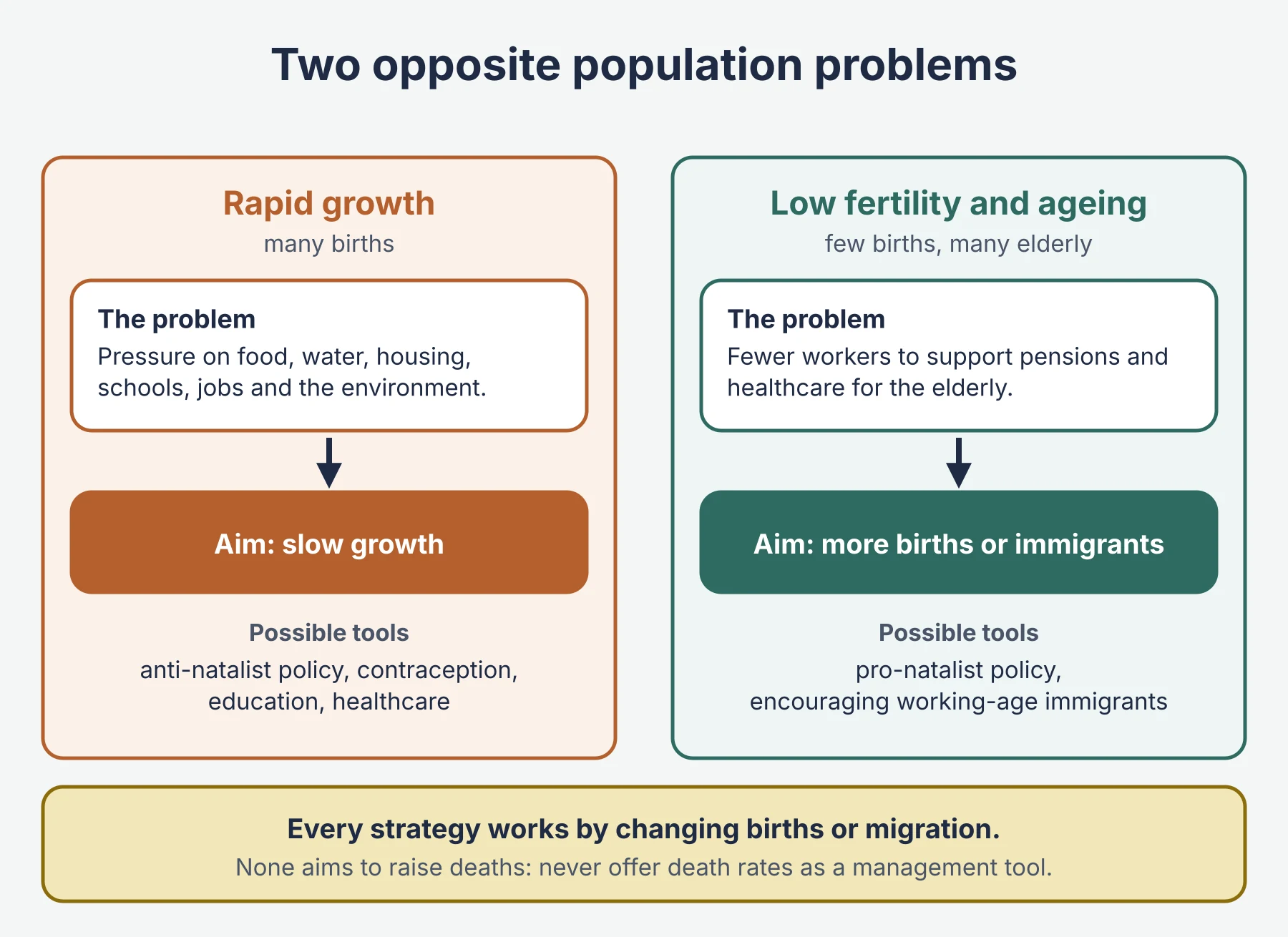
Governments act for opposite reasons:
- Rapid growth puts pressure on food, water, housing, schools, jobs and the environment, so some governments want to slow it.
- Low fertility and ageing leave fewer workers to support pensions and healthcare for the elderly, so other governments want more births or more immigrants.
Every strategy in 7.3.1 works by changing births or migration. None aims to raise deaths, so do not write about death rates as a management tool.
The five strategies (7.3.1)
(a) Access to contraception
Providing contraceptives and family planning advice, often free or cheaply, through clinics, health workers and pharmacies. It lets couples choose how many children to have and when.
- Benefits: voluntary, so widely accepted where it is culturally acceptable; relatively cheap per person; also improves maternal health by spacing births.
- Limitations: only reduces births if people want smaller families; religious or cultural objections in some communities; supplies can be hard to deliver to remote rural areas.
(b) Population policies: pro-natalist and anti-natalist
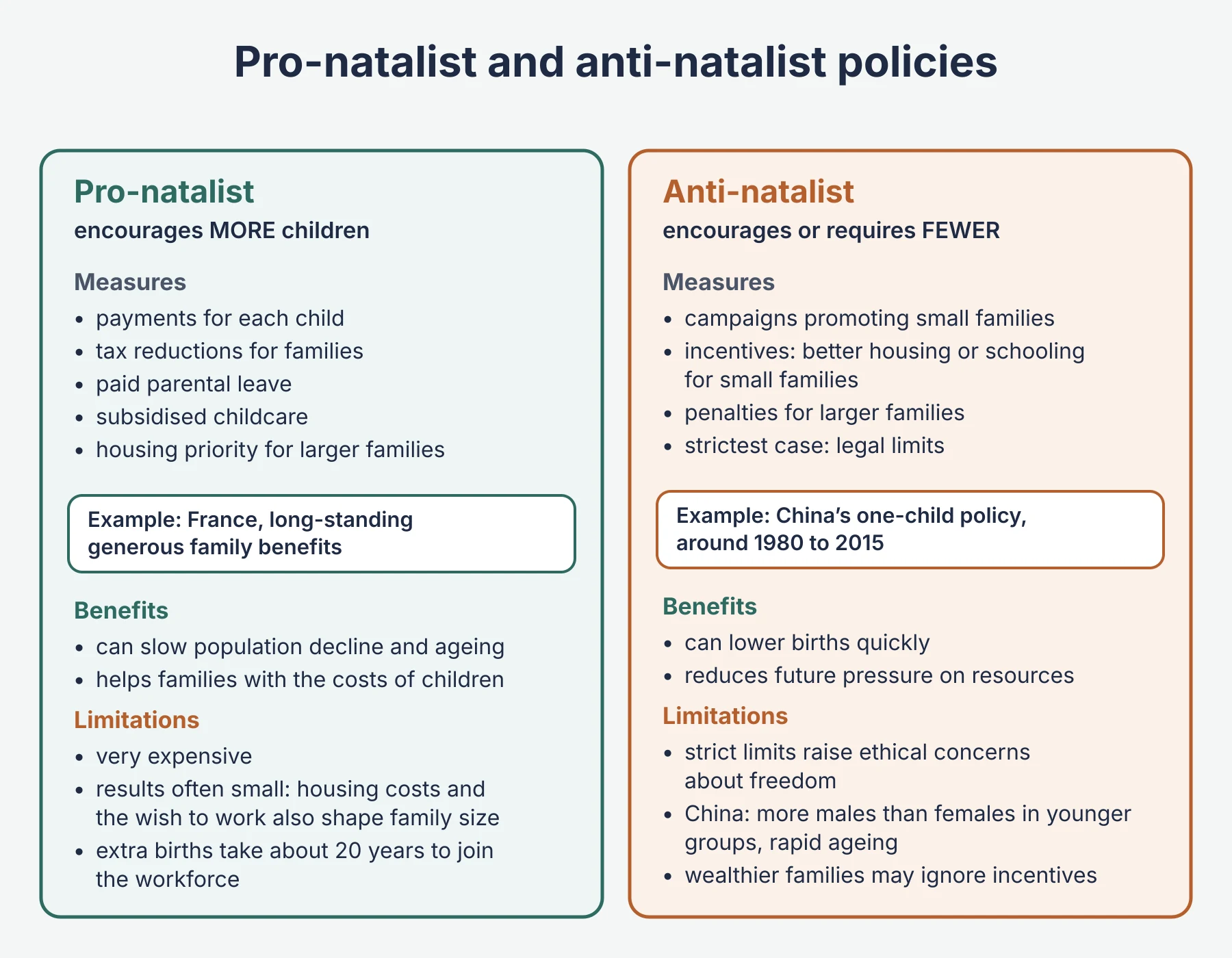
A pro-natalist policy encourages people to have more children. An anti-natalist policy encourages, or requires, people to have fewer.
Pro-natalist measures: payments for each child, tax reductions for families, paid parental leave, subsidised childcare and housing priority for larger families. France has long offered generous family benefits of this kind.
- Benefits: can slow population decline and ageing; supports families with the costs of children.
- Limitations: very expensive; results are often small, because the cost of housing and the wish to work also shape family size; any extra births take about 20 years to join the workforce.
Anti-natalist measures: campaigns promoting small families, incentives such as better housing or schooling for small families, penalties for larger ones, and in the strictest case legal limits. China’s one-child policy, introduced around 1980 and ended in 2015, is the best-known strict example.
- Benefits: can lower births quickly; reduces future pressure on resources.
- Limitations: strict limits raise serious ethical concerns about personal freedom; China’s policy contributed to more males than females in younger age groups and a rapidly ageing population; incentives may be ignored by wealthier families.
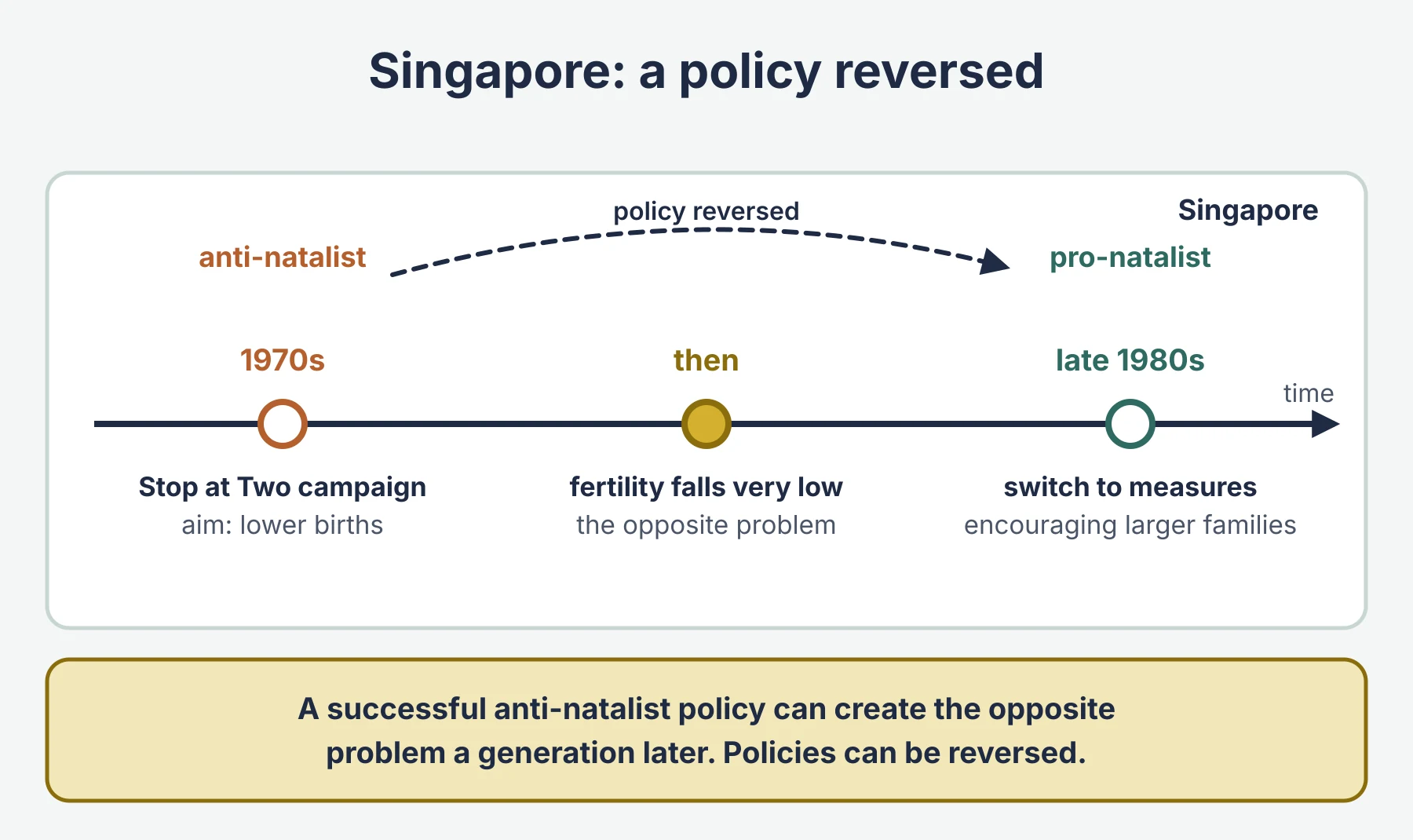
Policies can be reversed. Singapore ran a “Stop at Two” campaign in the 1970s to lower births, then, as fertility fell very low, switched in the late 1980s to measures encouraging larger families. This shows that a successful anti-natalist policy can create the opposite problem a generation later.
(c) Access to education
Keeping children, especially girls, in school for longer.
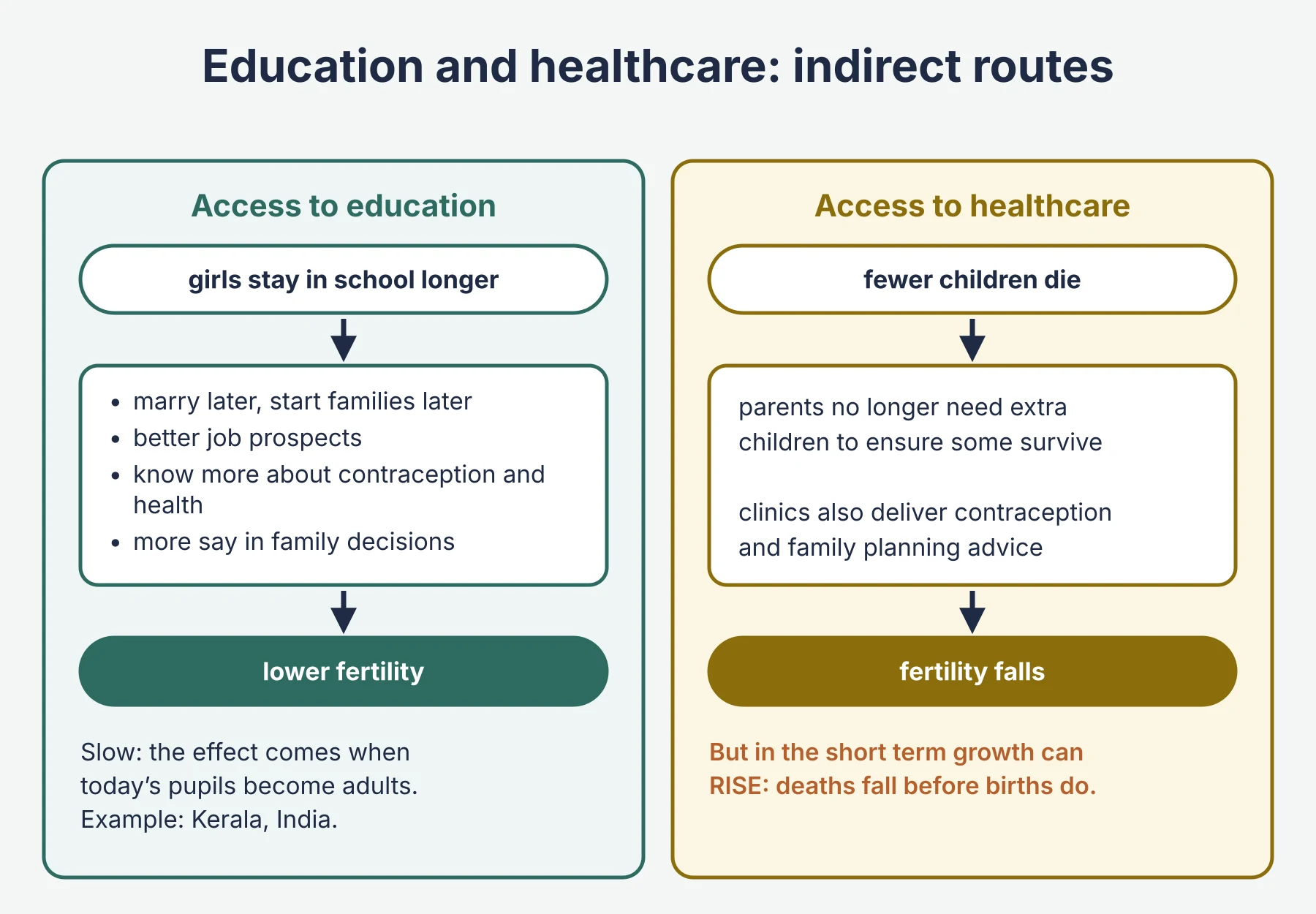
- How it lowers births: educated women tend to marry later, start families later, have better job prospects, know more about contraception and health, and have more say in family decisions. The Indian state of Kerala is often cited for combining high female literacy with low fertility.
- Benefits: improves the economy and quality of life as well as lowering fertility; voluntary and widely supported.
- Limitations: slow, because the effect comes when today’s pupils become adults; costs money for schools and teachers; families may need children’s labour or fees may be unaffordable.
(d) Access to healthcare
Clinics, vaccination, clean births and care for young children.
- How it lowers births: when fewer children die, parents no longer need to have extra children to ensure some survive, so fertility falls. Clinics are also where contraception and family planning advice are delivered.
- Benefits: saves lives and improves health; supports the other strategies.
- Limitations: in the short term it can increase population growth, because deaths fall before births do; it is costly to staff and supply clinics in rural areas.
(e) Control of migration
Governments manage who can enter and settle using visas, work permits, quotas and points-based systems that favour skills a country needs. Canada, for example, uses a points system for skilled workers.
- Raising population: encouraging working-age immigrants can fill labour shortages and offset an ageing population.
- Limiting population: restricting immigration reduces pressure on housing and services.
- Benefits: works quickly compared with birth-based policies; can target particular skills.
- Limitations: may cause labour shortages if too strict; illegal migration may continue; can create social tension; emigration of skilled workers harms the country they leave.
Discussing benefits and limitations (7.3.2)
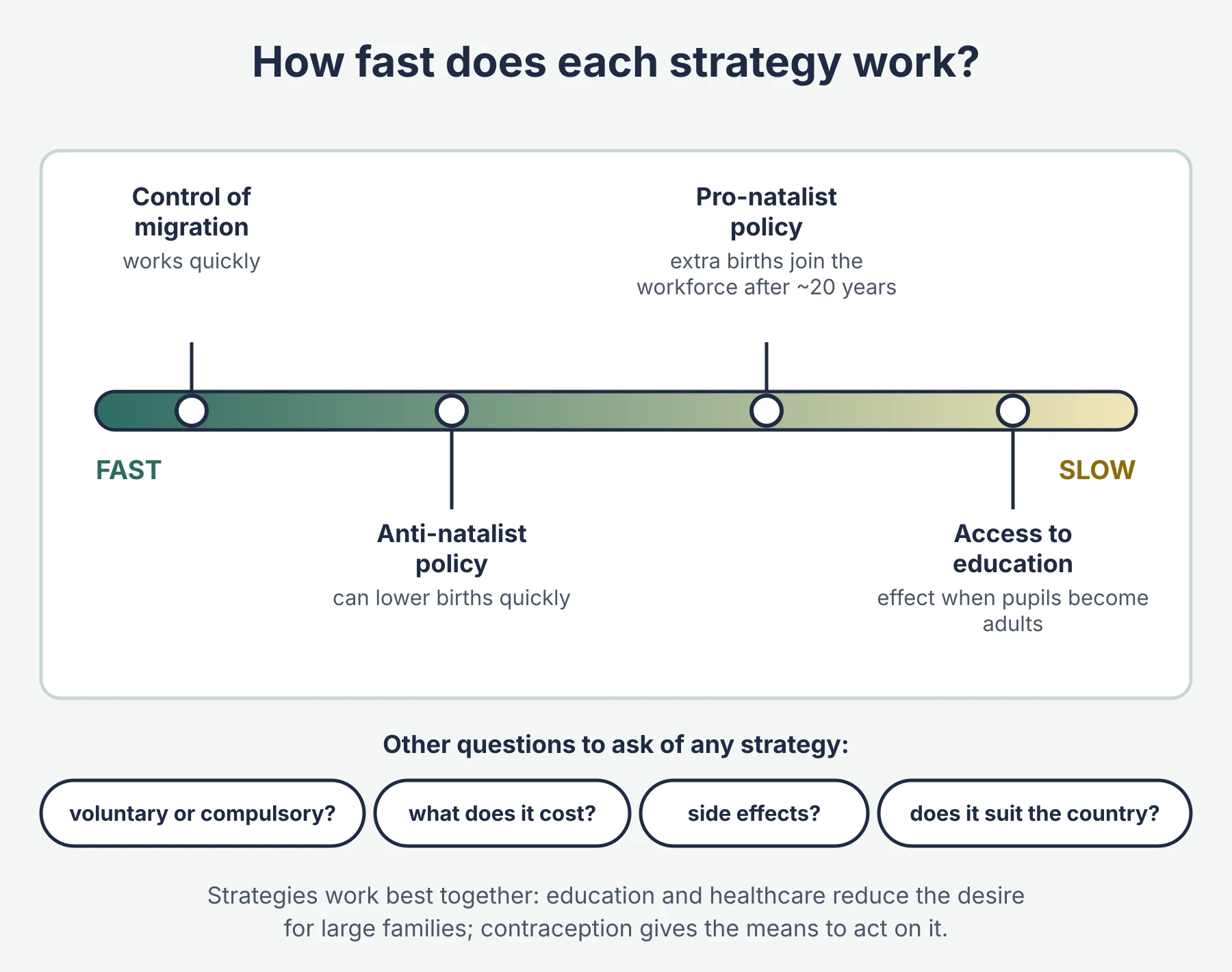
Use this checklist to evaluate any strategy:
| Question to ask | Example judgement |
|---|---|
| Is it voluntary or compulsory? | Voluntary strategies are more acceptable but may work more slowly |
| How fast does it work? | Migration control is fast; education is slow |
| What does it cost? | Pro-natalist payments are costly; campaigns are cheaper |
| Does it have side effects? | Strict anti-natalist laws can distort the sex ratio and speed up ageing |
| Does it suit the country? | Contraception campaigns fail where large families are valued for farm work |
Strategies work best together: education and healthcare reduce the desire for large families, and contraception gives people the means to act on that choice.
Worked example 1: measuring a policy’s effect
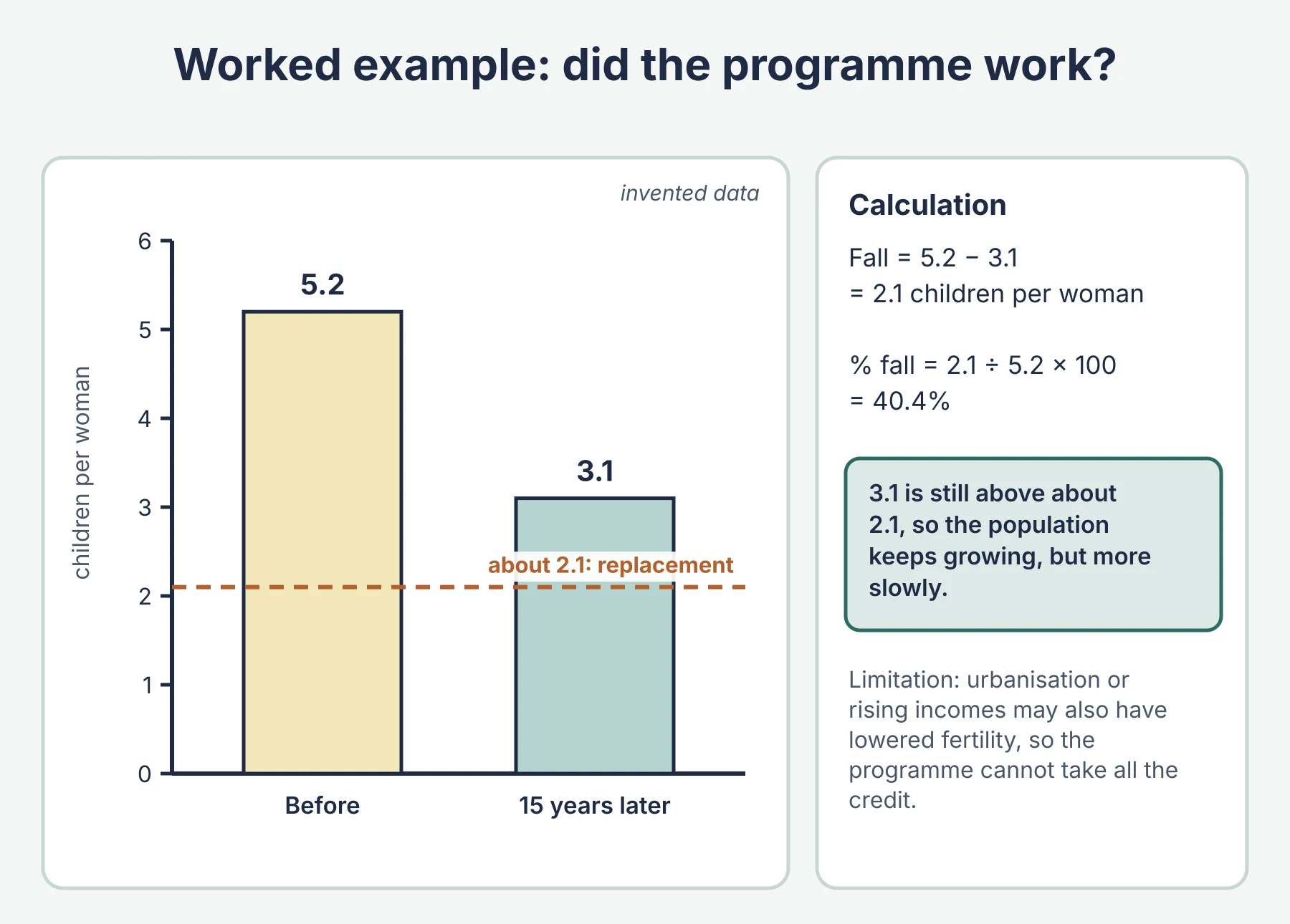
The data are invented. After a programme combining free contraception and girls’ education, a country’s fertility fell from 5.2 to 3.1 children per woman over 15 years.
- Fall = 5.2 − 3.1 = 2.1 children per woman.
- Percentage fall = 2.1 ÷ 5.2 × 100 = 40.4% (to one decimal place).
- The rate is still above about 2.1, the level that roughly replaces each generation, so the population will keep growing, but more slowly.
Note the limitation of the evidence: fertility might also have fallen because of urbanisation or rising incomes, so the programme cannot take all the credit.
Worked example 2: annotated “discuss” answer
Question: Discuss the benefits and limitations of a pro-natalist policy for a country with an ageing population. [4]
Model answer: Payments for each child and subsidised childcare reduce the cost of having children, which can raise the birth rate [1]. In the long term this provides more workers to pay taxes that fund pensions and healthcare for the elderly [1]. However, the policy is expensive for the government [1], and many couples still choose small families because of housing costs or careers, so the rise in births may be small and takes about 20 years to affect the workforce [1]. Encouraging working-age immigration may help more quickly.
Common mistakes
- Defining anti-natalist and pro-natalist the wrong way round.
- Saying healthcare lowers population straight away; at first it raises growth.
- Treating China’s policy as the only example of an anti-natalist policy.
- Forgetting that control of migration can be used to raise or lower population.
- Giving only benefits, or only describing strategies, in a “discuss” answer.
Exam technique
- Describe: say what the strategy involves and how it changes births or migration.
- Discuss: benefit with reason, limitation with reason, then a judgement on when it works best.
- Suggest a strategy for a given country: match it to the country’s problem, rapid growth or ageing, using evidence from the source.
Condense this with the Managing human population size revision notes, then practise with the Managing human population size practice questions.
Related resources
-
Revision notes
Cambridge IGCSE Environmental Management: Land — Revision Notes
Recall notes on soils and crop growth, food production and soil erosion for Topic 2 Land of Cambridge IGCSE Environmental Management 0680, 2027-2029 series.
Environmental Management · Cambridge · IGCSE
Revise topic -
Practice questions
Cambridge IGCSE Environmental Management (0680): Managing human population size – Practice Questions
Twelve original questions with answers on contraception, natalist policies, education, healthcare and migration control for Cambridge IGCSE 0680 sub-topic 7.3.
Environmental Management · Cambridge · IGCSE
Try questions -
Revision notes
Cambridge IGCSE Environmental Management (0680): Managing human population size – Revision Notes
Recall notes for Cambridge IGCSE 0680 sub-topic 7.3: five strategies for managing population size, their benefits and limitations, examples and a self-test.
Environmental Management · Cambridge · IGCSE
Revise topic
Get free revision emails (optional)
Occasional emails with practice questions, worked explanations and links to free resources for the qualification and subjects you choose. No spam, and you can unsubscribe from any email. The free tools on this site never need an email.