
Revision Notes
Cambridge IGCSE Environmental Management (0680): The atmosphere – Revision Notes
Recall notes on atmospheric layers, the ozone layer, clean-air composition, climate and the natural greenhouse effect, with a self-test, for IGCSE 0680.
- Subject
- Environmental Management
- Level
- IGCSE
- Topic
- Topic 4: The atmosphere and human activities
- Author
- Marlbridge Academic Team
- Updated
- Reviewed by
- Azam Siddique (what this means)
Aligned to Cambridge IGCSE Environmental Management (0680), 2027-2029. Official specification .
Syllabus page (what it covers and how it is assessed): Cambridge IGCSE Environmental Management.
Syllabus points this page covers
0680
- 4.1 The atmosphere
Found an error? Report a correction.
Need help with this topic? Request a free trial class for IGCSE Environmental Management (0680).
Condensed notes for sub-topic 4.1 of Cambridge IGCSE Environmental Management (0680). The atmosphere study guide explains each point and includes composition calculations and a model answer.
What 4.1 asks for
- 4.1.1 Structure: names and order of four layers; location of the ozone layer. Composition of clean air.
- 4.1.2 Definition of climate.
- 4.1.3 The natural greenhouse effect in five steps.
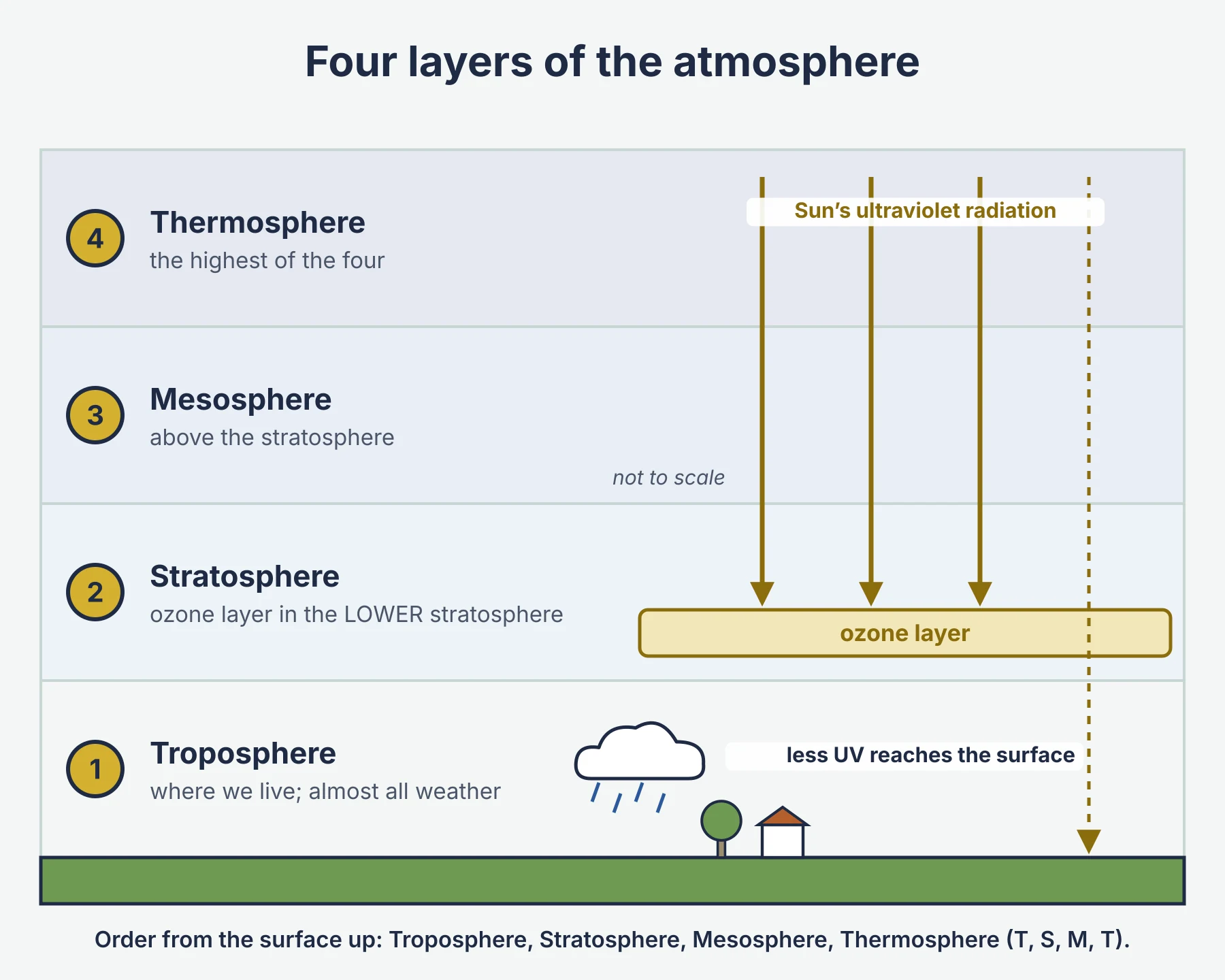
Layers, from the ground up
| Order | Layer | Fact to attach |
|---|---|---|
| 1 | Troposphere | Lowest layer; where we live and where almost all weather happens |
| 2 | Stratosphere | Contains the ozone layer, in its lower part |
| 3 | Mesosphere | Above the stratosphere |
| 4 | Thermosphere | Highest of the four |
Ozone layer: lower stratosphere. It absorbs much of the Sun’s ultraviolet radiation. This fact is the basis of sub-topic 4.4.
Clean air
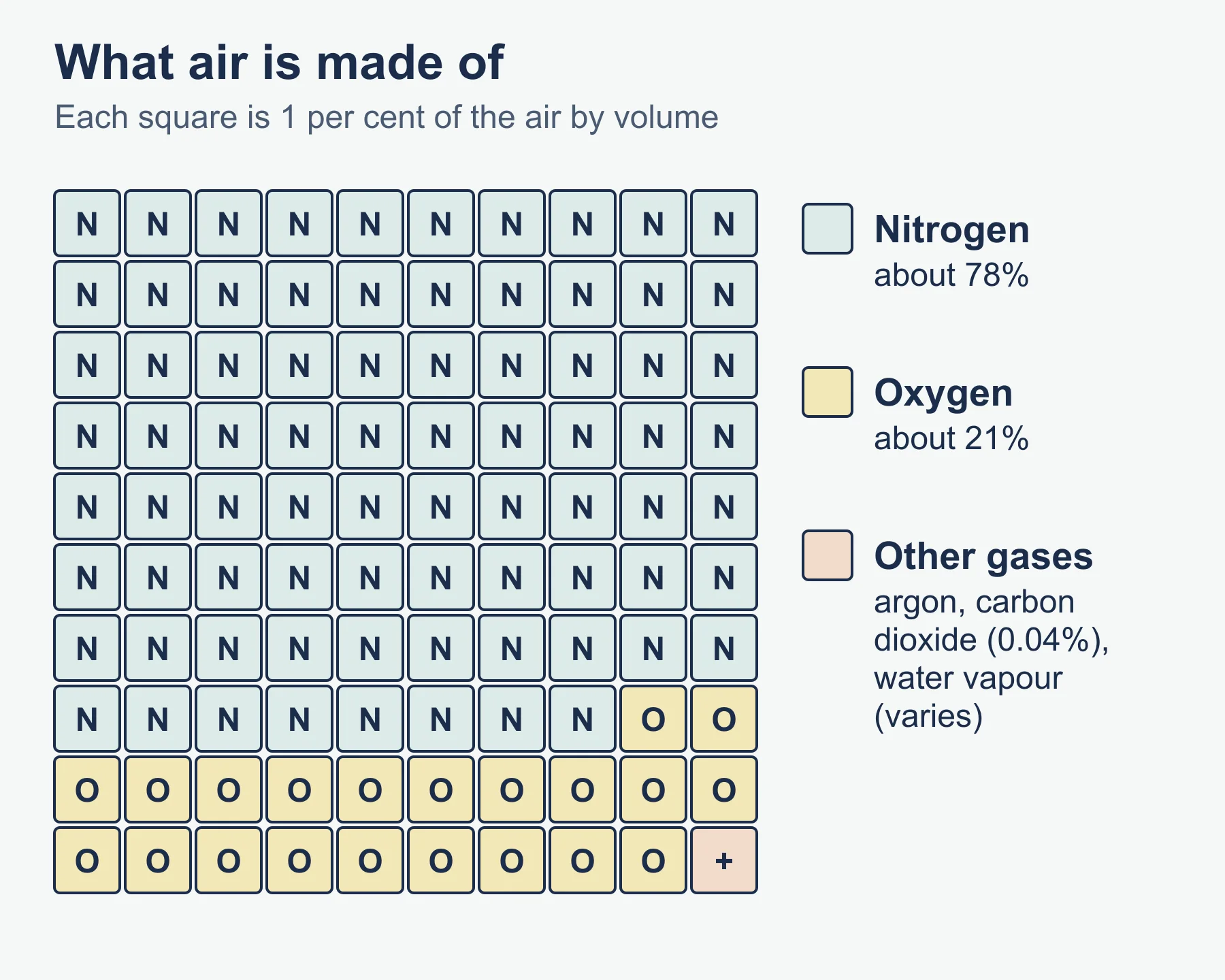
- Nitrogen 78%.
- Oxygen 21%.
- The remaining 1%: argon (most of it), carbon dioxide (about 0.04%) and water vapour (varies).
Learn the two numbers and all five names. “Clean” means no pollutants such as sulfur dioxide or particulates.
Climate and weather
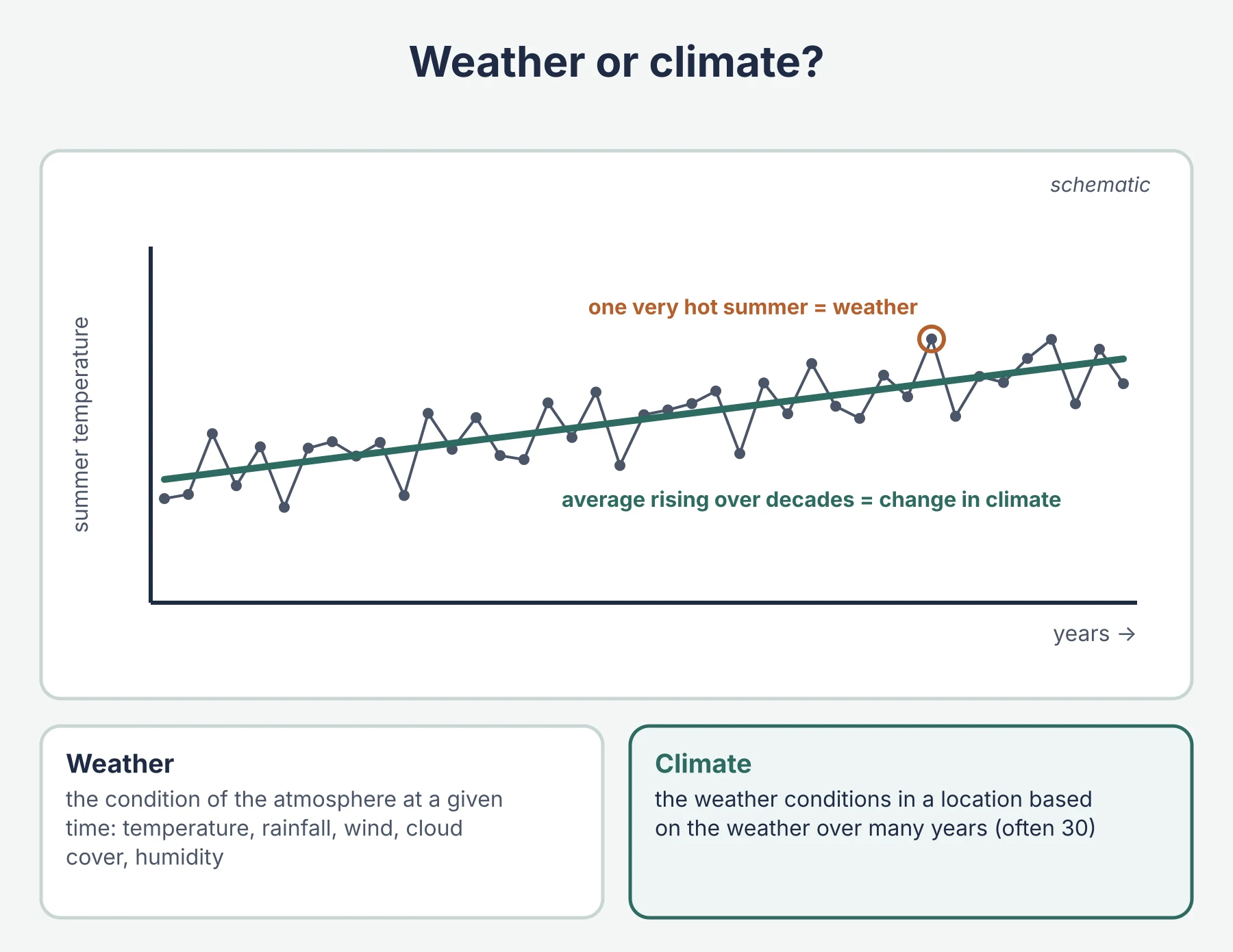
- Climate: the weather conditions in a location based on the weather over many years (often summarised over 30 years).
- Weather: the condition of the atmosphere at a particular time, such as today’s temperature, rainfall, wind and cloud.
One unusually cold winter is weather. A long-term shift in average conditions is climate change.
The natural greenhouse effect: five steps
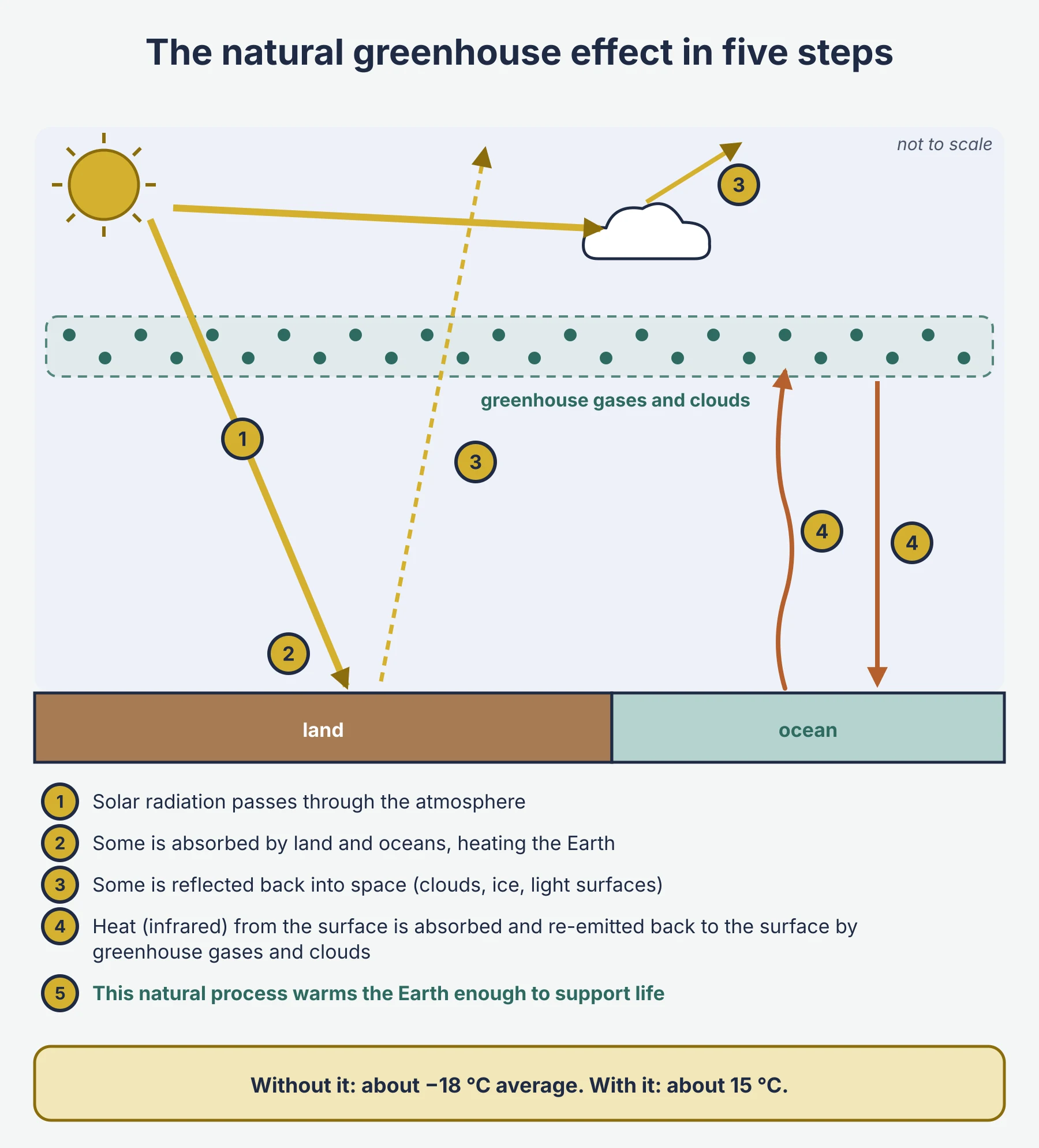
- Solar radiation passes through the atmosphere.
- Some is absorbed by land and oceans, heating the Earth.
- Some is reflected back into space.
- Some is absorbed and re-emitted back to the surface by greenhouse gases and clouds.
- This natural process warms the Earth enough to support life.
Supporting fact: without it, the Earth’s average surface temperature would be around −18 °C rather than about 15 °C.
Greenhouse gases to name in step 4: carbon dioxide, water vapour, methane (the three in 4.2.2).
Natural versus enhanced
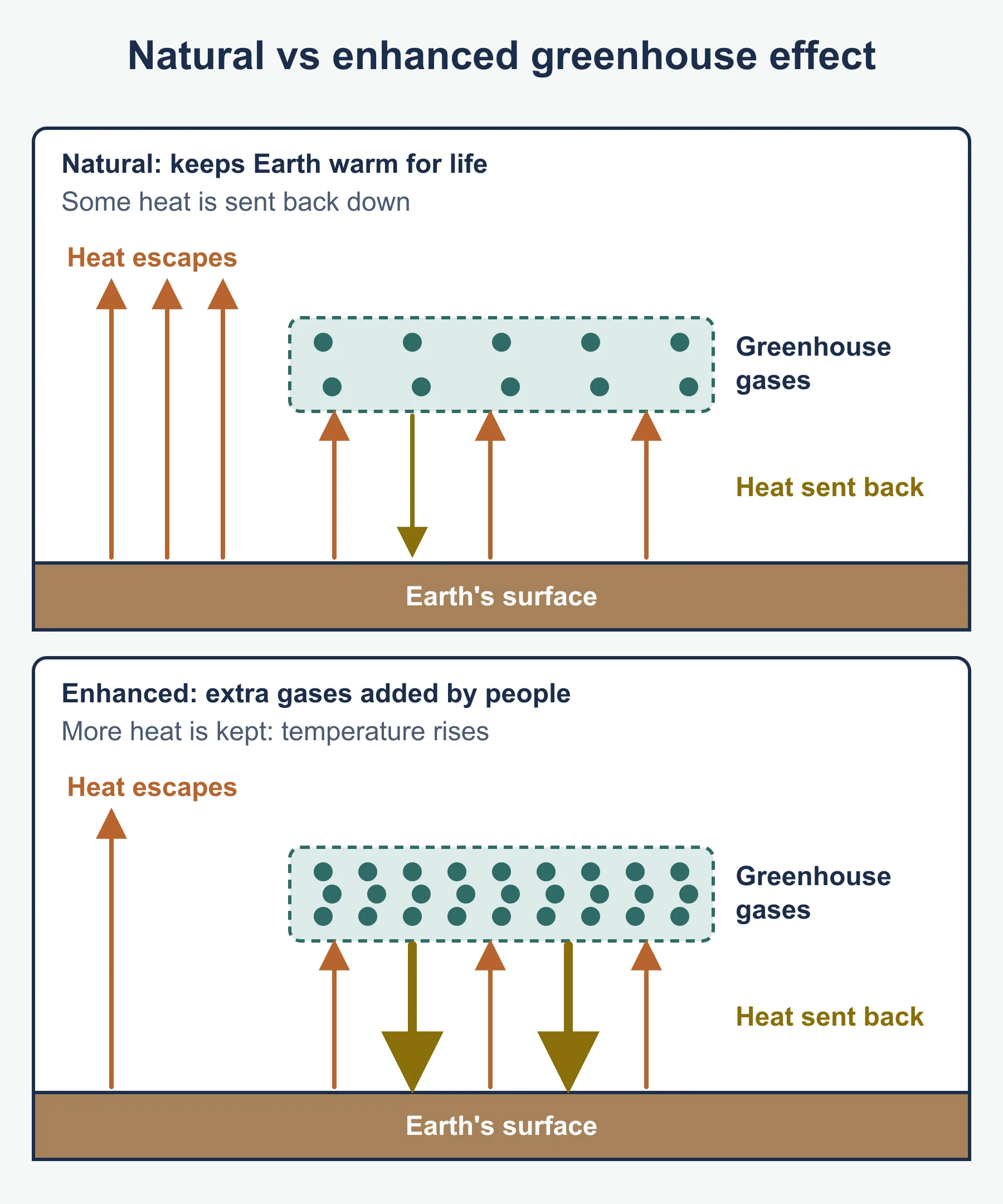
- Natural: greenhouse gases present naturally; keeps Earth habitable. Sub-topic 4.1.
- Enhanced: extra greenhouse gases from human activities; causes global warming, which can lead to climate change. Sub-topic 4.2.
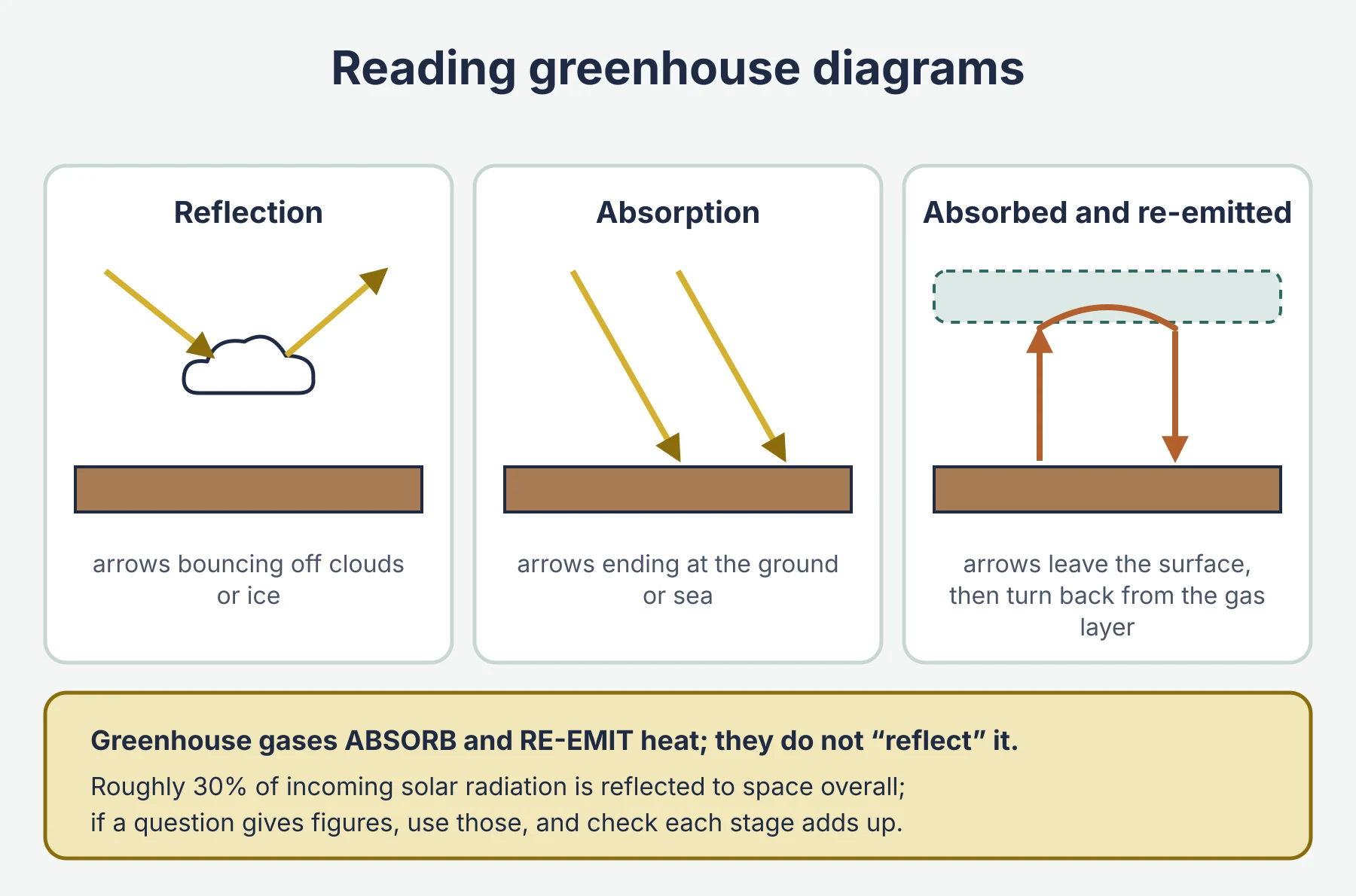
Reading a radiation diagram
- Arrows bouncing off clouds, ice or bright surfaces show reflection (step 3).
- Arrows ending at land or sea show absorption that heats the Earth (step 2).
- Arrows rising from the surface and turning back from a gas or cloud layer show absorption and re-emission (step 4).
- If the diagram gives numbers, each stage should add up: incoming = reflected + absorbed. Roughly 30% of incoming solar radiation is reflected overall, but always use the figures printed in the question.
- Thicker cloud means more reflection by day and more re-emission by night, which is why cloudy nights are warmer.
Key terms
| Term | Meaning |
|---|---|
| Atmosphere | The layer of gases surrounding the Earth, held by gravity |
| Troposphere | Lowest atmospheric layer |
| Stratosphere | Second layer; contains the ozone layer |
| Mesosphere | Third layer |
| Thermosphere | Fourth layer |
| Ozone layer | Region of ozone in the lower stratosphere that absorbs ultraviolet radiation |
| Climate | Weather conditions in a location based on the weather over many years |
| Solar radiation | Energy from the Sun reaching the Earth |
| Reflection | Radiation bouncing back without being absorbed |
| Greenhouse gas | A gas that absorbs radiation and emits the energy as thermal (heat) energy |
Calculation patterns
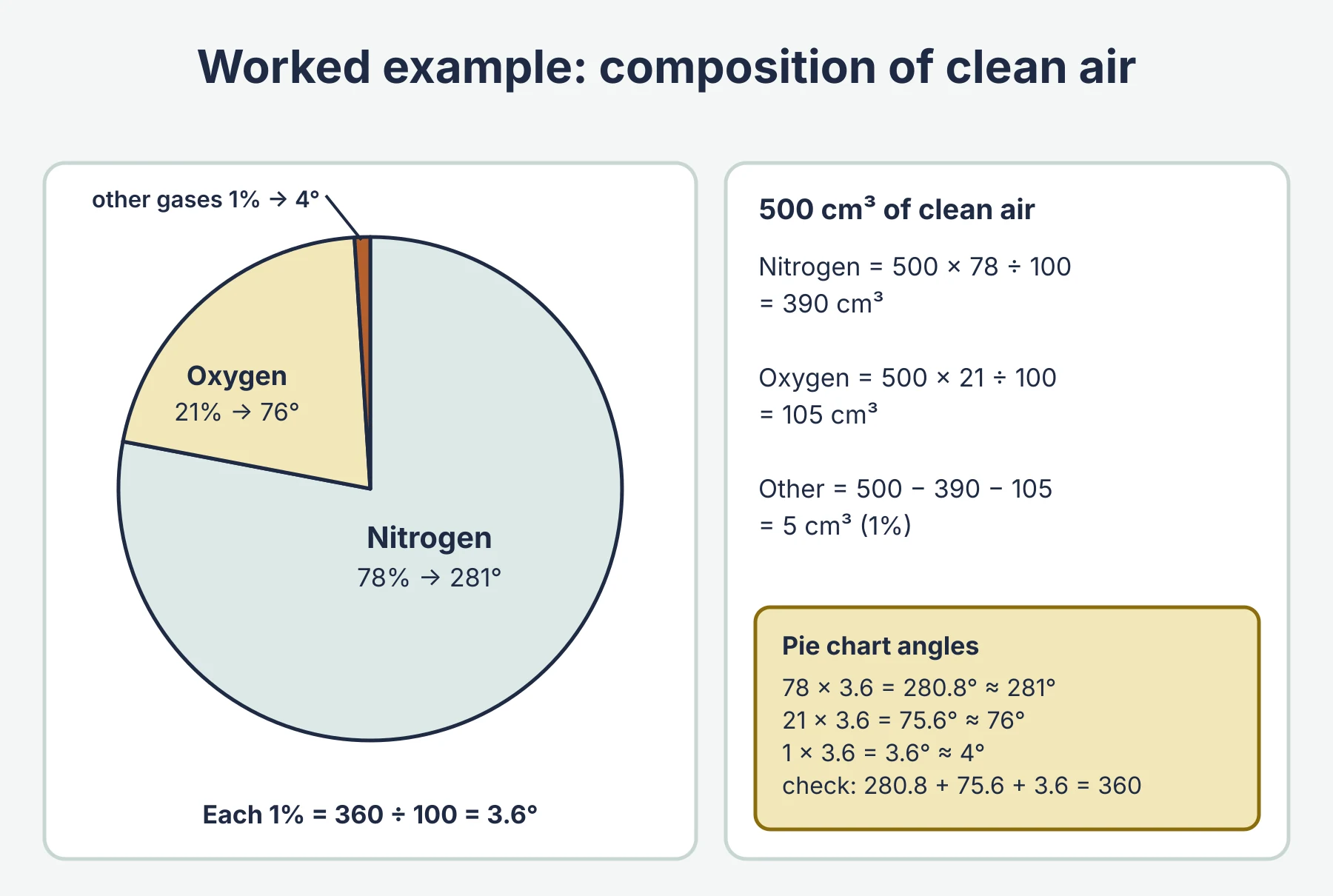
- Volume of a gas = total volume × percentage / 100. In 2,000 cm³ of clean air: nitrogen 1,560 cm³, oxygen 420 cm³, others 20 cm³.
- Pie chart angle = percentage × 3.6°. Nitrogen 280.8°, oxygen 75.6°, others 3.6°.
- Ratio: nitrogen to oxygen is 78 : 21, roughly 3.7 : 1, so there is almost four times as much nitrogen as oxygen.
Exam traps
- Order of layers: troposphere, stratosphere, mesosphere, thermosphere. Do not swap the middle two.
- Ozone location: the lower stratosphere, not the troposphere and not the “top of the atmosphere”.
- Oxygen is 21%, not 78%.
- Climate needs “many years” in the definition.
- Greenhouse gases absorb and re-emit; they do not reflect.
- The natural greenhouse effect is not a problem; it supports life. Only its enhancement is.
- Clouds appear in the syllabus step alongside greenhouse gases; include them.
Self-test
- Name the four layers of the atmosphere in order, starting at the surface.
- In which part of which layer is the ozone layer found?
- Why is the ozone layer important to living things?
- State the percentages of nitrogen and oxygen in clean air.
- Name the three other gases in clean air listed in the syllabus.
- Define climate.
- How does weather differ from climate?
- State what happens to solar radiation when it reaches the Earth’s surface.
- Name two things that reflect solar radiation back into space.
- What do greenhouse gases and clouds do with heat given off by the Earth?
- What is the overall effect of the natural greenhouse effect?
- Calculate the volume of oxygen in 300 cm³ of clean air.
Answers
- Troposphere, stratosphere, mesosphere, thermosphere.
- The lower stratosphere.
- It absorbs much of the Sun’s ultraviolet radiation, so less reaches the surface.
- Nitrogen 78%, oxygen 21%.
- Carbon dioxide, argon, water vapour.
- The weather conditions in a location based on the weather over many years.
- Weather is the condition of the atmosphere at a particular time; climate is the typical pattern over many years.
- Some is absorbed by land and oceans, heating the Earth; some is reflected back into space.
- Any two: clouds, ice and snow, light-coloured surfaces.
- They absorb it and re-emit some of it back towards the Earth’s surface.
- It warms the Earth enough to support life.
- 300 × 21 / 100 = 63 cm³.
Linked pages
Practise with the atmosphere practice questions, then move on to the climate change revision notes.
Related resources
-
Revision notes
Cambridge IGCSE Environmental Management: Land — Revision Notes
Recall notes on soils and crop growth, food production and soil erosion for Topic 2 Land of Cambridge IGCSE Environmental Management 0680, 2027-2029 series.
Environmental Management · Cambridge · IGCSE
Revise topic -
Study guides
Cambridge IGCSE Environmental Management (0680): The atmosphere and human activities – Study Guide
The structure of the atmosphere, the enhanced greenhouse effect, acid rain and ozone depletion, with causes, impacts, management and two worked calculations.
Environmental Management · Cambridge · IGCSE
Read guide -
Practice questions
Cambridge IGCSE Environmental Management: The Atmosphere and Human Activities — Practice Questions (0680)
Exam-style questions with answers on atmosphere layers, greenhouse gases, adaptation, acid rain and CFCs for Cambridge IGCSE Environmental Management 0680.
Environmental Management · Cambridge · IGCSE
Try questions
Get free revision emails (optional)
Occasional emails with practice questions, worked explanations and links to free resources for the qualification and subjects you choose. No spam, and you can unsubscribe from any email. The free tools on this site never need an email.