
Study Guides
Cambridge IGCSE Environmental Management (0680): The atmosphere
Layers and composition of the atmosphere, the ozone layer, climate versus weather and the natural greenhouse effect for Cambridge IGCSE 0680.
- Subject
- Environmental Management
- Level
- IGCSE
- Topic
- Topic 4: The atmosphere and human activities
- Author
- Marlbridge Academic Team
- Updated
- Reviewed by
- Azam Siddique (what this means)
Aligned to Cambridge IGCSE Environmental Management (0680), 2027-2029. Official specification .
Syllabus page (what it covers and how it is assessed): Cambridge IGCSE Environmental Management.
Syllabus points this page covers
0680
- 4.1 The atmosphere
Found an error? Report a correction.
Need help with this topic? Request a free trial class for IGCSE Environmental Management (0680).
Sub-topic 4.1 of Cambridge IGCSE Environmental Management (0680) is short in the syllabus but underpins the rest of Topic 4. It asks you to describe the structure and composition of the atmosphere, define climate, and describe the natural greenhouse effect in five named steps. Questions on climate change, acid rain and ozone depletion all assume you know this content, so precise wording here earns marks across the whole topic. The atmosphere and human activities study guide covers Topic 4 as a whole.
Structure of the atmosphere (4.1.1 a and b)
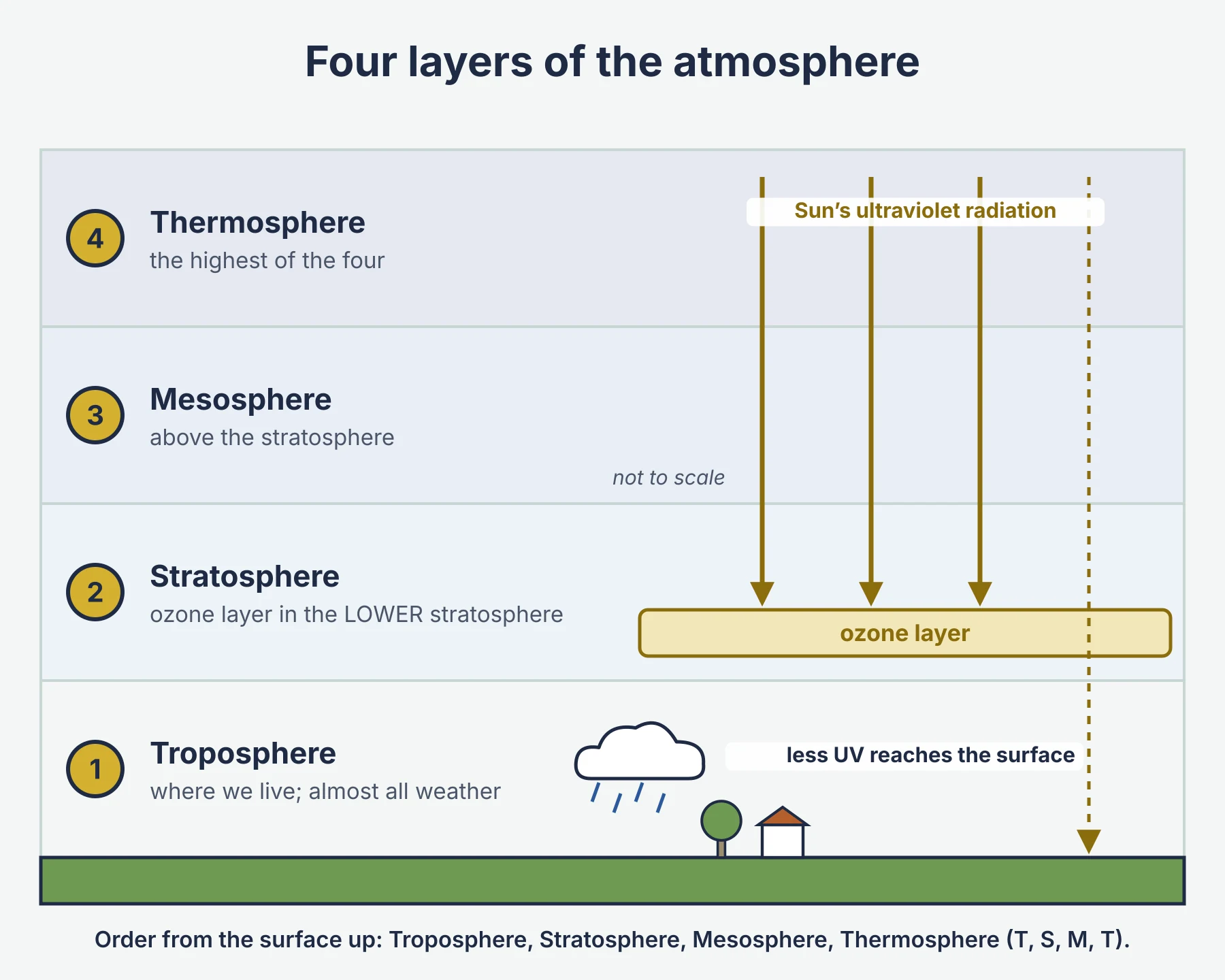
The atmosphere is the layer of gases held around the Earth by gravity. The syllabus requires the names and relative order of four layers, from the surface upwards:
- Troposphere: the lowest layer, where we live and where almost all weather happens.
- Stratosphere: above the troposphere; the ozone layer is found in the lower stratosphere.
- Mesosphere: above the stratosphere.
- Thermosphere: the highest of the four.
A memory aid built from the first letters, T, S, M, T, helps with order; make up your own phrase if it sticks better.
Why the location of the ozone layer matters
Ozone is a form of oxygen. In the lower stratosphere it absorbs much of the Sun’s ultraviolet radiation before it reaches the surface. This is why damage to the ozone layer, covered in sub-topic 4.4, raises the amount of ultraviolet radiation reaching living things. When a question asks where the ozone layer is, give the syllabus answer in full, “in the lower stratosphere”, rather than just “in the atmosphere”.
Composition of clean air (4.1.1 c)
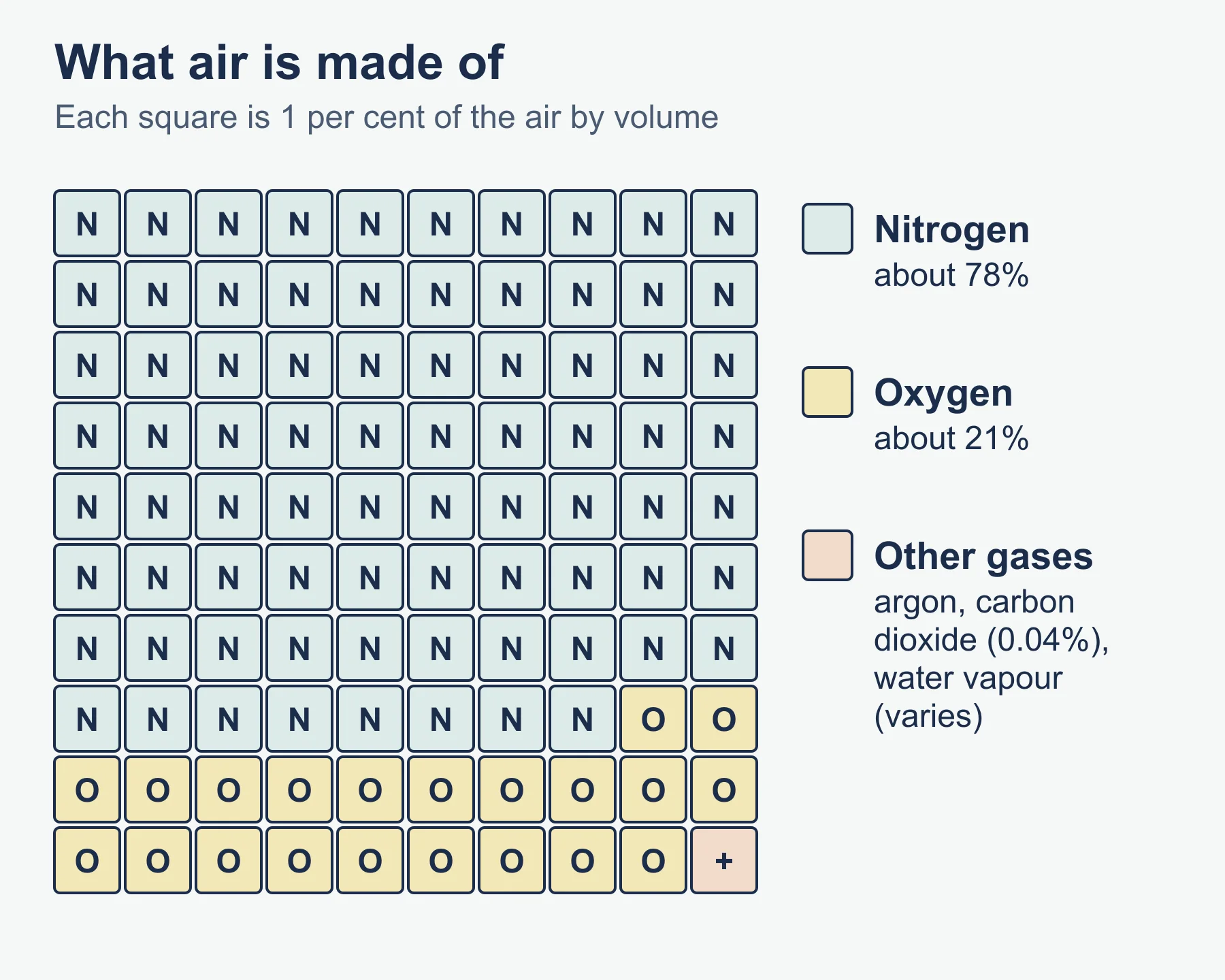
The syllabus gives the percentage composition of clean, dry air as 78% nitrogen and 21% oxygen, with carbon dioxide, argon and water vapour making up the rest. You need the two percentages exactly and the names of the three other gases.
| Gas | Share of clean air | Note |
|---|---|---|
| Nitrogen | 78% | Unreactive under most conditions; reacts with oxygen at high temperatures in engines (link to acid rain, 4.3) |
| Oxygen | 21% | Needed for aerobic respiration and combustion; produced by photosynthesis |
| Argon | most of the remaining 1% | Unreactive |
| Carbon dioxide | a very small fraction, about 0.04% | Greenhouse gas; used in photosynthesis; increased by human activity (4.2) |
| Water vapour | varies with place and weather | Greenhouse gas; forms clouds |
“Clean air” matters in the definition: polluted air also contains gases such as sulfur dioxide, oxides of nitrogen and particulates, which belong to later sub-topics.
Climate (4.1.2)
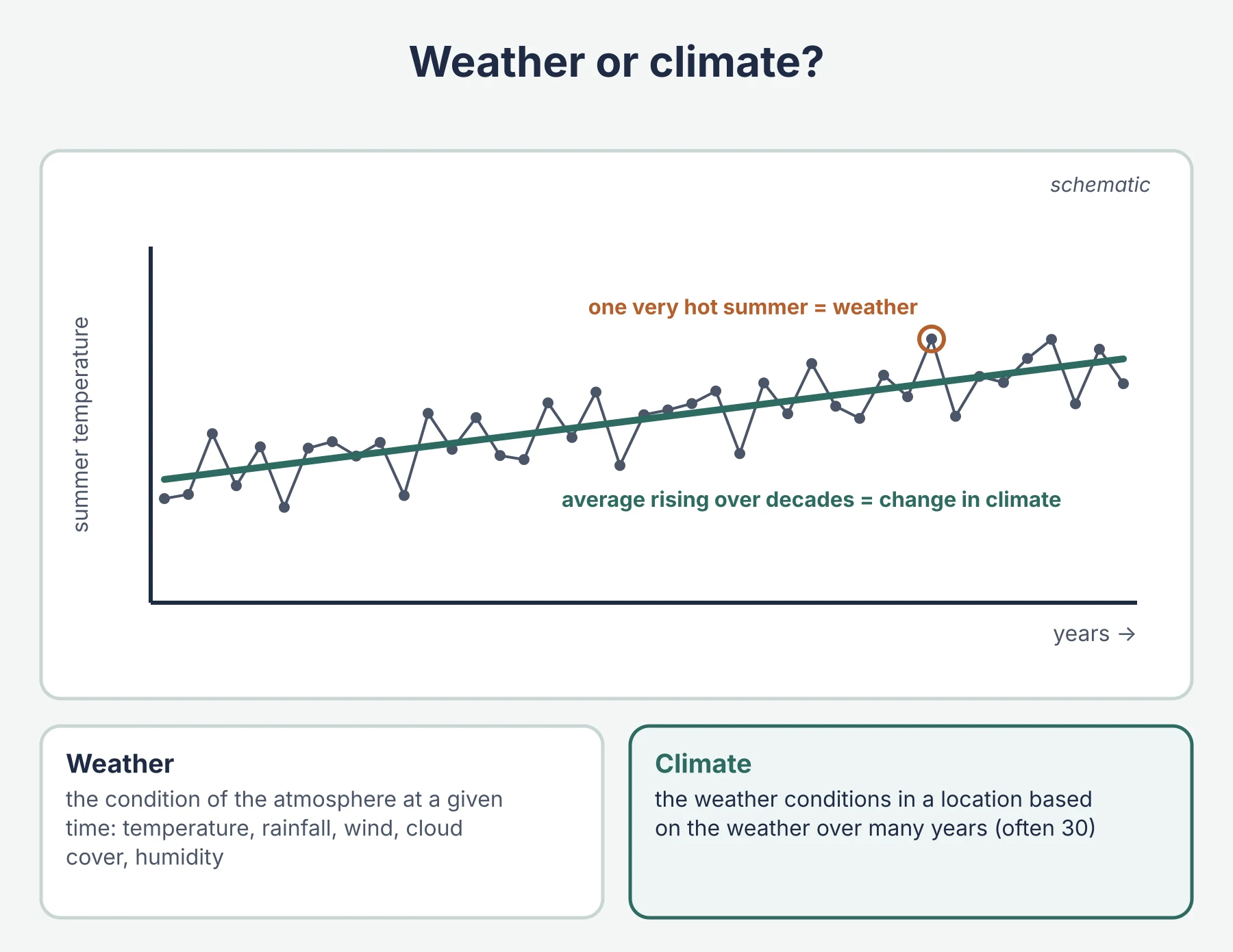
The syllabus defines climate as the weather conditions in a location based on the weather over many years. Weather is the condition of the atmosphere at a given time: temperature, rainfall, wind, cloud cover and humidity today or this week. Climate summarises those conditions over a long period, often 30 years, so it describes what is typical for a place.
The distinction matters in climate change questions. One very hot summer is weather; a rise in average summer temperatures over several decades is a change in climate.
The natural greenhouse effect (4.1.3)
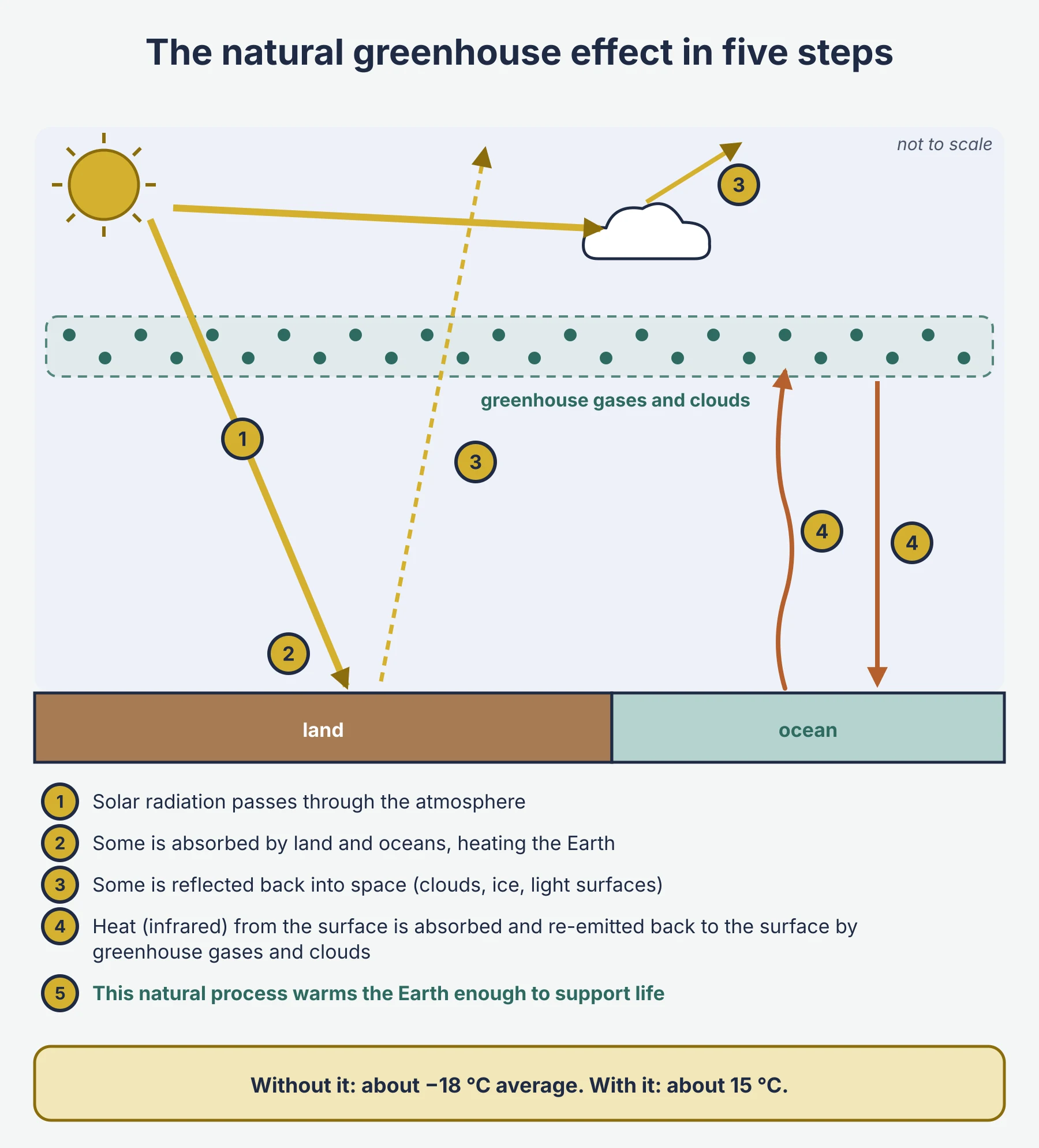
The syllabus lists five points. Learn them in order, because a “describe” question is usually marked one point per step.
- Solar radiation passes through the Earth’s atmosphere.
- Some solar radiation is absorbed by the land and oceans, heating the Earth.
- Some solar radiation is reflected back into space, for example by clouds, ice and light-coloured surfaces.
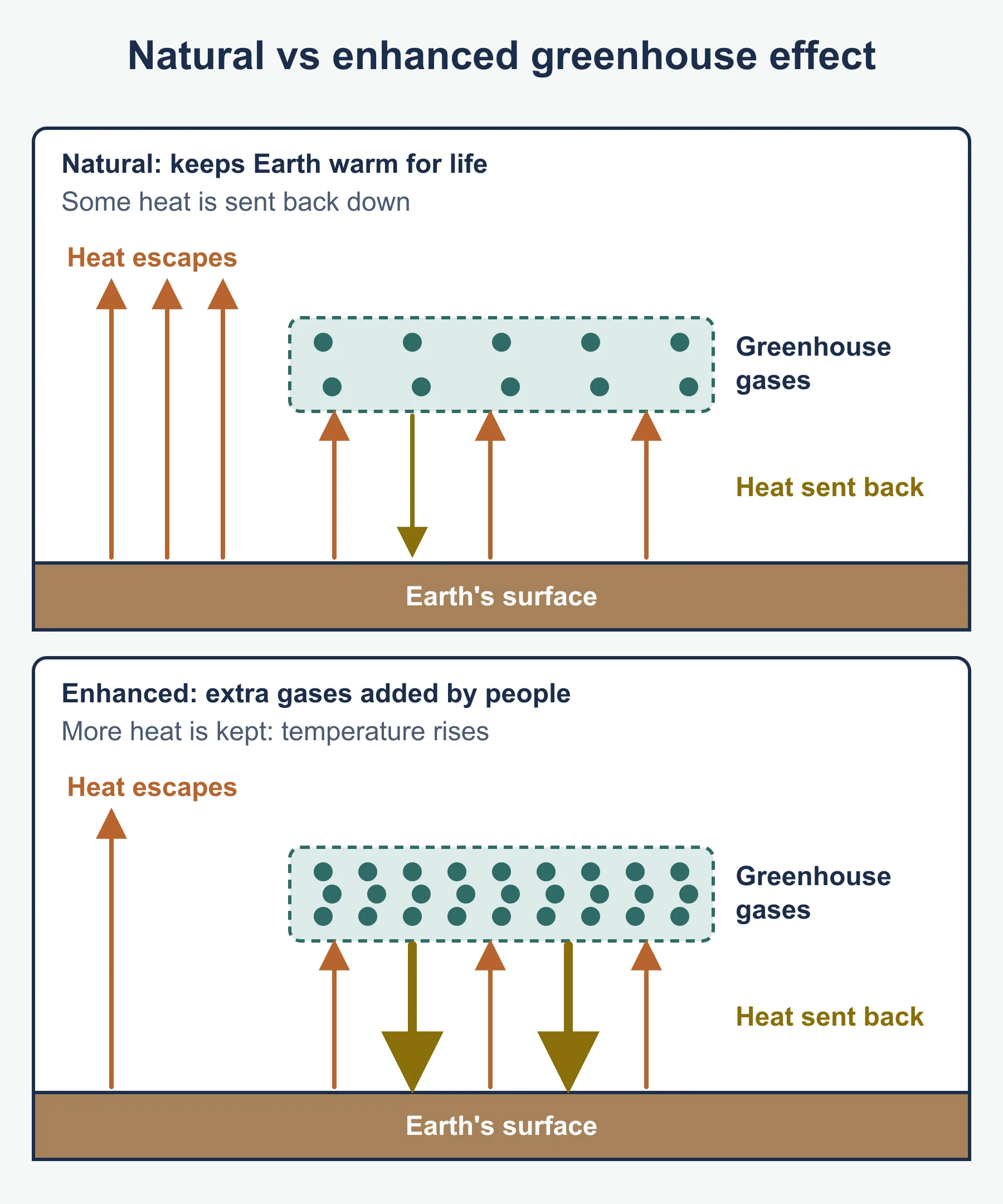
- Some radiation is absorbed and re-emitted back to the Earth’s surface by greenhouse gases and clouds. The warmed surface gives off heat (infrared radiation); greenhouse gases such as carbon dioxide, water vapour and methane absorb it and send part of it back down.
- This natural process warms the Earth enough to support life.
Without the natural greenhouse effect, the Earth’s average surface temperature would be around −18 °C instead of about 15 °C, too cold for most life as we know it. The effect is natural and beneficial; the problem studied in 4.2 is its enhancement by extra greenhouse gases from human activity.
Natural versus enhanced
| Natural greenhouse effect | Enhanced greenhouse effect | |
|---|---|---|
| Cause | Greenhouse gases and clouds present naturally | Extra greenhouse gases from human activities |
| Result | Earth warm enough to support life | Global warming, which can result in climate change |
| Sub-topic | 4.1 | 4.2 |
Worked example 1: composition calculations
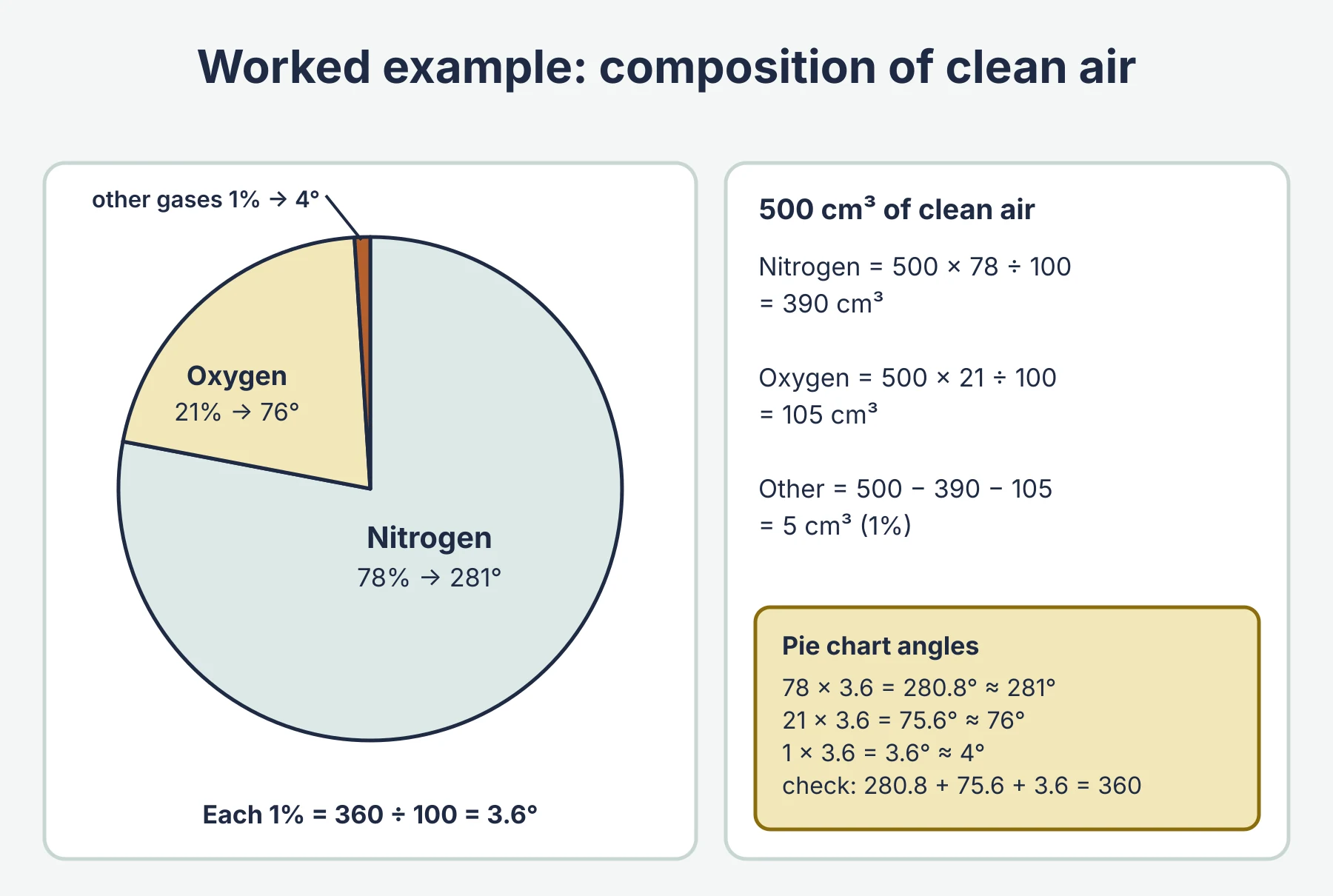
Question: a 500 cm³ sample of clean air is analysed. Calculate the volumes of nitrogen and oxygen, and the volume of all other gases combined.
- Nitrogen = 500 × 78 / 100 = 390 cm³.
- Oxygen = 500 × 21 / 100 = 105 cm³.
- Other gases = 500 − 390 − 105 = 5 cm³, which is 1% of the sample.
Question: draw a pie chart of the composition. Each 1% is 360 / 100 = 3.6°.
- Nitrogen: 78 × 3.6 = 280.8°, about 281°.
- Oxygen: 21 × 3.6 = 75.6°, about 76°.
- Other gases: 1 × 3.6 = 3.6°, about 4°.
Check that the angles add to 360°: 280.8 + 75.6 + 3.6 = 360.
Worked example 2: an annotated model answer
Question: describe the natural greenhouse effect. [4]
Model answer: Solar radiation from the Sun passes through the atmosphere (1). Some is absorbed by the land and oceans, which heats the Earth, and some is reflected back into space (1). Heat given off by the Earth is absorbed by greenhouse gases such as carbon dioxide and water vapour, and by clouds, and some is re-emitted back towards the surface (1). This keeps the Earth warm enough to support life (1).
Why it scores: the answer follows the syllabus order, names greenhouse gases and clouds, and ends with the purpose. A weak answer that writes “greenhouse gases trap heat like a greenhouse” earns at most one mark because it skips absorption, reflection and re-emission.
Interpreting diagrams
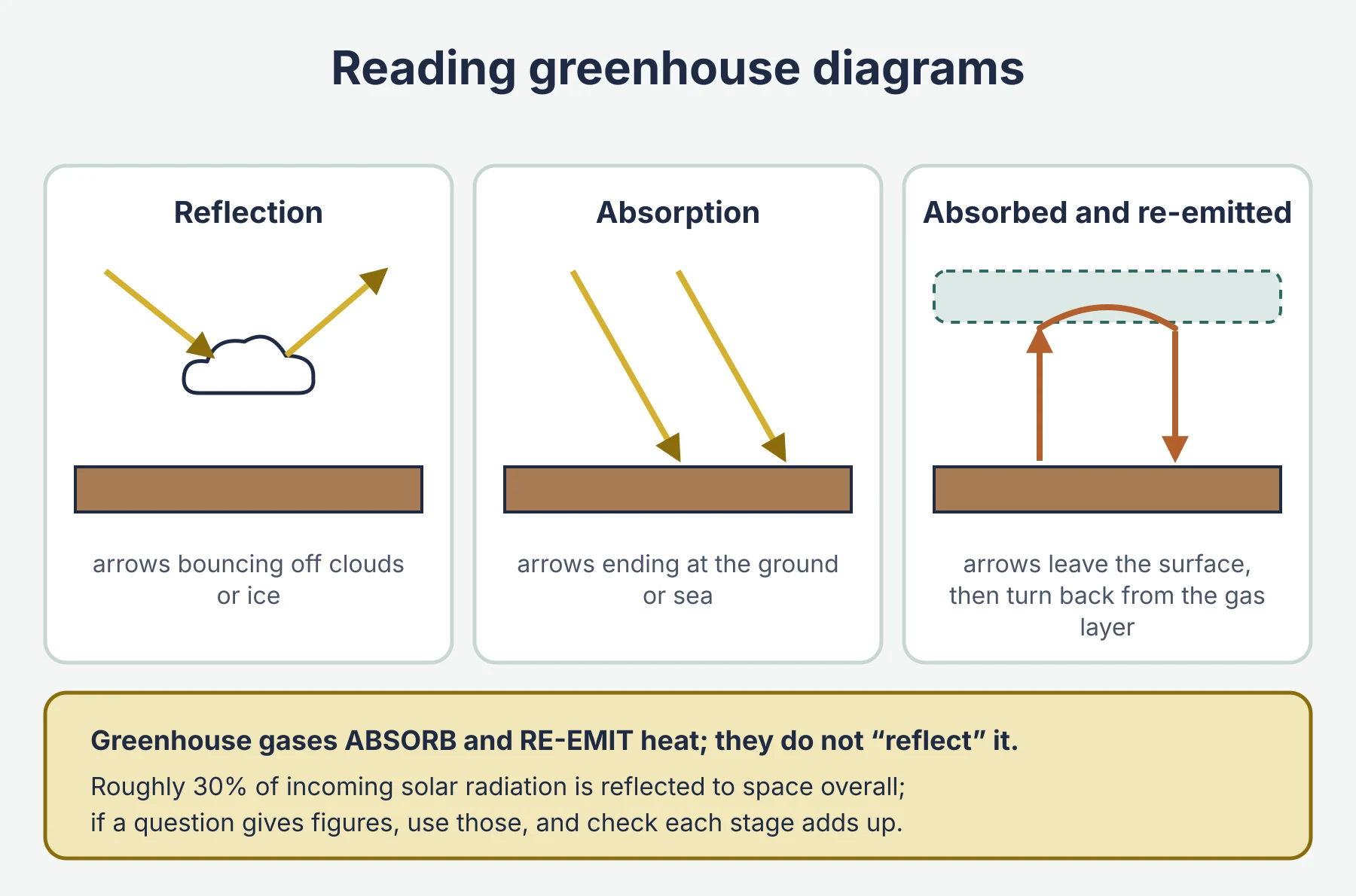
Exam diagrams often show arrows for incoming solar radiation, reflected radiation, absorbed radiation and re-emitted radiation. Read the labels carefully:
- Arrows bouncing off clouds or ice are reflection.
- Arrows ending at the ground or sea are absorption by land and oceans.
- Arrows leaving the surface, then turning back from the gas layer, are absorption and re-emission by greenhouse gases and clouds.
If percentages are shown, they should add up for each stage. Roughly 30% of incoming solar radiation is reflected back to space overall; if a question gives figures, use those instead.
Common mistakes
- Putting the layers in the wrong order, or placing the ozone layer in the troposphere.
- Writing “the air is 78% oxygen”. Nitrogen is 78%; oxygen is 21%.
- Defining climate as “the weather in a place”. The definition needs “over many years”.
- Describing the greenhouse effect as harmful. The natural effect supports life; the enhanced effect causes global warming.
- Saying greenhouse gases “reflect” heat back to Earth. The syllabus wording is absorbed and re-emitted.
Exam technique
State and name questions on layers and composition need exact terms and figures. Define questions on climate need the syllabus phrase. Describe the natural greenhouse effect is marked by steps, so write one sentence per step. In calculation questions, show the percentage working and give units, such as cm³ or degrees.
Revise with the atmosphere revision notes and test yourself with the atmosphere practice questions. The next sub-topic, the climate change study guide, builds directly on the greenhouse effect.
Related resources
-
Revision notes
Cambridge IGCSE Environmental Management: Land — Revision Notes
Recall notes on soils and crop growth, food production and soil erosion for Topic 2 Land of Cambridge IGCSE Environmental Management 0680, 2027-2029 series.
Environmental Management · Cambridge · IGCSE
Revise topic -
Practice questions
Cambridge IGCSE Environmental Management (0680): The atmosphere – Practice Questions
Original practice questions with answers on atmospheric layers, air composition, climate and the natural greenhouse effect for Cambridge IGCSE 0680.
Environmental Management · Cambridge · IGCSE
Try questions -
Revision notes
Cambridge IGCSE Environmental Management (0680): The atmosphere – Revision Notes
Recall notes on atmospheric layers, the ozone layer, clean-air composition, climate and the natural greenhouse effect, with a self-test, for IGCSE 0680.
Environmental Management · Cambridge · IGCSE
Revise topic
Get free revision emails (optional)
Occasional emails with practice questions, worked explanations and links to free resources for the qualification and subjects you choose. No spam, and you can unsubscribe from any email. The free tools on this site never need an email.