
Study Guides
Cambridge IGCSE Environmental Management (0680): Water pollution
Sources and impacts of water pollution, bioaccumulation, biomagnification, eutrophication and water-quality strategies for Cambridge IGCSE 0680.
- Subject
- Environmental Management
- Level
- IGCSE
- Topic
- Topic 3 – Water
- Author
- Marlbridge Academic Team
- Updated
- Reviewed by
- Azam Siddique (what this means)
Aligned to Cambridge IGCSE Environmental Management (0680), 2027-2029. Official specification .
Syllabus page (what it covers and how it is assessed): Cambridge IGCSE Environmental Management.
Syllabus points this page covers
0680
- 3.2 Water pollution
Found an error? Report a correction.
Need help with this topic? Request a free trial class for IGCSE Environmental Management (0680).
Sub-topic 3.2 of Cambridge IGCSE Environmental Management (0680) asks three things of you: describe where water pollution comes from, describe and explain what it does to people and the environment, and describe the strategies that improve water quality. The syllabus limits each list, so the safest preparation is to know every named item and be able to explain the mechanism behind it, not just name it. For the wider Water topic, see the Water study guide.
What the syllabus names
| Syllabus point | Items you must know |
|---|---|
| 3.2.1 Sources | domestic waste; sewage; plastic waste; industrial processes; agricultural practices |
| 3.2.2 Impacts | cholera; accumulation of toxic substances from industry; bioaccumulation; biomagnification; acid rain on organisms in rivers and lakes; leaching and nutrient enrichment leading to eutrophication |
| 3.2.3 Strategies | improved sanitation; treatment of sewage; pollution control and legislation |
Sources of water pollution
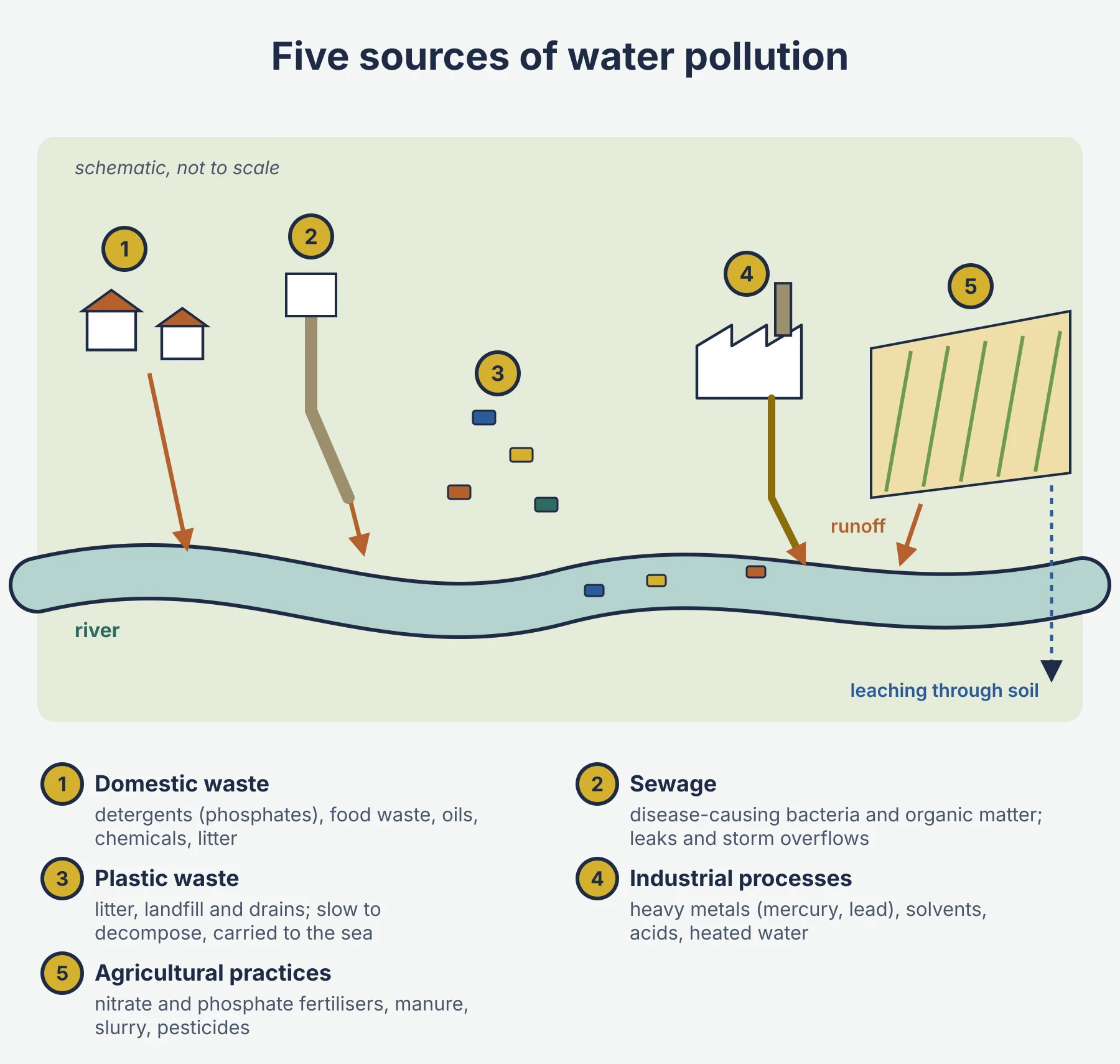
Domestic waste is what households wash away or throw out: detergents (which can contain phosphates), food waste, oils, cleaning chemicals and litter dumped near rivers. In places without collection services, rubbish is often thrown into channels that drain to rivers.
Sewage is human waste and wastewater. It carries two different problems: disease-causing bacteria from faeces, and organic matter that decomposers feed on. Untreated sewage reaches water where there is no sewer network, where pipes leak, or where treatment works overflow during heavy rain.
Plastic waste enters rivers as litter, from poorly managed landfill and from drains. It does not decompose quickly, so it builds up and is carried to the sea. Sub-topic 3.6 goes into plastics in detail.
Industrial processes release heavy metals such as mercury and lead, solvents, acids and other toxic chemicals in wastewater. Mining can add metal-rich runoff. Some industries also release heated water, which holds less dissolved oxygen.
Agricultural practices add fertilisers (nitrate and phosphate ions), animal manure and slurry, and pesticides. These reach water by runoff over the surface after rain, or by leaching down through the soil to groundwater and then into rivers.
Impacts on people and the environment
Cholera
Cholera is an infectious bacterial disease spread when people drink water, or eat food, contaminated with faeces from an infected person. It causes severe diarrhoea and dehydration, which can kill quickly without treatment. The link to pollution is direct: untreated sewage in a drinking-water source is how outbreaks start and spread. Sub-topic 3.3 covers how cholera is controlled.
Accumulation of toxic substances from industry
Some toxic substances, such as heavy metals and certain pesticides, are not broken down by organisms or by natural processes. Once released, they persist in water and sediment, so their concentration in a river or estuary can build up year after year even if each discharge is small.
Bioaccumulation and biomagnification
These two terms are tested together and are easy to confuse.
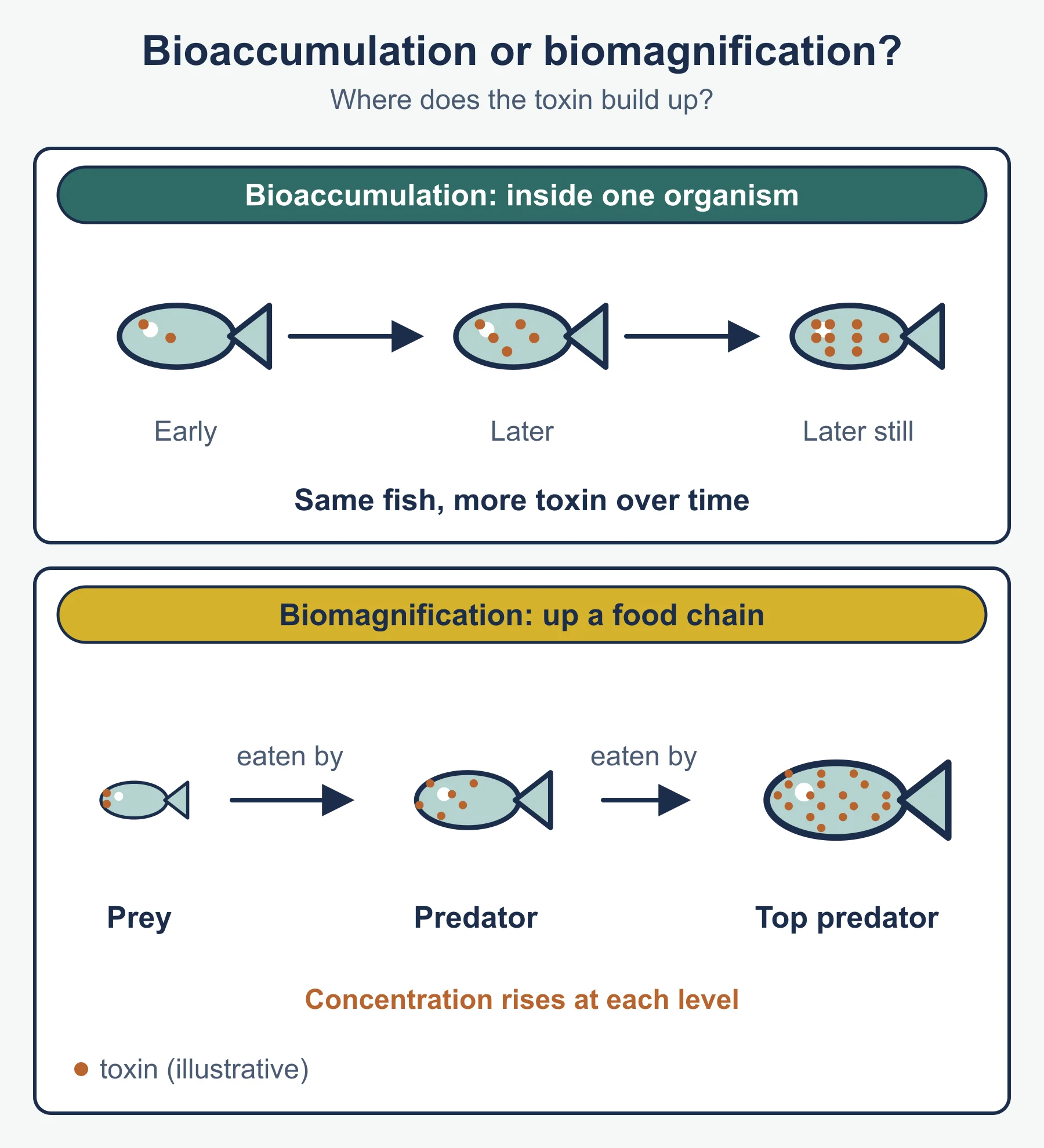
- Bioaccumulation happens in one organism over time. The organism absorbs a toxic substance faster than it can excrete or break it down, often because the substance is stored in fat. The concentration in its body rises the longer it lives.
- Biomagnification happens along a food chain. Each consumer eats many contaminated organisms from the level below, and keeps most of the toxin from all of them. So the concentration increases at each trophic level, and apex predators carry the highest doses.
Top consumers suffer most: the toxins can reduce breeding success, damage organs or kill. People who eat a lot of fish from polluted waters are also exposed.
Acid rain in rivers and lakes
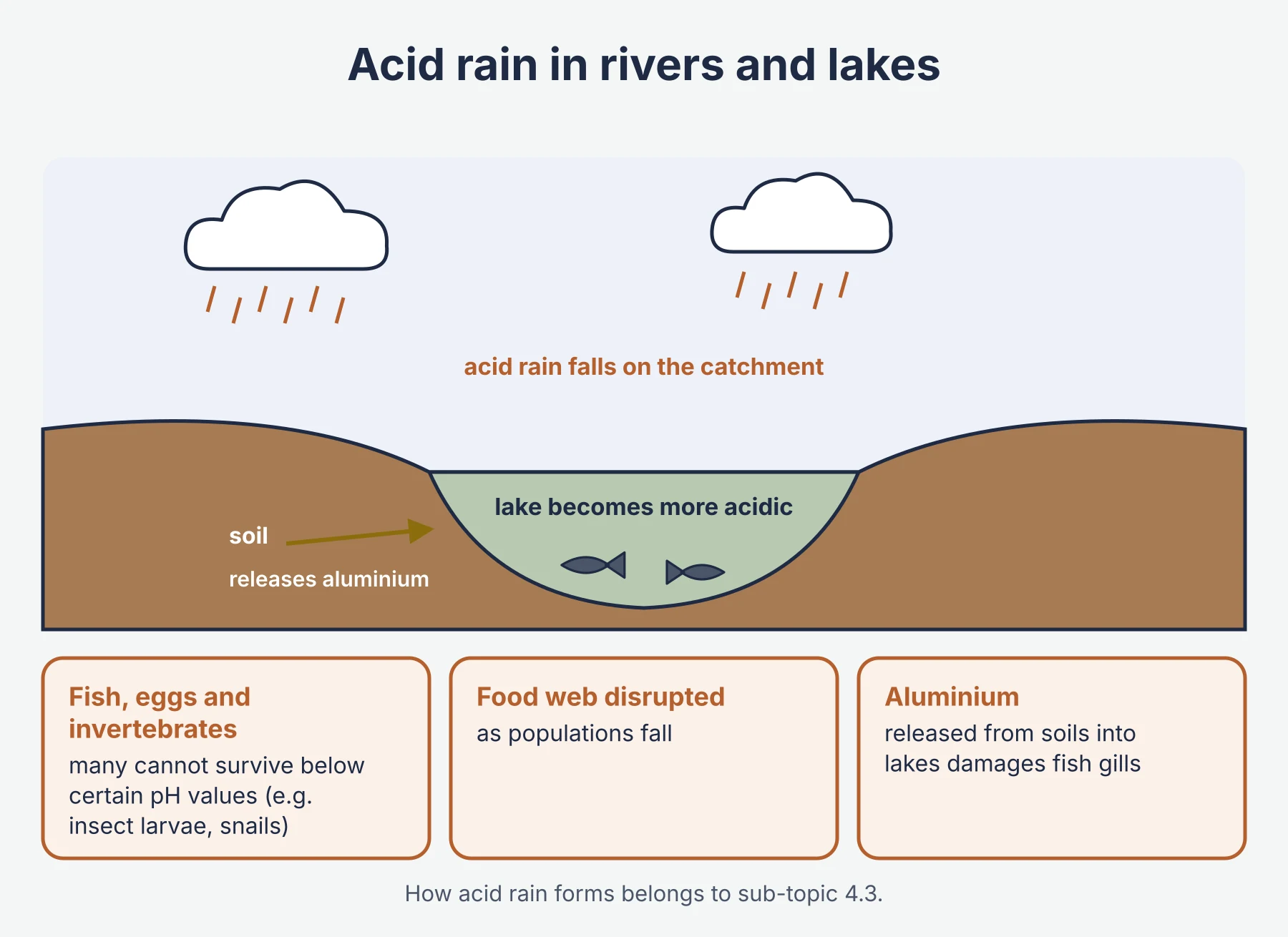
When acid rain falls on a catchment, rivers and lakes become more acidic. Many fish, their eggs and invertebrates such as insect larvae and snails cannot survive below certain pH values, so populations fall and the food web is disrupted. Acidic water can also release aluminium from soils into lakes, which damages fish gills. How acid rain forms belongs to sub-topic 4.3.
Leaching, nutrient enrichment and eutrophication
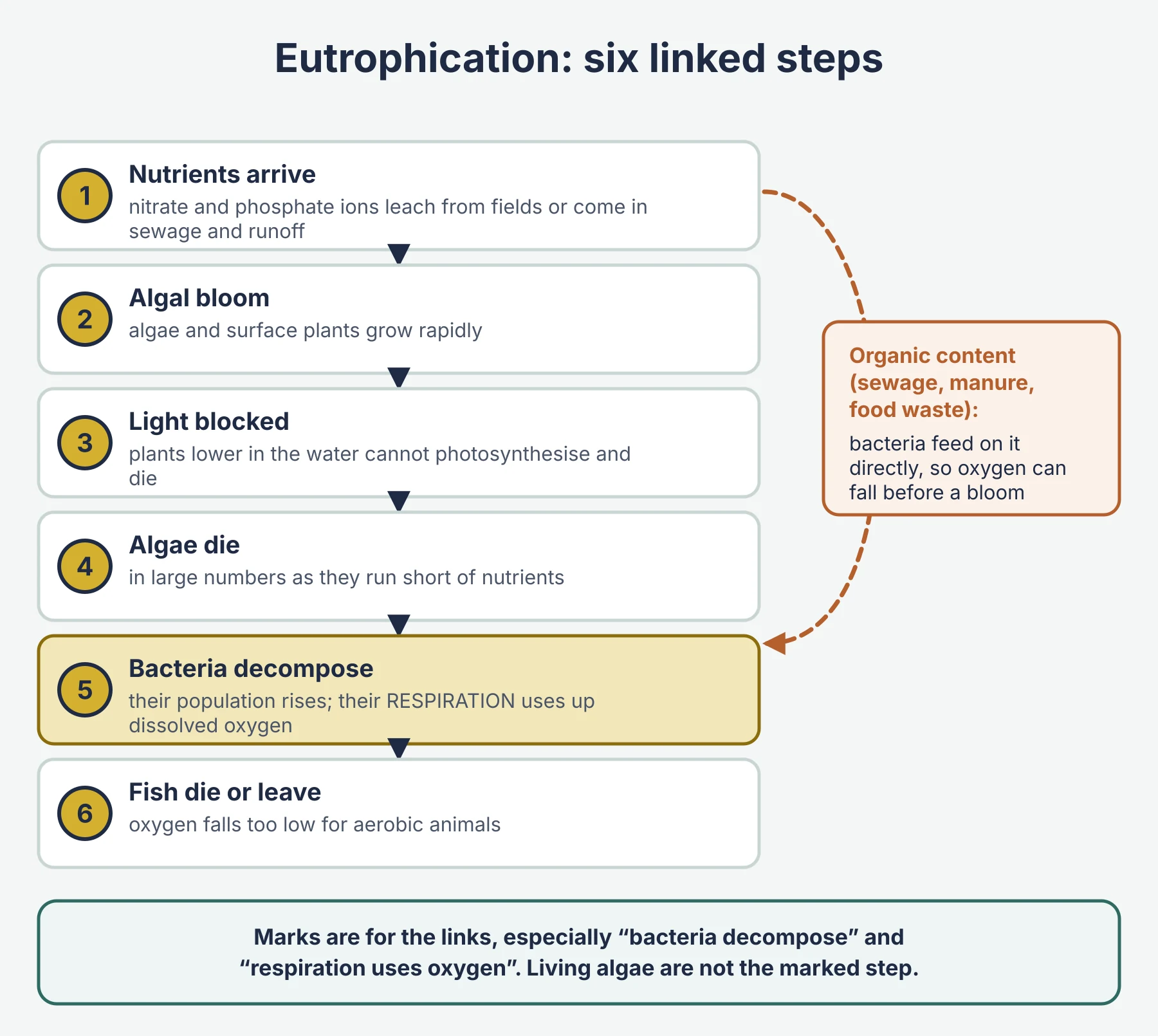
Eutrophication is the sequence that follows nutrient enrichment of water. The syllabus mentions two sources of nutrients: inorganic ions (nitrates and phosphates from fertilisers and detergents) and organic content (sewage, manure, food waste).
- Nitrate and phosphate ions leach from fields or arrive in sewage and runoff.
- Algae and surface plants grow rapidly, forming an algal bloom.
- The bloom blocks light from plants lower in the water, so they cannot photosynthesise and die.
- The algae themselves die in large numbers as they run short of nutrients.
- Bacteria decompose the dead material. Their population rises and their respiration uses up dissolved oxygen.
- Oxygen levels fall so low that fish and other aerobic animals die or leave.
Organic content shortens this chain: bacteria feed directly on sewage, so oxygen can fall even before an algal bloom forms. In an exam, the marks are for the links between steps, especially “bacteria decompose” and “respiration uses oxygen”.
Strategies for improving water quality
Improved sanitation means safe, hygienic disposal of human waste: toilets connected to sewers, or well-built pit latrines and septic tanks sited away from wells and rivers. It stops faeces reaching drinking water, so it tackles cholera at its source.
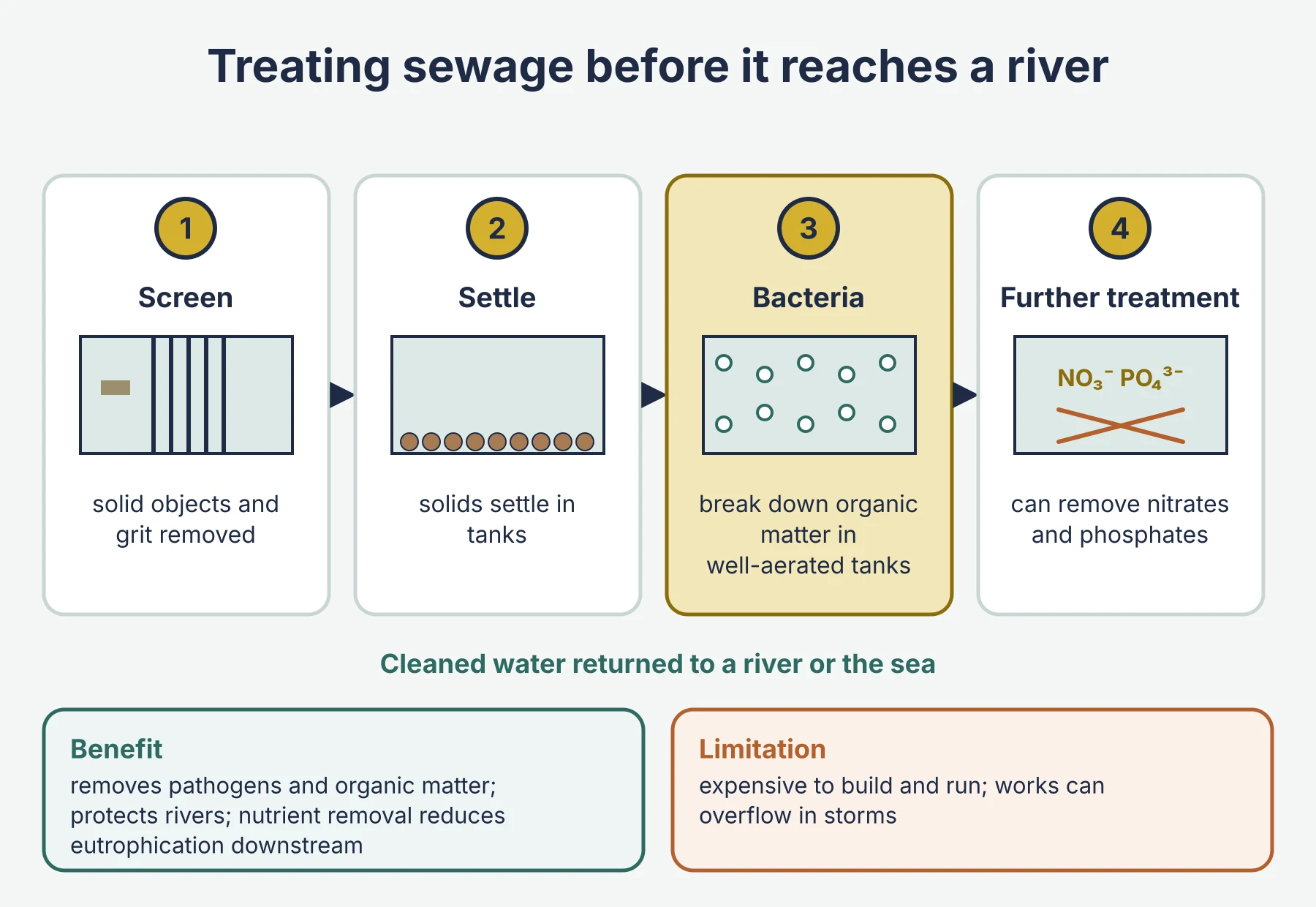
Treatment of sewage cleans wastewater before it is returned to a river or the sea. Solid objects and grit are screened out, solids settle in tanks, and bacteria are then used to break down the organic matter in well-aerated tanks. Further treatment can remove nitrates and phosphates, which reduces eutrophication downstream.
Pollution control and legislation sets legal limits on what factories, farms and water companies may discharge, requires permits, and backs this with monitoring and fines. Examples of control measures include treating industrial wastewater on site, banning the most persistent pesticides, limiting when and how much fertiliser may be spread near rivers, and buffer strips of vegetation along banks that trap runoff.
| Strategy | Benefit | Limitation |
|---|---|---|
| Improved sanitation | Cuts disease at source | High cost of sewers; latrines can contaminate groundwater if badly sited |
| Sewage treatment | Removes pathogens and organic matter; protects rivers | Expensive to build and run; works can overflow in storms |
| Legislation | Applies to every polluter; fines fund clean-up | Needs inspectors and honest monitoring; weak where enforcement is poor |
Worked example 1: interpreting biomagnification data
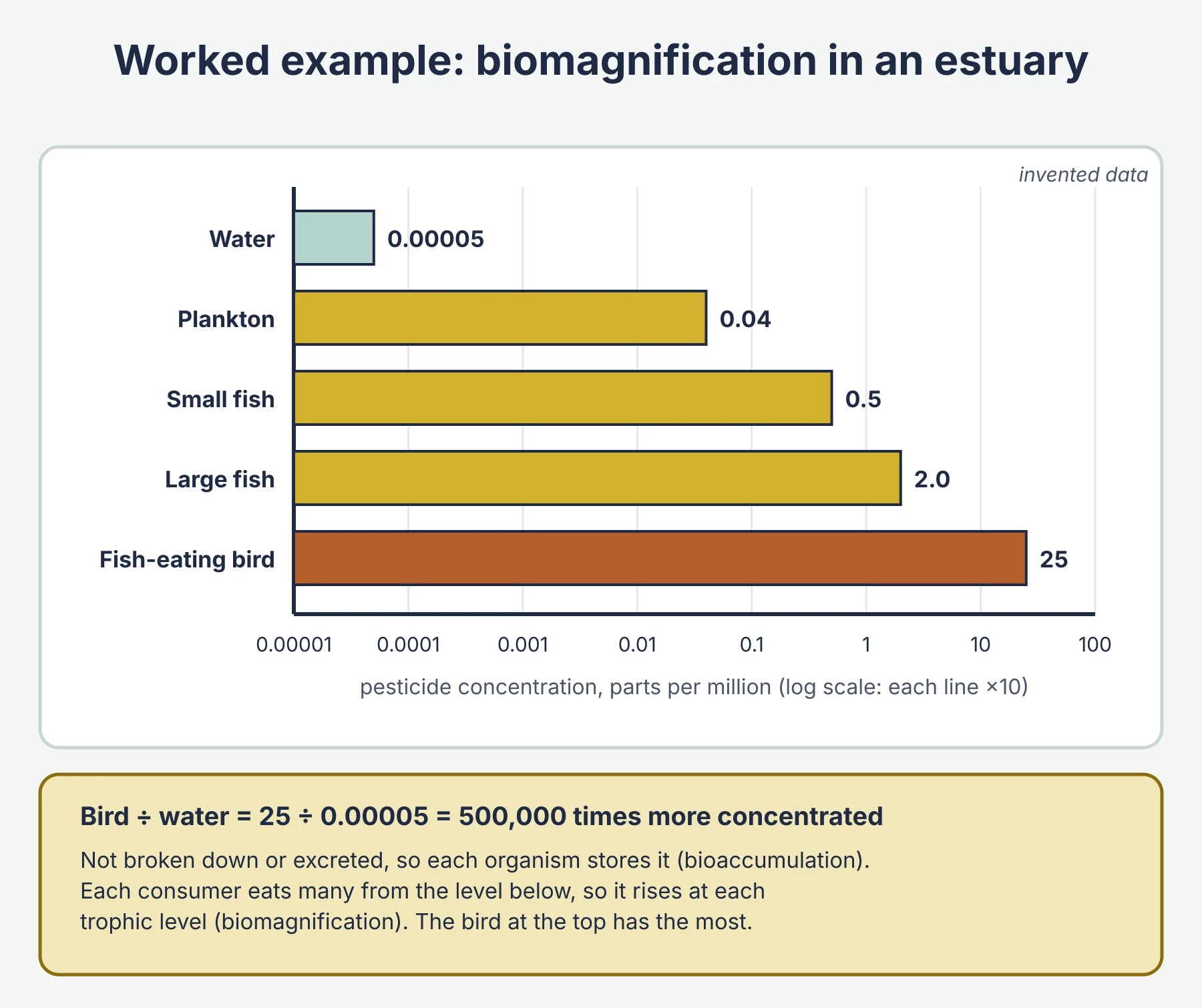
A survey of a polluted estuary measured a pesticide in each part of a food chain. The figures below are invented for practice.
| Sample | Concentration (parts per million) |
|---|---|
| Water | 0.00005 |
| Plankton | 0.04 |
| Small fish | 0.5 |
| Large fish | 2.0 |
| Fish-eating bird | 25 |
Question: calculate how many times more concentrated the pesticide is in the bird than in the water, and explain the pattern.
- Divide the bird value by the water value: 25 / 0.00005 = 500,000.
- The bird contains the pesticide at 500,000 times the concentration in the water.
- Explanation: the pesticide is not broken down or excreted, so each organism stores what it takes in (bioaccumulation). Each consumer eats many organisms from the level below, so the amount stored increases at each trophic level (biomagnification). The bird is at the top, so it has the highest concentration.
Notice that the answer uses both terms correctly and links them to the data.
Worked example 2: an annotated model answer
Question: explain how fertiliser use on farmland can lead to the death of fish in a nearby lake. [5]
Model answer: Rain causes nitrate and phosphate ions from fertiliser to leach through the soil and run off into the lake (1). These nutrients cause rapid growth of algae, an algal bloom (1). The algae block light, so plants below die, and the algae later die too (1). Bacteria decompose the dead plants and algae and their population increases (1). Bacterial respiration uses up the dissolved oxygen, so fish suffocate and die (1).
Why it scores: each sentence is one step, and every step causes the next. A weaker answer that writes “fertiliser makes algae grow and the fish die” gains one mark at most.
Common mistakes
- Writing that living algae use up the oxygen. Algae do respire, but the marked step is respiration by the bacteria that decompose dead material.
- Swapping bioaccumulation and biomagnification. One organism over time is bioaccumulation; up the food chain is biomagnification.
- Saying cholera is caused by dirty water in general. Name the route: water contaminated by faeces carrying the bacteria.
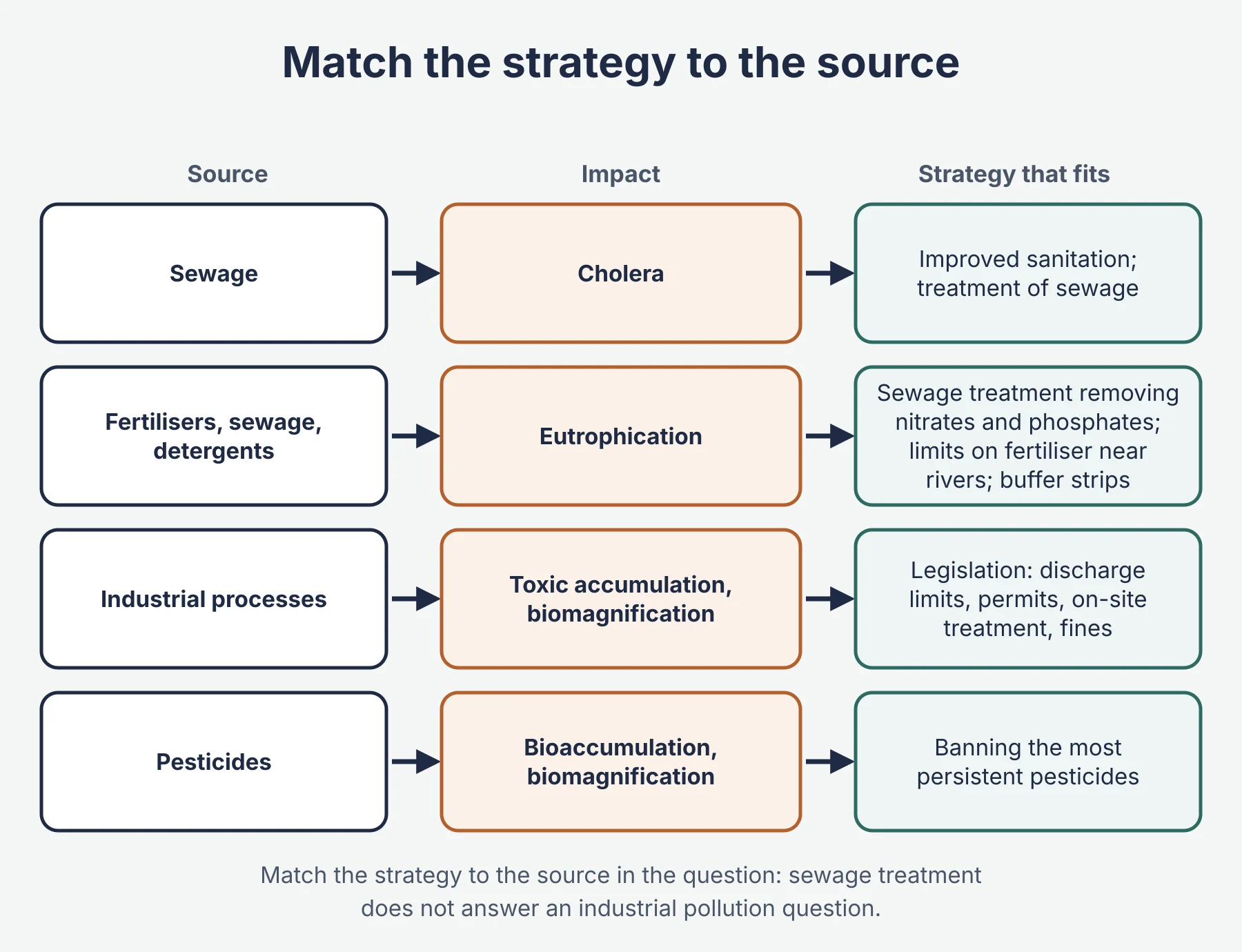
- Listing “treatment of sewage” for an industrial pollution question. Match the strategy to the source in the stem.
Exam technique
Describe questions want named sources or features in context, with a short detail for each. Explain questions want a reason or mechanism: use “because”, “so” and “which leads to”. Discuss the benefits and limitations is not in 3.2’s wording, but strategy questions on Paper 2 may still ask you to evaluate them, so learn one benefit and one limitation for each. In data questions, quote figures with their units and do any calculation step by step, as in the first worked example.
Condense this page with the water pollution revision notes, then test yourself with the water pollution practice questions.
Related resources
-
Revision notes
Cambridge IGCSE Environmental Management: Land — Revision Notes
Recall notes on soils and crop growth, food production and soil erosion for Topic 2 Land of Cambridge IGCSE Environmental Management 0680, 2027-2029 series.
Environmental Management · Cambridge · IGCSE
Revise topic -
Practice questions
Cambridge IGCSE Environmental Management (0680): Water pollution – Practice Questions
Original practice questions with mark-scheme answers on water pollution sources, biomagnification, eutrophication and sewage treatment for IGCSE 0680.
Environmental Management · Cambridge · IGCSE
Try questions -
Revision notes
Cambridge IGCSE Environmental Management (0680): Water pollution – Revision Notes
Quick-recall notes on water pollution sources, cholera, bioaccumulation, biomagnification, eutrophication and sewage treatment for IGCSE 0680.
Environmental Management · Cambridge · IGCSE
Revise topic
Get free revision emails (optional)
Occasional emails with practice questions, worked explanations and links to free resources for the qualification and subjects you choose. No spam, and you can unsubscribe from any email. The free tools on this site never need an email.