
Revision Notes
Cambridge IGCSE Environmental Management (0680): Water sources and supply – Revision Notes
Recall notes on water cycle stores and transfers, fresh water sources, water treatment, desalination and multipurpose dams for Cambridge IGCSE 0680.
- Subject
- Environmental Management
- Level
- IGCSE
- Topic
- Topic 3 – Water
- Author
- Marlbridge Academic Team
- Updated
- Reviewed by
- Azam Siddique (what this means)
Aligned to Cambridge IGCSE Environmental Management (0680), 2027-2029. Official specification .
Syllabus page (what it covers and how it is assessed): Cambridge IGCSE Environmental Management.
Syllabus points this page covers
0680
- 3.1 Water sources and supply
Found an error? Report a correction.
Need help with this topic? Request a free trial class for IGCSE Environmental Management (0680).
Condensed notes for sub-topic 3.1. Full explanations, comparison tables and a reservoir calculation are in the Water sources and supply study guide.
Water cycle (3.1.1)
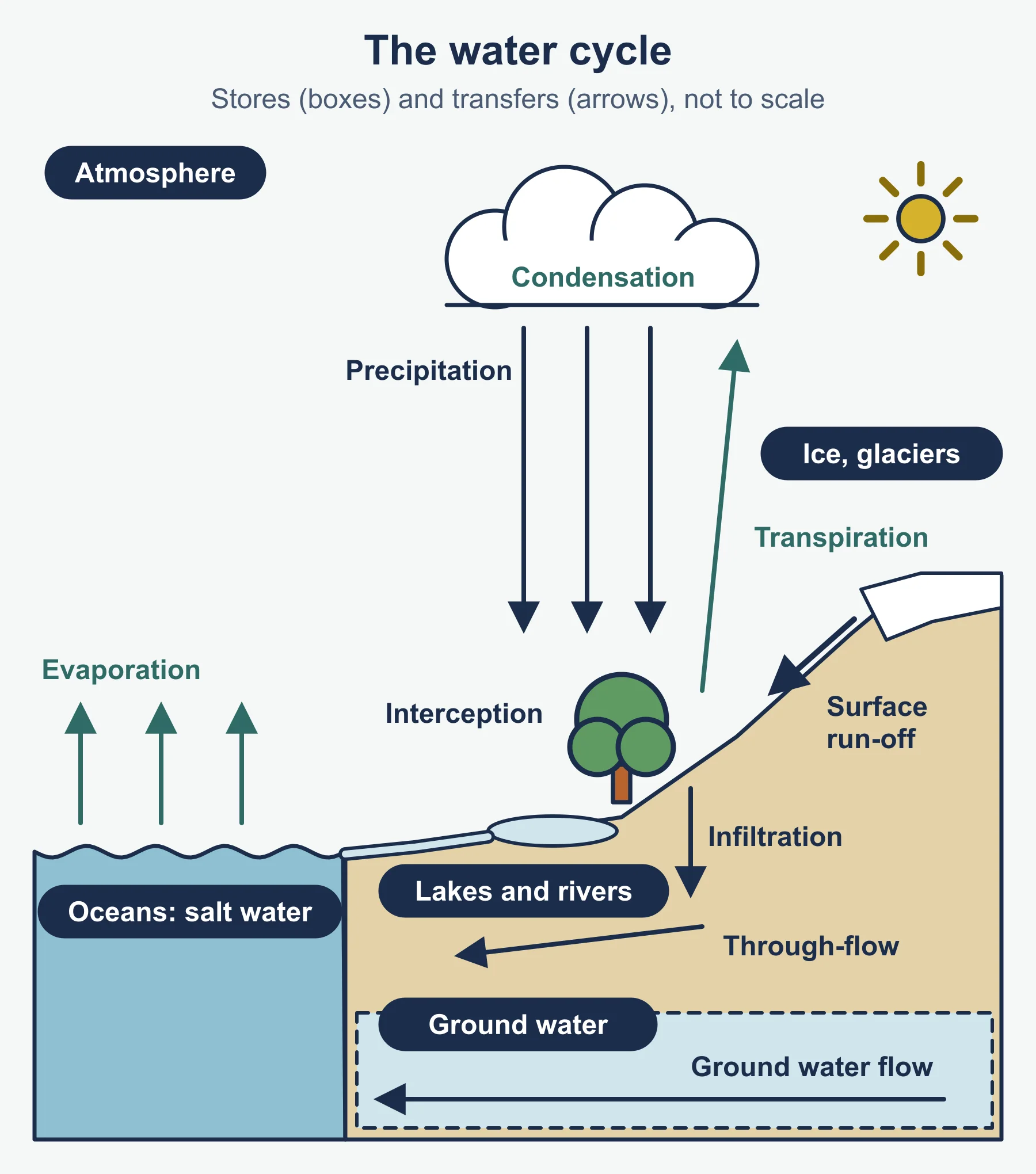
Stores
- Salt water: oceans.
- Fresh water: ice sheets and glaciers, ground water, atmosphere, lakes and rivers.
Transfers
| Transfer | One-line meaning |
|---|---|
| Evaporation | Liquid water to vapour, mainly from oceans |
| Transpiration | Water vapour lost from plant leaves |
| Condensation | Vapour cools to droplets, forming clouds |
| Precipitation | Rain, snow, sleet or hail falling from clouds |
| Interception | Leaves and branches catch precipitation |
| Infiltration | Water soaks into the soil surface |
| Surface run-off | Water flows over the ground |
| Through-flow | Water moves sideways through soil |
| Ground water flow | Water moves slowly through permeable rock |
Arrow positions on diagrams: up from sea or plants = evaporation or transpiration; clouds forming = condensation; down from clouds = precipitation; over the surface = run-off; into the ground = infiltration; within soil = through-flow; deep in rock = ground water flow.
Sources of fresh water (3.1.2)
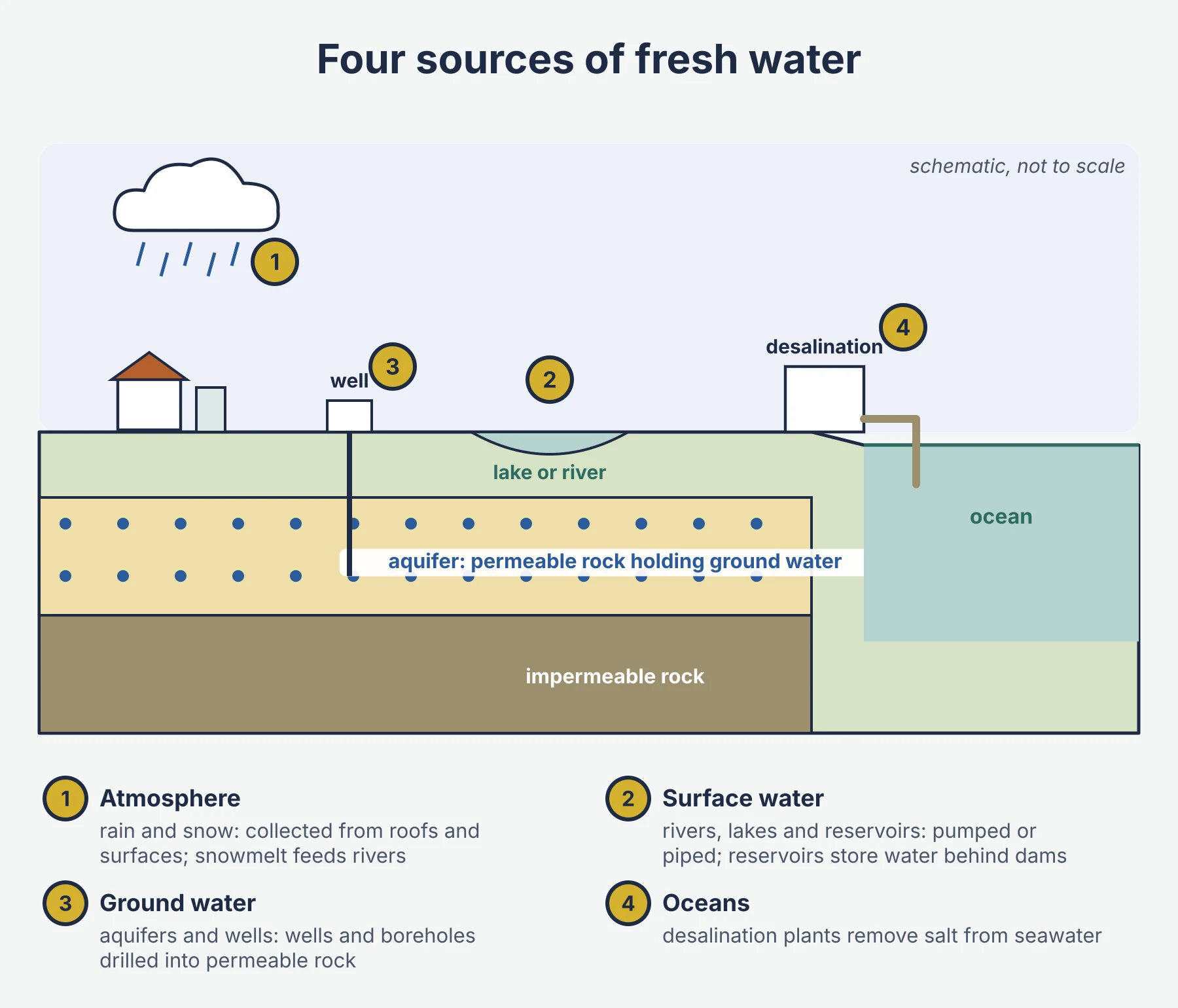
- Atmosphere: rain and snow.
- Surface water: rivers, lakes, reservoirs.
- Ground water: aquifers and wells.
- Oceans: desalination plants.
Aquifer: permeable rock (such as sandstone or limestone) that stores ground water above impermeable rock.
Oceans (3.1.3)
Pacific, Atlantic, Indian, Southern, Arctic.
Potable water and treatment (3.1.4 and 3.1.5)
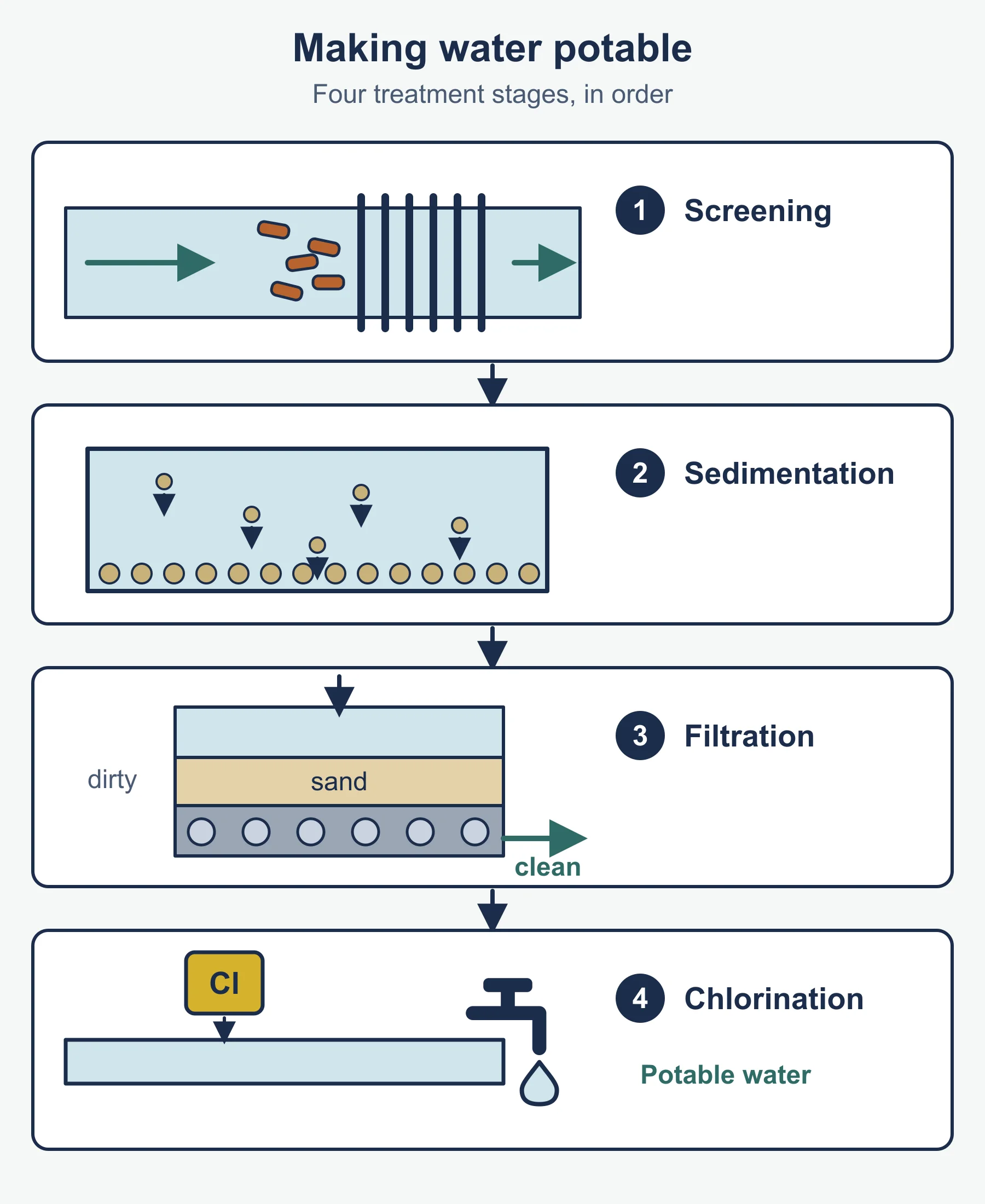
Potable water: water that is safe to drink.
| Stage | What it removes | How |
|---|---|---|
| 1 Screening | Large debris: sticks, leaves, plastic | Mesh screens |
| 2 Sedimentation | Heavier suspended particles | Water held still in tanks; particles settle |
| 3 Filtration | Smaller particles | Beds of sand and gravel |
| 4 Chlorination | Disease-causing microorganisms | Chlorine added; some remains to protect water in pipes |
Memory aid: large → heavy → small → living.
Availability of potable water (3.1.6)
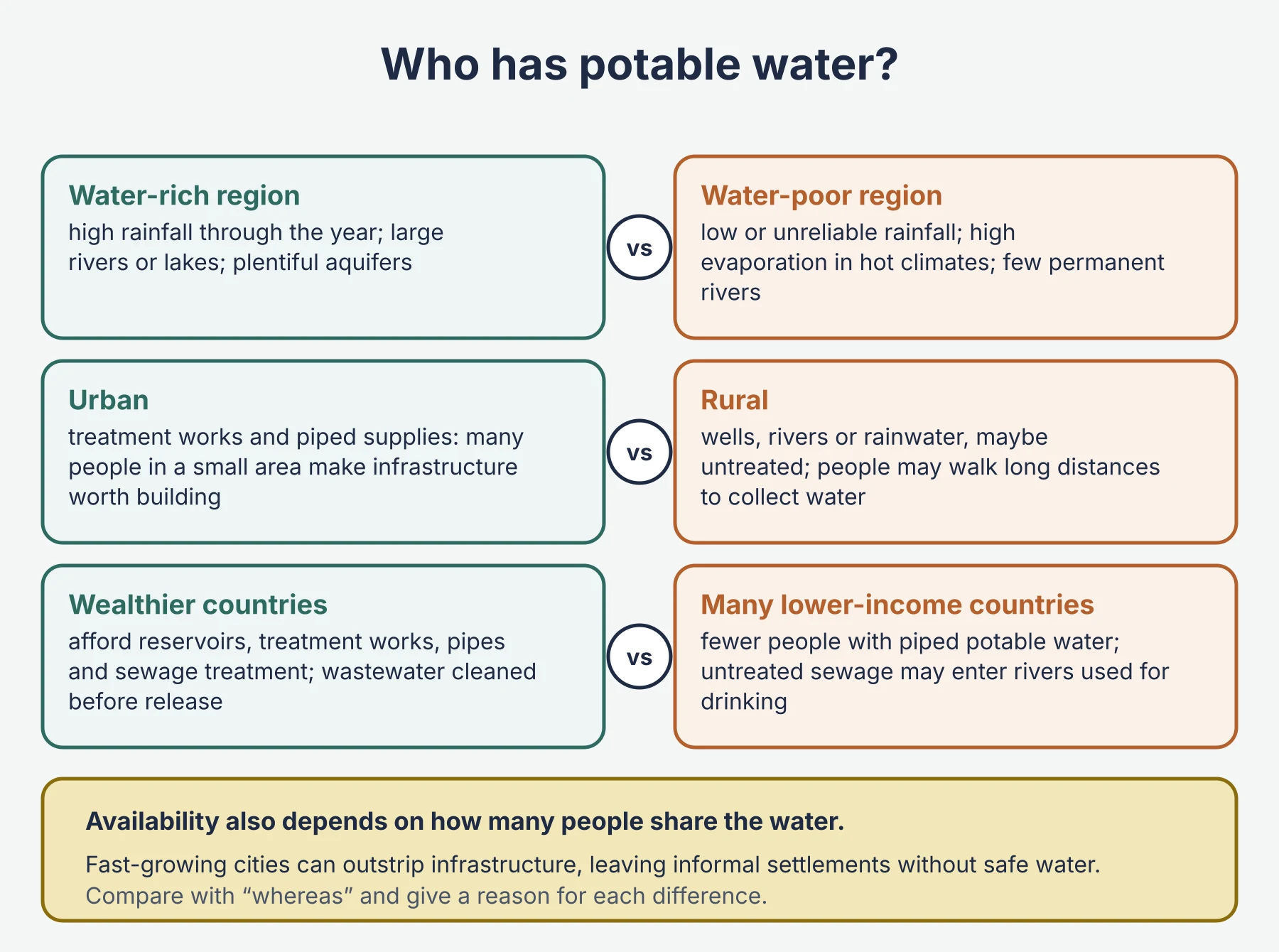
| Comparison | Better access | Poorer access |
|---|---|---|
| Water-rich vs water-poor | High, reliable rainfall; large rivers, lakes, aquifers | Low or unreliable rainfall; high evaporation; few permanent rivers |
| Urban vs rural | Cities: treatment works and pipes serve many people | Rural: wells, rivers, rainwater, often untreated; long walks to collect water |
| Global inequalities | Wealthier countries: reservoirs, treatment, sewage works | Lower-income countries: fewer piped supplies; untreated sewage may enter rivers |
Exception to note: fast-growing cities may outgrow their infrastructure, leaving informal settlements without safe water.
Desalination (3.1.7 and 3.1.8)
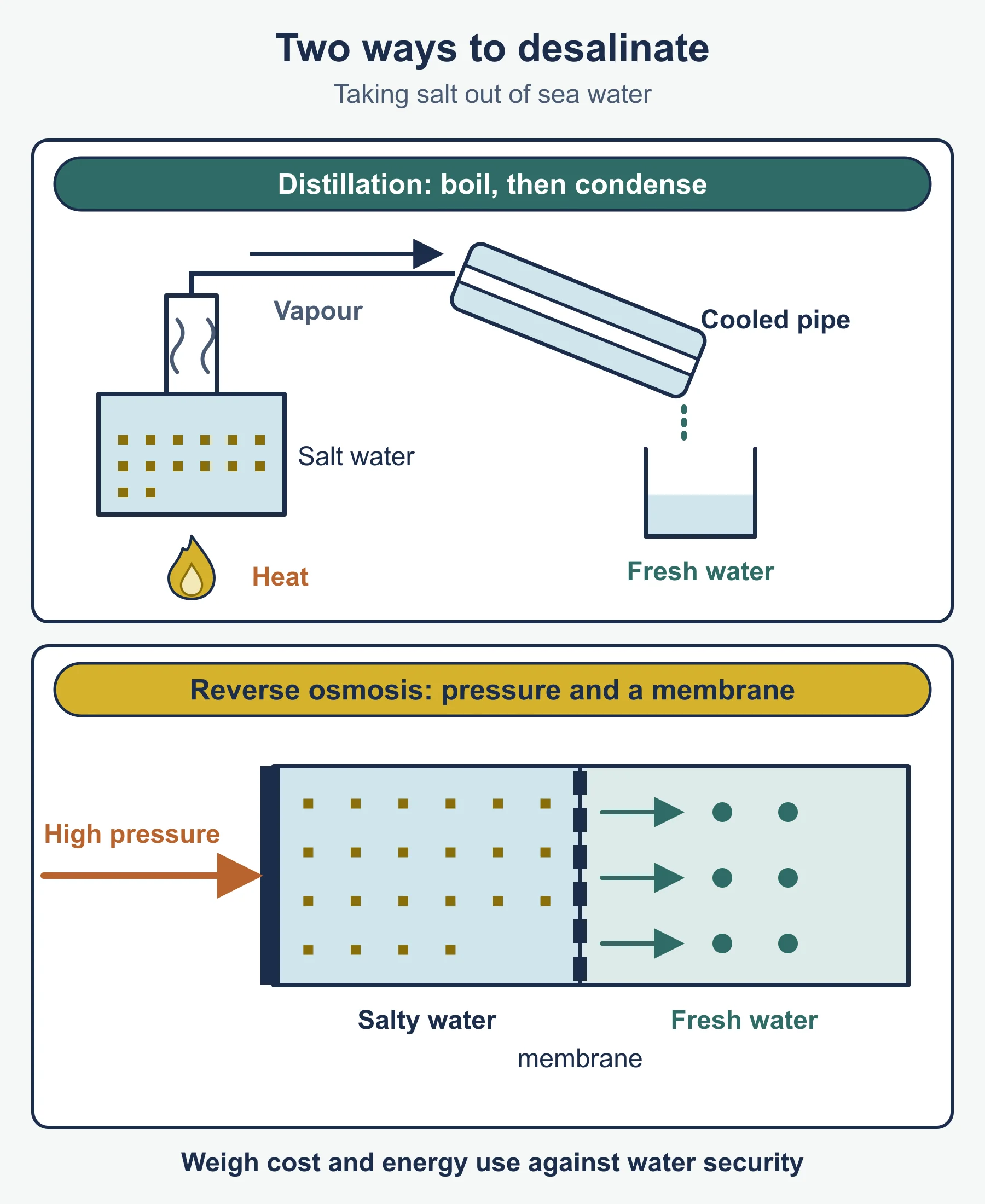
Distillation: heat water until it boils → salt remains in the liquid → steam is pure water → cool and condense the steam to form potable water.
Reverse osmosis: water under high pressure → passed through a membrane → water molecules pass through → most ions and other molecules are stopped.
| Benefits | Limitations |
|---|---|
| Ocean is an almost unlimited source | High energy use and cost; carbon dioxide if fossil-fuelled |
| Independent of rainfall; reliable in drought | Brine waste can harm marine life |
| Suits dry coastal countries | Only practical near the coast |
| Eases pressure on rivers and aquifers | High building cost |
Multipurpose dams (3.1.9 and 3.1.10)
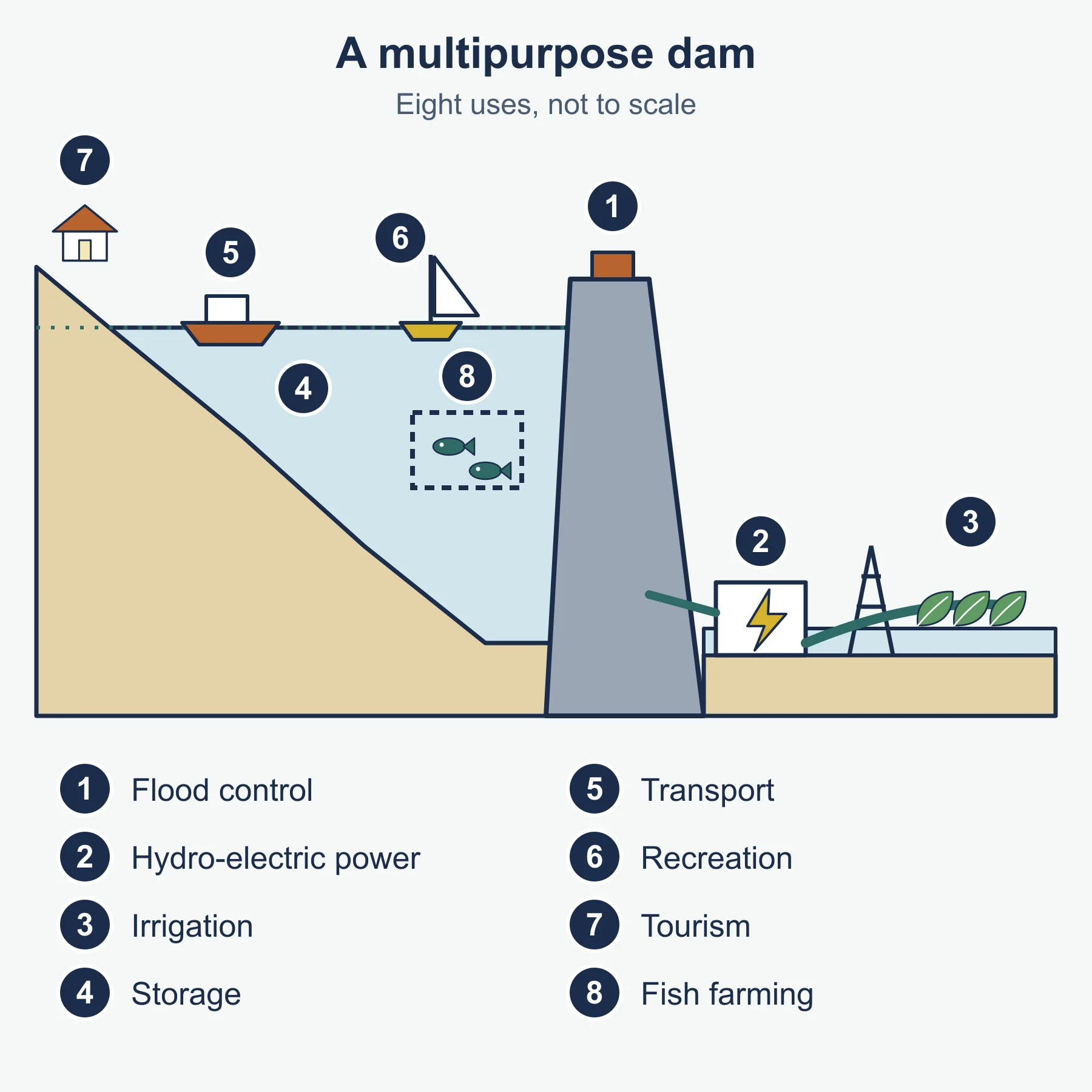
Eight uses: flood control, hydro-electric power, irrigation, storage of water, transport, recreation, tourism, fish farming.
| Benefits | Limitations |
|---|---|
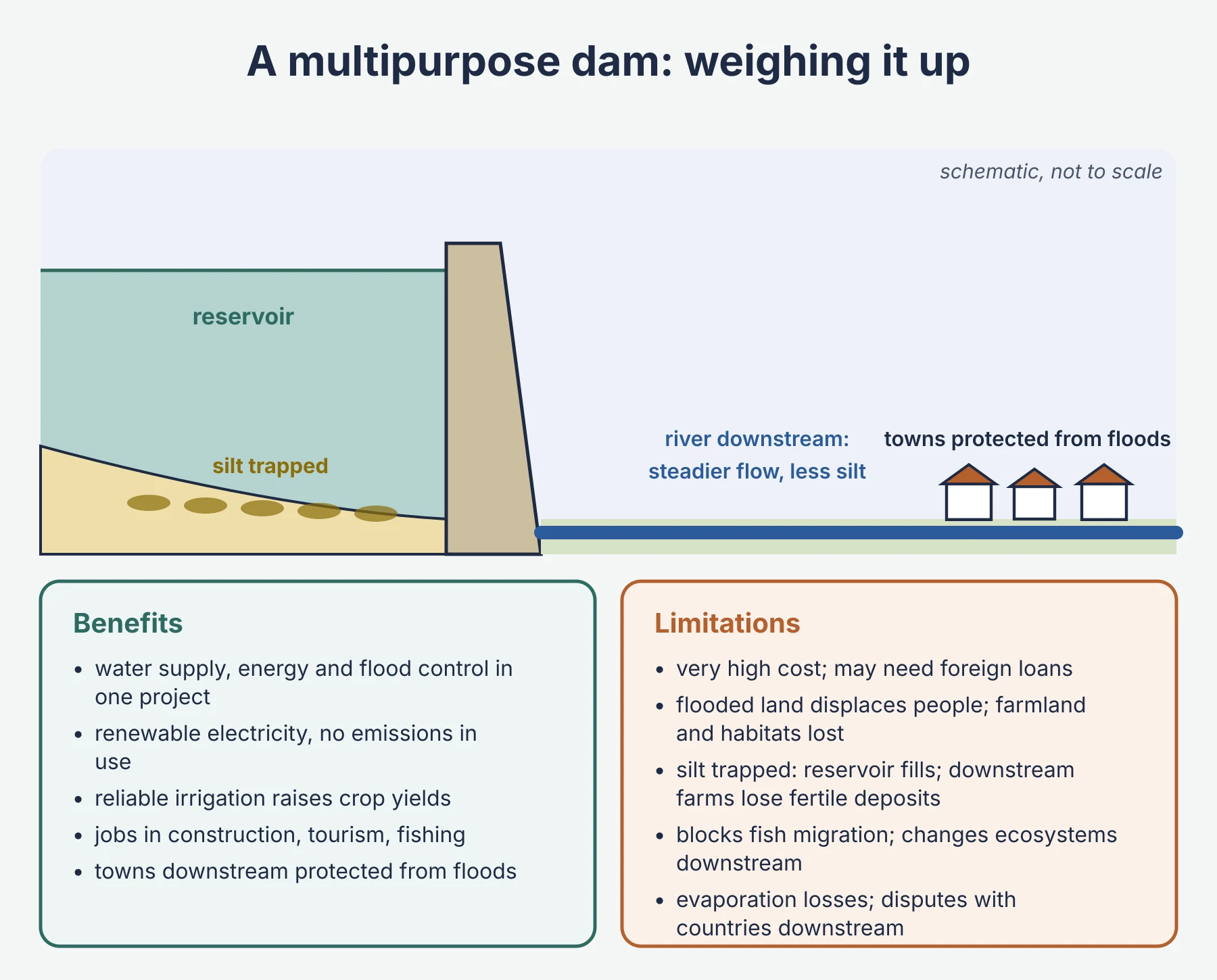
| Several uses from one project | Very high cost |
| Renewable electricity | People displaced; farmland and habitats flooded |
| Reliable irrigation; higher yields | Silt trapped; reservoir fills; downstream land loses fertile deposits |
| Flood protection downstream | Fish migration blocked; river ecosystems changed |
| Jobs in tourism and fishing | Evaporation losses; disputes with countries downstream |
Calculation to practise
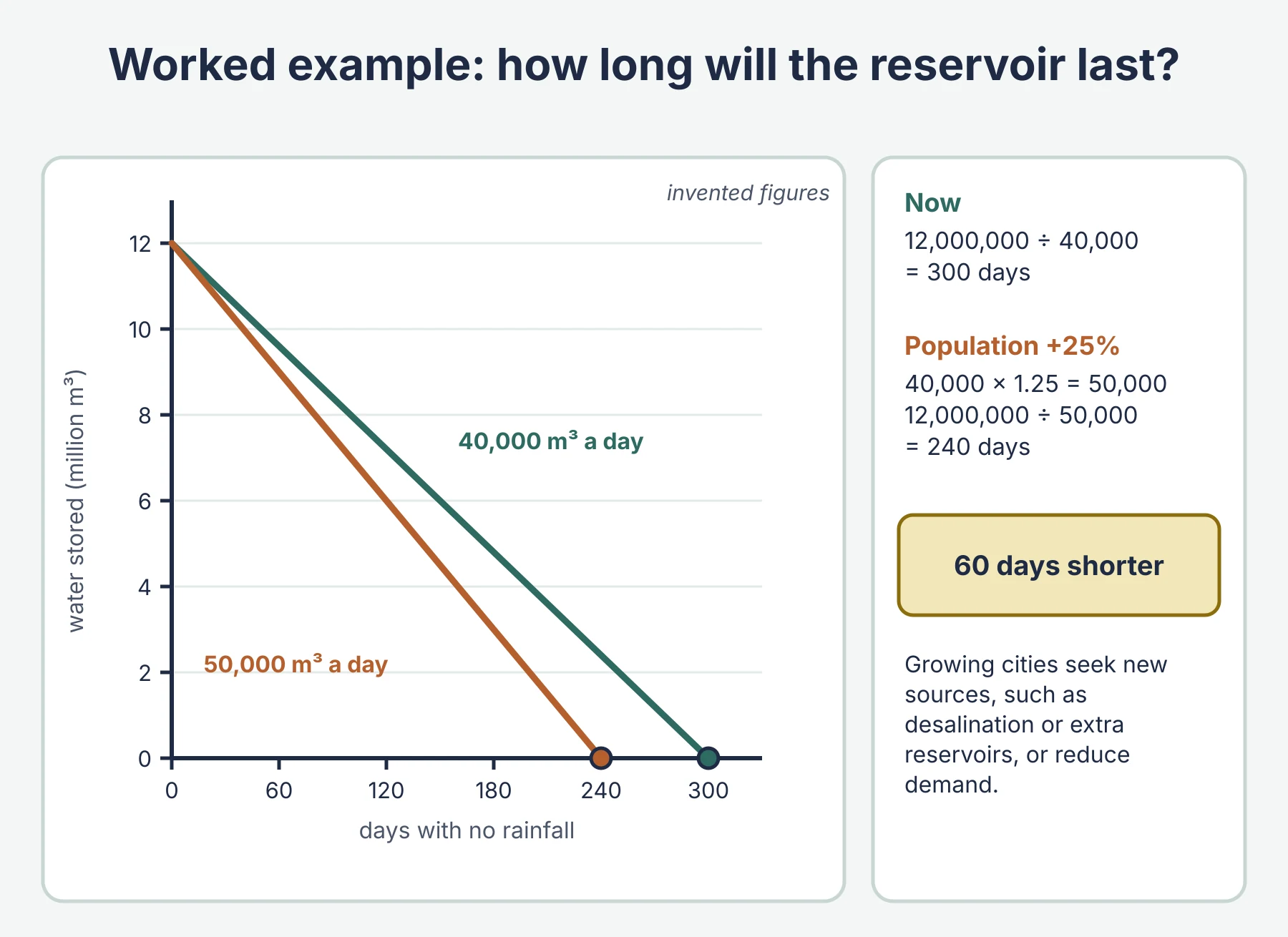
Days of supply = volume stored ÷ daily use.
Quick check: 9 million m³ ÷ 30,000 m³ a day = 300 days. If use rises by 20% to 36,000 m³ a day: 9,000,000 ÷ 36,000 = 250 days.
Key terms
| Term | Meaning |
|---|---|
| Store | Place where water is held |
| Transfer | Process that moves water between stores |
| Aquifer | Permeable rock holding ground water |
| Potable water | Water that is safe to drink |
| Brine | Very salty waste water from desalination |
| Reservoir | Artificial lake behind a dam |
Exam traps
- Infiltration is into the soil; through-flow is through it.
- Ice sheets are a fresh water store but not an accessible source.
- Filtration removes particles; chlorination kills microorganisms.
- Reverse osmosis needs high pressure and a membrane.
- Use “whereas” in compare questions.
- Discuss questions need benefits and limitations, then a judgement.
Self-test
- Name the four fresh water stores in the syllabus.
- What is the difference between interception and infiltration?
- Name the transfer in which water moves sideways through soil.
- Name the five oceans.
- Define potable water.
- List the four water treatment stages in order.
- What is the purpose of chlorination?
- Describe reverse osmosis.
- Give one environmental limitation of desalination.
- Give four uses of a multipurpose dam.
- Explain why rural areas often have less access to potable water than urban areas.
- A reservoir holds 6 million m³ and a city uses 25,000 m³ a day. How many days would it last without rain?
Answers
- Ice sheets and glaciers, ground water, the atmosphere, lakes and rivers.
- Interception is precipitation caught by vegetation; infiltration is water soaking into the soil.
- Through-flow.
- Pacific, Atlantic, Indian, Southern, Arctic.
- Water that is safe to drink.
- Screening, sedimentation, filtration, chlorination.
- To kill disease-causing microorganisms and keep the water safe in the pipes.
- Water is put under high pressure and passed through a membrane that lets water molecules through but stops most ions and other molecules.
- Brine returned to the sea harms marine life, or carbon dioxide from the energy used.
- Any four: flood control, hydro-electric power, irrigation, storage of water, transport, recreation, tourism, fish farming.
- People are spread out, so piped supplies and treatment works are costly to build; many rely on untreated wells or rivers.
- 6,000,000 ÷ 25,000 = 240 days.
Where to go next
Practise with the Water sources and supply practice questions. For the rest of Topic 3, use the Water revision notes.
Related resources
-
Revision notes
Cambridge IGCSE Environmental Management: Land — Revision Notes
Recall notes on soils and crop growth, food production and soil erosion for Topic 2 Land of Cambridge IGCSE Environmental Management 0680, 2027-2029 series.
Environmental Management · Cambridge · IGCSE
Revise topic -
Study guides
Cambridge IGCSE Environmental Management: Water (0680)
The water cycle, water supply, pollution, water-related diseases, marine aquaculture, and oil and plastic pollution: Topic 3 of Cambridge IGCSE 0680, 2027-2029.
Environmental Management · Cambridge · IGCSE
Read guide -
Practice questions
Cambridge IGCSE Environmental Management: Oil and Plastic Pollution — Practice Questions (0680)
Practice questions with answers on oil spill causes, impacts, prevention and clean-up, and on plastic types, microplastics and plastic pollution for IGCSE 0680.
Environmental Management · Cambridge · IGCSE
Try questions
Get free revision emails (optional)
Occasional emails with practice questions, worked explanations and links to free resources for the qualification and subjects you choose. No spam, and you can unsubscribe from any email. The free tools on this site never need an email.