
Study Guides
Cambridge IGCSE Environmental Management (0680): Water sources and supply
The water cycle, sources of fresh water, water treatment, global inequalities in potable water, desalination and multipurpose dams for Cambridge IGCSE 0680.
- Subject
- Environmental Management
- Level
- IGCSE
- Topic
- Topic 3 – Water
- Author
- Marlbridge Academic Team
- Updated
- Reviewed by
- Azam Siddique (what this means)
Aligned to Cambridge IGCSE Environmental Management (0680), 2027-2029. Official specification .
Syllabus page (what it covers and how it is assessed): Cambridge IGCSE Environmental Management.
Syllabus points this page covers
0680
- 3.1 Water sources and supply
Found an error? Report a correction.
Need help with this topic? Request a free trial class for IGCSE Environmental Management (0680).
Sub-topic 3.1 follows water from the natural cycle to the tap. It starts with where water is stored and how it moves, identifies the sources people draw on, explains how water is made safe to drink, and asks why some people have plenty while others have little. It ends with two large-scale ways of increasing supply, desalination and multipurpose dams, both of which you must be able to discuss. With ten statements, it is the longest sub-topic in Topic 3.
What the syllabus asks you to do
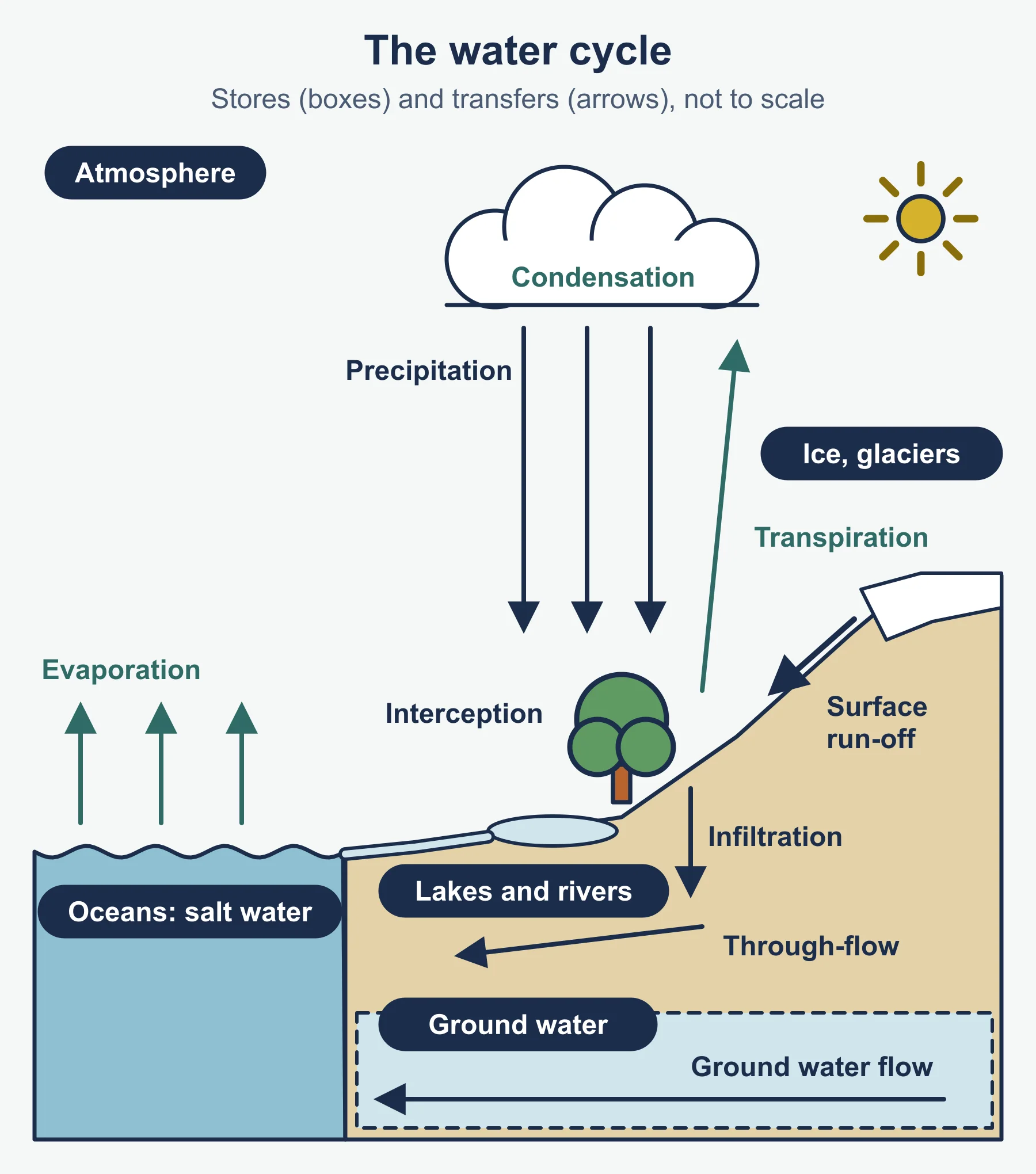
- 3.1.1 Describe and interpret the water cycle: stores (salt water in oceans; fresh water in ice sheets and glaciers, ground water, the atmosphere, and lakes and rivers) and transfers (precipitation, interception, surface run-off, infiltration, through-flow, ground water flow, transpiration, evaporation and condensation).
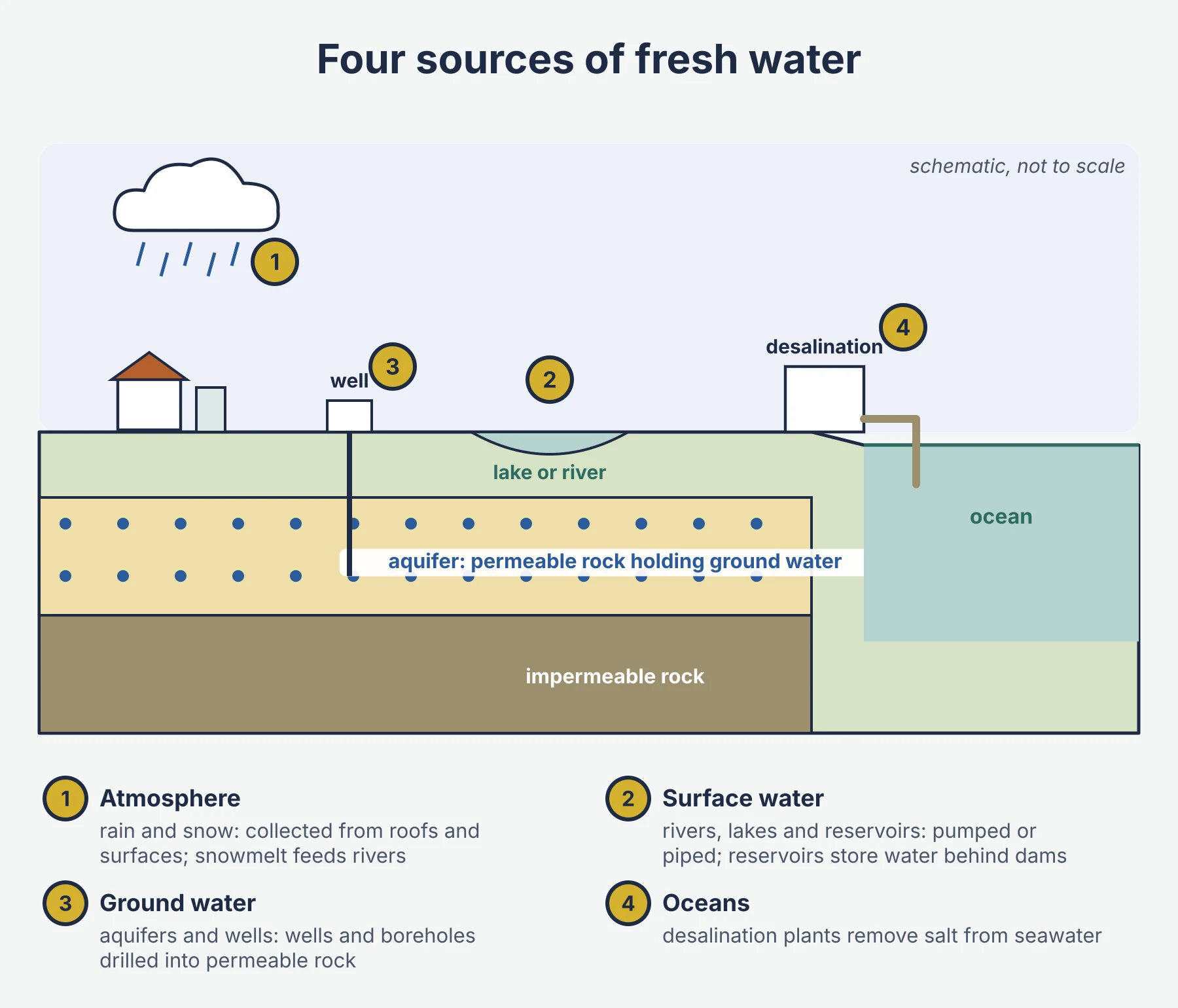
- 3.1.2 Describe sources of fresh water: atmosphere (rain and snow); surface water (rivers, lakes and reservoirs); ground water (aquifers and wells); oceans (desalination plants).
- 3.1.3 Identify the world’s oceans: Pacific, Atlantic, Indian, Southern and Arctic.
- 3.1.4 Define potable water as water that is safe to drink.
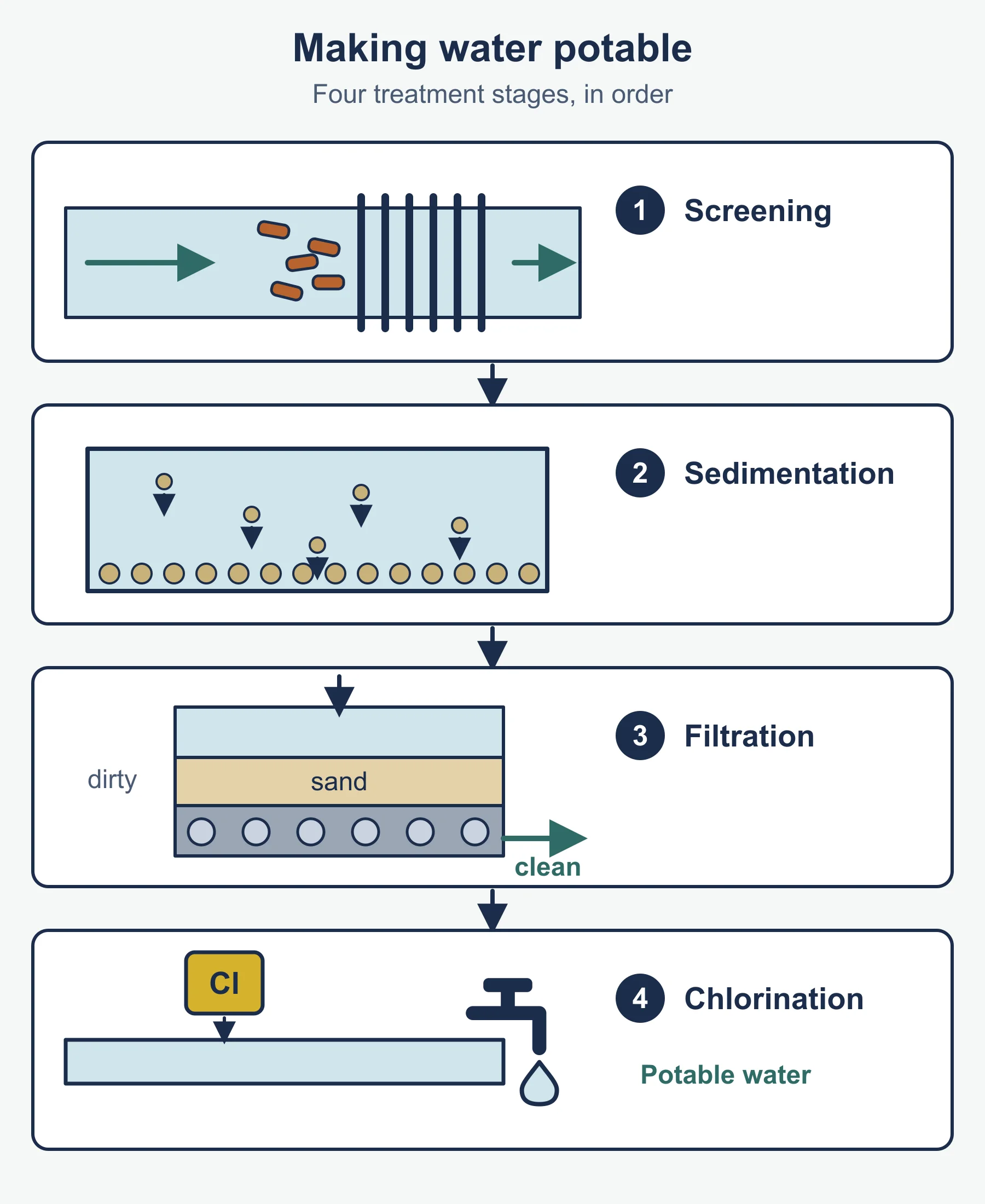
- 3.1.5 Describe the stages of water treatment: screening, sedimentation, filtration, chlorination.
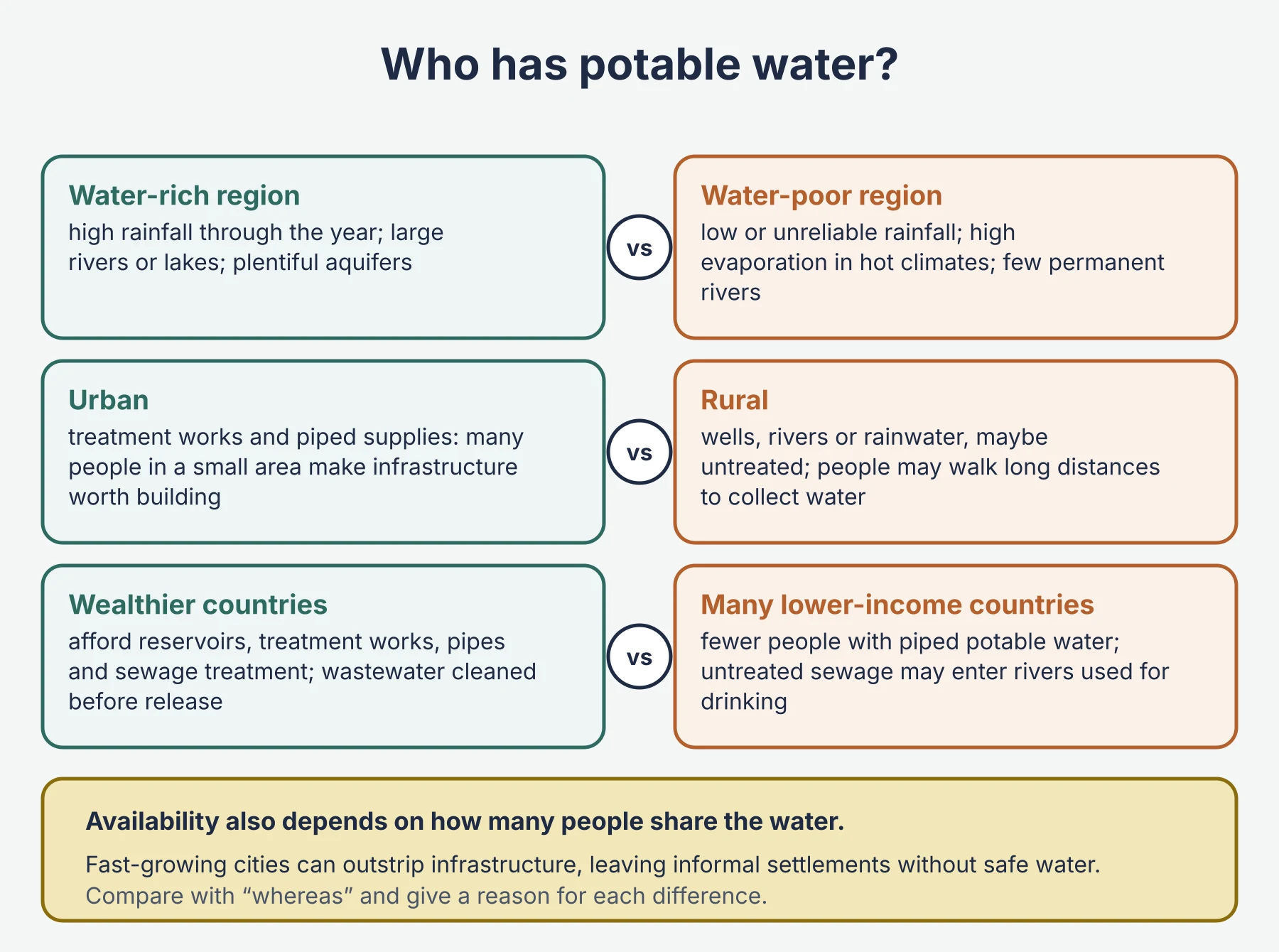
- 3.1.6 Compare the availability of potable water: water-rich and water-poor regions; urban and rural regions; global inequalities in water availability and sewage treatment.
- 3.1.7 Describe desalination by distillation and by reverse osmosis.
- 3.1.8 Discuss the benefits and limitations of desalination.
- 3.1.9 Describe the uses of a multipurpose dam: flood control, hydro-electric power, irrigation, storage of water, transport, recreation, tourism and fish farming.
- 3.1.10 Discuss the benefits and limitations of a multipurpose dam.
The water cycle: stores and transfers
A store is where water is held; a transfer is a process that moves water between stores.
Stores
- Salt water: the oceans, by far the largest store.
- Fresh water: ice sheets and glaciers (frozen, so mostly unavailable to people); ground water (in permeable rock and soil underground); the atmosphere (as water vapour and clouds); lakes and rivers (the most accessible, but a small store).
Transfers
| Transfer | What happens |
|---|---|
| Evaporation | Liquid water at the surface, mainly from oceans, turns into water vapour, using energy from the Sun |
| Transpiration | Water vapour is lost from plant leaves |
| Condensation | Water vapour cools and turns into tiny droplets, forming clouds |
| Precipitation | Water falls from clouds as rain, snow, sleet or hail |
| Interception | Precipitation is caught by leaves and branches before reaching the ground |
| Infiltration | Water soaks into the soil surface |
| Surface run-off | Water flows over the ground surface into rivers |
| Through-flow | Water moves sideways through the soil towards rivers |
| Ground water flow | Water moves slowly through permeable rock towards rivers and the sea |
Interpreting a diagram. Questions often give a diagram with labelled arrows. Arrows going up are evaporation or transpiration (from water or from plants); arrows across the sky with cloud symbols involve condensation; arrows down from clouds are precipitation; arrows on the surface are run-off; arrows into the ground are infiltration; arrows inside the soil are through-flow; arrows deep in rock are ground water flow.
How human activity changes the cycle: cutting down forests reduces interception and transpiration and increases run-off; paving towns stops infiltration, so run-off reaches rivers faster.
Sources of fresh water
| Source | Examples | How it is obtained |
|---|---|---|
| Atmosphere | Rain and snow | Collected from roofs and surfaces; snowmelt feeds rivers |
| Surface water | Rivers, lakes, reservoirs | Pumped or piped directly; reservoirs store water behind dams |
| Ground water | Aquifers and wells | Wells and boreholes are drilled into permeable rock that holds water (an aquifer) |
| Oceans | Desalination plants | Salt is removed from seawater |
The link to 1.1 is direct: an aquifer is permeable rock, such as sandstone or limestone, that stores ground water above impermeable rock.
The world’s oceans
The syllabus names five: Pacific (the largest), Atlantic, Indian, Southern (around Antarctica) and Arctic (around the North Pole). You may be asked to identify them on a world map.
Making water potable
Potable water is water that is safe to drink. Untreated water may carry solid debris, suspended particles and disease-causing microorganisms. Treatment removes each in turn:
- Screening: water passes through mesh screens that remove large objects such as sticks, leaves, plastic and dead animals.
- Sedimentation: water is held still in large tanks so that heavier suspended particles settle to the bottom as sludge.
- Filtration: water passes through beds of sand and gravel, which trap smaller particles that did not settle.
- Chlorination: chlorine is added to kill remaining microorganisms, such as bacteria, that could cause disease. Some chlorine remains in the water to keep it safe as it travels through pipes.
Order matters: each stage removes smaller material than the one before, and chlorination works best on clear water.
Comparing the availability of potable water
Water-rich and water-poor regions. Water-rich regions have high rainfall spread through the year, large rivers or lakes, or plentiful aquifers. Water-poor regions have low or unreliable rainfall, high evaporation in hot climates and few permanent rivers. Availability also depends on the number of people sharing the water.
Urban and rural regions. Cities usually have treatment works and piped supplies, because many people in a small area make infrastructure worth building. Rural areas may rely on wells, rivers or rainwater, which may be untreated, and people may walk long distances to collect water. However, rapidly growing cities can outstrip their infrastructure, leaving informal settlements without safe supplies.
Global inequalities in water availability and sewage treatment. Wealthier countries can afford reservoirs, treatment works, pipe networks and sewage treatment, so most people have safe water and wastewater is cleaned before release. In many lower-income countries, fewer people have piped potable water, and untreated sewage may enter rivers that are also used for drinking, which spreads water-related diseases (3.3).
Desalination
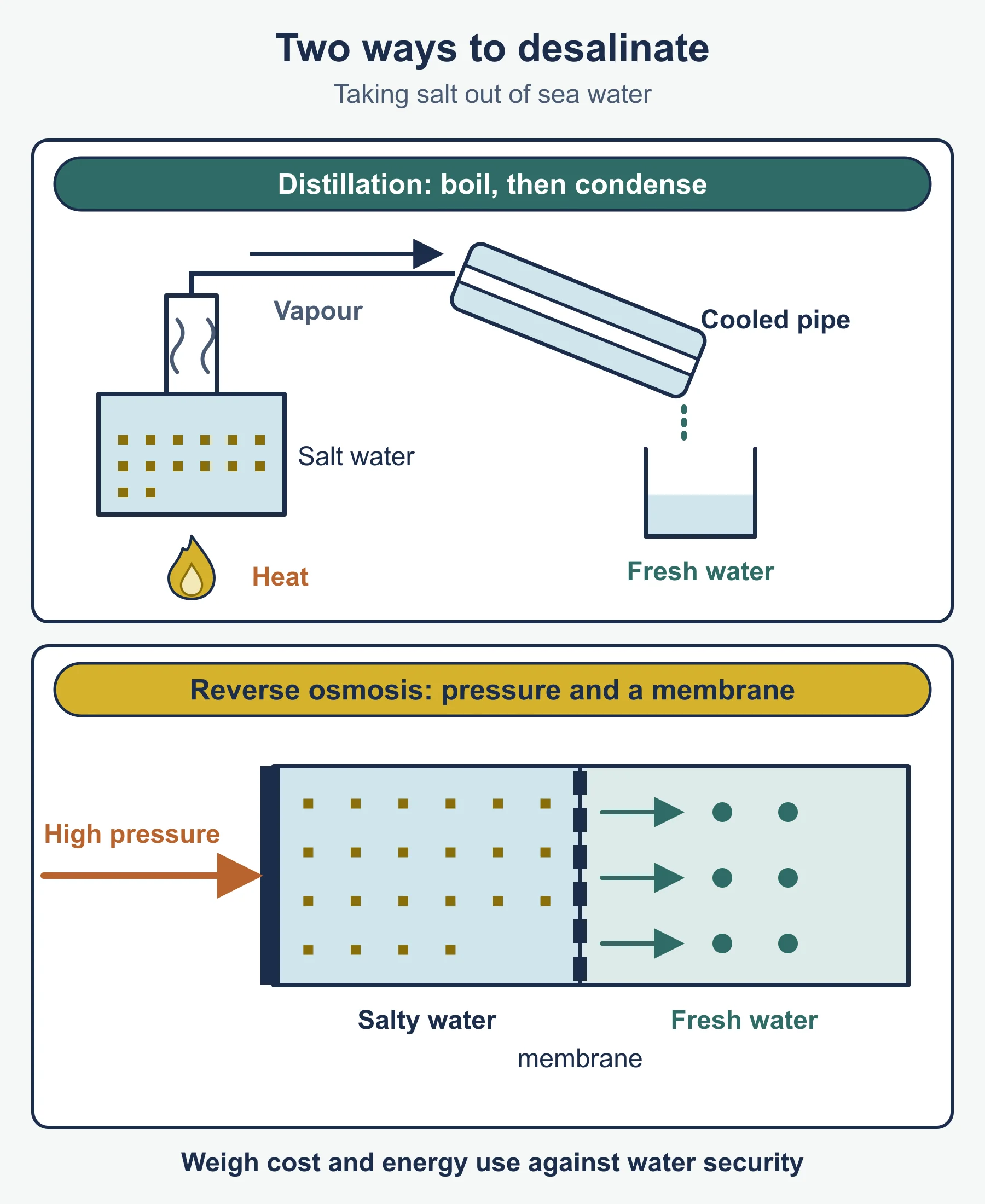
Desalination removes salt from seawater to make potable water. The syllabus describes two methods:
Distillation: water is heated until it boils; the salt remains in the liquid; the steam is pure water; the steam is cooled and condensed to form potable water.
Reverse osmosis: water is put under high pressure and passed through a membrane; the membrane allows water molecules to pass through but stops most ions and other molecules.
| Benefits | Limitations |
|---|---|
| Uses the ocean, an almost unlimited source | Uses large amounts of energy, often from fossil fuels, so it is expensive and adds carbon dioxide |
| Does not depend on rainfall, so it is reliable in droughts | Very salty waste water (brine) returned to the sea can harm marine life |
| Useful for dry coastal countries with few rivers | Only practical near the coast; piping inland adds cost |
| Reduces pressure on rivers and aquifers | High cost of building the plant; poorer countries may not afford it |
Multipurpose dams
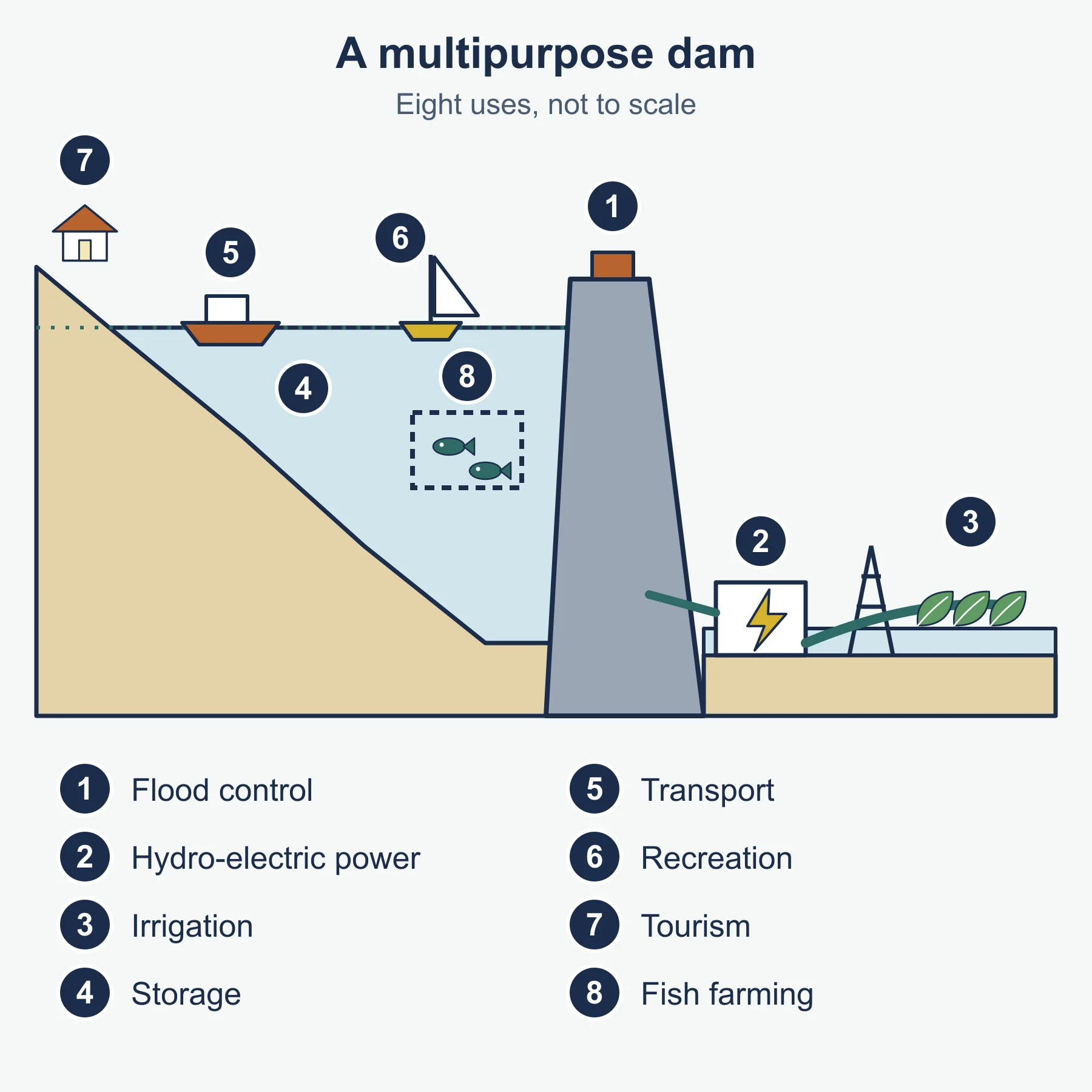
A multipurpose dam is built to serve several uses at once:
- Flood control: the reservoir holds back water during heavy rain and releases it slowly.
- Hydro-electric power: water released through turbines generates electricity (1.4).
- Irrigation: stored water is supplied to farms in dry seasons.
- Storage of water: a reliable supply for homes and industry.
- Transport: the reservoir and a more even river flow allow boats to travel.
- Recreation: sailing, fishing and other water sports.
- Tourism: visitors to the lake and the dam itself.
- Fish farming: fish can be reared in the reservoir.
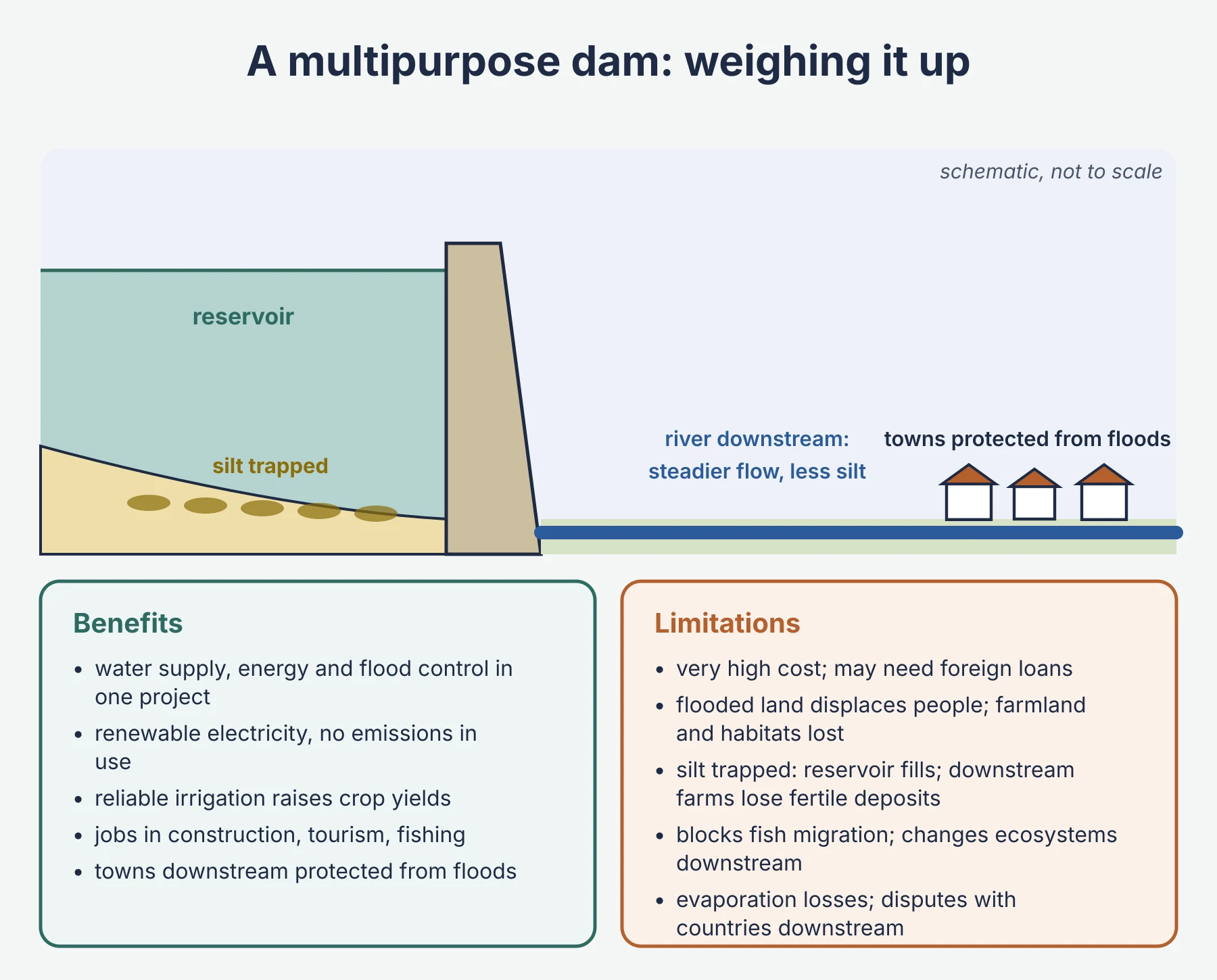
| Benefits | Limitations |
|---|---|
| Combines water supply, energy and flood control in one project | Very high building cost; may need foreign loans |
| Renewable electricity with no emissions in use | Land flooded by the reservoir displaces people and destroys farmland and habitats |
| Reliable irrigation increases crop yields | Silt is trapped behind the dam, so the reservoir fills up and farmland downstream loses natural fertile deposits |
| Jobs in construction, tourism and fishing | Blocks fish migration; changes river flow and ecosystems downstream |
| Protects towns downstream from floods | Water lost by evaporation from the reservoir surface; disputes with countries downstream |
Worked example: how long will a reservoir last?
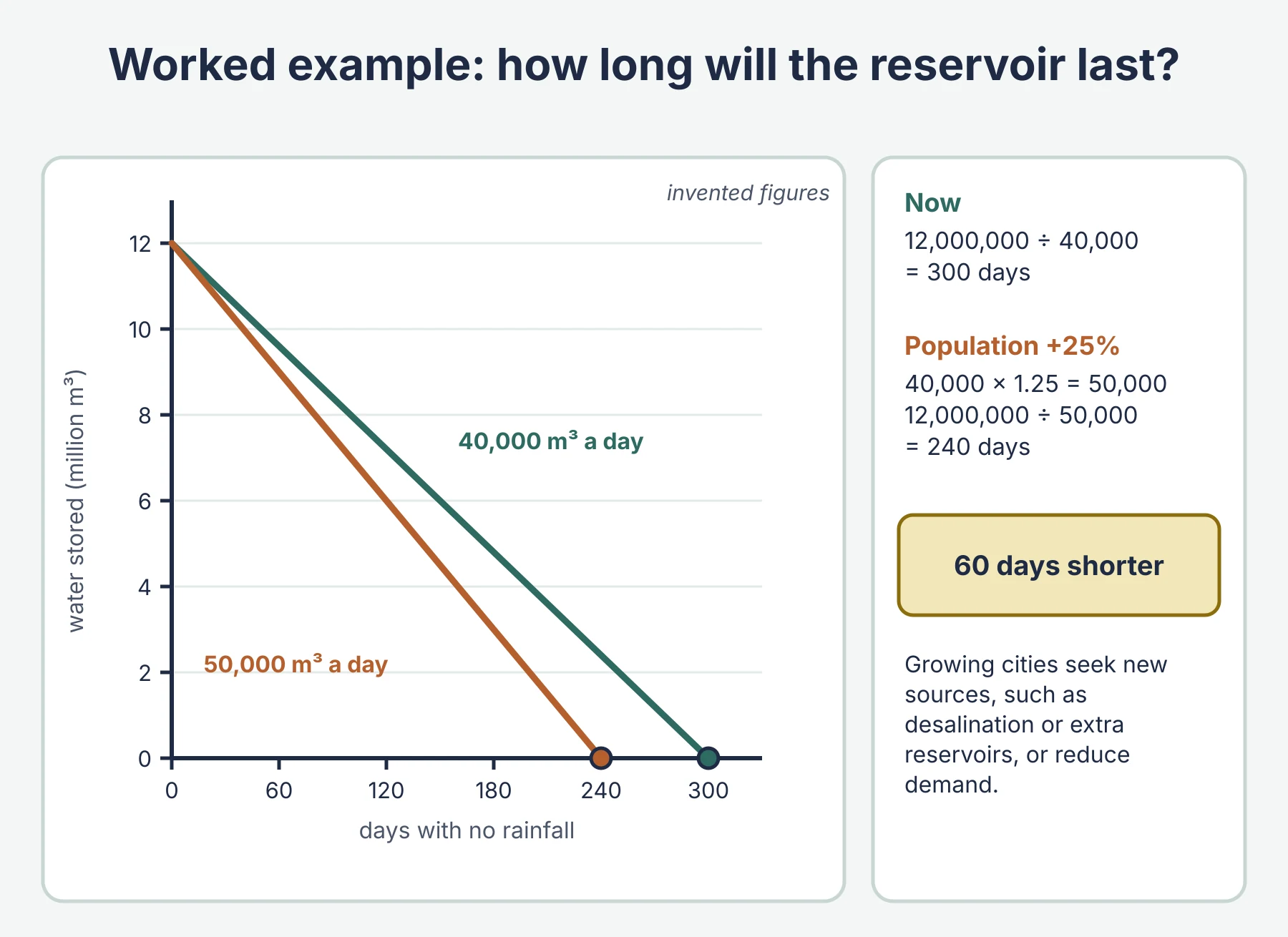
A reservoir holds 12 million m³ of water. A town uses 40,000 m³ a day. (Figures invented for practice.)
- With no rainfall, the reservoir would last 12,000,000 ÷ 40,000 = 300 days.
- If the town’s population grows by 25% and use per person stays the same, daily use becomes 40,000 × 1.25 = 50,000 m³, and the reservoir would last 12,000,000 ÷ 50,000 = 240 days.
Interpretation: population growth cuts the time the store can supply the town by 60 days, showing why growing cities seek new sources such as desalination or extra reservoirs, or reduce demand.
Common mistakes
- Confusing infiltration (into the soil surface) with through-flow (sideways through the soil).
- Calling ice sheets an accessible source of fresh water.
- Putting the treatment stages in the wrong order, or saying filtration kills bacteria.
- Describing reverse osmosis as “filtering out salt” without pressure and a membrane.
- Listing dam uses without limitations in a discuss question.
Exam technique
Describe and interpret the water cycle: name stores and transfers precisely. Compare availability: use “whereas” and give a reason for each difference. Discuss desalination or dams: benefits and limitations linked to the place in the source, then a judgement.
Revise with the Water sources and supply revision notes and practise with the Water sources and supply practice questions. For the whole of Topic 3, see the Water study guide.
Related resources
-
Revision notes
Cambridge IGCSE Environmental Management: Land — Revision Notes
Recall notes on soils and crop growth, food production and soil erosion for Topic 2 Land of Cambridge IGCSE Environmental Management 0680, 2027-2029 series.
Environmental Management · Cambridge · IGCSE
Revise topic -
Practice questions
Cambridge IGCSE Environmental Management (0680): Water sources and supply – Practice Questions
Original questions with answers on the water cycle, water treatment, access to potable water, reservoir data, desalination and dams for Cambridge IGCSE 0680.
Environmental Management · Cambridge · IGCSE
Try questions -
Revision notes
Cambridge IGCSE Environmental Management (0680): Water sources and supply – Revision Notes
Recall notes on water cycle stores and transfers, fresh water sources, water treatment, desalination and multipurpose dams for Cambridge IGCSE 0680.
Environmental Management · Cambridge · IGCSE
Revise topic
Get free revision emails (optional)
Occasional emails with practice questions, worked explanations and links to free resources for the qualification and subjects you choose. No spam, and you can unsubscribe from any email. The free tools on this site never need an email.