
Study Guides
Cambridge IGCSE Environmental Management (0680): Water-related diseases
How mosquitoes spread malaria, how cholera spreads, and the benefits and limitations of each control strategy for Cambridge IGCSE Environmental Management 0680.
- Subject
- Environmental Management
- Level
- IGCSE
- Topic
- Topic 3 – Water
- Author
- Marlbridge Academic Team
- Updated
- Reviewed by
- Azam Siddique (what this means)
Aligned to Cambridge IGCSE Environmental Management (0680), 2027-2029. Official specification .
Syllabus page (what it covers and how it is assessed): Cambridge IGCSE Environmental Management.
Syllabus points this page covers
0680
- 3.3 Water-related diseases
Found an error? Report a correction.
Need help with this topic? Request a free trial class for IGCSE Environmental Management (0680).
Sub-topic 3.3 of Cambridge IGCSE Environmental Management (0680) covers two diseases linked to water in very different ways. Malaria is spread by a mosquito that breeds in still water; cholera is spread by bacteria in water contaminated with faeces. The syllabus asks you to describe how mosquitoes spread malaria, describe the named strategies to control malaria and cholera, and discuss their benefits and limitations. The Water study guide sets this in the context of the whole topic.
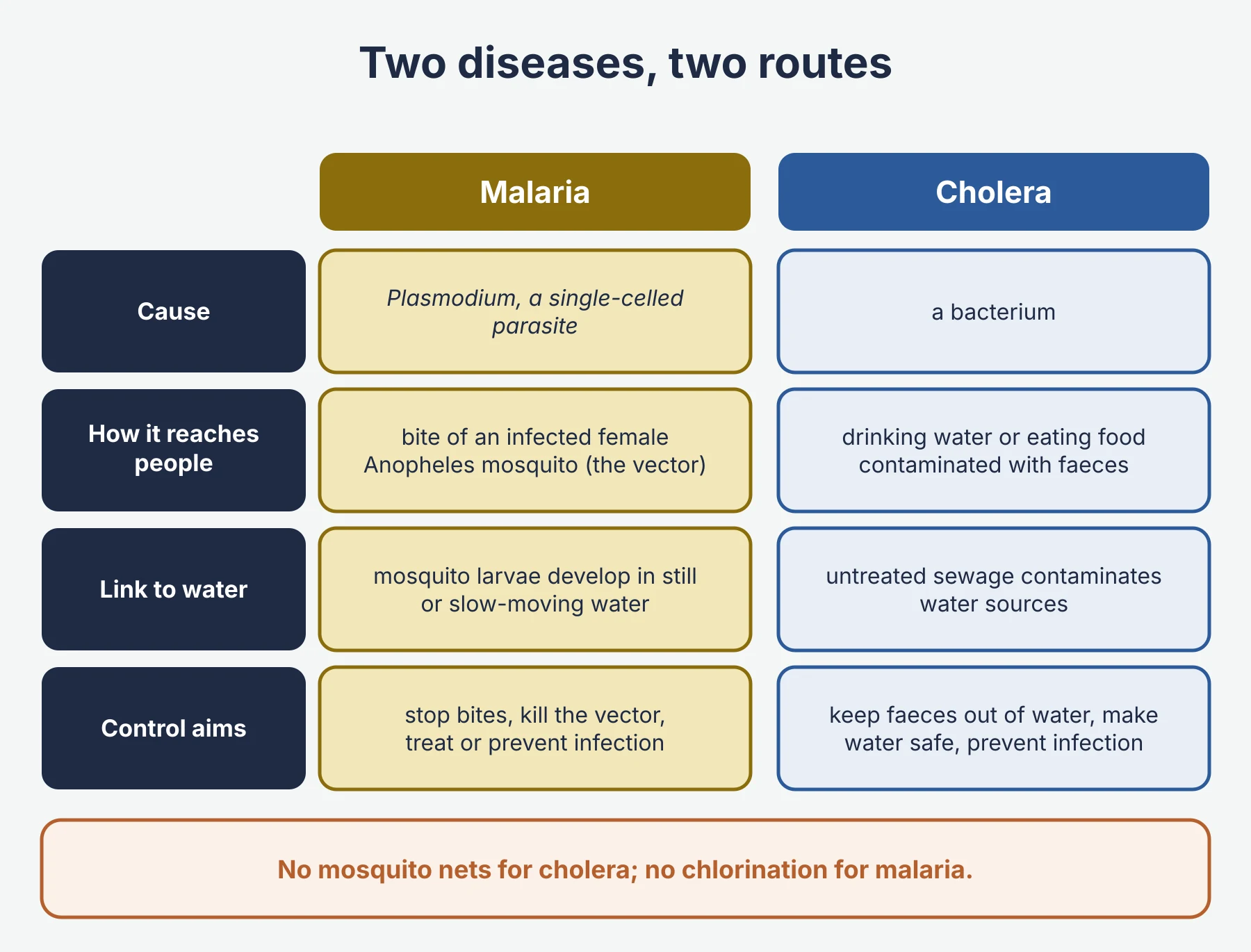
Two diseases, two routes
| Malaria | Cholera | |
|---|---|---|
| Cause | Plasmodium, a single-celled parasite | A bacterium |
| How it reaches people | Bite of an infected female Anopheles mosquito (the vector) | Drinking water or eating food contaminated with faeces |
| Link to water | Mosquito larvae develop in still or slow-moving water | Untreated sewage contaminates water sources |
| Control aims | Stop bites, kill the vector, treat or prevent infection | Keep faeces out of water, make water safe, prevent infection |
Keeping this table in your head prevents the most common error in this sub-topic: suggesting mosquito nets for cholera or chlorination for malaria.
How mosquitoes spread malaria (3.3.1)
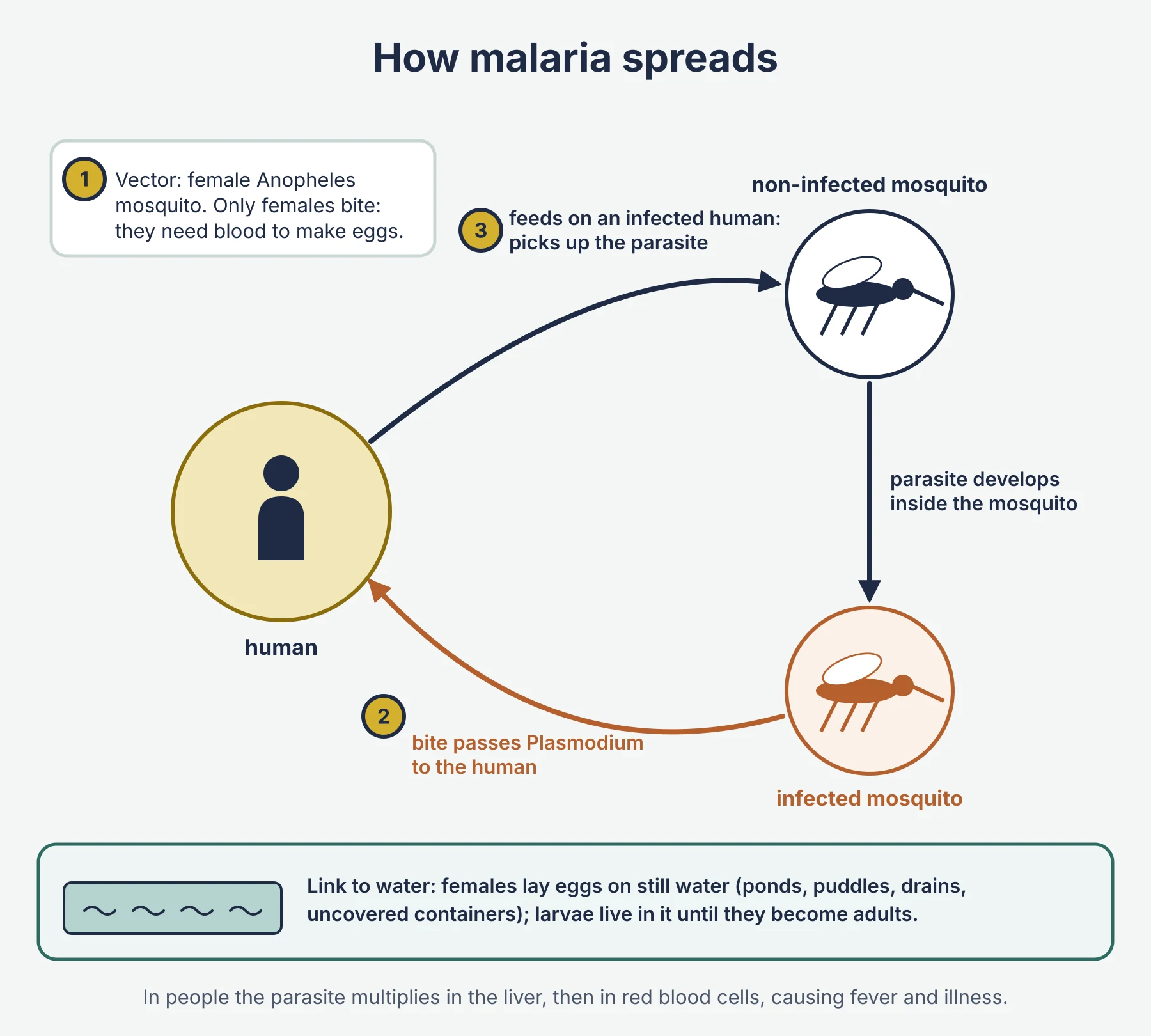
The syllabus breaks the transmission cycle into three points, and you should be able to write each one in order.
- The vector is the female Anopheles mosquito. A vector is an organism that carries a disease-causing organism from one host to another. Only females bite, because they need a blood meal to produce eggs.
- An infected mosquito passes the Plasmodium parasite to a human when it bites. The parasite enters the blood, multiplies in the liver and then in red blood cells, causing fever and illness.
- A non-infected mosquito picks up the parasite when it feeds on the blood of an infected human. The parasite develops inside the mosquito, which can then infect the next person it bites.
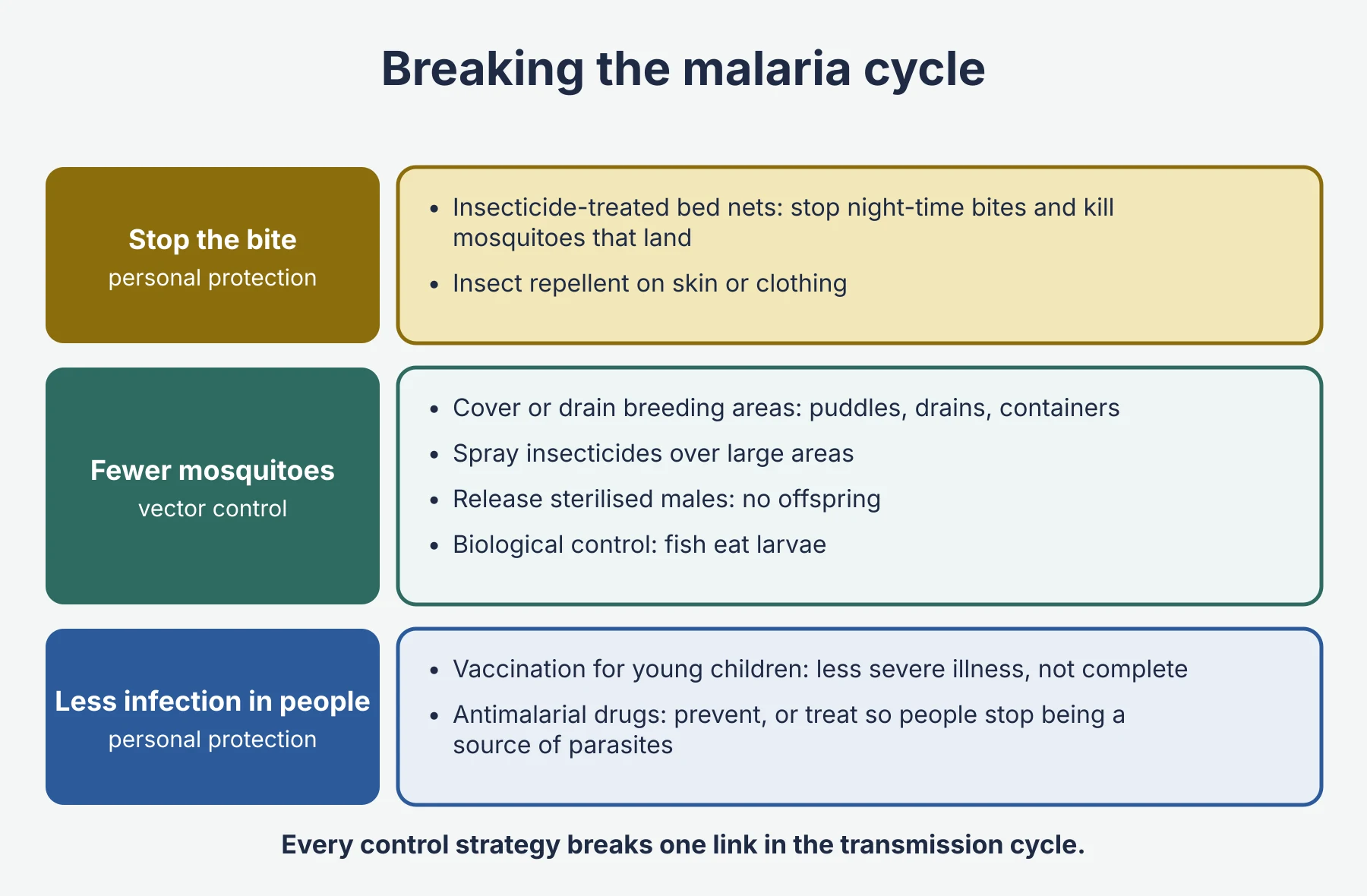
The cycle needs all three: people, mosquitoes and the parasite. Every control strategy breaks one link. Personal protection stops the bite; vector control reduces the number of mosquitoes; drugs and vaccination reduce infection in people, so fewer mosquitoes pick up the parasite.
Water matters because female mosquitoes lay eggs on the surface of still water, such as ponds, puddles, irrigation channels, blocked drains and water containers left uncovered. The larvae live in the water until they become adults.
Strategies to control malaria (3.3.2)
Personal protection
- Nets: sleeping under a bed net, especially one treated with insecticide, stops mosquitoes biting at night, when Anopheles mostly feed. Treated nets also kill mosquitoes that land on them.
- Insect repellent: applied to skin or clothing, it deters mosquitoes from biting.
- Vaccination: malaria vaccines are now given to young children in some countries where malaria is common. They reduce the chance of severe illness but do not give complete protection.
- Antimalarial drugs: taken to prevent infection, for example by travellers, or to treat infected people so they recover and stop being a source of parasites for mosquitoes.
Vector control
- Cover or drain breeding areas: draining standing water, filling puddles, clearing blocked drains and covering water containers leave mosquitoes nowhere to lay eggs.
- Spraying large areas with insecticides: kills adult mosquitoes or larvae, for example spraying inside houses or over breeding grounds.
- Sterilising male mosquitoes: large numbers of sterilised males are released. Females that mate with them produce no offspring, so the population falls over several generations.
- Biological control: a natural predator or disease of the mosquito is introduced, such as fish that eat mosquito larvae in ponds and water tanks.
Strategies to control cholera (3.3.3)
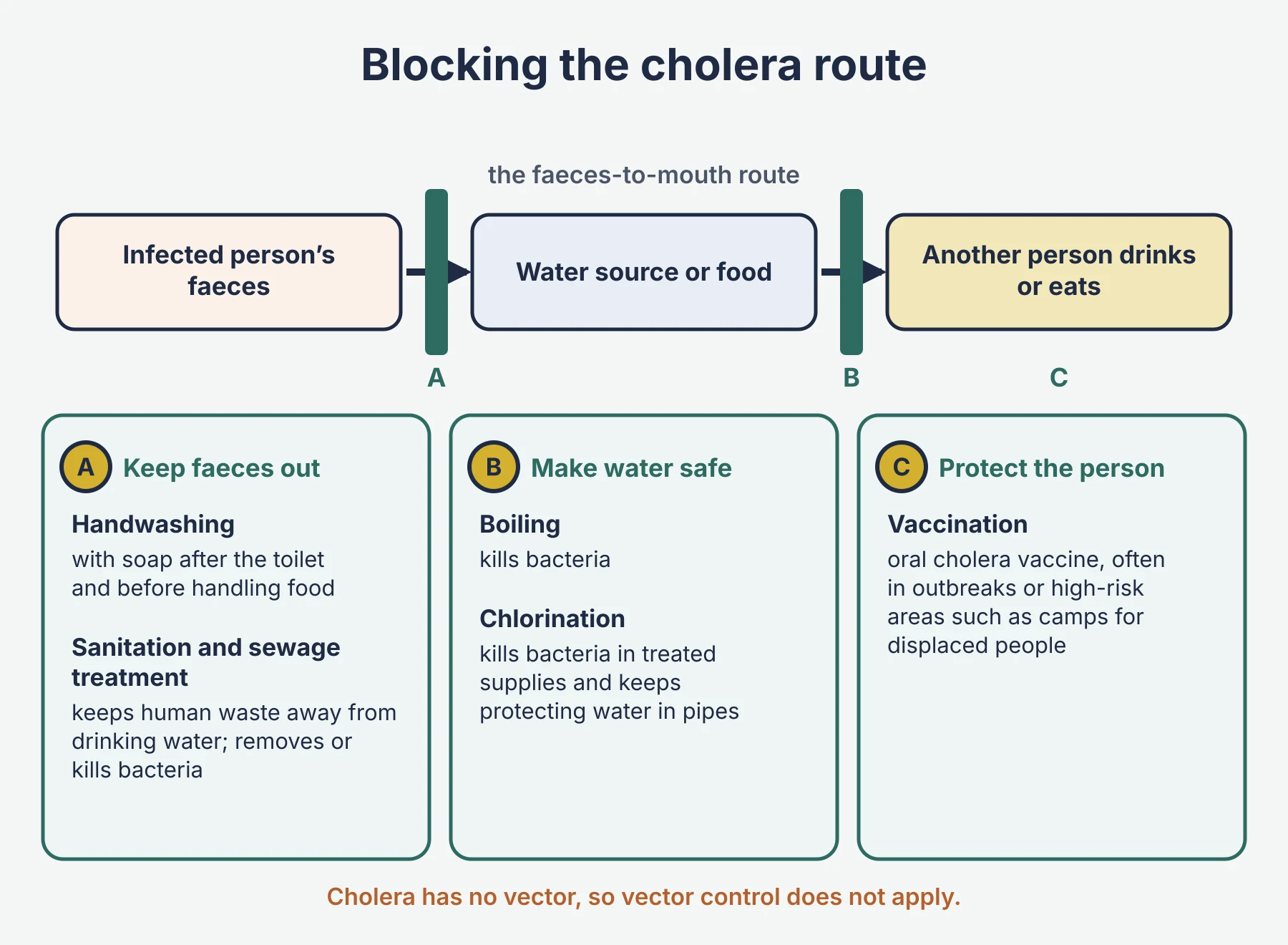
- Handwashing with soap after using the toilet and before handling food removes bacteria from hands, breaking the faeces-to-mouth route.
- Adequate sanitation and sewage treatment keeps human waste away from drinking water and removes or kills bacteria before wastewater reaches rivers.
- Potable water supply means water that is safe to drink. Boiling kills bacteria; chlorination adds chlorine, which kills bacteria in treated supplies and continues to protect water in pipes.
- Vaccination with oral cholera vaccine gives protection, often used during outbreaks or in high-risk areas such as camps for displaced people.
Benefits and limitations (3.3.4)
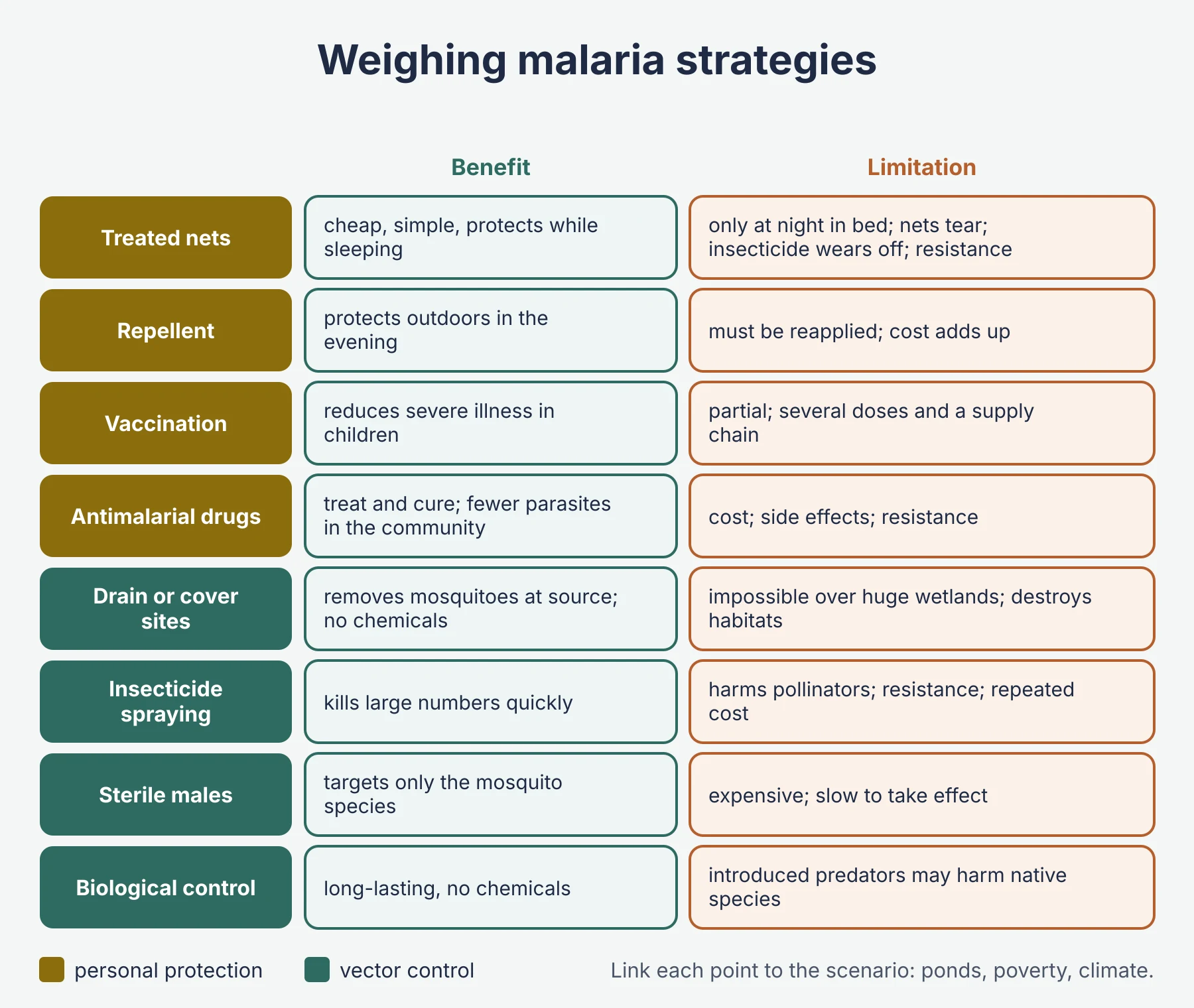
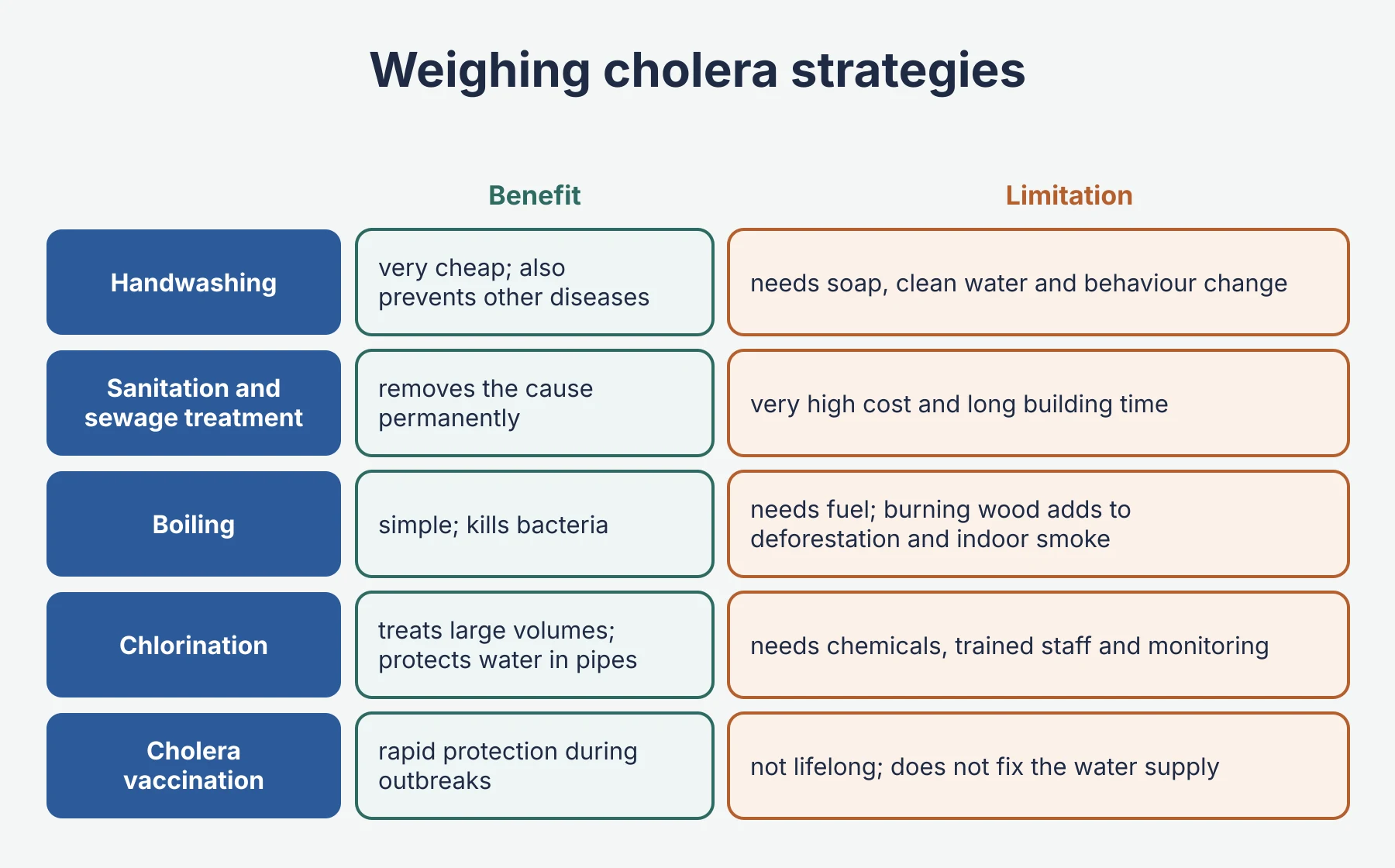
This is where the highest marks sit. A good answer gives a benefit and a limitation for each strategy, linked to the situation described in the question.
| Strategy | Benefit | Limitation |
|---|---|---|
| Insecticide-treated nets | Cheap, simple, protects while sleeping | Only protects at night in bed; nets tear; insecticide wears off; mosquitoes can become resistant |
| Repellent | Protects outdoors in the evening | Must be reapplied; cost adds up for poor families |
| Malaria vaccination | Reduces severe illness in children | Partial protection; needs several doses and a supply chain |
| Antimalarial drugs | Treat and cure; reduce parasites in the community | Cost; side effects; parasites can become resistant |
| Draining or covering breeding sites | Removes mosquitoes at source; no chemicals | Impossible across huge wetland or rainy-season areas; draining wetlands destroys habitats |
| Insecticide spraying | Kills large numbers quickly | Harms non-target species such as pollinators; resistance; repeated cost |
| Sterile males | Targets only the mosquito species | Expensive to rear and release; slow to take effect |
| Biological control | Long-lasting, no chemicals | Introduced predators may harm native species |
| Handwashing | Very cheap; also prevents other diseases | Needs soap, clean water and behaviour change |
| Sanitation and sewage treatment | Removes the cause permanently | Very high cost and long building time |
| Boiling | Simple, kills bacteria | Needs fuel; burning wood adds to deforestation and indoor smoke |
| Chlorination | Treats large volumes; protects water in pipes | Needs chemicals, trained staff and monitoring |
| Cholera vaccination | Rapid protection during outbreaks | Protection is not lifelong; does not fix the water supply |
Worked example: an annotated “discuss” answer
Question: a rural region with many ponds and no piped water has high rates of malaria. Discuss the benefits and limitations of using insecticide-treated bed nets and draining breeding areas to control malaria. [6]
Model answer:
Bed nets are cheap and easy to distribute, and protect people while they sleep, which is when Anopheles mosquitoes usually bite (benefit). Treated nets also kill mosquitoes that land on them (benefit). However, they only work if used every night and kept in good repair, and mosquitoes can become resistant to the insecticide (limitation).
Draining ponds removes the still water where females lay eggs, so fewer larvae survive to become adults (benefit). But this region has many ponds, so draining all of them would be expensive and slow, and the ponds may be needed for water or support wildlife (limitation).
Overall, nets give faster protection for individuals, while draining reduces the mosquito population for everyone; using both is more effective than either alone (judgement).
Why it scores: there are benefits and limitations for both strategies, each linked to the scenario (ponds, no piped water), and a final judgement. Writing “nets are good but expensive” earns little: nets are among the cheaper options, and the point is not explained.
Common mistakes
- Calling the mosquito the cause of malaria. The cause is the Plasmodium parasite; the mosquito is the vector.
- Saying any mosquito spreads malaria. Name the female Anopheles mosquito.
- Describing the cycle in one direction only. The syllabus includes both human-to-mosquito and mosquito-to-human transmission.
- Giving vector control for cholera. Cholera has no vector; it spreads in contaminated water and food.
- Listing a strategy without saying which link in the transmission chain it breaks.
Exam technique
For describe questions on transmission, number the steps and use the syllabus terms vector, parasite and infected. For describe strategies, name the strategy, then add how it works. For discuss the benefits and limitations, organise by strategy, give both sides for each, tie points to the scenario’s details such as poverty, climate, wetlands or lack of piped water, and finish with a judgement. In Paper 2, scenario data such as cases per month may come with the question: refer to it.
Revise the key facts in the water-related diseases revision notes and test yourself with the water-related diseases practice questions. Cholera’s link to sewage is developed further in the water pollution study guide.
Related resources
-
Revision notes
Cambridge IGCSE Environmental Management: Land — Revision Notes
Recall notes on soils and crop growth, food production and soil erosion for Topic 2 Land of Cambridge IGCSE Environmental Management 0680, 2027-2029 series.
Environmental Management · Cambridge · IGCSE
Revise topic -
Practice questions
Cambridge IGCSE Environmental Management (0680): Water-related diseases – Practice Questions
Original practice questions with full answers on malaria transmission and the control of malaria and cholera for Cambridge IGCSE Environmental Management 0680.
Environmental Management · Cambridge · IGCSE
Try questions -
Revision notes
Cambridge IGCSE Environmental Management (0680): Water-related diseases – Revision Notes
Recall notes on malaria transmission, malaria and cholera control strategies, key terms and a self-test for Cambridge IGCSE Environmental Management 0680.
Environmental Management · Cambridge · IGCSE
Revise topic
Get free revision emails (optional)
Occasional emails with practice questions, worked explanations and links to free resources for the qualification and subjects you choose. No spam, and you can unsubscribe from any email. The free tools on this site never need an email.