
Study Guides
Cambridge IGCSE Islamiyat (0493): Major Themes of the Qur'an
How to read the fifteen set Qur'an passages for 0493 Paper 1 Question 1: finding the theme, using key Arabic words and linking each one to Muslim life.
- Subject
- Islamiyat
- Level
- IGCSE
- Topic
- Paper 1
- Author
- Marlbridge Academic Team
- Updated
- Reviewed by
- Azam Siddique (what this means)
Aligned to Cambridge IGCSE Islamiyat (0493), 2026-2027. Official specification .
Syllabus page (what it covers and how it is assessed): Cambridge IGCSE Islamiyat.
Syllabus points this page covers
0493
- 1.1 Major Themes of the Qur’an
Found an error? Report a correction.
Need help with this topic? Request a free trial class for IGCSE Islamiyat (0493).
Major Themes of the Qur’an is Paper 1 Topic 1 of Cambridge IGCSE Islamiyat 0493, and it is always
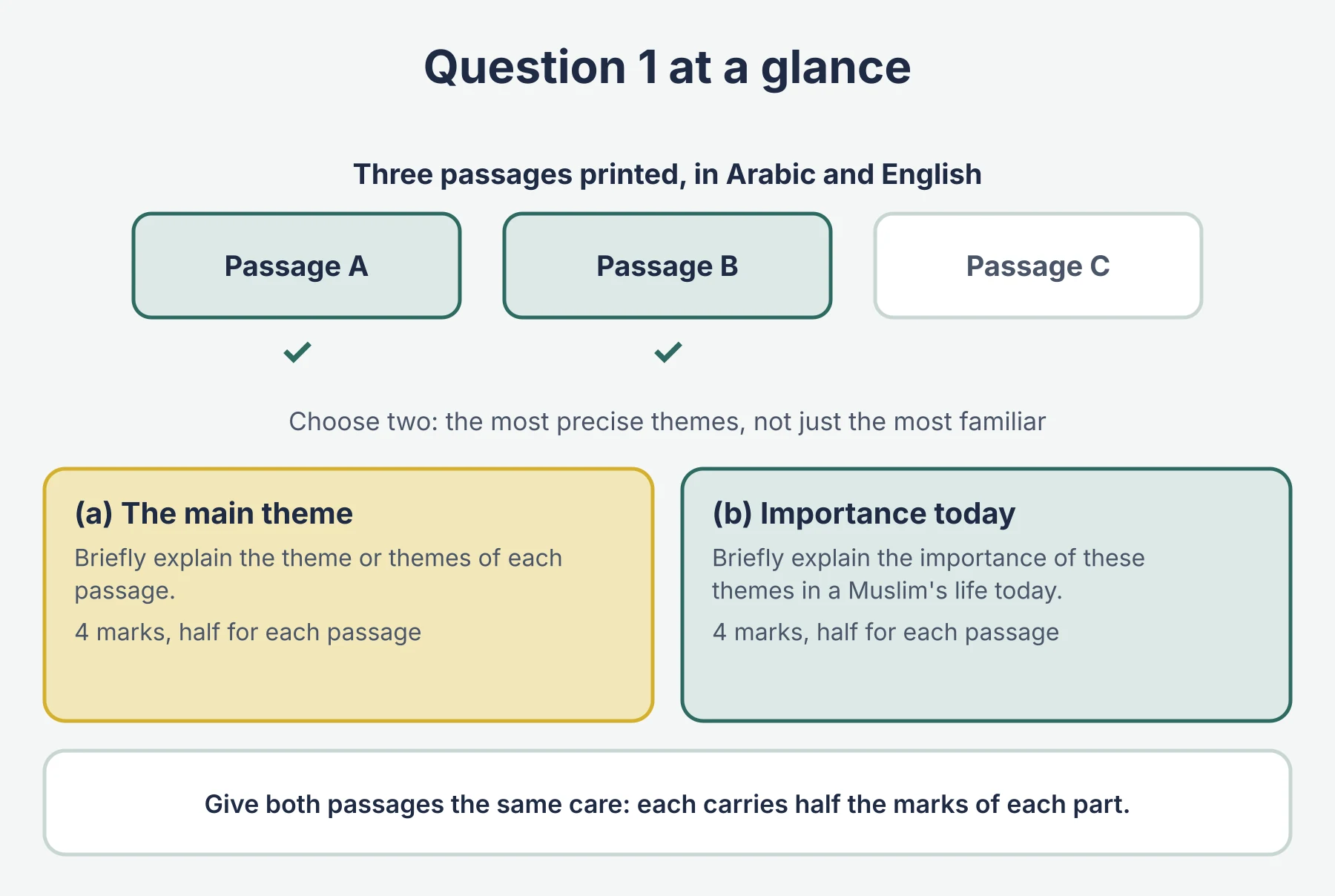
Question 1. The syllabus sets fifteen passages in three groups. In the exam three of them are
printed in Arabic and English, you choose two, and you write (a) the main theme or themes of each and
(b) the importance of those themes in the lives of Muslims today. This guide explains how to read a
passage for its theme, which Arabic words to know, how the passages connect with each other, and how
to write an application that fits the passage rather than a general one.
Syllabus coverage
0493 Paper 1, Topic 1 (2026–2027 syllabus)
- Three groups of passages for close study: God in Himself; God’s relationship with the created world; God’s Messengers
- The major theme or themes that appear in each passage
- The importance of these themes in the lives of Muslims today
- Study in a recognised English translation, with reference to the original Arabic; knowledge of the original as well as the translation
- Exam: three passages set from Appendix 1, of which you choose two (8 marks)
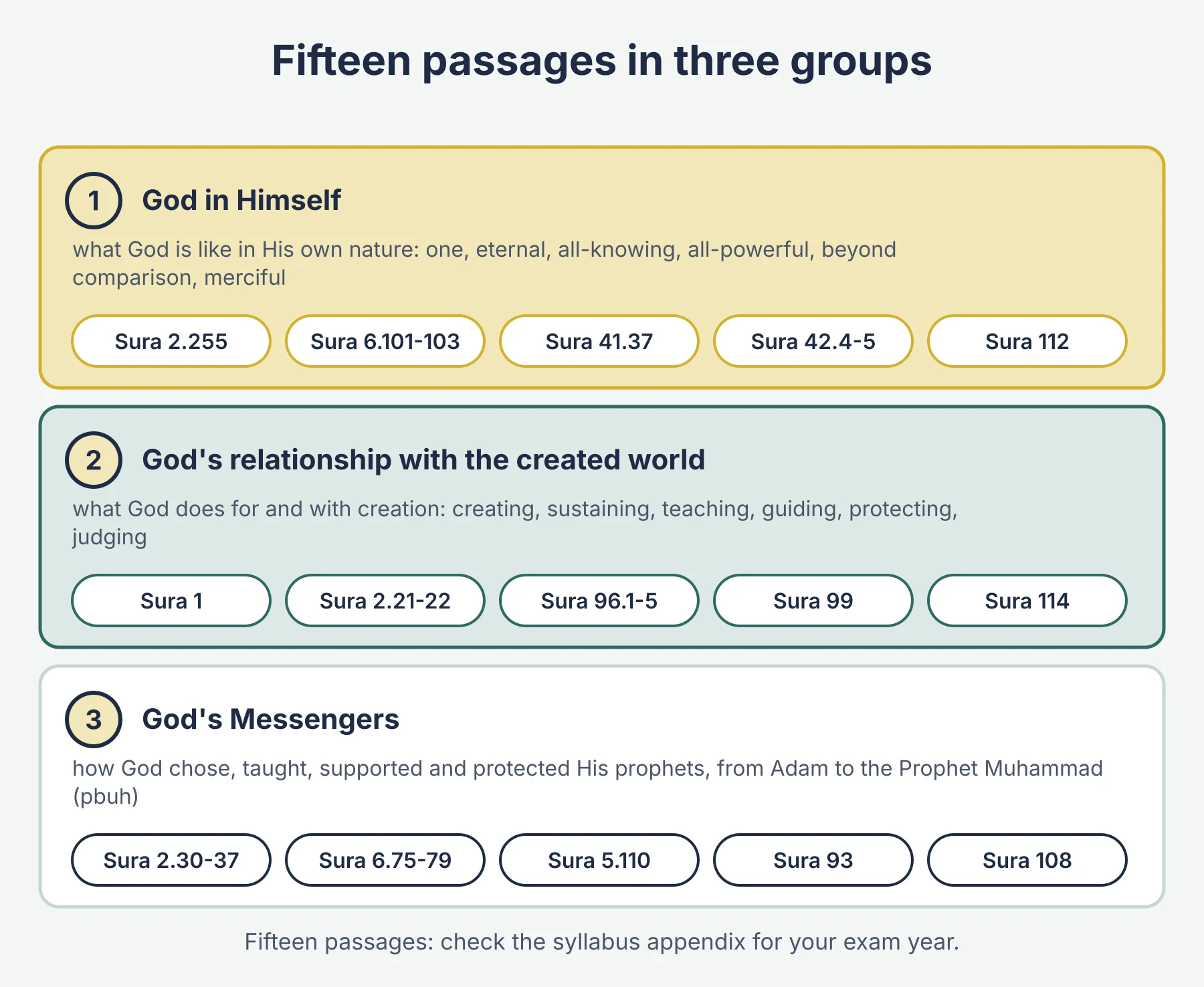
The fifteen passages are listed in the syllabus appendix, which Cambridge reviews from time to time, so always check the appendix for your exam year.
What does “theme” mean in Question 1?
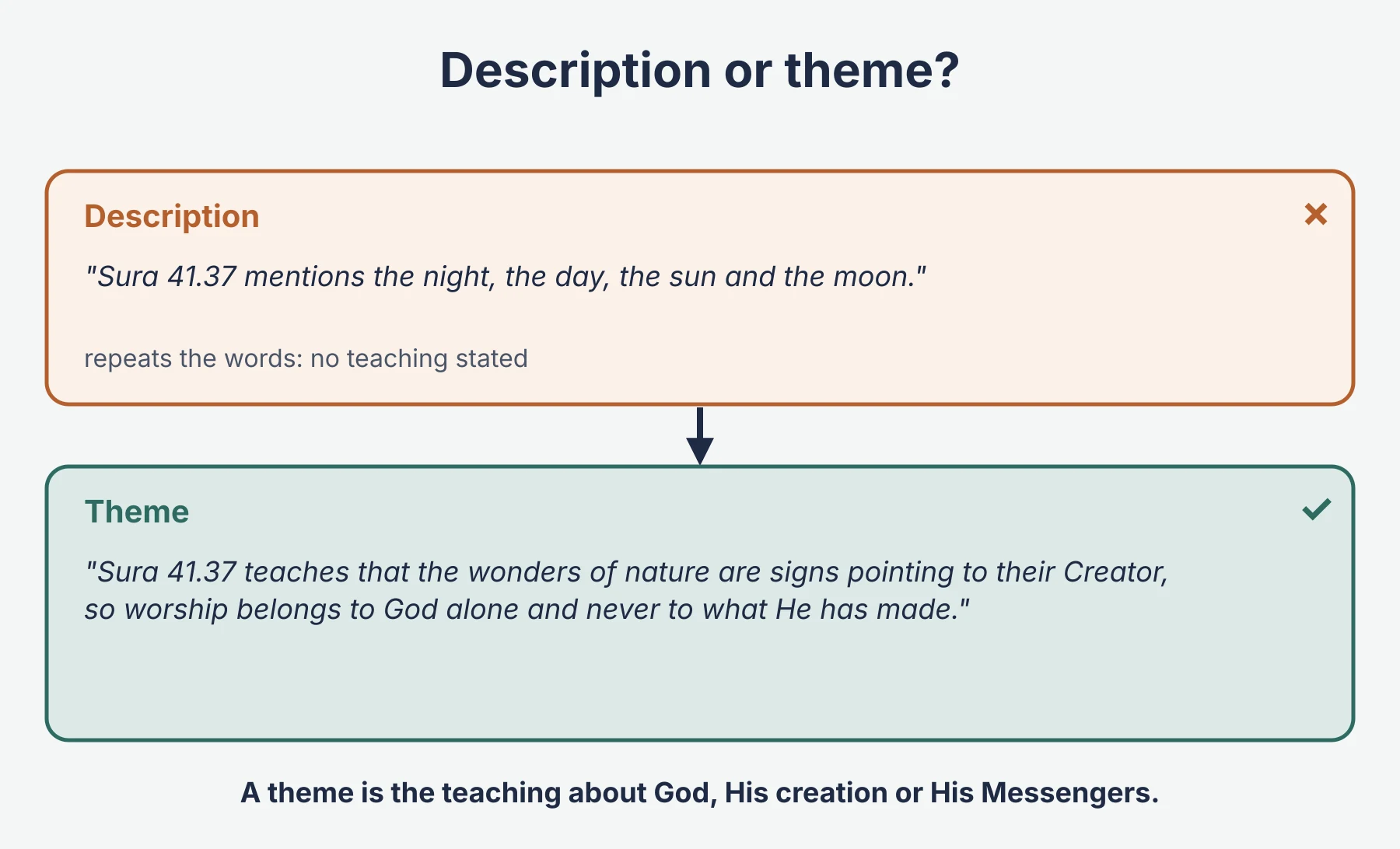
A theme is the teaching the passage gives about God, His creation or His Messengers, not a summary of its words. “Sura 41.37 mentions the night, the day, the sun and the moon” is a description. “Sura 41.37 teaches that the wonders of nature are signs pointing to their Creator, so worship belongs to God alone and never to what He has made” is a theme. Each group heading tells you the direction the theme will take:
- God in Himself (Sura 2.255, 6.101–103, 41.37, 42.4–5, 112): what God is like in His own nature: one, eternal, all-knowing, all-powerful, beyond comparison and merciful.
- God’s relationship with the created world (Sura 1, 2.21–22, 96.1–5, 99, 114): what God does for and with His creation: creating, sustaining, teaching, guiding, protecting and judging.
- God’s Messengers (Sura 2.30–37, 6.75–79, 5.110, 93, 108): how God chose, taught, supported and protected His prophets, from Adam to the Prophet Muhammad (pbuh).
Which Arabic words should you know?
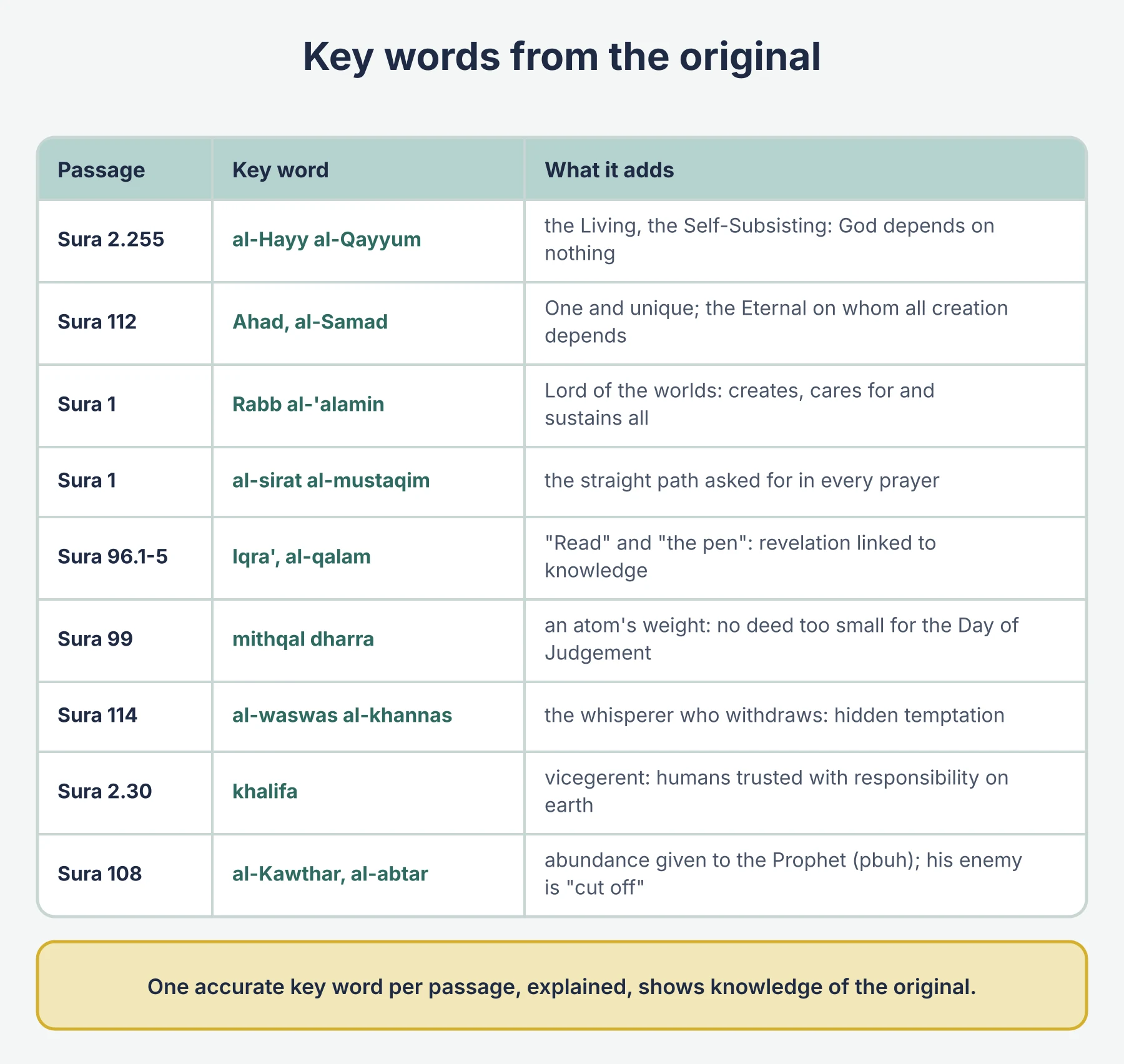
The syllabus asks you to show knowledge of the original as well as the translation. You do not need to quote whole verses, but one accurate key word per passage, explained, shows the examiner that you have studied the Arabic.
| Passage | Key word or phrase | What it adds to your answer |
|---|---|---|
| Sura 2.255 | al-Hayy al-Qayyum | The Living, the Self-Subsisting: God depends on nothing and everything depends on Him |
| Sura 112 | Ahad, al-Samad | One and unique; the Eternal on whom all creation depends |
| Sura 1 | Rabb al-’alamin | Lord of the worlds: the One who creates, cares for and sustains all |
| Sura 1 | al-sirat al-mustaqim | The straight path: the guidance Muslims ask for in every prayer |
| Sura 96.1–5 | Iqra’, al-qalam | “Read” and “the pen”: revelation begins with a command linked to knowledge |
| Sura 99 | mithqal dharra | An atom’s weight: no deed is too small to be shown on the Day of Judgement |
| Sura 114 | al-waswas al-khannas | The whisperer who withdraws: the hidden source of temptation |
| Sura 2.30 | khalifa | Vicegerent: humans are trusted with responsibility on earth |
| Sura 108 | al-Kawthar, al-abtar | Abundance given to the Prophet (pbuh); his enemy, not he, is “cut off” |
How do the passages connect with one another?
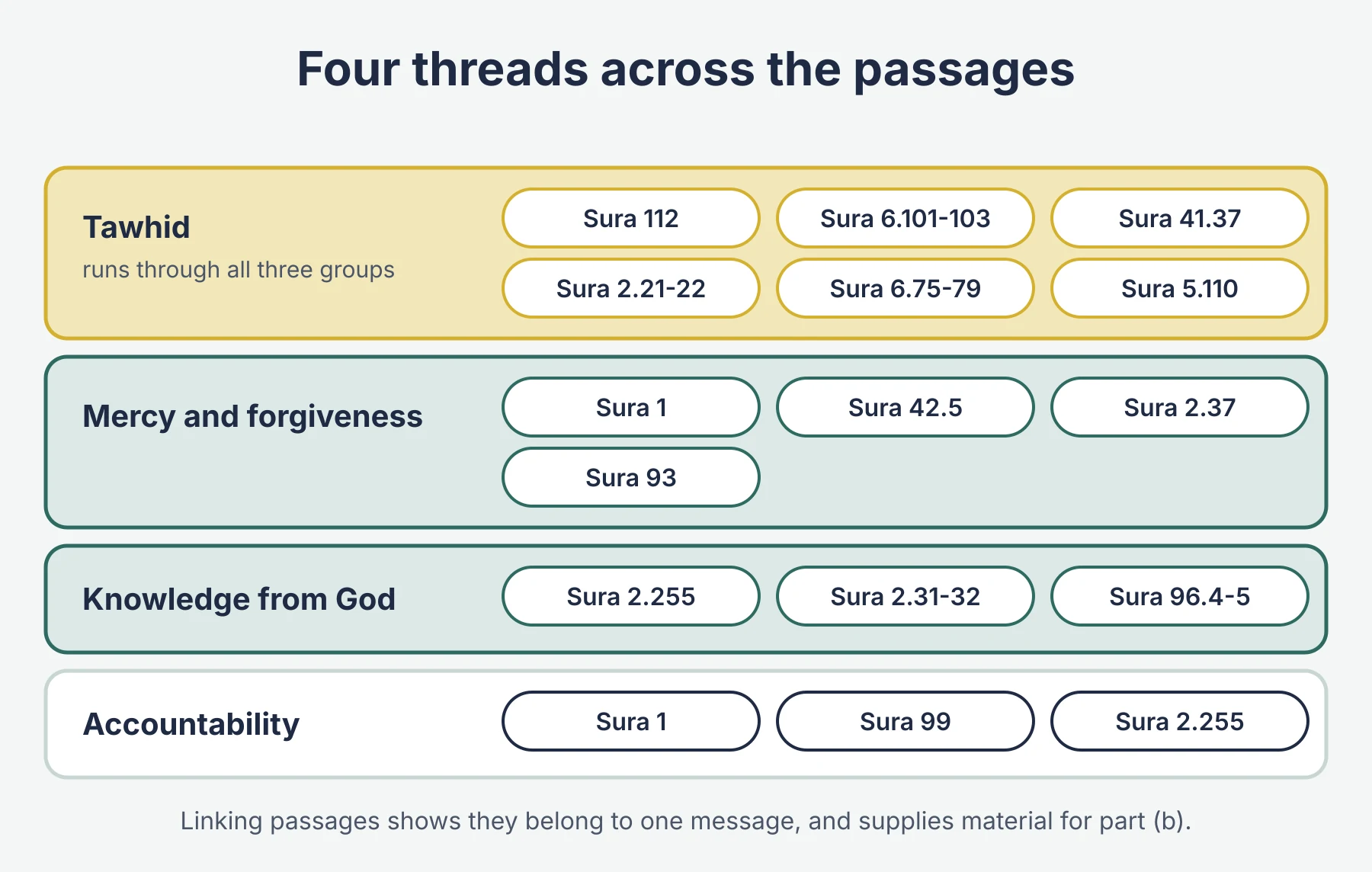
Examiners reward answers that show the passages belong to one message. Several ideas appear in more than one group, and noticing them gives you material for part (b).
Tawhid runs through all three groups. Sura 112 states it directly. Sura 6.101–103 argues for it: God originated the heavens and the earth, so He has no need of a consort or son. Sura 41.37 applies it: do not bow to the sun and moon. Sura 2.21–22 ends “do not set up rivals to Allah”. In the Messengers group, Ibrahim reaches it by reflection in Sura 6.75–79, and Isa’s miracles in Sura 5.110 happen “by my leave”, so even a great prophet’s power is God’s, not his own.
God’s mercy and forgiveness. Sura 1 calls God “most gracious, most merciful” twice. Sura 42.5 shows the angels asking forgiveness for people on earth, and ends with God as “oft-forgiving, most merciful”. In Sura 2.37 Adam learns words of repentance and God “turned towards him”. Sura 93 reminds the Prophet (pbuh) how God cared for him as an orphan.
Knowledge belongs to God and is given by Him. In Sura 2.255 people grasp only as much of His knowledge “as He wills”. In Sura 2.31–32 God teaches Adam the names and the angels admit they know only what God has taught them. Sura 96.4–5 says He “taught by the pen” and “taught man what he did not know”.
Accountability. Sura 1 calls God “Master of the day of judgement” and Sura 99 describes that day. Sura 2.255 says no one intercedes “except as He permits”. Linking these passages helps you explain why belief changes behaviour.
How do you turn a theme into importance today?
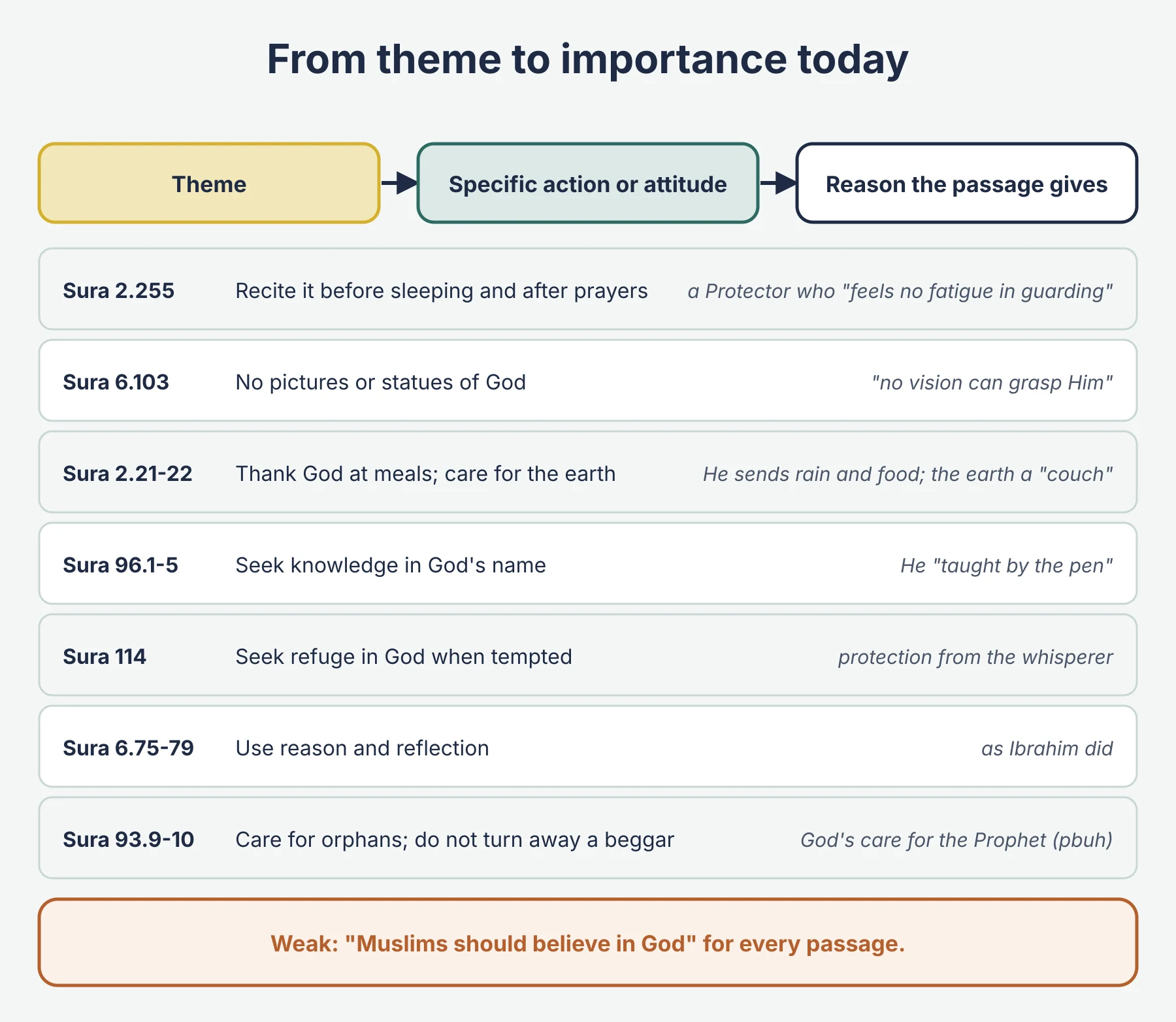
Part (b) asks how the theme matters in a Muslim’s life now. A good application has three parts: the theme, a specific action or attitude, and the reason the passage gives for it. Weak answers repeat “Muslims should believe in God” for every passage. Strong answers use what is distinctive:
- Sura 2.255: many Muslims recite it before sleeping and after prayers, trusting a Protector who “feels no fatigue in guarding” the heavens and earth.
- Sura 6.103: because “no vision can grasp Him”, Muslims do not make pictures or statues of God and avoid imagining Him in human form.
- Sura 2.21–22: gratitude for rain and food leads to thanking God before and after meals and to caring for the earth that He made a “couch” for people.
- Sura 96.1–5: seeking knowledge, including secular study, becomes an act of worship when begun in God’s name.
- Sura 114: when tempted, Muslims seek refuge in God, often by reciting this sura, rather than feeling helpless.
- Sura 6.75–79: Muslims are encouraged to use reason and reflection, as Ibrahim did, to strengthen faith rather than follow custom blindly.
- Sura 93.9–10: caring for orphans and not turning away a beggar is a direct command that follows from God’s care for the Prophet (pbuh).
Worked example
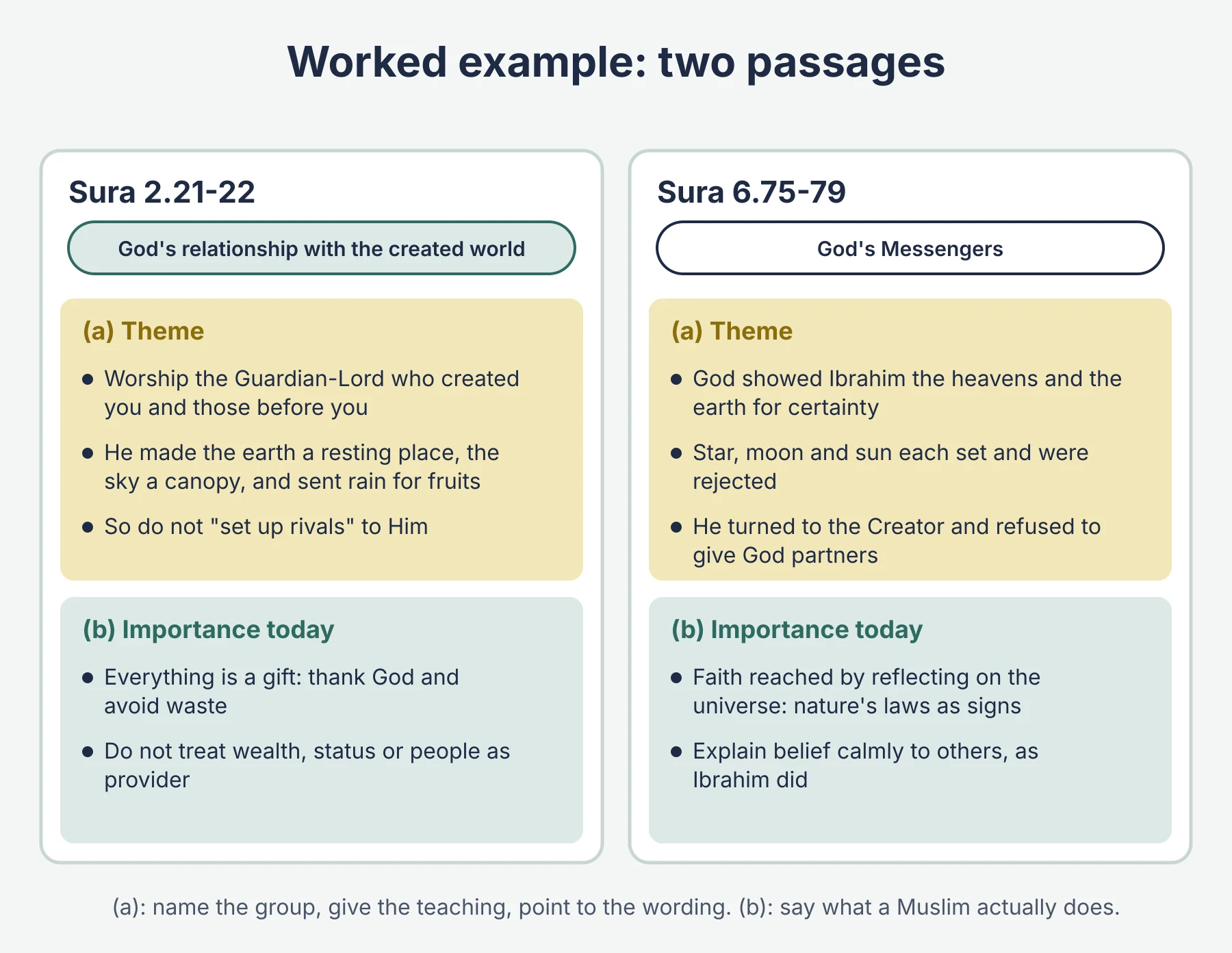
Question: Sura 2.21–22 and Sura 6.75–79. (a) Briefly explain the main theme in each passage. [4] (b) Briefly explain the importance of these themes in a Muslim’s life today. [4]
Model answer, (a): Sura 2.21–22 belongs to God’s relationship with the created world. It calls on all people to worship their Guardian-Lord because He created them and those before them, made the earth a resting place and the sky a canopy, and sent rain to bring out fruits as provision. Because He alone provides, people must not “set up rivals” to Him. Sura 6.75–79 is about God’s Messengers. God showed Ibrahim the “power and the laws of the heavens and the earth” so that he might have certainty. Ibrahim saw a star, the moon and the sun each rise and set and rejected each one, since a true Lord does not disappear. He turned to the One who created the heavens and the earth and declared he would never give God partners.
Model answer, (b): Sura 2.21–22 reminds Muslims that everything they eat and use is a gift, so they thank God and avoid waste; it also warns against treating wealth, status or other people as if they were provider instead of God. Sura 6.75–79 shows that faith can be reached by thinking about the universe. A Muslim student studying science can see the regular laws of nature as signs of the Creator, and Muslims can explain their belief calmly to others, as Ibrahim did with his people.
Why it works: each part of (a) names the group, gives the teaching and points to wording in the passage; each part of (b) is specific to that passage and says what a Muslim actually does.
Common mistakes
- Retelling instead of explaining. Paraphrasing every verse uses time but does not state the theme.
- Mixing up the groups. Sura 96.1–5 is about God as Creator and Teacher of humans, in the created-world group; do not answer it only as the story of the first revelation.
- Treating Sura 5.110 as only praise of Isa. Its theme is God’s favour to His Messenger: every miracle happens “by my leave”.
- Ignoring the Arabic. One accurate key word, explained, is easy credit you otherwise lose.
- Unequal answers. Each passage carries half the marks of each part, so give both the same care.
Exam technique
Question 1 has two parts worth 4 marks each, and the two passages you choose are marked together. The command words are “briefly explain”, so write a short, focused paragraph per passage for each part, about the length of the model answer above. Read all three passages first and choose the two whose themes you can explain most precisely, not just the two you find most familiar. Start each part (a) paragraph with the theme in one sentence, then support it with two or three phrases from the printed translation. Start each part (b) paragraph with an action and give the reason from the passage.
Frequently asked questions
Do I have to learn all fifteen passages? Yes. Any three may be printed and you must answer on two, so a gap in your learning removes choice.
Can a passage have more than one theme? Yes. Sura 1, for example, includes praise, mercy, judgement and the request for guidance. Name the main one first, then mention others if they are clearly in the wording.
Do I need to write in Arabic? No. Answers are in English, but referring to key Arabic words in transliteration shows knowledge of the original, which the syllabus asks for.
Related pages
- Major Themes of the Qur’an practice questions
- Major Themes of the Qur’an revision notes
- History and Importance of the Qur’an study guide
- Paper 1 study guide
Source: Cambridge International, Cambridge IGCSE Islamiyat 0493 syllabus for examination in 2026 and 2027, Paper 1 Topic 1 and Appendix 1.
Related resources
-
Practice questions
Cambridge IGCSE Islamiyat (0493): Major Themes of the Qur'an — Practice Questions
Twelve original questions on the set Qur'an passages for Cambridge IGCSE Islamiyat 0493 Paper 1 Question 1, with themes, applications and full mark guidance.
Islamiyat · Cambridge · IGCSE
Try questions -
Revision notes
Cambridge IGCSE Islamiyat: Major Themes of the Qur'an — Revision Notes (0493)
Passage-by-passage recall notes on the 15 set Qur'an passages for Cambridge IGCSE Islamiyat 0493 Paper 1 Question 1: theme, key ideas and importance to Muslims.
Islamiyat · Cambridge · IGCSE
Revise topic -
Study guides
IGCSE Islamiyat: Paper 1 (Cambridge 0493)
Paper 1 of Cambridge IGCSE Islamiyat 0493 (2026-2027): themes of the Qur'an, its history and importance, the life of the Prophet (pbuh) and the first community.
Islamiyat · Cambridge · IGCSE
Read guide
Get free revision emails (optional)
Occasional emails with practice questions, worked explanations and links to free resources for the qualification and subjects you choose. No spam, and you can unsubscribe from any email. The free tools on this site never need an email.