
Study Guides
Cambridge IGCSE Islamiyat (0493): The History and Importance of the Qur'an
Study guide to the revelation of the Qur'an (610–632), its compilation under Abu Bakr and Uthman, its use in law and its importance, for IGCSE Islamiyat 0493.
- Subject
- Islamiyat
- Level
- IGCSE
- Topic
- Paper 1
- Author
- Marlbridge Academic Team
- Updated
- Reviewed by
- Azam Siddique (what this means)
Aligned to Cambridge IGCSE Islamiyat (0493), 2026-2027. Official specification .
Syllabus page (what it covers and how it is assessed): Cambridge IGCSE Islamiyat.
Syllabus points this page covers
0493
- 1.2 The History and Importance of the Qur’an
Found an error? Report a correction.
Need help with this topic? Request a free trial class for IGCSE Islamiyat (0493).
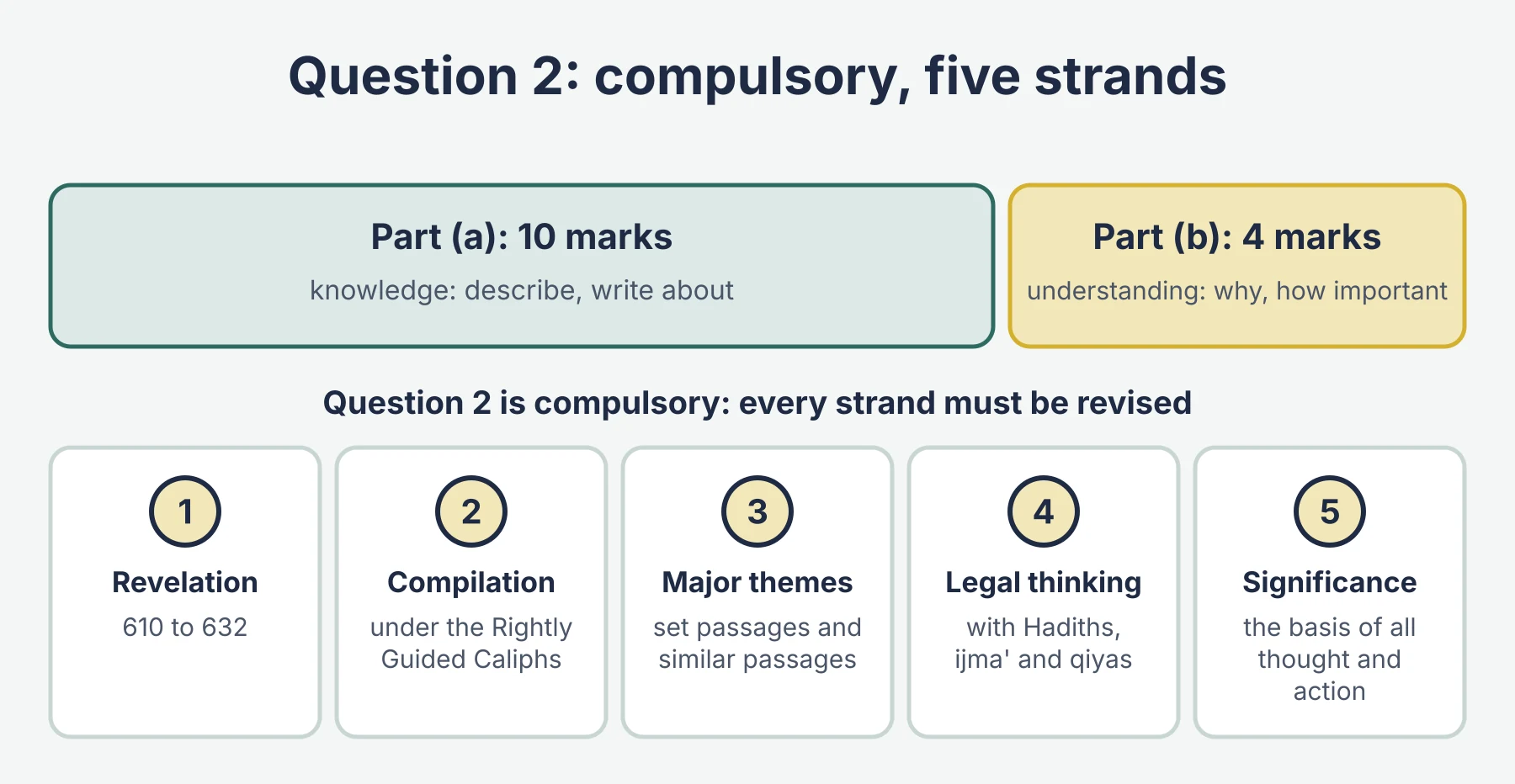
The History and Importance of the Qur’an is Paper 1 Topic 2 of Cambridge IGCSE Islamiyat 0493, and it is always Question 2, which every candidate must answer. It is worth 14 marks: a 10-mark knowledge part (a) and a 4-mark understanding part (b). The topic has five strands: how the Qur’an was revealed between 610 and 632, how it was compiled under the Rightly Guided Caliphs, its major themes, its use in legal thinking alongside the Hadith, ijma’ and qiyas, and why it is the basis of all thought and action in Islam. Because the question is compulsory, you cannot leave any strand unrevised.
Syllabus coverage
0493 Paper 1, Topic 2 (2026–2027 syllabus)
- The revelation of the Qur’an to the Prophet (pbuh) between the years 610 and 632
- The account of the compilation of the Qur’an under the Rightly Guided Caliphs
- The major themes of the Qur’an, in the set passages and in other similar passages
- The use of the Qur’an in legal thinking, and its relationship with the Hadith, consensus (ijma’) and analogy (qiyas)
- Its significance as the basis of all thought and action in Islam
How did revelation begin?
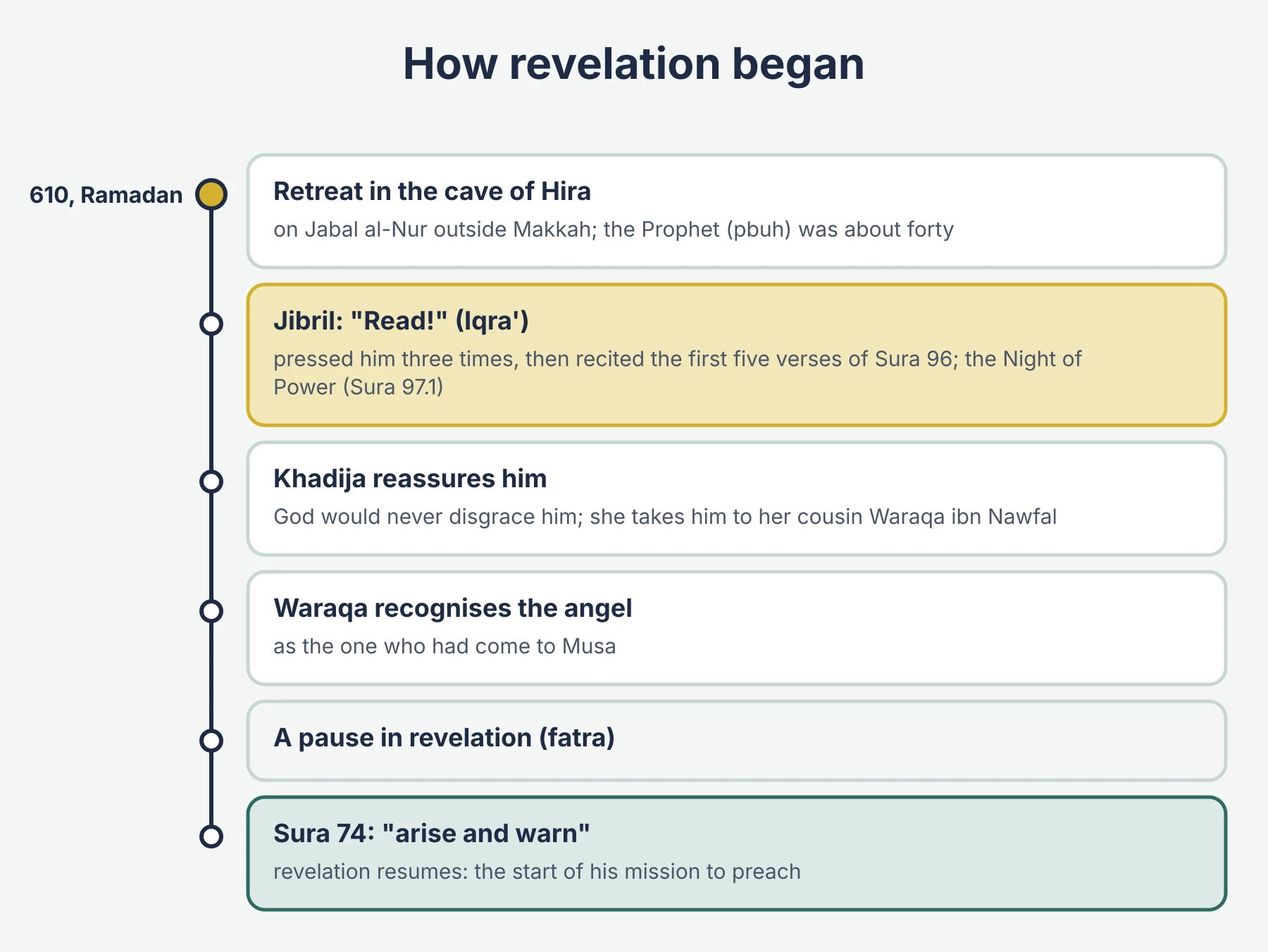
In 610, during Ramadan, the Prophet (pbuh), then about forty, was spending time in retreat in the cave of Hira on Jabal al-Nur outside Makka. The angel Jibril came to him and commanded “Read!” (Iqra’). He replied that he could not read; Jibril pressed him tightly three times and then recited the first five verses of Sura 96. The night is remembered as Laylat al-Qadr, the Night of Power (Sura 97.1). The Prophet (pbuh) returned home trembling and asked Khadija (RA) to cover him. She reassured him that God would never disgrace him, because he was kind to relatives, helped the weak and was hospitable, and she took him to her cousin Waraqa ibn Nawfal, a Christian scholar, who recognised the angel as the one who had come to Musa.
A pause in revelation (fatra) followed. When it resumed, the opening verses of Sura 74 commanded the Prophet (pbuh) to “arise and warn”, which marks the start of his mission to preach.
In what ways did revelation come?
The Prophet (pbuh) described several modes, and a full answer names more than one:
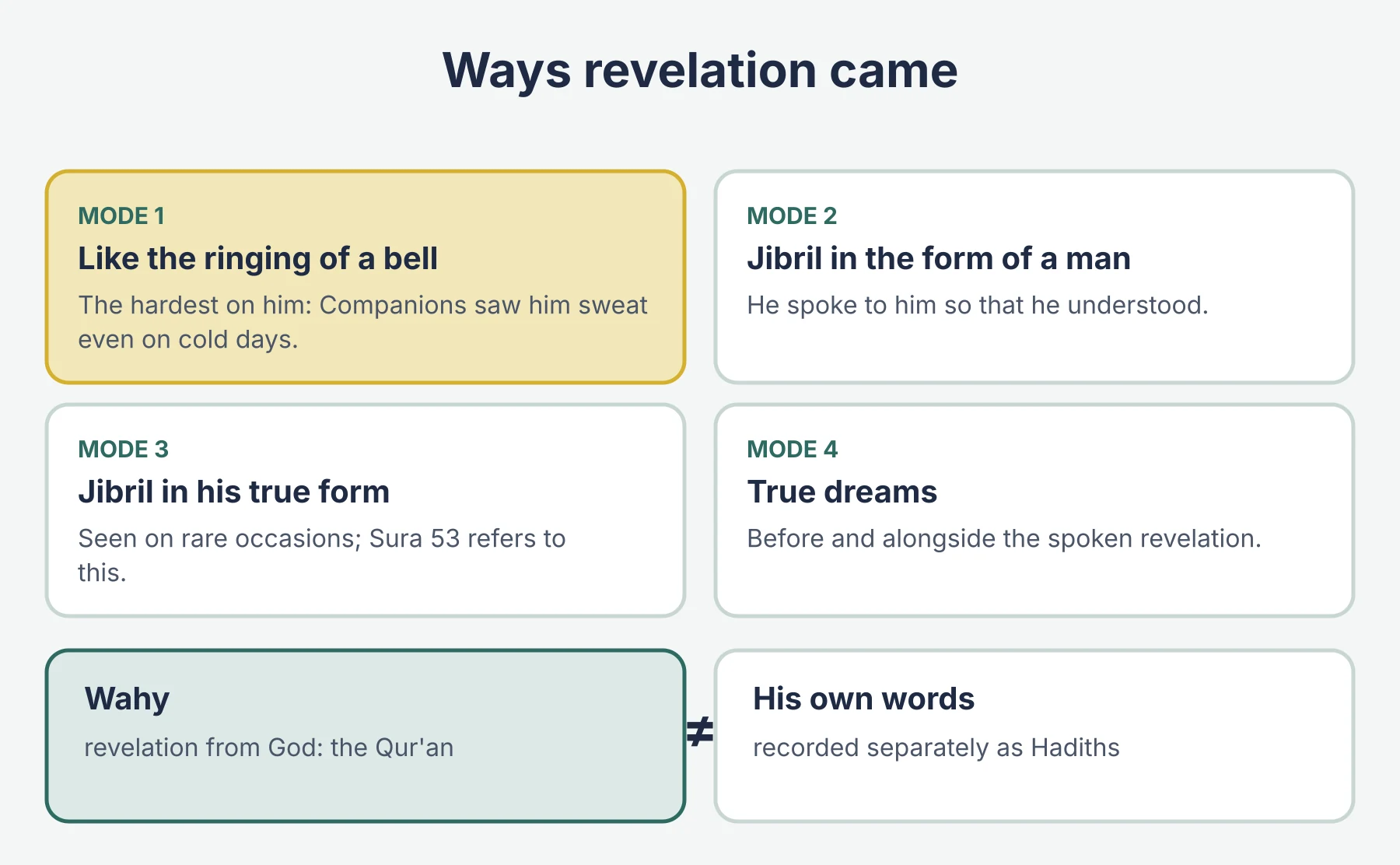
- Like the ringing of a bell, which he said was the hardest on him; Companions saw him sweat even on cold days.
- Jibril in the form of a man, who spoke to him so that he understood.
- Jibril in his true form, which the Prophet (pbuh) saw on rare occasions (Sura 53 refers to this).
- True dreams, which came before and alongside the spoken revelation.
All of these are forms of wahy, revelation from God, which Muslims distinguish from the Prophet’s (pbuh) own words; his own sayings are recorded separately as Hadith.
Why was the Qur’an revealed gradually?
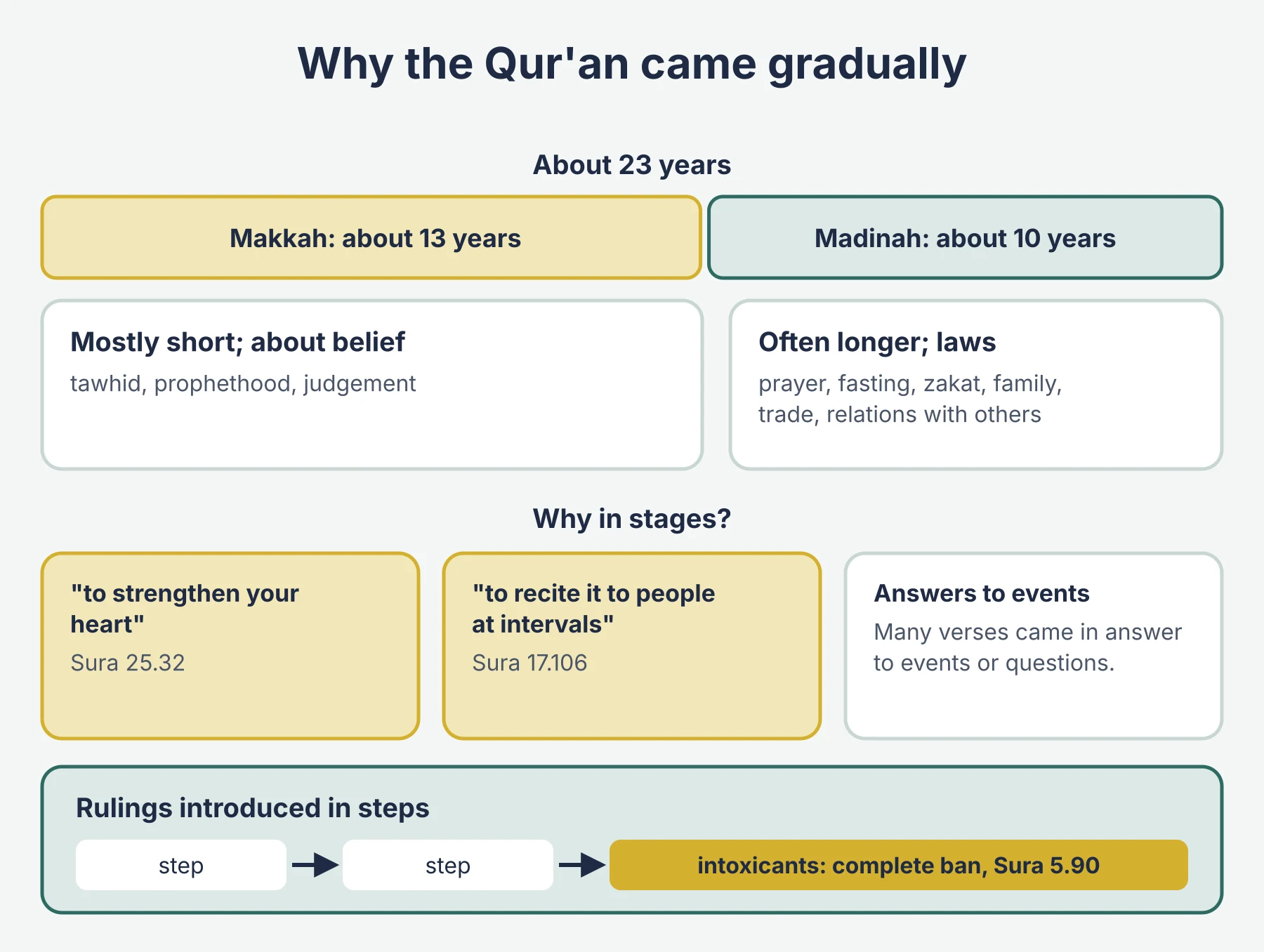
Revelation continued for about 23 years, roughly 13 in Makka and 10 in Madina. Makkan passages are mostly short and concern belief: tawhid, prophethood, judgement. Madinan passages are often longer and include laws for a community: prayer, fasting, zakat, family life, trade and relations with others. Many verses came in answer to events or questions. The Qur’an gives its own reason: it was revealed in stages “to strengthen your heart” (Sura 25.32), and “so that you may recite it to people at intervals” (Sura 17.106). Gradual revelation also allowed rulings to be introduced in steps, as with the prohibition of intoxicants, which ended with the complete ban in Sura 5.90.
How was the Qur’an preserved in the Prophet’s (pbuh) lifetime?
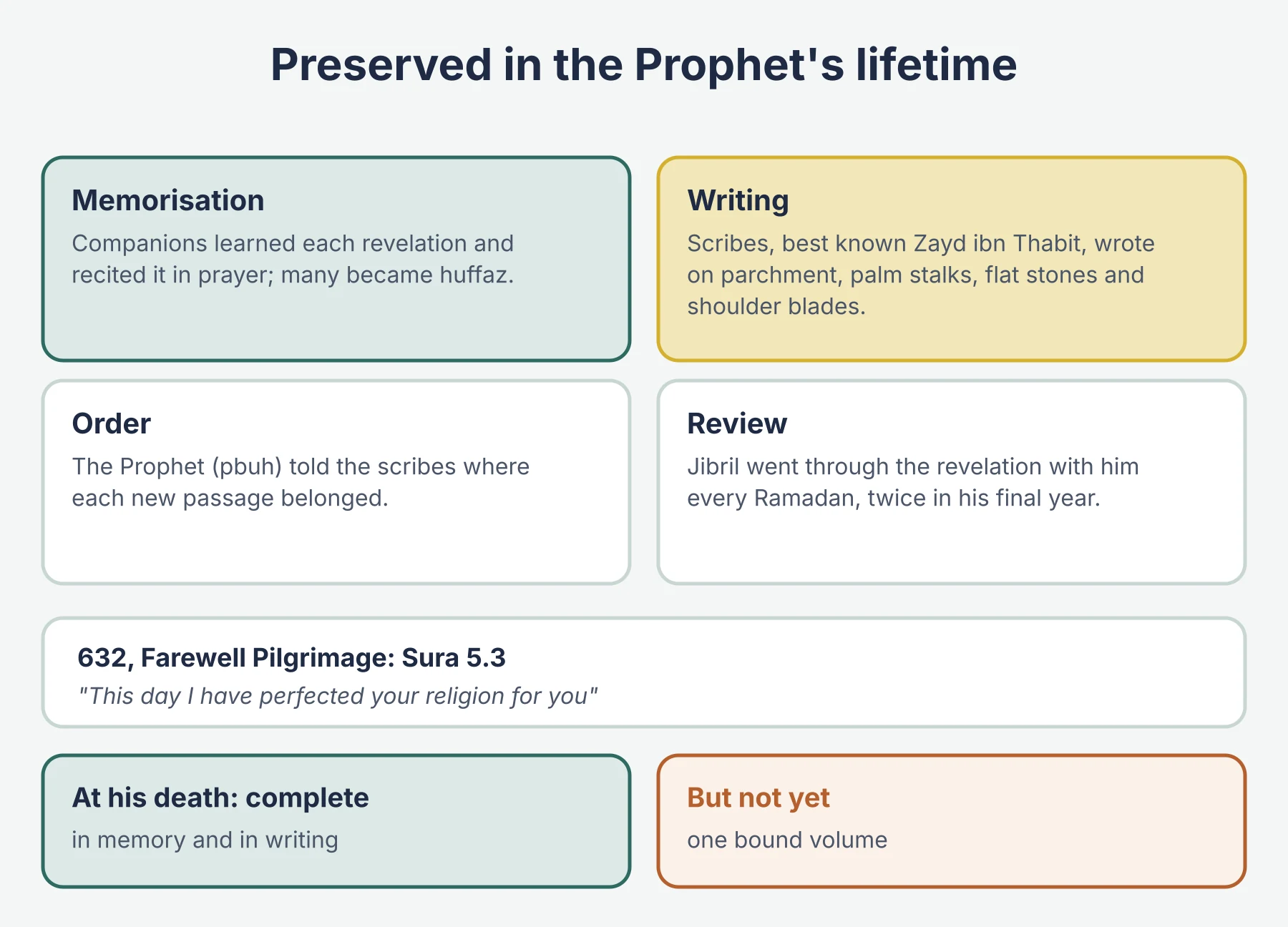
- Memorisation. The Prophet (pbuh) recited each revelation to the Companions, who learned it and recited it in prayer; many became huffaz, people who knew the whole text by heart.
- Writing. Scribes, the best known being Zayd ibn Thabit (RA), wrote verses down on what was available: parchment, palm stalks, flat stones and the shoulder blades of animals.
- Order. The Prophet (pbuh) told the scribes where each new passage belonged.
- Review. Jibril went through the revelation with the Prophet (pbuh) every Ramadan, and twice in his final year.
Sura 5.3, “This day I have perfected your religion for you”, was revealed during the Farewell Pilgrimage in 632. At the Prophet’s (pbuh) death the whole Qur’an existed in memory and in writing, but not as one bound volume.
How was the Qur’an compiled under Abu Bakr (RA)?
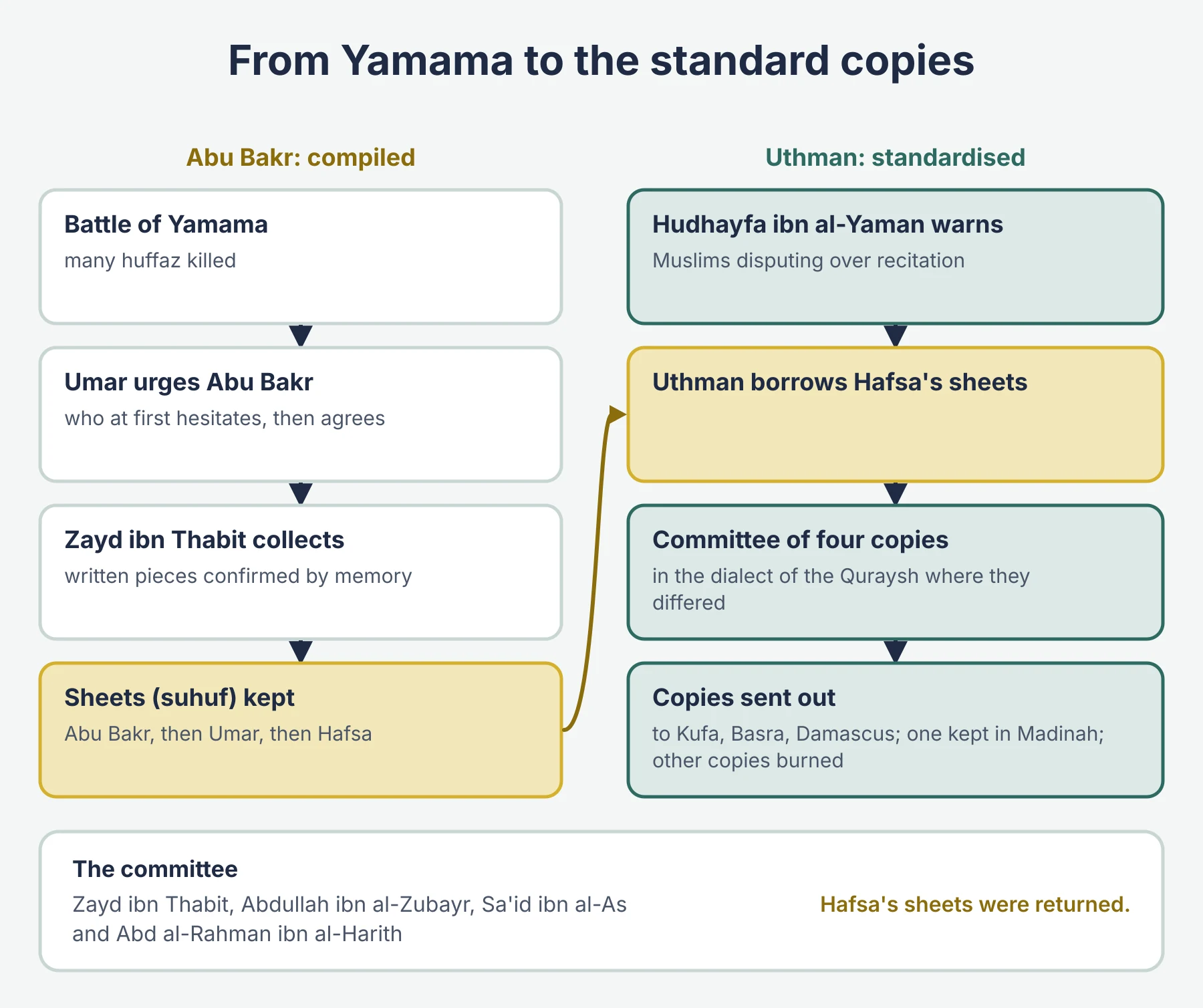
During the Ridda wars, many huffaz were killed at the Battle of Yamama (632–633). Umar (RA) feared that parts of the Qur’an could be lost if more memorisers died and urged Abu Bakr (RA) to collect it. Abu Bakr (RA) at first hesitated to do something the Prophet (pbuh) had not done, but became convinced it was right. He gave the task to Zayd ibn Thabit (RA), because he was young, trustworthy, a scribe of revelation and had been present at the final review. Zayd said that moving a mountain would have been easier.
Zayd gathered the written pieces and checked them against the memories of the Companions, accepting written material only when it was confirmed. The last verses of Sura 9 were found written with only one Companion, Abu Khuzayma al-Ansari, though they were well known from memory. The completed sheets (suhuf) stayed with Abu Bakr (RA), then with Umar (RA), and on Umar’s (RA) death with his daughter Hafsa (RA), a wife of the Prophet (pbuh).
How was it standardised under Uthman (RA)?
By Uthman’s (RA) caliphate, Islam had spread to people who recited the Qur’an in differing ways. During campaigns in Armenia and Azerbaijan, the Companion Hudhayfa ibn al-Yaman heard Muslims from different regions disputing over recitation, and warned Uthman (RA) to act before the community divided as earlier peoples had over their scriptures.
Uthman (RA) borrowed Hafsa’s (RA) sheets and appointed Zayd ibn Thabit (RA), Abdullah ibn al-Zubayr, Sa’id ibn al-As and Abd al-Rahman ibn al-Harith to make copies. Where they differed, they were to write in the dialect of the Quraysh, in which the Qur’an had been revealed. Copies were sent to major centres such as Kufa, Basra and Damascus, one was kept in Madina, the original sheets were returned to Hafsa (RA), and other written copies were burned so that only the agreed text remained. For this Uthman (RA) is known as Jami’ al-Qur’an, the gatherer of the Qur’an.
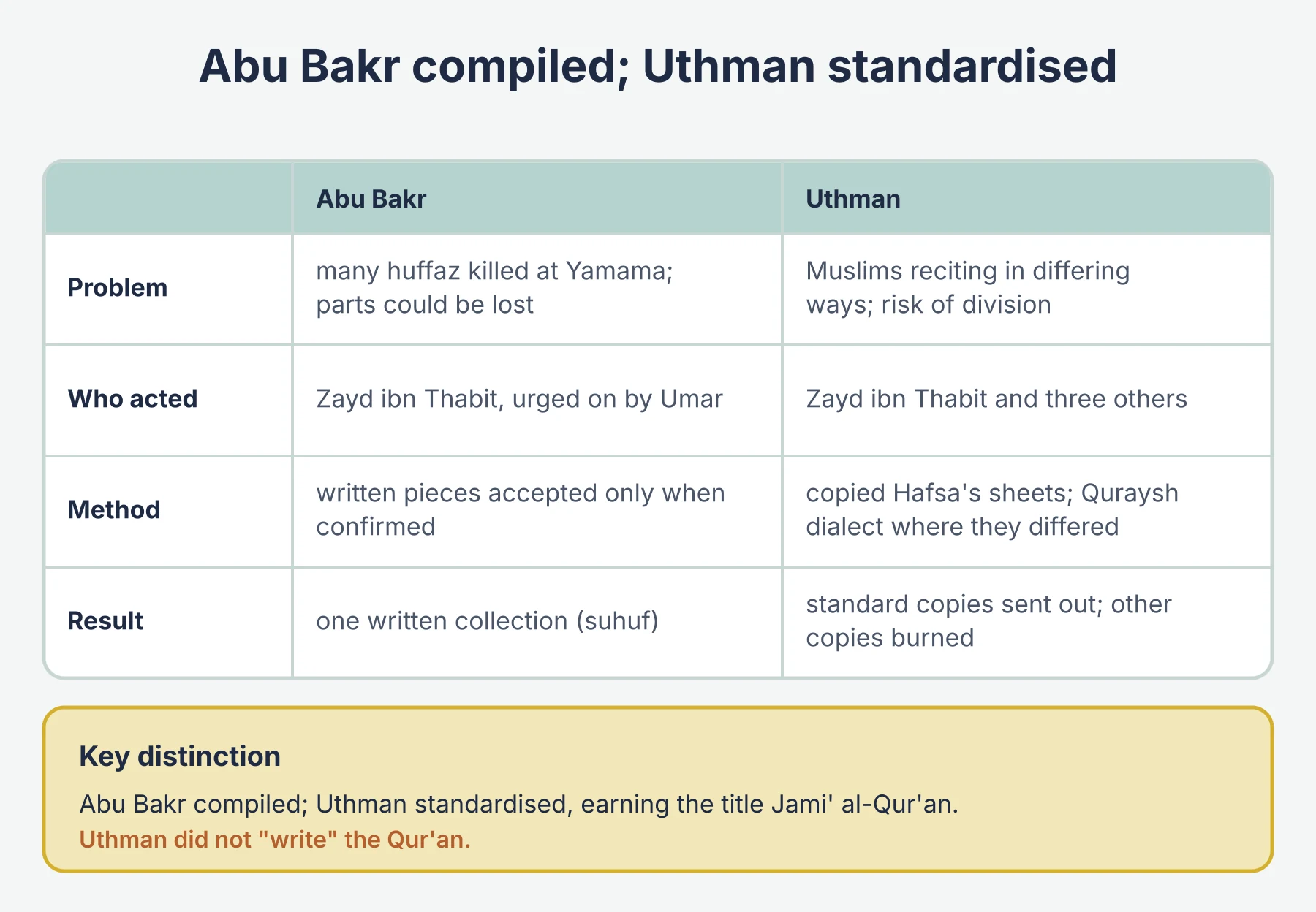
Key distinction: Abu Bakr (RA) compiled the Qur’an into one written collection; Uthman (RA) made standard copies and sent them out so that all Muslims used the same text.
How is the Qur’an used in legal thinking?
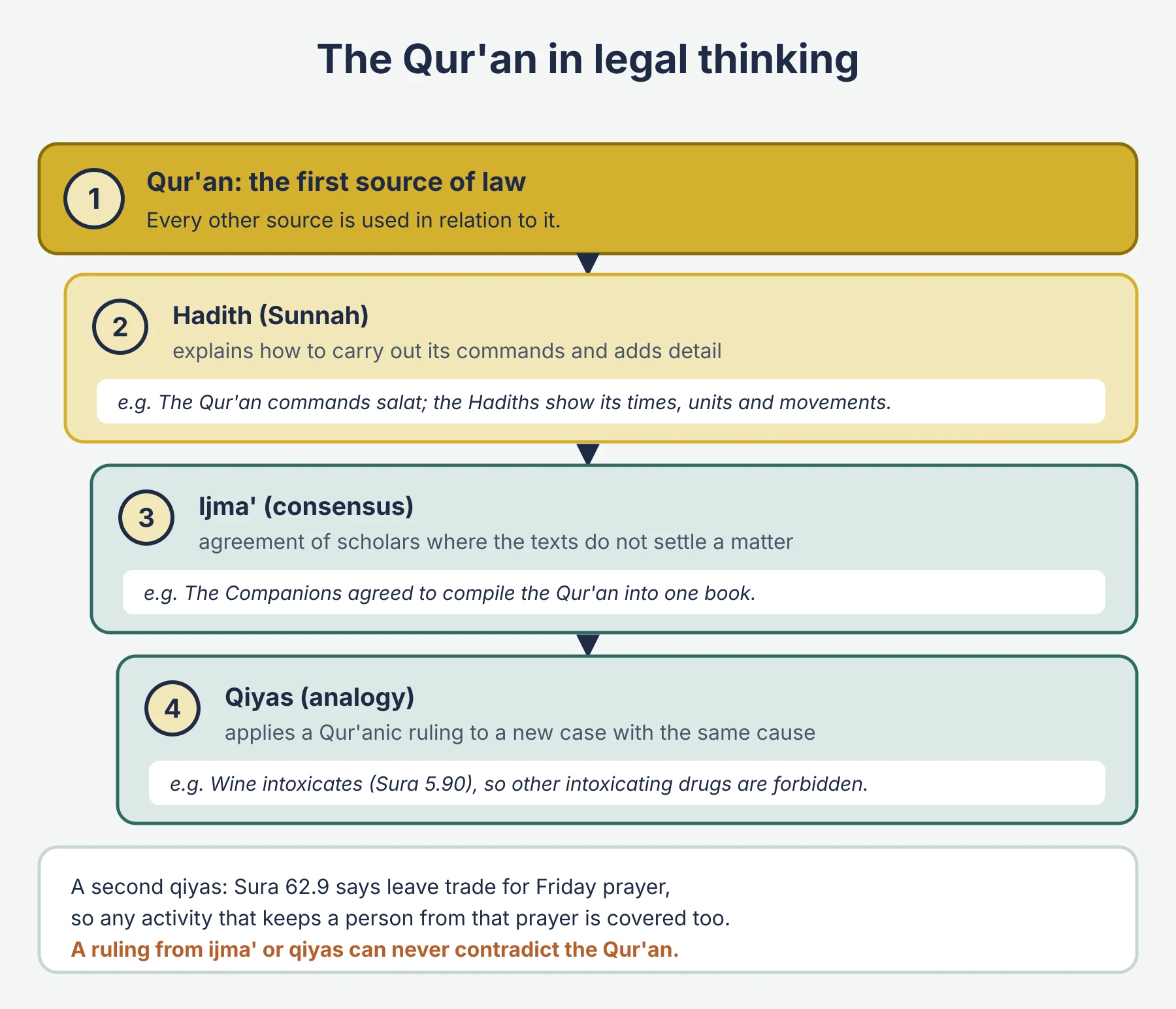
The Qur’an is the first source of law. Scholars then use three further sources, always in relation to it:
| Source | How it relates to the Qur’an | Example |
|---|---|---|
| Hadith (Sunnah) | Explains how to carry out the Qur’an’s commands and adds detail | The Qur’an commands salat; the Hadith show its times, units and movements |
| Ijma’ (consensus) | Agreement of scholars on a matter the texts do not settle directly | The Companions agreed to compile the Qur’an into one book |
| Qiyas (analogy) | Applies a Qur’anic ruling to a new case with the same cause | Wine is forbidden because it intoxicates (Sura 5.90), so other intoxicating drugs are forbidden |
A second qiyas example: Sura 62.9 tells believers to leave trade when called to Friday prayer; scholars reason that any activity which keeps a person from that prayer is covered too. A ruling from ijma’ or qiyas can never contradict the Qur’an.
Why is the Qur’an the basis of all thought and action?
- It is the word of God, revealed through Jibril, so it is the final authority (Sura 2.2).
- It is preserved: Muslims believe God has promised to guard it (Sura 15.9), and the Arabic text is unchanged and memorised by millions.
- It shapes worship: it is recited in every prayer, and Muslims learn to read it from childhood.
- It shapes daily conduct: honesty in trade, kindness to parents, care for orphans and justice.
- It unites Muslims of every language around one Arabic text.
Worked example: a 4-mark part (b)
Question: Why was the compilation of the Qur’an important for later Muslims? [4]
Model answer: The compilation meant the Qur’an no longer depended only on the memories of people who might die in battle, as at Yamama, so later generations received it complete. Because Uthman’s (RA) copies were sent to every major city, Muslims everywhere recite exactly the same words, which keeps the community united in worship and law, and gives Muslims confidence that the text they follow today is the one revealed to the Prophet (pbuh).
Why it works: two separate reasons, each linked to an effect on Muslims, which is what part (b) rewards.
Common mistakes
- Confusing revelation (610–632, in the Prophet’s (pbuh) lifetime) with compilation (after his death).
- Saying Uthman (RA) “wrote” the Qur’an; his committee copied the sheets compiled under Abu Bakr (RA).
- Forgetting Hafsa (RA), who links the two compilations.
- Listing ijma’ and qiyas without explaining their relationship to the Qur’an.
- Writing 10-mark answers as short lists: develop each point with names, places and reasons.
Exam technique
Question 2(a) often asks you to “describe” or “write about” revelation or compilation: tell the events in order with detail. Question 2(b) usually asks “why” or “how important”: give two reasons, each explained. Spend more of your time on (a), but never skip (b).
Frequently asked questions
Who was Zayd ibn Thabit (RA)? A young Companion from Madina who was a scribe of revelation; he led the compilation under Abu Bakr (RA) and the copying under Uthman (RA).
Why did Abu Bakr (RA) hesitate? He was reluctant to do something the Prophet (pbuh) had not done, until Umar (RA) persuaded him that it was necessary to protect the Qur’an.
Related pages
- History and Importance of the Qur’an revision notes
- History and Importance of the Qur’an practice questions
- Major Themes of the Qur’an study guide
- Paper 1 study guide
Source: Cambridge International, Cambridge IGCSE Islamiyat 0493 syllabus for examination in 2026 and 2027, Paper 1 Topic 2.
Related resources
-
Practice questions
Cambridge IGCSE Islamiyat (0493): The History and Importance of the Qur'an — Practice Questions
Twelve original questions on the revelation, compilation and legal use of the Qur'an for Cambridge IGCSE Islamiyat 0493 Paper 1 Question 2, with mark guidance.
Islamiyat · Cambridge · IGCSE
Try questions -
Revision notes
Cambridge IGCSE Islamiyat (0493): The History and Importance of the Qur'an — Revision Notes
Recall notes for 0493 Paper 1 Question 2: stages of revelation, the two compilations, key people, the Qur'an in law and its importance, with a self-test.
Islamiyat · Cambridge · IGCSE
Revise topic -
Study guides
Cambridge IGCSE Islamiyat (0493): The Life and Importance of the Prophet Muhammad (pbuh)
Study guide to the Prophet's life in Makka and Madina, his character, his example for individuals and states, and the Seal of the Prophets, for IGCSE 0493.
Islamiyat · Cambridge · IGCSE
Read guide
Get free revision emails (optional)
Occasional emails with practice questions, worked explanations and links to free resources for the qualification and subjects you choose. No spam, and you can unsubscribe from any email. The free tools on this site never need an email.