
Study Guides
Cambridge IGCSE Islamiyat (0493): The Life and Importance of the Prophet Muhammad (pbuh)
Study guide to the Prophet's life in Makka and Madina, his character, his example for individuals and states, and the Seal of the Prophets, for IGCSE 0493.
- Subject
- Islamiyat
- Level
- IGCSE
- Topic
- Paper 1
- Author
- Marlbridge Academic Team
- Updated
- Reviewed by
- Azam Siddique (what this means)
Aligned to Cambridge IGCSE Islamiyat (0493), 2026-2027. Official specification .
Syllabus page (what it covers and how it is assessed): Cambridge IGCSE Islamiyat.
Syllabus points this page covers
0493
- 1.3 The Life and Importance of the Prophet Muhammad (pbuh)
Found an error? Report a correction.
Need help with this topic? Request a free trial class for IGCSE Islamiyat (0493).
The Life and Importance of the Prophet Muhammad (pbuh) is Paper 1 Topic 3 of Cambridge IGCSE
Islamiyat 0493. One or two of Questions 3 to 5 are set on it, each worth 14 marks: a 10-mark part
(a) asking you to describe events, and a 4-mark part (b) asking what those events mean for Muslims
today. The syllabus asks for more than a timeline. It wants his actions and character, the lessons
they give individuals and communities, including in relations with women, non-Muslims and other
states, and his significance as the Seal of the Prophets.
Syllabus coverage
0493 Paper 1, Topic 3 (2026–2027 syllabus)
- Main events from his birth to his call to prophethood
- Main events of his activities in Makka and his experiences with his opponents
- Main events in Madina: his leadership of the community and his conflicts with the Makkans and others
- His actions and character
- His actions as examples for individuals in personal conduct and relations with others, including women and non-Muslims
- His actions as examples for Muslim communities in their relations with other states
- His significance as Seal of the Prophets and last Messenger of God
How should you divide the life for revision?
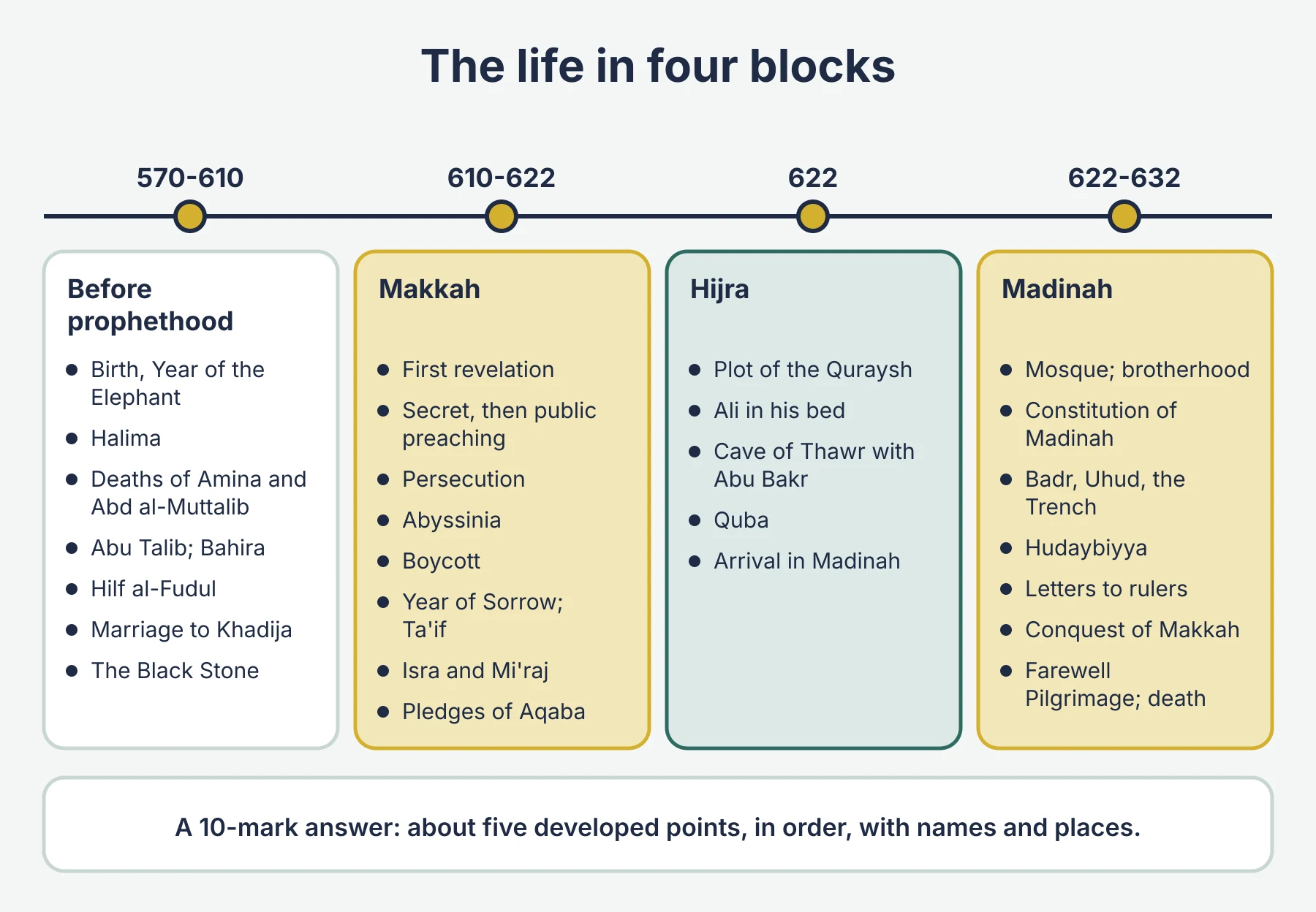
Learn the life in four blocks, each with a short list of events you can describe in detail:
| Block | Years | Core events |
|---|---|---|
| Before prophethood | 570–610 | Birth in the Year of the Elephant; Halima; deaths of Amina and Abd al-Muttalib; Abu Talib; Bahira; Hilf al-Fudul; marriage to Khadija (RA); the Black Stone |
| Makka | 610–622 | First revelation; secret then public preaching; persecution; Abyssinia; boycott; Year of Sorrow; Ta’if; Isra and Mi’raj; pledges of Aqaba |
| Hijra | 622 | Plot of the Quraysh; Ali (RA) in his bed; cave of Thawr with Abu Bakr (RA); Quba; arrival in Madina |
| Madina | 622–632 | Mosque; brotherhood; Constitution of Madina; Badr; Uhud; the Trench; Hudaybiyya; letters to rulers; conquest of Makka; Farewell Pilgrimage; death |
What happened in Makka, and how did his opponents respond?
For about three years the Prophet (pbuh) invited people privately; early believers included Khadija (RA), Ali (RA), Abu Bakr (RA) and Zayd ibn Haritha (RA). When commanded to preach openly, he called the Quraysh from Mount Safa; his uncle Abu Lahab cursed him, and Sura 111 was revealed about Abu Lahab.
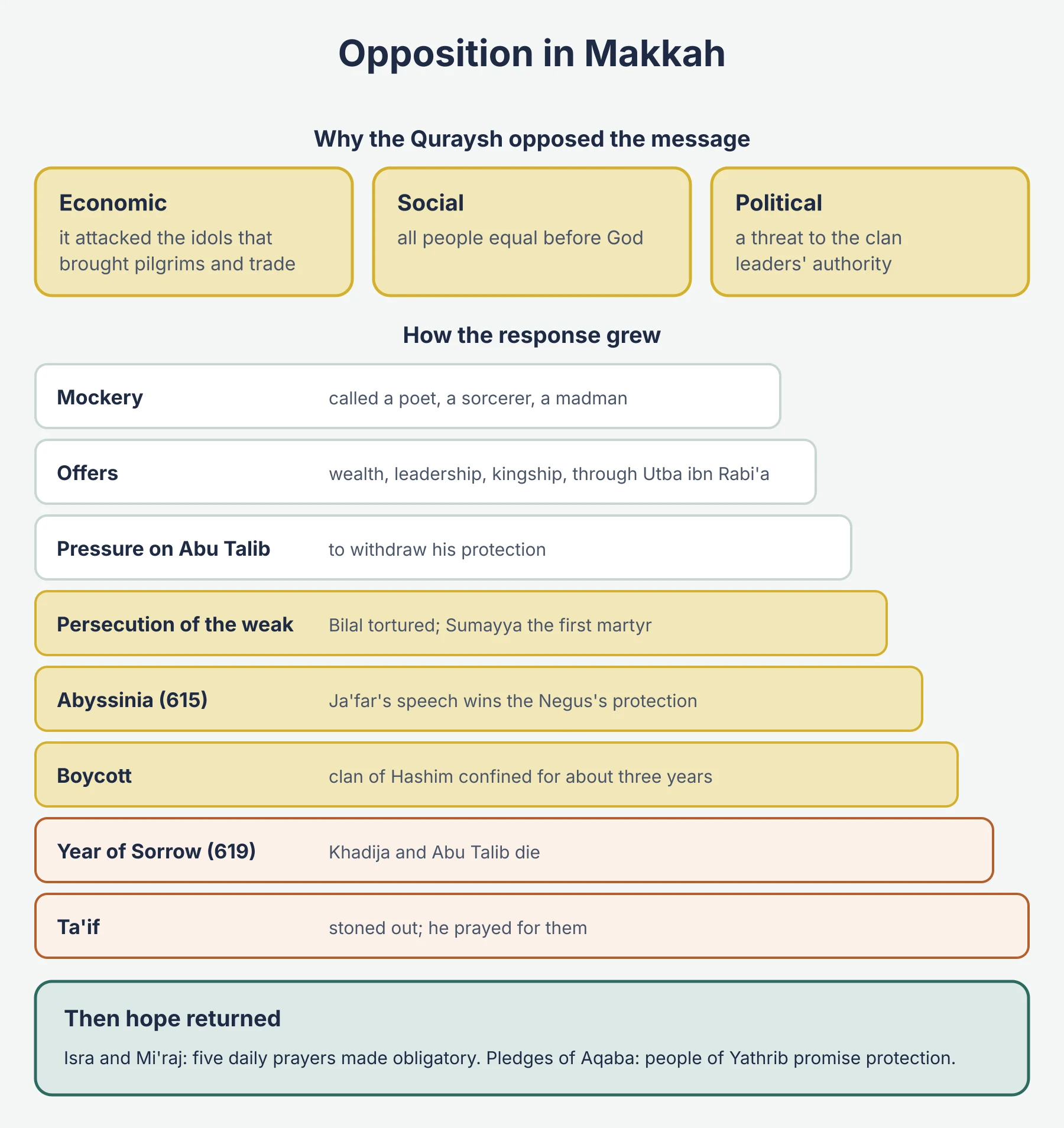
The Quraysh opposed him because his message attacked the idols that brought pilgrims and trade to Makka, taught that all people were equal before God, and threatened the authority of the clan leaders. Their response grew step by step:
- Mockery: they called him a poet, a sorcerer and a madman.
- Offers: through Utba ibn Rabi’a they offered wealth, leadership and even kingship if he stopped.
- Pressure on Abu Talib to withdraw his protection; the Prophet (pbuh) replied that he would not stop even if they placed the sun in his right hand and the moon in his left.
- Persecution of the weak: Bilal (RA) was tortured on hot sand by Umayya ibn Khalaf; Sumayya was killed, becoming the first martyr of Islam.
- Migration to Abyssinia (615): a group of Muslims sought the protection of its Christian king, the Negus; Ja’far ibn Abi Talib’s speech and recitation from Sura Maryam persuaded him to protect them.
- Boycott: the clan of Hashim was confined to the valley of Abu Talib for about three years.
- Year of Sorrow (619): Khadija (RA) and Abu Talib died, removing his chief support and his protector.
- Ta’if: its leaders rejected him and had him stoned out of the town; he prayed for them rather than against them.
Hope returned with the Isra and Mi’raj, the night journey to Jerusalem and ascension, when the five daily prayers were made obligatory, and with the pledges of Aqaba, when people from Yathrib (Madina) accepted Islam and promised to protect him.
How did he lead the community in Madina?
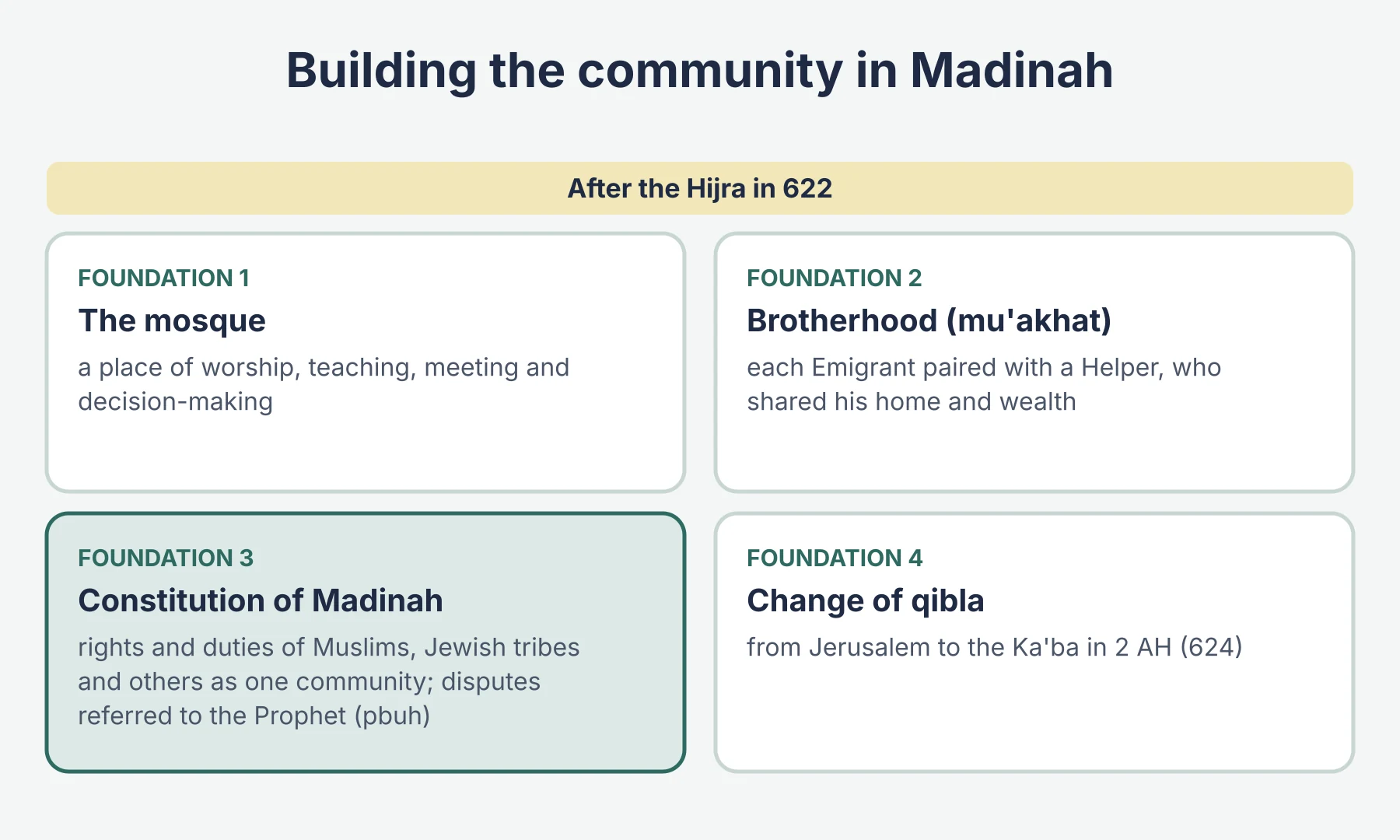
After the Hijra in 622 he built a community from the start:
- The mosque was built as a place of worship, teaching, meeting and decision-making.
- Brotherhood (mu’akhat): each Emigrant was paired with a Helper, who shared his home and wealth.
- The Constitution of Madina set out the rights and duties of the Muslims, the Jewish tribes and others as one community, with disputes referred to the Prophet (pbuh).
- Change of qibla from Jerusalem to the Ka’ba in 2 AH (624).
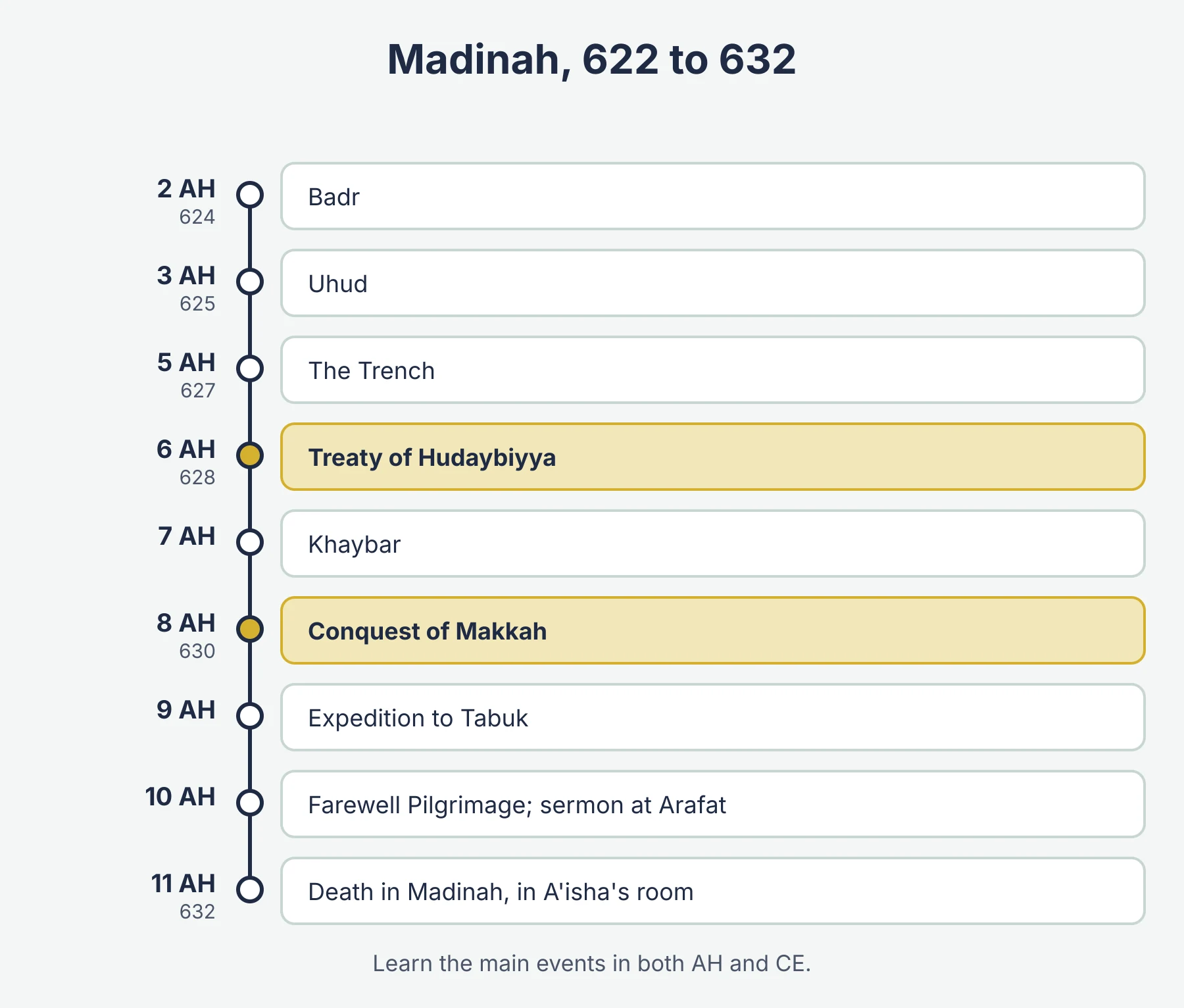
His conflicts with the Makkans and others include Badr (2 AH, 624), Uhud (3 AH, 625), the Trench (5 AH, 627), the Treaty of Hudaybiyya (6 AH, 628), Khaybar (7 AH), the conquest of Makka (8 AH, 630) and the expedition to Tabuk (9 AH). In 10 AH he led the Farewell Pilgrimage and gave his sermon at Arafat; he died in Madina in 11 AH (632), in the room of A’isha.
What do his actions show about his character?
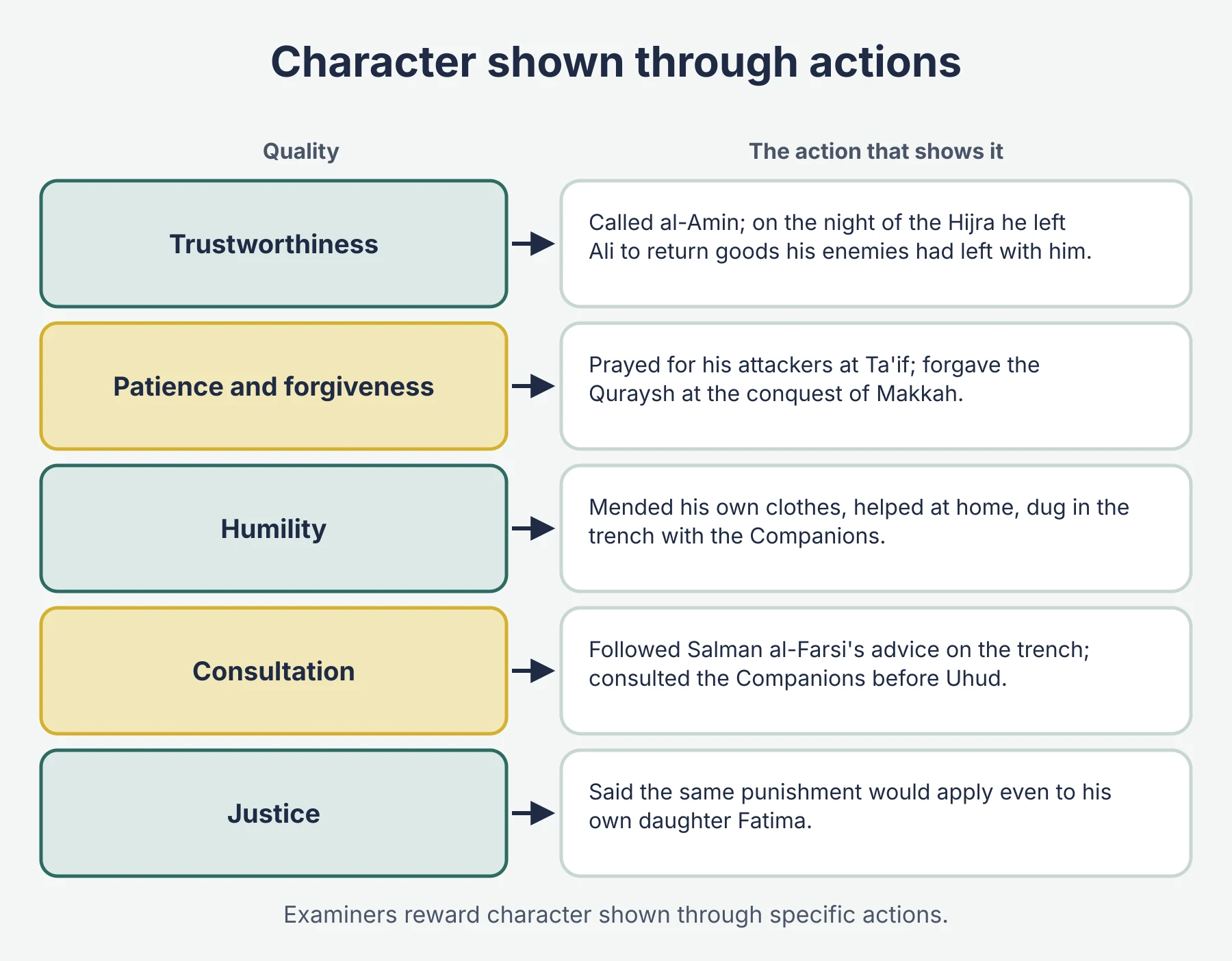
Examiners reward character shown through specific actions:
- Trustworthiness: called al-Amin before prophethood; on the night of the Hijra he left Ali (RA) to return goods his enemies had left with him.
- Patience and forgiveness: at Ta’if he prayed for his attackers; at the conquest of Makka he forgave the Quraysh, saying there was no blame on them that day.
- Humility: he mended his own clothes and helped with work at home, as A’isha reported, and dug in the trench alongside the Companions.
- Consultation: he followed Salman al-Farsi’s (RA) advice to dig the trench and consulted the Companions before Uhud.
- Justice: he said that if his own daughter Fatima (RA) stole he would apply the same punishment as for anyone else.
What example does he give individuals?
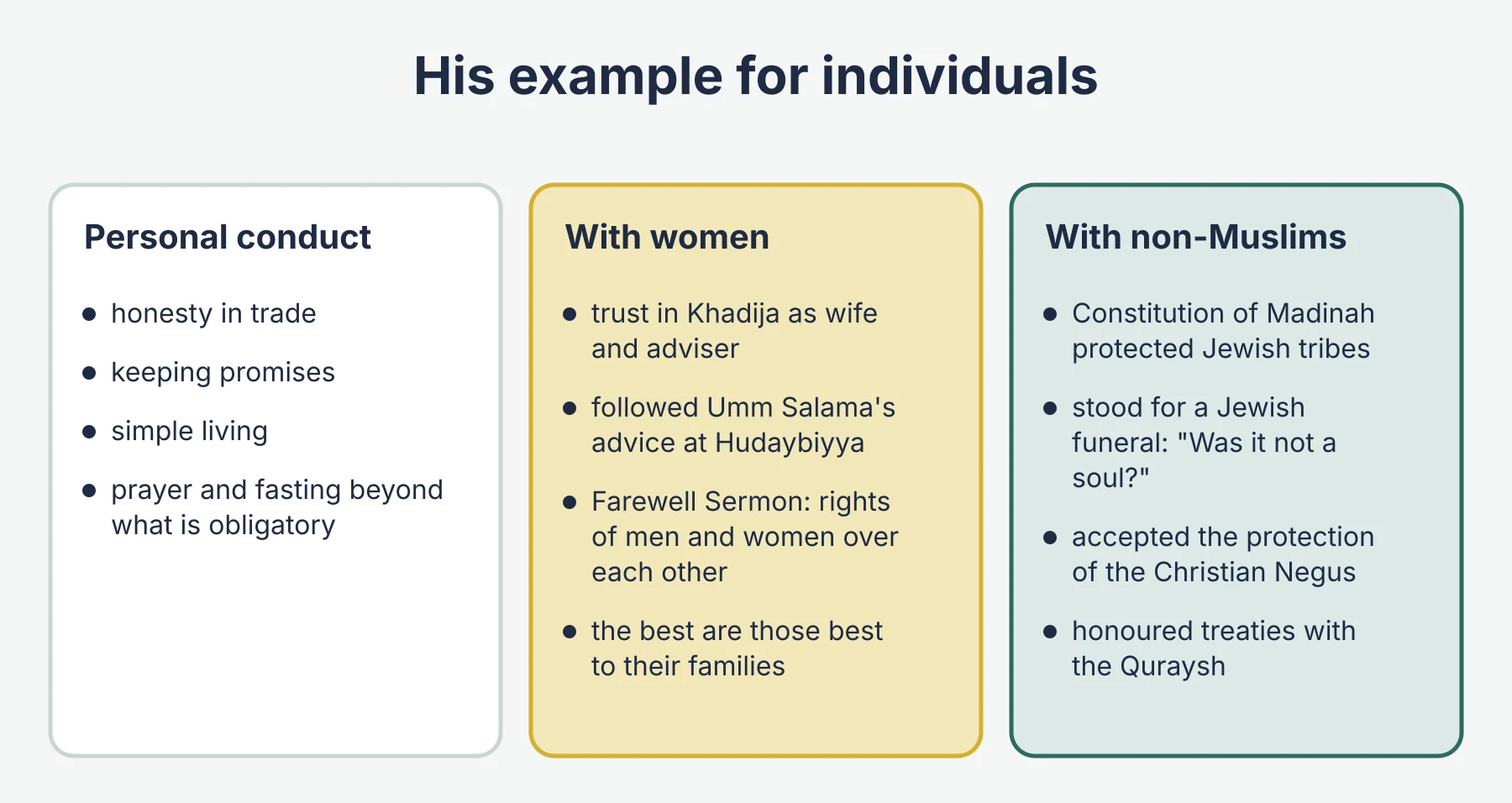
In personal conduct: honesty in trade, keeping promises, simple living, and prayer and fasting beyond what is obligatory.
With women: his trust in Khadija (RA) as wife and adviser; consulting Umm Salama (RA) at Hudaybiyya, whose advice he followed; his teaching in the Farewell Sermon that men have rights over women and women have rights over men; and his saying that the best of people are those who are best to their families.
With non-Muslims: the Constitution of Madina protected Jewish tribes as part of the community; he stood up when a Jewish funeral passed, saying “Was it not a soul?”; he accepted the protection of the Christian Negus; he honoured treaties with the Quraysh even when they were hard on Muslims.
What example does he give communities and states?
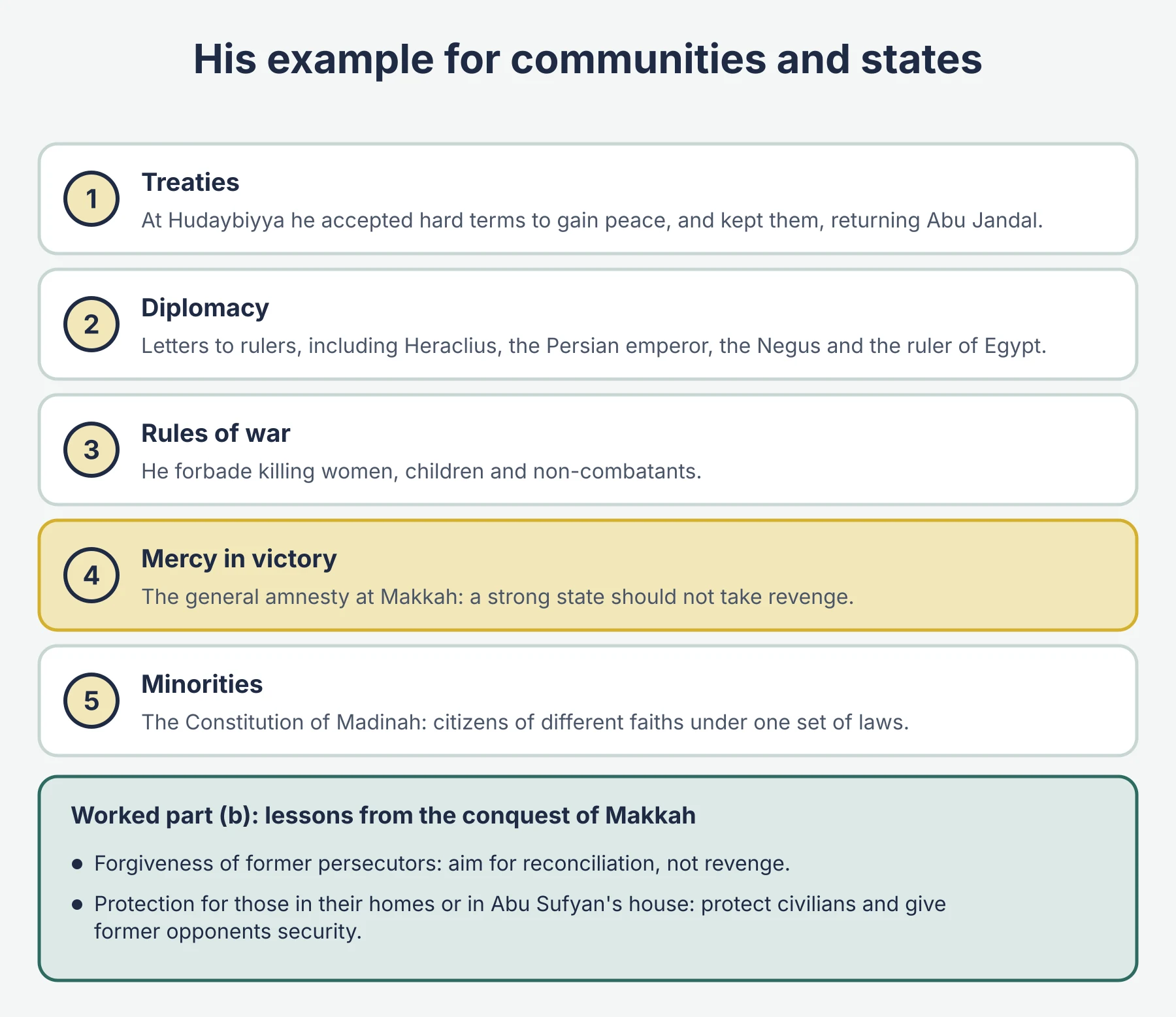
- Treaties: at Hudaybiyya he accepted difficult terms to gain peace, and kept them, returning Abu Jandal as agreed.
- Diplomacy: after Hudaybiyya he sent letters inviting rulers to Islam, including Heraclius of Byzantium, the Persian emperor, the Negus and the ruler of Egypt, showing peaceful contact between states.
- Rules of war: he forbade killing women, children and non-combatants.
- Mercy in victory: the general amnesty at Makka shows that a strong state should not take revenge.
- Agreements with minorities: the Constitution of Madina is a model for citizens of different faiths living under one set of laws.
Why is he the Seal of the Prophets?
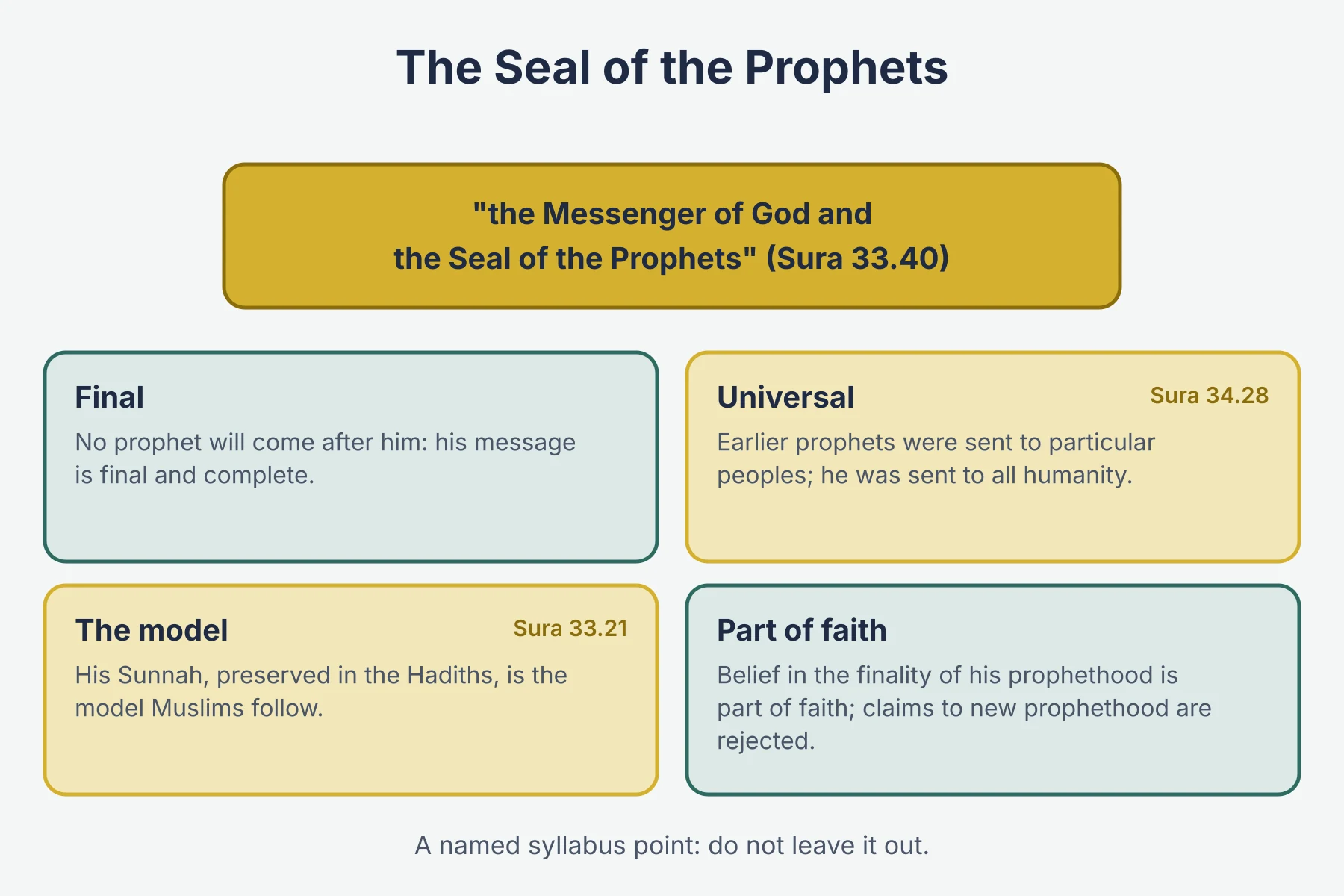
Sura 33.40 calls him “the Messenger of God and the Seal of the Prophets”. Muslims believe:
- no prophet will come after him, so his message is final and complete;
- earlier prophets were sent to particular peoples, but he was sent to all humanity (Sura 34.28);
- his Sunnah, preserved in the Hadith, is the model Muslims follow (Sura 33.21);
- belief in the finality of his prophethood is part of faith, so a claim to new prophethood is rejected.
Worked example: a 4-mark part (b)
Question: What can Muslim states learn today from the Prophet’s (pbuh) conduct at the conquest of Makka? [4]
Model answer: The Prophet (pbuh) entered Makka with about ten thousand men, yet he forgave people who had persecuted him for years. A state that wins a conflict should therefore aim for reconciliation rather than revenge, because forgiveness wins hearts, as it did when many Makkans then accepted Islam. He also protected those who stayed in their homes or in the house of Abu Sufyan, so states should protect civilians and give their former opponents security once fighting ends.
Why it works: two developed lessons, each tied to a specific action and applied to states today.
Common mistakes
- Telling the whole life when the question names one period or event.
- Dates without events, or events without detail: name people and places.
- In part (b), drawing a lesson for individuals when the question asks about communities or states.
- Forgetting the Seal of the Prophets, which is a named syllabus point.
Frequently asked questions
Which dates must I know? The main ones: 570 birth, 610 first revelation, 615 Abyssinia, 619 Year of Sorrow, 622 Hijra, and the Madinan events in AH and CE as given above.
How detailed should a 10-mark answer be? About five developed points, each with names, places and what happened, in order.
Related pages
- Life of the Prophet (pbuh) revision notes
- Life of the Prophet (pbuh) practice questions
- The First Islamic Community study guide
- Paper 1 study guide
Source: Cambridge International, Cambridge IGCSE Islamiyat 0493 syllabus for examination in 2026 and 2027, Paper 1 Topic 3.
Related resources
-
Practice questions
Cambridge IGCSE Islamiyat (0493): The Life and Importance of the Prophet Muhammad (pbuh) — Practice Questions
Twelve original questions on the Hijra, Uhud, the Trench, the Farewell Sermon and life in Madina for Cambridge IGCSE Islamiyat 0493 Paper 1, with mark guidance.
Islamiyat · Cambridge · IGCSE
Try questions -
Revision notes
Cambridge IGCSE Islamiyat (0493): The Life and Importance of the Prophet Muhammad (pbuh) — Revision Notes
Recall notes on the Prophet's (pbuh) life for 0493 Paper 1: timeline, Makkan opposition, the Madinan battles and treaties, lessons for today, and a self-test.
Islamiyat · Cambridge · IGCSE
Revise topic -
Study guides
Cambridge IGCSE Islamiyat (0493): Major Themes of the Qur'an
How to read the fifteen set Qur'an passages for 0493 Paper 1 Question 1: finding the theme, using key Arabic words and linking each one to Muslim life.
Islamiyat · Cambridge · IGCSE
Read guide
Get free revision emails (optional)
Occasional emails with practice questions, worked explanations and links to free resources for the qualification and subjects you choose. No spam, and you can unsubscribe from any email. The free tools on this site never need an email.