
Revision Notes
Cambridge IGCSE Islamiyat (0493): The History and Importance of the Qur'an — Revision Notes
Recall notes for 0493 Paper 1 Question 2: stages of revelation, the two compilations, key people, the Qur'an in law and its importance, with a self-test.
- Subject
- Islamiyat
- Level
- IGCSE
- Topic
- Paper 1
- Author
- Marlbridge Academic Team
- Updated
- Reviewed by
- Azam Siddique (what this means)
Aligned to Cambridge IGCSE Islamiyat (0493), 2026-2027. Official specification .
Syllabus page (what it covers and how it is assessed): Cambridge IGCSE Islamiyat.
Syllabus points this page covers
0493
- 1.2 The History and Importance of the Qur’an
Found an error? Report a correction.
Need help with this topic? Request a free trial class for IGCSE Islamiyat (0493).
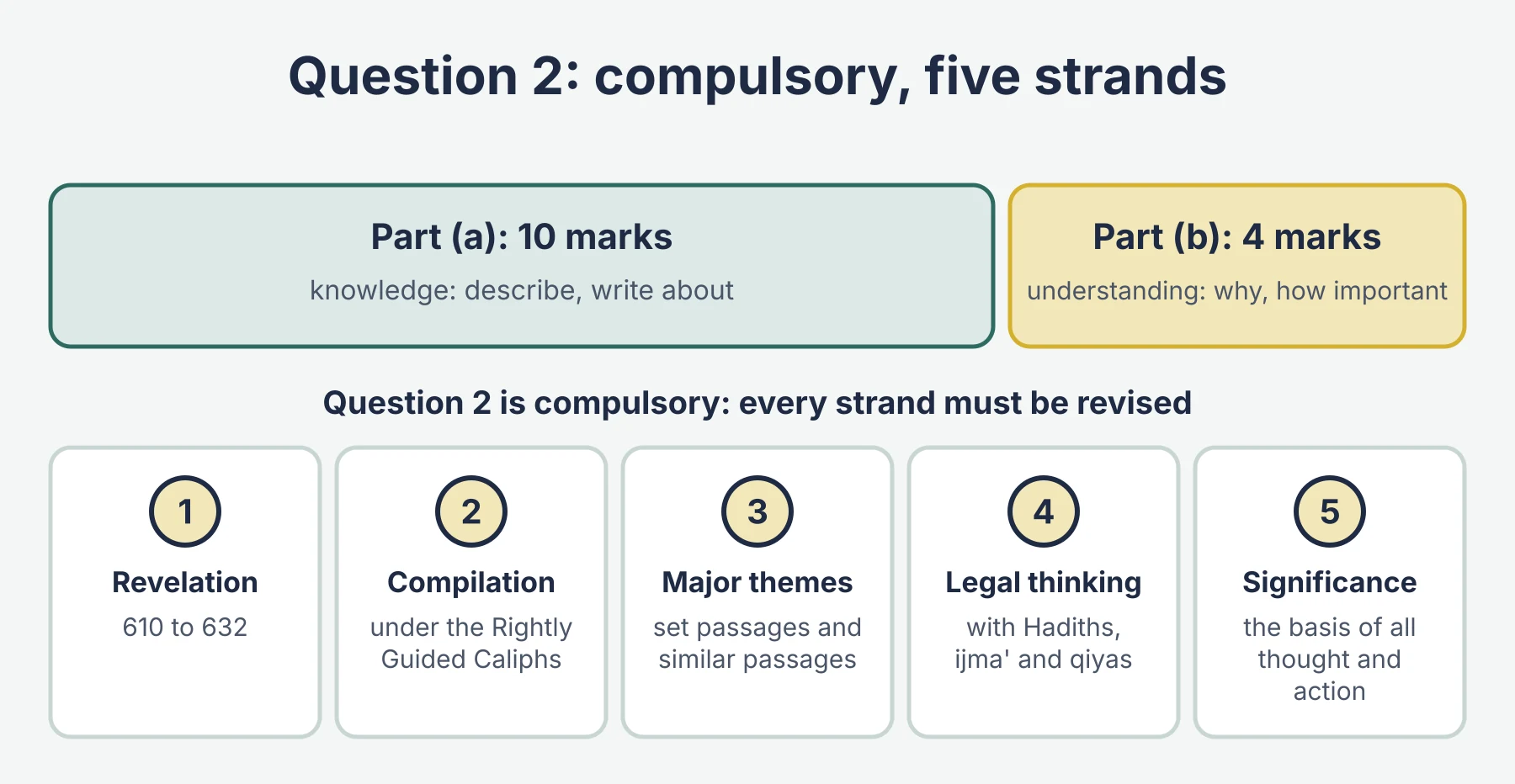
These notes condense Paper 1 Topic 2 of Cambridge IGCSE Islamiyat 0493, The History and Importance of the Qur’an, which is examined by the compulsory Question 2. Learn the revelation story in order, the two stages of compilation and who did what, how the Qur’an sits with the other sources of law, and four or five reasons it matters to Muslims. Each 10-mark part (a) needs detailed, developed points; each 4-mark part (b) needs two explained reasons.
Syllabus coverage
0493 Paper 1, Topic 2 (2026–2027 syllabus): revelation 610–632; compilation under the Rightly Guided Caliphs; major themes in the set and similar passages; use in legal thinking with the Hadith, ijma’ and qiyas; significance as the basis of all thought and action.
Key terms
| Term | Meaning |
|---|---|
| Wahy | Revelation from God to a prophet |
| Iqra’ | “Read!” or “Recite!”, the first word revealed (Sura 96.1) |
| Laylat al-Qadr | The Night of Power, when revelation began (Sura 97) |
| Fatra | The pause in revelation after the first experience |
| Hafiz (pl. huffaz) | A person who has memorised the whole Qur’an |
| Katib al-wahy | Scribe of revelation |
| Suhuf | The sheets compiled under Abu Bakr (RA) |
| Mushaf | A written copy of the Qur’an as a book |
| Makki / Madani | Passages revealed before / after the Hijra |
| Ijma’ | Consensus of scholars |
| Qiyas | Analogy from an existing ruling |
| Jami’ al-Qur’an | “Gatherer of the Qur’an”, title of Uthman (RA) |
Revelation, 610–632: the sequence
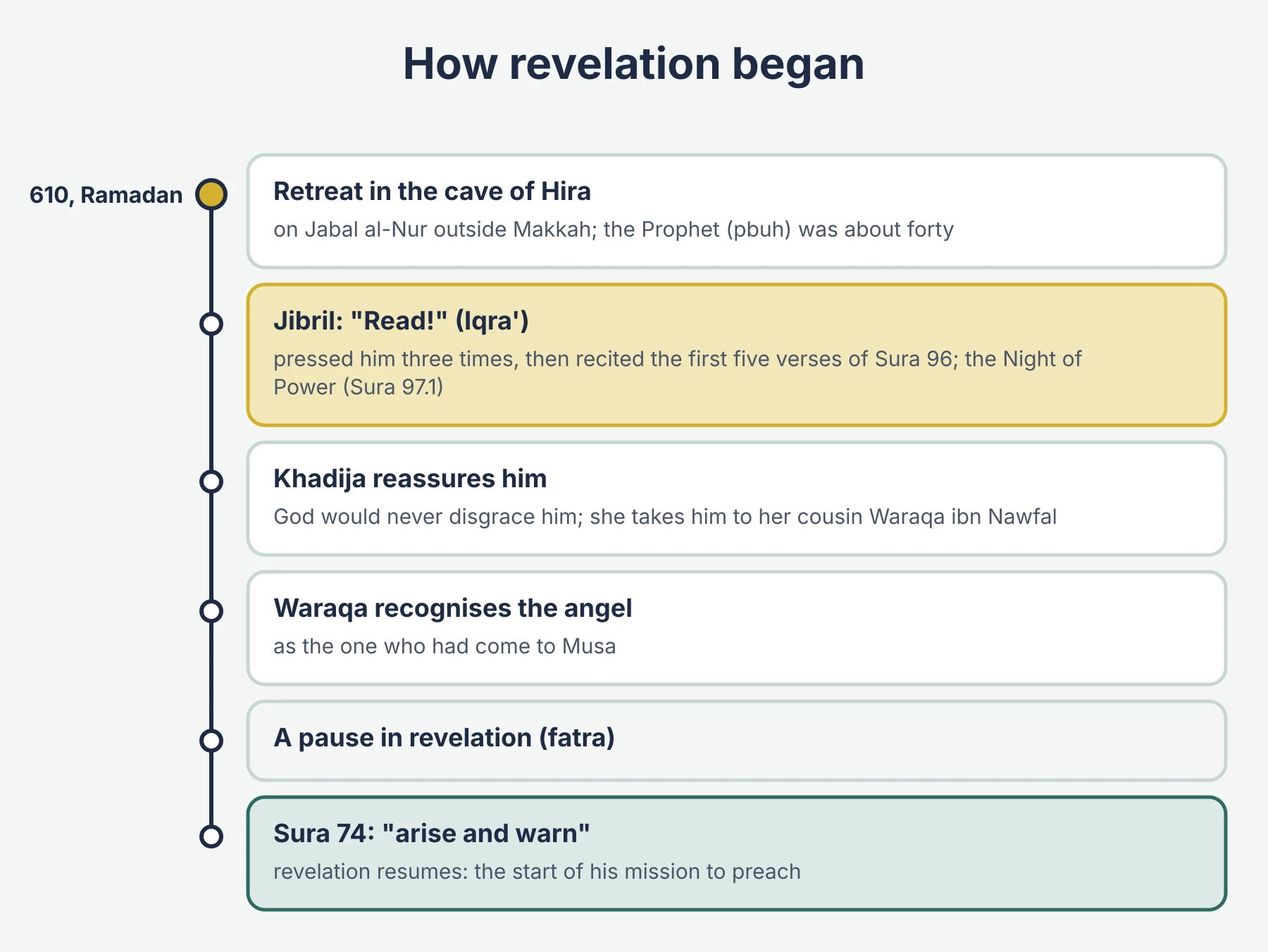
- Hira, Ramadan 610. The Prophet (pbuh), about forty, in retreat on Jabal al-Nur; Jibril commands “Read!”; Sura 96.1–5 revealed.
- Khadija (RA) comforts him: God would never disgrace one who helps kin, the weak and guests.
- Waraqa ibn Nawfal identifies the angel as the one sent to Musa and warns that his people will drive him out.
- Fatra (pause), then Sura 74.1–2: “Arise and warn”.
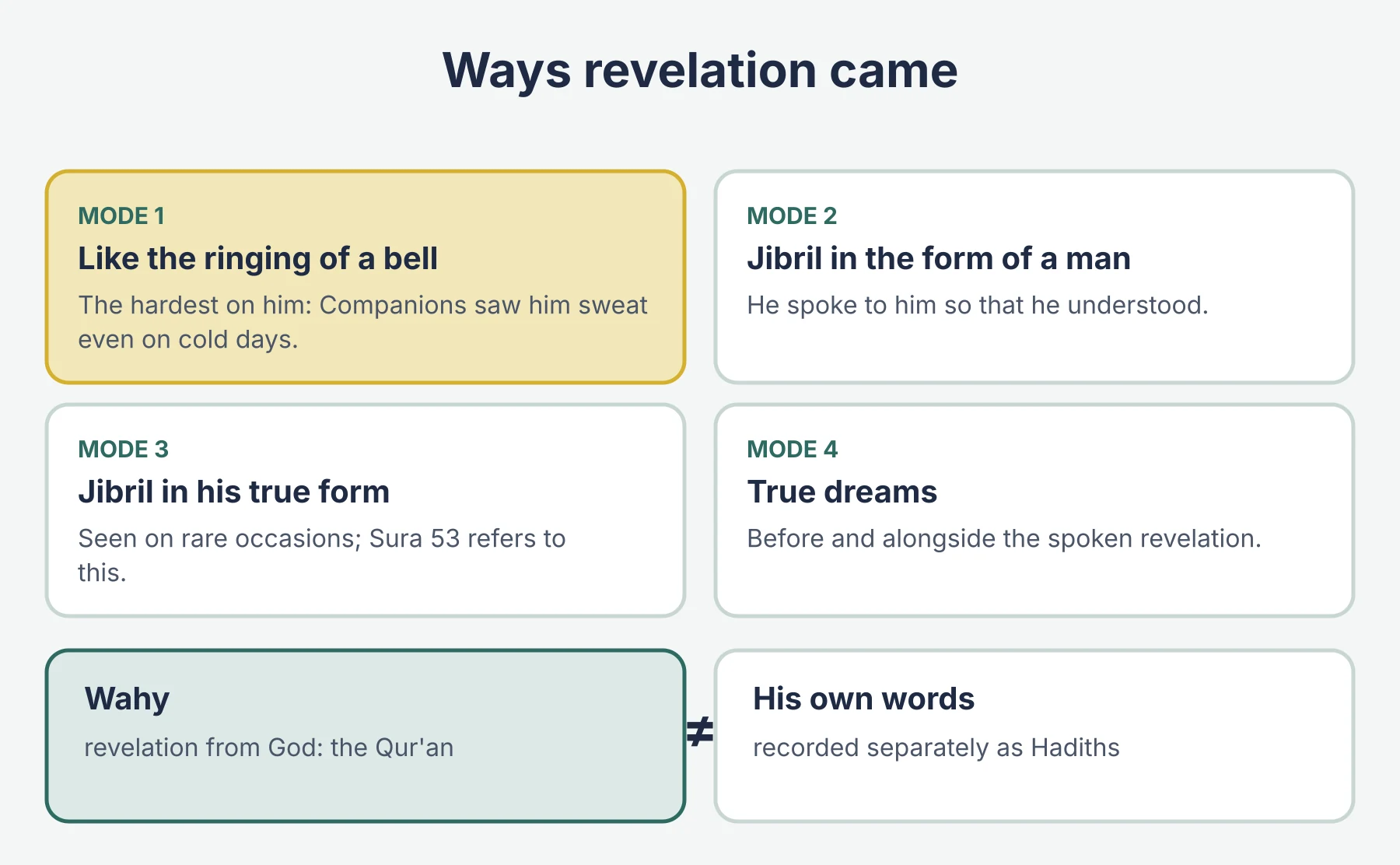
- Modes: ringing of a bell (hardest); Jibril as a man; Jibril in true form; true dreams.
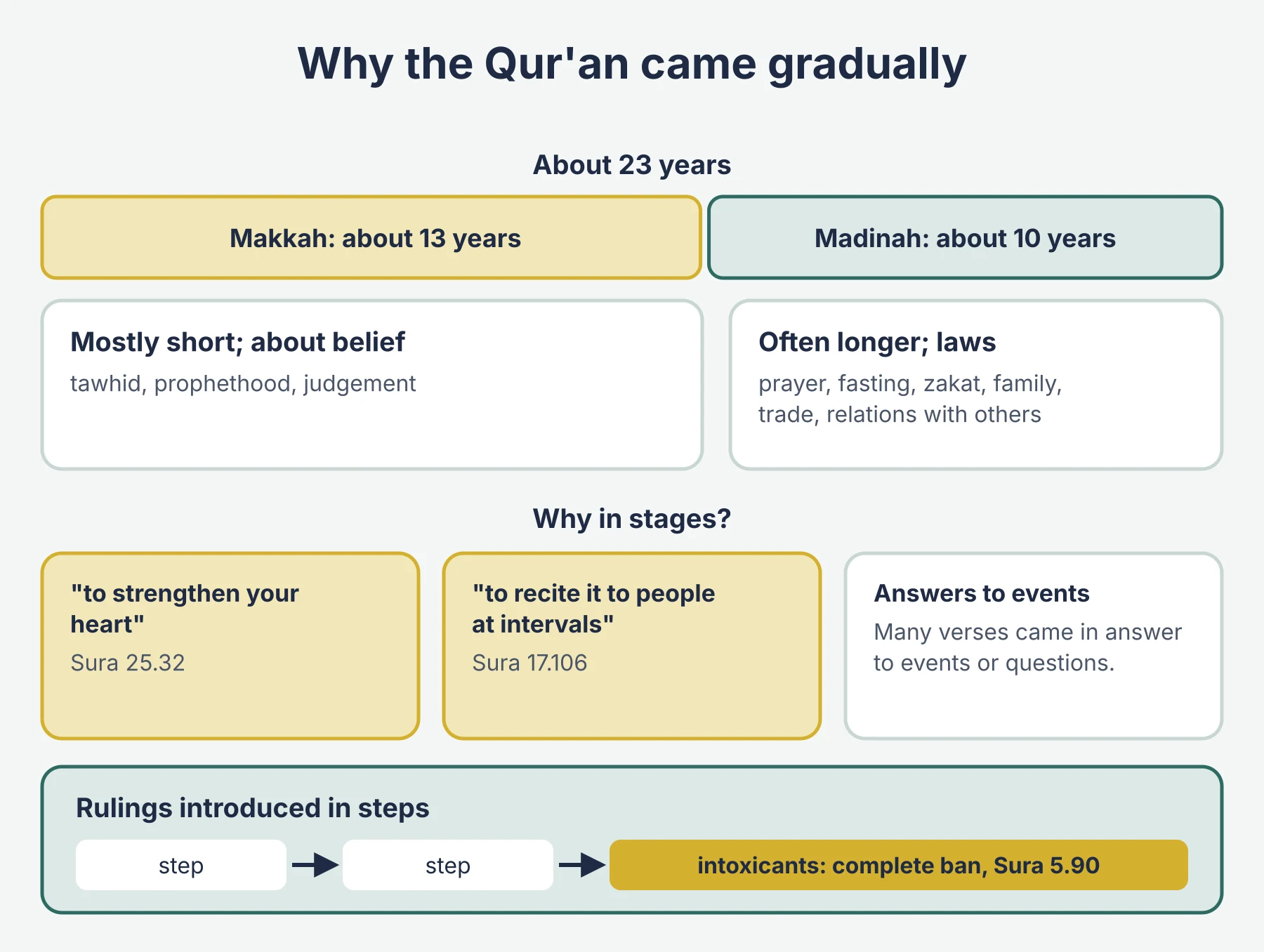
- About 23 years: roughly 13 in Makka, 10 in Madina; often linked to events and questions.
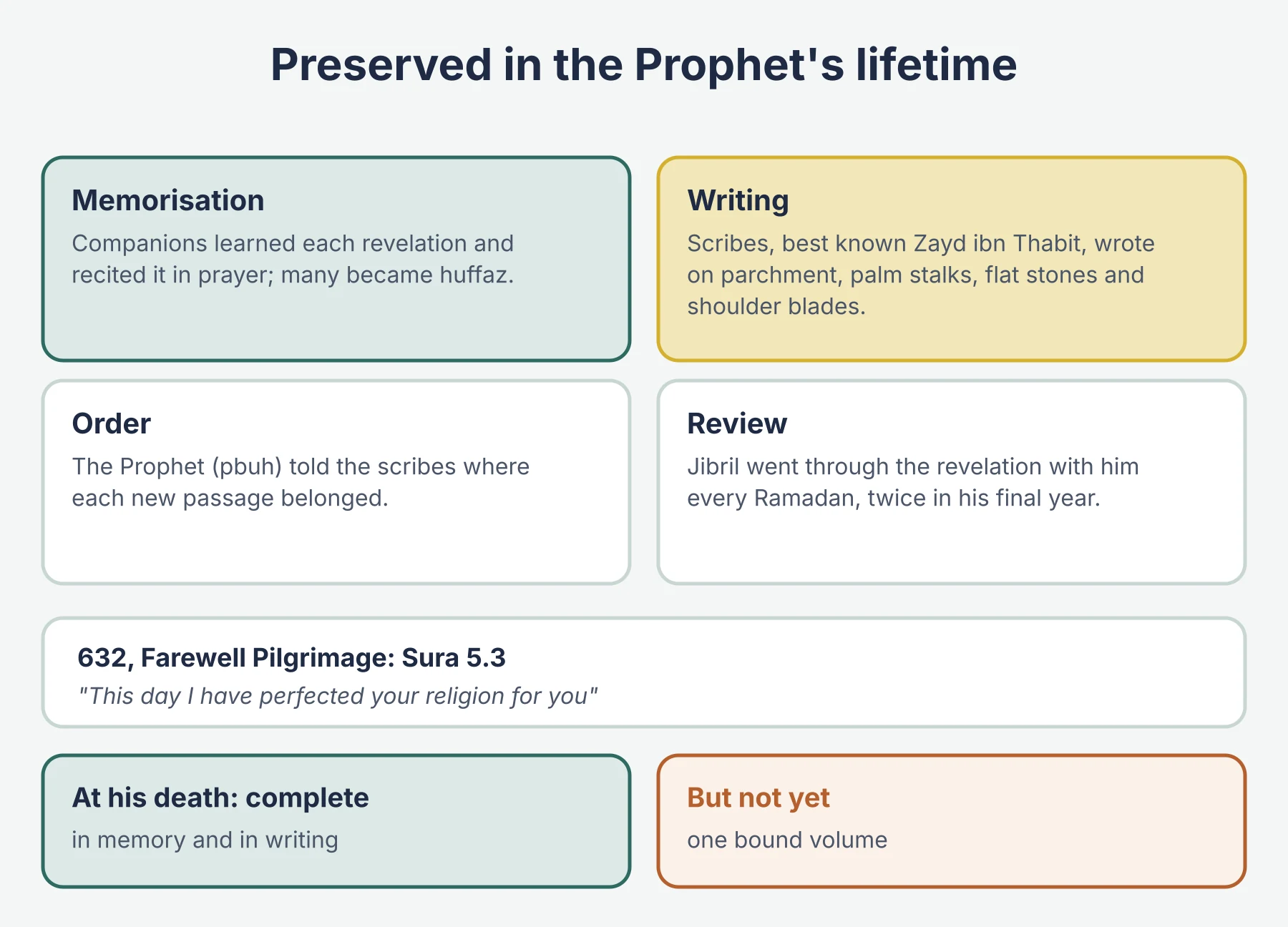
- Preservation: memorised and recited in prayer; written by scribes on parchment, palm stalks, stones and bones; order of verses set by the Prophet (pbuh).
- Annual review with Jibril in Ramadan; twice in the final year.
- Sura 5.3 revealed at the Farewell Pilgrimage, 632: “This day I have perfected your religion”.
Makkan vs Madinan: Makkan passages are shorter and stress belief, the oneness of God, the prophets and the hereafter. Madinan passages are longer and include laws for worship, family, trade, war and peace.
Reasons for gradual revelation (part (b)): strengthened the Prophet’s (pbuh) heart (Sura 25.32); easier to memorise and act upon (Sura 17.106); answered real situations; introduced laws step by step, as with the ban on intoxicants (Sura 5.90).
Compilation: two stages
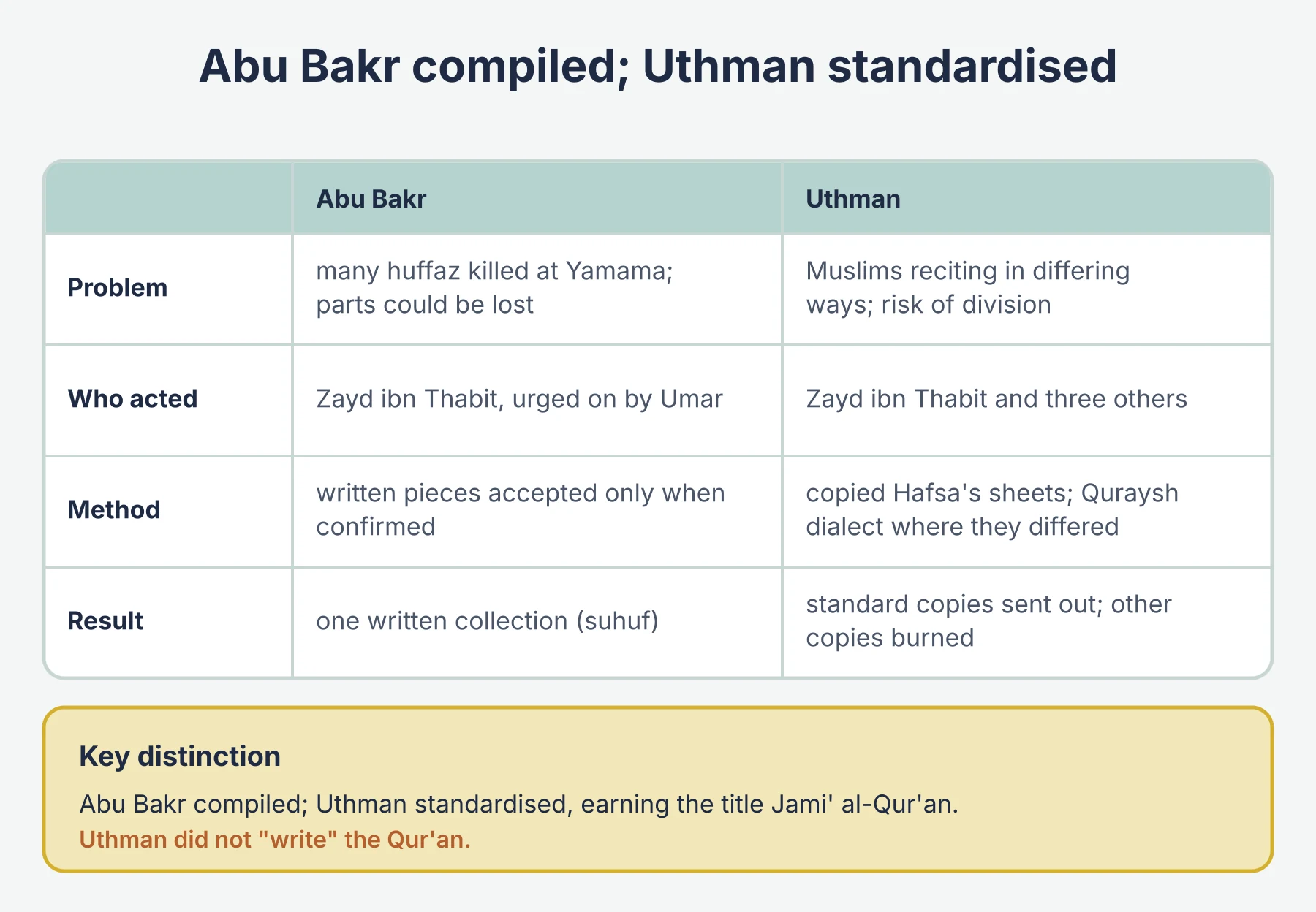
| Abu Bakr (RA) | Uthman (RA) | |
|---|---|---|
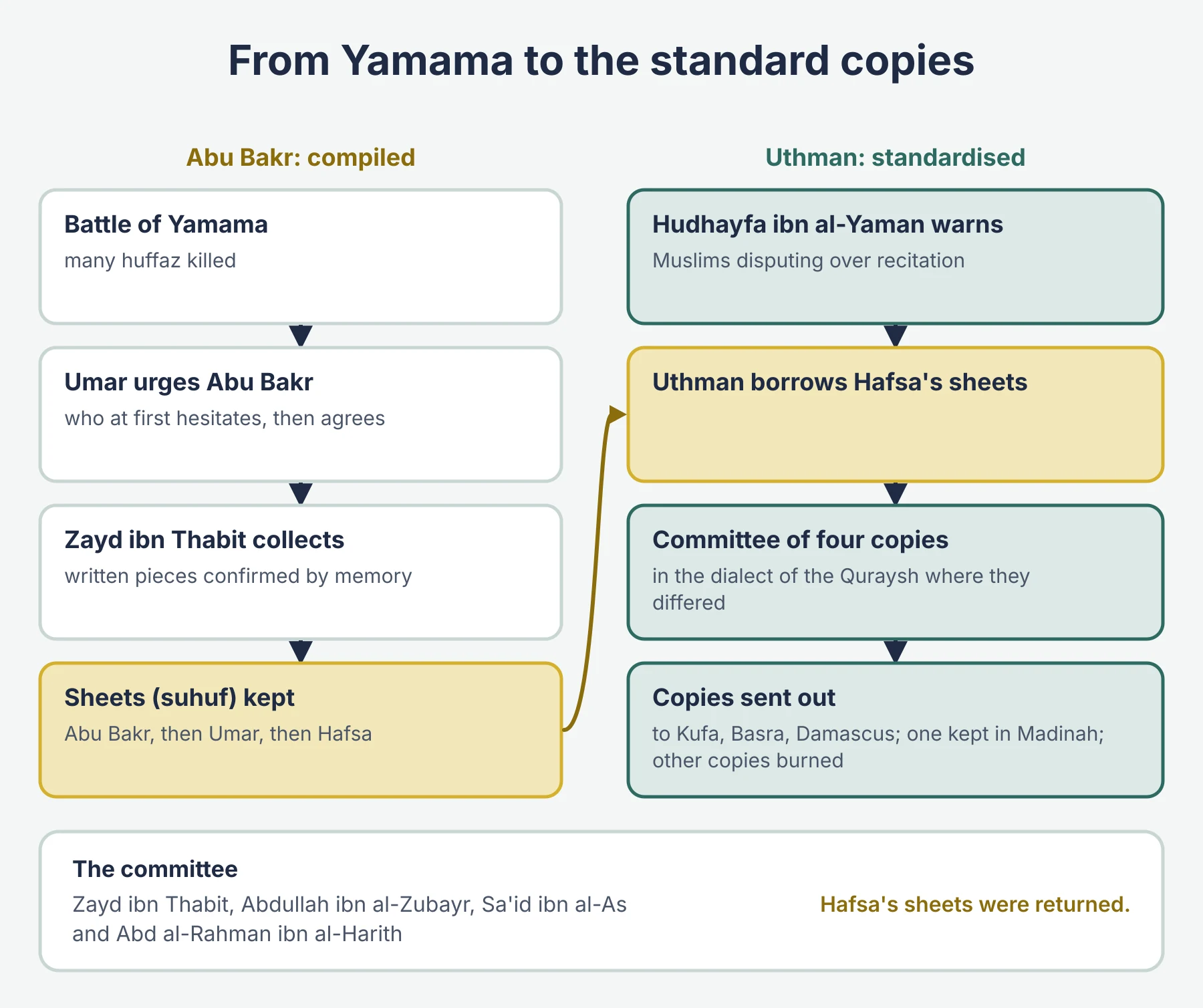
| Trigger | Many huffaz killed at Yamama during the Ridda wars | Disputes over recitation reported by Hudhayfa ibn al-Yaman after campaigns in Armenia and Azerbaijan |
| Who urged it | Umar (RA) | Hudhayfa |
| Who did the work | Zayd ibn Thabit (RA) | Zayd ibn Thabit (RA), Abdullah ibn al-Zubayr, Sa’id ibn al-As, Abd al-Rahman ibn al-Harith |
| Method | Collected written pieces; accepted them only when confirmed by Companions’ memory | Copied Hafsa’s (RA) sheets; where the copyists differed, they followed the dialect of Quraysh |
| Result | One complete collection, the suhuf | Standard copies sent to major centres; other copies burned |
| Where it went | Abu Bakr (RA), then Umar (RA), then Hafsa (RA) | Copies to cities such as Kufa, Basra and Damascus; one kept in Madina; sheets returned to Hafsa (RA) |
One line to remember: Abu Bakr (RA) collected; Uthman (RA) standardised and distributed.
Detail that lifts a Level 3 answer to Level 4: Abu Bakr’s (RA) initial reluctance; Zayd’s remark that moving a mountain would have been easier; the last verses of Sura 9 found written only with Abu Khuzayma al-Ansari; Hafsa’s (RA) role as keeper of the sheets.
The Qur’an in legal thinking
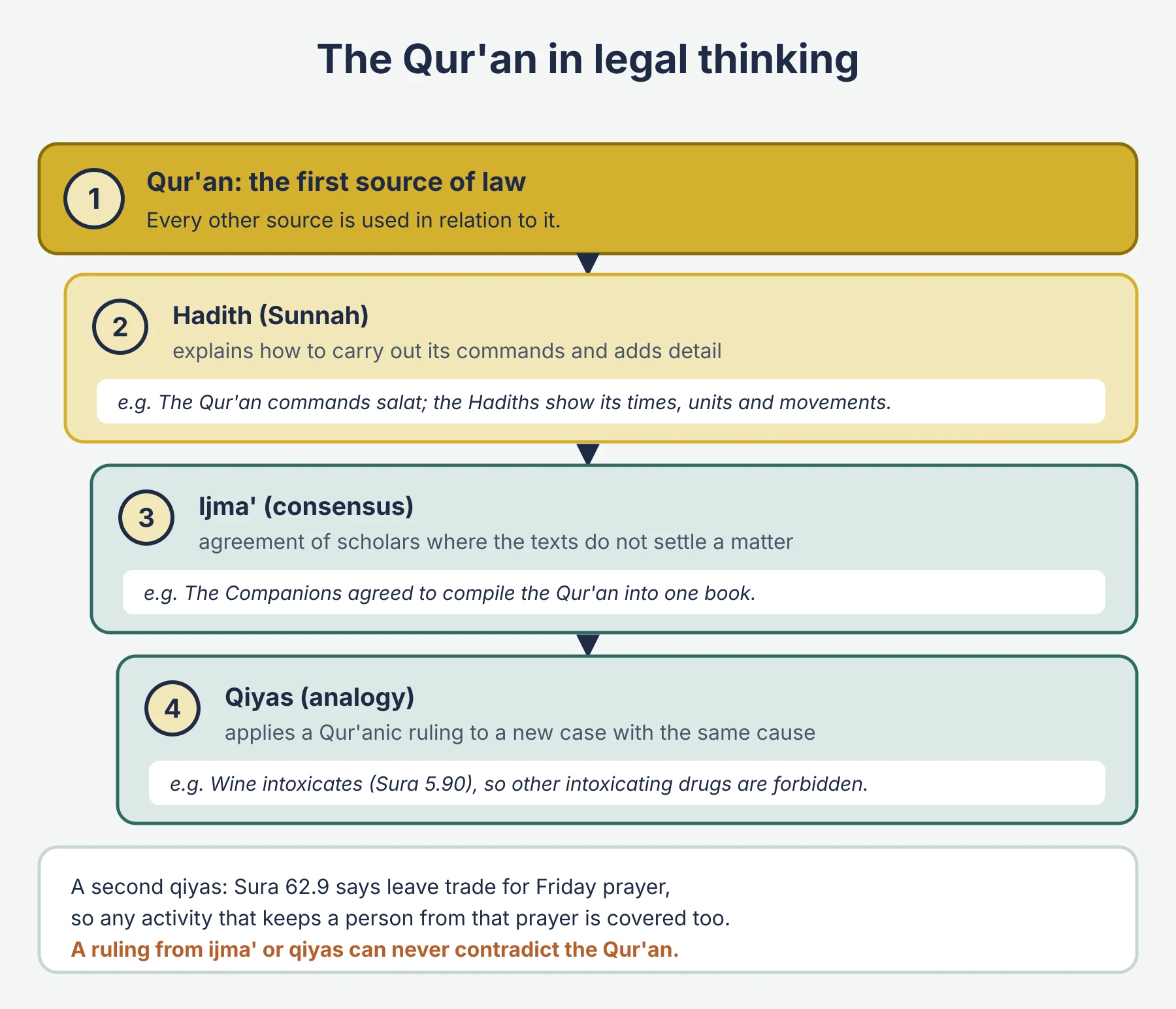
- Qur’an: first source; nothing may contradict it.
- Hadith: explains and details it, e.g. how to pray, zakat rates, hajj rites.
- Ijma’: agreement of scholars, e.g. the decision to compile the Qur’an.
- Qiyas: new case judged by an existing ruling with the same cause, e.g. drugs forbidden like wine because they intoxicate; all business forbidden at the time of the Friday call (Sura 62.9).
Order of use: Qur’an first, then Hadith; if neither answers, ijma’; if there is no consensus, qiyas.
Why the Qur’an is the basis of thought and action
- Direct word of God; final and complete guidance (Sura 2.2).
- Preserved unchanged, as God promises to guard it (Sura 15.9).
- Recited in every prayer; memorised from childhood.
- Source of law and of everyday conduct.
- Unites Muslims across languages through one Arabic text.
Exam traps
- Mixing revelation and compilation. Revelation ends in 632; compilation begins after.
- Crediting Uthman (RA) with the first collection. His copies came from Abu Bakr’s (RA) sheets.
- Missing Hafsa (RA). She kept the sheets between the two stages.
- Vague legal examples. Name a source and a specific case.
- Narrative in part (b). Part (b) asks why or how important: give reasons, not more events.
Self-test
- In which month and year did revelation begin, and where?
- Which verses were revealed first?
- Name two modes of revelation described by the Prophet (pbuh).
- What command came when revelation resumed after the pause?
- Give two reasons the Qur’an itself gives for gradual revelation.
- Which battle prompted the first compilation, and who urged it?
- Why was Zayd ibn Thabit (RA) chosen?
- Who kept the sheets after Umar’s (RA) death?
- Who warned Uthman (RA) about differences in recitation?
- Name the four men on Uthman’s (RA) copying committee.
- Give one example of qiyas based on a Qur’anic ruling.
- Give two reasons the Qur’an is central to a Muslim’s daily life.
Answers: 1. Ramadan 610, in the cave of Hira on Jabal al-Nur. 2. Sura 96.1–5. 3. Any two: like the ringing of a bell; Jibril in the form of a man; Jibril in his true form; true dreams. 4. Sura 74.1–2, “Arise and warn”. 5. To strengthen the Prophet’s (pbuh) heart (25.32); so it could be recited to people at intervals (17.106). 6. Yamama; Umar (RA) urged Abu Bakr (RA). 7. He was young, trustworthy, a scribe of revelation who had memorised the Qur’an and had been present at the final review. 8. Hafsa (RA), the Prophet’s wife and Umar’s (RA) daughter. 9. Hudhayfa ibn al-Yaman. 10. Zayd ibn Thabit (RA), Abdullah ibn al-Zubayr, Sa’id ibn al-As, Abd al-Rahman ibn al-Harith. 11. Drugs are forbidden by analogy with wine, because both intoxicate (or: all activity is forbidden at the Friday call, by analogy with trade in 62.9). 12. Any two: it is recited in every prayer; it is the first source of law; it guides daily conduct; it is God’s preserved word; it unites Muslims.
Related pages
- History and Importance of the Qur’an study guide
- History and Importance of the Qur’an practice questions
- Paper 1 revision notes
Source: Cambridge International, Cambridge IGCSE Islamiyat 0493 syllabus for examination in 2026 and 2027, Paper 1 Topic 2.
Related resources
-
Study guides
Cambridge IGCSE Islamiyat (0493): The Life and Importance of the Prophet Muhammad (pbuh)
Study guide to the Prophet's life in Makka and Madina, his character, his example for individuals and states, and the Seal of the Prophets, for IGCSE 0493.
Islamiyat · Cambridge · IGCSE
Read guide -
Practice questions
Cambridge IGCSE Islamiyat (0493): The Life and Importance of the Prophet Muhammad (pbuh) — Practice Questions
Twelve original questions on the Hijra, Uhud, the Trench, the Farewell Sermon and life in Madina for Cambridge IGCSE Islamiyat 0493 Paper 1, with mark guidance.
Islamiyat · Cambridge · IGCSE
Try questions -
Revision notes
Cambridge IGCSE Islamiyat (0493): The Life and Importance of the Prophet Muhammad (pbuh) — Revision Notes
Recall notes on the Prophet's (pbuh) life for 0493 Paper 1: timeline, Makkan opposition, the Madinan battles and treaties, lessons for today, and a self-test.
Islamiyat · Cambridge · IGCSE
Revise topic
Get free revision emails (optional)
Occasional emails with practice questions, worked explanations and links to free resources for the qualification and subjects you choose. No spam, and you can unsubscribe from any email. The free tools on this site never need an email.