
Revision Notes
Cambridge IGCSE Islamiyat (0493): The Life and Importance of the Prophet Muhammad (pbuh) — Revision Notes
Recall notes on the Prophet's (pbuh) life for 0493 Paper 1: timeline, Makkan opposition, the Madinan battles and treaties, lessons for today, and a self-test.
- Subject
- Islamiyat
- Level
- IGCSE
- Topic
- Paper 1
- Author
- Marlbridge Academic Team
- Updated
- Reviewed by
- Azam Siddique (what this means)
Aligned to Cambridge IGCSE Islamiyat (0493), 2026-2027. Official specification .
Syllabus page (what it covers and how it is assessed): Cambridge IGCSE Islamiyat.
Syllabus points this page covers
0493
- 1.3 The Life and Importance of the Prophet Muhammad (pbuh)
Found an error? Report a correction.
Need help with this topic? Request a free trial class for IGCSE Islamiyat (0493).
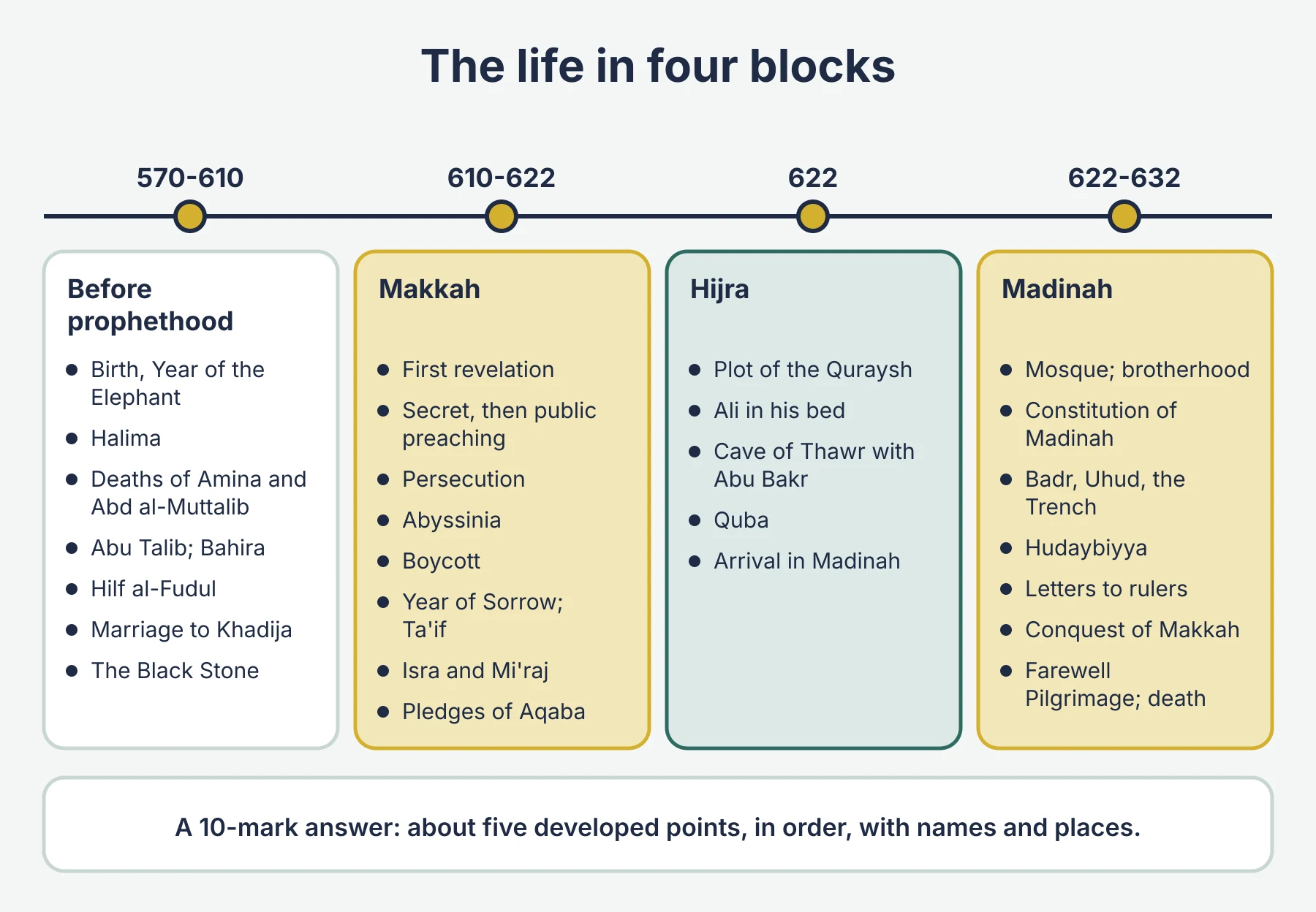
These notes condense Paper 1 Topic 3 of Cambridge IGCSE Islamiyat 0493, The Life and Importance of the Prophet Muhammad (pbuh). One or two of Questions 3 to 5 are set on this topic. Learn the events in order with the names and places that make a point “developed”, and attach to each major event one lesson for individuals and one for communities, ready for part (b).
Syllabus coverage
0493 Paper 1, Topic 3 (2026–2027 syllabus): birth to call; Makka and his opponents; Madina, his leadership and conflicts; actions and character; example for individuals, including with women and non-Muslims; example for communities in relations with other states; Seal of the Prophets.
Key terms
| Term | Meaning |
|---|---|
| Al-Amin / al-Sadiq | The Trustworthy / the Truthful: his titles before prophethood |
| Hilf al-Fudul | Pact of clans to protect anyone wronged in Makka |
| Hijra | Migration from Makka to Madina, 622; start of the Islamic calendar |
| Muhajirun | Emigrants from Makka |
| Ansar | Helpers: the Muslims of Madina |
| Mu’akhat | Brotherhood pairing each Emigrant with a Helper |
| Isra and Mi’raj | Night journey to Jerusalem and ascension through the heavens |
| Ghazwa | An expedition led by the Prophet (pbuh) himself |
| Khatam al-nabiyyin | Seal of the Prophets (Sura 33.40) |
| Khutbat al-wada’ | The Farewell Sermon, 10 AH |
Timeline
Before prophethood
- 570: born in Makka, Year of the Elephant; father Abdullah already dead.
- With Halima in the desert; Amina dies when he is six; Abd al-Muttalib until he is eight; then Abu Talib.
- About twelve: caravan to Syria; the monk Bahira sees signs of prophethood.
- Young man: shepherd, then trader; joins Hilf al-Fudul.
- 25: marries Khadija (RA). 35: places the Black Stone on a cloak lifted by all the clans.
Makka, 610–622
- 610: first revelation in Hira.
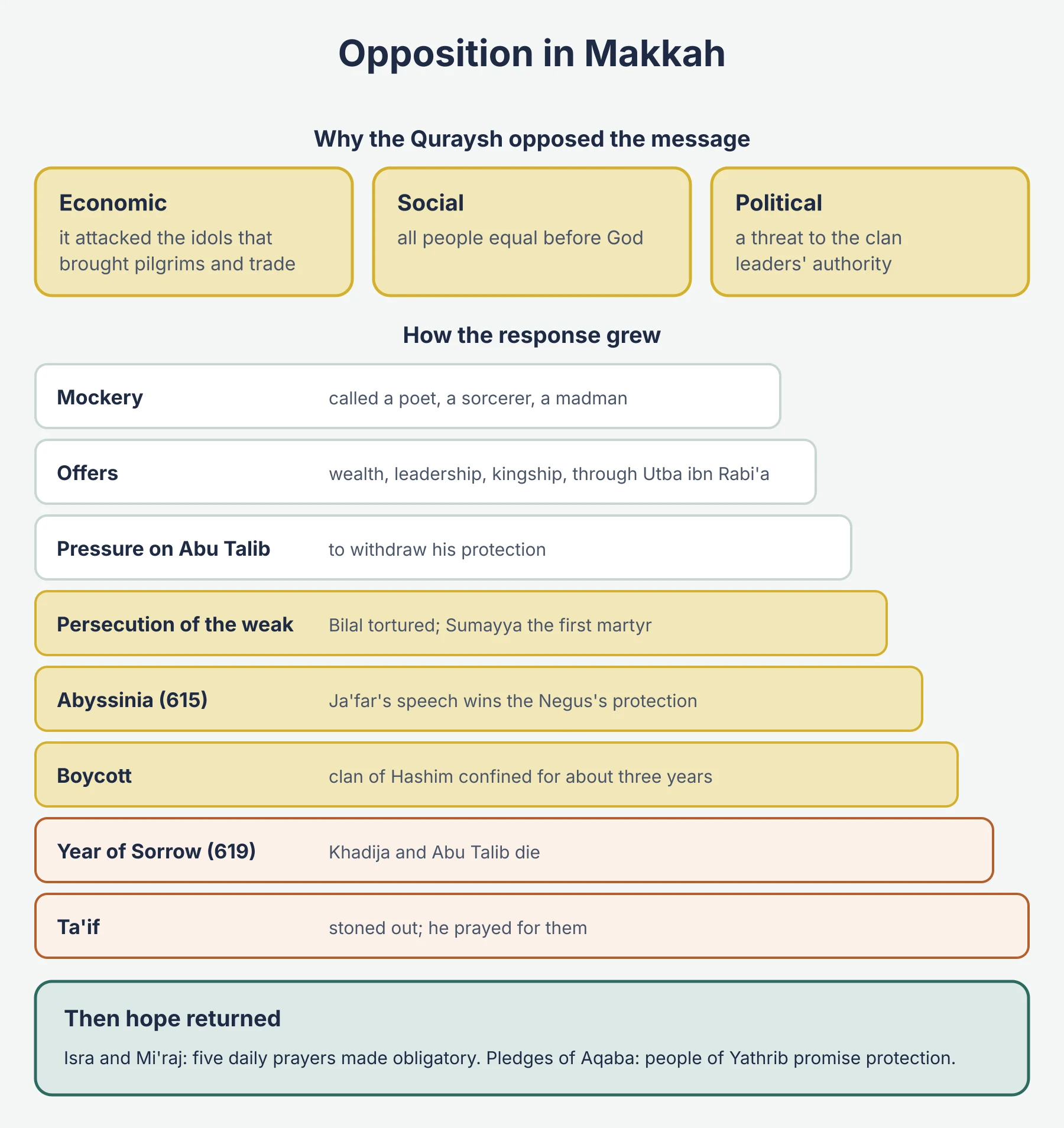
- About 613: public call from Mount Safa; Abu Lahab’s hostility (Sura 111).
- Persecution of Bilal (RA), Sumayya, Yasir and Ammar; offers through Utba ibn Rabi’a refused.
- 615: Muslims migrate to Abyssinia; Ja’far’s speech before the Negus.
- About 616–619: boycott of Banu Hashim in the valley of Abu Talib.
- 619: Year of Sorrow, deaths of Khadija (RA) and Abu Talib; visit to Ta’if with Zayd ibn Haritha (RA).
- Isra and Mi’raj: five daily prayers made obligatory.
- 621 and 622: first and second pledges of Aqaba with people of Yathrib.
Hijra, 622
- Quraysh plan to kill him, one man from each clan; Ali (RA) sleeps in his bed.
- Three days in the cave of Thawr with Abu Bakr (RA); pursuers turn back.
- Stops at Quba and builds its mosque; enters Madina, staying with Abu Ayyub al-Ansari.
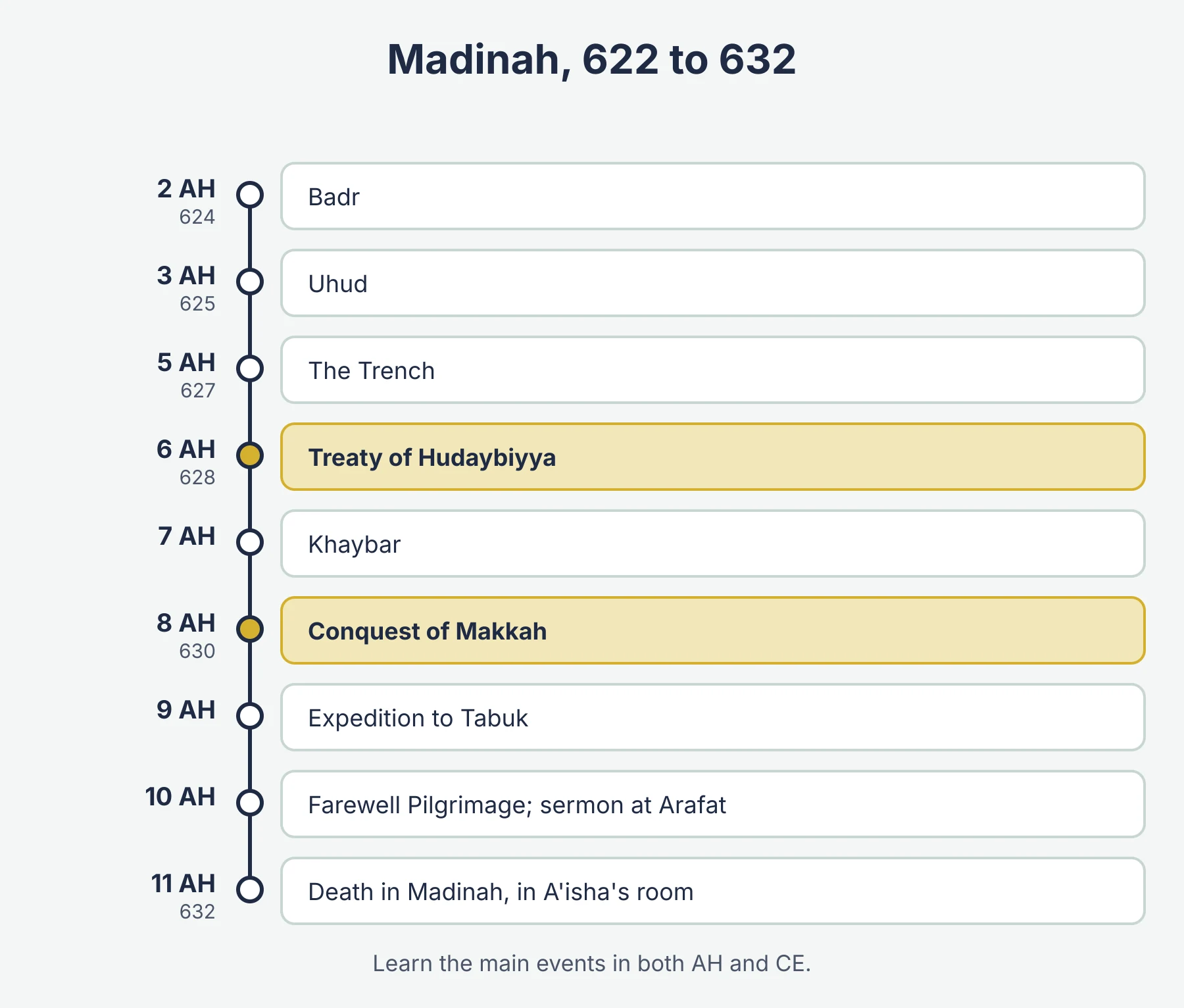
Madina, 622–632
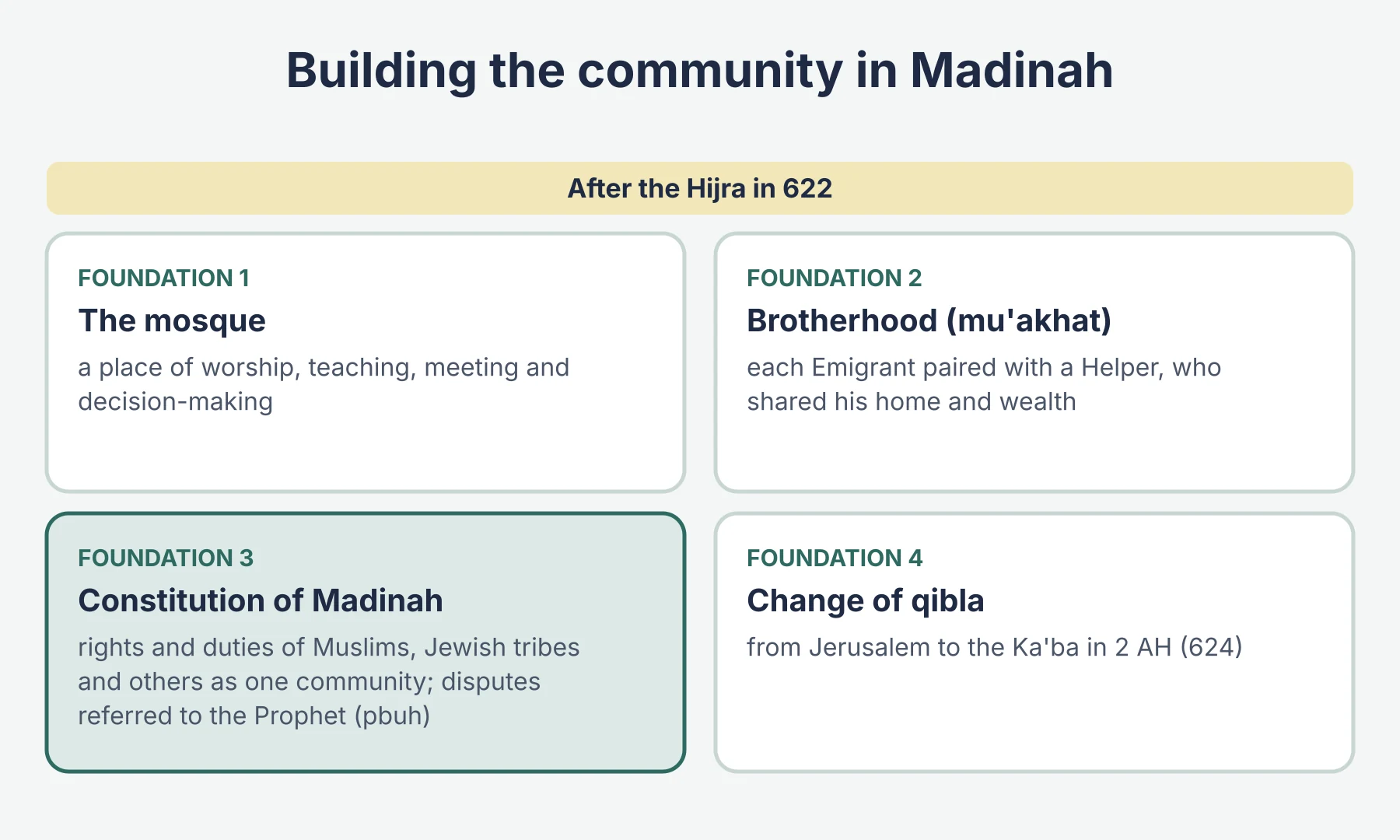
- Prophet’s mosque; mu’akhat; Constitution of Madina.
- 2 AH (624): qibla changed to the Ka’ba; Badr in Ramadan, about 313 Muslims defeat a much larger Makkan army.
- 3 AH (625): Uhud.
- 5 AH (627): the Trench.
- 6 AH (628): Hudaybiyya; letters to rulers follow.
- 7 AH: Khaybar; the delayed umra.
- 8 AH (630): conquest of Makka; Hunayn.
- 9 AH: Tabuk; many delegations accept Islam.
- 10 AH: Farewell Pilgrimage and sermon at Arafat.
- 11 AH (632): death in A’isha’s room; buried there.
Uhud and the Trench: detail that earns credit
Uhud (3 AH): the Quraysh came to avenge Badr with about 3,000 men. The Prophet (pbuh) consulted and went out to meet them; Abdullah ibn Ubayy withdrew with about a third of the army, leaving about 700. Fifty archers under Abdullah ibn Jubayr were placed on a hill and ordered not to move. The Muslims were winning, but most archers left to collect spoils; Khalid ibn al-Walid’s cavalry attacked from behind. Hamza (RA) was killed, the Prophet (pbuh) was wounded, and a rumour of his death spread. Lesson: obedience to leadership and not being distracted by wealth.
Trench (5 AH): a confederate army of Quraysh and allied tribes, about 10,000, marched on Madina. Salman al-Farsi (RA) advised digging a trench across the open northern side; the Prophet (pbuh) dug with the Companions in cold and hunger. The siege lasted weeks; a fierce wind and divisions among the enemy broke it. The Banu Qurayza, who had broken their treaty, were then besieged. Lesson: consultation, shared hardship between leader and people, trust in God.
Lessons for part (b)
| Event | For individuals | For communities and states |
|---|---|---|
| Ta’if | Patience; pray for those who harm you | Do not answer rejection with revenge |
| Hijra | Trust in God with careful planning | A people may move to safety to protect faith |
| Constitution of Madina | Live peacefully with neighbours of other faiths | Equal rights and duties under agreed law |
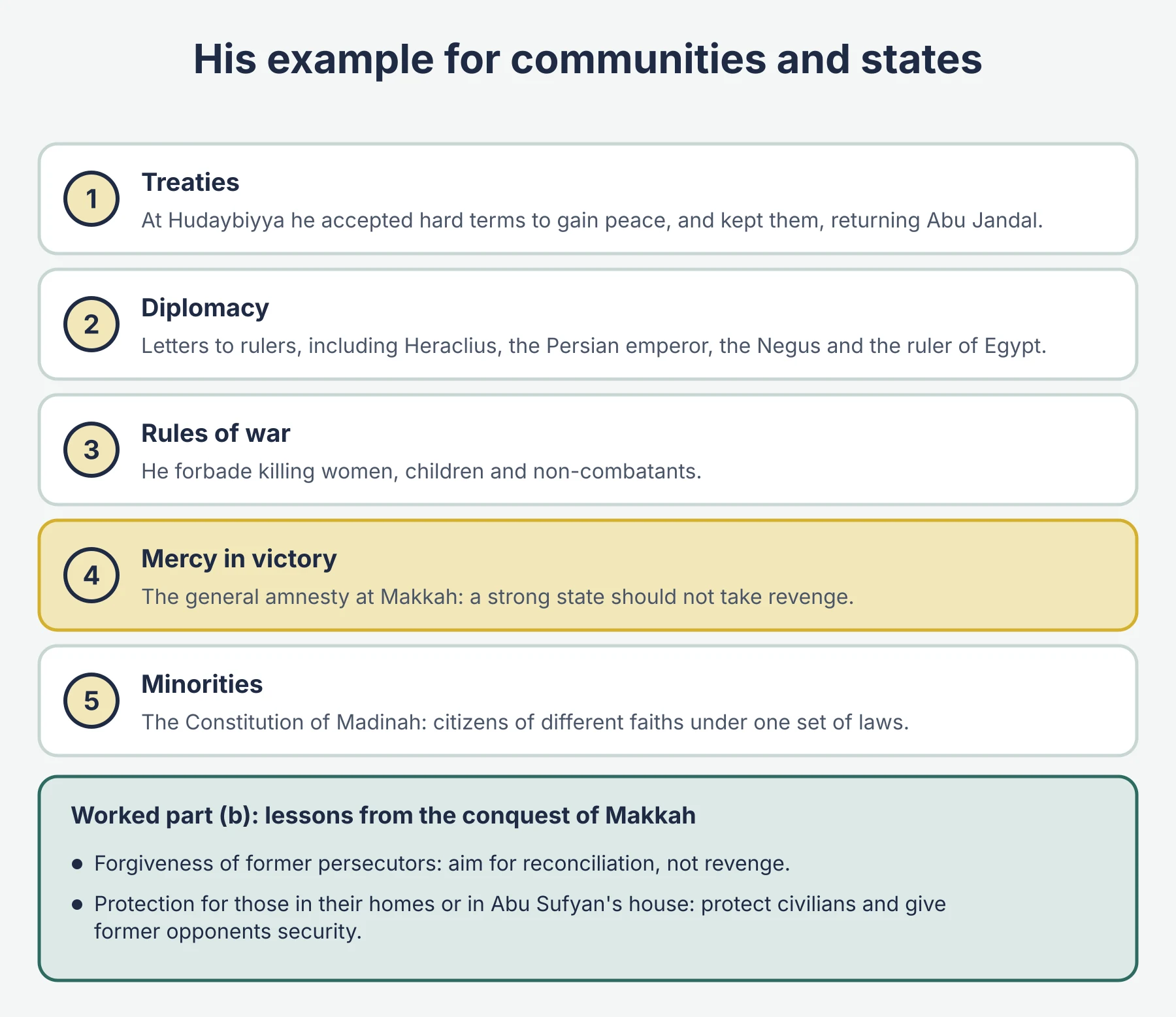
| Hudaybiyya | Keep promises even when costly | Compromise for peace; honour treaties |
| Letters to rulers | Invite others politely | Peaceful diplomacy between states |
| Conquest of Makka | Forgive personal enemies | Amnesty and protection of civilians after victory |
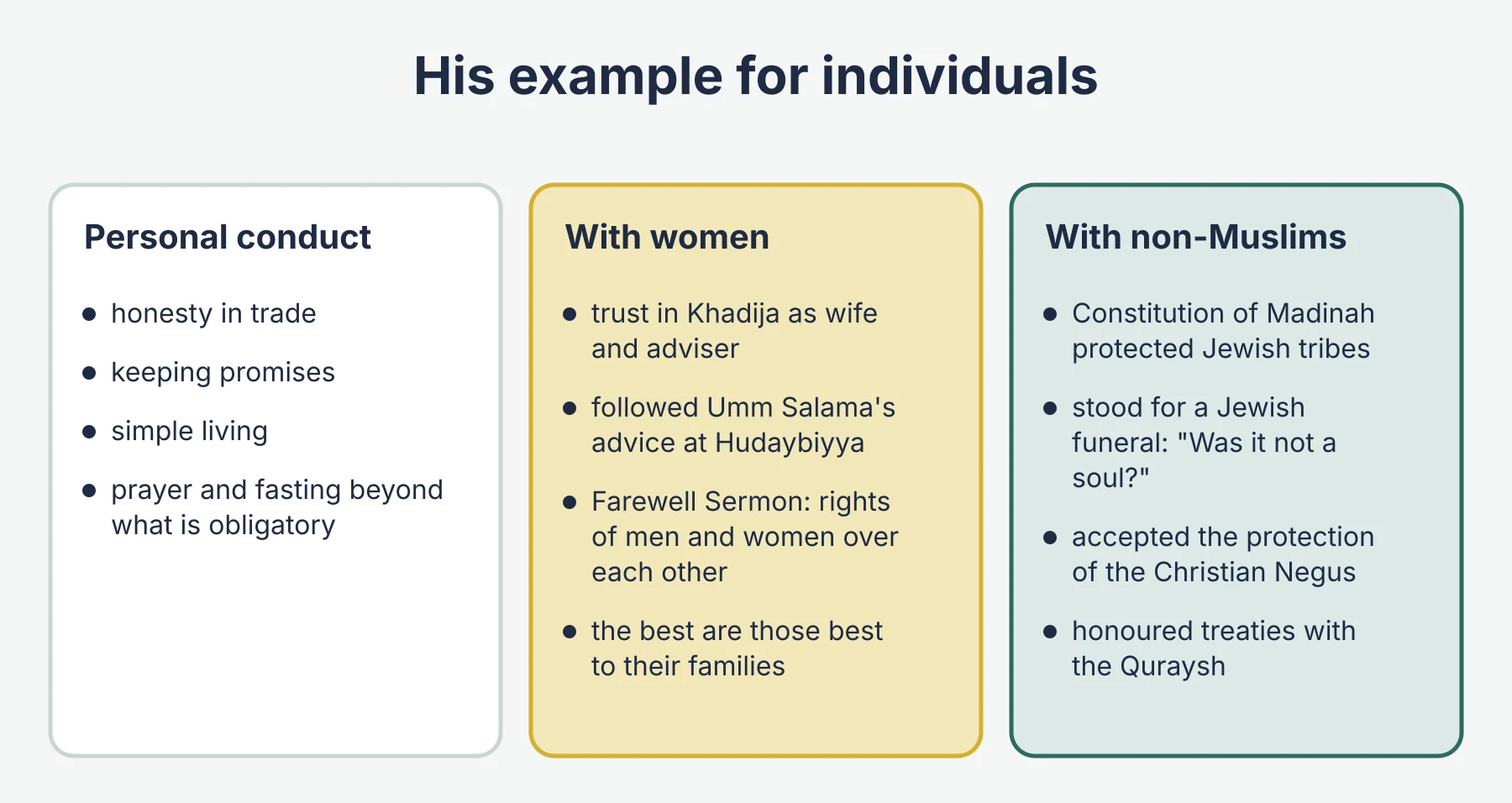
| Farewell Sermon | Rights of spouses; honesty in dealings | Equality of all races; sanctity of life and property |
Seal of the Prophets: four points
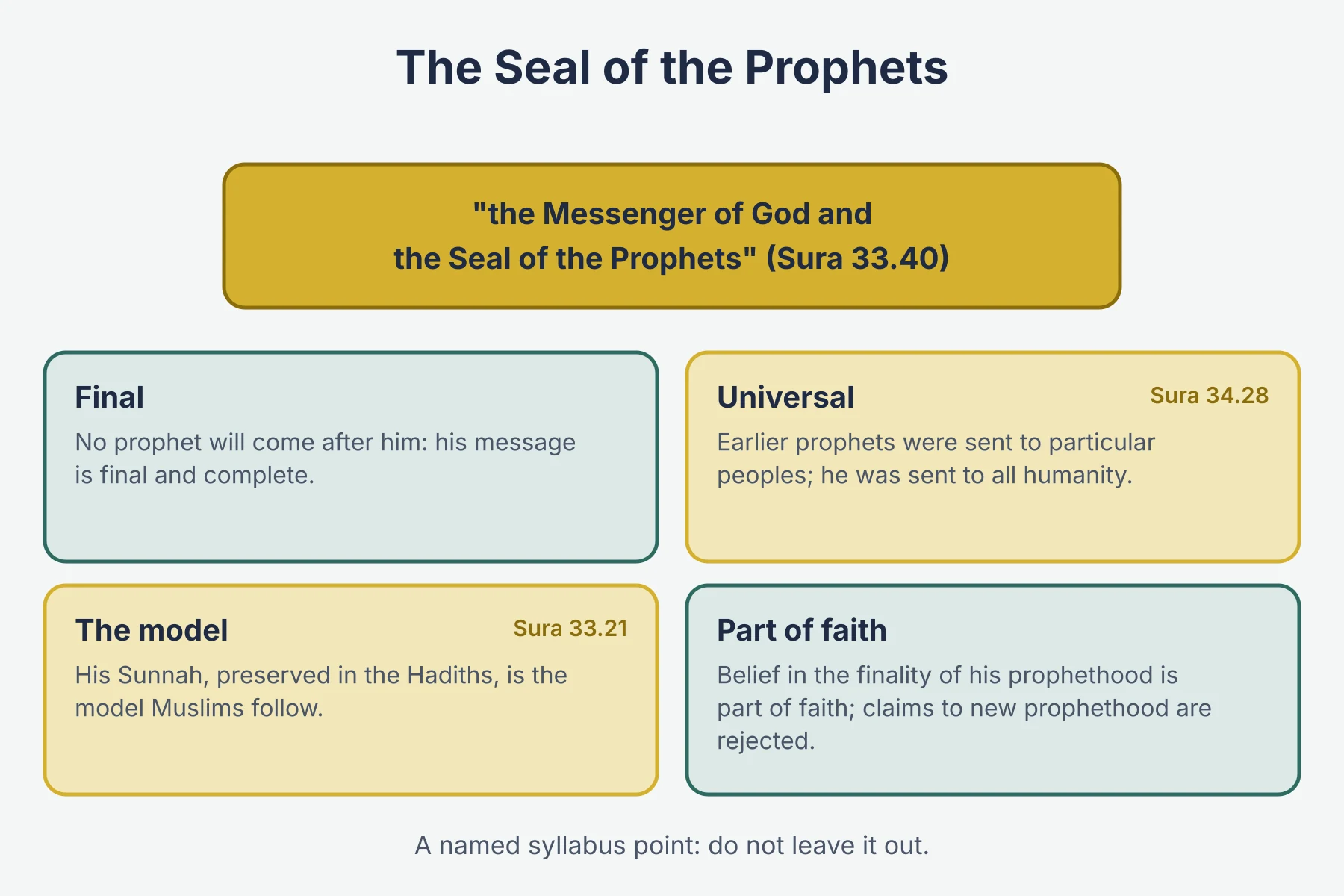
- Sura 33.40 names him the Seal of the Prophets.
- No prophet comes after him; his message completes earlier ones.
- He was sent to all humanity, not one people (Sura 34.28).
- His Sunnah is the lasting model (Sura 33.21).
Exam traps
- Writing everything you know when the question names one event.
- Placing Isra and Mi’raj after the Hijra: it took place in Makka.
- Saying the archers at Uhud were “defeated”: they left their post.
- Giving lessons for individuals when the question asks about states.
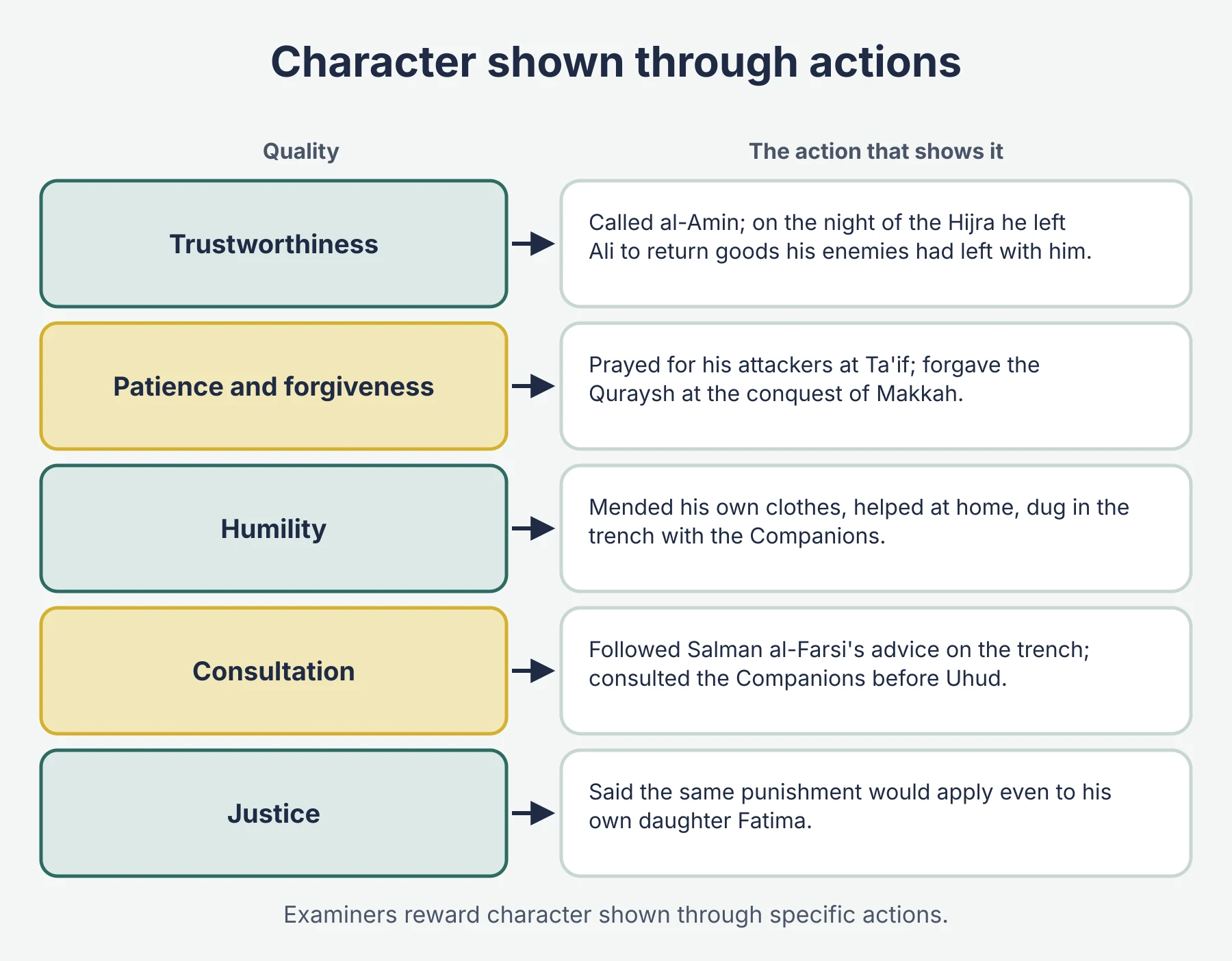
- Leaving out the Prophet’s (pbuh) own actions; the syllabus stresses actions and character.
Self-test
- Who cared for the Prophet (pbuh) after his mother’s death?
- What was Hilf al-Fudul?
- Where did Muslims migrate in 615, and who spoke for them?
- Which two deaths made 619 the Year of Sorrow?
- What became obligatory during the Mi’raj?
- Who slept in the Prophet’s (pbuh) bed on the night of the Hijra?
- Name two provisions of the Constitution of Madina.
- Why did the Muslims suffer losses at Uhud?
- Whose idea was the trench, and why did it work?
- What did the Prophet (pbuh) do with his enemies at the conquest of Makka?
- Give two teachings of the Farewell Sermon.
- Which verse calls him the Seal of the Prophets, and what does the title mean?
Answers: 1. His grandfather Abd al-Muttalib, then his uncle Abu Talib. 2. A pact of clans to defend anyone wronged in Makka; he joined it as a young man. 3. Abyssinia; Ja’far ibn Abi Talib. 4. Khadija (RA) and Abu Talib. 5. The five daily prayers. 6. Ali (RA). 7. Any two: all groups formed one community; Jews kept their religion; all would defend Madina together; disputes went to the Prophet (pbuh); no one would aid the Quraysh. 8. Most archers left the hill against orders to collect spoils, and Khalid’s cavalry attacked from behind. 9. Salman al-Farsi’s (RA); the cavalry could not cross it, so the siege stalled. 10. He forgave them in a general amnesty. 11. Any two: all people are equal, no Arab is superior to a non-Arab except in righteousness; life and property are sacred; husbands and wives have rights over each other; usury is forbidden. 12. Sura 33.40; no prophet will come after him and his message is final.
Related pages
- Life of the Prophet (pbuh) study guide
- Life of the Prophet (pbuh) practice questions
- Paper 1 revision notes
Source: Cambridge International, Cambridge IGCSE Islamiyat 0493 syllabus for examination in 2026 and 2027, Paper 1 Topic 3.
Related resources
-
Study guides
Cambridge IGCSE Islamiyat (0493): Major Themes of the Qur'an
How to read the fifteen set Qur'an passages for 0493 Paper 1 Question 1: finding the theme, using key Arabic words and linking each one to Muslim life.
Islamiyat · Cambridge · IGCSE
Read guide -
Practice questions
Cambridge IGCSE Islamiyat (0493): Major Themes of the Qur'an — Practice Questions
Twelve original questions on the set Qur'an passages for Cambridge IGCSE Islamiyat 0493 Paper 1 Question 1, with themes, applications and full mark guidance.
Islamiyat · Cambridge · IGCSE
Try questions -
Revision notes
Cambridge IGCSE Islamiyat: Major Themes of the Qur'an — Revision Notes (0493)
Passage-by-passage recall notes on the 15 set Qur'an passages for Cambridge IGCSE Islamiyat 0493 Paper 1 Question 1: theme, key ideas and importance to Muslims.
Islamiyat · Cambridge · IGCSE
Revise topic
Get free revision emails (optional)
Occasional emails with practice questions, worked explanations and links to free resources for the qualification and subjects you choose. No spam, and you can unsubscribe from any email. The free tools on this site never need an email.