
Study Guides
Cambridge IGCSE Islamiyat (0493): The First Islamic Community
The Prophet's wives, descendants and Imams, the Ten Blessed Companions, scribes, Emigrants, Helpers and the four caliphs, for Cambridge IGCSE Islamiyat 0493.
- Subject
- Islamiyat
- Level
- IGCSE
- Topic
- Paper 1
- Author
- Marlbridge Academic Team
- Updated
- Reviewed by
- Azam Siddique (what this means)
Aligned to Cambridge IGCSE Islamiyat (0493), 2026-2027. Official specification .
Syllabus page (what it covers and how it is assessed): Cambridge IGCSE Islamiyat.
Syllabus points this page covers
0493
- 1.4 The First Islamic Community
Found an error? Report a correction.
Need help with this topic? Request a free trial class for IGCSE Islamiyat (0493).
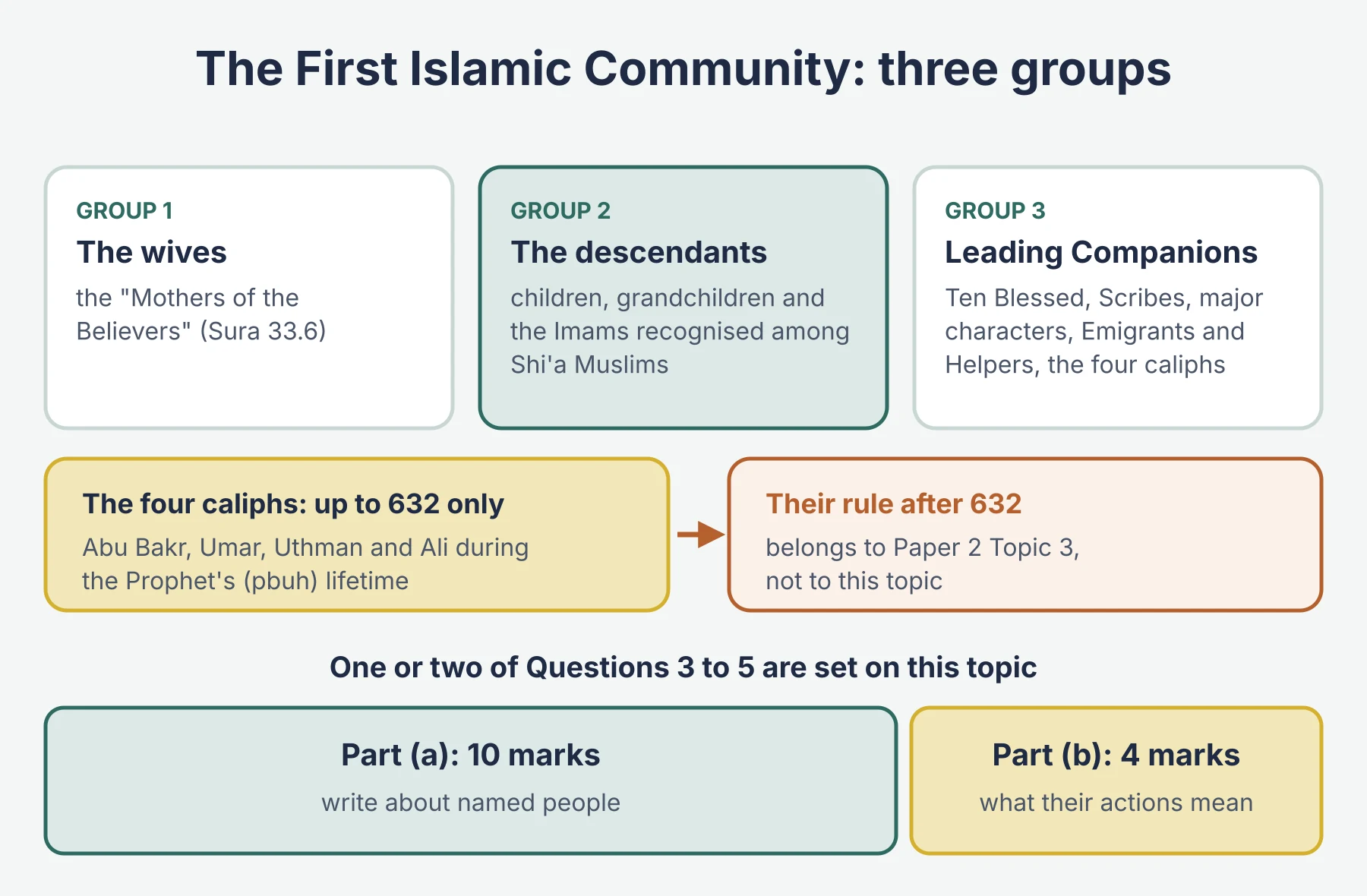
The First Islamic Community is Paper 1 Topic 4 of Cambridge IGCSE Islamiyat 0493. It is about people: the Prophet’s (pbuh) wives, his descendants, and the Companions who lived and worked with him. One or two of Questions 3 to 5 are set on it, each with a 10-mark part (a) asking you to write about named people, and a 4-mark part (b) asking what their actions mean for Muslims. The syllabus asks you to know the main characters “who lived with and near the Prophet (pbuh)”, the significant facts of their lives, and the importance of their actions in the history and beliefs of Islam.
Syllabus coverage
0493 Paper 1, Topic 4 (2026–2027 syllabus)
- The Prophet’s (pbuh) wives
- His descendants, including his children, grandchildren and the direct line recognised among Shi’a Muslims as Imams
- His leading Companions: the Ten Blessed Companions, his Scribes, the major characters who surrounded him in his ministry, the Emigrants and Helpers, and the four Rightly Guided Caliphs during his lifetime
The caliphs’ rule after 632 belongs to Paper 2 Topic 3, not here. For this topic, write about Abu Bakr, Umar (RA), Uthman (RA) and Ali (RA) only up to the Prophet’s (pbuh) death.
Who were the Prophet’s (pbuh) wives?
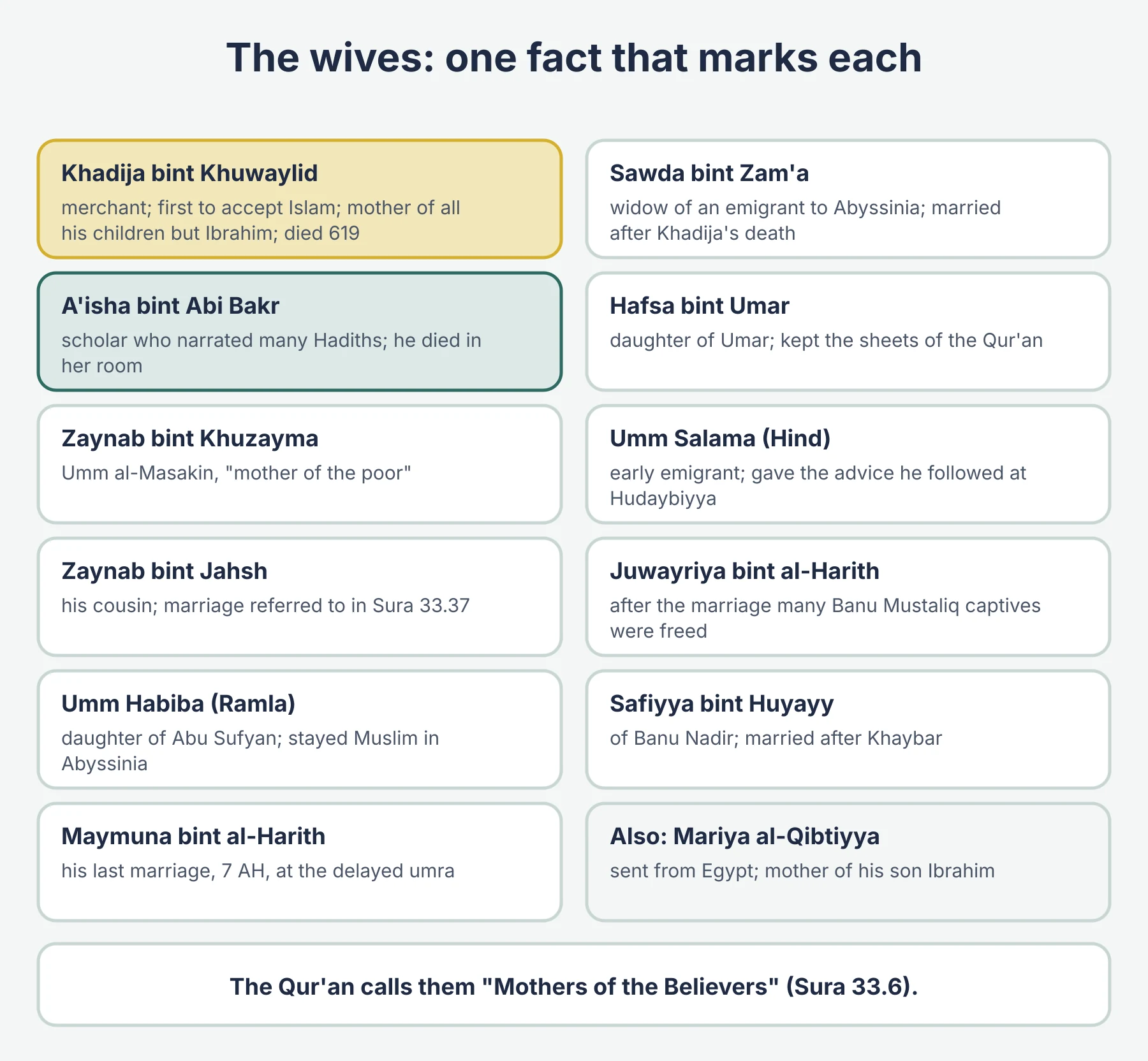
Learn each wife with one or two facts that make her distinctive. The Qur’an calls them “Mothers of the Believers” (Sura 33.6).
| Wife | Key facts |
|---|---|
| Khadija (RA) bint Khuwaylid | Wealthy merchant; married him when he was 25; first to accept Islam; mother of all his children except Ibrahim; died 619 |
| Sawda (RA) bint Zam’a | Widow of an early Muslim who had migrated to Abyssinia; married after Khadija’s (RA) death; cared for his household |
| A’isha bint Abi Bakr | Daughter of Abu Bakr (RA); great scholar who narrated many Hadith and taught men and women; the Prophet (pbuh) died in her room |
| Hafsa (RA) bint Umar (RA) | Daughter of Umar (RA); widowed when her husband died of wounds from early fighting; kept the sheets of the Qur’an |
| Zaynab bint Khuzayma (RA) | Known as Umm al-Masakin, “mother of the poor”, for her generosity; died a few months after the marriage |
| Umm Salama (RA) (Hind) | Widow of Abu Salama; an early emigrant; gave the advice he followed at Hudaybiyya |
| Zaynab bint Jahsh (RA) | His cousin; her marriage, after her divorce from Zayd ibn Haritha (RA), is referred to in Sura 33.37; known for generosity and her handwork |
| Juwayriya bint al-Harith | Daughter of the chief of Banu Mustaliq; after the marriage the Muslims freed many captives of her tribe |
| Umm Habiba (RA) (Ramla) | Daughter of Abu Sufyan; stayed Muslim in Abyssinia when her husband left Islam |
| Safiyya (RA) bint Huyayy | From the Jewish tribe of Banu Nadir; married after Khaybar; the Prophet (pbuh) defended her when others spoke of her background |
| Maymuna (RA) bint al-Harith | His last marriage, in 7 AH, at the time of the delayed umra |
Mariya al-Qibtiyya, sent from Egypt, was the mother of his son Ibrahim.
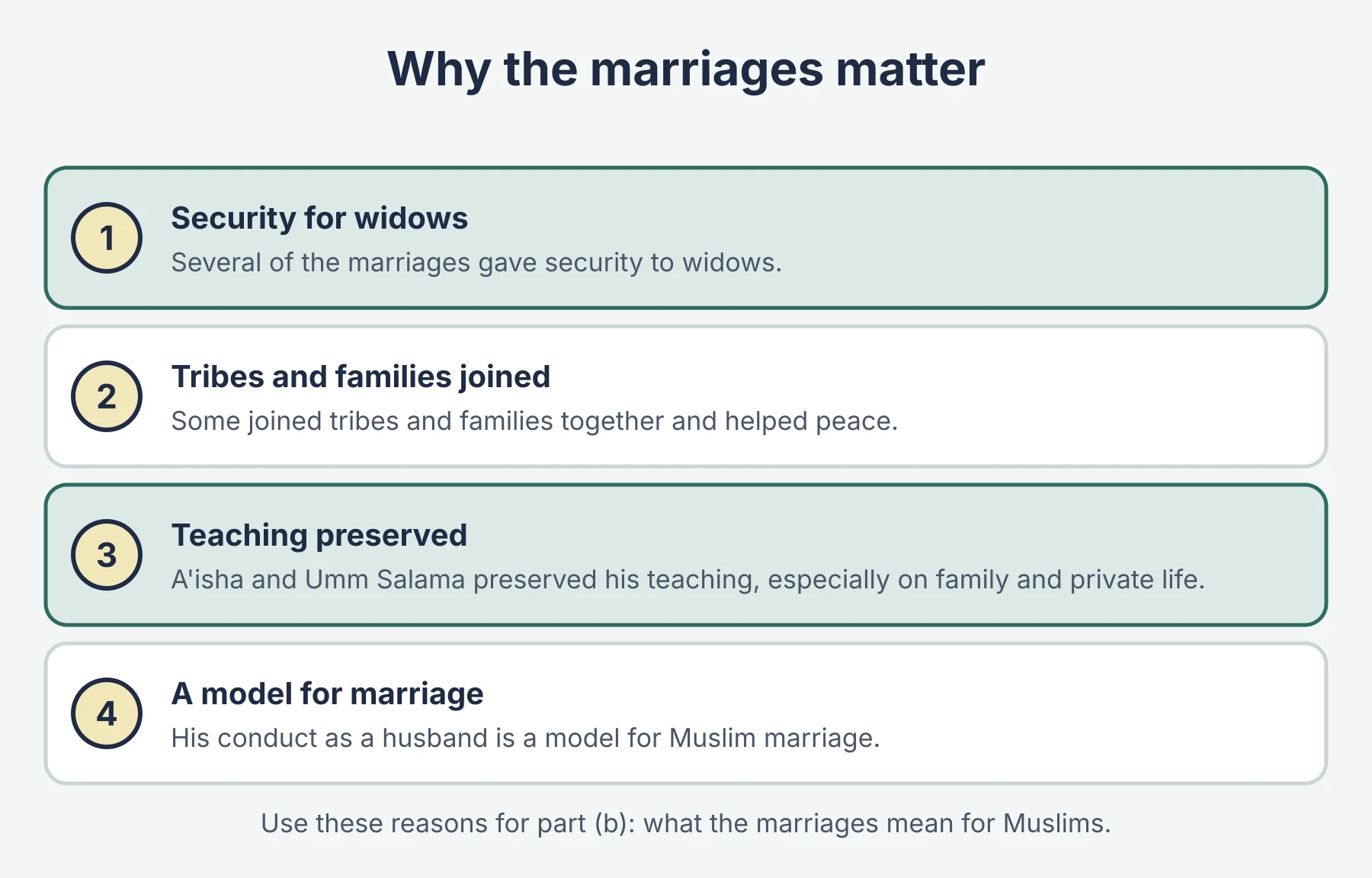
Why the marriages matter (part (b) material): several gave security to widows; some joined tribes and families together and helped peace; A’isha and Umm Salama (RA) preserved his teaching, especially on family and private life; and his conduct as a husband is a model for Muslim marriage.
Who were his descendants?
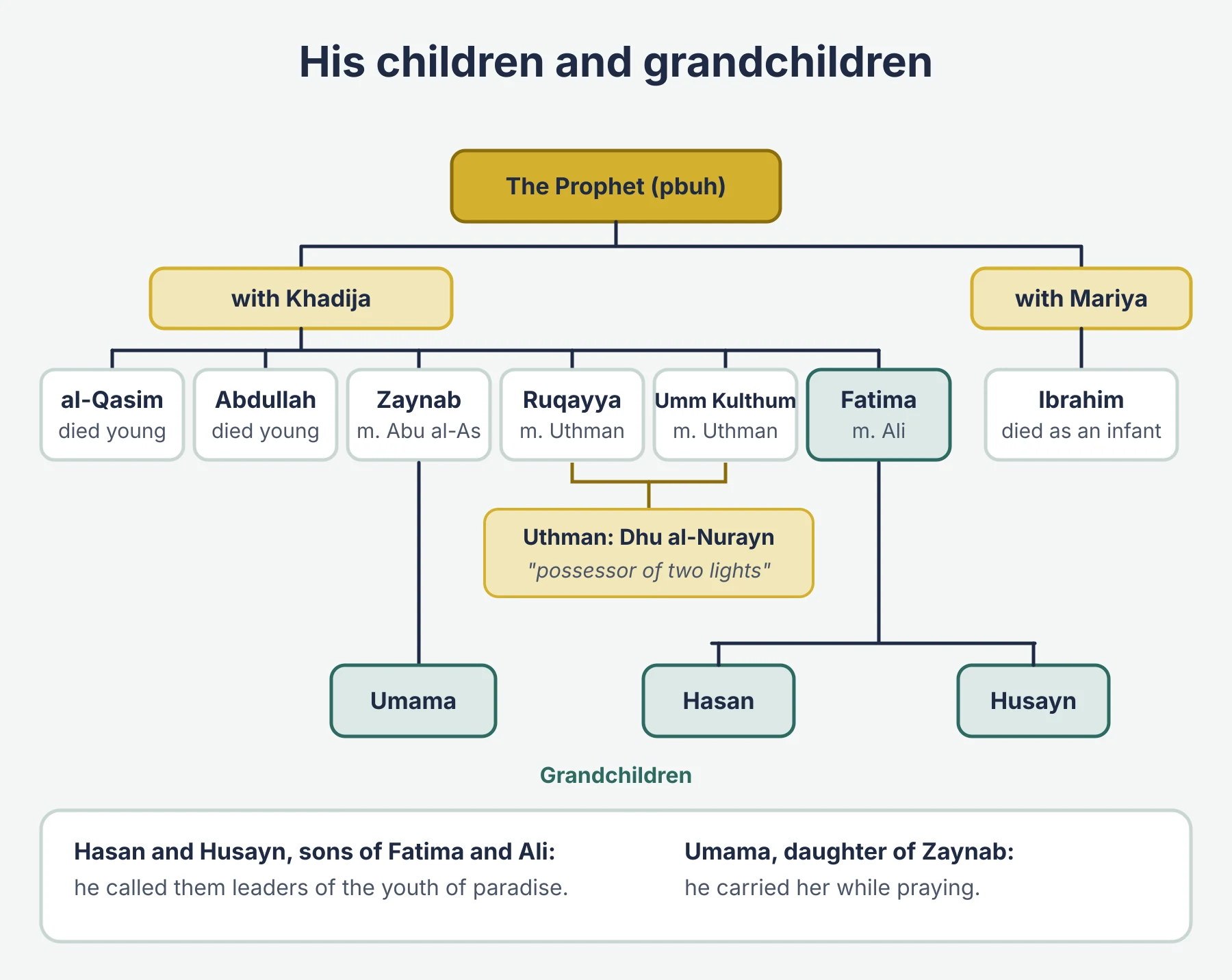
- Sons: al-Qasim and Abdullah, sons of Khadija (RA), died in childhood; Ibrahim, son of Mariya, died as an infant in Madina.
- Daughters: Zaynab (married Abu al-As); Ruqayya and Umm Kulthum, who in turn married Uthman (RA), so he is called Dhu al-Nurayn, “possessor of two lights”; and Fatima (RA), who married Ali (RA).
- Grandchildren: Hasan (RA) and Husayn (RA), sons of Fatima (RA) and Ali (RA), whom he loved and called leaders of the youth of paradise; also Umama, daughter of Zaynab, whom he carried while praying.
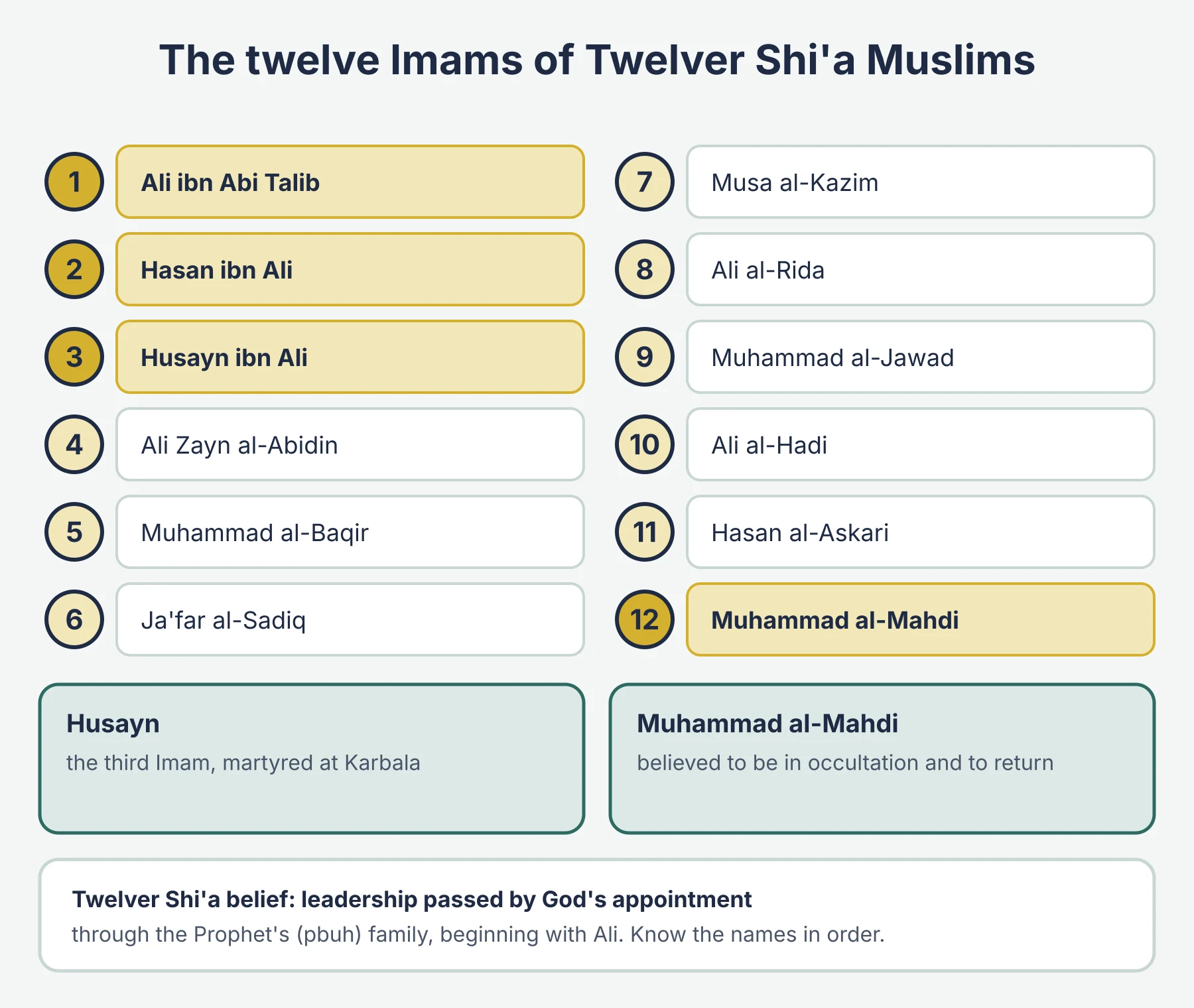
The Imams recognised among Shi’a Muslims. Twelver Shi’a Muslims believe leadership of the community passed by God’s appointment through the Prophet’s (pbuh) family, beginning with Ali (RA):
- Ali ibn Abi Talib (RA)
- Hasan ibn Ali (RA)
- Husayn ibn Ali (RA), martyred at Karbala
- Ali Zayn al-Abidin
- Muhammad al-Baqir
- Ja’far al-Sadiq
- Musa al-Kazim
- Ali al-Rida
- Muhammad al-Jawad
- Ali al-Hadi
- Hasan al-Askari
- Muhammad al-Mahdi, believed to be in occultation and to return
Who were the Ten Blessed Companions?
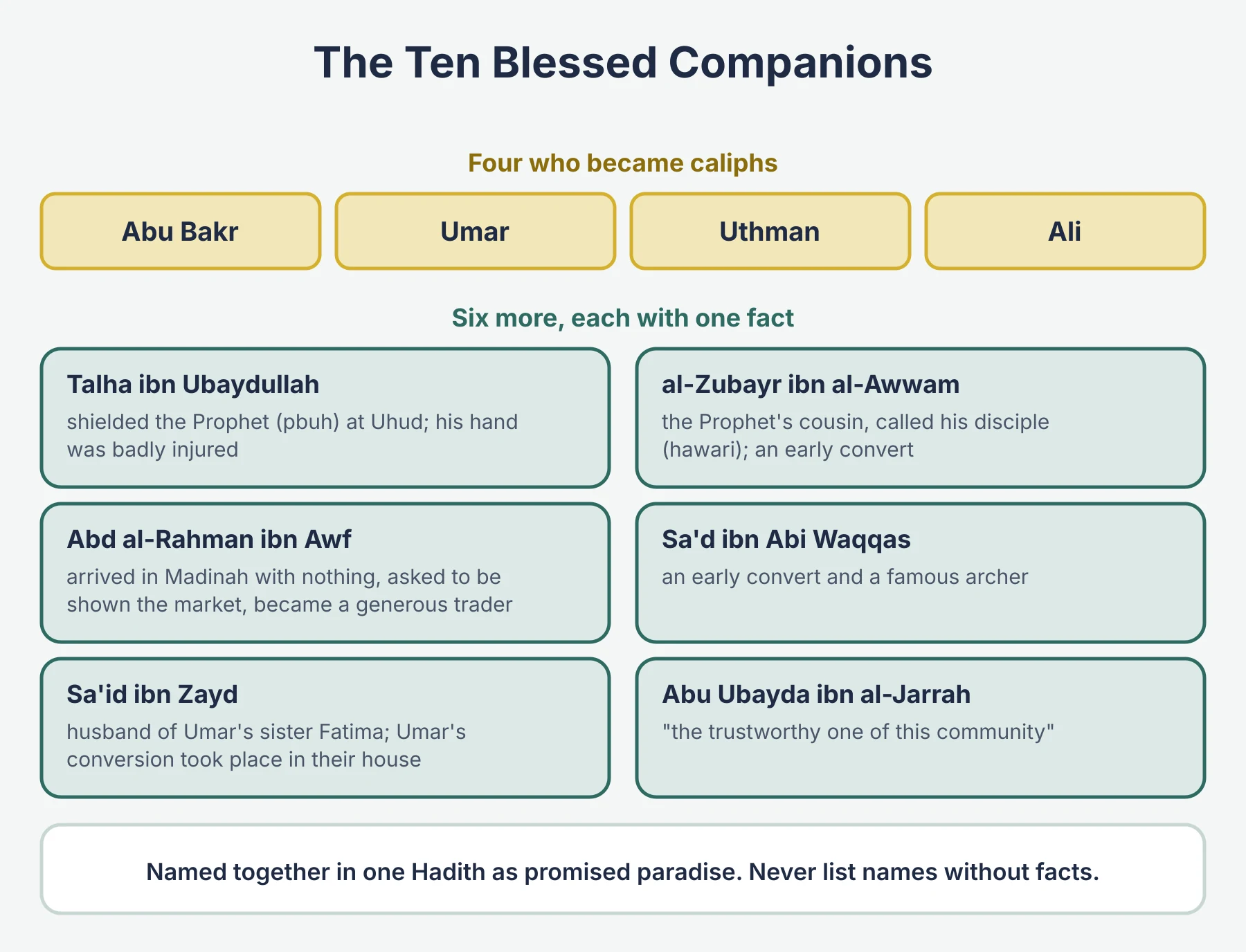
They are the ten whom the Prophet (pbuh) named in one Hadith as promised paradise: Abu Bakr (RA), Umar (RA), Uthman (RA), Ali (RA), Talha ibn Ubaydullah (RA), al-Zubayr ibn al-Awwam (RA), Abd al-Rahman ibn Awf (RA), Sa’d ibn Abi Waqqas, Sa’id ibn Zayd (RA) and Abu Ubayda ibn al-Jarrah (RA). A one-line fact for each of the six who were not caliphs:
- Talha (RA): shielded the Prophet (pbuh) at Uhud and his hand was badly injured.
- Al-Zubayr: the Prophet’s (pbuh) cousin, called his disciple (hawari); an early convert.
- Abd al-Rahman ibn Awf (RA): arrived in Madina with nothing, asked only to be shown the market, and became a wealthy, generous trader.
- Sa’d ibn Abi Waqqas (RA): an early convert and a famous archer.
- Sa’id ibn Zayd (RA): husband of Umar’s (RA) sister Fatima (RA); Umar’s (RA) conversion took place in their house.
- Abu Ubayda (RA): called “the trustworthy one of this community” by the Prophet (pbuh).
Who were the Scribes?
The scribes wrote down revelation and letters. The best known is Zayd ibn Thabit (RA), a young Helper who also learned other languages at the Prophet’s (pbuh) request; others included Ubayy ibn Ka’b (RA), a leading reciter, Ali (RA), Uthman (RA) and Mu’awiya ibn Abi Sufyan. Their importance is that the Qur’an was recorded in writing from the time of revelation.
Who were the other major characters?
Learn a short profile of each:
- Bilal ibn Rabah (RA): a freed slave, tortured for his faith, first to give the adhan.
- Hamza ibn Abd al-Muttalib (RA): the Prophet’s (pbuh) uncle, “lion of God”, martyred at Uhud.
- Ja’far ibn Abi Talib: spoke for the Muslims before the Negus; martyred at Mu’ta.
- Zayd ibn Haritha (RA): freed slave whom the Prophet (pbuh) loved as a son; the only Companion named in the Qur’an (Sura 33.37); martyred at Mu’ta.
- Salman al-Farsi (RA): a Persian who searched for truth; proposed the trench.
- Mus’ab ibn Umayr (RA): gave up wealth for Islam; first teacher sent to Madina.
- Abu Talib and Abu Lahab: two uncles, one his protector, one his bitter opponent.
Who were the Emigrants and Helpers?
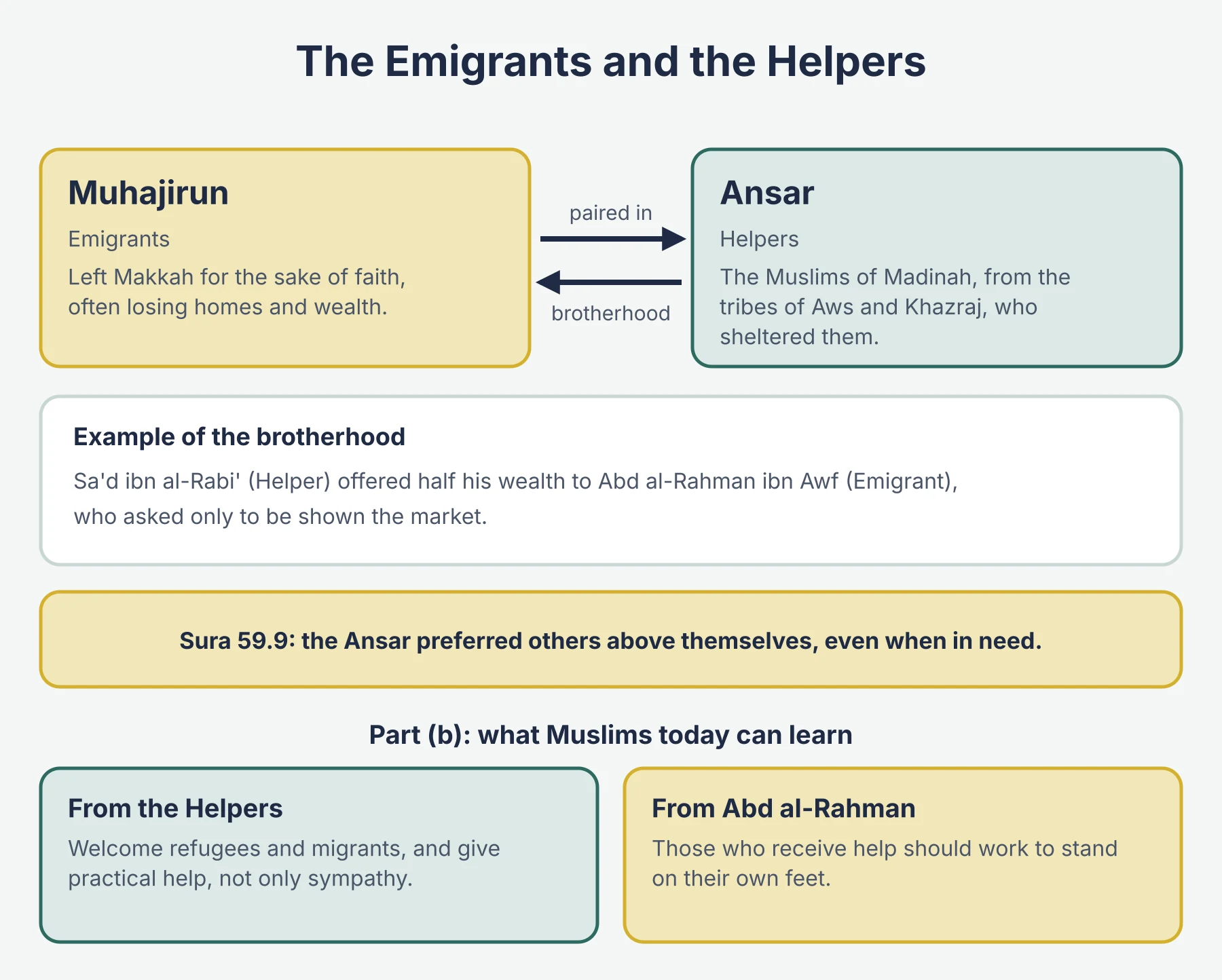
The Muhajirun left Makka for the sake of faith, often losing homes and wealth. The Ansar were the Muslims of Madina, from the tribes of Aws and Khazraj, who sheltered them. The Prophet (pbuh) paired them in brotherhood; for example Sa’d ibn al-Rabi’ offered half his wealth to Abd al-Rahman ibn Awf. The Qur’an praises the Ansar for preferring others above themselves even when in need (Sura 59.9).
What did the four caliphs do during his lifetime?
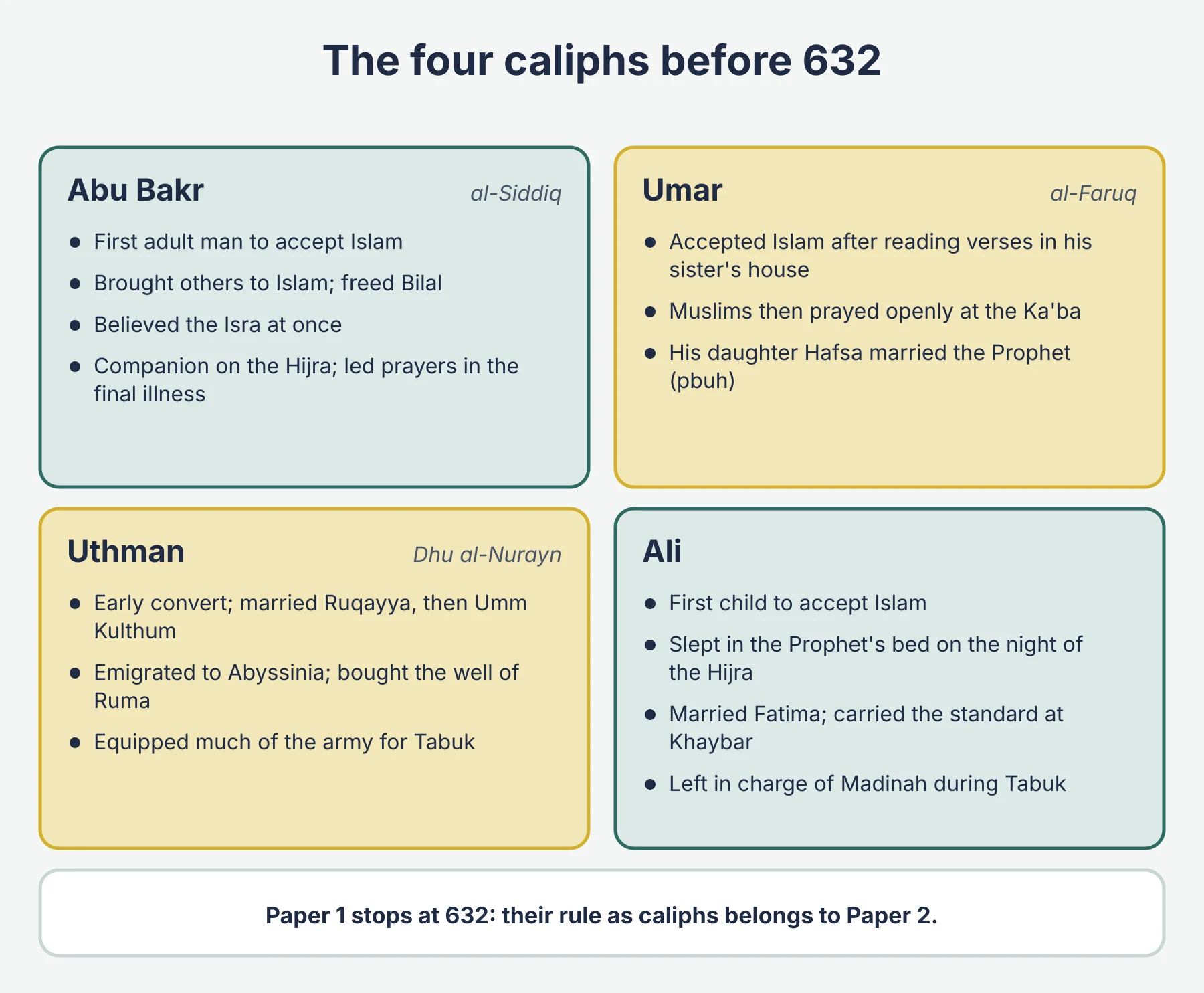
- Abu Bakr (RA): first adult man to accept Islam; brought others such as Uthman (RA) and Abd al-Rahman ibn Awf; freed Bilal (RA); called al-Siddiq for believing the Isra at once; companion on the Hijra; led prayers in the Prophet’s (pbuh) final illness.
- Umar (RA): accepted Islam after reading verses in his sister’s house; Muslims then prayed openly at the Ka’ba; called al-Faruq; his daughter Hafsa (RA) married the Prophet (pbuh).
- Uthman (RA): early convert; married Ruqayya, then Umm Kulthum; emigrated to Abyssinia; bought the well of Ruma for Muslims; equipped much of the army for Tabuk; envoy before Hudaybiyya.
- Ali (RA): first child to accept Islam; slept in the Prophet’s (pbuh) bed on the night of the Hijra; married Fatima (RA); carried the standard at Khaybar; left in charge of Madina during Tabuk.
Worked example: a 4-mark part (b)
Question: What can Muslims today learn from the Helpers’ treatment of the Emigrants? [4]
Model answer: The Helpers shared homes and wealth with strangers who had lost everything, which teaches Muslims to welcome refugees and migrants and to give practical help, not only sympathy. Abd al-Rahman ibn Awf’s (RA) refusal of Sa’d’s offer, asking only to be shown the market, shows the other side: those who receive help should work to stand on their own feet, so that generosity is not misused.
Common mistakes
- Writing about the caliphs’ rule after 632 in a Paper 1 answer.
- Confusing Zaynab bint Khuzayma (RA) with Zaynab bint Jahsh (RA), or Umm Kulthum the daughter with a wife.
- Listing the Ten Blessed names without any facts about them.
- Leaving out the Shi’a Imams when a question asks about descendants.
Frequently asked questions
How many wives must I know? Know the main facts about each; questions often name two or three wives.
Do I need all twelve Imams? Know the names in order, and fuller detail on Ali (RA), Hasan (RA) and Husayn (RA).
Related pages
- First Islamic Community revision notes
- First Islamic Community practice questions
- Life of the Prophet (pbuh) study guide
- Paper 1 study guide
Source: Cambridge International, Cambridge IGCSE Islamiyat 0493 syllabus for examination in 2026 and 2027, Paper 1 Topic 4.
Related resources
-
Practice questions
Cambridge IGCSE Islamiyat (0493): The First Islamic Community — Practice Questions
Twelve original questions on the Prophet's wives, descendants, Companions, Emigrants and Helpers for Cambridge IGCSE Islamiyat 0493 Paper 1, with mark guidance.
Islamiyat · Cambridge · IGCSE
Try questions -
Revision notes
Cambridge IGCSE Islamiyat (0493): The First Islamic Community — Revision Notes
Who's who recall notes for 0493 Paper 1 Topic 4: family links, wives, children, Imams, the Ten Blessed, scribes, Emigrants and Helpers, with a self-test.
Islamiyat · Cambridge · IGCSE
Revise topic -
Study guides
Cambridge IGCSE Islamiyat (0493): The History and Importance of the Qur'an
Study guide to the revelation of the Qur'an (610–632), its compilation under Abu Bakr and Uthman, its use in law and its importance, for IGCSE Islamiyat 0493.
Islamiyat · Cambridge · IGCSE
Read guide
Get free revision emails (optional)
Occasional emails with practice questions, worked explanations and links to free resources for the qualification and subjects you choose. No spam, and you can unsubscribe from any email. The free tools on this site never need an email.