
Revision Notes
Cambridge IGCSE Pakistan Studies (0448): Cultural and Historical Background to the Pakistan Movement – Revision Notes
Revision notes for Cambridge IGCSE Pakistan Studies 0448 Paper 1 Section 1: religious reformers, Mughal decline, 1857, Sir Syed and languages, with a self-test.
- Subject
- Pakistan Studies
- Level
- IGCSE
- Topic
- Paper 1 – The History and Culture of Pakistan
- Author
- Marlbridge Academic Team
- Updated
- Reviewed by
- Azam Siddique (what this means)
Aligned to Cambridge IGCSE Pakistan Studies (0448), 2026. Official specification .
Syllabus page (what it covers and how it is assessed): Cambridge IGCSE Pakistan Studies.
Syllabus points this page covers
0448
- 1.1 Cultural and historical background to the Pakistan Movement
Found an error? Report a correction.
Need help with this topic? Request a free trial class for IGCSE Pakistan Studies (0448).
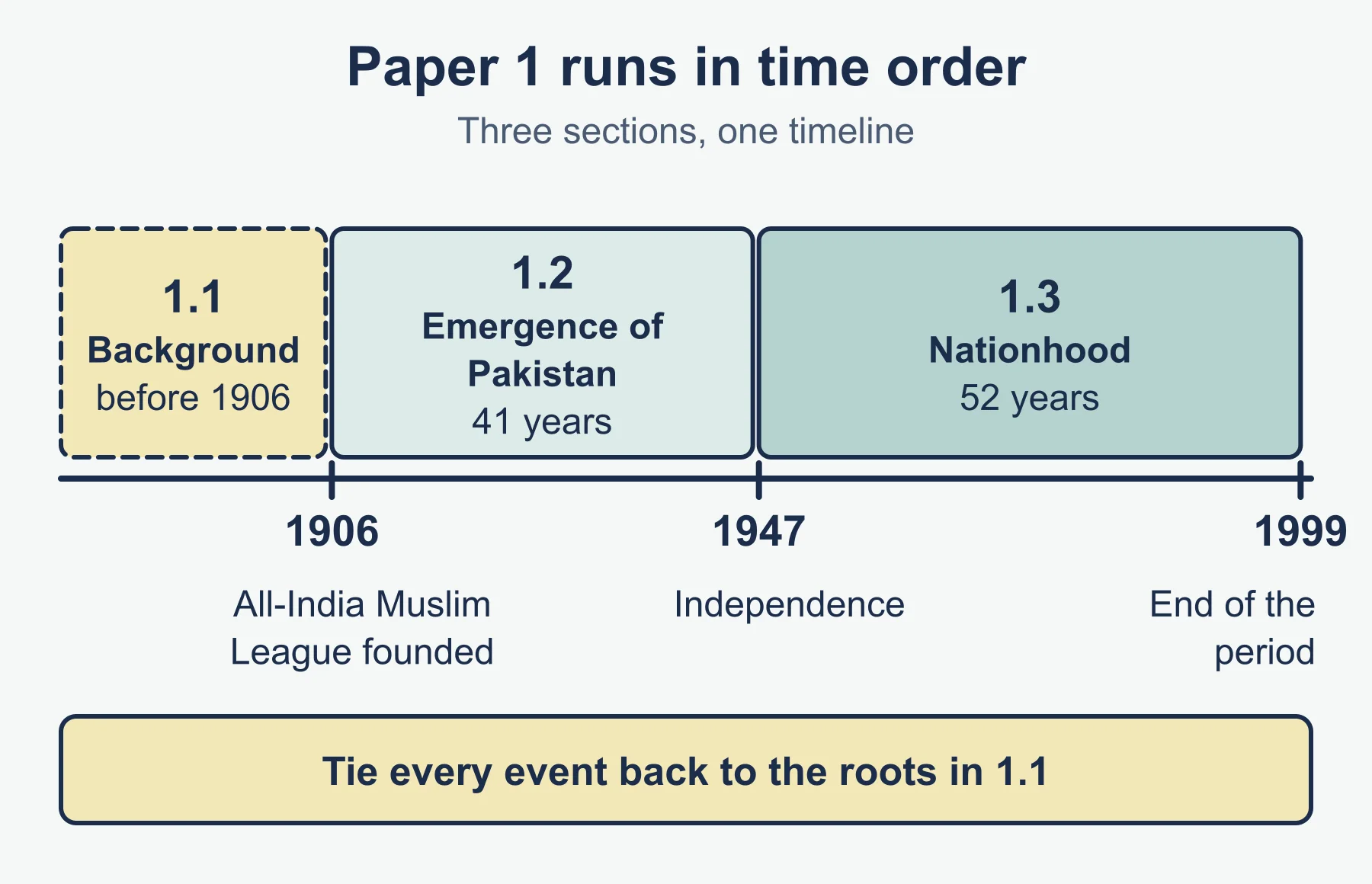
These notes condense Section 1 of Paper 1, Cultural and historical background to the Pakistan Movement, in Cambridge IGCSE Pakistan Studies 0448. The section is built from Key Questions 1 to 5: the religious thinkers of the 18th and 19th centuries, the decline of the Mughal Empire, the War of Independence 1857–58, Sir Syed Ahmad Khan, and Urdu and the regional languages. The full explanation is in the History and Culture of Pakistan study guide; practise with the Cultural and historical background practice questions.
Syllabus coverage
0448 Paper 1, Section 1 (2026 syllabus)
- Key Question 1: How successful were the religious thinkers in spreading Islam in the subcontinent during the 18th and 19th centuries?
- Key Question 2: What were the causes and consequences of the decline of the Mughal Empire?
- Key Question 3: What were the causes and consequences of the War of Independence 1857–58?
- Key Question 4: How important was the work of Sir Syed Ahmad Khan to the development of the Pakistan Movement during the 19th century?
- Key Question 5: To what extent have Urdu and regional languages contributed to the cultural development of Pakistan since 1947?
Key terms
| Term | Meaning |
|---|---|
| Faraiz | Obligatory religious duties, the focus of Haji Shariatullah’s movement |
| Dar-ul-Harb | A land not under Muslim rule, where the Faraizis held Friday and Eid congregational prayers should not be offered |
| Mujahideen | Fighters of Syed Ahmad Barelvi’s Jihad movement |
| Doctrine of Lapse | British policy of taking over a state whose ruler died without a natural heir |
| Annexation | Taking control of a territory and adding it to British-ruled India |
| Forward Policy | British policy of pushing control into the tribal areas of the North-West Frontier |
| Durand Line | The boundary agreed with Afghanistan in 1893 |
| Two-Nation Theory | The idea that Hindus and Muslims were separate nations |
| Hindi–Urdu controversy | The dispute from 1867 over replacing Urdu in the Persian script with Hindi in the Devanagari script |
| National language | The language chosen to unite the country; Urdu in Pakistan |
Key Question 1: the religious thinkers
| Thinker | Dates | Main work | Assessment |
|---|---|---|---|
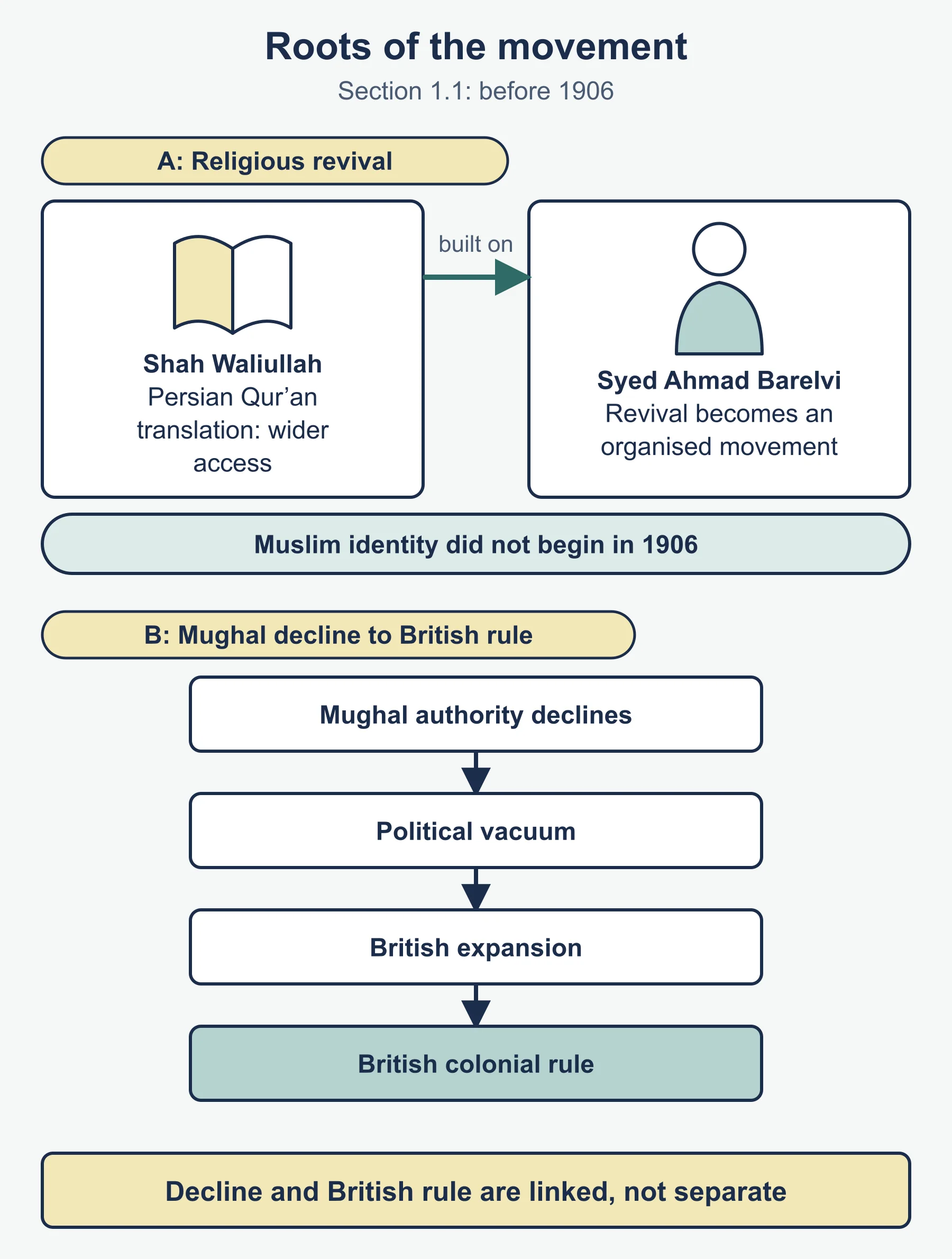
| Shah Waliullah | 1703–62 | Translated the Qur’an into Persian; wrote Hujjat Allah al-Baligha; tried to reconcile Sunni and Shia and the schools of law; wrote to Ahmad Shah Abdali, who defeated the Marathas at Panipat in 1761 | Lasting religious influence through his sons, who translated the Qur’an into Urdu; political aims only partly met |
| Syed Ahmad Barelvi | 1786–1831 | Disciple of Shah Abdul Aziz; led the Jihad movement against Sikh rule from the North-West Frontier; took Peshawar in 1830 | Lost the support of Pathan tribal leaders; killed at Balakot in 1831; remembered as an inspiration for later movements |
| Haji Shariatullah | 1781–1840 | Founded the Faraizi movement in Bengal after returning from Makkah; stressed obligatory duties and rejected un-Islamic customs | Gave Bengali peasants confidence; his son Dudu Miyan organised them against Hindu landlords and indigo planters |
Judgement pattern: each succeeded more in reviving Muslim religious identity than in achieving political goals.
Key Question 2: why the Mughal Empire declined
Internal reasons
- Aurangzeb’s long Deccan wars emptied the treasury; his religious policies alienated Rajputs, Sikhs and Marathas.
- Weak successors, wars of succession and powerful nobles.
- The empire was too large to control from Delhi with poor communications.
- The rise of the Maratha and Sikh empires.
External reasons
- Invasions by Nadir Shah of Persia (sack of Delhi, 1739) and Ahmad Shah Abdali of Afghanistan.
- The East India Company: Plassey (1757), Buxar (1764) and control of Bengal’s revenue (1765).
- British expansion to the 1850s: annexation of Sindh (1843) and, after the Anglo-Sikh wars, of the Punjab, including Lahore and Peshawar (1849).
- The search for a “scientific” North-West Frontier, the Durand Line (1893) and a policy towards the tribal territory that relied on local jirgas and allowances rather than direct rule.
Key Question 3: the War of Independence 1857–58
Underlying causes: political (Doctrine of Lapse; annexation of Awadh, 1856); economic (heavy land taxes, ruined craftsmen); social and religious (fear of conversion, missionary activity, Western reforms); military (low pay, service overseas).
Immediate cause: cartridges for the new Enfield rifle, rumoured to be greased with cow and pig fat; the rising began at Meerut in May 1857.
Bahadur Shah Zafar: the elderly Mughal emperor was proclaimed leader by the sepoys who reached Delhi, but he was a reluctant figurehead; after Delhi fell in September 1857 he was tried and exiled to Rangoon.
Reasons for failure: no united leadership or plan; British control of the Punjab, where many troops stayed loyal; better British weapons, communications and resources; many rulers stayed out.
Consequences: the Government of India Act (1858) ended Company rule; Queen Victoria’s Proclamation (1858) promised non-interference in religion and an end to annexations; the army was reorganised; Muslims were blamed and lost posts in government and the army.
Key Question 4: Sir Syed Ahmad Khan (1817–98)
- Rebuilding trust: The Causes of the Indian Revolt and The Loyal Muhammadans of India.
- Education: the Scientific Society, the journal Tahzib-ul-Akhlaq, the Muhammadan Anglo-Oriental School at Aligarh (1875), which became a college, and the Muhammadan Educational Conference (1886).
- Religion: argued that the Qur’an and science did not conflict; some ulama opposed him fiercely.
- Politics: after the Hindi–Urdu controversy (1867) he concluded that Hindus and Muslims were separate nations; he opposed Muslim participation in the Indian National Congress (founded 1885).
Key Question 5: Urdu and the regional languages
Why Urdu? It was understood across the provinces, written in a Perso-Arabic script, had been linked to the Pakistan Movement since the Hindi–Urdu controversy, and had a rich literature.
Advantages and disadvantages: it unites people from different provinces; but it is the mother tongue of a minority, and the demand in East Pakistan for Bengali to be a national language showed the risk of imposing one language.
Regional languages: Punjabi (Waris Shah’s Heer), Sindhi (Shah Abdul Latif Bhitai), Pushto (Khushal Khan Khattak and Rahman Baba) and Balochi have strong literary traditions; they are promoted through academies such as the Pashto Academy in Peshawar, broadcasting and teaching in schools.
Worked example
Question: Explain why the War of Independence failed. [7]
Model approach: two or three reasons, each explained. Lack of unity: rebels in Delhi, Lucknow, Kanpur and Jhansi fought separately with no shared plan, so the British could defeat them one by one. British control of the Punjab: the Punjab stayed under British control and troops raised there helped to retake Delhi in September 1857. Resources: the British had modern weapons, the telegraph and the ability to bring troops by sea, so they could keep fighting longer.
Exam traps
- Confusing Syed Ahmad Barelvi (Jihad movement, d. 1831) with Sir Syed Ahmad Khan (Aligarh, d. 1898).
- Treating the Faraizi movement as a military campaign: it was mainly a religious and social reform movement.
- Giving only internal reasons for Mughal decline in a question that also covers external ones.
- Describing the Hindi–Urdu controversy without linking it to the Two-Nation Theory.
- On languages, writing only about Urdu when the question asks about regional languages.
Self-test
- Who translated the Qur’an into Persian?
- Where was Syed Ahmad Barelvi killed, and in what year?
- What did the Faraizi movement mean by “faraiz”?
- Name the Persian ruler who sacked Delhi in 1739.
- In which year did the British annex the Punjab?
- What was the Doctrine of Lapse?
- Where did the War of Independence begin?
- Name the Act that ended East India Company rule.
- In which year was the school at Aligarh founded?
- When did the Hindi–Urdu controversy begin?
- Give two reasons why Urdu was chosen as the national language.
- Name one poet associated with Sindhi literature.
Answers
- Shah Waliullah. 2. Balakot, 1831. 3. The obligatory duties of Islam. 4. Nadir Shah. 5. 1849.
- The British took over a state whose ruler died without a natural heir. 7. Meerut, May 1857.
- The Government of India Act, 1858. 9. 1875. 10. 1867. 11. Any two: understood across the provinces; Perso-Arabic script; linked to the Pakistan Movement; rich literature. 12. Shah Abdul Latif Bhitai.
Frequently asked questions
Do I need to know the frontier policies in detail? The syllabus notes that the focus points on British expansion do not require detailed teaching but give essential background, so know the main events and their purpose.
How should I revise five Key Questions? Make one summary card per Key Question with dates, people, reasons and a judgement.
Related pages
Source: Cambridge International, Cambridge IGCSE Pakistan Studies 0448 syllabus for examination in 2026, Paper 1 Section 1, Key Questions 1–5.
Related resources
-
Practice questions
Cambridge IGCSE Pakistan Studies (0448): The Emergence of Pakistan, 1906–47 – Practice Questions
Original 4, 7 and 14-mark questions with answers on Cambridge IGCSE Pakistan Studies 0448 Paper 1 Section 2, the emergence of Pakistan from 1906 to 1947.
Pakistan Studies · Cambridge · IGCSE
Try questions -
Revision notes
Cambridge IGCSE Pakistan Studies (0448): The Emergence of Pakistan, 1906–47 – Revision Notes
Revision notes for Cambridge IGCSE Pakistan Studies 0448 Paper 1 Section 2, 1906–47: a dated timeline, key terms, causes chains, exam traps and a self-test.
Pakistan Studies · Cambridge · IGCSE
Revise topic -
Practice questions
Cambridge IGCSE Pakistan Studies (0448): Nationhood, 1947–99 – Practice Questions
Original 4, 7 and 14-mark questions with answers on Cambridge IGCSE Pakistan Studies 0448 Paper 1 Section 3, Pakistan's nationhood from 1947 to 1999.
Pakistan Studies · Cambridge · IGCSE
Try questions
Get free revision emails (optional)
Occasional emails with practice questions, worked explanations and links to free resources for the qualification and subjects you choose. No spam, and you can unsubscribe from any email. The free tools on this site never need an email.