
Revision Notes
Cambridge IGCSE Pakistan Studies (0448): The Emergence of Pakistan, 1906–47 – Revision Notes
Revision notes for Cambridge IGCSE Pakistan Studies 0448 Paper 1 Section 2, 1906–47: a dated timeline, key terms, causes chains, exam traps and a self-test.
- Subject
- Pakistan Studies
- Level
- IGCSE
- Topic
- Paper 1 – The History and Culture of Pakistan
- Author
- Marlbridge Academic Team
- Updated
- Reviewed by
- Azam Siddique (what this means)
Aligned to Cambridge IGCSE Pakistan Studies (0448), 2026. Official specification .
Syllabus page (what it covers and how it is assessed): Cambridge IGCSE Pakistan Studies.
Syllabus points this page covers
0448
- 1.2 The emergence of Pakistan 1906–47
Found an error? Report a correction.
Need help with this topic? Request a free trial class for IGCSE Pakistan Studies (0448).
These notes condense Section 2 of Paper 1, The emergence of Pakistan 1906–47, in Cambridge IGCSE Pakistan Studies 0448. The section is examined through Key Questions 6 to 10. Learn the timeline first, then the reasons that link one event to the next, because the 7- and 14-mark parts reward explanation rather than narrative. The full account is in the Emergence of Pakistan, 1906–47 study guide; practise with the Emergence of Pakistan practice questions.
Syllabus coverage
0448 Paper 1, Section 2 (2026 syllabus)
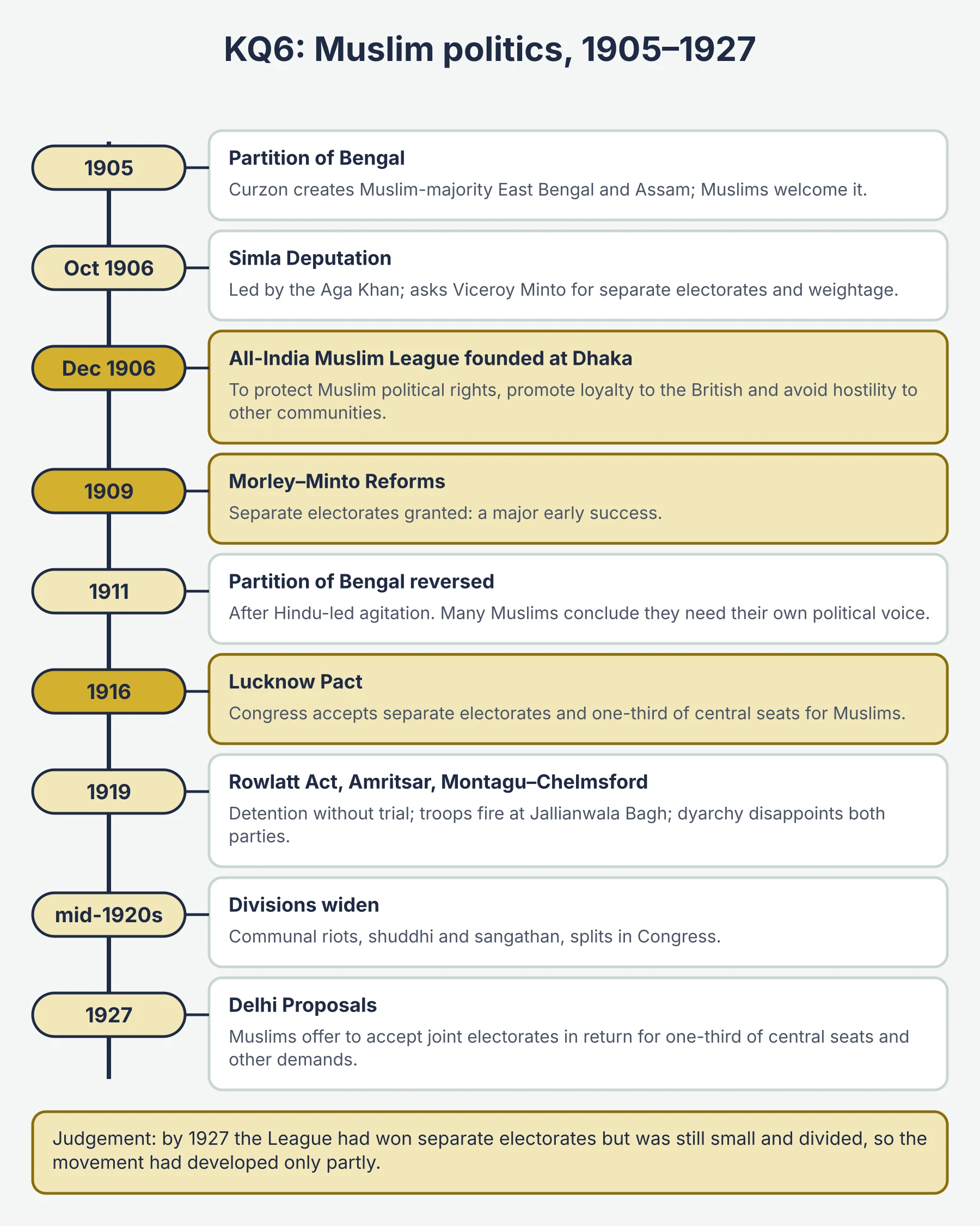
- Key Question 6: How far did the Pakistan Movement develop during the early 20th century?
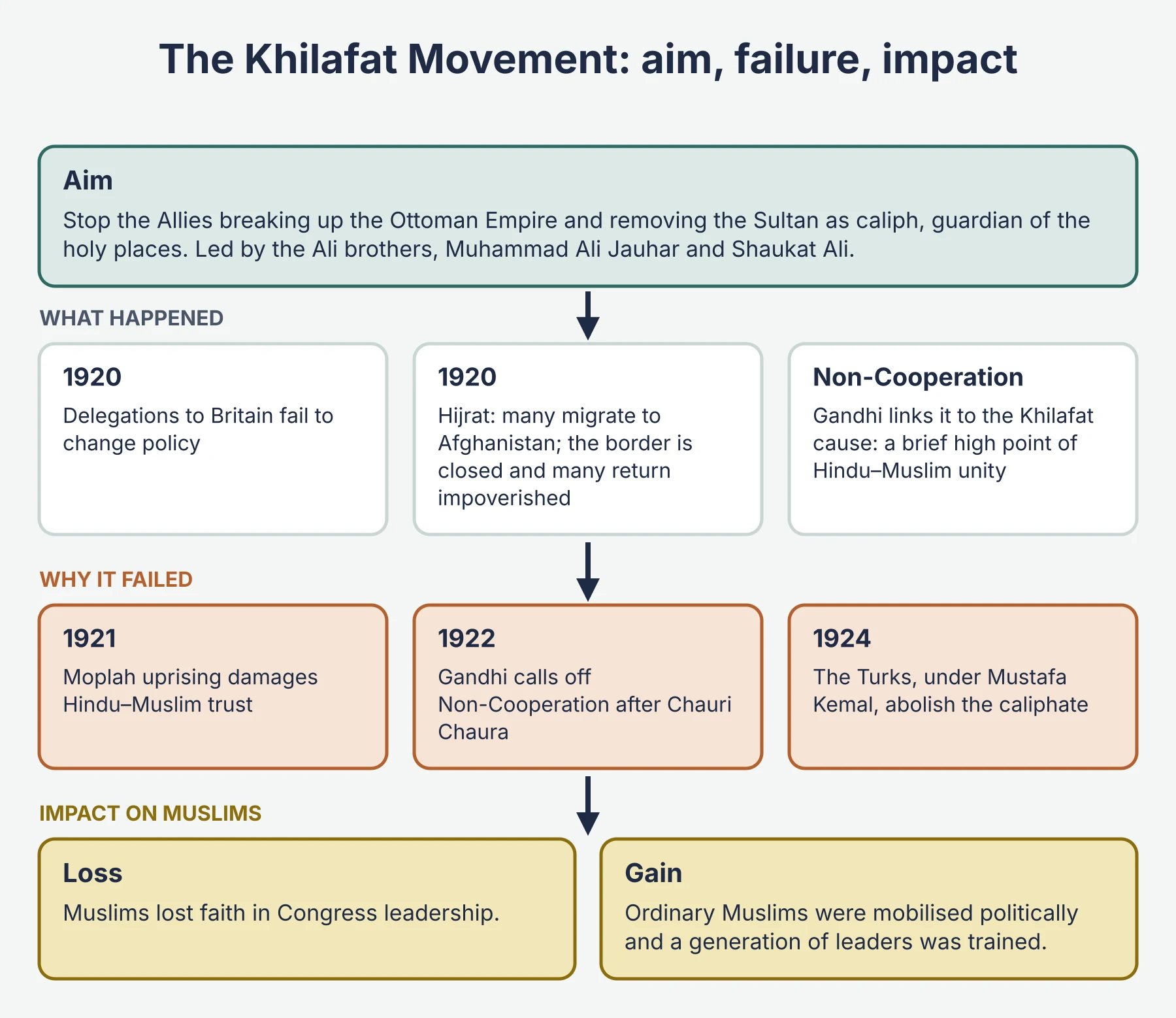
- Key Question 7: How successful was the Khilafat Movement in advancing the cause of the Pakistan Movement?
- Key Question 8: How successful was the Pakistan Movement in the years 1927 to 1939?
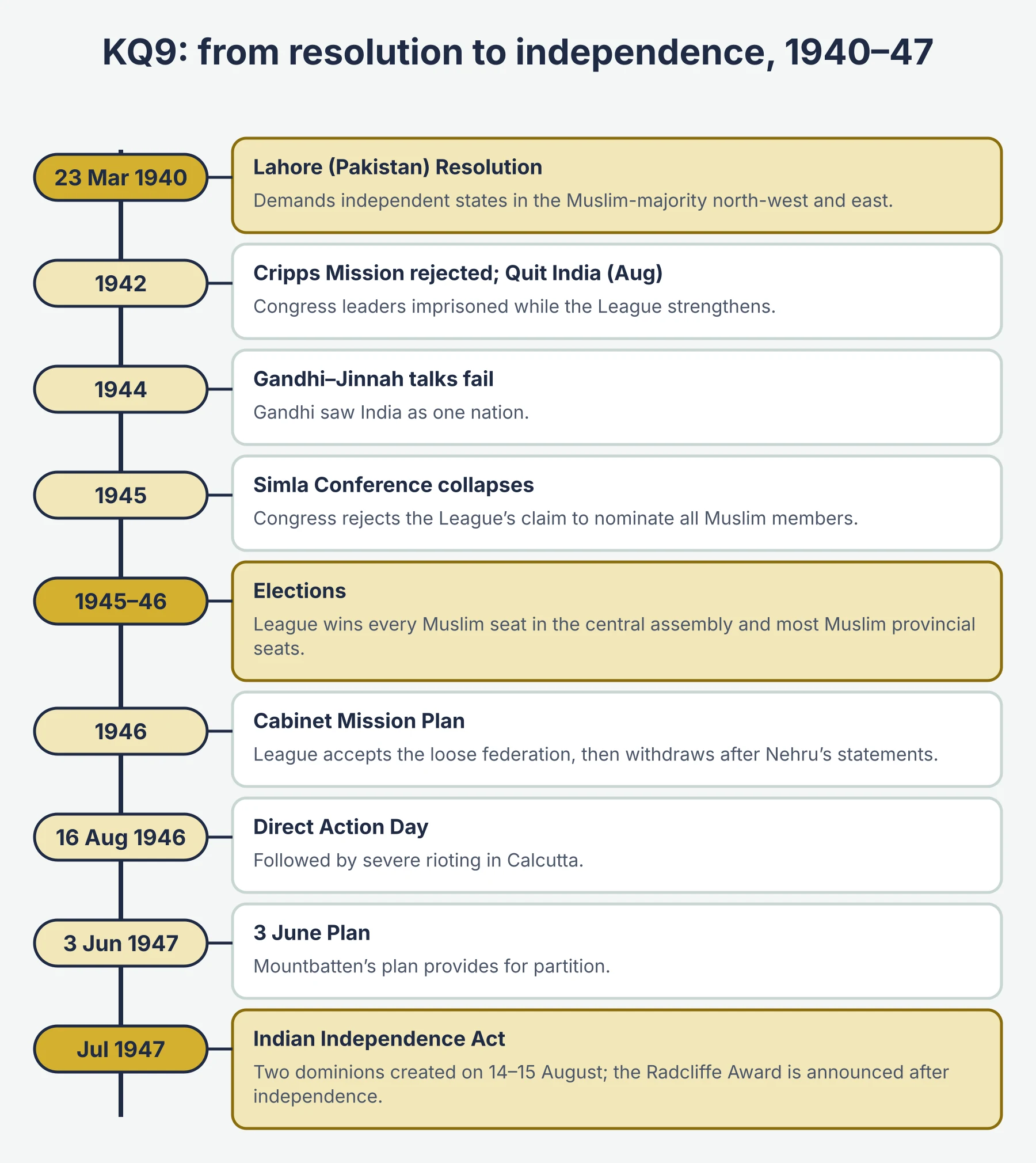
- Key Question 9: How successful were attempts to find solutions to the problems facing the subcontinent in the years 1940 to 1947?
- Key Question 10: How important were the contributions of Jinnah, Allama Iqbal and Rahmat Ali to the success of the Pakistan Movement to 1947?
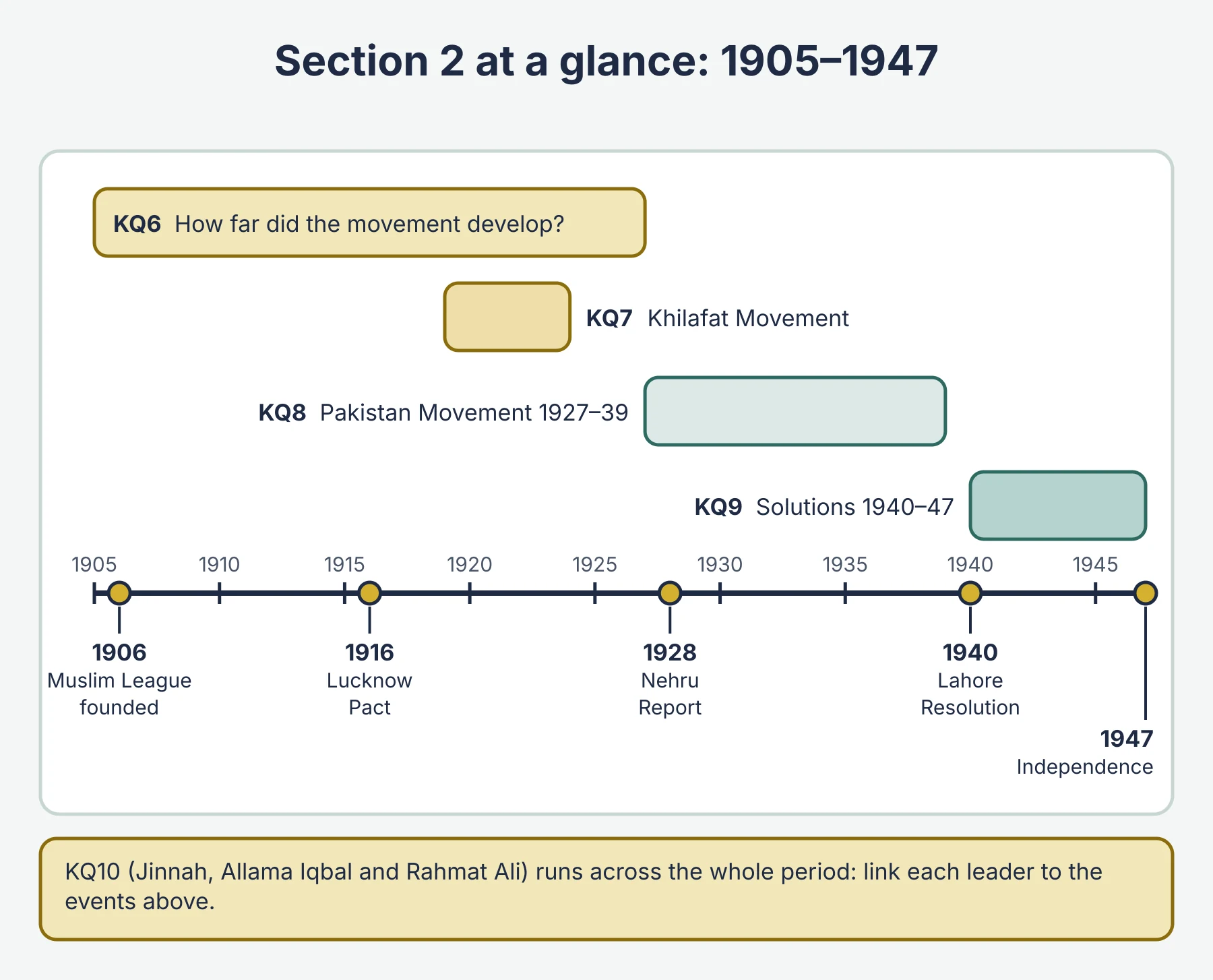
Timeline
| Year | Event | Why it matters |
|---|---|---|
| 1905 | Partition of Bengal | Muslim-majority province welcomed by Muslims; Hindu agitation followed |
| 1906 | Simla Deputation (October); Muslim League founded at Dhaka (December) | Demand for separate electorates; a Muslim political party |
| 1909 | Morley–Minto Reforms | Separate electorates granted |
| 1911 | Partition of Bengal reversed | Muslims felt let down by the British |
| 1916 | Lucknow Pact | Congress accepted separate electorates; high point of co-operation |
| 1919 | Rowlatt Act; Amritsar Massacre; Montagu–Chelmsford Reforms | Repression and disappointing reform |
| 1919–24 | Khilafat Movement; Hijrat (1920); Non-Cooperation called off (1922); caliphate abolished (1924) | Brief unity, then lasting distrust |
| 1927 | Delhi Proposals; Simon Commission appointed | Muslim offer on electorates; an all-British commission |
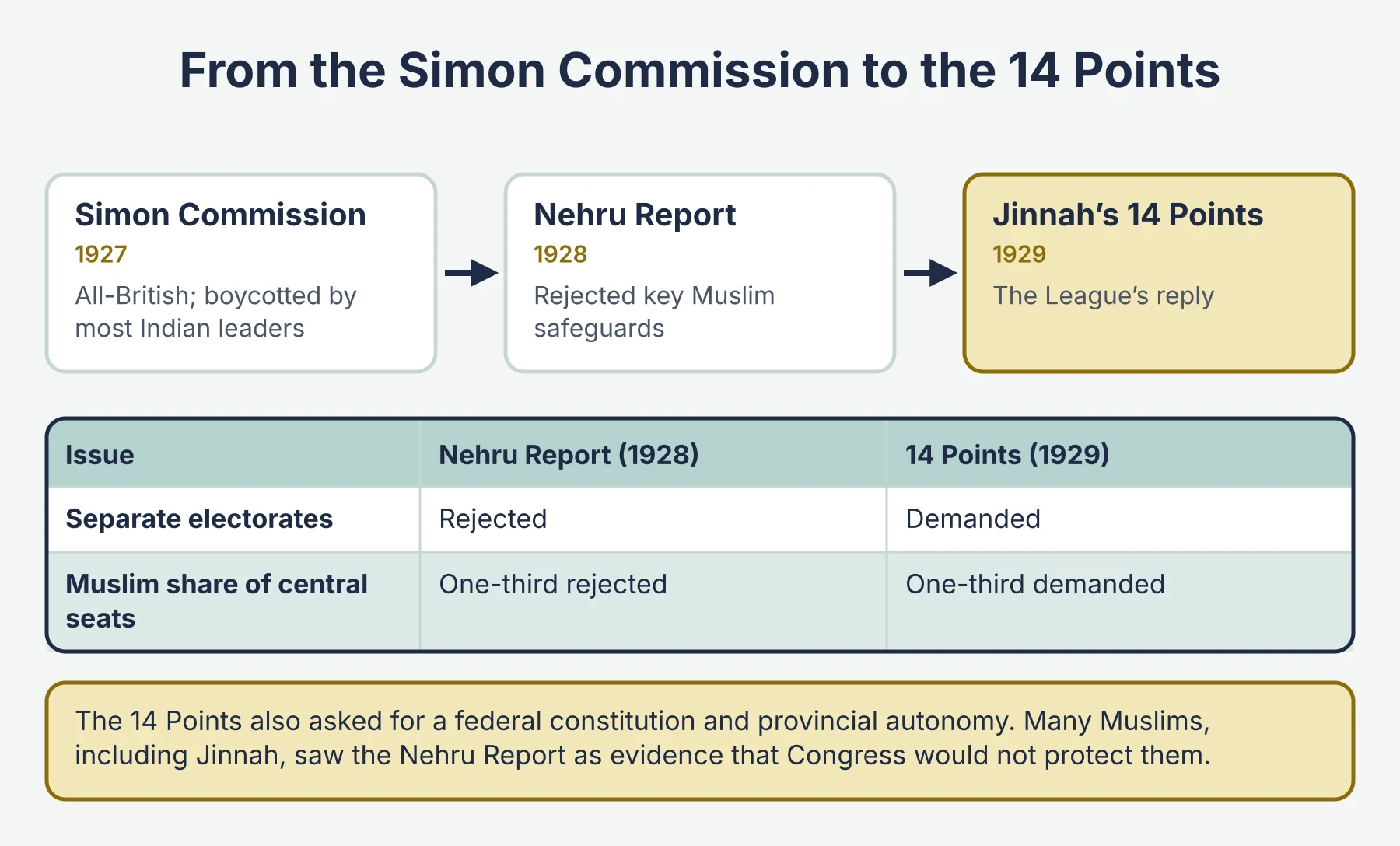
| 1928 | Nehru Report | Rejected separate electorates; alienated Muslims |
| 1929 | Jinnah’s Fourteen Points | Clear statement of Muslim demands |
| 1930 | Allama Iqbal’s Allahabad address | A consolidated north-western Muslim state |
| 1930–32 | Round Table Conferences | No agreement on minorities |
| 1932 | Communal Award | Separate electorates kept |
| 1933 | Rahmat Ali’s Now or Never | The name “Pakistan” |
| 1935 | Government of India Act | Provincial autonomy |
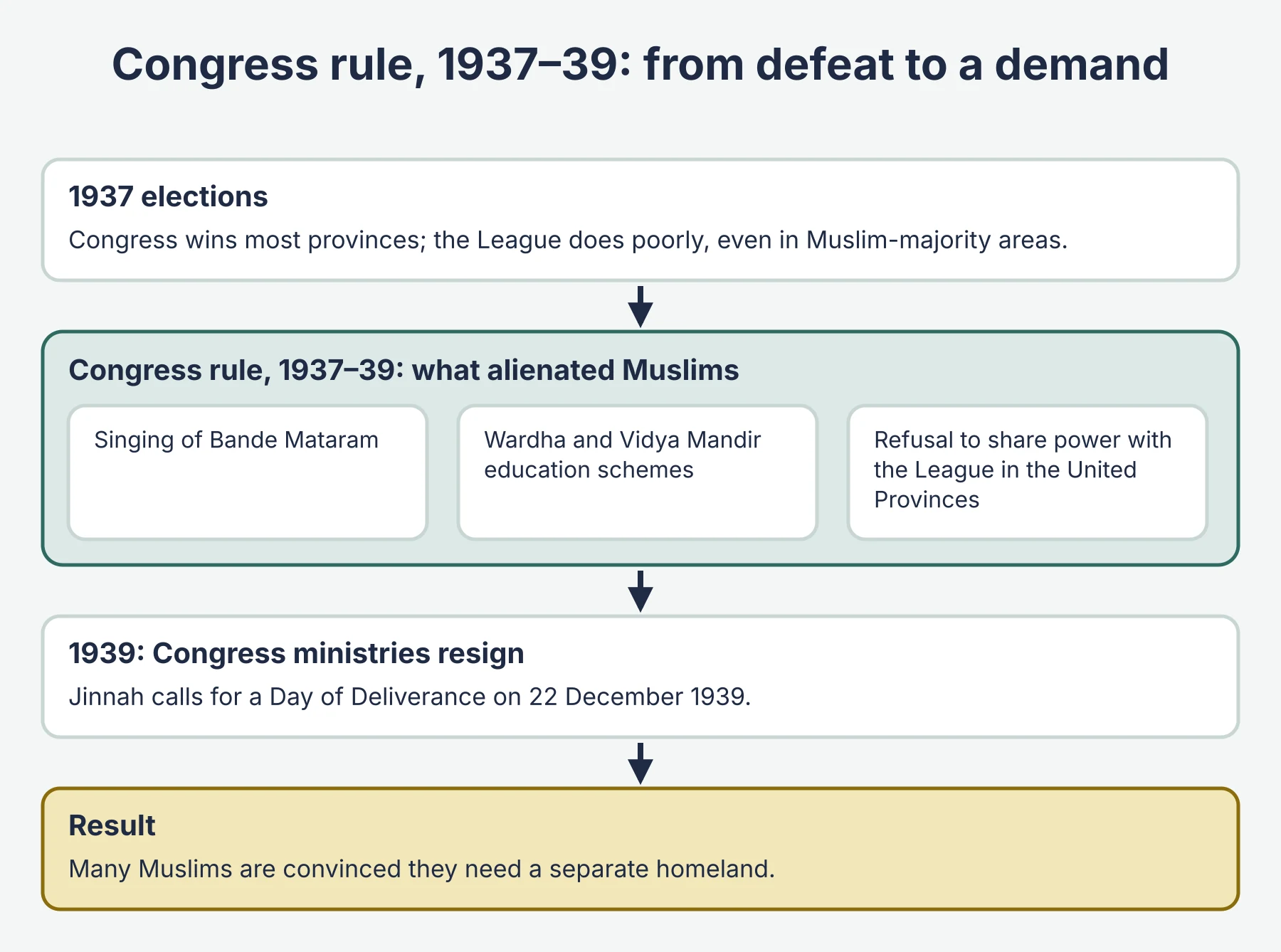
| 1937–39 | Elections; Congress rule | Muslims alienated; League revived |
| 1939 | Day of Deliverance (22 December) | Celebrating the end of Congress ministries |
| 1940 | Pakistan (Lahore) Resolution, 23 March | Demand for independent states |
| 1942 | Cripps Mission; Quit India Movement | Congress leaders jailed; League strengthened |
| 1944 | Gandhi–Jinnah talks | No agreement |
| 1945 | Simla Conference | Failed over who would nominate Muslim members |
| 1945–46 | Elections | League won the Muslim seats |
| 1946 | Cabinet Mission Plan; Direct Action Day (16 August) | Last plan for unity; violence |
| 1947 | 3 June Plan; Indian Independence Act; Radcliffe Award | Partition and independence |
Key terms
| Term | Meaning |
|---|---|
| Separate electorates | Muslims voting for Muslim candidates in reserved seats |
| Weightage | More seats than population share, to protect a minority |
| Dyarchy | Split of provincial subjects between elected ministers and British officials (1919) |
| Communalism | Loyalty to one’s religious community above others, leading to tension |
| Khilafat | The caliphate of the Ottoman Sultan |
| Hijrat | Migration for religious reasons, here to Afghanistan in 1920 |
| Provincial autonomy | Elected provincial governments running most provincial subjects (1935) |
| Day of Deliverance | 22 December 1939, marking the resignation of Congress ministries |
| Grouping | The Cabinet Mission’s plan to group provinces into three sections |
| Boundary award | The Radcliffe decision on the borders in Punjab and Bengal |
Chains of cause and effect
- Bengal reversal (1911) → Muslim distrust of British promises → greater reliance on the League.
- Nehru Report (1928) → Muslims convinced Congress would not protect them → Fourteen Points (1929).
- League’s poor 1937 results → Congress rule without the League → Muslim grievances → League membership grows → Lahore Resolution (1940).
- Quit India (1942) → Congress leaders imprisoned → League free to organise → strong results in 1945–46.
- Cabinet Mission Plan (1946) → Nehru’s remarks about grouping → League withdraws acceptance → Direct Action Day → violence → partition accepted as the only solution (1947).
Key Question 10 in brief
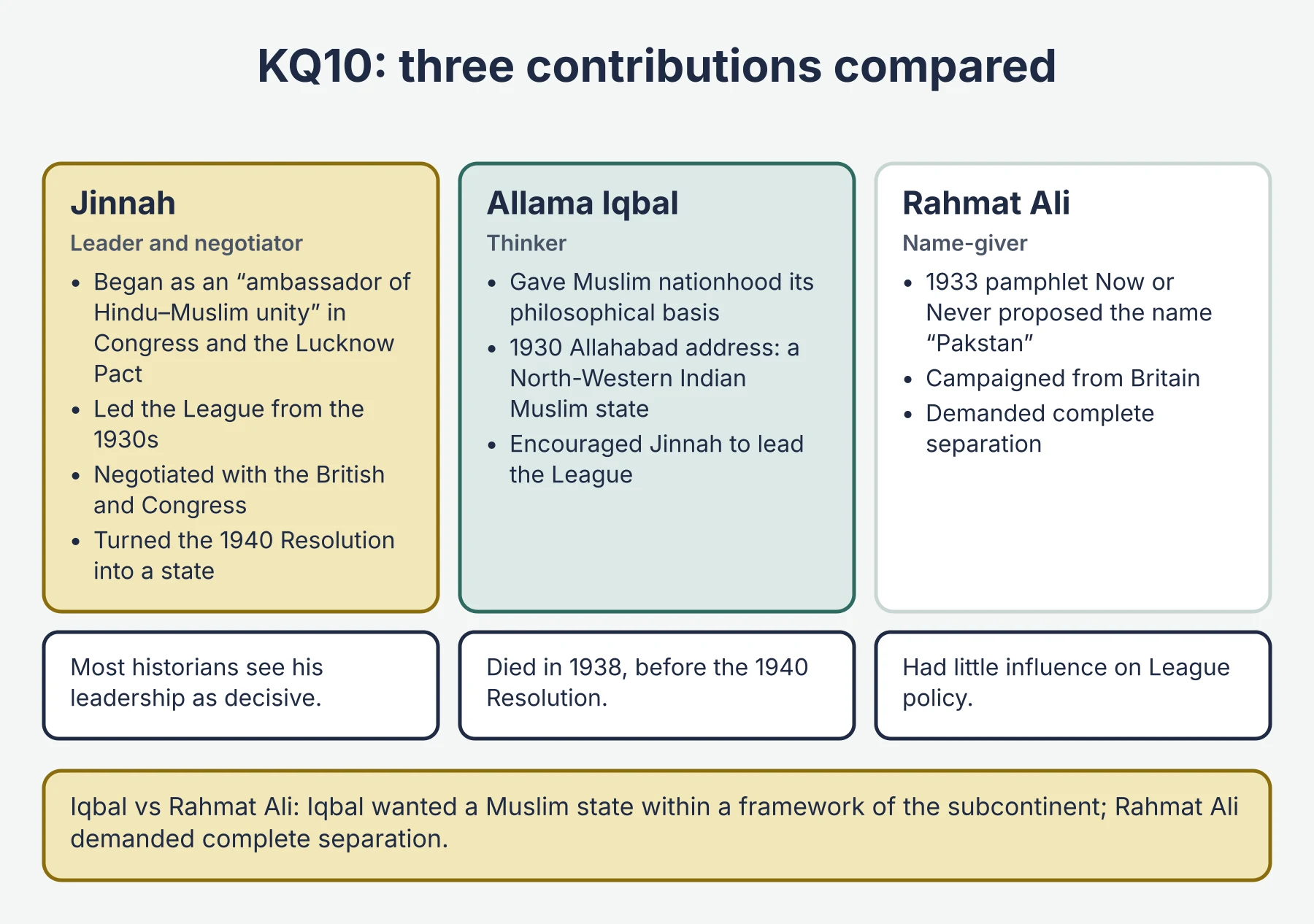
- Jinnah: Congress member and “ambassador of Hindu–Muslim unity” (Lucknow Pact, 1916); left Congress after Non-Cooperation; Fourteen Points; reorganised the League after the mid-1930s; negotiated with the British and Congress; led the League to victory in 1945–46.
- Allama Iqbal: philosophical case for Muslim nationhood; Allahabad address (1930); letters encouraging Jinnah to lead; died in 1938.
- Rahmat Ali: Now or Never (1933) and the name “Pakistan”; demanded a fully separate state rather than a Muslim state within a federation; had little influence on League policy.
Exam traps
- The Simla Deputation (1906) and the Simla Conference (1945) are different events.
- The Nehru Report (1928) came before the Fourteen Points (1929), which answered it.
- Iqbal did not coin the name “Pakistan”; Rahmat Ali did.
- The Cripps Mission (1942) is not the Cabinet Mission (1946).
- Direct Action Day was called by the League after it withdrew from the Cabinet Mission Plan.
- In 14-mark answers on “how successful”, balance success and failure for the period named only.
Self-test
- Who led the Simla Deputation in 1906?
- Where was the Muslim League founded?
- What did the Lucknow Pact give the Muslims?
- What was the Hijrat Movement?
- Why did Gandhi call off Non-Cooperation in 1922?
- What did the Delhi Proposals offer?
- What was the Communal Award?
- Why did Jinnah call for a Day of Deliverance?
- Who moved the Lahore Resolution?
- Why did the Simla Conference of 1945 fail?
- Name the three members of the Cabinet Mission.
- What did Rahmat Ali want that differed from Iqbal’s idea?
Answers
- The Aga Khan. 2. Dhaka, December 1906. 3. Congress accepted separate electorates and one-third of the seats in the central legislature for Muslims. 4. The migration of Muslims to Afghanistan in 1920, on the view that India was no longer a place where they could freely practise Islam; Afghanistan closed its border and many returned impoverished. 5. Violence at Chauri Chaura, where police were killed. 6. Muslims would accept joint electorates in return for one-third of central seats, the separation of Sindh from Bombay, reforms in the North-West Frontier Province and Balochistan, and representation by population in Punjab and Bengal. 7. A British decision of 1932 keeping separate electorates for minorities. 8. To mark the resignation of the Congress ministries in December 1939. 9. A. K. Fazlul Haq. 10. Congress rejected the League’s claim to nominate all the Muslim members of the proposed council. 11. Lord Pethick-Lawrence, Sir Stafford Cripps and A. V. Alexander. 12. A completely separate homeland rather than a Muslim state within a framework of the subcontinent.
Frequently asked questions
Which events are most often asked about in 4-mark questions? Any named item in the specified content can be asked; learn three or four facts for each.
How do I balance a “how successful” question on 1927–39? Successes: the Fourteen Points, Iqbal’s vision, the Communal Award, the League’s revival after 1937. Failures: the 1937 election results and the lack of agreement at the Round Table Conferences.
Related pages
Source: Cambridge International, Cambridge IGCSE Pakistan Studies 0448 syllabus for examination in 2026, Paper 1 Section 2, Key Questions 6–10.
Related resources
-
Practice questions
Cambridge IGCSE Pakistan Studies (0448): Nationhood, 1947–99 – Practice Questions
Original 4, 7 and 14-mark questions with answers on Cambridge IGCSE Pakistan Studies 0448 Paper 1 Section 3, Pakistan's nationhood from 1947 to 1999.
Pakistan Studies · Cambridge · IGCSE
Try questions -
Revision notes
Cambridge IGCSE Pakistan Studies (0448): Nationhood, 1947–99 – Revision Notes
Revision notes for Cambridge IGCSE Pakistan Studies 0448 Paper 1 Section 3, 1947–99: early problems, governments, 1971, foreign policy and a self-test.
Pakistan Studies · Cambridge · IGCSE
Revise topic -
Study guides
Cambridge IGCSE Pakistan Studies: The Emergence of Pakistan, 1906–47 (0448)
Study guide to Section 2 of Cambridge IGCSE Pakistan Studies 0448 Paper 1: the Muslim League, Khilafat, the road to 1947, and Jinnah, Iqbal and Rahmat Ali.
Pakistan Studies · Cambridge · IGCSE
Read guide
Get free revision emails (optional)
Occasional emails with practice questions, worked explanations and links to free resources for the qualification and subjects you choose. No spam, and you can unsubscribe from any email. The free tools on this site never need an email.