
Revision Notes
Cambridge IGCSE Pakistan Studies (0448): Nationhood, 1947–99 – Revision Notes
Revision notes for Cambridge IGCSE Pakistan Studies 0448 Paper 1 Section 3, 1947–99: early problems, governments, 1971, foreign policy and a self-test.
- Subject
- Pakistan Studies
- Level
- IGCSE
- Topic
- Paper 1 – The History and Culture of Pakistan
- Author
- Marlbridge Academic Team
- Updated
- Reviewed by
- Azam Siddique (what this means)
Aligned to Cambridge IGCSE Pakistan Studies (0448), 2026. Official specification .
Syllabus page (what it covers and how it is assessed): Cambridge IGCSE Pakistan Studies.
Syllabus points this page covers
0448
- 1.3 Nationhood 1947–99
Found an error? Report a correction.
Need help with this topic? Request a free trial class for IGCSE Pakistan Studies (0448).
These notes condense Section 3 of Paper 1, Nationhood 1947–99, in Cambridge IGCSE Pakistan Studies 0448. The section is examined through Key Questions 11 to 16, from the problems of 1947–48 to General Musharraf’s takeover in 1999, together with Pakistan’s role in world affairs. The full account is in the Nationhood, 1947–99 study guide; practise with the Nationhood, 1947–99 practice questions.
Syllabus coverage
0448 Paper 1, Section 3 (2026 syllabus)
- Key Question 11: How successful was the establishment of an independent nation between 1947 and 1948?
- Key Question 12: How far did Pakistan achieve stability following the death of Jinnah?
- Key Question 13: Why did East Pakistan seek and then form the independent state of Bangladesh?
- Key Question 14: How successful was Pakistan in the twenty years following the “Decade of Progress”?
- Key Question 15: How effective were Pakistan’s governments in the final decade of the 20th century?
- Key Question 16: How important has Pakistan’s role been in world affairs since 1947?
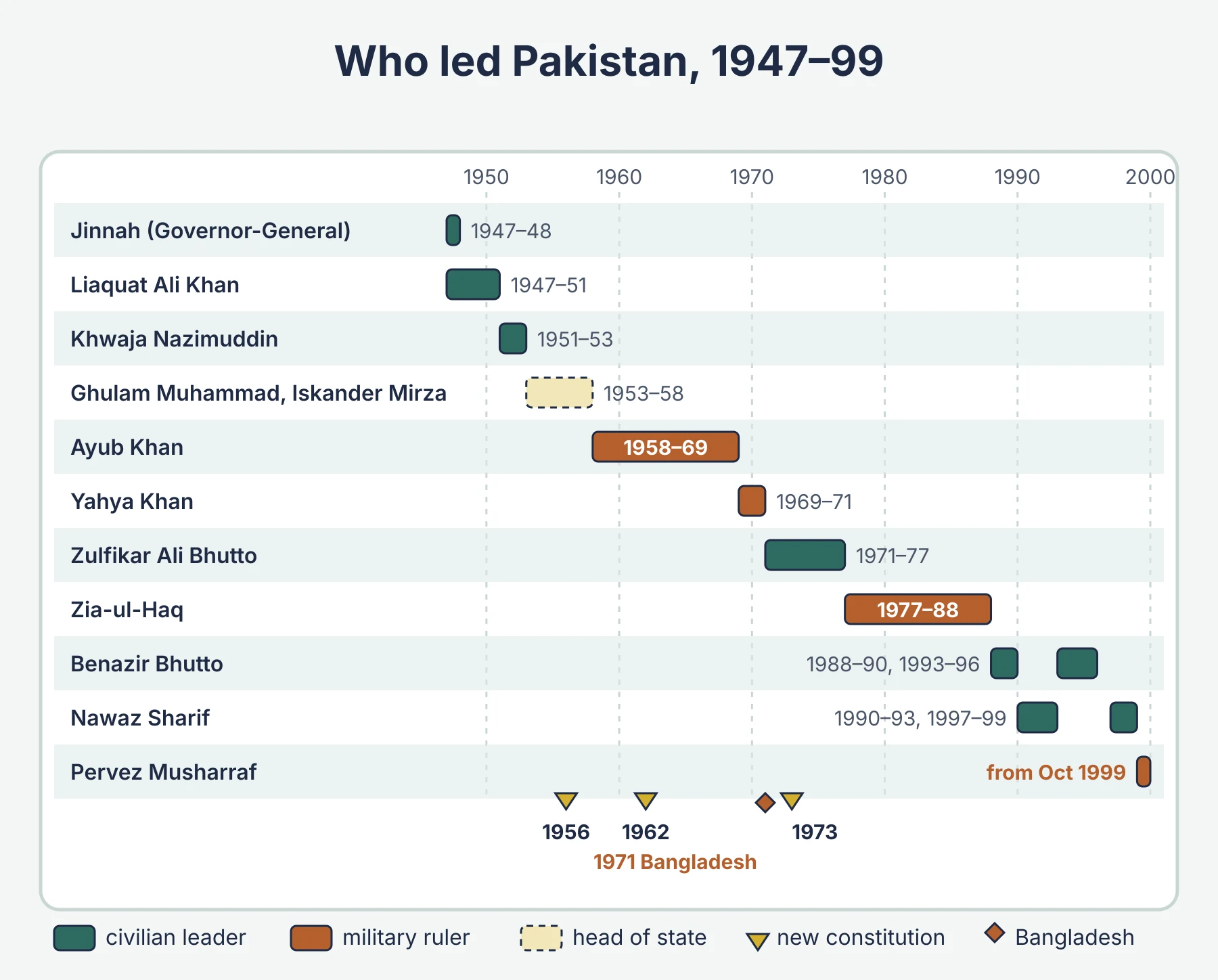
Key Question 11: problems of 1947–48
| Problem | Key facts | Outcome |
|---|---|---|
| Radcliffe Award | Muslim-majority areas such as parts of Gurdaspur went to India, giving it a land route to Kashmir | Lasting grievance |
| Refugees | Millions crossed the borders amid violence | Relief camps; the Quaid’s Relief Fund |
| Division of assets | India delayed Pakistan’s share of cash and military stores | Pakistan short of money and equipment |
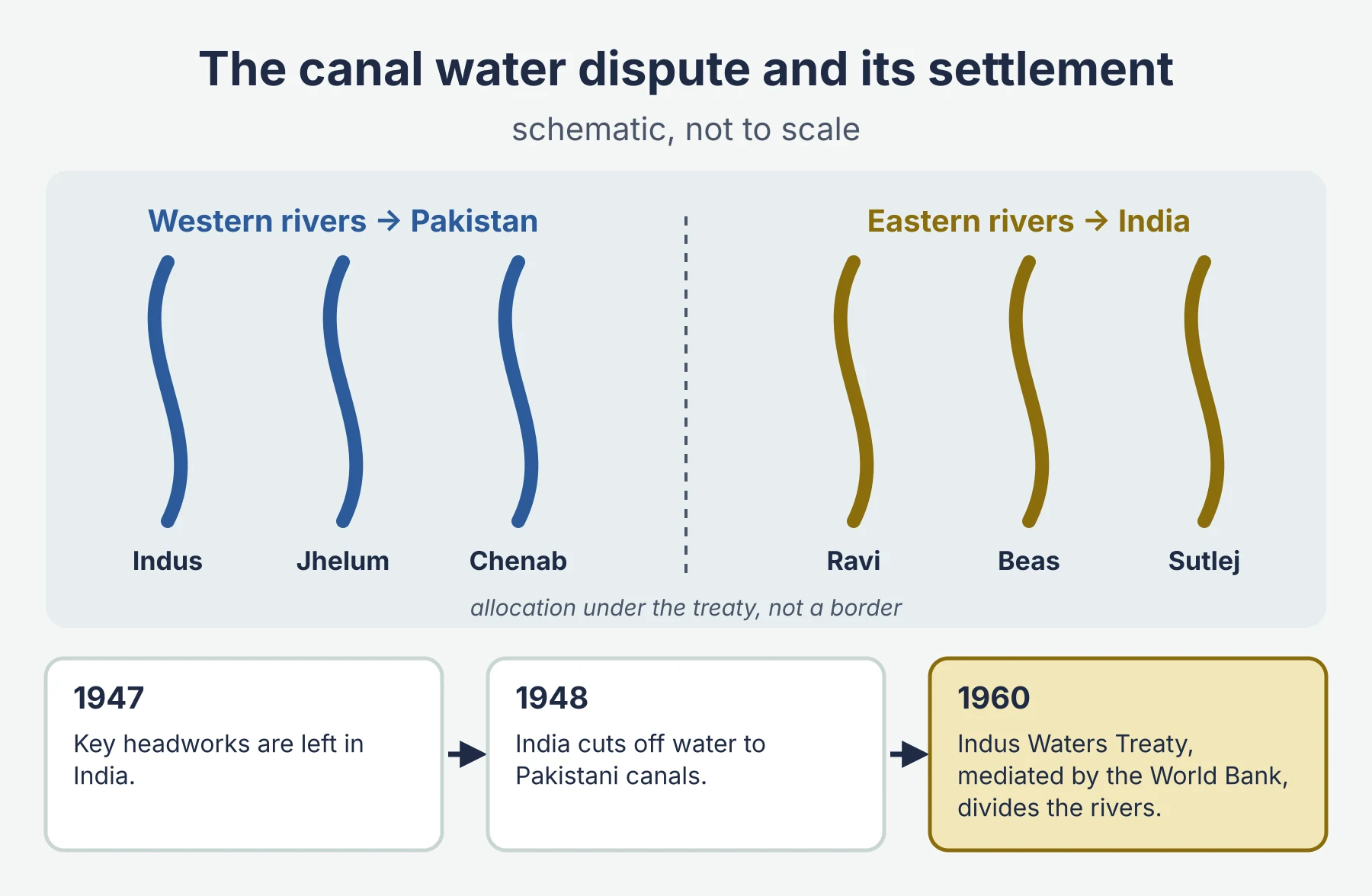
| Canal water | India cut the flow to Pakistan’s canals in 1948 | Indus Waters Treaty (1960), mediated by the World Bank |
| Princely states | Junagadh, Hyderabad and Kashmir | War over Kashmir; UN ceasefire from January 1949 |
| Government | No capital buildings, few officials, little equipment | Karachi as capital; administration built from scratch |
| National language | Bengali speakers objected to Urdu alone | Later language movement in East Pakistan |
Jinnah as Governor-General: set up the government and the State Bank (1948), led the response to the refugee crisis, set out a vision of a tolerant state; died 11 September 1948.
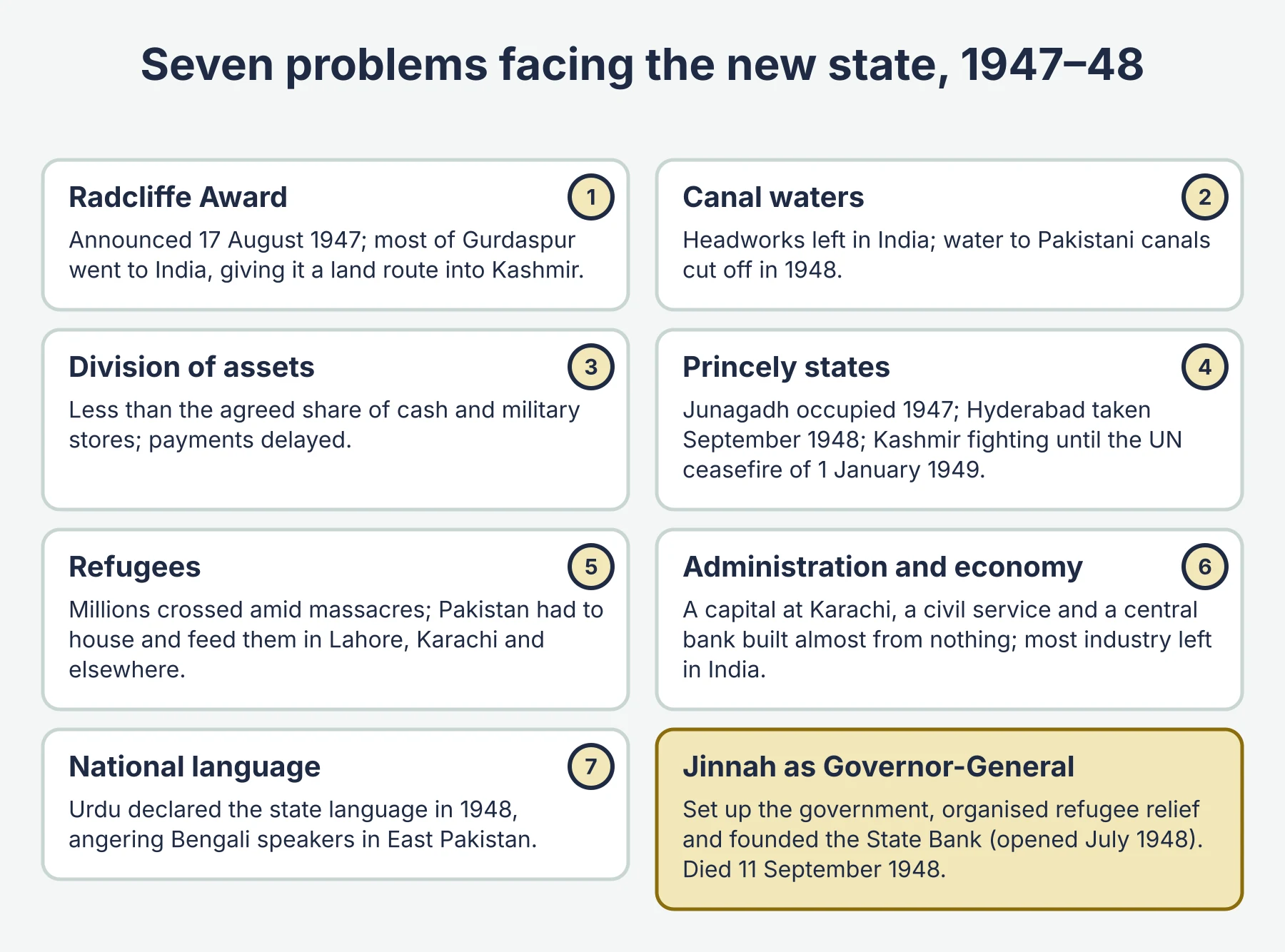
Key Question 12: leaders, 1948–71
| Leader | Role and dates | Main points |
|---|---|---|
| Liaquat Ali Khan | Prime Minister 1947–51 | Objectives Resolution (1949); Liaquat–Nehru Pact (1950); visit to the USA (1950); assassinated in Rawalpindi (1951) |
| Khwaja Nazimuddin | Governor-General 1948–51; Prime Minister 1951–53 | Food shortages; disturbances in Lahore (1953); dismissed by Ghulam Muhammad |
| Ghulam Muhammad | Governor-General 1951–55 | Dismissed Nazimuddin (1953) and the Constituent Assembly (1954) |
| Iskander Mirza | Governor-General 1955–56, then first President 1956–58 | One Unit came into force (1955); 1956 Constitution; frequent changes of Prime Minister; declared martial law (October 1958) |
| Ayub Khan | President 1958–69 | “Decade of Progress”: land reforms, Basic Democracies, 1962 Constitution, industrial and agricultural growth, Indus Waters Treaty, Islamabad; 1965 war and Tashkent Declaration (1966) |
| Yahya Khan | President 1969–71 | Ended One Unit; Legal Framework Order; 1970 elections; the 1971 crisis |
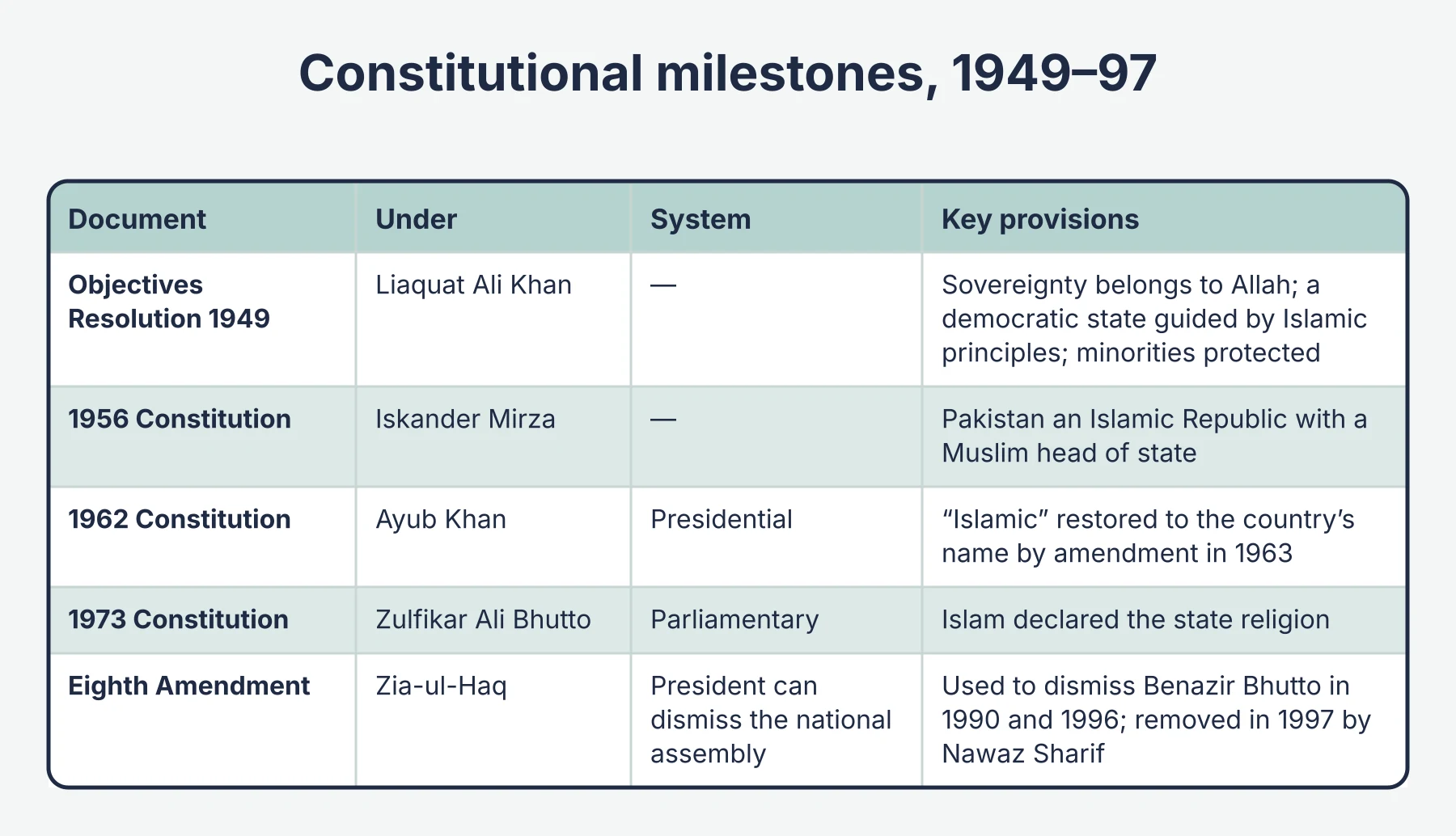
Constitutions and Islamic provisions: 1956 (Islamic Republic; President must be a Muslim); 1962 (initially “Republic of Pakistan”, with “Islamic” restored by amendment; advisory bodies on Islamic law); 1973 (Islam the state religion; President and Prime Minister must be Muslims).
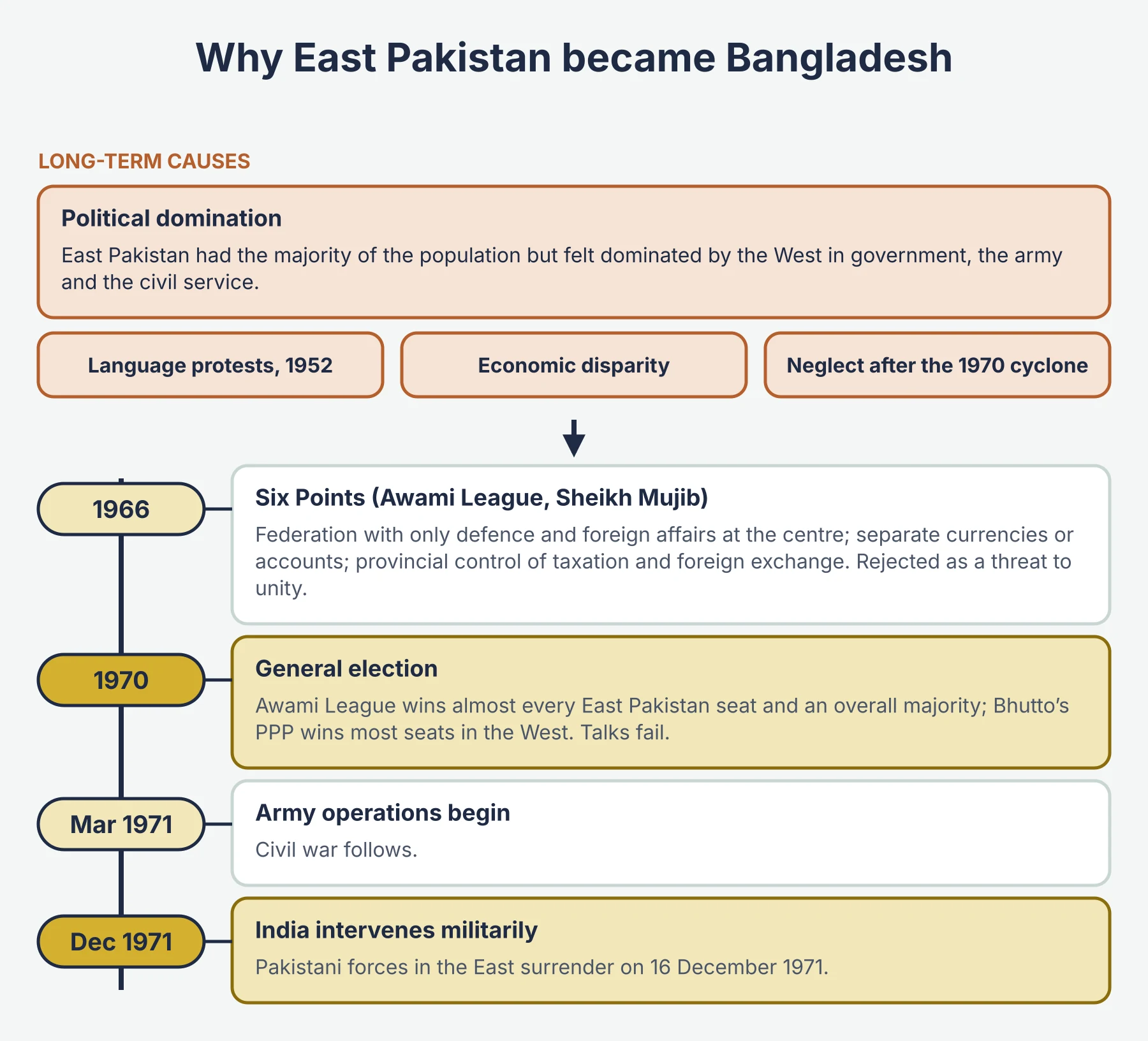
Key Question 13: why East Pakistan became Bangladesh
- Distance: about 1,600 km of Indian territory between the two wings.
- Language: the Urdu-only policy led to the language movement and the deaths of protesters in Dhaka in 1952.
- Economic grievances: East Pakistan earned much foreign exchange from jute but received a smaller share of development spending.
- Under-representation in the army and civil service.
- Sheikh Mujib’s Six Points (1966): a federation with very limited central powers, separate currencies or accounts, provincial control of taxes and foreign trade, and a separate militia.
- The 1970 elections: the Awami League won an overall majority; the transfer of power was delayed.
- Military action from March 1971, refugees into India, Indian intervention, surrender in Dhaka on 16 December 1971.
Key Question 14: Bhutto and Zia
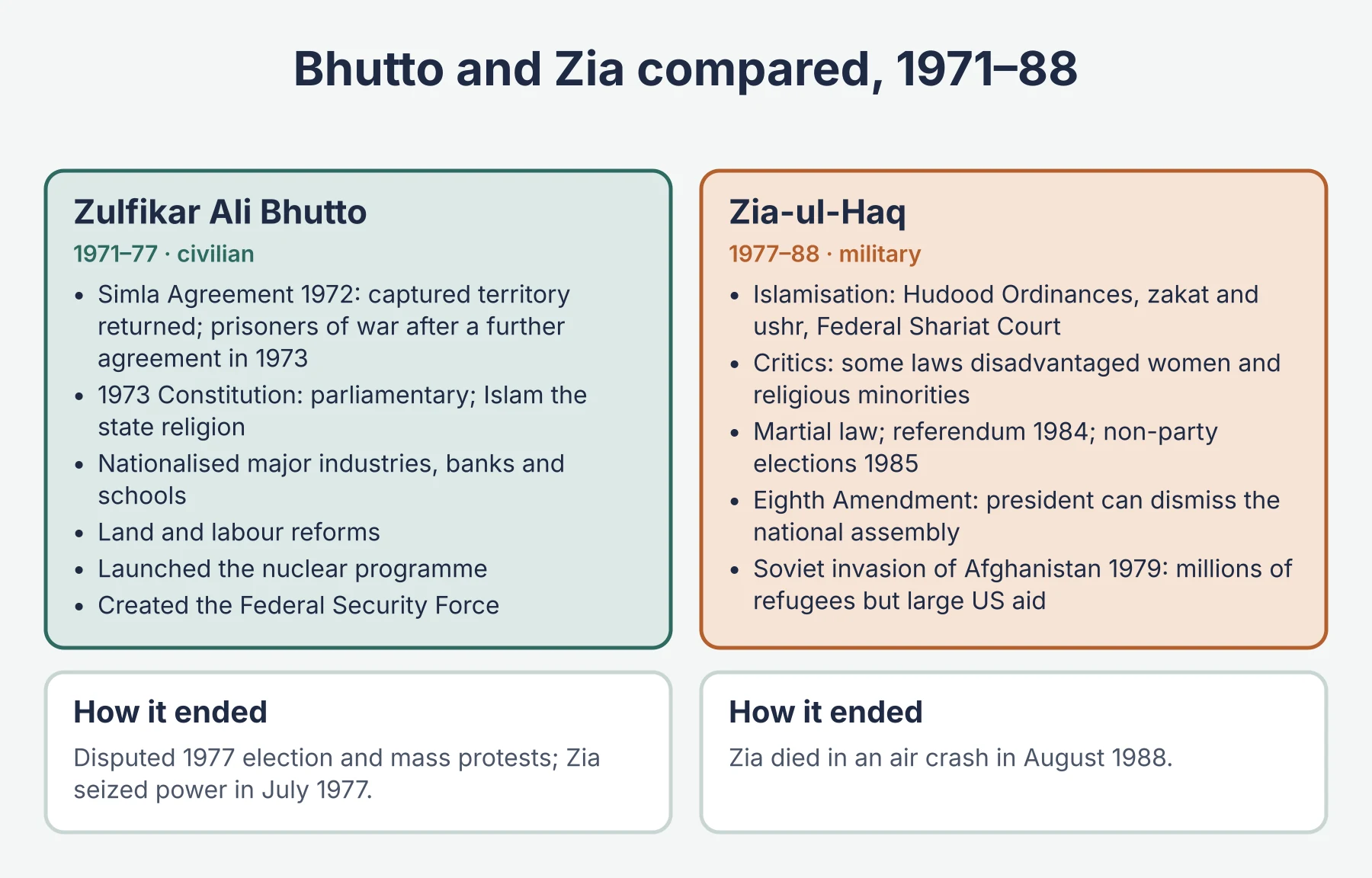
Zulfikar Ali Bhutto (1971–77): Simla Agreement (1972); 1973 Constitution; nationalisation of major industries, banks and schools; land reforms (1972, 1977); Federal Security Force; Islamic Summit in Lahore (1974); overthrown by General Zia on 5 July 1977 after disputed elections; executed in 1979.
Zia-ul-Haq (1977–88): Islamisation (Hudood Ordinances, Zakat and Ushr, Federal Shariat Court); the Majlis-e-Shoora; referendum (1984) and non-party elections (1985); the Eighth Amendment (1985), which allowed the President to dissolve the National Assembly; the Soviet invasion of Afghanistan (1979) and US support; died in an air crash (August 1988).
Key Question 15: the 1990s
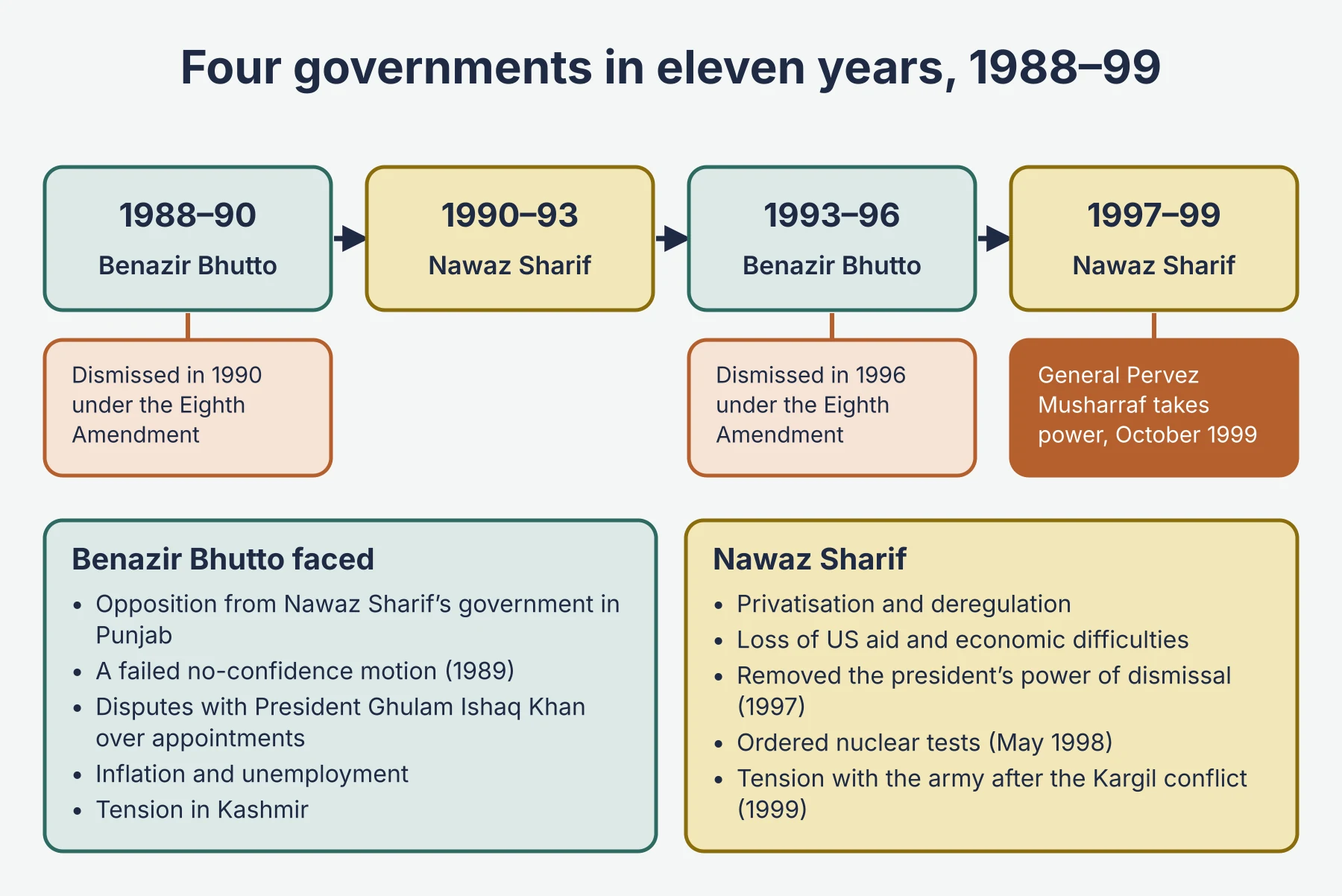
| Government | Problems | End |
|---|---|---|
| Benazir Bhutto, 1988–90 | Conflict with Nawaz Sharif in Punjab; a no-confidence motion (1989); disputes with President Ghulam Ishaq Khan; inflation | Dismissed by the President (1990) |
| Nawaz Sharif, 1990–93 | Privatisation criticised for profiteering; loss of US aid; Kashmir | Dismissed (1993); restored by the Supreme Court, then resigned |
| Benazir Bhutto, 1993–96 | Kashmir tensions; demonstrations; inflation; IMF concerns and devaluation | Dismissed by President Farooq Leghari (1996) |
| Nawaz Sharif, 1997–99 | Nuclear tests and sanctions (1998); Kargil (1999) | Removed by General Musharraf (October 1999) |
Key Question 16: foreign relations
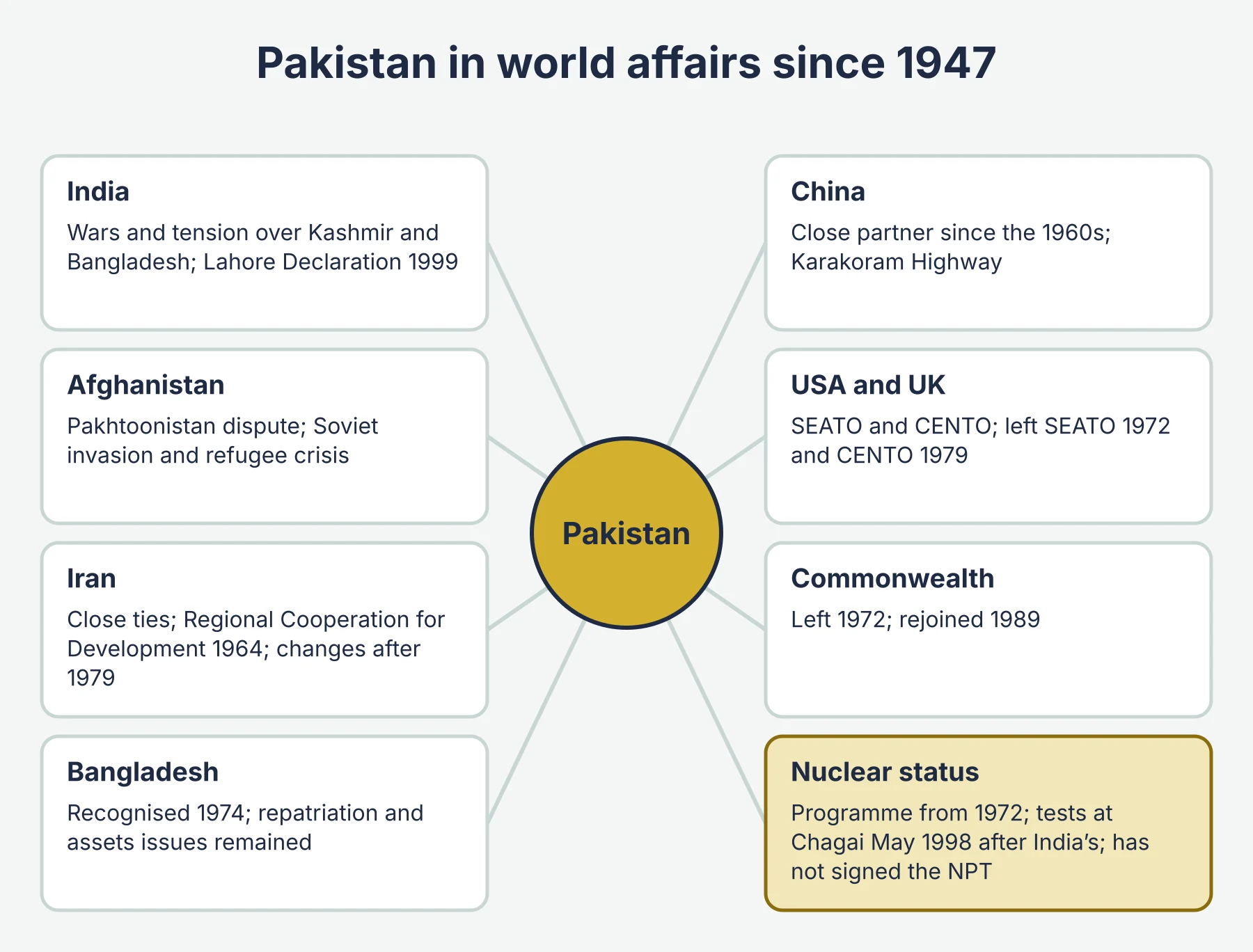
- India: wars of 1948, 1965 and 1971; Kashmir; Simla Agreement (1972); Lahore Declaration (1999).
- Afghanistan: Pakhtoonistan dispute and the Durand Line; Soviet invasion (1979); refugees.
- China: border agreement (1963); the Karakoram Highway; trade and military co-operation.
- USA: SEATO (1954) and CENTO; aid and alliance; strains after 1965, 1971 and over the nuclear programme; close ties during the Afghan war in the 1980s.
- Iran: Regional Cooperation for Development (1964) with Turkey; relations after the 1979 revolution.
- UK and the Commonwealth: Pakistan left in 1972 after Bangladesh’s recognition and rejoined in 1989.
- Nuclear: programme launched in 1972; India’s test in 1974; Pakistan’s tests in May 1998; refusal to sign the Non-Proliferation Treaty.
Exam traps
- The Simla Agreement (1972) with India is not the Simla Conference (1945).
- Ghulam Muhammad (Governor-General) and Iskander Mirza (President) are different people.
- The Eighth Amendment (1985) gave the President the power to dissolve the Assembly; it was later removed by the Thirteenth Amendment (1997).
- In “how successful” questions on a government, set achievements against failures from the same period only.
Self-test
- Which treaty settled the canal water dispute, and who mediated it?
- When did Jinnah die?
- Who was assassinated in Rawalpindi in 1951?
- What was the One Unit scheme?
- Name two features of Ayub Khan’s Decade of Progress.
- What were the Six Points?
- When did the war of 1971 end?
- Name two of Zulfikar Ali Bhutto’s reforms.
- What did the Eighth Amendment allow?
- Who dismissed Benazir Bhutto’s second government?
- In which year did Pakistan carry out nuclear tests?
- Which highway links Pakistan and China?
Answers
- The Indus Waters Treaty (1960), mediated by the World Bank. 2. 11 September 1948. 3. Liaquat Ali Khan. 4. The merger of the provinces of West Pakistan into a single province (1955). 5. Any two: land reforms, Basic Democracies, the 1962 Constitution, industrial growth, the Green Revolution, the Indus Waters Treaty, building Islamabad. 6. Sheikh Mujib’s 1966 demands for autonomy for East Pakistan.
- 16 December 1971. 8. Any two: nationalisation, land reforms, the 1973 Constitution, the Federal Security Force, education and health reforms. 9. The President could dissolve the National Assembly.
- President Farooq Leghari, in 1996. 11. 1998. 12. The Karakoram Highway.
Frequently asked questions
Is this the largest section of Paper 1? It has the most Key Questions (six), so plan revision time accordingly.
How much foreign policy detail is needed? Know the main features of relations with each country named in the syllabus and be ready to judge how successful they were.
Related pages
Source: Cambridge International, Cambridge IGCSE Pakistan Studies 0448 syllabus for examination in 2026, Paper 1 Section 3, Key Questions 11–16.
Related resources
-
Study guides
Cambridge IGCSE Pakistan Studies: The Emergence of Pakistan, 1906–47 (0448)
Study guide to Section 2 of Cambridge IGCSE Pakistan Studies 0448 Paper 1: the Muslim League, Khilafat, the road to 1947, and Jinnah, Iqbal and Rahmat Ali.
Pakistan Studies · Cambridge · IGCSE
Read guide -
Study guides
Cambridge IGCSE Pakistan Studies: Nationhood, 1947–99 (0448)
Study guide to Section 3 of Cambridge IGCSE Pakistan Studies 0448 Paper 1: early problems, governments to 1999, Bangladesh 1971 and foreign relations.
Pakistan Studies · Cambridge · IGCSE
Read guide -
Study guides
IGCSE Pakistan Studies: The History and Culture of Pakistan (Cambridge 0448)
Paper 1 of Cambridge IGCSE Pakistan Studies 0448, 2026 series: background to the Pakistan Movement, the emergence of Pakistan 1906-47 and nationhood 1947-99.
Pakistan Studies · Cambridge · IGCSE
Read guide
Get free revision emails (optional)
Occasional emails with practice questions, worked explanations and links to free resources for the qualification and subjects you choose. No spam, and you can unsubscribe from any email. The free tools on this site never need an email.