
Revision Notes
Cambridge IGCSE Pakistan Studies (0448): Trade – Revision Notes
Revision notes on Section 6 Trade for Cambridge IGCSE Pakistan Studies 0448 Paper 2: key terms, exports, imports, partners, exchange rates and a self-test.
- Subject
- Pakistan Studies
- Level
- IGCSE
- Topic
- Paper 2 – The Environment of Pakistan
- Author
- Marlbridge Academic Team
- Updated
- Reviewed by
- Azam Siddique (what this means)
Aligned to Cambridge IGCSE Pakistan Studies (0448), 2026. Official specification .
Syllabus page (what it covers and how it is assessed): Cambridge IGCSE Pakistan Studies.
Syllabus points this page covers
0448
- 2.6 Trade
Found an error? Report a correction.
Need help with this topic? Request a free trial class for IGCSE Pakistan Studies (0448).
These notes summarise Section 6 Trade of Cambridge IGCSE Pakistan Studies 0448 Paper 2. Learn the main exports and imports with where the exports are made, the meanings of GDP, GNP and the balance of trade, the main partners and goods, and the factors that help or hinder trade. The full explanations and worked examples are in the Trade study guide; test yourself with the Trade practice questions.
Syllabus coverage
0448 Paper 2, Section 6 (2026 syllabus)
- 6(a) Main exports and imports; recent changes in types, amounts and value; GNP and GDP; the effect of trends on the balance of trade and the economy
- 6(b) Main partners and the goods traded; factors that promote or hinder trade; why a developing country struggles to keep or raise its share; trading blocs, trade barriers and exchange rates
Key terms
| Term | Meaning |
|---|---|
| Export | A good or service sold to another country |
| Import | A good or service bought from another country |
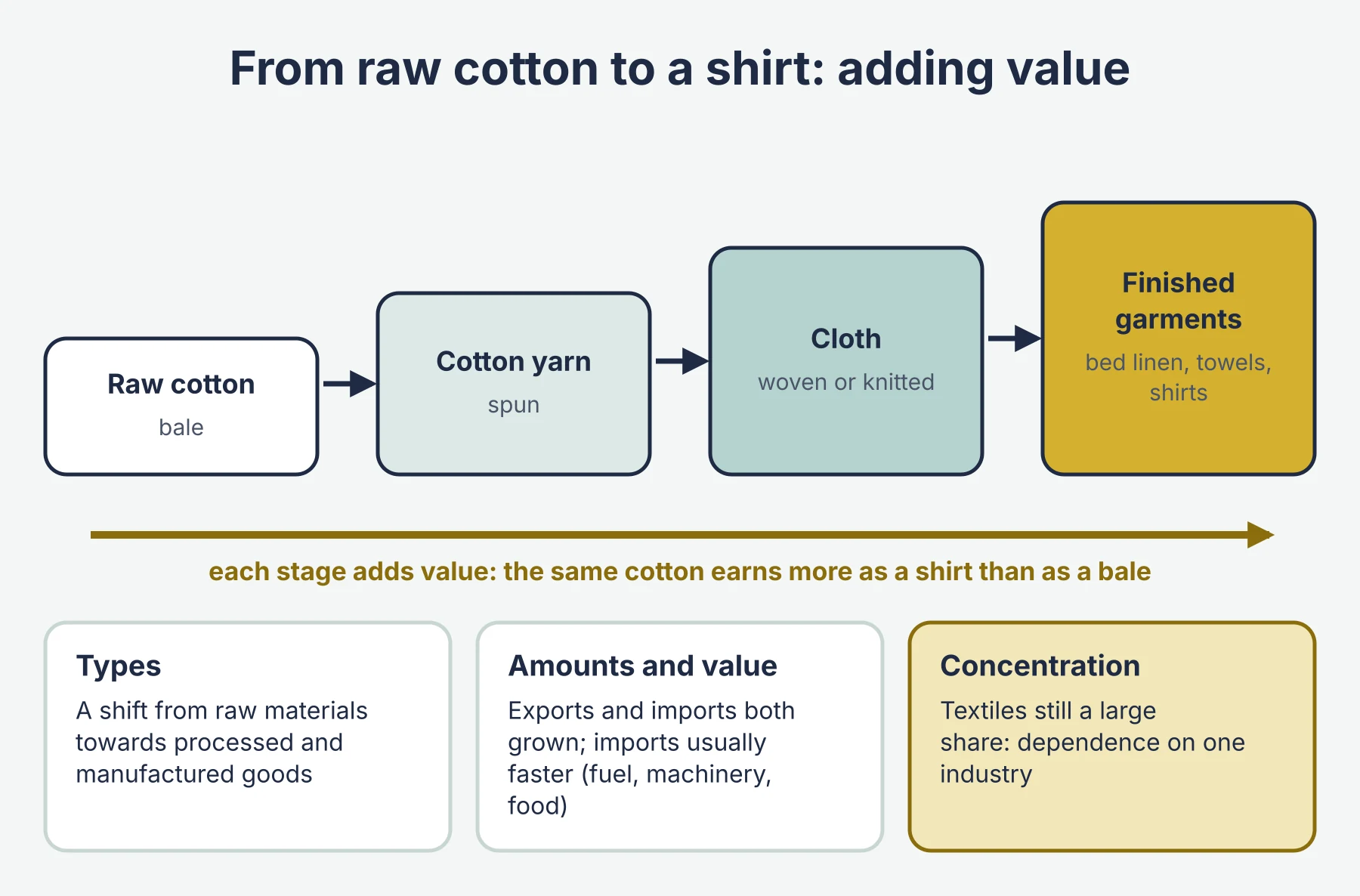
| Value added | The extra value created by processing a raw material, for example cotton into cloth |
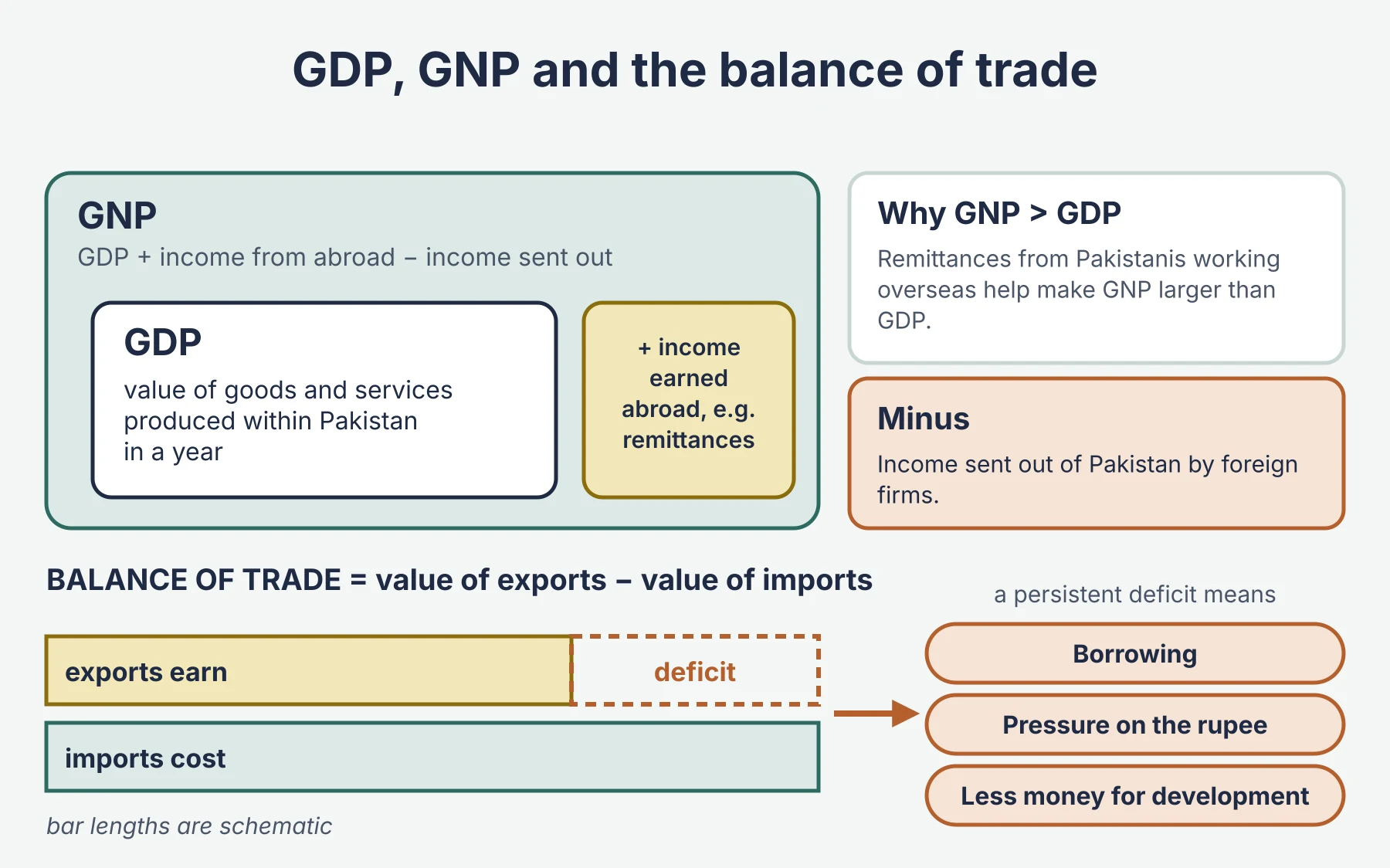
| GDP | The value of all goods and services produced within the country in a year |
| GNP | GDP plus income earned abroad by the country’s people and firms, minus income paid to foreign owners |
| Balance of trade | Value of exports minus value of imports |
| Trade deficit | Imports worth more than exports |
| Trade surplus | Exports worth more than imports |
| Trading bloc | A group of countries that reduce trade barriers between themselves |
| Tariff | A tax on imports |
| Quota | A limit on the quantity of a good that may be imported |
| Exchange rate | The price of one currency in terms of another |
| Devaluation / depreciation | A fall in the value of the rupee against other currencies |
Exports and where they come from
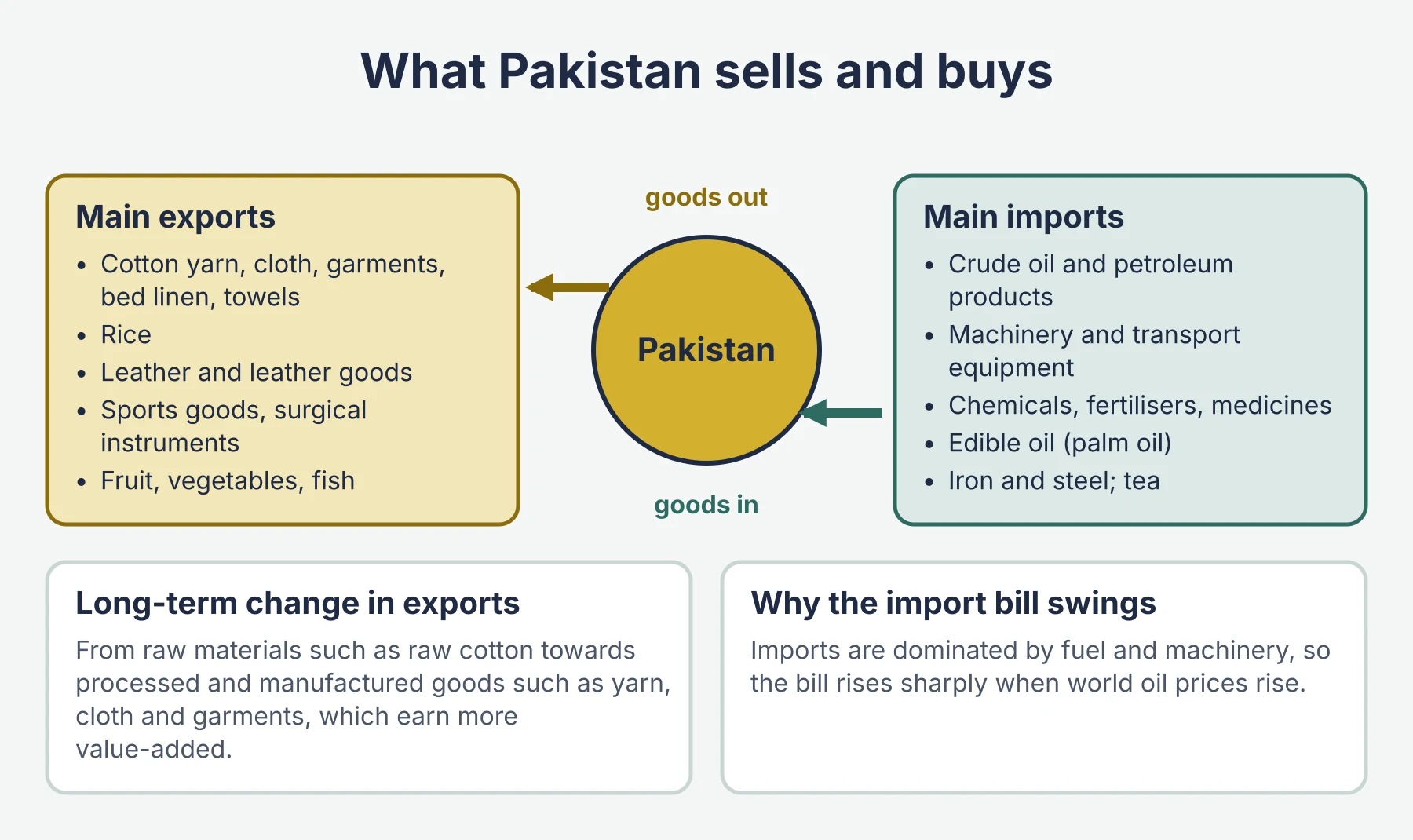
- Textiles (yarn, cloth, knitwear, garments, bed linen, towels): Faisalabad, Karachi, Lahore.
- Rice (including basmati): northern Punjab rice belt; Sindh.
- Leather goods: Karachi, Lahore, Kasur, Sialkot.
- Sports goods and surgical instruments: Sialkot.
- Fish and seafood: Karachi and the coast.
- Fruit and vegetables: for example mangoes and kinnow.
Main imports
Petroleum and petroleum products; liquefied natural gas; machinery and transport equipment; chemicals, fertilisers and medicines; palm oil; iron and steel; vehicles; electronics; tea.
Changes in trade
- Type: from raw cotton towards yarn, cloth and garments (more value added).
- Value: exports and imports both rising; imports usually rising faster.
- Result: a persistent trade deficit, funded by borrowing and remittances.
Partners and goods
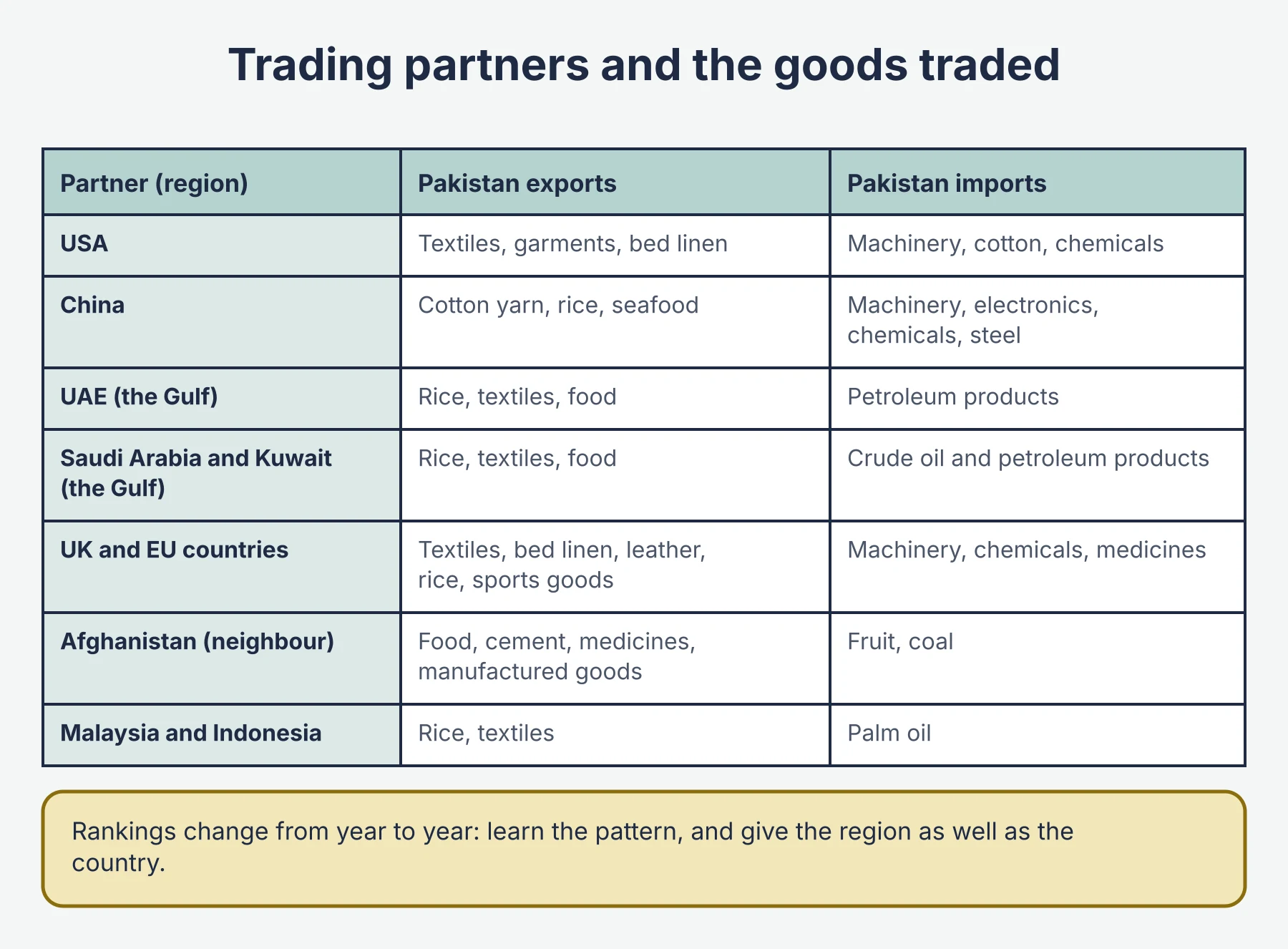
| Partner | Pakistan sells | Pakistan buys |
|---|---|---|
| USA | Textiles, garments | Machinery, cotton, chemicals |
| China | Yarn, rice, seafood | Machinery, electronics, steel, chemicals |
| Gulf states (UAE, Saudi Arabia, Kuwait) | Rice, textiles, food | Crude oil and petroleum products |
| UK and EU | Textiles, leather, rice, sports goods | Machinery, chemicals, medicines |
| Afghanistan | Food, cement, medicines | Fruit, coal |
| Malaysia and Indonesia | Rice, textiles | Palm oil |
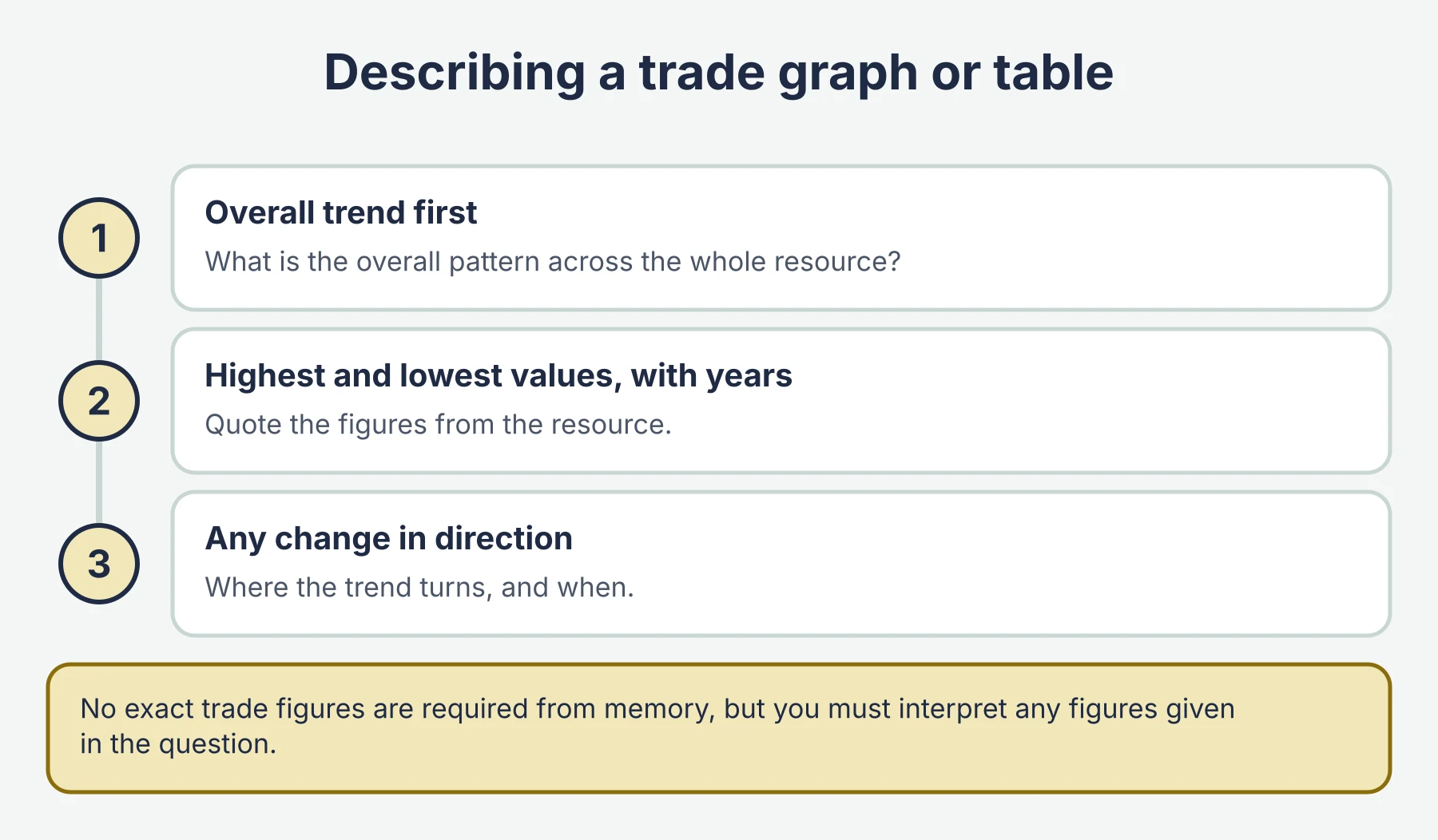
Rankings change from year to year: use the figures in the question.
Promoting and limiting factors
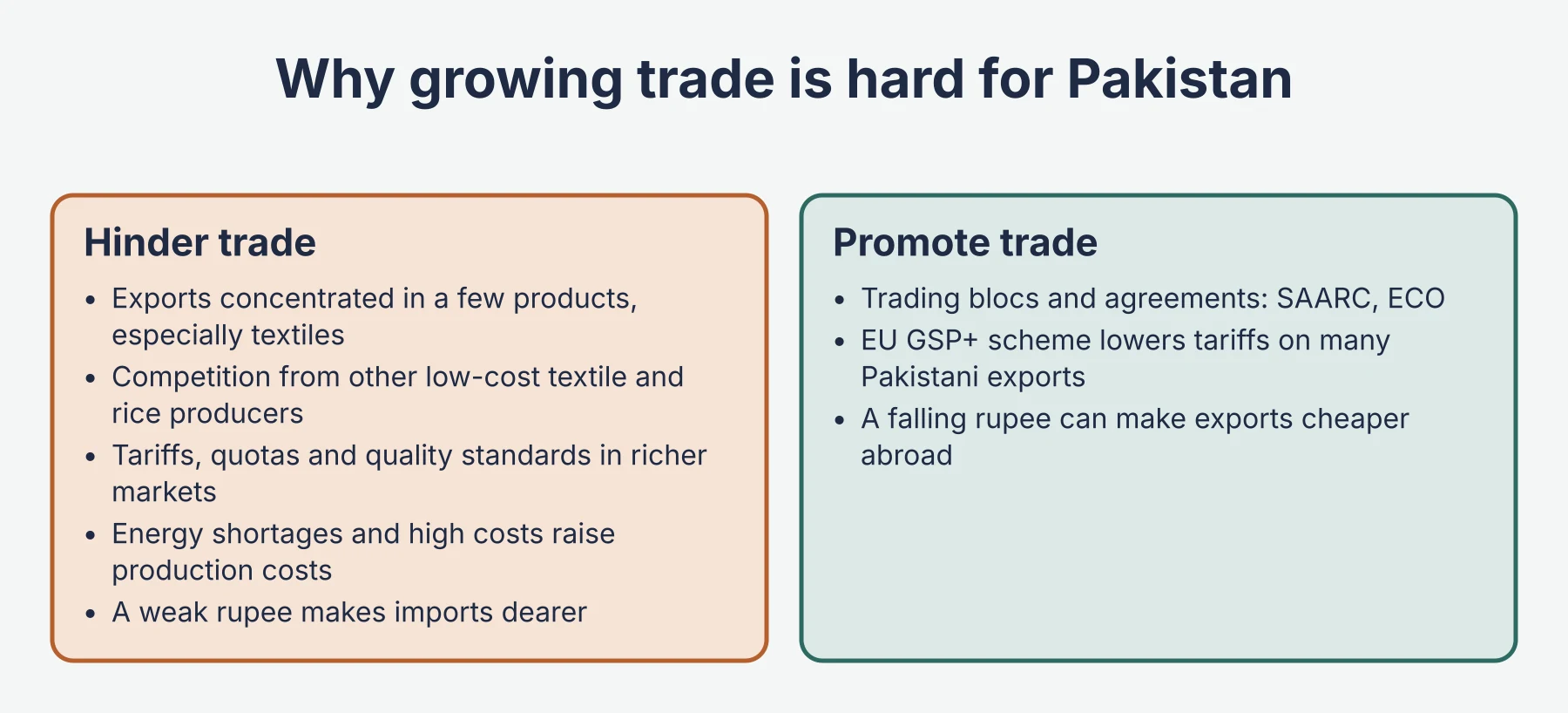
| Promote | Limit |
|---|---|
| SAARC and its free-trade area; ECO | Tariffs and quotas abroad |
| Free-trade agreement with China | Strict quality and labour standards |
| EU GSP+ tariff concessions | Exchange-rate swings |
| Ports at Karachi, Port Qasim and Gwadar | Political tension closing borders |
| Low labour costs in textiles | Energy shortages and high costs |
Exchange rates in one line each
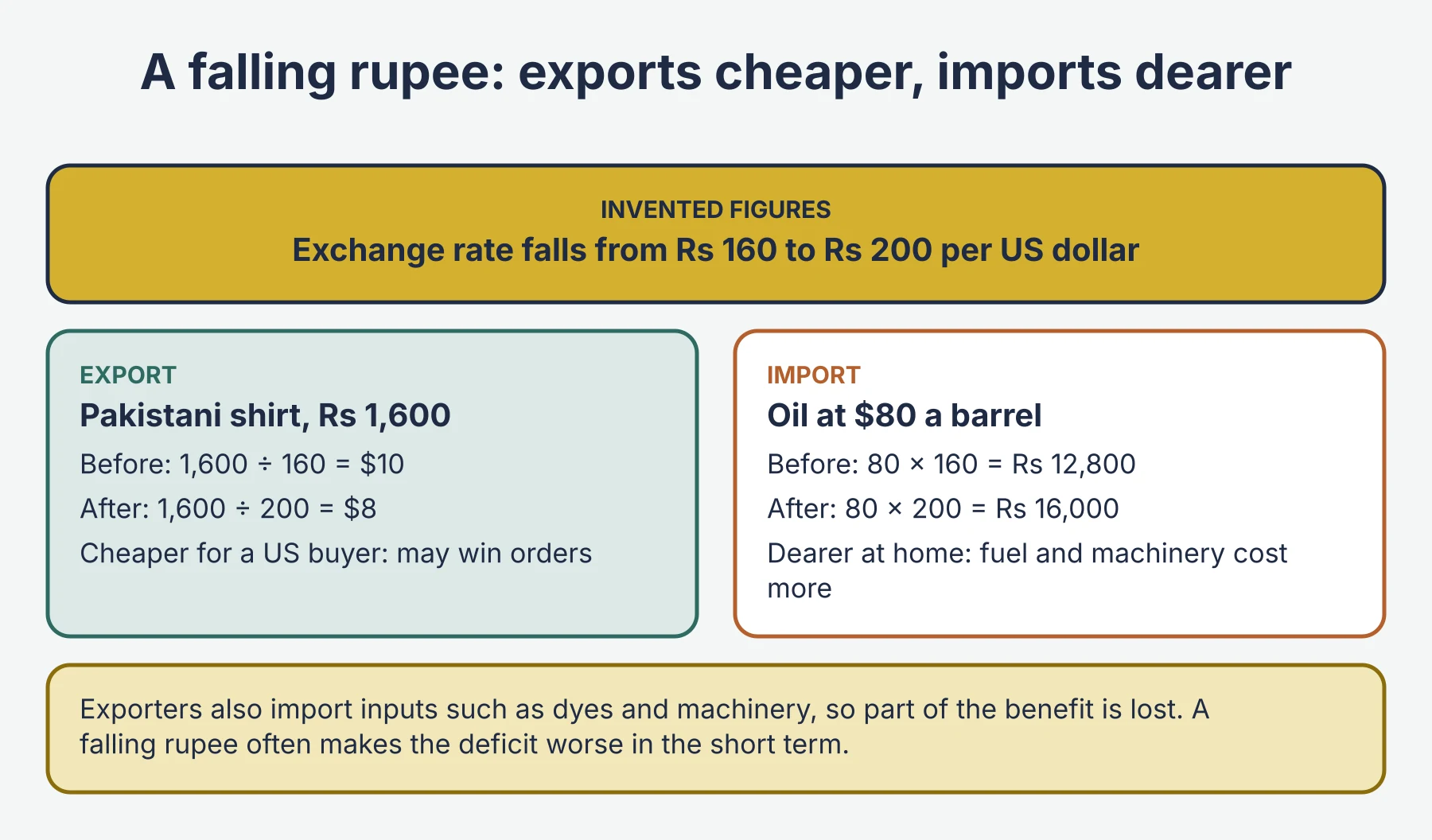
- Weaker rupee: exports cheaper abroad (good for orders), imports dearer at home (bad for the fuel and machinery bill).
- Stronger rupee: imports cheaper, exports dearer and harder to sell.
Why a developing country struggles
Narrow export base; low value added; strong competitors; high energy costs; standards and barriers; dependence on imported fuel; image and security concerns.
Worked example
Question: Explain how the change from exporting raw cotton to exporting garments has helped Pakistan’s economy. [4]
Model answer: Garments sell for much more than the raw cotton used to make them, so export earnings rise for the same crop [1]. Processing creates jobs in spinning, weaving and stitching factories [1]. Higher earnings help to reduce the trade deficit [1], and the industry encourages investment in machinery and skills [1].
Common mistakes and exam traps
- Defining GNP as “GDP plus exports”.
- Saying a weak rupee always improves the trade balance.
- Calling SAARC or ECO a single country’s policy rather than a regional organisation.
- Writing “Punjab” for every export: Sialkot is the answer for sports goods and surgical instruments.
- Describing a graph without quoting figures and years.
How is this section examined?
On Paper 2 (1 hour 30 minutes, 75 marks) you answer three questions from five, each worth 25 marks with parts (a) to (d) based on resources. Part (d) assesses analysis, so finish revision with a judgement, such as how far trading blocs help Pakistan.
Self-test
- Name the town best known for sports goods and surgical instruments.
- Give two of Pakistan’s main imports.
- What is value added?
- Define GDP.
- How does GNP differ from GDP?
- Exports are worth $28 bn and imports $50 bn. What is the balance of trade?
- Name two trading organisations or agreements that include Pakistan.
- What is a quota?
- What happens to the rupee cost of imported oil if the rupee weakens?
- Name the countries Pakistan buys most of its palm oil from.
- Give two reasons why Pakistan finds it hard to raise its share of world trade.
- Name the city at the centre of the textile industry in Punjab.
Answers
- Sialkot. 2. Any two: petroleum, liquefied natural gas, machinery, chemicals, palm oil, iron and steel. 3. The extra value created when a raw material is processed into a more valuable product.
- The value of goods and services produced within the country in a year. 5. GNP adds income earned abroad by the country’s people and firms and subtracts income paid to foreign owners. 6. A deficit of $22 bn. 7. Any two: SAARC, ECO, the China free-trade agreement, the EU GSP+ scheme. 8. A limit on the quantity of a good that can be imported. 9. It rises. 10. Malaysia and Indonesia. 11. Any two: dependence on textiles; competition; trade barriers; high energy costs; low value added.
- Faisalabad.
Related pages
Source: Cambridge International, Cambridge IGCSE Pakistan Studies 0448 syllabus for examination in 2026, Paper 2 Section 6.
Related resources
-
Study guides
Cambridge IGCSE Pakistan Studies (0448): Transport and telecommunications
Study guide to Section 7 of Cambridge IGCSE Pakistan Studies 0448 Paper 2: road, rail and air networks, border crossings, ports and telecommunications.
Pakistan Studies · Cambridge · IGCSE
Read guide -
Practice questions
Cambridge IGCSE Pakistan Studies (0448): Transport and telecommunications – Practice Questions
Fourteen original questions with answers on Section 7 of Cambridge IGCSE Pakistan Studies 0448 Paper 2: networks, border routes, ports, airports and telecoms.
Pakistan Studies · Cambridge · IGCSE
Try questions -
Revision notes
Cambridge IGCSE Pakistan Studies (0448): Transport and telecommunications – Revision Notes
Revision notes on Section 7 of Cambridge IGCSE Pakistan Studies 0448 Paper 2: network patterns, passes, ports, dry ports, airports, telecoms and a self-test.
Pakistan Studies · Cambridge · IGCSE
Revise topic
Get free revision emails (optional)
Occasional emails with practice questions, worked explanations and links to free resources for the qualification and subjects you choose. No spam, and you can unsubscribe from any email. The free tools on this site never need an email.