
Study Guides
Cambridge IGCSE Pakistan Studies (0448): Trade
Study guide to Section 6 Trade in Cambridge IGCSE Pakistan Studies 0448 Paper 2: exports, imports, GDP and GNP, trade balance, partners and exchange rates.
- Subject
- Pakistan Studies
- Level
- IGCSE
- Topic
- Paper 2 – The Environment of Pakistan
- Author
- Marlbridge Academic Team
- Updated
- Reviewed by
- Azam Siddique (what this means)
Aligned to Cambridge IGCSE Pakistan Studies (0448), 2026. Official specification .
Syllabus page (what it covers and how it is assessed): Cambridge IGCSE Pakistan Studies.
Syllabus points this page covers
0448
- 2.6 Trade
Found an error? Report a correction.
Need help with this topic? Request a free trial class for IGCSE Pakistan Studies (0448).
Trade is Section 6 of Paper 2, The environment of Pakistan, in Cambridge IGCSE Pakistan Studies 0448. It has two parts: (a) major exports and imports, and (b) Pakistan’s trading partners. You need to name what Pakistan buys and sells, explain how changes in trade affect the economy, and explain why trade is difficult for a developing country. This guide goes into more depth than the combined Trade, Transport and Telecommunications study guide, with worked examples on the balance of trade, GNP and exchange rates. Revise it with the Trade revision notes and test yourself with the Trade practice questions.
Syllabus coverage
CAMBRIDGE IGCSE PAKISTAN STUDIES (0448), 2026 — PAPER 2, SECTION 6: TRADE
- 6(a) Major exports and imports: name the main exports and imports; describe changes in the types, amounts and value of goods exported and imported in recent years; know the meaning of GNP and GDP and the difference between them; explain the effect of changing trends in exports and imports on Pakistan’s balance of trade and economy.
- 6(b) Pakistan’s trading partners: name and locate the main trading partners and the goods traded with them; understand the factors that may promote or hinder trade, and why it is difficult for Pakistan as a developing country to maintain or increase its share of trade; understand the factors that may promote and limit trade, including trading blocs, trade barriers and currency exchange rates.
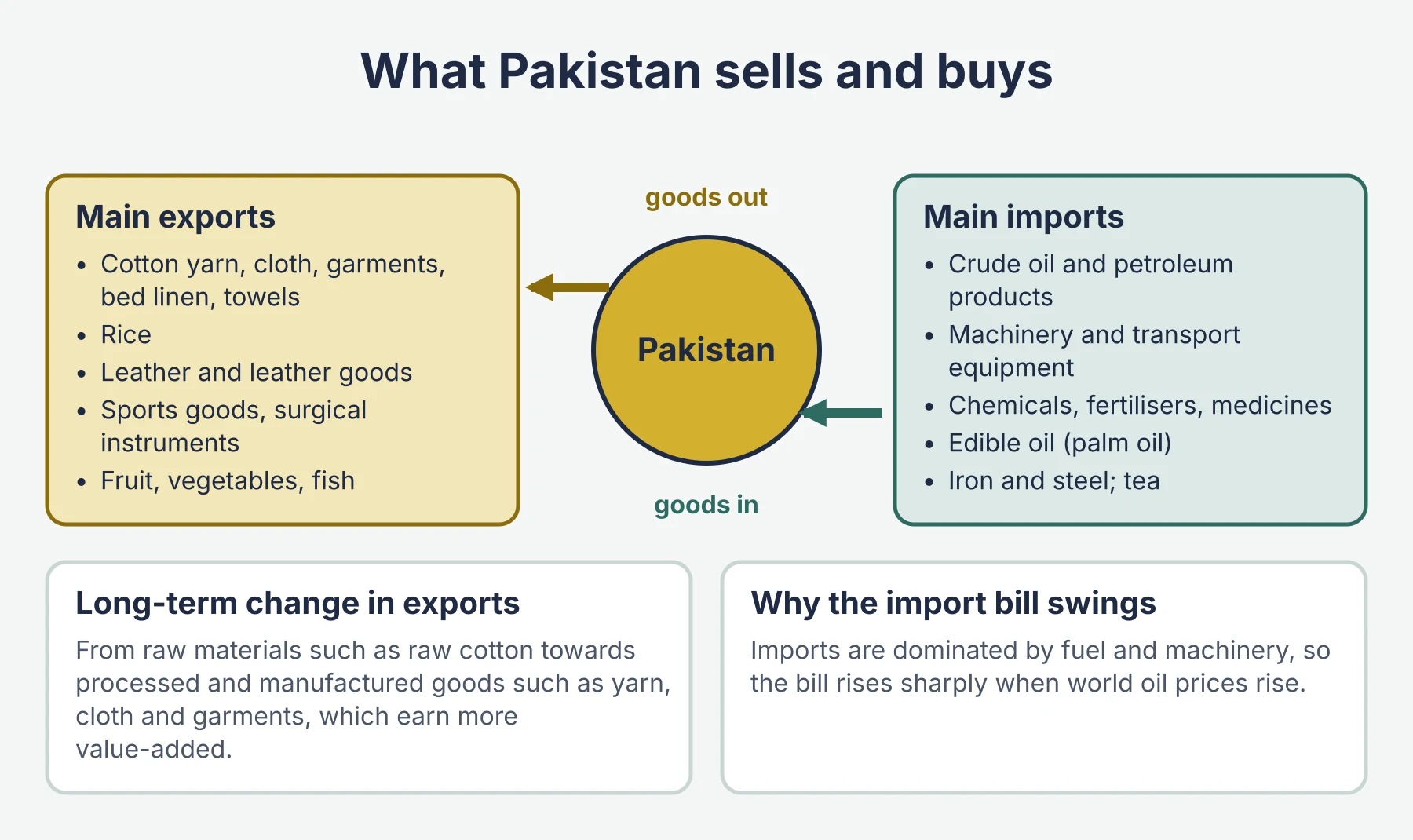
What does Pakistan export, and where are the goods made?
| Export | Where it comes from | Note |
|---|---|---|
| Textiles: cotton yarn, cloth, knitwear, garments, bed linen, towels | Faisalabad, Karachi, Lahore and other Punjab cities | The largest group of exports, built on home-grown cotton |
| Rice, including basmati | The rice belt of northern Punjab; Sindh | A major food export |
| Leather and leather goods | Karachi, Lahore, Kasur, Sialkot | Jackets, gloves and footwear from livestock hides |
| Sports goods | Sialkot | Footballs and other equipment |
| Surgical instruments | Sialkot | High-value metal goods made by skilled workers |
| Fish and seafood | Karachi and the coast | Sold to East Asia and the Middle East |
| Fruit and vegetables | Punjab, Sindh, Balochistan | For example mangoes and kinnow |
What does Pakistan import?
- Petroleum and petroleum products, and liquefied natural gas, because home production does not meet demand for transport, power and industry.
- Machinery and transport equipment, for factories, power stations and infrastructure.
- Chemicals, fertilisers and medicines.
- Edible oil, especially palm oil from Malaysia and Indonesia.
- Iron and steel, vehicles, electronics and tea.
How has trade changed?
The syllabus asks you to describe changes in the types, amounts and value of goods.
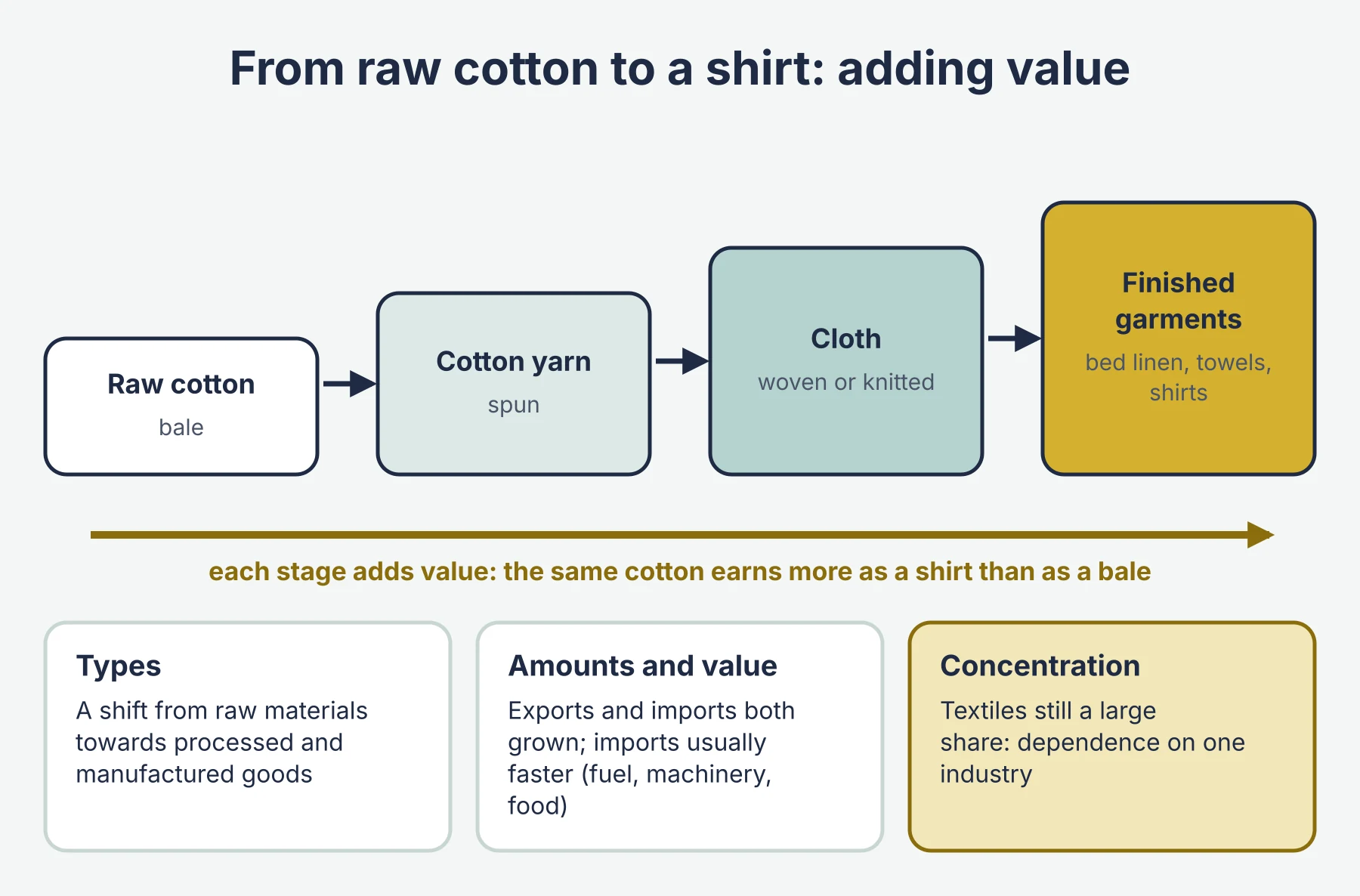
- Types: a shift from exporting raw materials, such as raw cotton, towards processed and manufactured goods, such as yarn, cloth and finished garments. Each stage adds value, so the same cotton earns more as a shirt than as a bale.
- Amounts and value: the value of both exports and imports has grown, but imports have usually grown faster, driven by fuel, machinery and food.
- Concentration: textiles still make up a large share of exports, so the country depends on one industry.
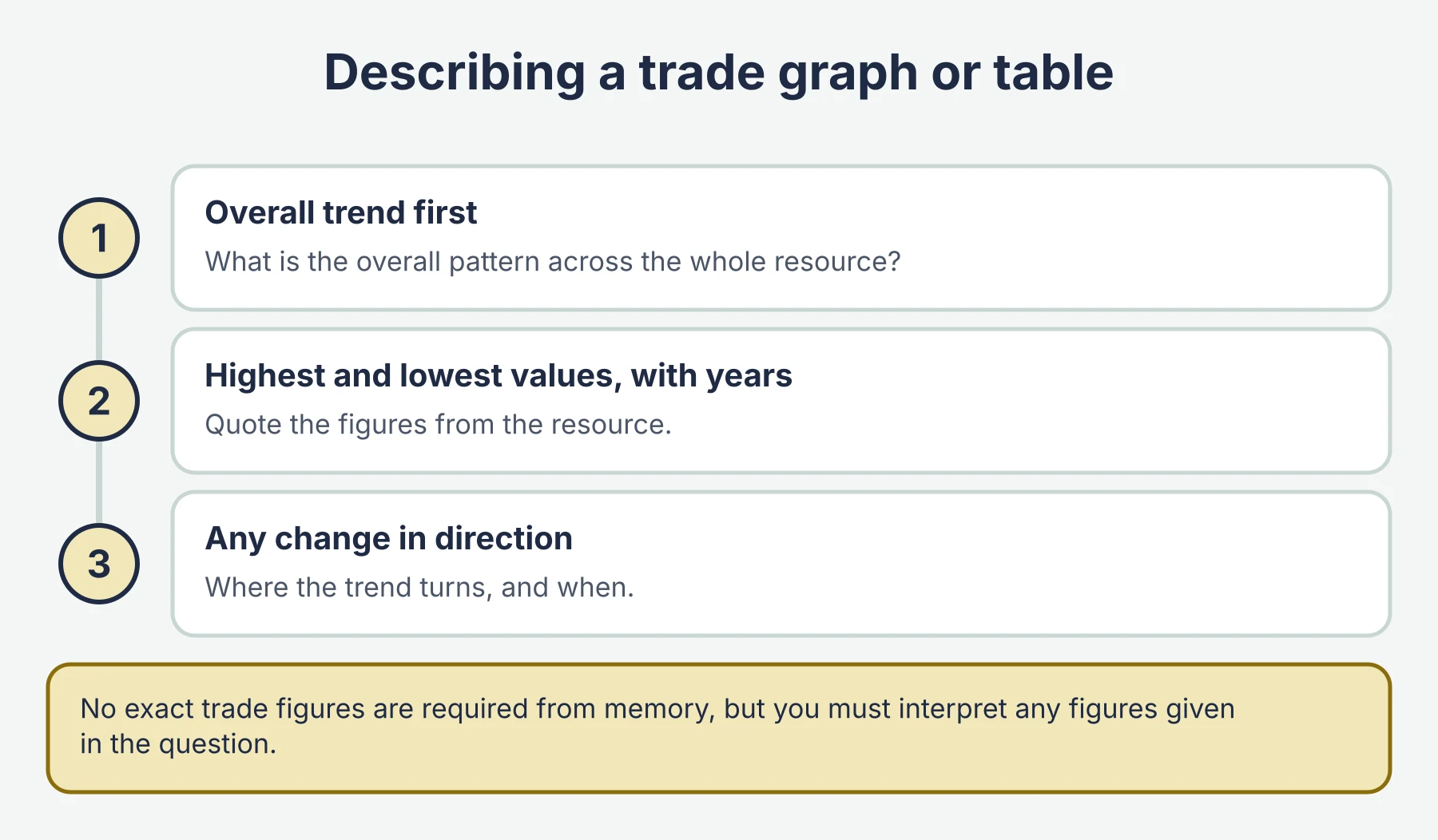
When you answer from a graph or table in the exam, describe the overall trend first, then quote the highest and lowest values with their years, and finally note any change in direction.
GDP, GNP and the balance of trade
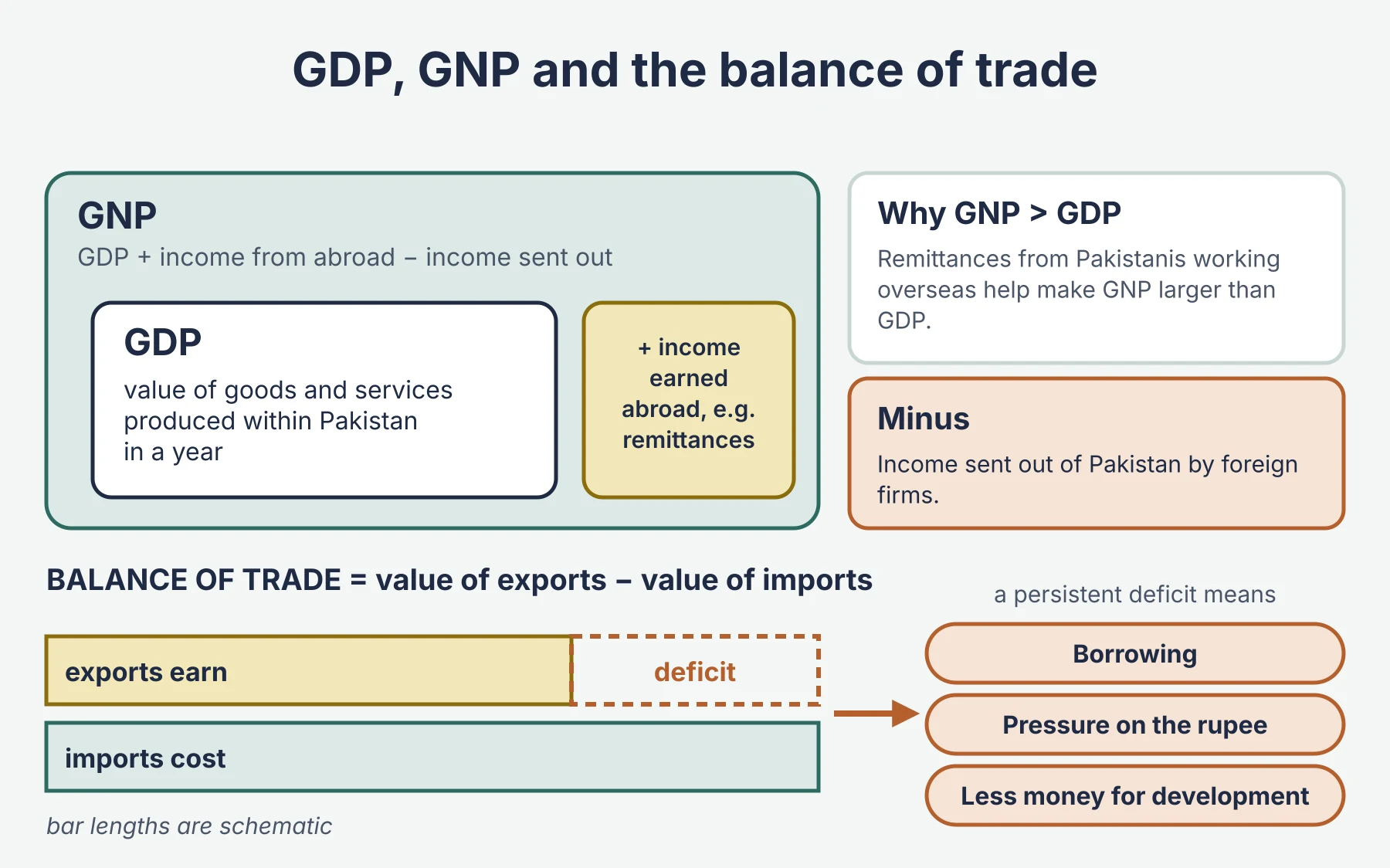
- GDP (gross domestic product): the total value of goods and services produced within the country in a year.
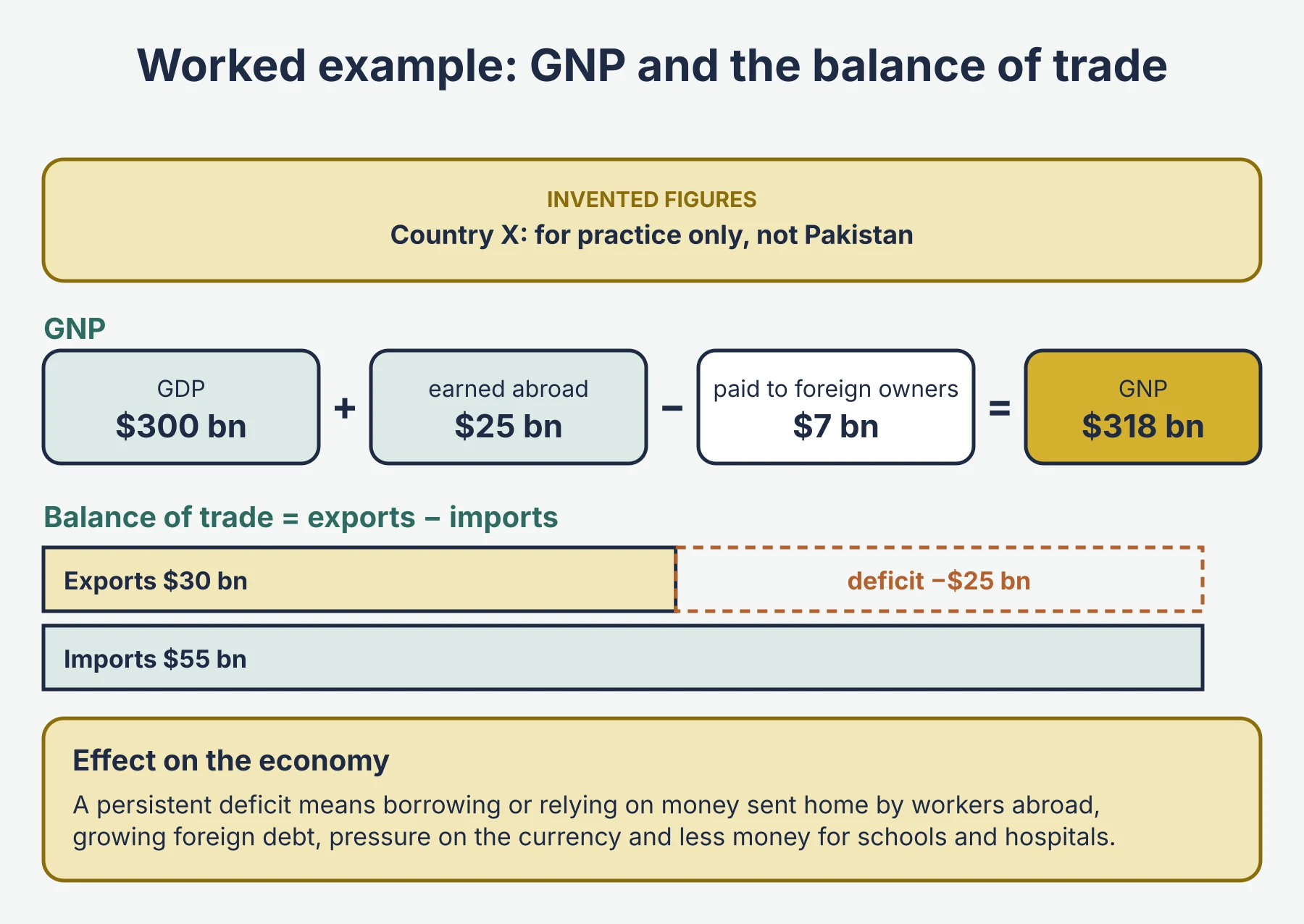
- GNP (gross national product): GDP plus income earned from abroad by the country’s people and businesses, minus income paid to foreign owners.
- Balance of trade: the value of exports minus the value of imports. A deficit means imports cost more than exports earn; a surplus means the opposite.
Worked example (invented figures)
These figures are invented for practice and do not describe Pakistan.
Country X
GDP                                         $300 bn
Income earned abroad by Country X residents  $25 bn
Income paid to foreign owners                 $7 bn
GNP = 300 + 25 - 7                          = $318 bn

Exports                                      $30 bn
Imports                                      $55 bn
Balance of trade = 30 - 55                   = -$25 bn (a deficit)
Effect of a persistent deficit on the economy: the country must pay for imports with borrowing or with money sent home by workers abroad; foreign debt grows; pressure on the currency increases; less money is left for development such as schools and hospitals. If exports grow faster than imports, the deficit narrows, foreign exchange reserves can recover and industries that export create jobs.
Pakistan’s trading partners
| Partner | Pakistan exports | Pakistan imports |
|---|---|---|
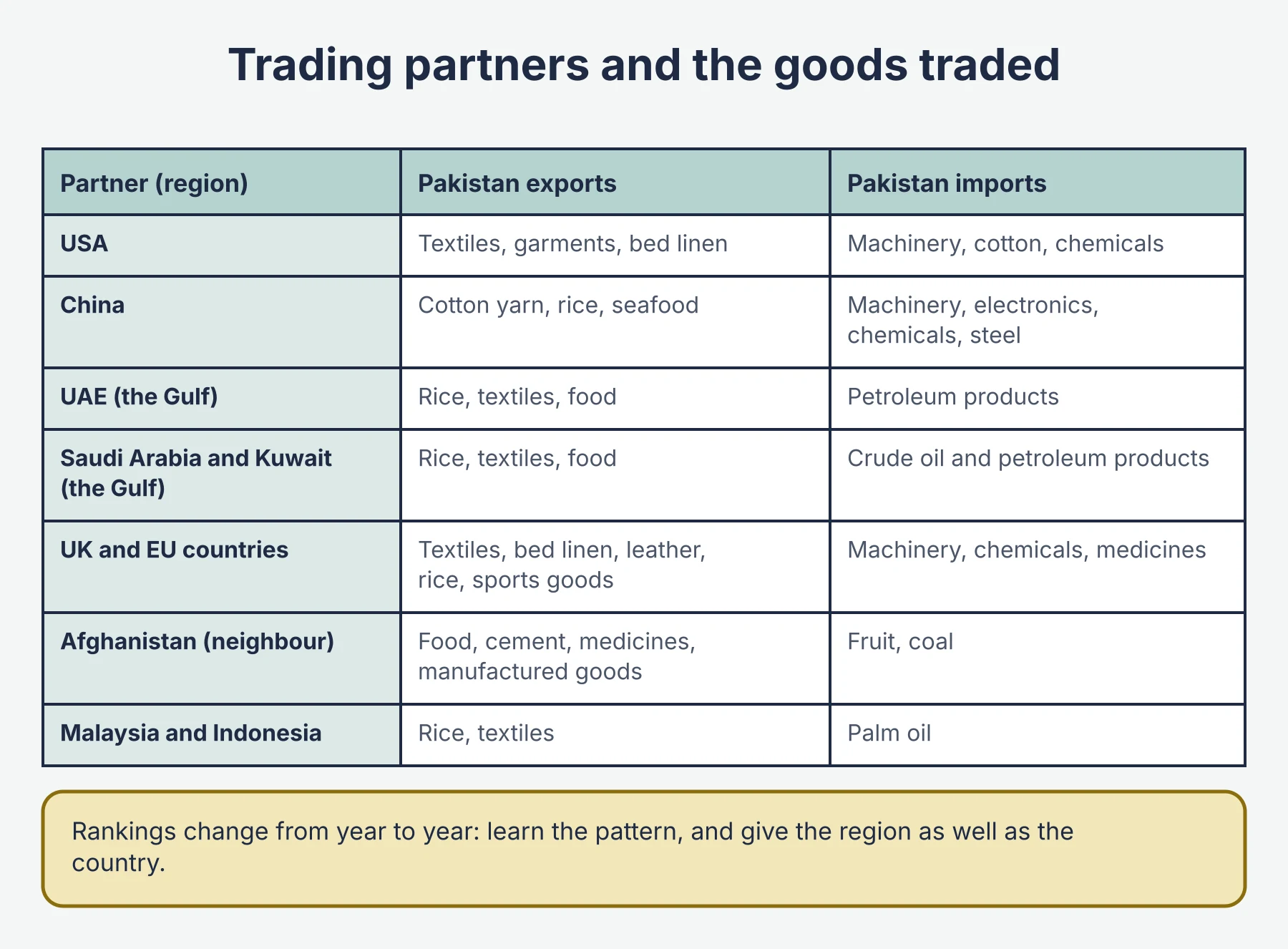
| USA | Textiles, garments, bed linen | Machinery, cotton, chemicals |
| China | Cotton yarn, rice, seafood | Machinery, electronics, chemicals, steel |
| UAE | Rice, textiles, food | Petroleum products |
| Saudi Arabia and Kuwait | Rice, textiles, food | Crude oil and petroleum products |
| UK and EU countries | Textiles, bed linen, leather, rice, sports goods | Machinery, chemicals, medicines |
| Afghanistan | Food, cement, medicines, manufactured goods | Fruit, coal |
| Malaysia and Indonesia | Rice, textiles | Palm oil |
Partners and their rankings change from year to year, so learn the pattern rather than exact positions, and use the figures your course or the exam resource gives you. In a “name and locate” question, give the region as well as the country, for example “the UAE in the Gulf”.
Factors that promote and limit trade
Promoting factors
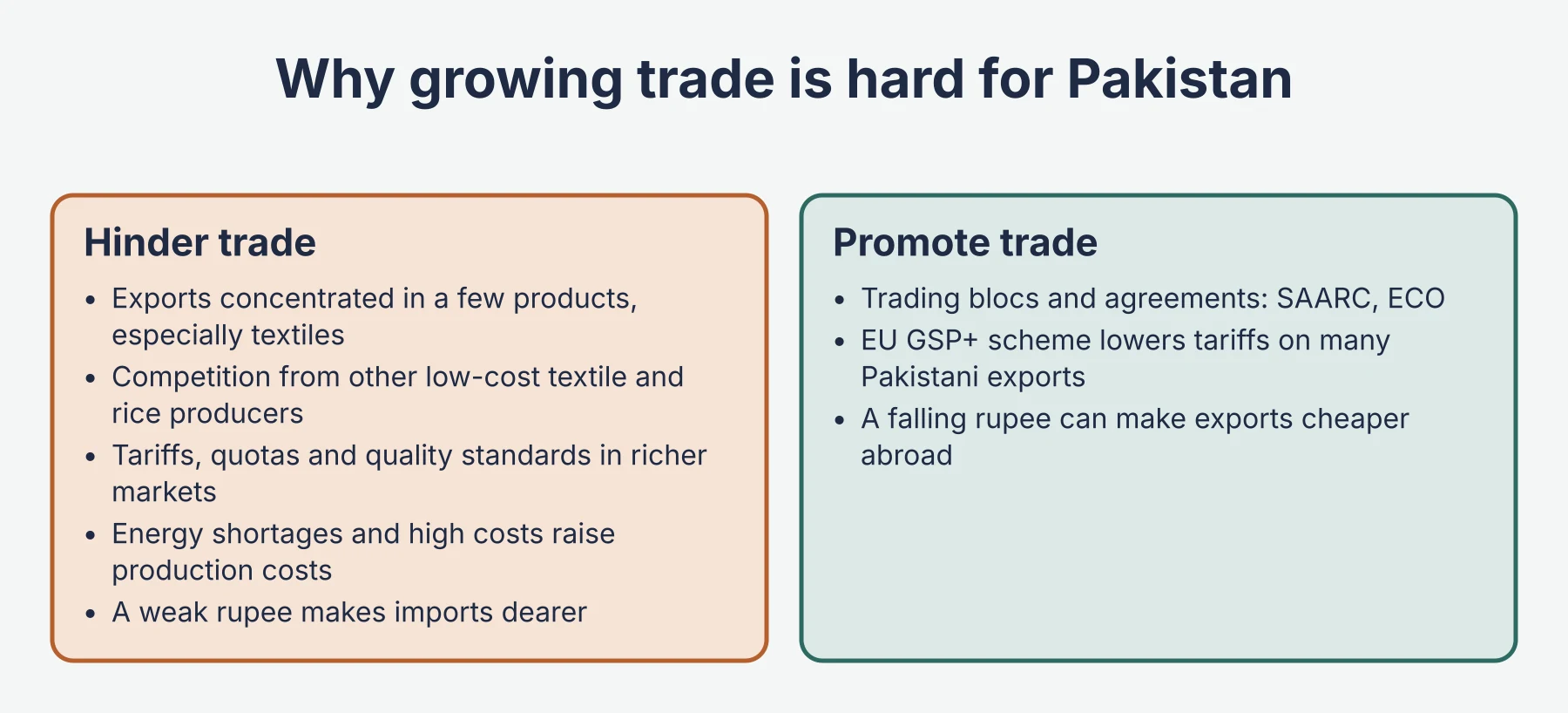
- Trading blocs and agreements, which lower tariffs between members: the South Asian Association for Regional Cooperation (SAARC) and its free-trade area; the Economic Cooperation Organisation (ECO); a free-trade agreement with China; the European Union’s GSP+ scheme, which removes or reduces tariffs on many Pakistani exports.
- Good transport links, such as Karachi’s ports, and developing routes such as those linked to Gwadar.
- Competitive costs in labour-intensive industries.
Limiting factors
- Trade barriers: tariffs (taxes on imports), quotas (limits on quantity) and strict quality, safety and labour standards in richer markets.
- Currency exchange rates (see below).
- Political tension with neighbours, which can close borders.
Exchange rates: a worked example
The figures below are invented to show the principle.
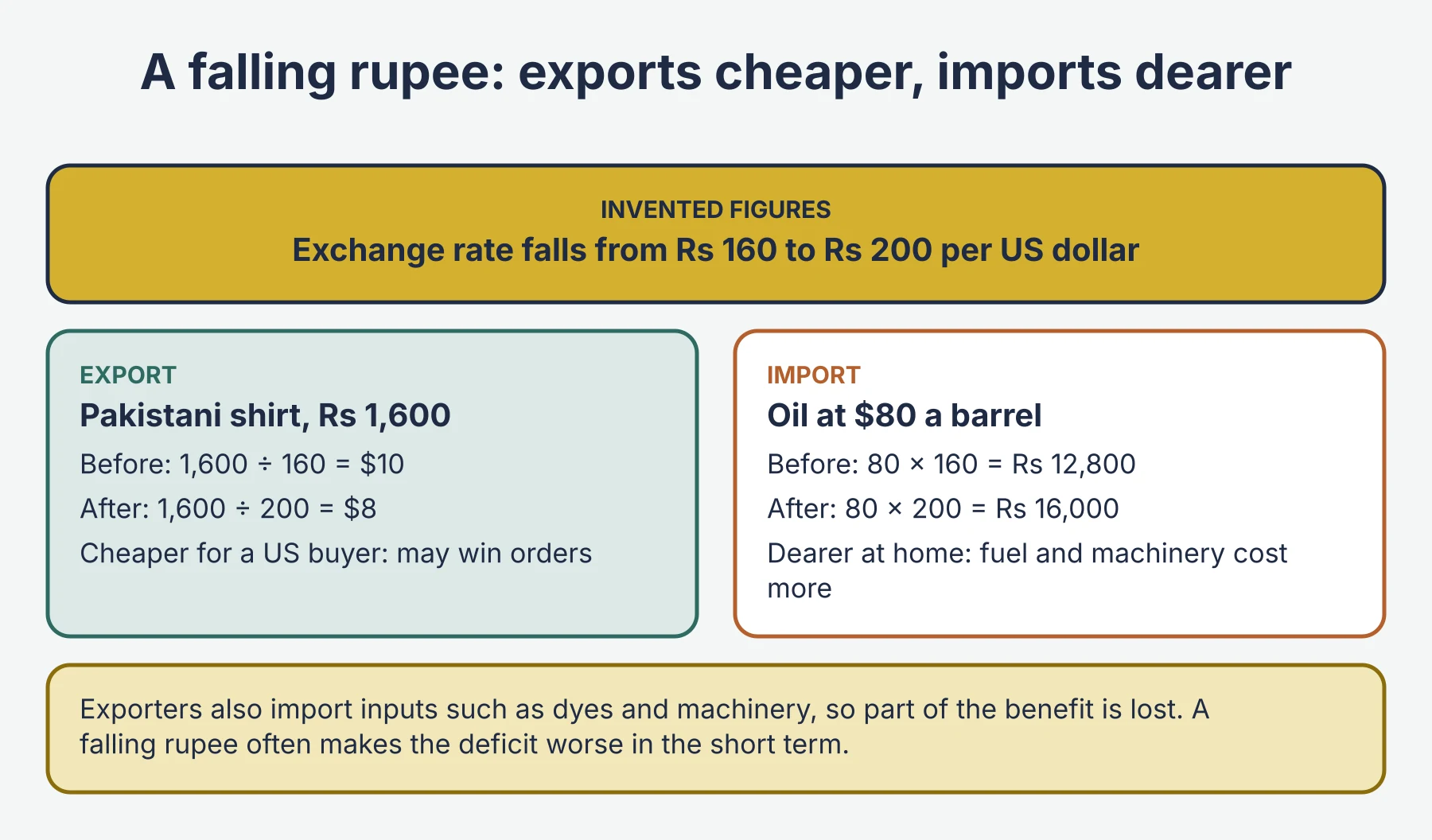
Exchange rate falls from Rs 160 to Rs 200 per US dollar

Pakistani shirt priced at Rs 1,600
  cost to a US buyer before: 1,600 / 160 = $10
  cost to a US buyer after:  1,600 / 200 = $8     -> exports become cheaper abroad

Imported oil at $80 a barrel
  cost in rupees before: 80 x 160 = Rs 12,800
  cost in rupees after:  80 x 200 = Rs 16,000    -> imports become dearer at home
A weaker rupee can help exporters win orders, but it raises the cost of fuel and machinery, which are essential imports. Many exporters also import inputs such as dyes and machinery, so part of the benefit is lost. This is why a falling rupee often makes the trade deficit worse in the short term.
Why is trade difficult for a developing country?
- Narrow export base: dependence on textiles means a fall in world prices or demand hits earnings hard.
- Low value added: semi-processed goods, such as yarn, earn less than branded finished goods.
- Competition from other low-cost producers of textiles and rice.
- Energy shortages and high costs raise production costs and delay orders.
- Standards and barriers in richer markets need investment to meet.
- Dependence on imported fuel and machinery, whose prices Pakistan cannot control.
- Image and security concerns, which can discourage buyers and investors.
Linking to the Paper 2 themes
The syllabus asks you to apply recurring themes across Paper 2: problems of a developing country, environmental effects and conservation, sustainable development, and feasibility. For trade, examples are the problems listed above; the pollution caused by tanneries and textile dyeing; the sustainability of relying on one crop; and the feasibility of developing new exports, such as information technology services.
Exam technique
Paper 2 lasts 1 hour 30 minutes: you answer three questions from a choice of five, each worth 25 marks with parts (a) to (d) built around resources. Part (d) specifically assesses analysis.
- Name or identify: one word or phrase each; no explanation.
- Describe a trend from a graph: overall pattern, figures with years, any change.
- Explain: give reasons, each developed.
- Evaluate or give your views: consider evidence for and against and reach a judgement.
Common mistakes
- Confusing GDP and GNP, or the balance of trade with the balance of payments.
- Saying a falling rupee is simply good for trade.
- Listing problems for developing countries without linking them to Pakistan’s exports.
- Naming partners without the goods traded.
Frequently asked questions
Do I need current trade statistics? No exact figures are required from memory, but you must interpret any figures in the question.
Is the balance of trade the same as the balance of payments? No. The balance of trade covers goods only; the wider balance of payments also includes services, income and transfers such as remittances.
Related pages
Source: Cambridge International, Cambridge IGCSE Pakistan Studies 0448 syllabus for examination in 2026, Paper 2 Section 6.
Related resources
-
Practice questions
Cambridge IGCSE Pakistan Studies (0448): Trade – Practice Questions
Fourteen original questions with answers on Section 6 Trade for Cambridge IGCSE Pakistan Studies 0448 Paper 2: exports, GNP, trade balance and exchange rates.
Pakistan Studies · Cambridge · IGCSE
Try questions -
Revision notes
Cambridge IGCSE Pakistan Studies (0448): Trade – Revision Notes
Revision notes on Section 6 Trade for Cambridge IGCSE Pakistan Studies 0448 Paper 2: key terms, exports, imports, partners, exchange rates and a self-test.
Pakistan Studies · Cambridge · IGCSE
Revise topic -
Study guides
Cambridge IGCSE Pakistan Studies (0448): Transport and telecommunications
Study guide to Section 7 of Cambridge IGCSE Pakistan Studies 0448 Paper 2: road, rail and air networks, border crossings, ports and telecommunications.
Pakistan Studies · Cambridge · IGCSE
Read guide
Get free revision emails (optional)
Occasional emails with practice questions, worked explanations and links to free resources for the qualification and subjects you choose. No spam, and you can unsubscribe from any email. The free tools on this site never need an email.