
Study Guides
Cambridge IGCSE Physics (0625): Electrical quantities
Study guide for Cambridge IGCSE Physics 0625 section 4.2: charge, electric fields, current, e.m.f., p.d., resistance, I-V graphs, power and the kilowatt-hour.
- Subject
- Physics
- Level
- IGCSE
- Topic
- Electricity and magnetism
- Author
- Marlbridge Academic Team
- Updated
- Reviewed by
- Iftikhar Azeemi (what this means)
Aligned to Cambridge IGCSE Physics (0625), For examination in 2026, 2027 and 2028. Official specification .
Syllabus page (what it covers and how it is assessed): Cambridge IGCSE Physics.
Syllabus points this page covers, with Core and Extended
0625
- 4.2 Electrical quantities · Core and Extended
"Core and Extended" means part of that syllabus point is Extended only. The page's own tier notes say which part.
Found an error? Report a correction.
Need help with this topic? Request a free trial class for IGCSE Physics (0625).
This guide covers one subtopic of the Cambridge IGCSE Physics 0625 syllabus (for examination in 2026, 2027 and 2028): 4.2 Electrical quantities, in five parts: electric charge, current, e.m.f. and p.d., resistance, and electrical energy and power. Core content is for every candidate; content marked Extended only is Supplement material, examined on Papers 2 and 4. The Electricity and magnetism study guide describes the charging, conductor-testing and resistance experiments; this page concentrates on how the quantities connect and on choosing the right equation.
What 4.2 asks you to do
| Part | Core | Extended only |
|---|---|---|
| 4.2.1 Charge | Two kinds of charge; forces between them; charging by friction (electron transfer); detecting charge; conductors and insulators (electron model) | Charge in coulombs; electric field definition and direction; field patterns for a point charge, a charged sphere and parallel plates |
| 4.2.2 Current | Current related to flow of charge; ammeters and ranges; free electrons in metals; d.c. and a.c. | I = Q/t; conventional current + to −, electrons − to + |
| 4.2.3 e.m.f. and p.d. | Definitions; both in volts; voltmeters and ranges | E = W/Q; V = W/Q |
| 4.2.4 Resistance | R = V/I; experiment with voltmeter and ammeter; R rises with length, falls with cross-sectional area | I–V graphs for resistor, filament lamp, diode; R ∝ L and R ∝ 1/A |
| 4.2.5 Energy and power | Energy transferred from source to components to surroundings; P = IV; E = IVt; kW h and cost | – |
The quantities and how they connect
| Quantity | Symbol | Unit | Meaning |
|---|---|---|---|
| Charge | Q | coulomb, C | Amount of electricity carried by particles such as electrons |
| Current | I | ampere, A | Rate of flow of charge |
| e.m.f. | E | volt, V | Work done by a source moving unit charge round a complete circuit |
| p.d. | V | volt, V | Work done by unit charge passing through a component |
| Resistance | R | ohm, Ω | How much a component opposes current; R = V/I |
| Power | P | watt, W | Energy transferred per second; P = IV |
| Energy | E | joule, J (or kW h) | E = IVt |
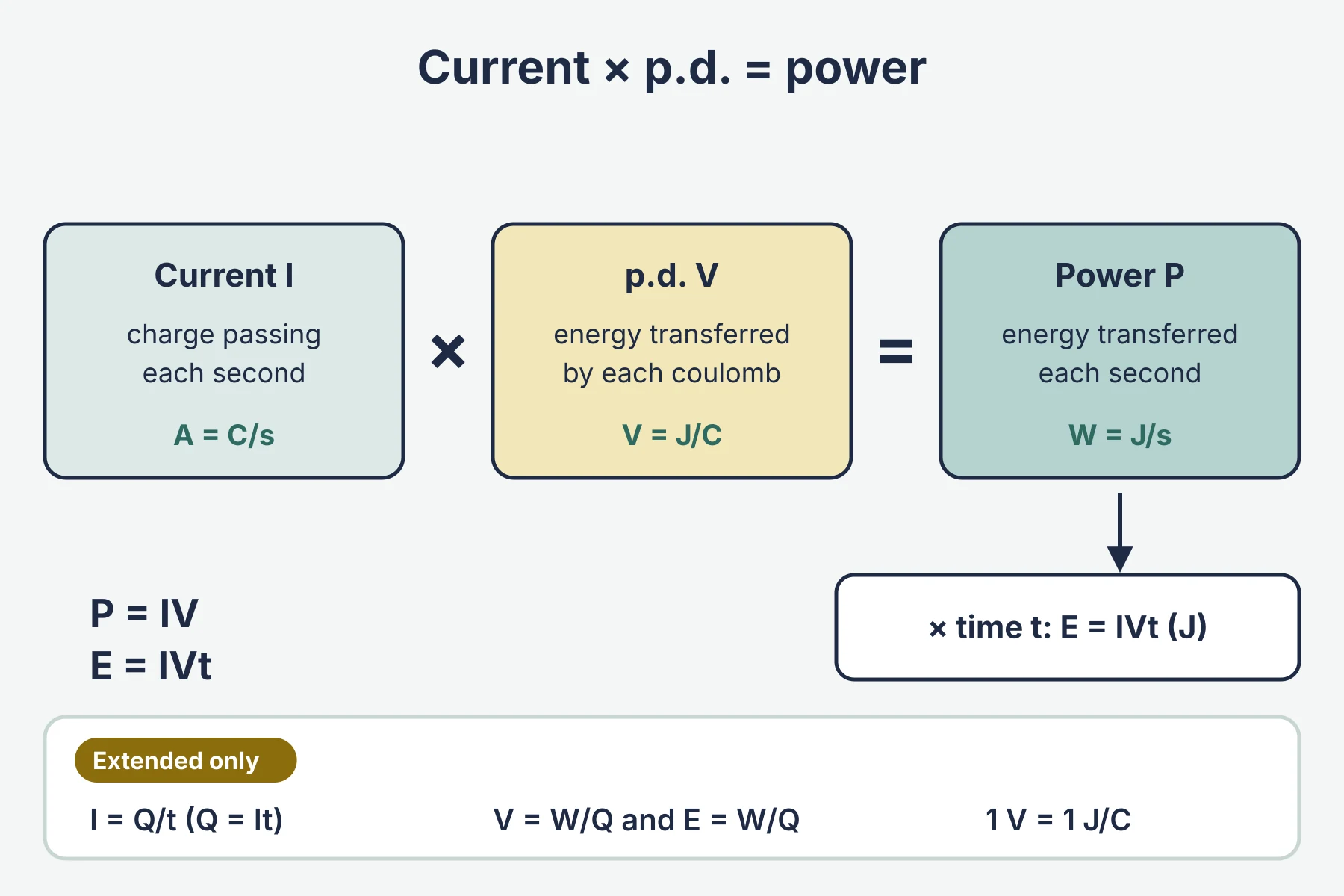
One way to keep them straight: current says how much charge passes each second; p.d. says how much energy each coulomb transfers; multiply them and you get energy per second, which is power. That is why P = IV, and why E = IVt.
Extended only. The links are written as equations: I = Q/t (so Q = It), and E = W/Q for a source, V = W/Q for a component (so W = QV). One volt is one joule per coulomb.
Charge and electric fields
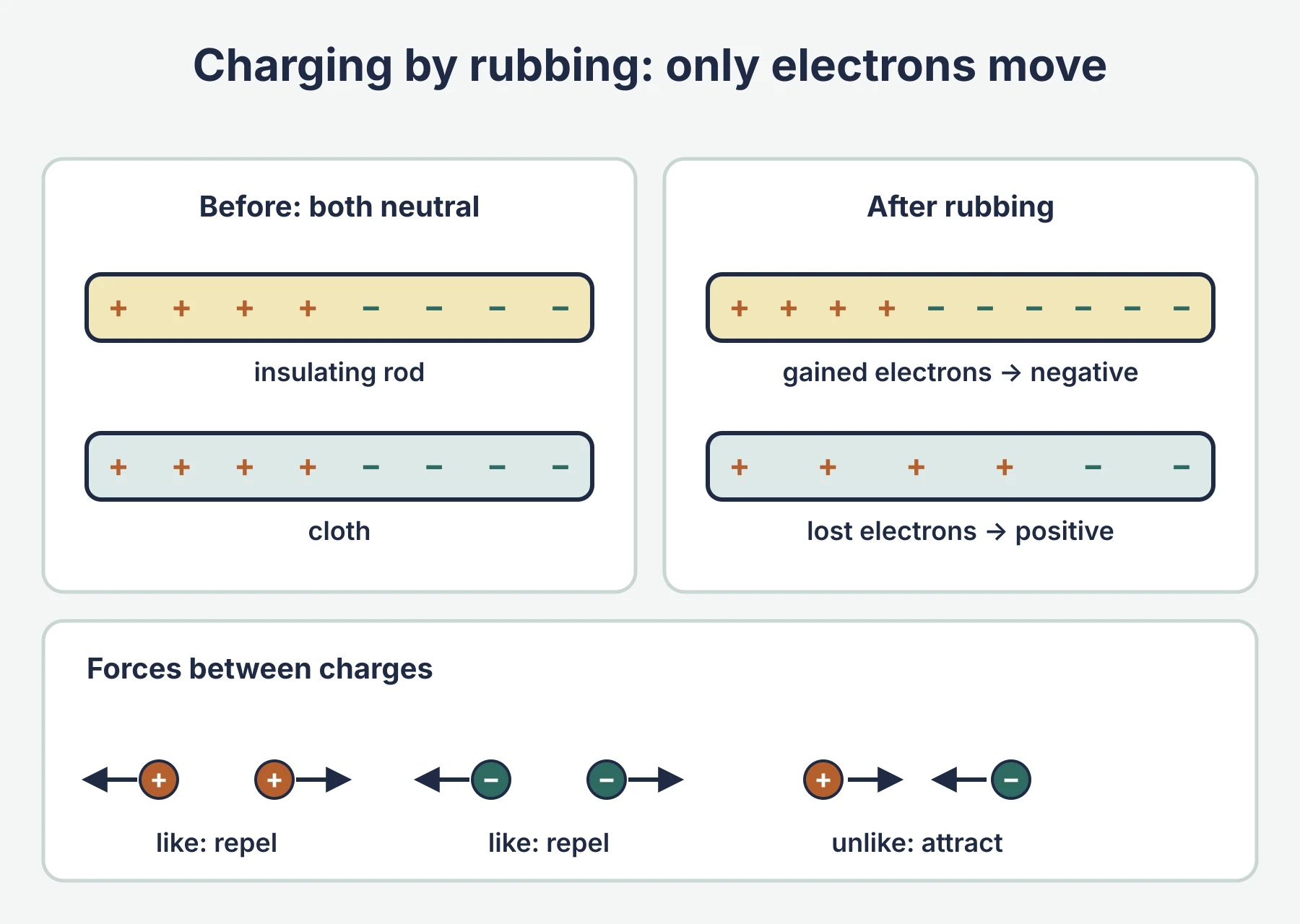
Charges are positive or negative; like charges repel and unlike charges attract. When an insulator is rubbed, only electrons move: the material that gains electrons becomes negative, the one that loses them becomes positive. Positive charges never move in this process. In metals, some electrons are free to move between the atoms, which makes metals conductors; in insulators the electrons are held in place.
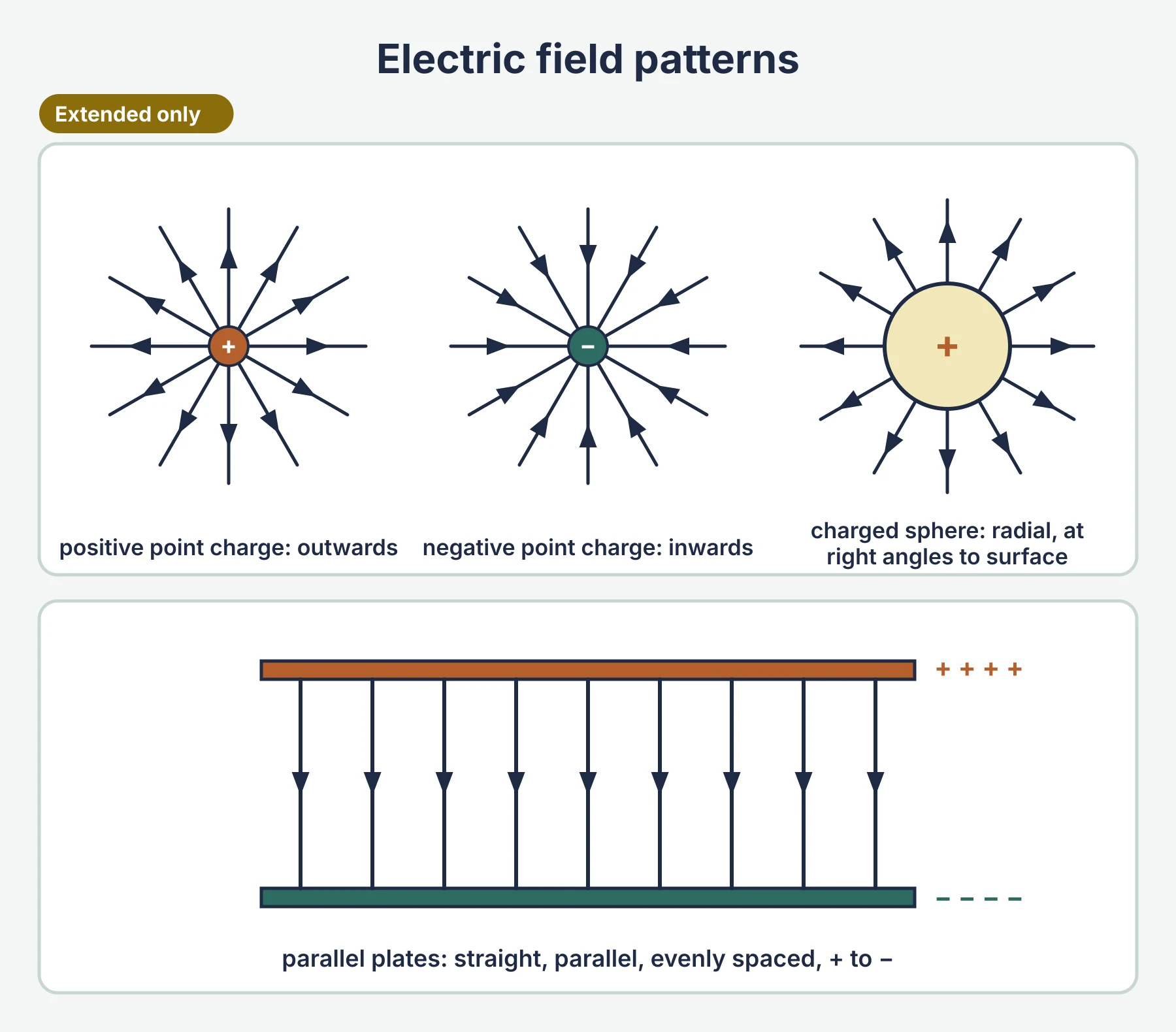
Electric fields (Extended only). An electric field is a region in which an electric charge experiences a force. Its direction at a point is the direction of the force on a positive charge there. Three patterns to draw:
- Isolated positive point charge: straight lines pointing radially outwards. (For a negative point charge, radially inwards.)
- Charged conducting sphere: the same radial pattern, starting at the surface, at right angles to it.
- Two oppositely charged parallel plates: straight, parallel, evenly spaced lines from the positive plate to the negative plate (end effects are not examined).
Current, ammeters and voltmeters
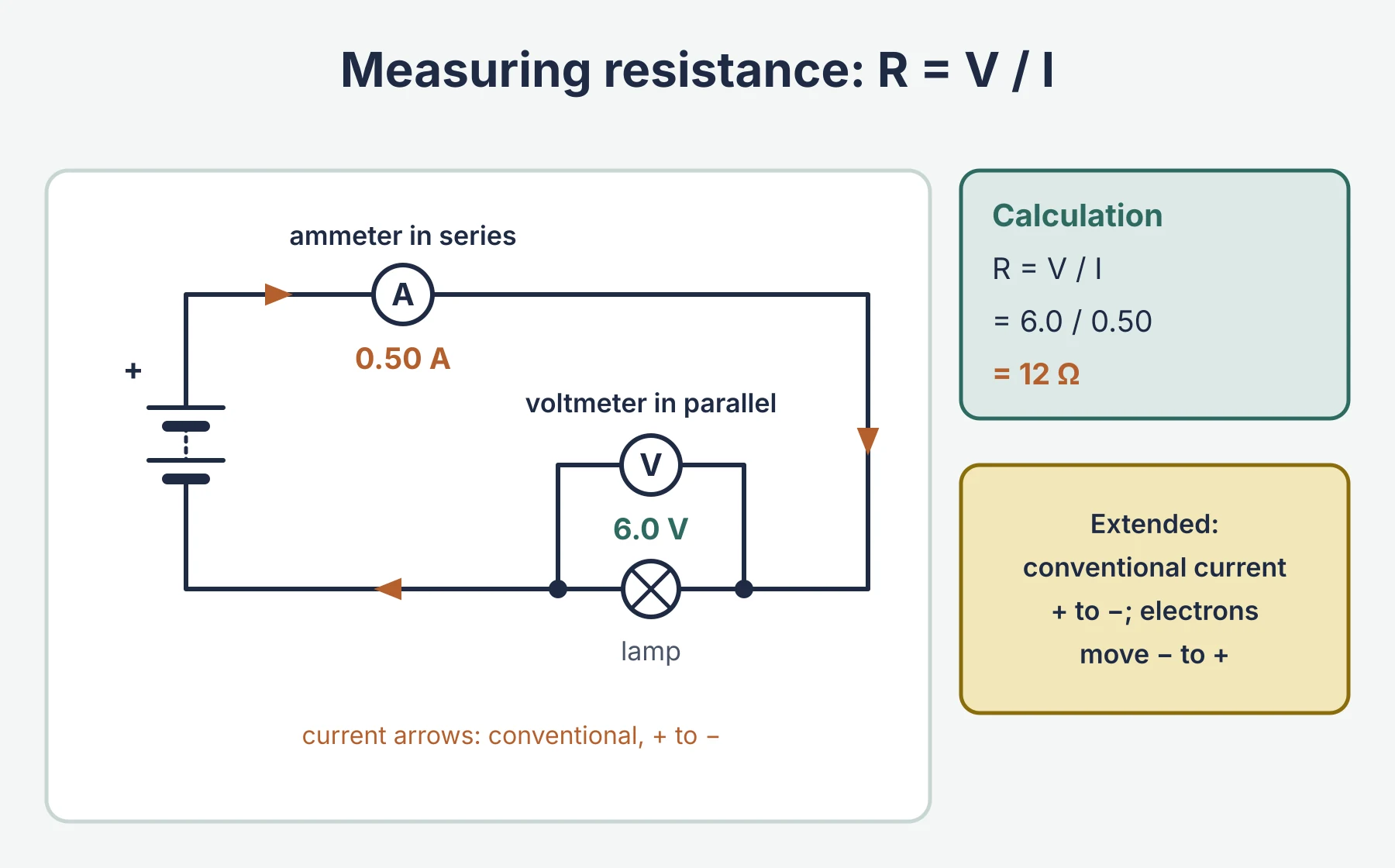
Current in a metal is a flow of free electrons. Direct current (d.c.) flows one way only; alternating current (a.c.) repeatedly reverses. Extended only: conventional current is drawn from + to −, although the electrons actually move from − to +.
An ammeter goes in series; a voltmeter goes in parallel across the component. On a multi-range meter, start on the highest range and switch down until the reading uses as much of the scale (or as many digits) as possible without overloading. A reading of 0.25 A on a 0–10 A range is hard to read precisely; the same current on a 0–1 A range is read far more precisely.
Resistance
R = V/I. Rearranged: V = IR and I = V/R. A lamp with 6.0 V across it and 0.50 A through it has R = 6.0 / 0.50 = 12 Ω. If a resistance is given in kΩ, convert first: 2.2 kΩ = 2200 Ω.
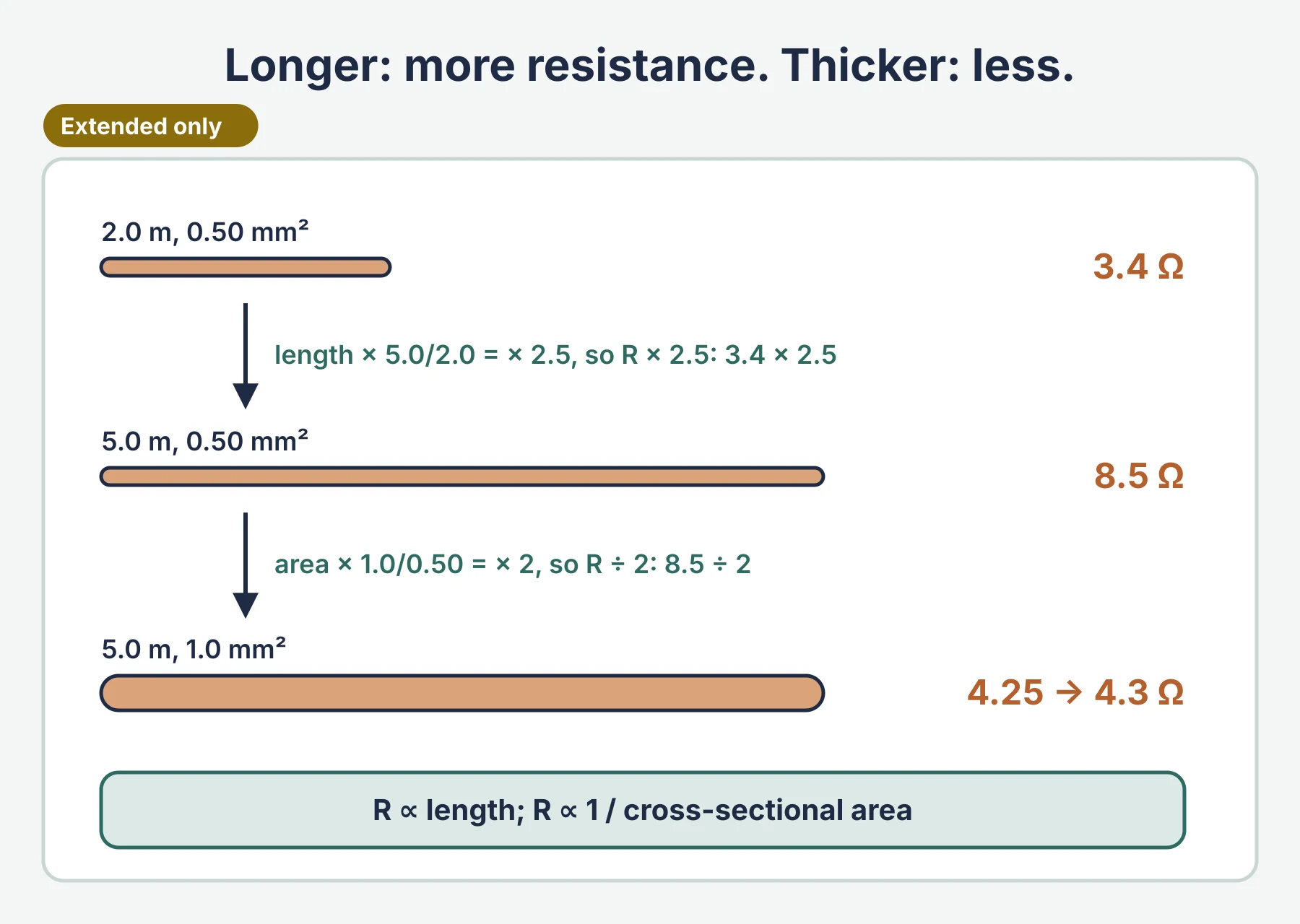
For a metal wire at constant temperature, a longer wire has more resistance and a thicker wire (larger cross-sectional area) has less. Extended only: R is directly proportional to length and inversely proportional to cross-sectional area.
Worked example 1 (Extended)
2.0 m of a wire with cross-sectional area 0.50 mm² has a resistance of 3.4 Ω. Find the resistance of 5.0 m of the same metal with area 1.0 mm².
length × (5.0 / 2.0):   3.4 × 2.5 = 8.5 Ω
area × (1.0 / 0.50):    8.5 ÷ 2   = 4.25 Ω  →  4.3 Ω
Treat each change as a separate scale factor; it avoids mixing up “proportional” and “inversely proportional”.
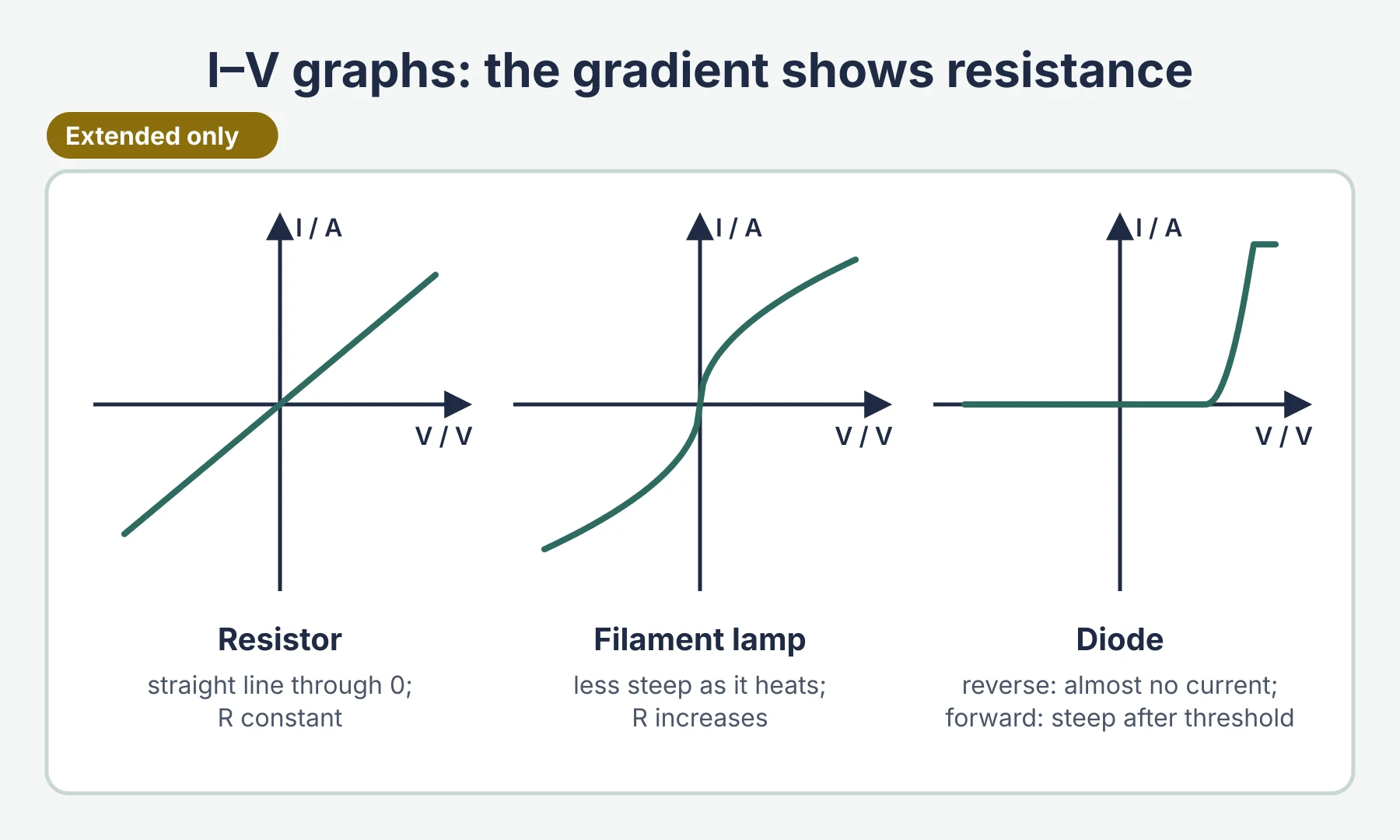
I–V graphs (Extended only). The key is what the gradient tells you. With I on the vertical axis, a steeper line means a smaller resistance.
- Resistor at constant temperature: straight line through the origin, same in both directions; R constant (I directly proportional to V).
- Filament lamp: curve through the origin that becomes less steep at higher p.d. As the current rises, the filament gets hotter and its resistance increases. The curve has the same shape for negative p.d.
- Diode: almost no current for any reverse p.d. (very high resistance); in the forward direction, almost no current until a small threshold p.d., then the current rises steeply (low resistance).
When asked to explain the lamp’s curve, you need both points: the temperature of the filament increases, and therefore its resistance increases.
Electrical energy and power
A circuit transfers energy from the source (a cell or the mains) to the components and then to the surroundings, for example by heating and light.
- P = IV (watts)
- E = IVt (joules, with t in seconds)
- One kilowatt-hour is the energy transferred by a 1 kW appliance in 1 hour. For cost: energy (kW h) = power (kW) × time (h); cost = energy × price per kW h.
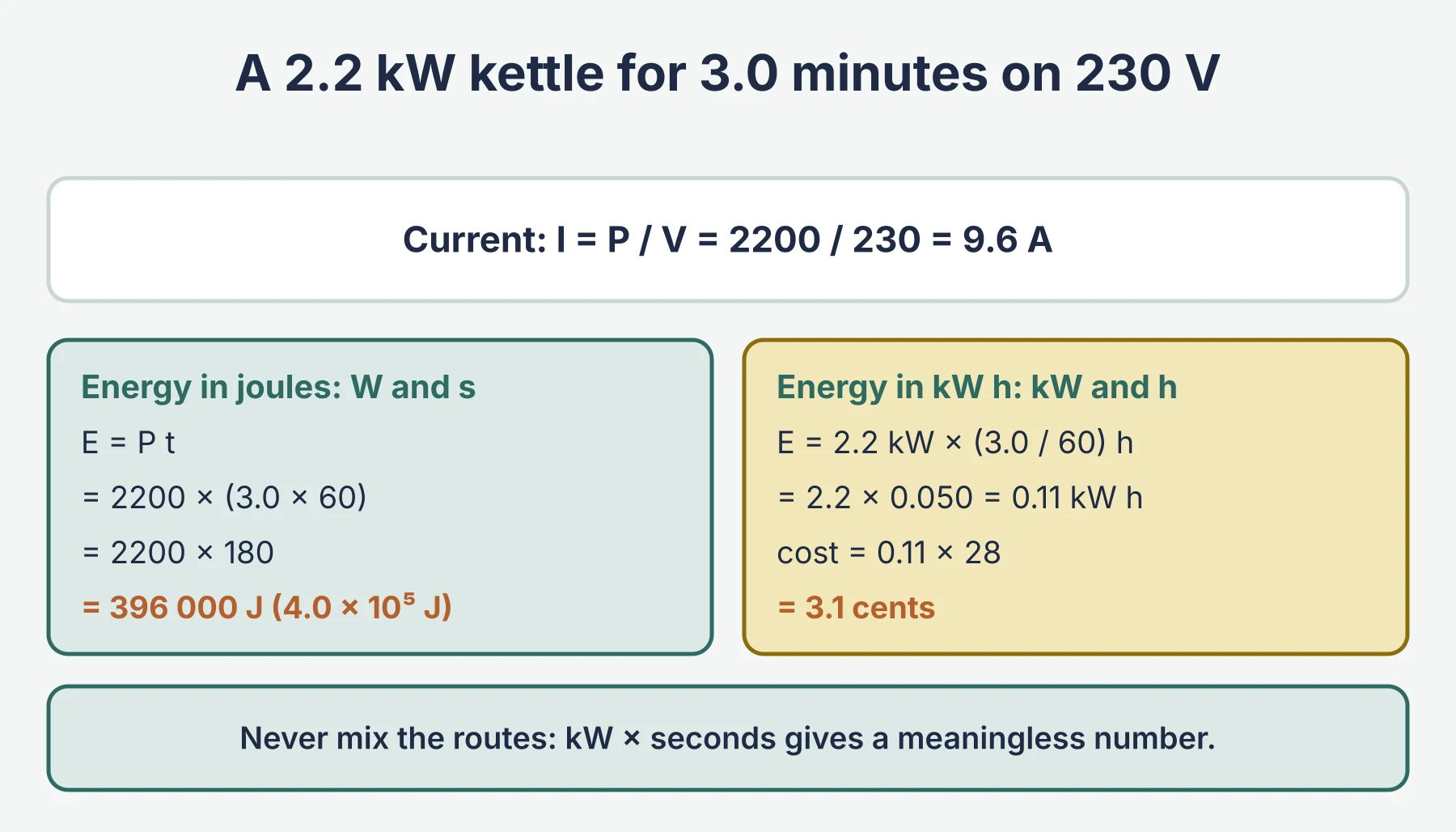
Worked example 2
A 2.2 kW kettle runs on a 230 V supply for 3.0 minutes. Electricity costs 28 cents per kW h. Find the current, the energy in joules, the energy in kW h and the cost.
I = P / V = 2200 / 230 = 9.6 A
E = P t = 2200 × (3.0 × 60) = 396 000 J  (4.0 × 10⁵ J)
energy in kW h = 2.2 kW × (3.0 / 60) h = 0.11 kW h
cost = 0.11 × 28 = 3.1 cents
Two unit systems appear here. For joules use watts and seconds; for kW h use kilowatts and hours. Mixing them (kW × seconds) is the most common error in cost questions.
Common mistakes
- Saying positive charges move when a rod is charged by rubbing.
- Defining p.d. as “the voltage across a component” (a circular definition): use work done per unit charge.
- Leaving minutes or hours in E = IVt when joules are needed.
- Treating “proportional to area” as direct rather than inverse.
- Saying the filament lamp’s line curves because “resistance changes”, without saying it increases due to heating.
- Drawing electric field arrows pointing towards a positive charge.
Exam technique
- Define: use the syllabus wording, for example “e.m.f. is the electrical work done by a source in moving a unit charge around a complete circuit”.
- Calculate: write the equation in symbols, substitute with units converted, and give the unit.
- Sketch an I–V graph: label axes with quantities and units, pass through the origin, and show the correct shape for negative values.
- Explain a graph: link the gradient to resistance and give the physical reason.
- Describe an experiment: include the circuit (ammeter in series, voltmeter in parallel), how readings are varied, and the calculation.
Condense this with the electrical quantities revision notes and practise with the electrical quantities practice questions. The next subtopic is electric circuits.
Official syllabus
Cambridge International, Cambridge IGCSE Physics 0625 syllabus for examination in 2026, 2027 and 2028, Topic 4 Electricity and magnetism, section 4.2 Electrical quantities (4.2.1 to 4.2.5).
Related resources
-
Practice questions
Cambridge IGCSE Physics (0625): Electrical quantities – Practice Questions
Thirteen original Cambridge IGCSE Physics 0625 questions on charge, current, e.m.f., resistance, I-V graphs, power and cost, with mark-by-mark answers.
Physics · Cambridge · IGCSE
Try questions -
Revision notes
Cambridge IGCSE Physics (0625): Electrical quantities – Revision Notes
Revision notes for Cambridge IGCSE Physics 0625 section 4.2: charge, current, e.m.f., p.d., resistance, I-V graphs, power and kW h cost, with a self-test.
Physics · Cambridge · IGCSE
Revise topic -
Study guides
Cambridge IGCSE Physics (0625): Electrical safety
Study guide for Cambridge IGCSE Physics 0625 section 4.4 Electrical safety: mains hazards, live, neutral and earth, fuses, trip switches and double insulation.
Physics · Cambridge · IGCSE
Read guide
Related articles
Get free revision emails (optional)
Occasional emails with practice questions, worked explanations and links to free resources for the qualification and subjects you choose. No spam, and you can unsubscribe from any email. The free tools on this site never need an email.