
Revision Notes
Cambridge IGCSE Physics (0625): Simple phenomena of magnetism – Revision Notes
Revision notes for Cambridge IGCSE Physics 0625 section 4.1: magnetic poles, induced magnetism, soft iron versus steel, field lines, uses and a self-test.
- Subject
- Physics
- Level
- IGCSE
- Topic
- Electricity and magnetism
- Author
- Marlbridge Academic Team
- Updated
- Reviewed by
- Iftikhar Azeemi (what this means)
Aligned to Cambridge IGCSE Physics (0625), For examination in 2026, 2027 and 2028. Official specification .
Syllabus page (what it covers and how it is assessed): Cambridge IGCSE Physics.
Syllabus points this page covers, with Core and Extended
0625
- 4.1 Simple phenomena of magnetism · Core and Extended
"Core and Extended" means part of that syllabus point is Extended only. The page's own tier notes say which part.
Found an error? Report a correction.
Need help with this topic? Request a free trial class for IGCSE Physics (0625).
These notes condense section 4.1 Simple phenomena of magnetism of the Cambridge IGCSE Physics 0625 syllabus (for examination in 2026, 2027 and 2028). Lines marked Extended only are Supplement content, examined on Papers 2 and 4. For explanations and an annotated model answer, read the magnetism study guide.
Forces between poles
- Every magnet has an N pole and an S pole.
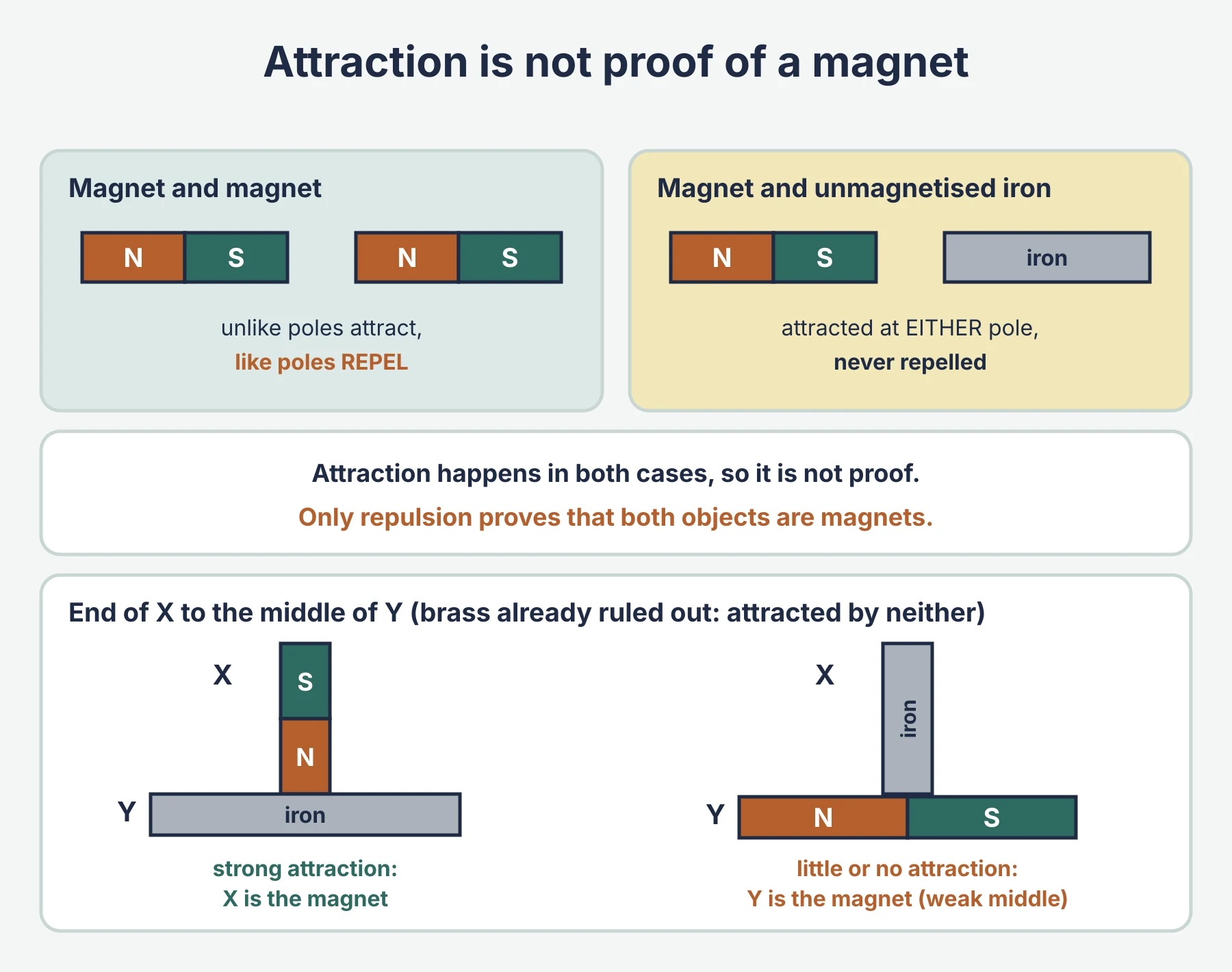
- Like poles repel; unlike poles attract.
- A magnet attracts unmagnetised magnetic material with either pole.
- Attraction can mean magnet + magnet or magnet + magnetic material.
- Repulsion happens only between two magnets: it is the only proof that an object is magnetised.
Magnetic and non-magnetic materials
| Magnetic (attracted; can be magnetised) | Non-magnetic |
|---|---|
| Iron, steel, nickel, cobalt | Copper, aluminium, brass, wood, plastic, glass |
- Not all metals are magnetic.
Induced magnetism
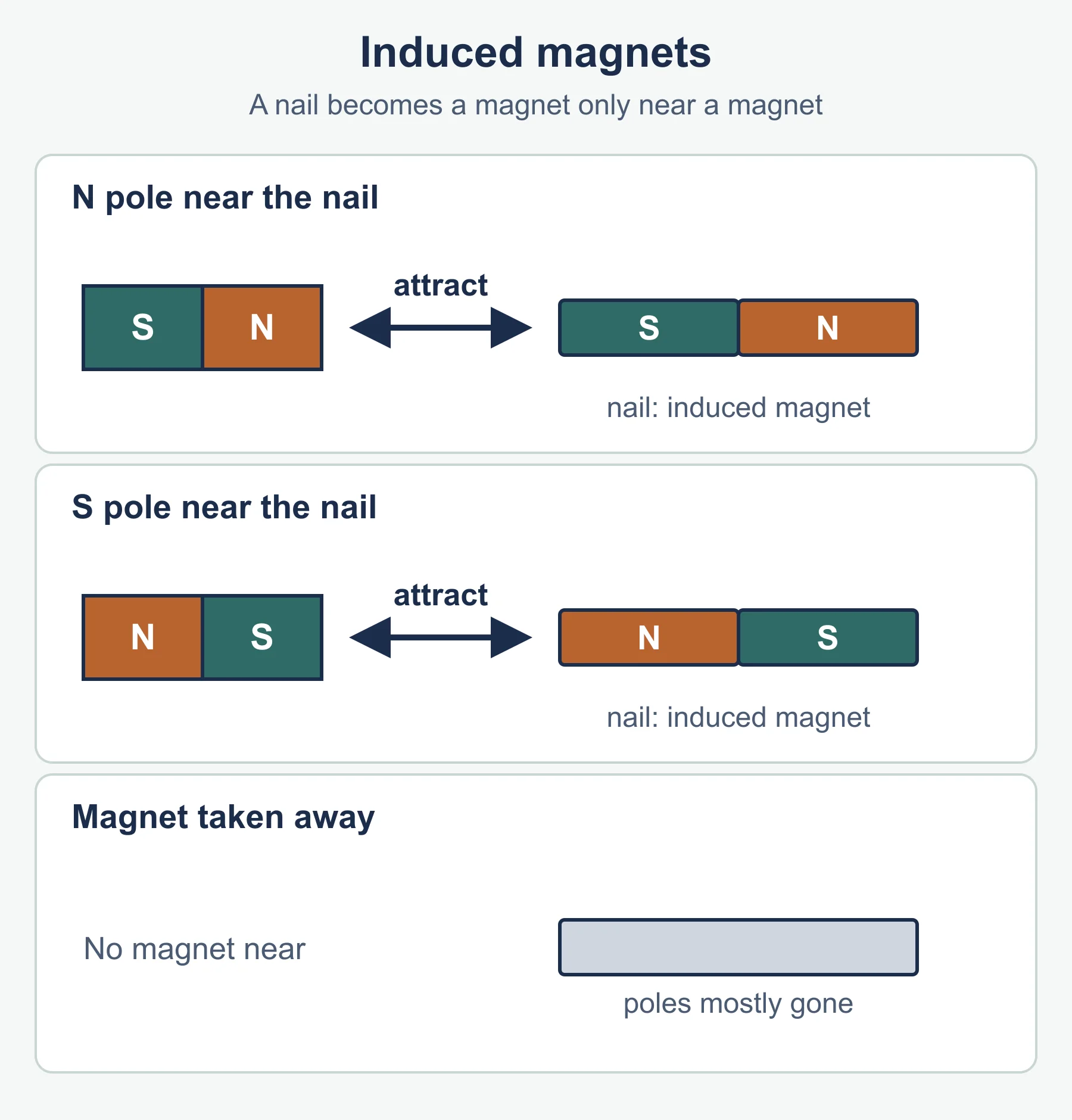
- A magnetic material near a magnet becomes a magnet.
- The end nearest the magnet becomes the opposite pole, so they attract.
- Explains chains of nails or paper clips hanging from a magnet.
Temporary and permanent magnets
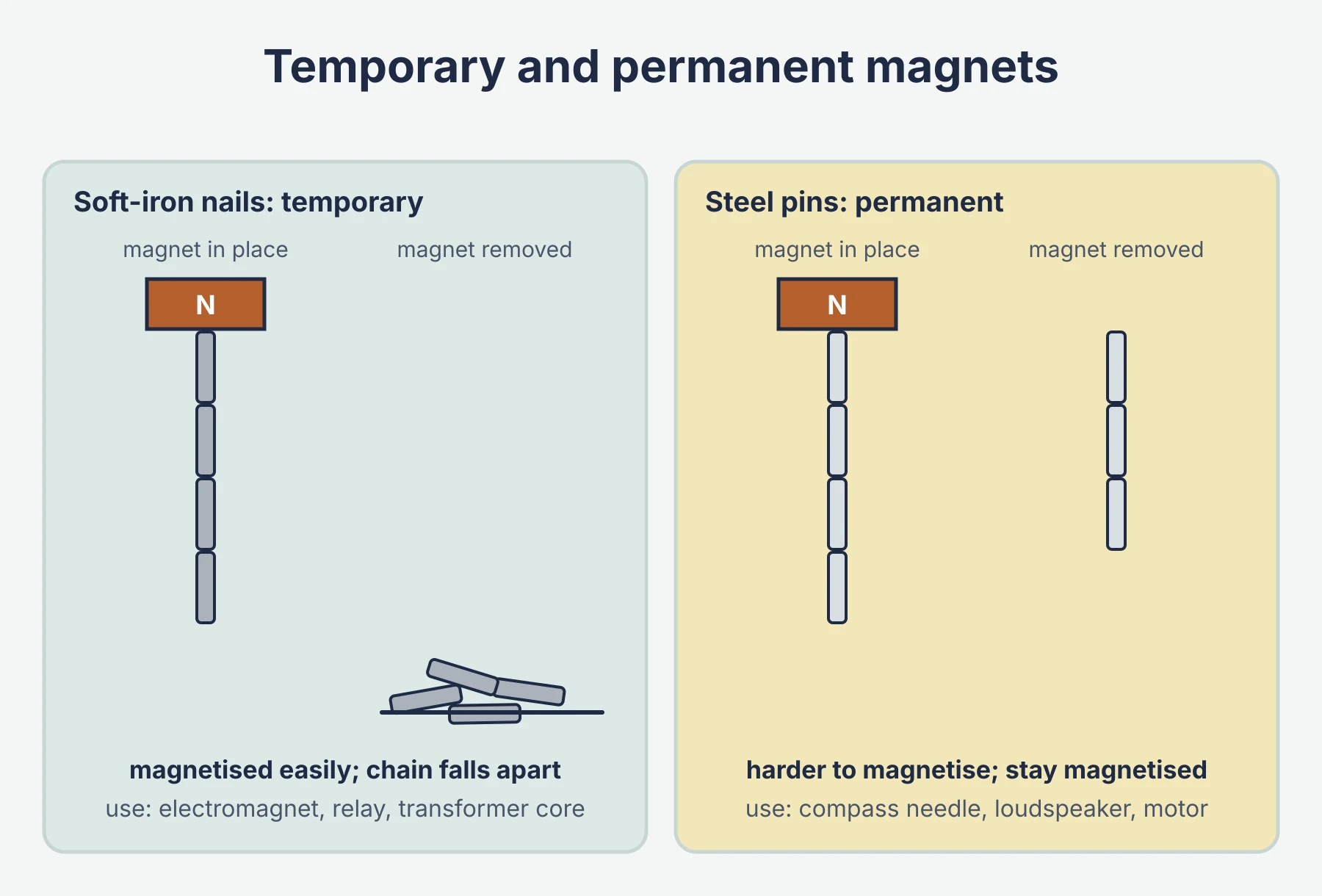
| Soft iron | Steel | |
|---|---|---|
| Magnetises | easily | less easily |
| When field removed | loses magnetism | keeps magnetism |
| Type | temporary | permanent |
| Used for | electromagnet and relay cores | compass needles, motors, loudspeakers |
Rule: must the magnetism switch off? Soft iron. Must it stay? Steel.
Magnetic fields
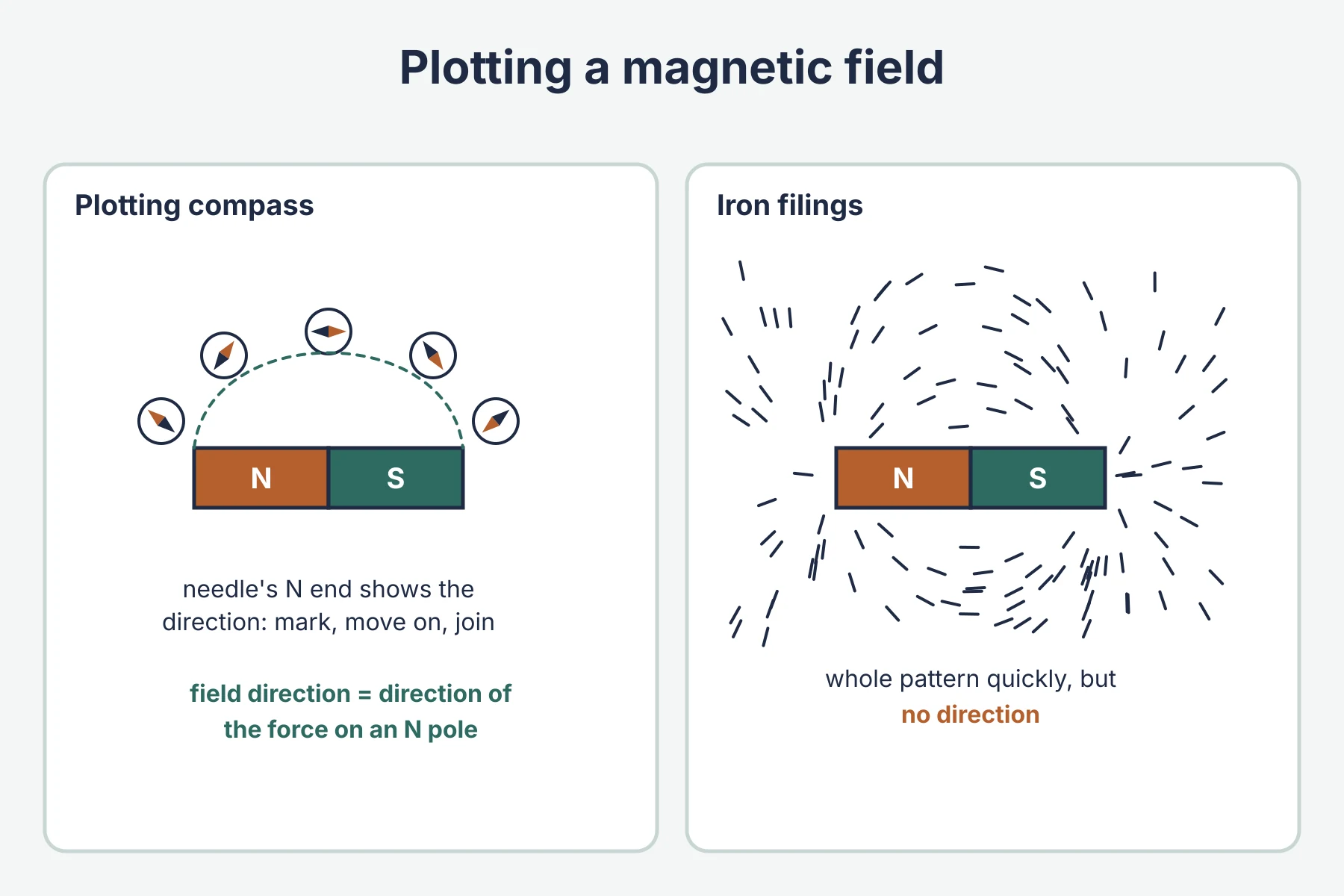
- Magnetic field: a region in which a magnetic pole experiences a force.
- Direction: the direction of the force on an N pole at that point.
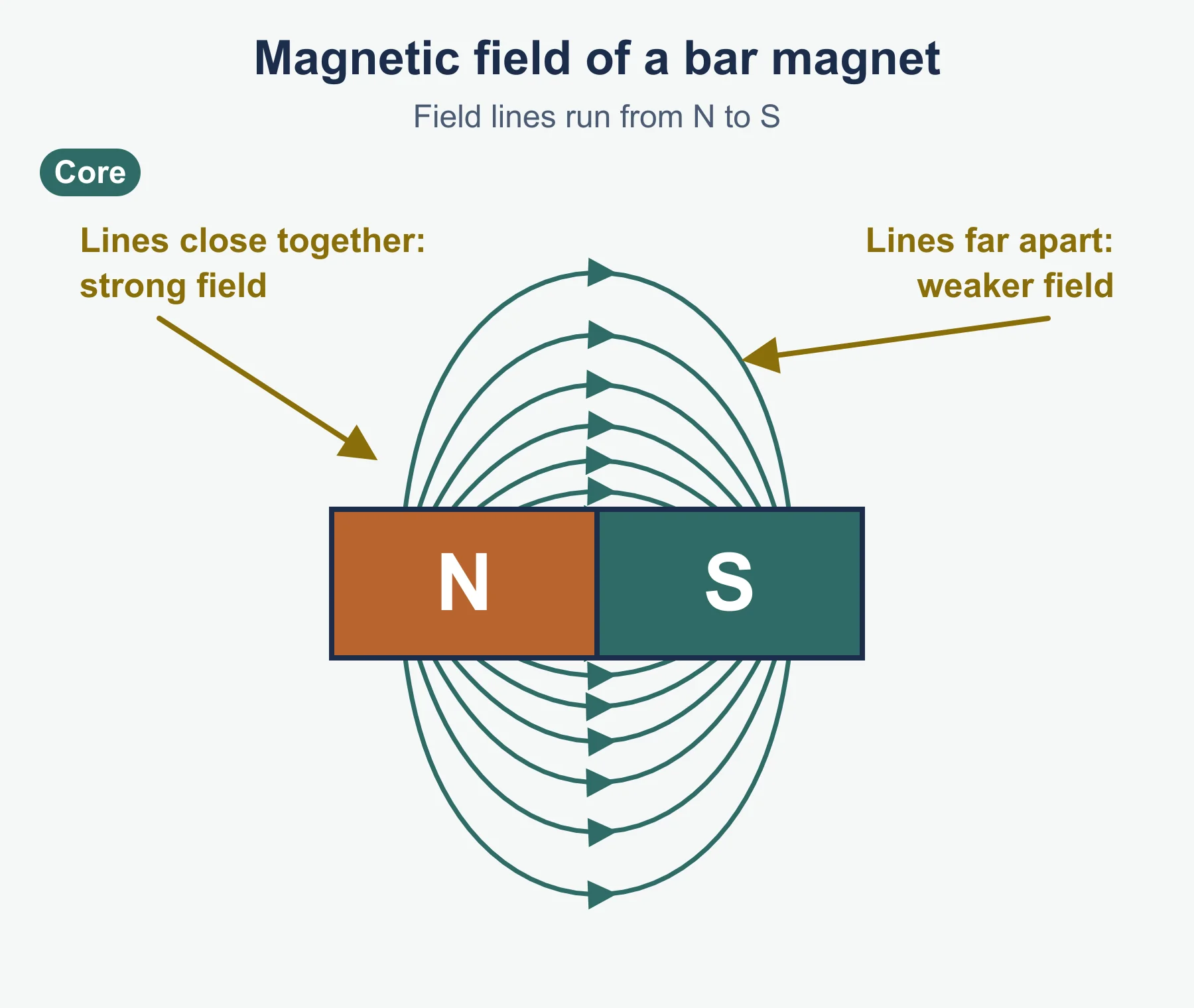
- Bar magnet field lines: leave N, enter S, arrows N → S outside the magnet.
- Lines never cross; closest together at the poles.
- Plotting compass: shows direction; mark the needle tip, move the compass, repeat, join the dots.
- Iron filings: show the pattern quickly but not the direction.
Extended only
- Magnetic forces are due to interactions between magnetic fields.
- Closer field lines = stronger field.
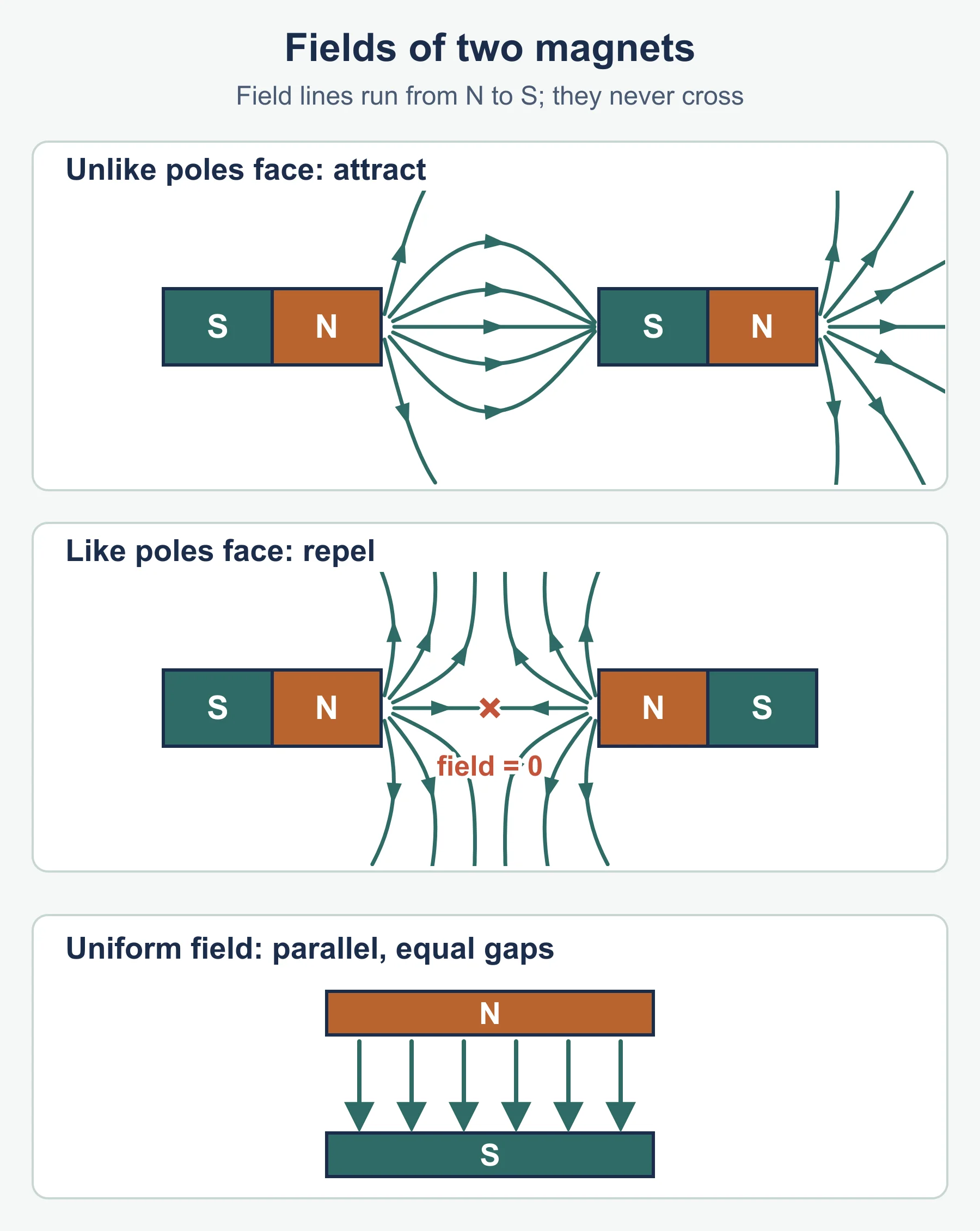
- N facing S: lines cross the gap; attraction.
- N facing N: lines bend away; a neutral point midway where the fields cancel; repulsion.
- Between the flat poles of a U-shaped magnet: parallel, evenly spaced lines; uniform field.
Uses
| Permanent magnets | Electromagnets |
|---|---|
| Loudspeakers, motors, compasses, door catches | Scrap-metal cranes, relays, electric bells, sorting iron from waste |
| Steady field, no power needed | Can be switched off and its strength varied |
Must-know distinctions
- Magnetic vs magnetised: a magnetic material can be attracted and magnetised; a magnetised object already has its own N and S poles.
- Temporary vs permanent: the test is what happens when the magnetising field is removed.
- Pattern vs direction: iron filings give the pattern; a compass gives the direction.
- Attraction vs repulsion: attraction has two possible causes; repulsion has only one.
Key terms
| Term | Meaning |
|---|---|
| Magnetised | Has become a magnet, with N and S poles |
| Unmagnetised | Magnetic material that is not acting as a magnet |
| Induced magnetism | Magnetism produced in a magnetic material by a nearby magnet |
| Temporary magnet | Loses its magnetism when the magnetising field is removed (soft iron) |
| Permanent magnet | Keeps its magnetism (steel) |
| Magnetic field | Region in which a magnetic pole experiences a force |
| Field line | Line showing the direction of the force on an N pole |
| Uniform field (Extended only) | Same strength and direction everywhere; parallel, evenly spaced lines |
Exam traps
- “It was attracted, so it is a magnet”: wrong; repulsion is the test.
- Aluminium cans and copper wire are not attracted by magnets.
- Arrows on field lines point from N to S outside the magnet.
- Iron filings show shape, not direction.
- Electromagnet cores are soft iron, not steel: steel would stay magnetised when the current stopped.
- Field lines must not cross or start in mid-air.
Self-test
- State what happens when two S poles are brought together.
- A bar is attracted to both ends of a magnet. What can you conclude about the bar?
- Name two magnetic and two non-magnetic metals.
- What is induced magnetism?
- A magnet’s N pole is near one end of an iron nail. Which pole is induced at that end?
- Why are electromagnet cores made of soft iron?
- Define a magnetic field.
- What determines the direction of a magnetic field at a point?
- Give one advantage of a plotting compass over iron filings.
- Give one use of an electromagnet and explain why an electromagnet is needed for it.
- (Extended) How is the strength of a magnetic field shown on a field diagram?
- (Extended) Describe the field between the poles of a U-shaped magnet with flat, parallel faces.
Answers
- They repel.
- It is made of a magnetic material but is unmagnetised (a magnet would be repelled by one end).
- Magnetic: any two of iron, nickel, cobalt (and steel, an alloy). Non-magnetic: copper, aluminium (or brass).
- Magnetism produced in an unmagnetised magnetic material when it is placed near a magnet.
- An S pole.
- Soft iron magnetises easily and loses its magnetism when the current is switched off.
- A region in which a magnetic pole experiences a force.
- The direction of the force on an N pole placed there.
- It shows the direction of the field.
- A scrap-yard crane: the magnetism must be switched off to drop the load (or a relay: switched on and off by a current).
- By the spacing of the lines: closer lines mean a stronger field.
- Uniform: parallel, evenly spaced lines from N to S.
Official syllabus
Cambridge International, Cambridge IGCSE Physics 0625 syllabus for examination in 2026, 2027 and 2028, Topic 4 Electricity and magnetism, section 4.1 Simple phenomena of magnetism. Test yourself with the magnetism practice questions.
Related resources
-
Study guides
Cambridge IGCSE Physics 0625: Electricity and magnetism – Study Guide
Study guide for Cambridge IGCSE Physics 0625 Topic 4: magnetism, charge, circuits, electrical safety and electromagnetic effects, Core and Extended.
Physics · Cambridge · IGCSE
Read guide -
Revision notes
Cambridge IGCSE Physics 0625: Electricity and magnetism – Revision Notes
Revision notes for Cambridge IGCSE Physics 0625 electricity and magnetism: equations, circuit rules, safety, motors, transformers and a self-test.
Physics · Cambridge · IGCSE
Revise topic -
Practice questions
IGCSE Physics: Electricity and Magnetism (Extended) — Practice Questions (Cambridge 0625)
Original Cambridge IGCSE Physics 0625 Extended questions on charge, parallel resistors, wire resistance, induction, transformers and cable losses, with answers.
Physics · Cambridge · IGCSE
Try questions
Related articles
Get free revision emails (optional)
Occasional emails with practice questions, worked explanations and links to free resources for the qualification and subjects you choose. No spam, and you can unsubscribe from any email. The free tools on this site never need an email.