
Study Guides
Cambridge IGCSE Physics (0625): Simple phenomena of magnetism
Study guide for Cambridge IGCSE Physics 0625 section 4.1 Magnetism: poles, induced magnetism, soft iron and steel, field lines, plotting fields and uses.
- Subject
- Physics
- Level
- IGCSE
- Topic
- Electricity and magnetism
- Author
- Marlbridge Academic Team
- Updated
- Reviewed by
- Iftikhar Azeemi (what this means)
Aligned to Cambridge IGCSE Physics (0625), For examination in 2026, 2027 and 2028. Official specification .
Syllabus page (what it covers and how it is assessed): Cambridge IGCSE Physics.
Syllabus points this page covers, with Core and Extended
0625
- 4.1 Simple phenomena of magnetism · Core and Extended
"Core and Extended" means part of that syllabus point is Extended only. The page's own tier notes say which part.
Found an error? Report a correction.
Need help with this topic? Request a free trial class for IGCSE Physics (0625).
This guide covers one subtopic of the Cambridge IGCSE Physics 0625 syllabus (for examination in 2026, 2027 and 2028): 4.1 Simple phenomena of magnetism. Core content is for every candidate; content marked Extended only is Supplement material, examined on Papers 2 and 4. The Electricity and magnetism study guide summarises 4.1 alongside the rest of Topic 4 and describes how to plot the field of a bar magnet; this page goes further into identifying magnets, choosing materials and reading field patterns.
What 4.1 asks you to do
| Core | Extended only |
|---|---|
| Describe forces between poles, and between magnets and magnetic materials (N pole, S pole, attraction, repulsion, magnetised, unmagnetised) | Explain that magnetic forces are due to interactions between magnetic fields |
| Describe induced magnetism | Know that the relative strength of a field is shown by the spacing of the field lines |
| State the differences between temporary (soft iron) and permanent (steel) magnets | |
| State the difference between magnetic and non-magnetic materials | |
| Describe a magnetic field as a region in which a magnetic pole experiences a force | |
| Draw the field pattern and direction around a bar magnet | |
| State that field direction is the direction of the force on an N pole | |
| Describe plotting field lines with a compass or iron filings | |
| Describe uses of permanent magnets and electromagnets |
Poles and forces
Every magnet has two poles, a north-seeking (N) pole and a south-seeking (S) pole, where its magnetic effect is strongest. Between two magnets:
- like poles repel (N and N, or S and S);
- unlike poles attract (N and S).
A magnetic material is one that is attracted by a magnet and can be magnetised: iron, steel, nickel and cobalt. A non-magnetic material is not attracted and cannot be magnetised: copper, aluminium, brass, wood, plastic, glass. Note that aluminium and copper are metals but are non-magnetic; “all metals are magnetic” is a common wrong answer.
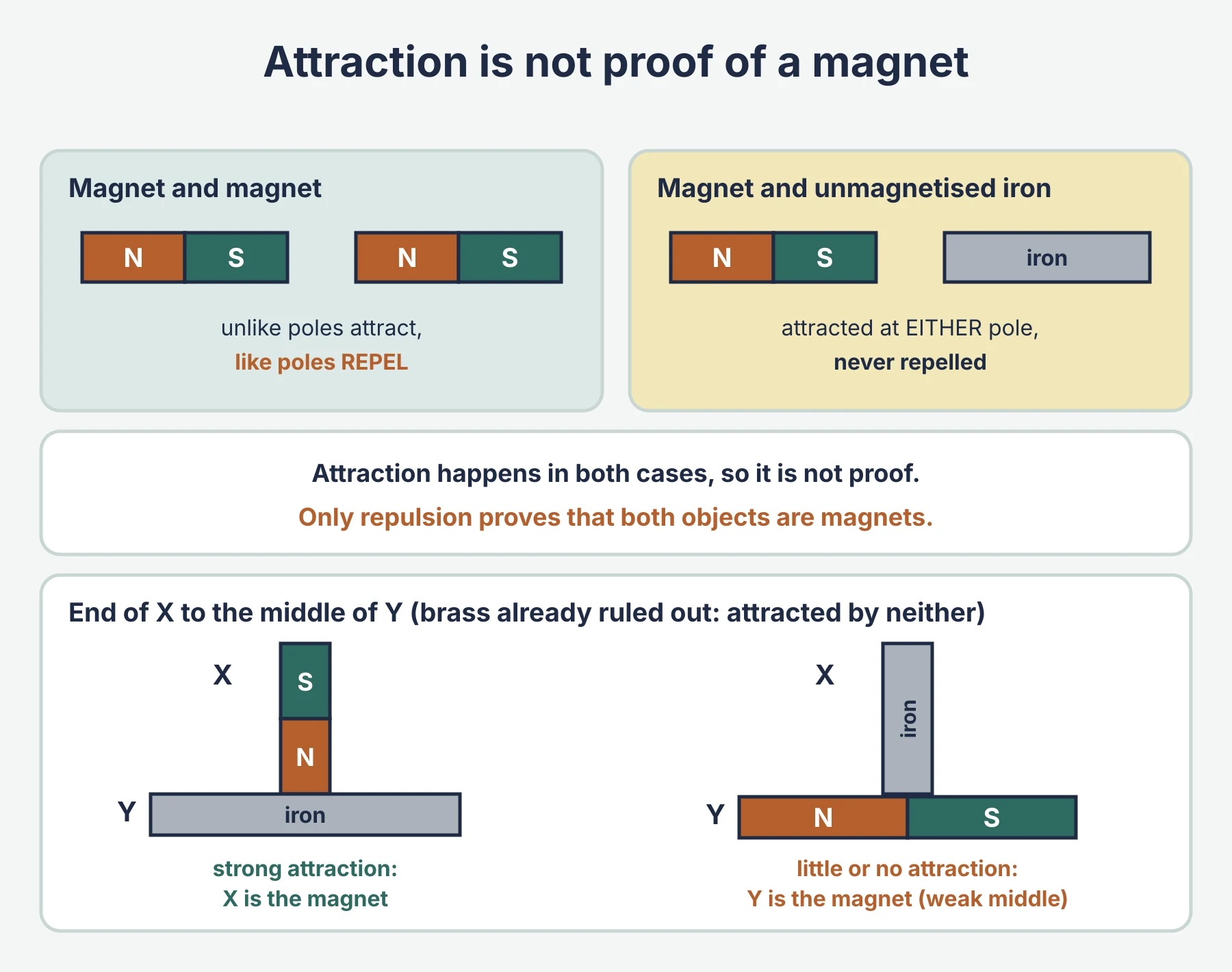
An unmagnetised piece of magnetic material is attracted by either pole of a magnet. A magnet is attracted to one pole of another magnet and repelled by the other. So:
Attraction happens between a magnet and a magnet (unlike poles) or between a magnet and an unmagnetised magnetic material. Only repulsion proves that both objects are magnets.
Annotated model answer: identifying three bars
Three identical-looking bars, X, Y and Z, are a magnet, an unmagnetised iron bar and a brass bar. Describe how to identify each, using only the bars. [4]
“Bring each bar near both ends of each other bar. The bar that is not attracted to either of the others is the brass bar, because brass is non-magnetic. [1] The remaining two bars attract each other whichever ends are brought together, so attraction alone cannot tell them apart: a magnet attracts unmagnetised iron at either pole. [1] Now hold bar X so that one end touches the middle of bar Y. If they attract strongly, X is the magnet: its pole induces magnetism in the iron. [1] If there is little or no attraction, Y is the magnet, because the middle of a magnet has almost no magnetic effect. [1]”
Why this scores: it uses the idea that attraction is not proof correctly, and the end-to-middle test really does separate the magnet from the iron. Repulsion is not available as a test here, because there is only one magnet.
Induced magnetism
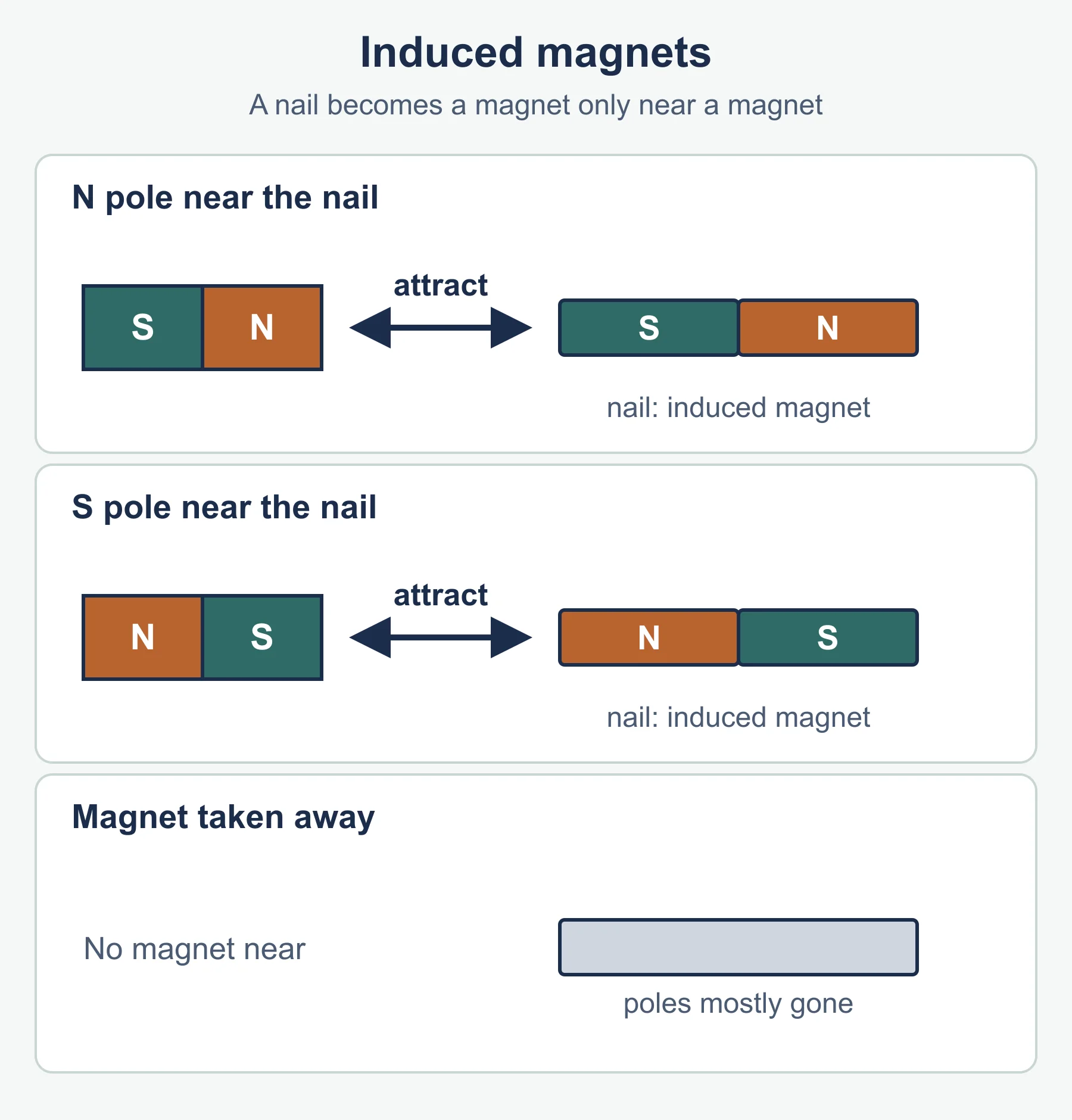
When a piece of unmagnetised magnetic material is placed near (or touching) a magnet, it becomes a magnet itself: this is induced magnetism. The end nearest the magnet becomes the opposite pole, so the two attract. That is why a magnet attracts iron from either pole: an N pole induces an S pole in the near end of the iron, and an S pole induces an N pole.
Induced magnetism explains a chain of iron nails hanging from one pole of a magnet: each nail is magnetised by the one above it and attracts the next.
Temporary and permanent magnets
| Property | Soft iron | Steel |
|---|---|---|
| How easily it is magnetised | Easily | Less easily |
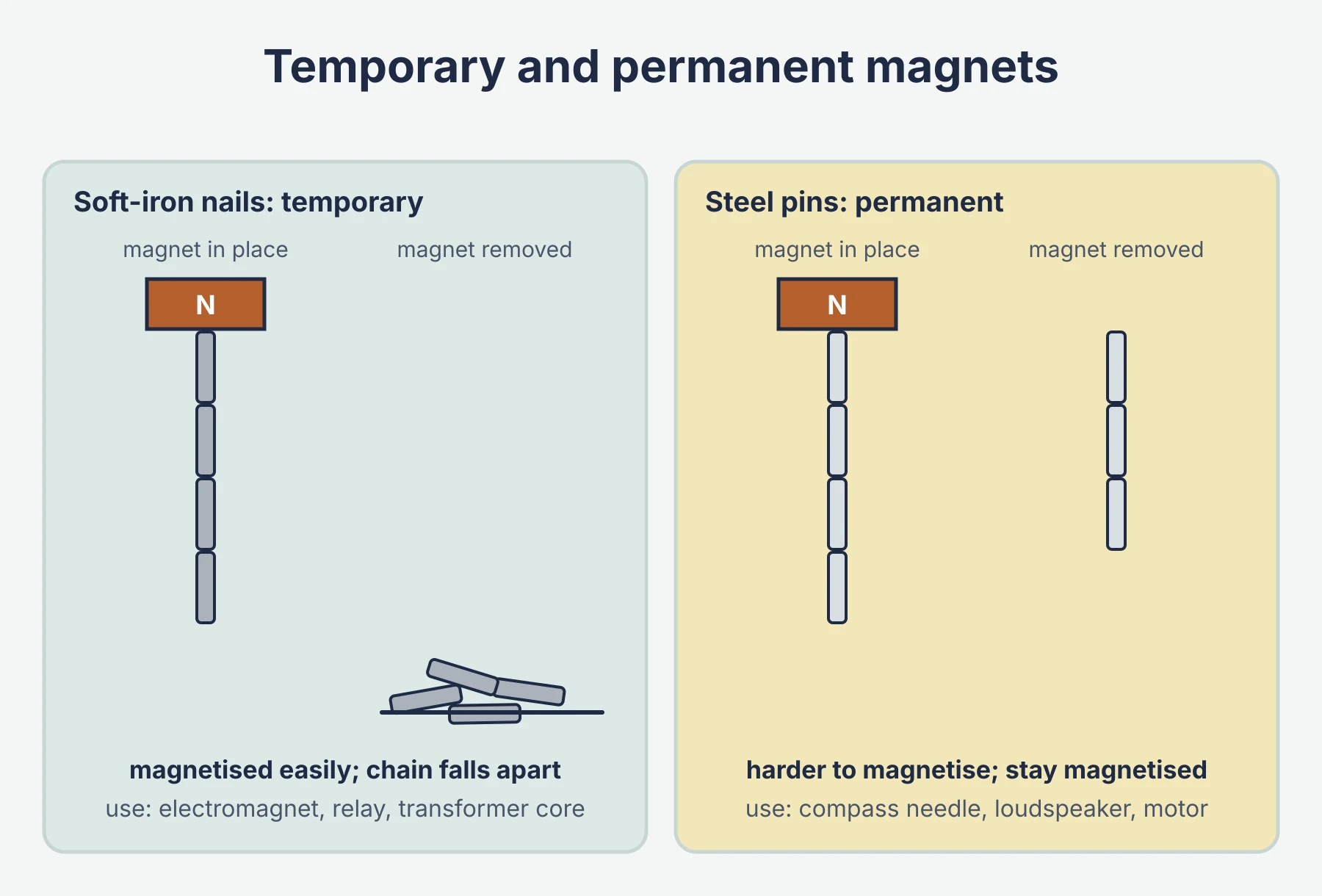
| What happens when the magnetising field is removed | Loses almost all its magnetism | Keeps its magnetism |
| Type of magnet | Temporary | Permanent |
| Typical use | Core of an electromagnet, relay or transformer | Compass needle, magnets in loudspeakers and motors |
A clear demonstration: hang a chain of soft-iron nails from one magnet and a chain of steel pins from another. Remove the magnets carefully. The soft-iron chain falls apart at once; the steel pins stay partly stuck together because they remain magnetised.
Choosing a material in an exam question comes down to one test: does the magnetism need to switch off (soft iron) or stay (steel)?
Magnetic fields
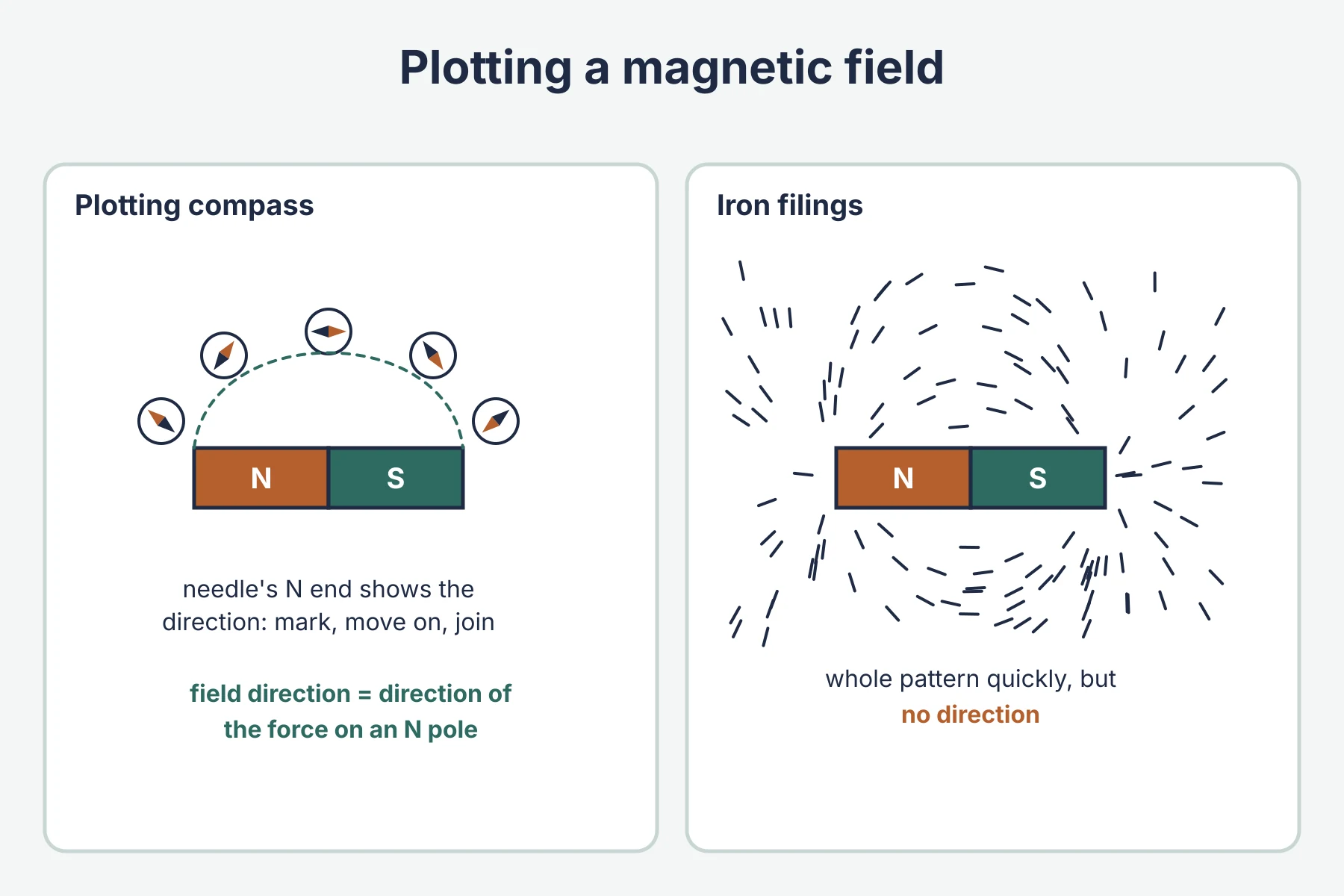
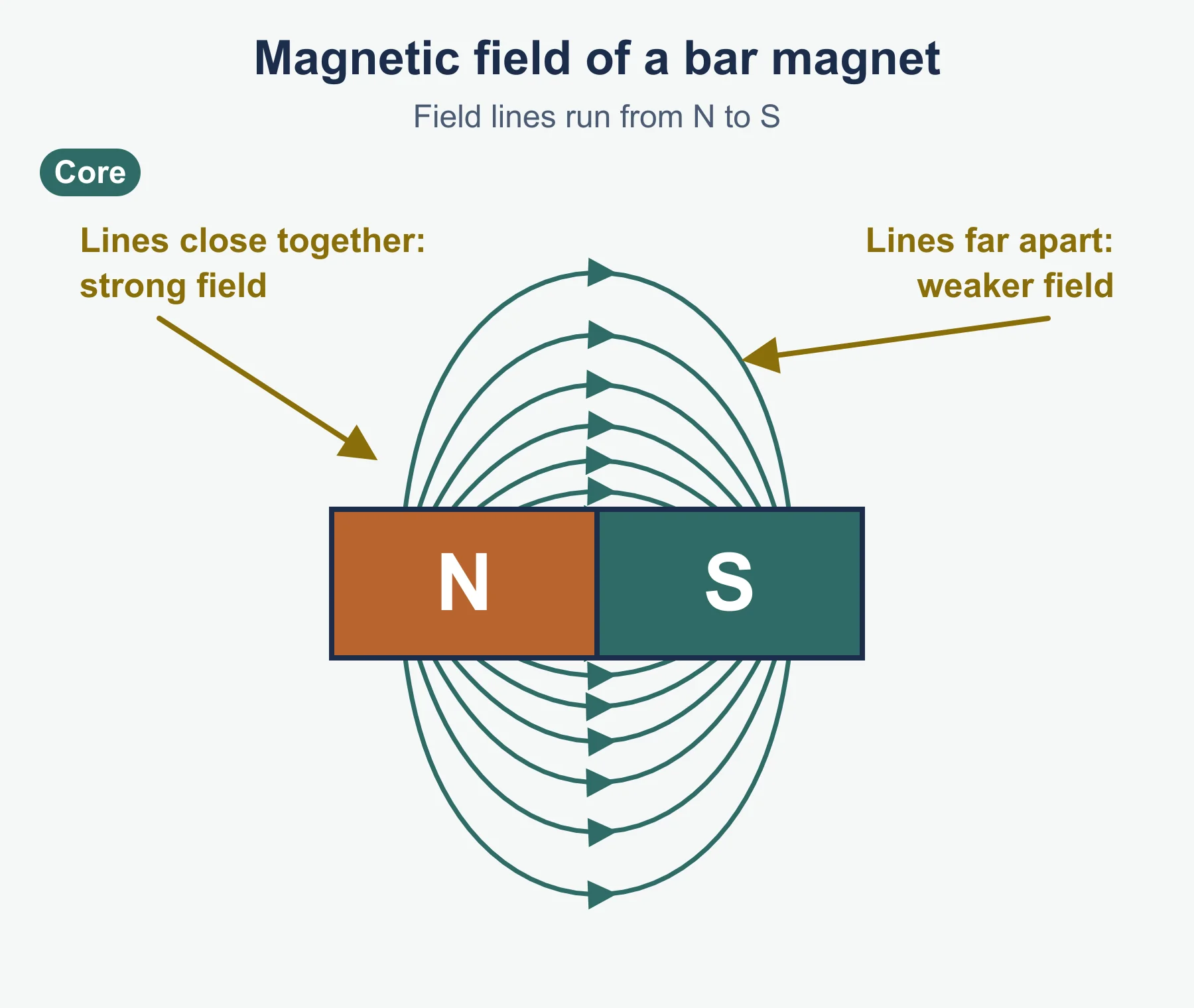
A magnetic field is a region in which a magnetic pole experiences a force. The direction of the field at a point is the direction of the force on an N pole placed there. That is why field lines are drawn leaving N poles and entering S poles, and why a small plotting compass lines up along the field: its own N pole is pushed along the field direction and its S pole the opposite way.
Rules for drawing field lines:
- Start on N and end on S; put an arrow on every line, pointing from N to S outside the magnet.
- Lines never cross (at any point the field has only one direction).
- Lines are closest together where the field is strongest, at the poles.
- Draw them smooth and symmetrical; do not let them touch except at the poles.
Plotting compass or iron filings? Iron filings sprinkled on card over a magnet show the whole pattern quickly, but every filing is magnetised by induction and lines up along the field without indicating which way it points, so filings give no direction. A plotting compass is slower, but its needle shows the direction at each point; mark its tip, move it on, and join the dots.
Interacting fields (Extended only)
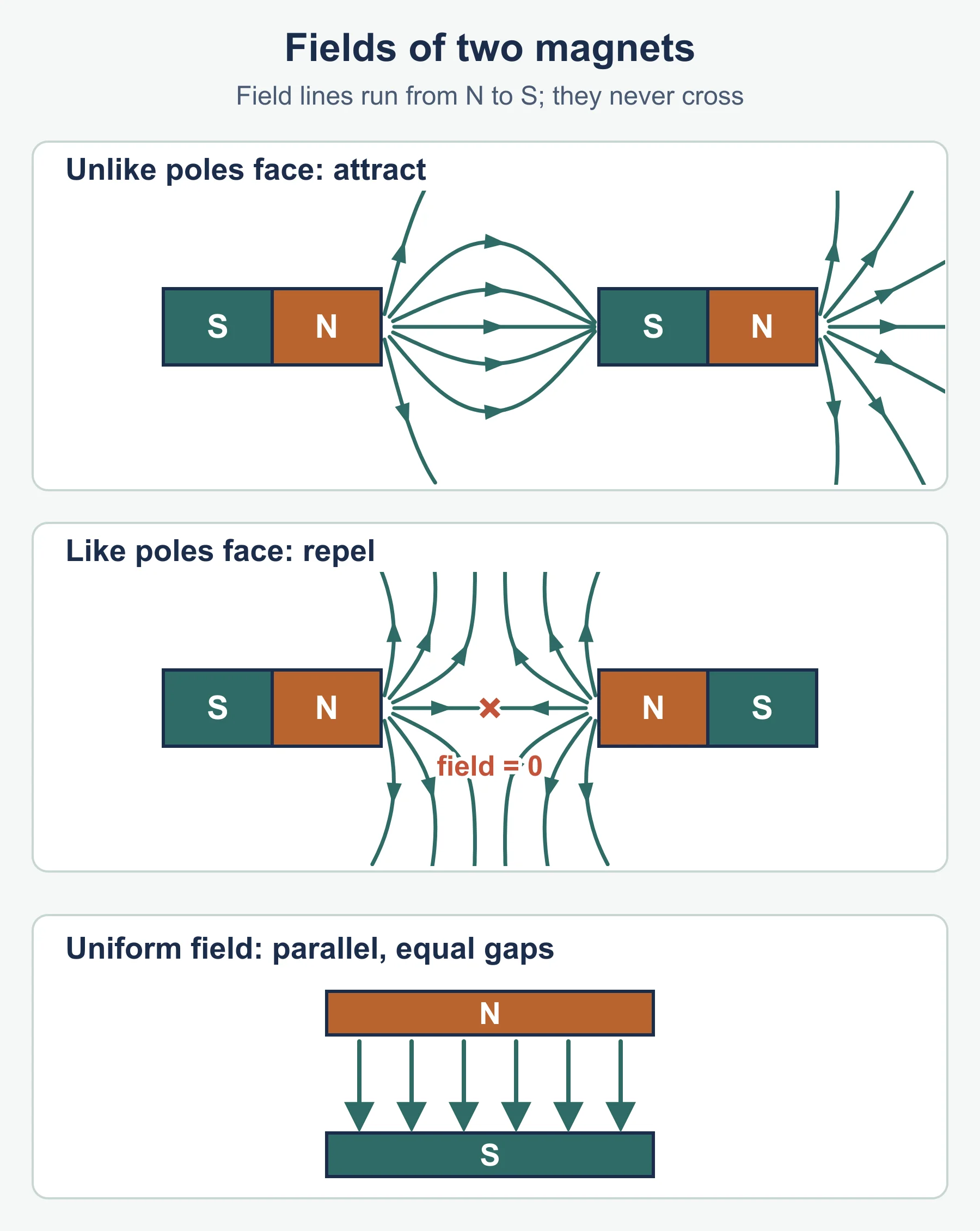
The forces between magnets are due to interactions between their magnetic fields. Placing two magnets close together produces a combined field:
- Unlike poles facing (N to S): lines run straight across the gap from N to S, closely spaced. The magnets attract.
- Like poles facing (N to N): lines from each pole curve away from the gap. Midway between the poles is a neutral point where the two fields cancel and a compass would not settle in any direction. The magnets repel.
- Between the flat, wide poles of a U-shaped (horseshoe) magnet: lines are parallel, evenly spaced and run from N to S: a uniform field, the same strength everywhere in that region.
The relative strength of a field is shown by the spacing of the lines: closer lines, stronger field. So the field of a bar magnet is strongest at its poles and gets weaker with distance.
Uses of permanent magnets and electromagnets
An electromagnet is a coil of wire, usually wound on a soft-iron core, that is magnetised when a current flows and loses its magnetism when the current is switched off. Its strength can be changed by changing the current.
| Permanent magnets | Electromagnets |
|---|---|
| Loudspeakers and headphones | Cranes that lift scrap iron and drop it when switched off |
| Electric motors | Relays (a small current switches a larger one) |
| Compass needles | Electric bells and door locks |
| Magnetic catches on doors and fridge seals | Separating iron and steel from other waste |
In an exam, justify the choice: an electromagnet is chosen when the magnetism must be turned on and off or varied; a permanent magnet when a steady field is needed with no power supply.
Common mistakes
- Using attraction as proof that an object is a magnet.
- Saying all metals are magnetic.
- Drawing field lines that cross, or without arrows, or with arrows from S to N outside the magnet.
- Swapping soft iron and steel in a temporary-or-permanent question.
- Saying iron filings show the direction of the field.
- Describing induced magnetism without saying which pole is induced at the near end.
Exam technique
- State: a short fact, such as “like poles repel”.
- Describe an experiment: name the apparatus, what you do, what you see and what it shows.
- Explain (Extended): bring in the idea that the fields of the two magnets interact, and refer to line spacing for strength.
- Draw: at least four lines on each side of a bar magnet, symmetrical, with arrows; use a pencil and keep lines smooth.
- Suggest a material or a type of magnet: link your choice to whether the magnetism must be temporary or permanent.
Condense this with the magnetism revision notes and practise with the magnetism practice questions. The next subtopic is electrical quantities, and magnetic effects of currents are covered under electromagnetic effects.
Official syllabus
Cambridge International, Cambridge IGCSE Physics 0625 syllabus for examination in 2026, 2027 and 2028, Topic 4 Electricity and magnetism, section 4.1 Simple phenomena of magnetism.
Related resources
-
Practice questions
Cambridge IGCSE Physics (0625): Simple phenomena of magnetism – Practice Questions
Thirteen original Cambridge IGCSE Physics 0625 magnetism questions: poles, induced magnetism, soft iron and steel, field lines, plotting and uses, with answers.
Physics · Cambridge · IGCSE
Try questions -
Revision notes
Cambridge IGCSE Physics (0625): Simple phenomena of magnetism – Revision Notes
Revision notes for Cambridge IGCSE Physics 0625 section 4.1: magnetic poles, induced magnetism, soft iron versus steel, field lines, uses and a self-test.
Physics · Cambridge · IGCSE
Revise topic -
Study guides
Cambridge IGCSE Physics 0625: Electricity and magnetism – Study Guide
Study guide for Cambridge IGCSE Physics 0625 Topic 4: magnetism, charge, circuits, electrical safety and electromagnetic effects, Core and Extended.
Physics · Cambridge · IGCSE
Read guide
Related articles
Get free revision emails (optional)
Occasional emails with practice questions, worked explanations and links to free resources for the qualification and subjects you choose. No spam, and you can unsubscribe from any email. The free tools on this site never need an email.