
Revision Notes
Cambridge IGCSE Physics (0625): Electrical safety – Revision Notes
Revision notes for Cambridge IGCSE Physics 0625 section 4.4: mains hazards, the three wires, fuse ratings, trip switches, earthing and double insulation.
- Subject
- Physics
- Level
- IGCSE
- Topic
- Electricity and magnetism
- Author
- Marlbridge Academic Team
- Updated
- Reviewed by
- Iftikhar Azeemi (what this means)
Aligned to Cambridge IGCSE Physics (0625), For examination in 2026, 2027 and 2028. Official specification .
Syllabus page (what it covers and how it is assessed): Cambridge IGCSE Physics.
Syllabus points this page covers, with Core and Extended
0625
- 4.4 Electrical safety · Core
"Core and Extended" means part of that syllabus point is Extended only. The page's own tier notes say which part.
Found an error? Report a correction.
Need help with this topic? Request a free trial class for IGCSE Physics (0625).
These notes condense section 4.4 Electrical safety of the Cambridge IGCSE Physics 0625 syllabus (for examination in 2026, 2027 and 2028). All of 4.4 is Core content, so every candidate needs every line here. For explanations and worked examples, read the electrical safety study guide.
Hazards of using a mains supply
| Hazard | Danger |
|---|---|
| Damaged insulation | Live wire exposed: shock; short circuit: fire |
| Overheating cables | Insulation melts: fire, then exposed wires |
| Damp conditions | Water conducts: shock |
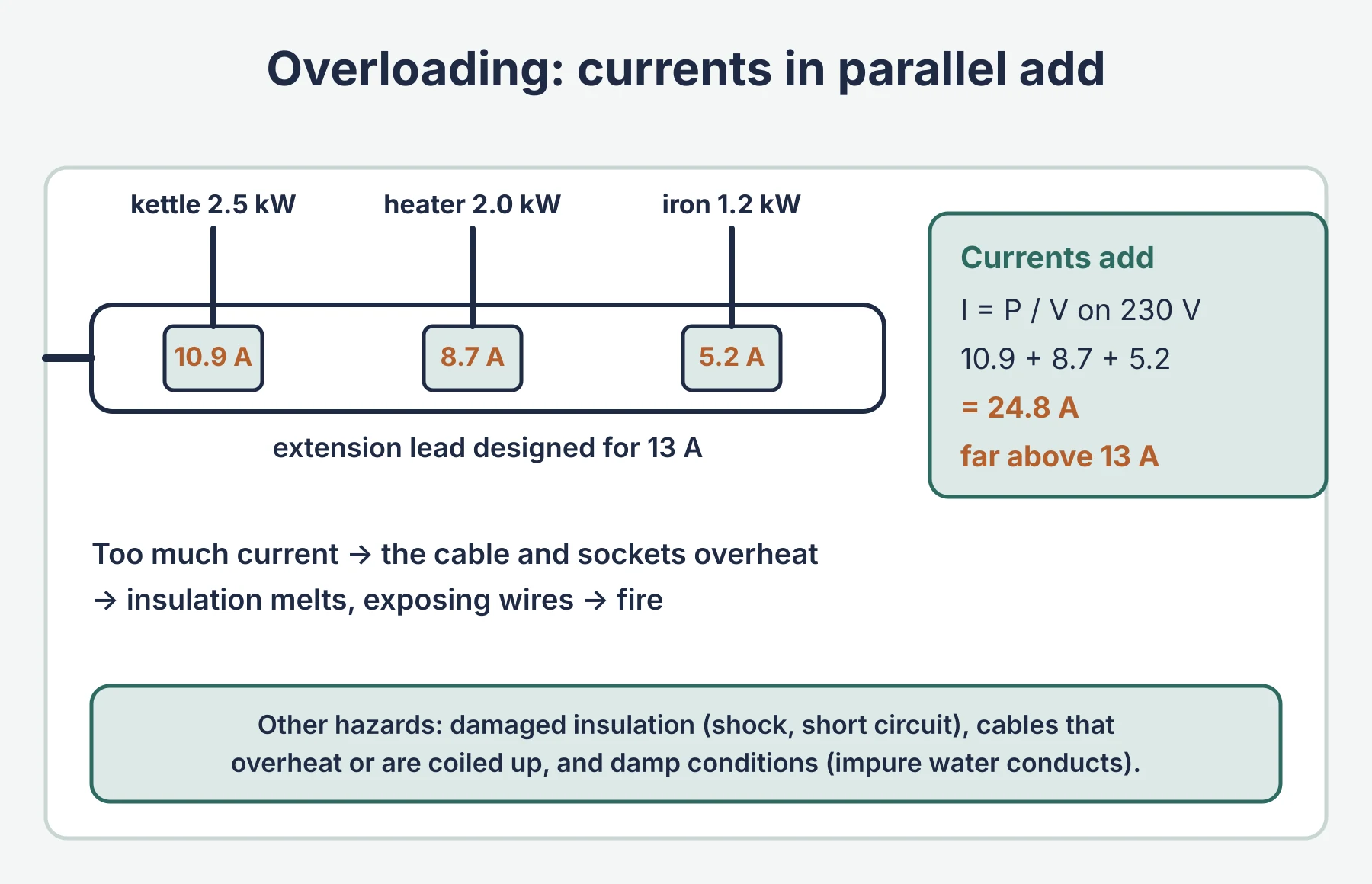
| Overloading plugs, extension leads, single and multiple sockets | Total current too large: cables overheat, fire |
- Appliances on one extension lead are in parallel: their currents add.
The mains circuit
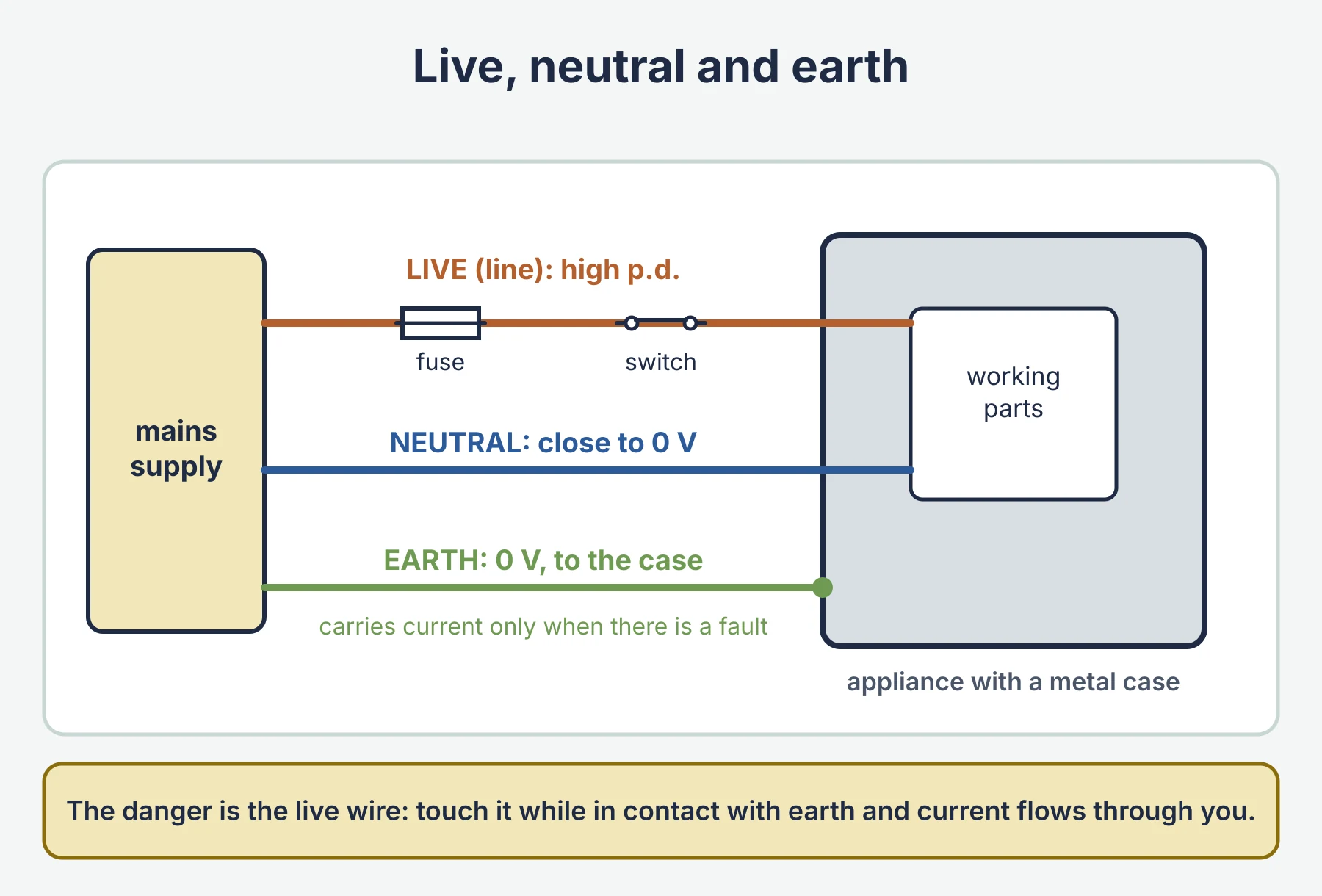
- Live (line) wire: carries the high alternating p.d.; the dangerous wire.
- Neutral wire: completes the circuit; close to zero p.d.
- Earth wire: safety wire to the ground; carries current only in a fault.
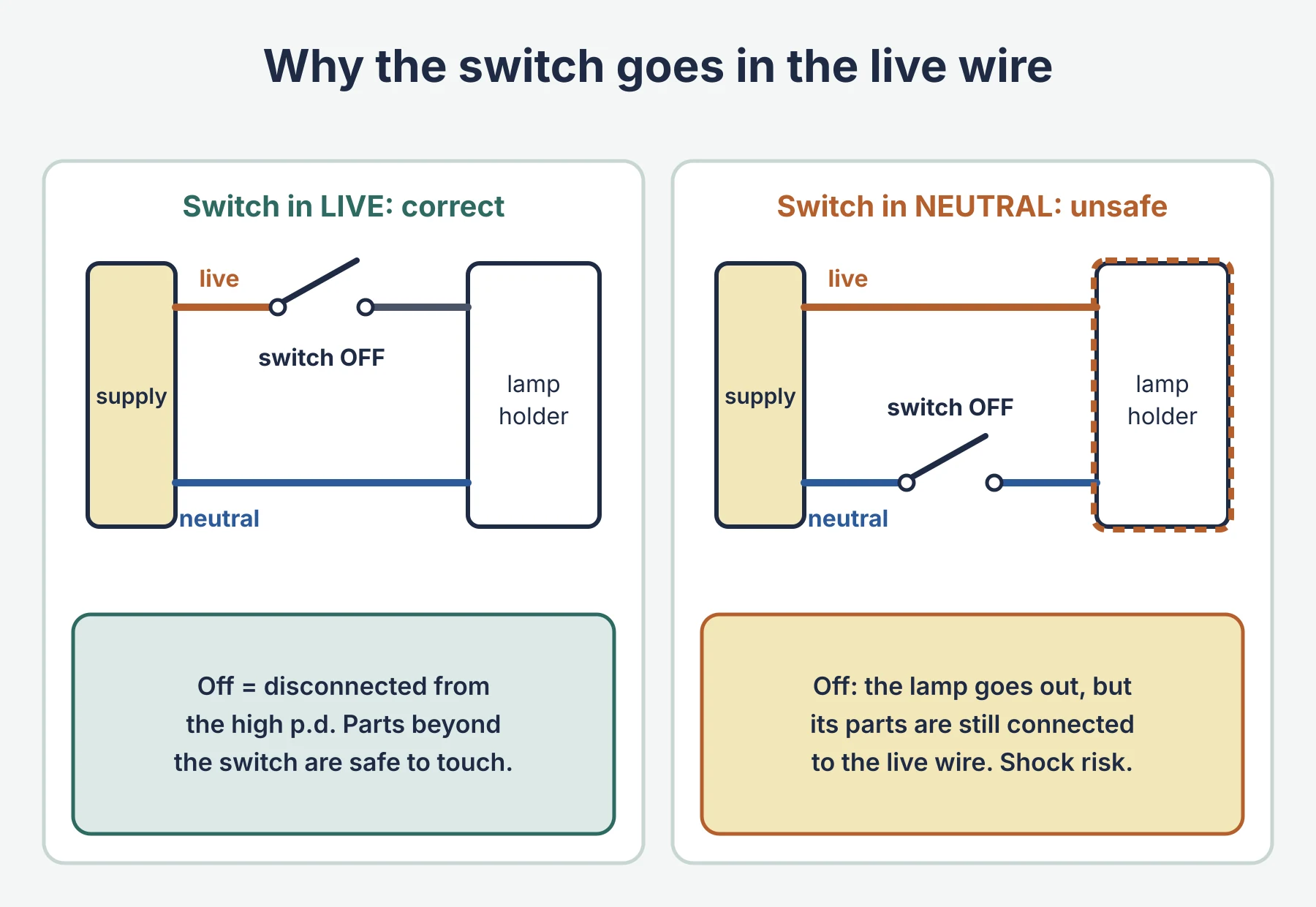
- Switch in the live wire: “off” disconnects the appliance from the high p.d.
- A switch in the neutral would leave the appliance’s parts live even when off.
- Fuses also go in the live wire, for the same reason.
Fuses
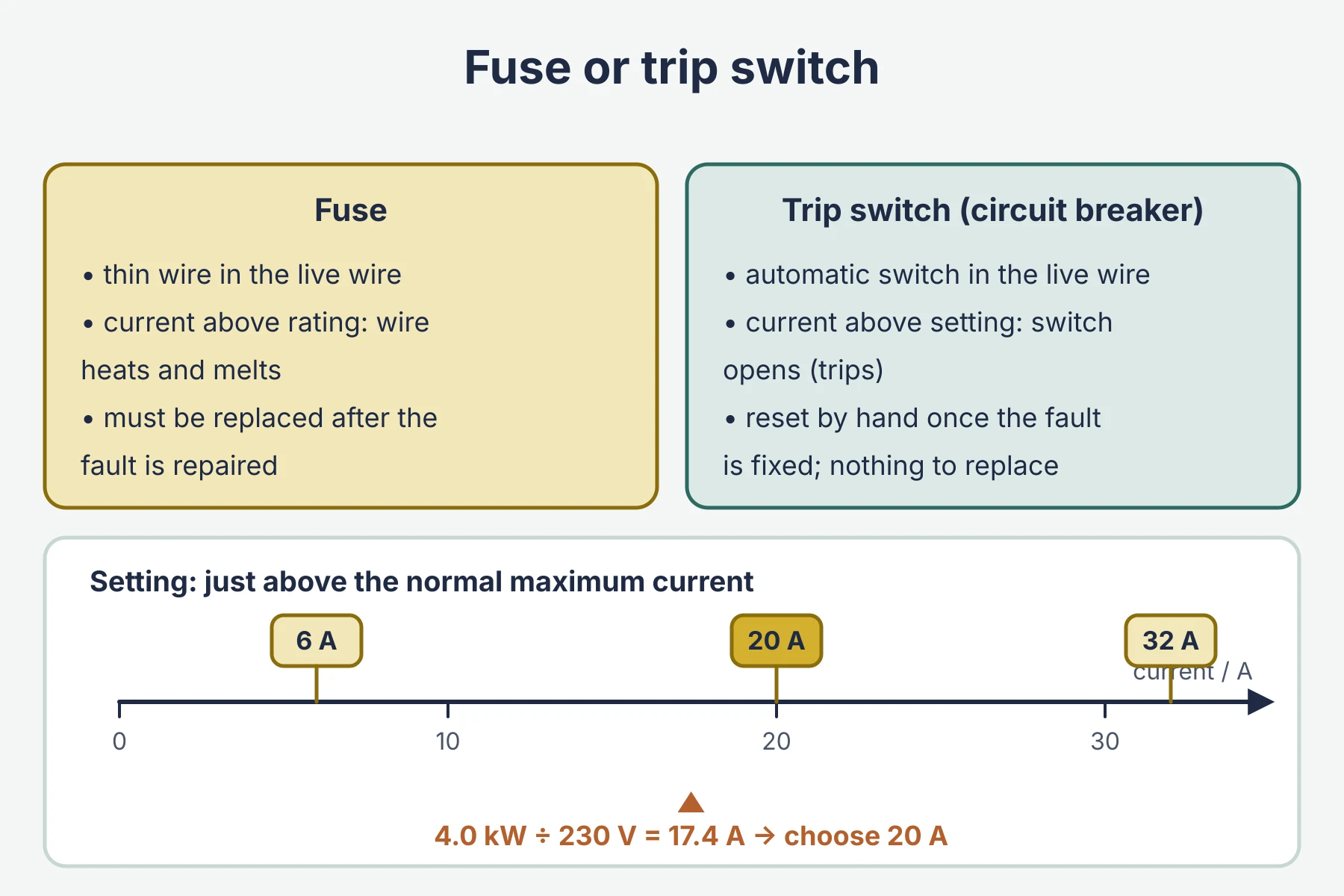
- Thin wire that heats and melts when the current exceeds its rating.
- Breaks the circuit and disconnects the live supply.
- Must be replaced after the fault is repaired.
Method in steps: choosing a fuse rating
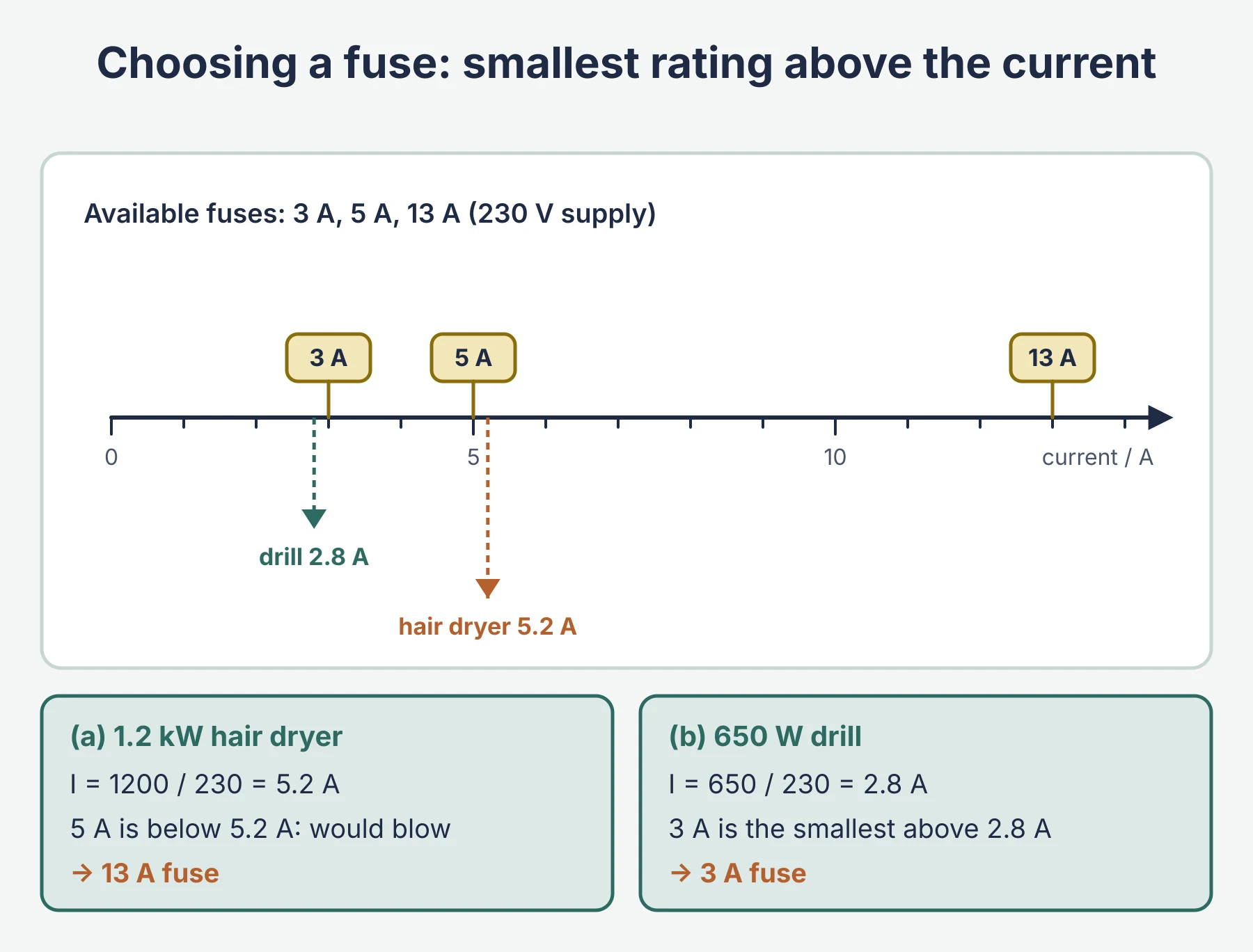
- Calculate the normal current: I = P / V (power in watts).
- List the available ratings.
- Choose the smallest rating greater than the normal current.
- Give the reason: lower would blow in normal use; much higher would not protect against a fault.
Trip switches
- Automatic switch that opens when the current exceeds its setting.
- Can be reset once the fault is fixed; nothing to replace.
- Choose the setting just above the normal maximum current of the circuit.
Earthing and double insulation
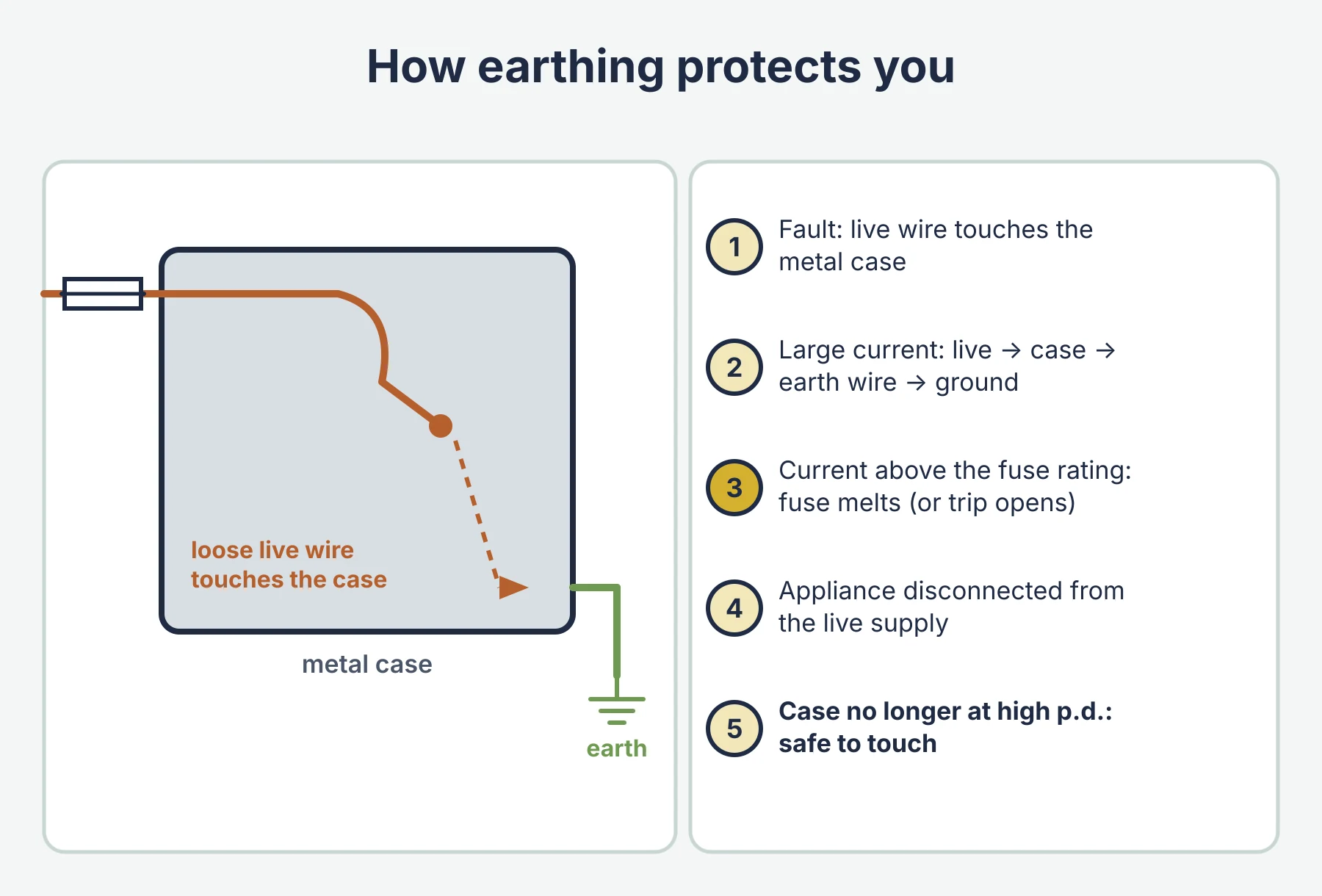
Earthed metal case, in steps
- Fault: live wire touches the metal case.
- Large current flows through the low-resistance earth wire to the ground.
- The fuse melts (or trip switch opens).
- The live supply is disconnected; the case is safe to touch.
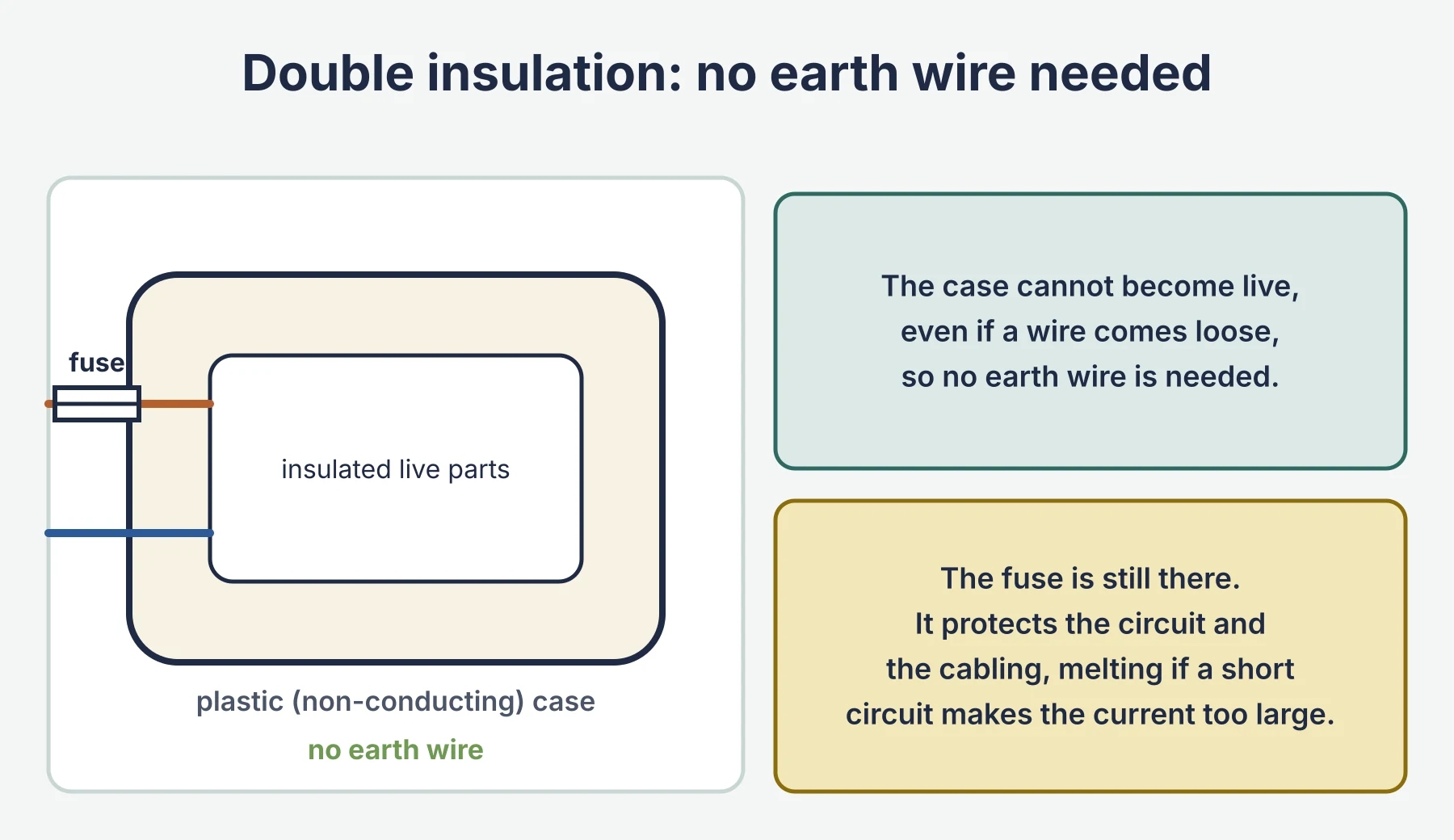
Double-insulated appliance
- Outer casing is non-conducting (for example plastic): it cannot become live.
- No earth wire is needed.
- Its fuse (with no earth wire) protects the circuit and the cabling.
Fuse choices at 230 V (calculated)
| Appliance power | Normal current | Fuse (from 3 A, 5 A, 13 A) |
|---|---|---|
| 60 W | 0.26 A | 3 A |
| 650 W | 2.8 A | 3 A |
| 800 W | 3.5 A | 5 A |
| 1200 W | 5.2 A | 13 A |
| 2500 W | 10.9 A | 13 A |
Key terms
| Term | Meaning |
|---|---|
| Live wire | Wire carrying the high alternating p.d. from the supply |
| Neutral wire | Return wire completing the circuit, near zero p.d. |
| Earth wire | Low-resistance safety path from a metal case to the ground |
| Fuse rating | Current above which the fuse melts |
| Trip switch | Automatic switch that opens on excess current and can be reset |
| Double-insulated | Has a non-conducting outer casing; needs no earth wire |
| Overloading | Drawing too much total current from one plug, lead or socket |
Exam traps
- Reason for the switch in live: disconnects from the high p.d., not “turns it off”.
- A fuse melts; it does not “limit” or “reduce” the current.
- The earth wire does not store or absorb charge; it provides a path for a large fault current.
- The fuse rating must be above the normal current, not equal to or below it.
- Double-insulated appliances still have fuses.
- “Water and electricity don’t mix” scores nothing: say water conducts.
Self-test
- Name the three wires in a mains circuit.
- Which wire is at a high p.d.?
- Explain why a switch is connected in the live wire.
- State the hazard of using a hair dryer with wet hands.
- Why is plugging many appliances into one extension lead dangerous?
- Describe how a fuse protects a circuit.
- A 230 V television is rated at 150 W. Choose a fuse from 3 A, 5 A and 13 A.
- A 230 V iron draws a current of 5.2 A. Explain why a 5 A fuse is unsuitable.
- State one advantage of a trip switch over a fuse.
- Explain why a metal-cased toaster must be earthed.
- Why does a double-insulated drill not need an earth wire?
- What does the fuse protect in a double-insulated appliance?
Answers
- Live (line), neutral and earth.
- The live wire.
- So that when switched off the appliance is disconnected from the high p.d.; a switch in the neutral would leave parts live.
- Electric shock: water conducts, so current can flow through the person.
- The currents add, so the total current is too large; the cables overheat and could cause a fire.
- If the current exceeds the rating the fuse wire melts, breaking the circuit and disconnecting the live supply.
- I = 150 ÷ 230 = 0.65 A, so 3 A.
- 5 A is below the normal current, so the fuse would melt in normal use; a 13 A fuse is needed.
- It can be reset rather than replaced.
- If the live wire touches the case, a large current flows to earth, the fuse melts and the live supply is cut off, so the case does not stay live.
- Its outer casing is non-conducting, so it cannot become live.
- The circuit and the cabling.
Official syllabus
Cambridge International, Cambridge IGCSE Physics 0625 syllabus for examination in 2026, 2027 and 2028, Topic 4 Electricity and magnetism, section 4.4 Electrical safety. Test yourself with the electrical safety practice questions.
Related resources
-
Study guides
Cambridge IGCSE Physics (0625): Electromagnetic effects
Study guide for Cambridge IGCSE Physics 0625 section 4.5: induction, the a.c. generator, fields of currents, the motor effect, d.c. motors and transformers.
Physics · Cambridge · IGCSE
Read guide -
Practice questions
Cambridge IGCSE Physics (0625): Electromagnetic effects – Practice Questions
Thirteen original Cambridge IGCSE Physics 0625 questions on induction, generators, the motor effect, loudspeakers and transformers, with mark-by-mark answers.
Physics · Cambridge · IGCSE
Try questions -
Revision notes
Cambridge IGCSE Physics (0625): Electromagnetic effects – Revision Notes
Revision notes for Cambridge IGCSE Physics 0625 section 4.5: induction, generators, the motor effect, transformers and cable losses, with a self-test.
Physics · Cambridge · IGCSE
Revise topic
Related articles
Get free revision emails (optional)
Occasional emails with practice questions, worked explanations and links to free resources for the qualification and subjects you choose. No spam, and you can unsubscribe from any email. The free tools on this site never need an email.