
Revision Notes
Cambridge IGCSE Physics (0625): Sound – Revision Notes
Revision notes for Cambridge IGCSE Physics 0625 section 3.4 Sound: longitudinal waves, audible range, speed of sound, echoes, ultrasound and a self-test.
- Subject
- Physics
- Level
- IGCSE
- Topic
- Waves
- Author
- Marlbridge Academic Team
- Updated
- Reviewed by
- Iftikhar Azeemi (what this means)
Aligned to Cambridge IGCSE Physics (0625), For examination in 2026, 2027 and 2028. Official specification .
Syllabus page (what it covers and how it is assessed): Cambridge IGCSE Physics.
Syllabus points this page covers, with Core and Extended
0625
- 3.4 Sound · Core and Extended
"Core and Extended" means part of that syllabus point is Extended only. The page's own tier notes say which part.
Found an error? Report a correction.
Need help with this topic? Request a free trial class for IGCSE Physics (0625).
These notes condense section 3.4 Sound of the Cambridge IGCSE Physics 0625 syllabus (for examination in 2026, 2027 and 2028). Lines marked Extended only are Supplement content, examined on Papers 2 and 4. For explanations and worked examples, read the Sound study guide.
Numbers to know
| Quantity | Value |
|---|---|
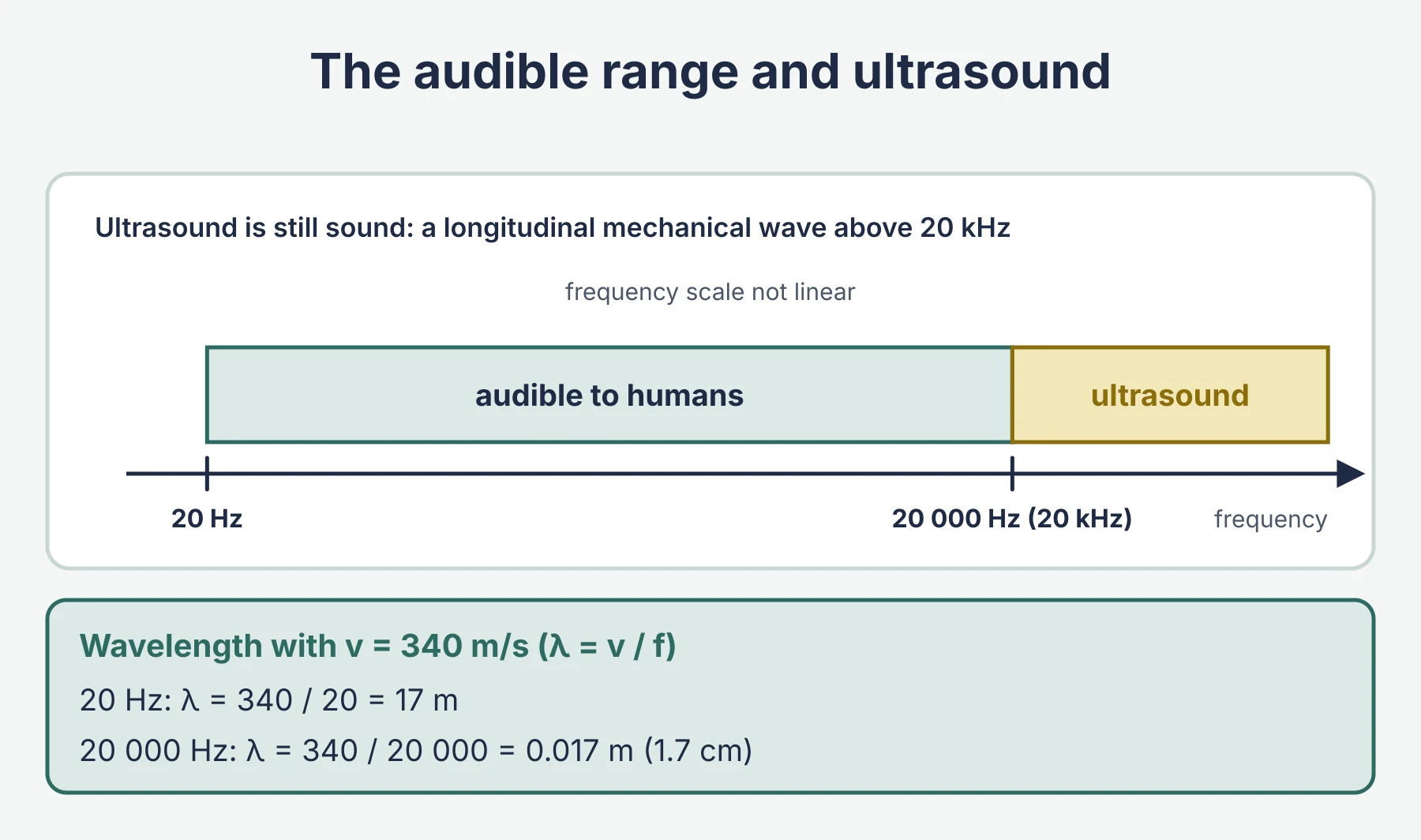
| Audible range (humans) | 20 Hz to 20 000 Hz |
| Ultrasound | frequency above 20 kHz (20 000 Hz) |
| Speed of sound in air | about 330–350 m/s |
Production and nature (Core)
- Sound is produced by vibrating sources (strings, loudspeaker cones, vocal cords, tuning forks).
- Sound is a longitudinal wave: particles vibrate parallel to the direction the wave travels.
- Particles vibrate about fixed positions; energy is transferred, not the air.
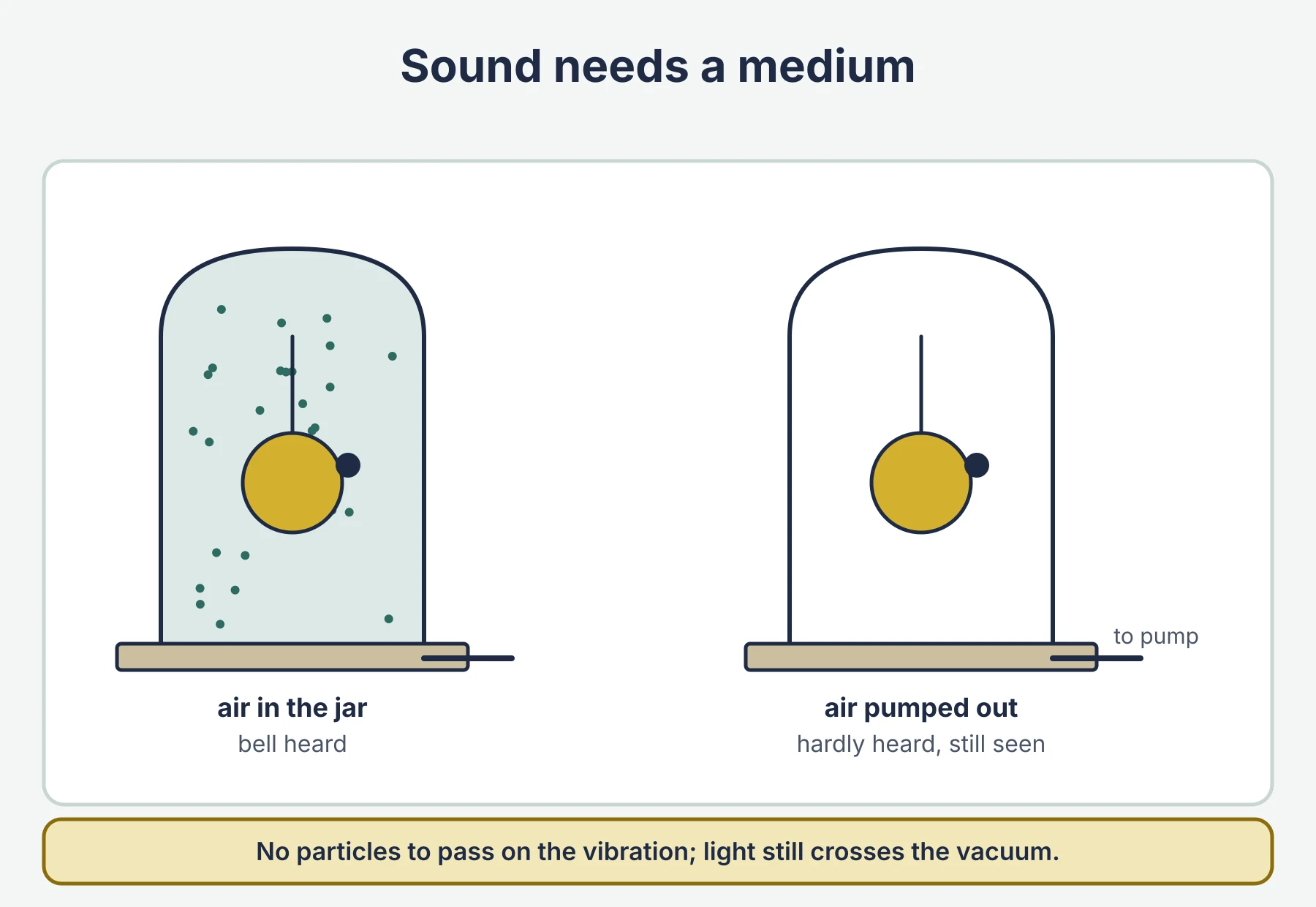
- A medium (solid, liquid or gas) is needed: sound cannot travel through a vacuum.
- Bell-in-a-jar: pump the air out and the ringing fades although the hammer is still seen moving; let air in and the sound returns.
Extended only
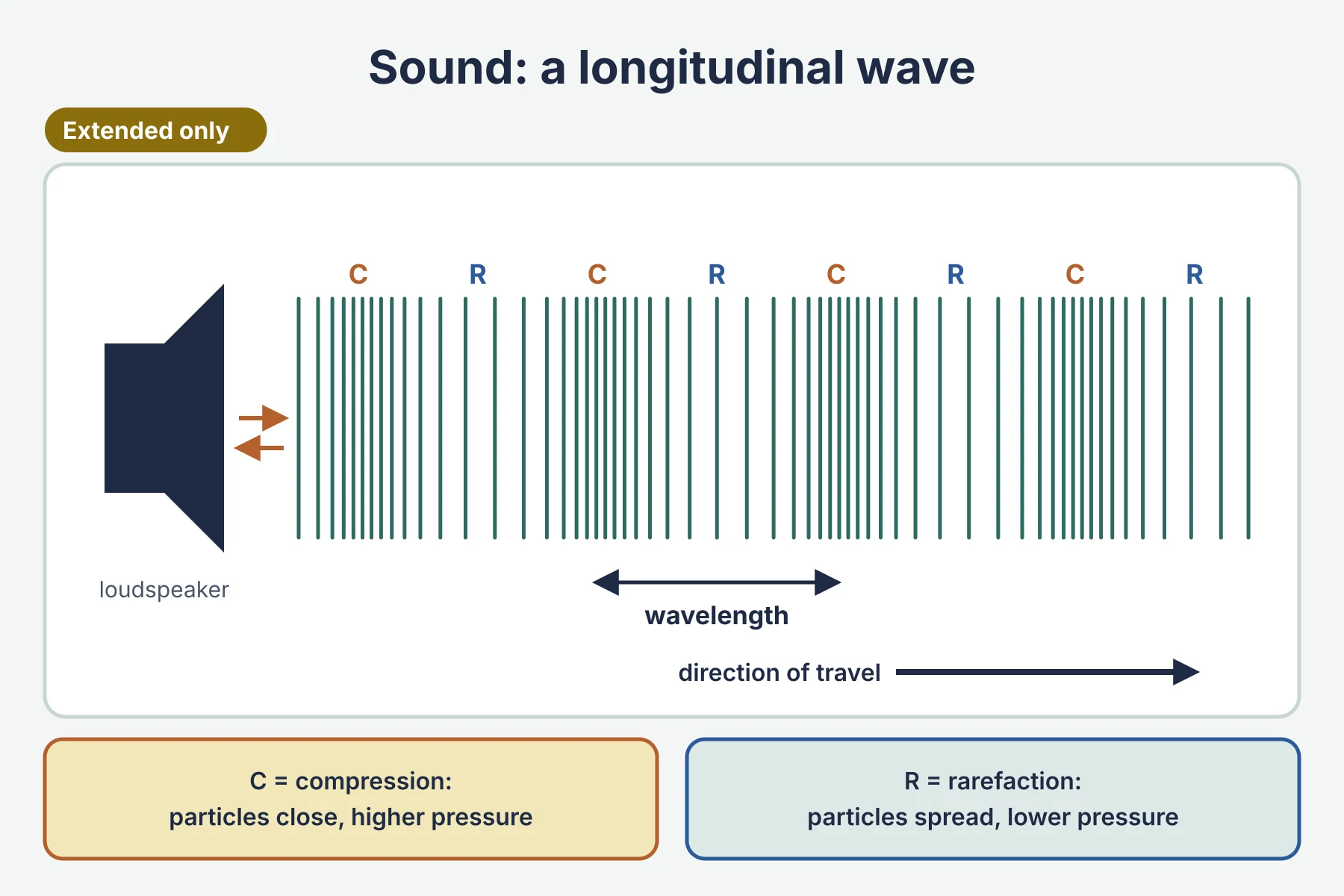
- Compression: region where particles are pushed close together (higher pressure).
- Rarefaction: region where particles are spread apart (lower pressure).
- Wavelength = distance between centres of neighbouring compressions (or rarefactions).
- Speed: generally solids > liquids > gases.
- Typical given values: air about 340 m/s, water about 1500 m/s, steel several thousand m/s.
Loudness and pitch (Core)
| Property of the wave | Heard as | Trace on a screen |
|---|---|---|
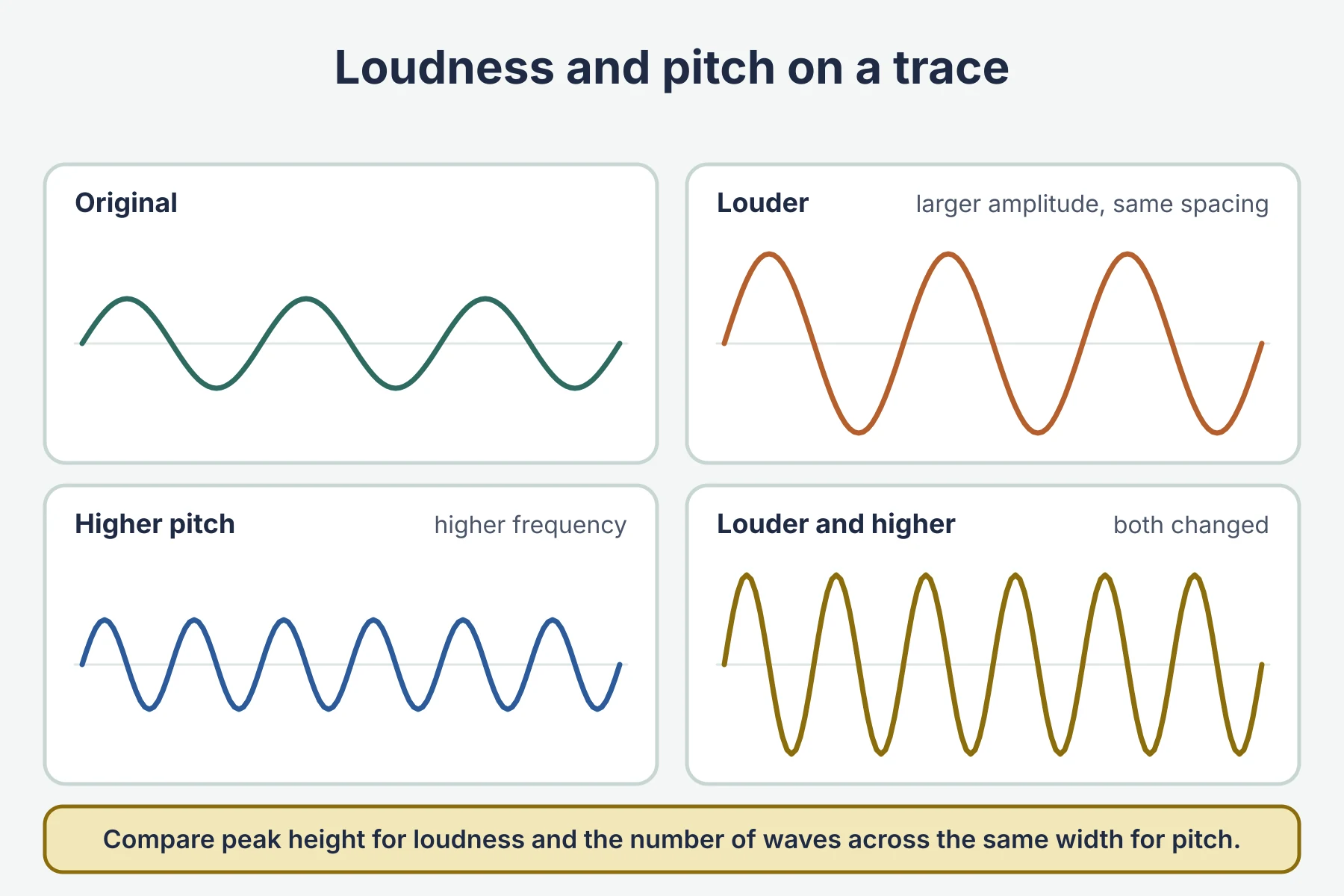
| Amplitude ↑ | louder | taller peaks |
| Frequency ↑ | higher pitch | waves closer together |
- The two are independent: change one without the other.
Echoes and speed of sound (Core)
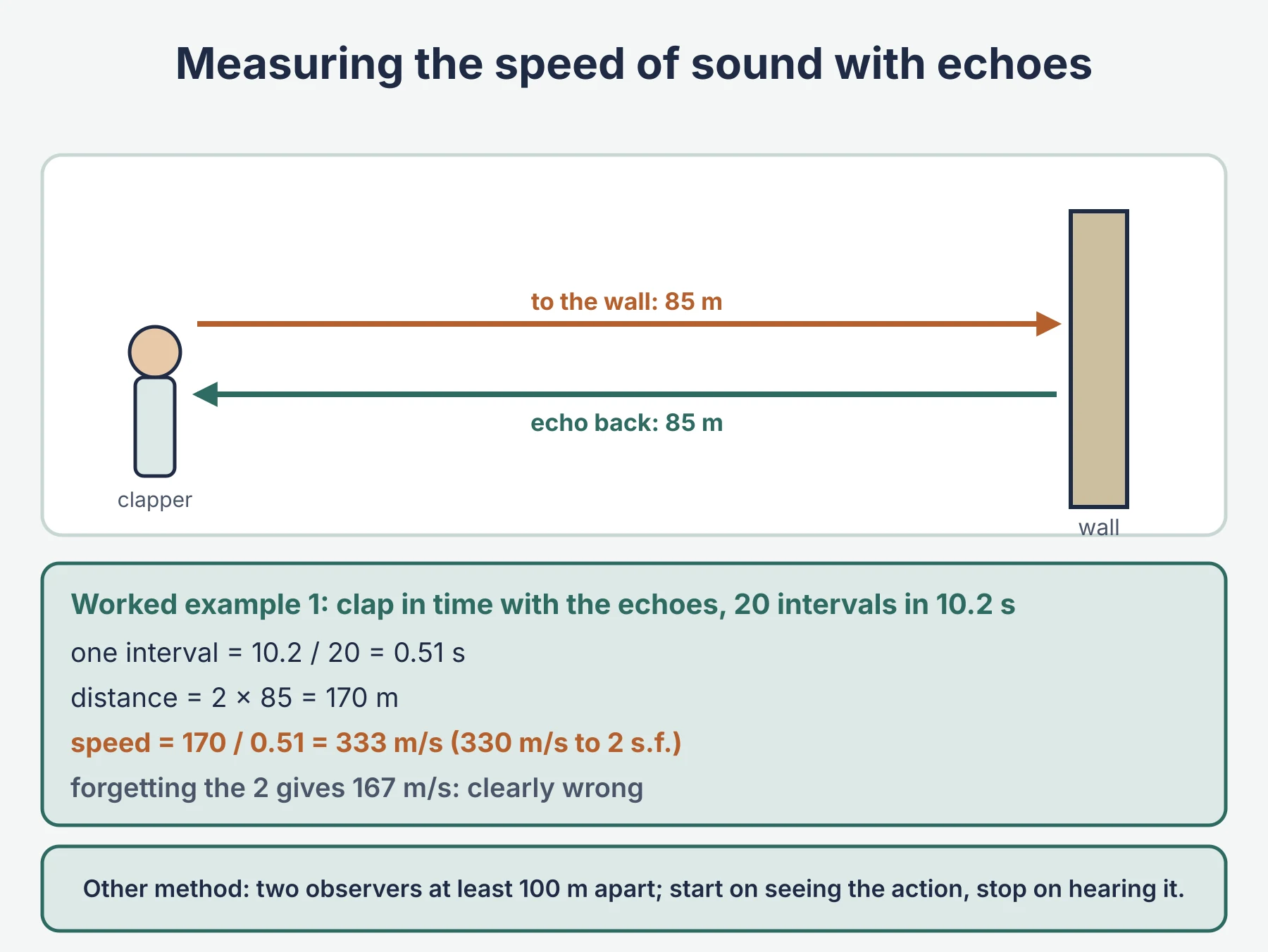
- An echo is sound reflected from a surface.
- Echo distance travelled = 2 × distance to the surface.
- Speed = distance ÷ time.
Two-observer method, in steps
- Measure a distance of at least 100 m with a tape or trundle wheel.
- One person makes a sound with a visible action (blocks clapped together above the head, starting pistol).
- The other starts a stopwatch on seeing the action and stops it on hearing the sound.
- Speed = distance ÷ time; repeat and average; swap ends to reduce the effect of wind.
Echo method, in steps
- Stand a measured distance d from a large wall.
- Clap so each clap coincides with the echo of the previous one.
- Time a large number n of intervals; one interval t = total time ÷ n.
- Speed = 2d ÷ t.
Ultrasound uses (Extended only)
| Use | What reflects the pulse |
|---|---|
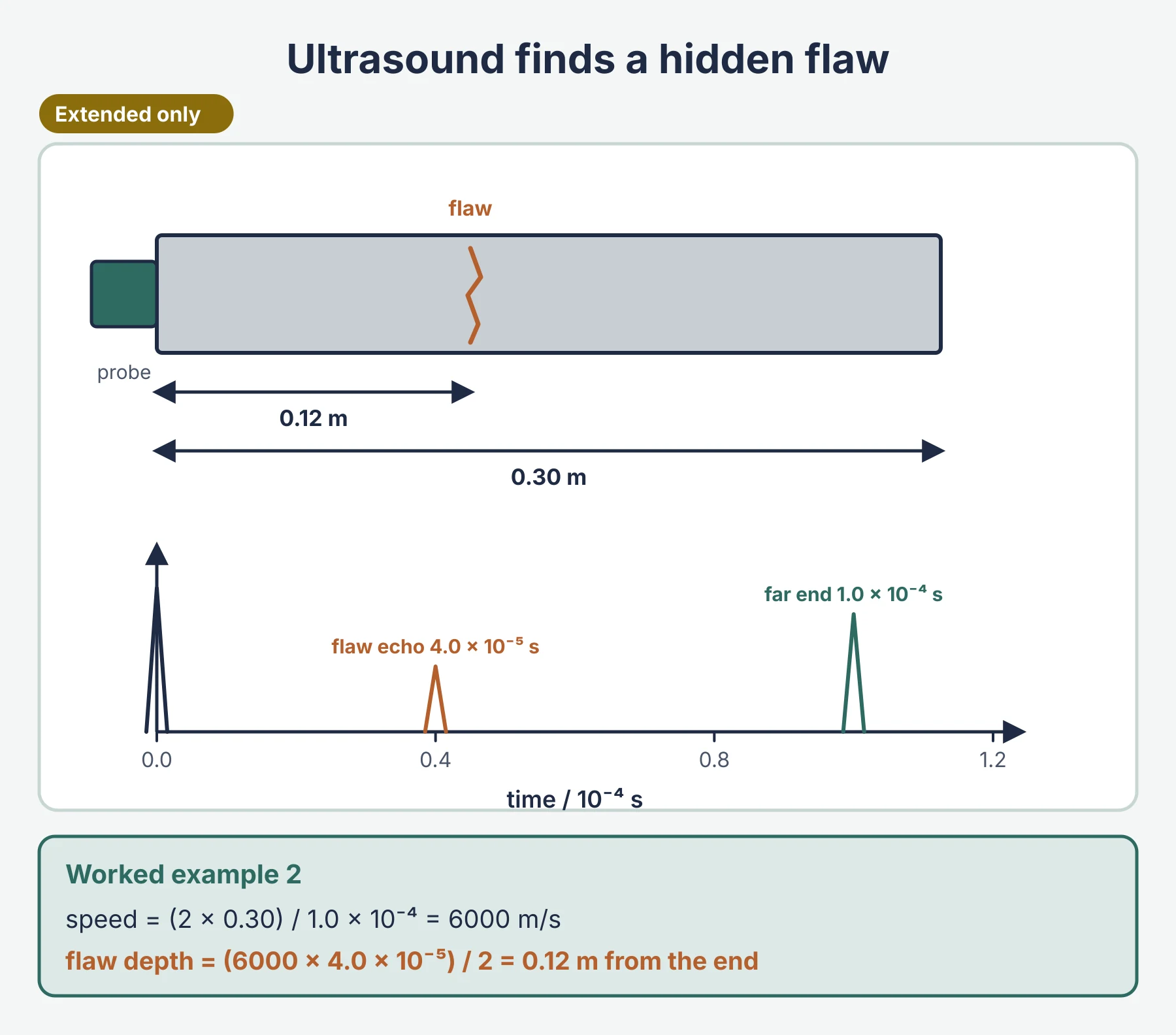
| Non-destructive testing | Far side of a metal part, plus any crack (earlier echo) |
| Medical scanning of soft tissue | Boundaries between tissues |
| Sonar | Sea bed or shoal of fish |
Depth or distance = (speed × time) ÷ 2, where time is from sending the pulse to receiving the echo.
Key terms
| Term | Meaning |
|---|---|
| Longitudinal wave | Vibrations parallel to the direction of travel |
| Medium | Material that carries the wave |
| Echo | Reflected sound |
| Pitch | How high or low a note sounds; set by frequency |
| Loudness | Set by amplitude |
| Ultrasound | Sound above 20 kHz |
| Compression (Extended only) | Region of particles close together |
| Rarefaction (Extended only) | Region of particles spread apart |
Exam traps
- “Sound is transverse” or “air moves from the speaker to the ear”: both wrong.
- Forgetting to double the distance (or halve the time) for an echo.
- Writing that ultrasound has a higher speed than ordinary sound in air: it has a higher frequency; the speed is the same.
- Using v = fλ for an echo calculation when you are given a distance and a time.
- Mixing up 20 Hz and 20 kHz: 20 kHz is the upper limit of hearing and the lower limit of ultrasound.
- Saying sound travels fastest in gases.
Self-test
- What do all sources of sound have in common?
- State the audible range of frequencies for humans.
- Why can astronauts on a spacewalk not talk to each other directly through space?
- Two notes have the same amplitude but note B has twice the frequency of note A. Compare how they sound.
- A student hears an echo from a cliff 1.5 s after shouting. The speed of sound is 340 m/s. How far away is the cliff?
- In a two-observer experiment the observers are 500 m apart and the time is 1.5 s. Calculate the speed of sound.
- Why should the two observers be far apart?
- Define ultrasound.
- Calculate the wavelength of a 680 Hz sound in air, where v = 340 m/s.
- (Extended) What is a rarefaction?
- (Extended) Put air, steel and water in order of increasing speed of sound.
- (Extended) A sonar pulse returns from a shoal of fish 0.12 s after being sent. Speed of sound in sea water = 1500 m/s. How deep is the shoal?
Answers
- They are all vibrating.
- 20 Hz to 20 000 Hz.
- Space is a vacuum: there is no medium to carry sound.
- Same loudness; B has a higher pitch.
- Distance there and back = 340 × 1.5 = 510 m, so the cliff is 255 m away.
- 500 ÷ 1.5 = 333 m/s (330 m/s to 2 s.f.).
- So the time is long compared with the observer’s reaction time, reducing its effect on the result.
- Sound with a frequency higher than 20 kHz.
- λ = 340 ÷ 680 = 0.50 m.
- A region where the particles are spread further apart than normal (lower pressure).
- Air, water, steel.
- (1500 × 0.12) ÷ 2 = 90 m.
Official syllabus
Cambridge International, Cambridge IGCSE Physics 0625 syllabus for examination in 2026, 2027 and 2028, Topic 3 Waves, section 3.4 Sound. Test yourself with the Sound practice questions.
Related resources
-
Study guides
IGCSE Physics: Waves (Cambridge 0625)
Cambridge IGCSE Physics 0625 Topic 3 Waves guide for 2026-2028: wave properties, reflection, refraction, thin lenses, the electromagnetic spectrum and sound.
Physics · Cambridge · IGCSE
Read guide -
Practice questions
IGCSE Physics: Waves — Practice Questions (Cambridge 0625)
Original Cambridge IGCSE Physics 0625 Topic 3 questions with worked answers on wave properties, reflection, refraction, lenses, the EM spectrum and sound.
Physics · Cambridge · IGCSE
Try questions -
Revision notes
IGCSE Physics: Waves — Revision Notes (Cambridge 0625)
Revision notes for Cambridge IGCSE Physics 0625 Topic 3 Waves: wave properties, reflection, refraction, lenses, the EM spectrum and sound, Core and Supplement.
Physics · Cambridge · IGCSE
Revise topic
Related articles
Get free revision emails (optional)
Occasional emails with practice questions, worked explanations and links to free resources for the qualification and subjects you choose. No spam, and you can unsubscribe from any email. The free tools on this site never need an email.