
Study Guides
Cambridge IGCSE Physics (0625): Sound
Study guide for Cambridge IGCSE Physics 0625 section 3.4 Sound: vibrations, longitudinal waves, measuring the speed of sound, pitch, loudness and ultrasound.
- Subject
- Physics
- Level
- IGCSE
- Topic
- Waves
- Author
- Marlbridge Academic Team
- Updated
- Reviewed by
- Iftikhar Azeemi (what this means)
Aligned to Cambridge IGCSE Physics (0625), For examination in 2026, 2027 and 2028. Official specification .
Syllabus page (what it covers and how it is assessed): Cambridge IGCSE Physics.
Syllabus points this page covers, with Core and Extended
0625
- 3.4 Sound · Core and Extended
"Core and Extended" means part of that syllabus point is Extended only. The page's own tier notes say which part.
Found an error? Report a correction.
Need help with this topic? Request a free trial class for IGCSE Physics (0625).
This guide covers one subtopic of the Cambridge IGCSE Physics 0625 syllabus (for examination in 2026, 2027 and 2028): 3.4 Sound. Core content is for every candidate; content marked Extended only is Supplement material, examined on Papers 2 and 4. The Waves study guide introduces sound alongside the other waves in Topic 3 and gives a sonar depth example; this page goes further into how sound travels, the speed-of-sound experiments and echo calculations.
What 3.4 asks you to do
| Core | Extended only |
|---|---|
| Describe how vibrating sources produce sound | Describe compression and rarefaction |
| Describe the longitudinal nature of sound waves | Know that sound is generally fastest in solids, slower in liquids and slowest in gases |
| State the audible range, 20 Hz to 20 000 Hz | Describe ultrasound in non-destructive testing, medical scanning of soft tissue and sonar, including calculating depth or distance |
| Know that a medium is needed to transmit sound | |
| Know that the speed of sound in air is about 330–350 m/s | |
| Describe a distance-and-time method for the speed of sound in air | |
| Describe how amplitude and frequency affect loudness and pitch | |
| Describe an echo as reflected sound; define ultrasound as above 20 kHz |
How sound is produced and travels
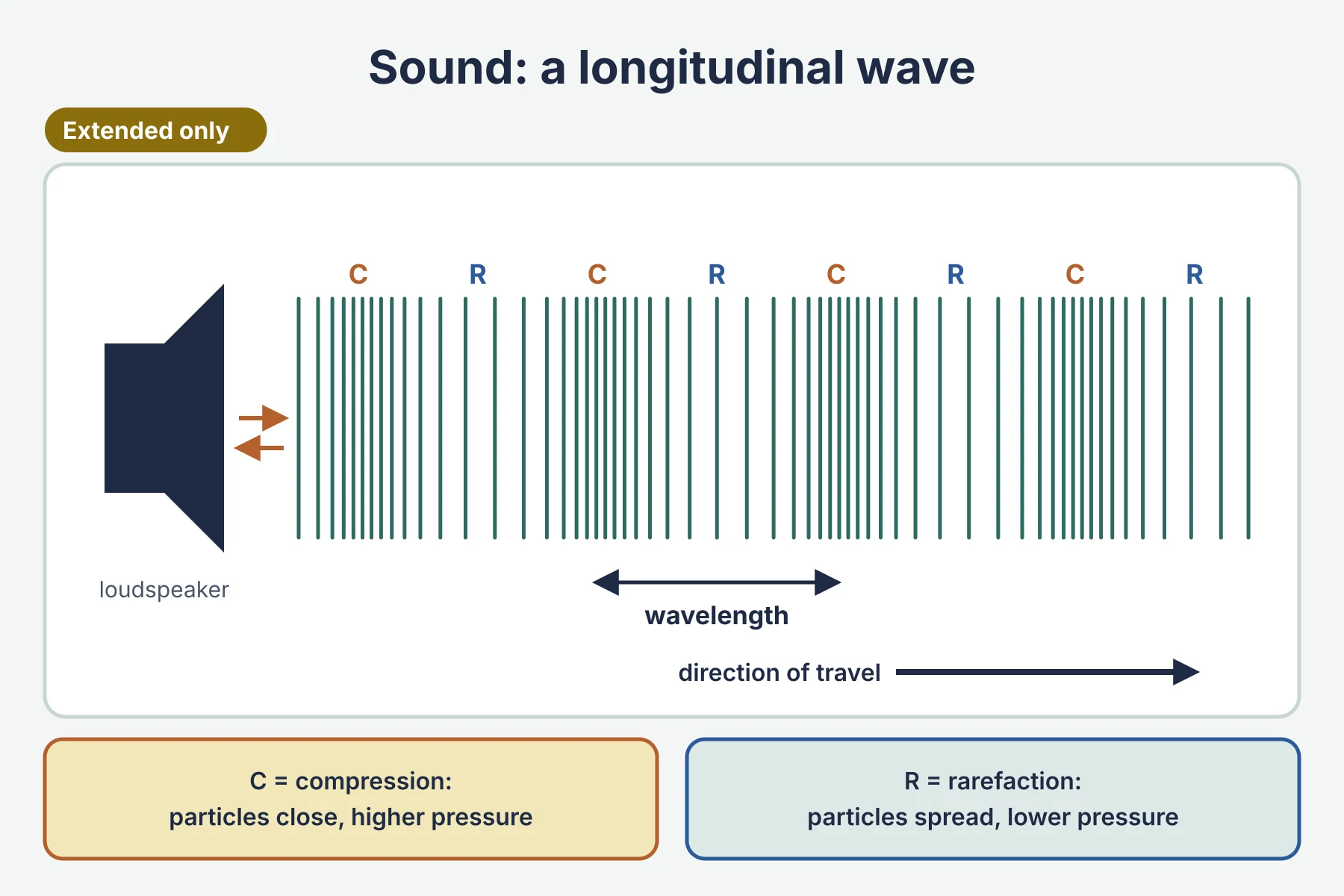
Every sound comes from something vibrating: a guitar string, the cone of a loudspeaker, the vocal cords, a struck tuning fork. The vibrating surface pushes on the air particles next to it, which push on their neighbours, and so on. The particles themselves only vibrate backwards and forwards about a fixed position, in the same direction as the wave travels: sound is a longitudinal wave. Energy moves from the source to your ear; the air does not.
Extended only. As the surface moves forward it squeezes the particles together, making a compression (a region of higher pressure). As it moves back it leaves the particles spread out, making a rarefaction (a region of lower pressure). A sound wave is a series of compressions and rarefactions moving away from the source. The wavelength is the distance from the centre of one compression to the centre of the next.
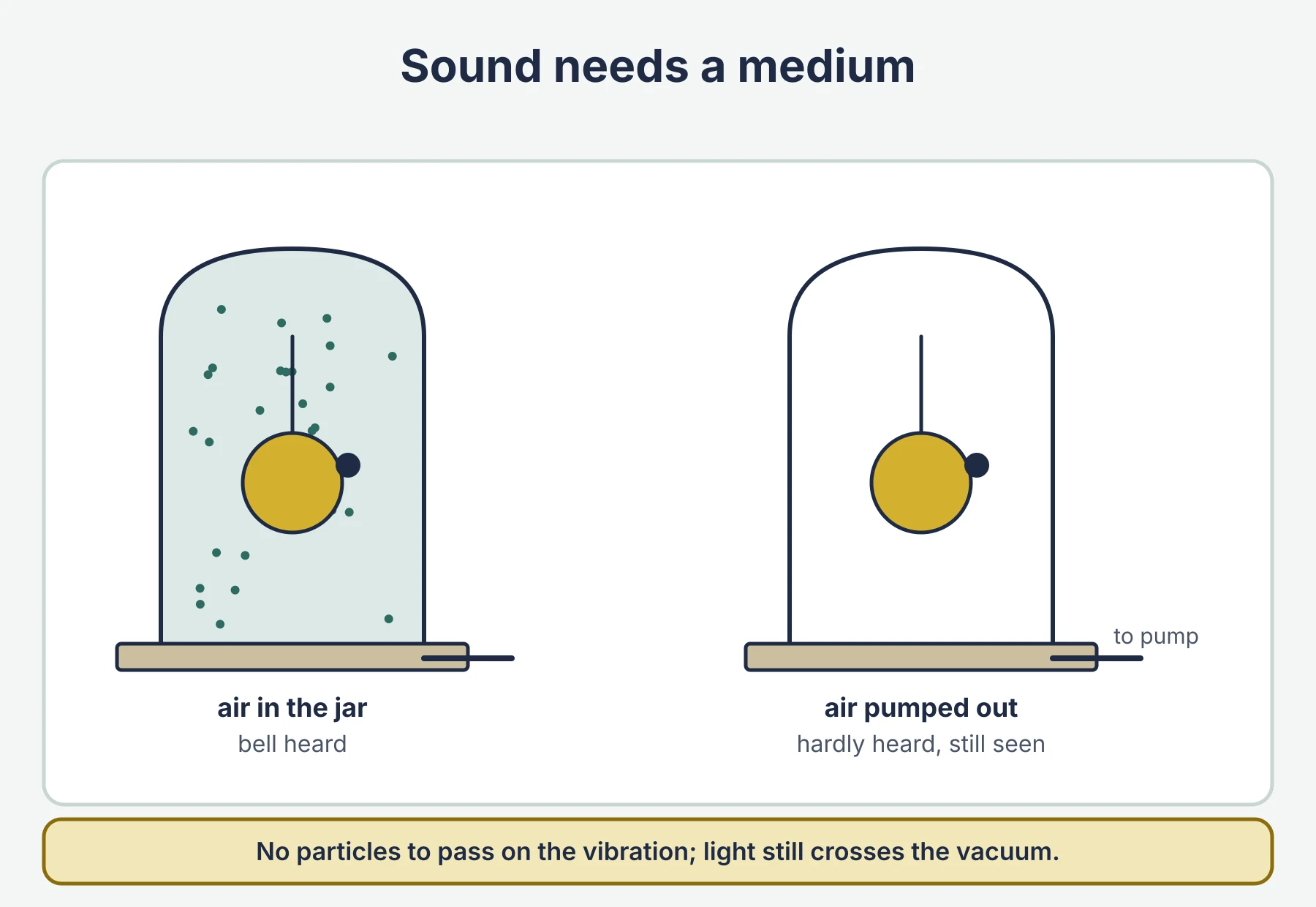
A medium is needed. Because sound is passed on by particles, it cannot travel through a vacuum. The standard demonstration: an electric bell rings inside a sealed glass jar. As a vacuum pump removes the air, the sound becomes fainter until it can hardly be heard, even though the hammer can still be seen striking the bell. Letting air back in restores the sound. (Light still crosses the vacuum, which is why you can see the bell.)
Extended only: speed in different materials. In general sound travels fastest in solids, more slowly in liquids and most slowly in gases. In a solid the particles are close together and strongly linked, so each vibration is passed on quickly. Typical values to use when a question gives them: about 340 m/s in air, about 1500 m/s in water and several thousand metres per second in steel.
The audible range and ultrasound
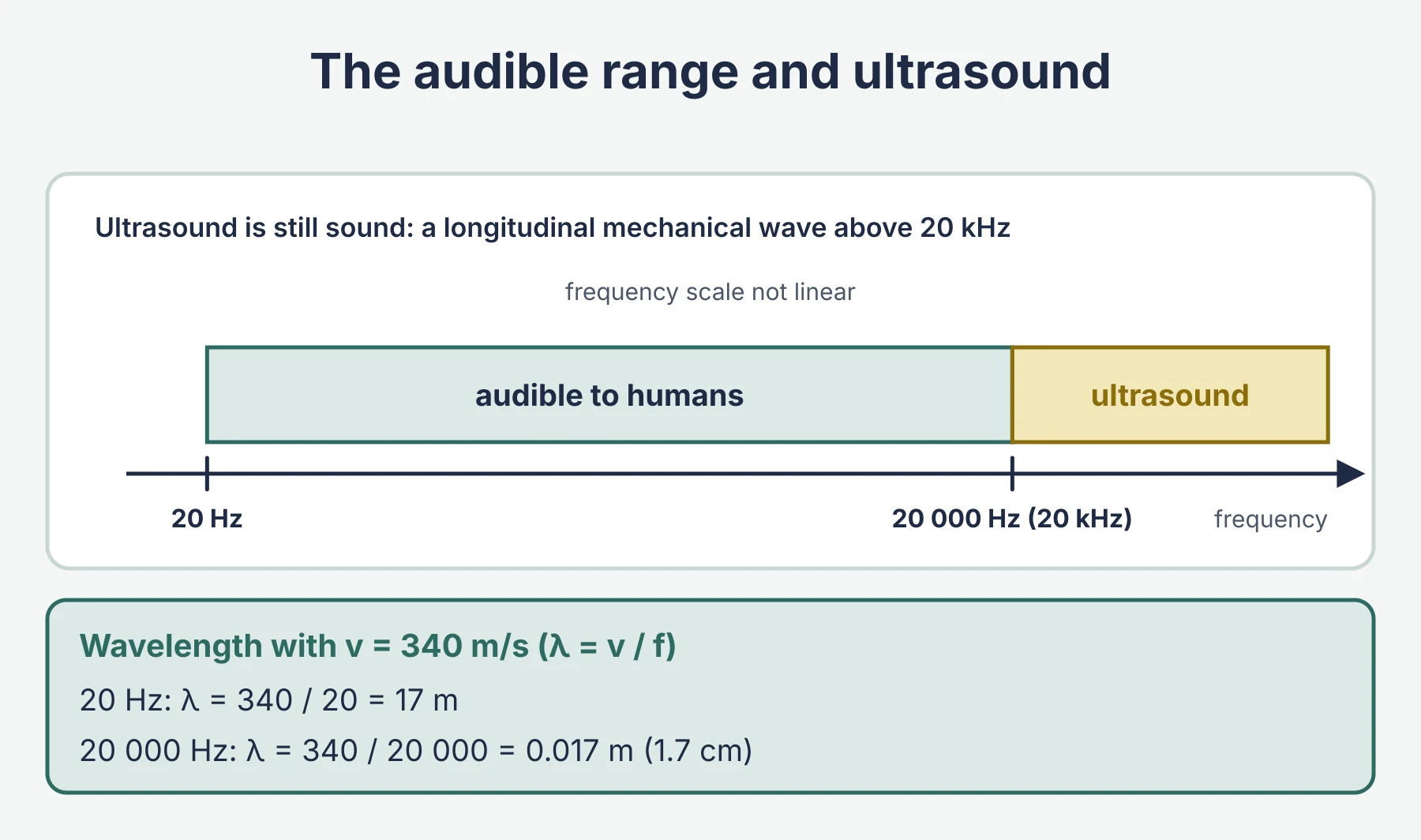
Humans can hear frequencies from about 20 Hz to 20 000 Hz (20 kHz). Sound with a frequency above 20 kHz is ultrasound: it is still sound (a longitudinal mechanical wave), just too high-pitched for humans to hear.
You can use v = fλ from section 3.1 with sound. With v = 340 m/s, a 20 Hz sound has λ = 340 / 20 = 17 m, and a 20 000 Hz sound has λ = 340 / 20 000 = 0.017 m (1.7 cm).
Loudness and pitch
| Change | Effect | On a display of the wave |
|---|---|---|
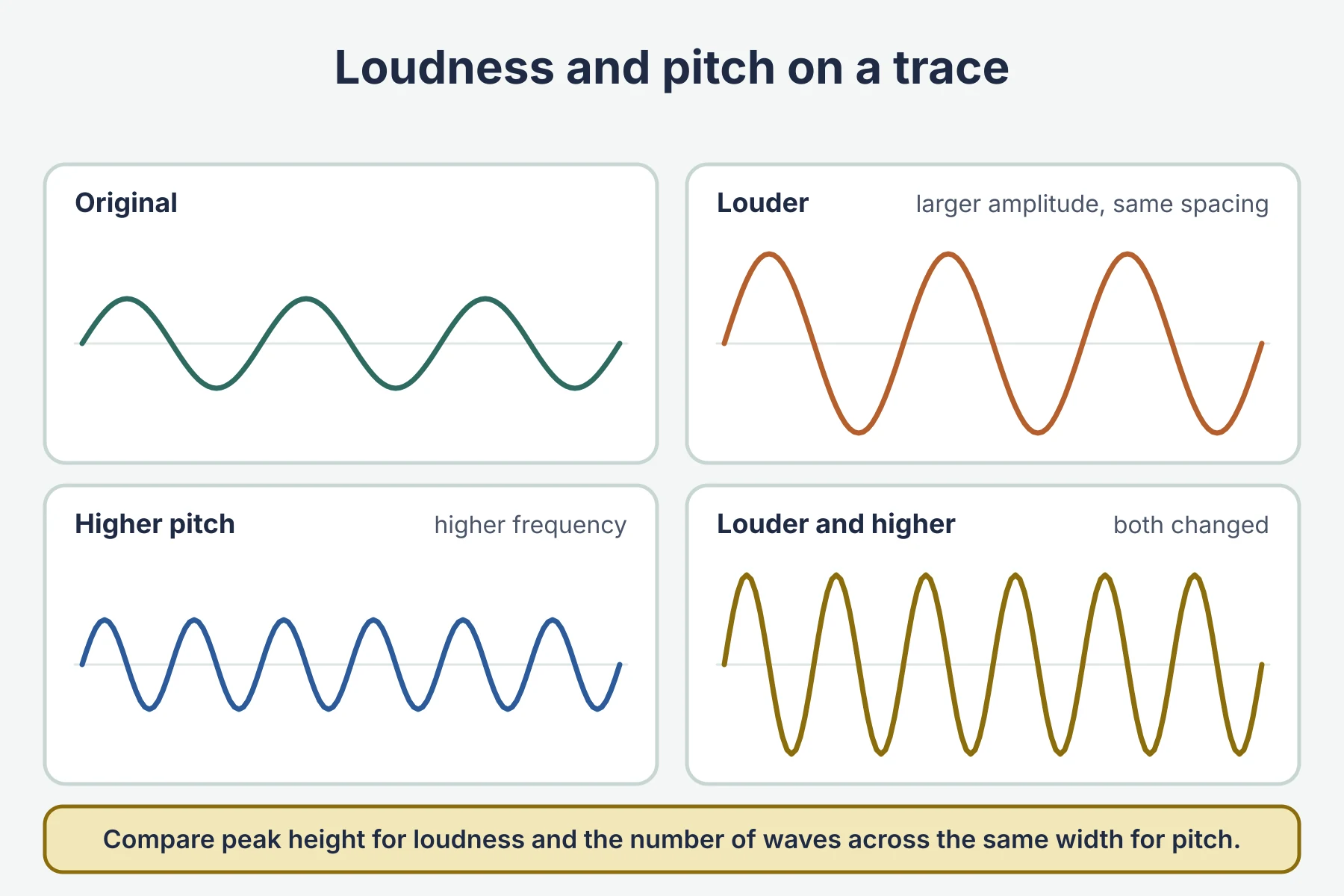
| Larger amplitude | Louder sound | Taller peaks, same spacing |
| Smaller amplitude | Quieter sound | Shorter peaks |
| Higher frequency | Higher pitch | More waves across the same width |
| Lower frequency | Lower pitch | Fewer, more widely spaced waves |
Amplitude and frequency are independent: a sound can be loud and low, or quiet and high. When comparing two traces drawn on the same scales, compare peak height for loudness and the number of complete waves for pitch. Plucking a guitar string harder increases the amplitude (louder) but not the frequency; shortening or tightening the string increases the frequency (higher pitch).
Measuring the speed of sound in air
The syllabus asks for a method that measures a distance and a time. Two standard versions:
Method 1: two observers. Observer A stands at least 100 m away from observer B, in an open space, with the distance measured using a long tape or trundle wheel. A makes a sound that can also be seen, such as banging two blocks together above the head or firing a starting pistol. B starts a stopwatch on seeing the action (light arrives almost instantly) and stops it on hearing the sound. Speed = distance / time. Repeat several times and average, then swap positions to cancel any effect of wind. A long distance matters because the reaction time is a large fraction of a short time.
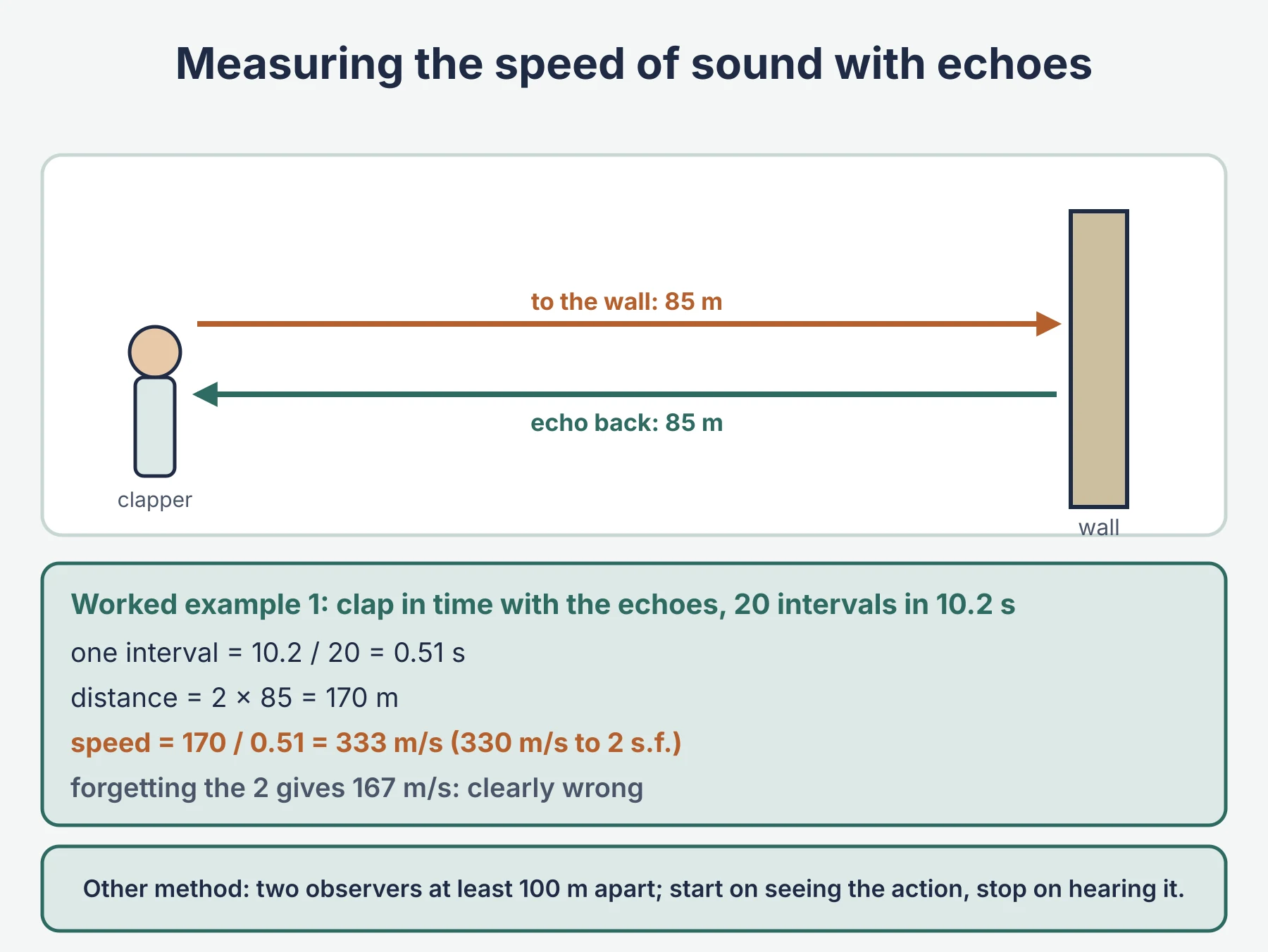
Method 2: echoes. Stand a measured distance (for example 85 m) from a large flat wall and clap. An echo is sound reflected from the wall, so the sound travels to the wall and back: total distance = 2 × 85 = 170 m. Single echo times are too short to measure well, so clap in a steady rhythm so that each clap coincides with the echo of the one before, and time many intervals.
Worked example 1
A student 85 m from a wall claps in time with the echoes. Another student times 20 intervals as 10.2 s. Calculate the speed of sound.
time for one interval = 10.2 / 20 = 0.51 s
distance in that time = 2 × 85 = 170 m
speed = 170 / 0.51 = 333 m/s   (330 m/s to 2 s.f.)
The answer lies in the expected range of 330–350 m/s, which is a useful check. Forgetting the factor of 2 gives 167 m/s, which should immediately look wrong.
Uses of ultrasound (Extended only)
All three uses work the same way: a short pulse of ultrasound is sent out, part of it reflects from a boundary, and the time for the echo to return is measured. Then:
distance to the boundary = (speed × time) ÷ 2
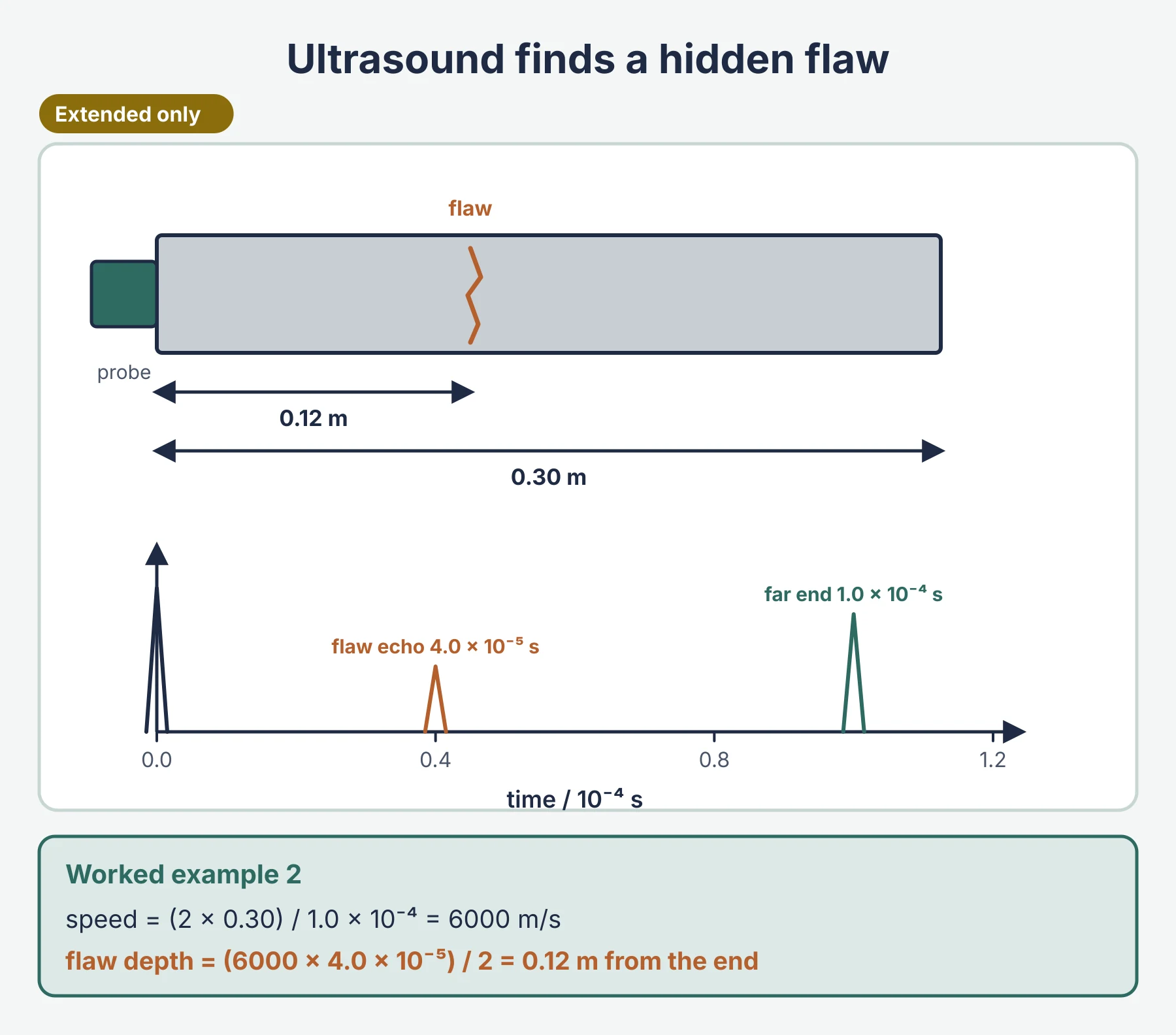
- Non-destructive testing: a pulse is sent into a metal part. The far side returns an echo; a crack or hollow inside returns an extra, earlier echo. The part is checked without being cut or damaged.
- Medical scanning of soft tissue: pulses partly reflect at each boundary between tissues, and the echo times are used to build an image, for example of a fetus.
- Sonar: a ship sends pulses down and times echoes from the sea bed or a shoal of fish.
Worked example 2 (Extended)
A steel rail section is 0.30 m long. An ultrasound pulse sent in at one end returns from the far end after 1.0 × 10⁻⁴ s. A second, smaller echo returns after 4.0 × 10⁻⁵ s. Find the speed of sound in the steel and the depth of the flaw.
speed = (2 × 0.30) / 1.0 × 10⁻⁴ = 6000 m/s
flaw depth = (6000 × 4.0 × 10⁻⁵) / 2 = 0.12 m from the end
Ultrasound is used for these tasks because its short wavelength gives detailed reflections and, in medicine, because it is not ionising.
Common mistakes
- Calling sound transverse, or saying the air particles travel from the source to the ear.
- Forgetting the factor of 2 for echoes.
- Using a short distance (a few metres) in the two-observer method.
- Linking loudness to frequency, or pitch to amplitude.
- Saying ultrasound is “not sound” or that it is an electromagnetic wave.
- Saying sound travels faster in air than in water.
Exam technique
- Describe a method: name the apparatus, what is measured (distance and time), how, and the calculation. Add one improvement such as repeats or a larger distance.
- Explain why sound cannot cross a vacuum: link it to particles passing on the vibration.
- Calculate: write speed = distance / time, decide whether the distance is there and back, and include units.
- Compare two traces: comment on both amplitude and frequency, with the effect on loudness and pitch.
Condense this with the Sound revision notes and practise with the Sound practice questions. The previous subtopic is the electromagnetic spectrum; Topic 4 starts with simple phenomena of magnetism.
Official syllabus
Cambridge International, Cambridge IGCSE Physics 0625 syllabus for examination in 2026, 2027 and 2028, Topic 3 Waves, section 3.4 Sound.
Related resources
-
Practice questions
Cambridge IGCSE Physics (0625): Sound – Practice Questions
Thirteen original Cambridge IGCSE Physics 0625 sound questions: vibrations, pitch and loudness, speed of sound experiments, echoes and ultrasound, with answers.
Physics · Cambridge · IGCSE
Try questions -
Revision notes
Cambridge IGCSE Physics (0625): Sound – Revision Notes
Revision notes for Cambridge IGCSE Physics 0625 section 3.4 Sound: longitudinal waves, audible range, speed of sound, echoes, ultrasound and a self-test.
Physics · Cambridge · IGCSE
Revise topic -
Study guides
IGCSE Physics: Waves (Cambridge 0625)
Cambridge IGCSE Physics 0625 Topic 3 Waves guide for 2026-2028: wave properties, reflection, refraction, thin lenses, the electromagnetic spectrum and sound.
Physics · Cambridge · IGCSE
Read guide
Related articles
Get free revision emails (optional)
Occasional emails with practice questions, worked explanations and links to free resources for the qualification and subjects you choose. No spam, and you can unsubscribe from any email. The free tools on this site never need an email.