
Revision Notes
Cambridge IGCSE Physics (0625): Electromagnetic spectrum – Revision Notes
Revision notes for Cambridge IGCSE Physics 0625 section 3.3: spectrum order, uses and hazards, satellites, digital versus analogue signals, plus a self-test.
- Subject
- Physics
- Level
- IGCSE
- Topic
- Waves
- Author
- Marlbridge Academic Team
- Updated
- Reviewed by
- Iftikhar Azeemi (what this means)
Aligned to Cambridge IGCSE Physics (0625), For examination in 2026, 2027 and 2028. Official specification .
Syllabus page (what it covers and how it is assessed): Cambridge IGCSE Physics.
Syllabus points this page covers, with Core and Extended
0625
- 3.3 Electromagnetic spectrum · Core and Extended
"Core and Extended" means part of that syllabus point is Extended only. The page's own tier notes say which part.
Found an error? Report a correction.
Need help with this topic? Request a free trial class for IGCSE Physics (0625).
These notes condense section 3.3 Electromagnetic spectrum of the Cambridge IGCSE Physics 0625 syllabus (for examination in 2026, 2027 and 2028). Lines marked Extended only are Supplement content, examined on Papers 2 and 4. For explanations and worked examples, read the electromagnetic spectrum study guide.
The order
| Region | Frequency | Wavelength |
|---|---|---|
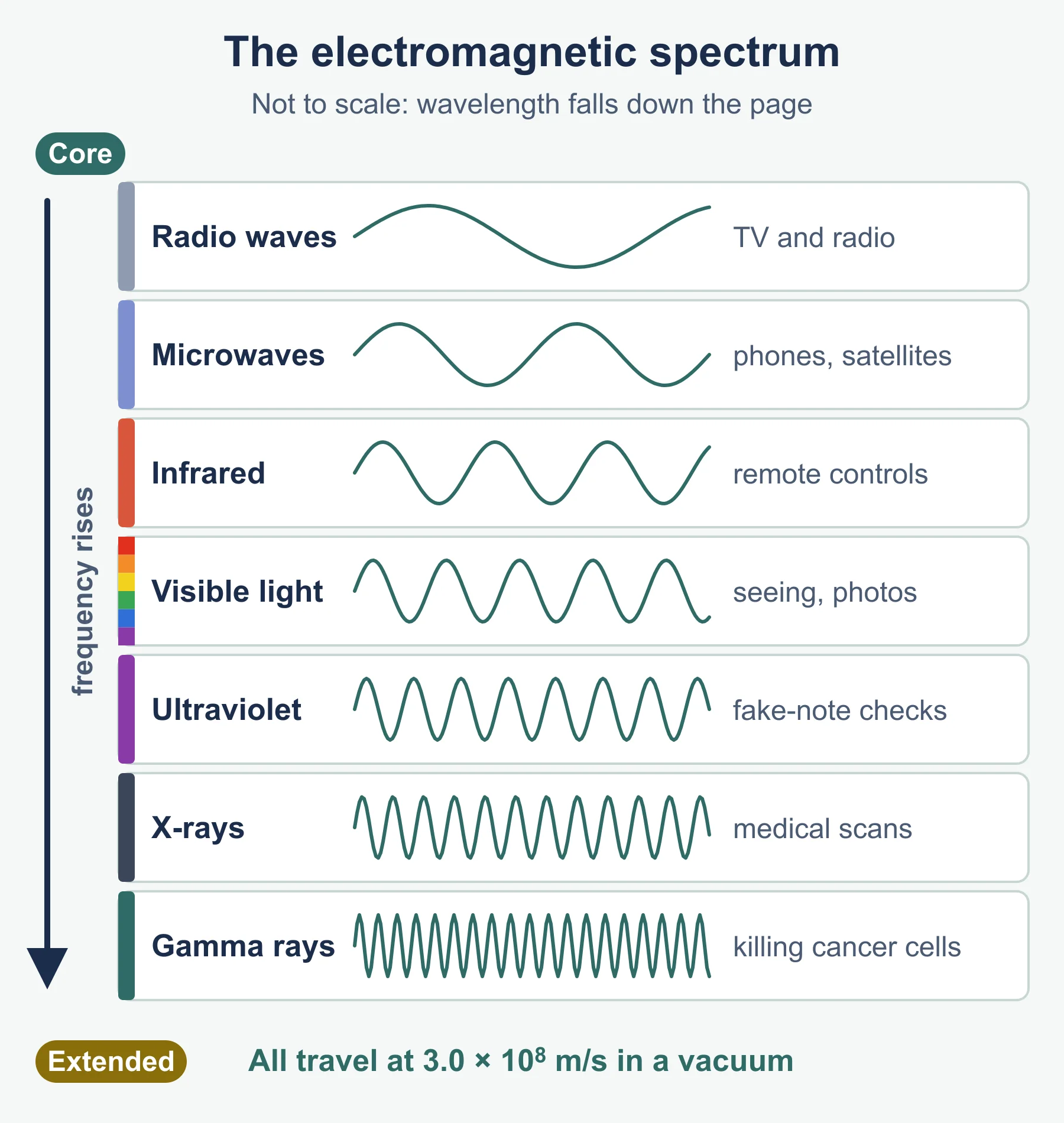
| Radio waves | lowest | longest |
| Microwaves | ↑ | ↓ |
| Infrared | ↑ | ↓ |
| Visible light (red → violet) | ↑ | ↓ |
| Ultraviolet | ↑ | ↓ |
| X-rays | ↑ | ↓ |
| Gamma rays | highest | shortest |
- Asked for increasing wavelength? Start at gamma rays.
- All regions are transverse and travel at the same speed in a vacuum.
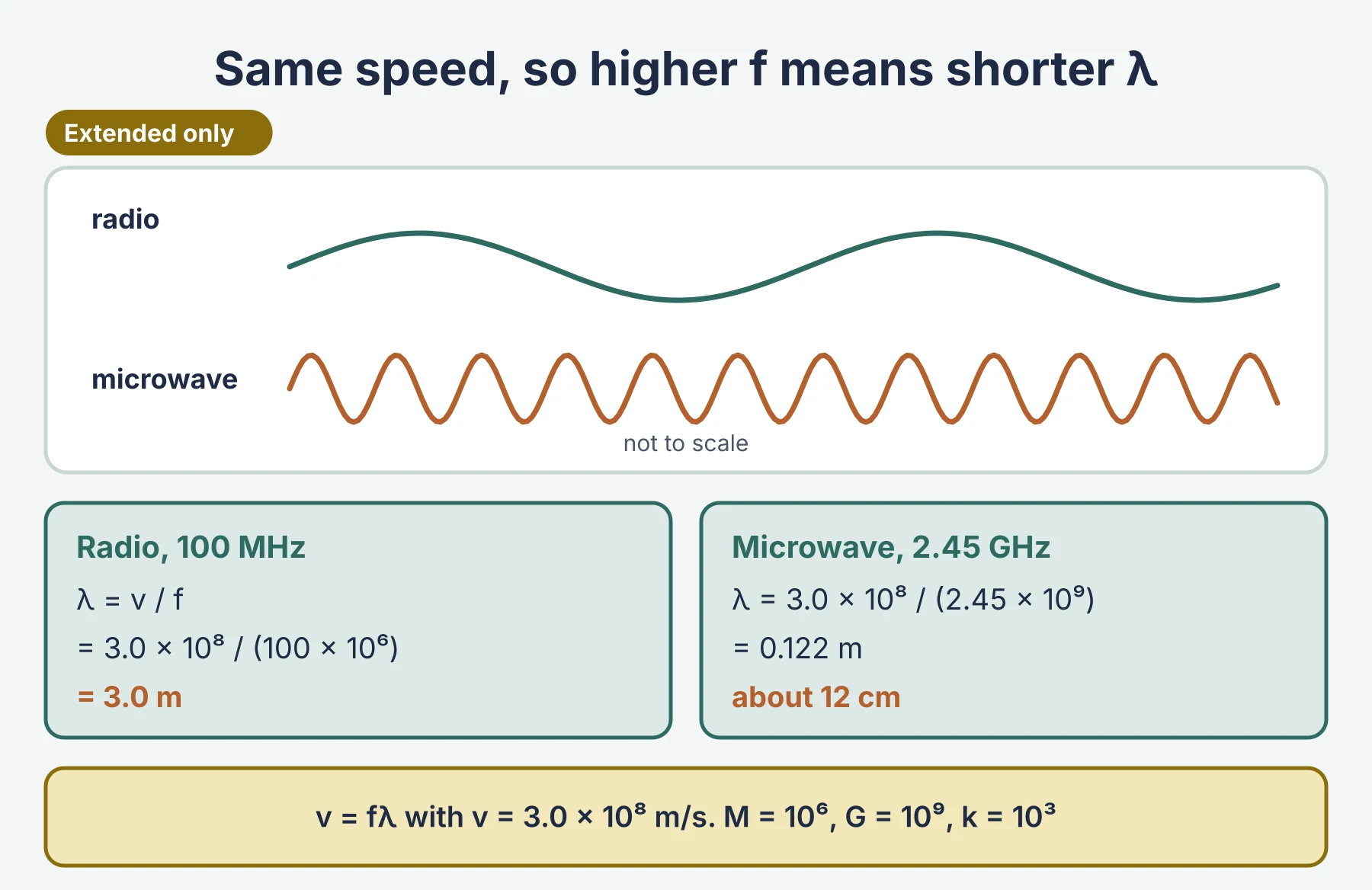
- Extended only: that speed is 3.0 × 10⁸ m/s, about the same in air.
- Same speed, so higher frequency means shorter wavelength: v = fλ.
- Prefixes: k = 10³, M = 10⁶, G = 10⁹.
Uses (Core)
| Region | Uses named in the syllabus | Property behind it |
|---|---|---|
| Radio | Radio and television transmissions, astronomy, RFID | Long range; detected without contact |
| Microwaves | Satellite television, mobile phones, microwave ovens | Absorbed by water (heating); carry signals |
| Infrared | Electric grills, remote controllers, intruder alarms, thermal imaging, optical fibres | Emitted by warm objects; heats |
| Visible | Vision, photography, illumination | Detected by eyes and cameras |
| Ultraviolet | Security marking, detecting fake bank notes, sterilising water | Makes some materials glow; kills microorganisms |
| X-rays | Medical scanning, security scanners | Pass through soft tissue, absorbed by bone and metal |
| Gamma | Sterilising food and medical equipment, detecting and treating cancer | Very penetrating; kills cells |
Hazards (Core)
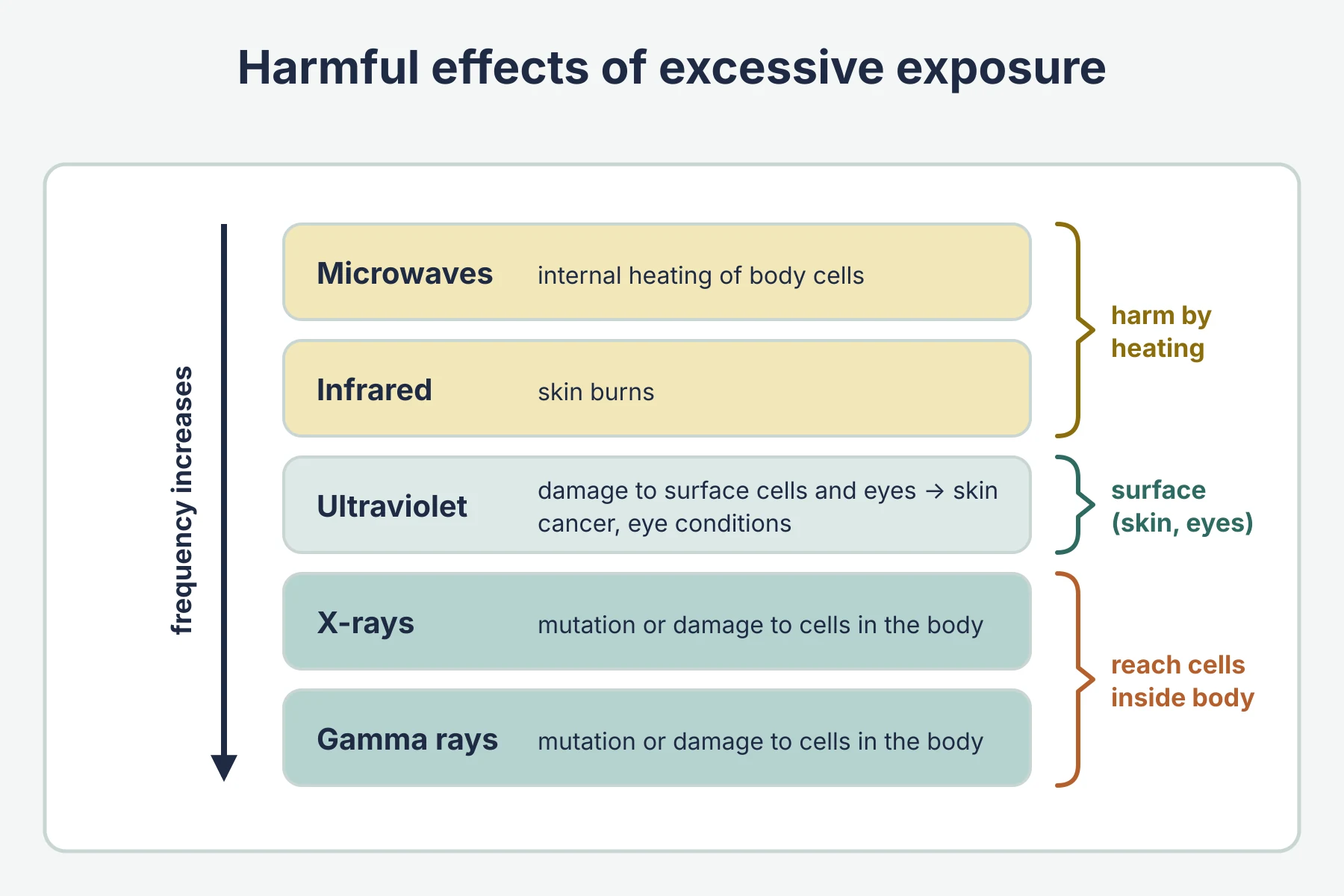
- Microwaves: internal heating of body cells.
- Infrared: skin burns.
- Ultraviolet: damage to surface cells and eyes, leading to skin cancer and eye conditions.
- X-rays and gamma rays: mutation or damage to cells in the body.
- Radio waves and visible light: no harmful effect is named in the syllabus.
Satellites (Core)
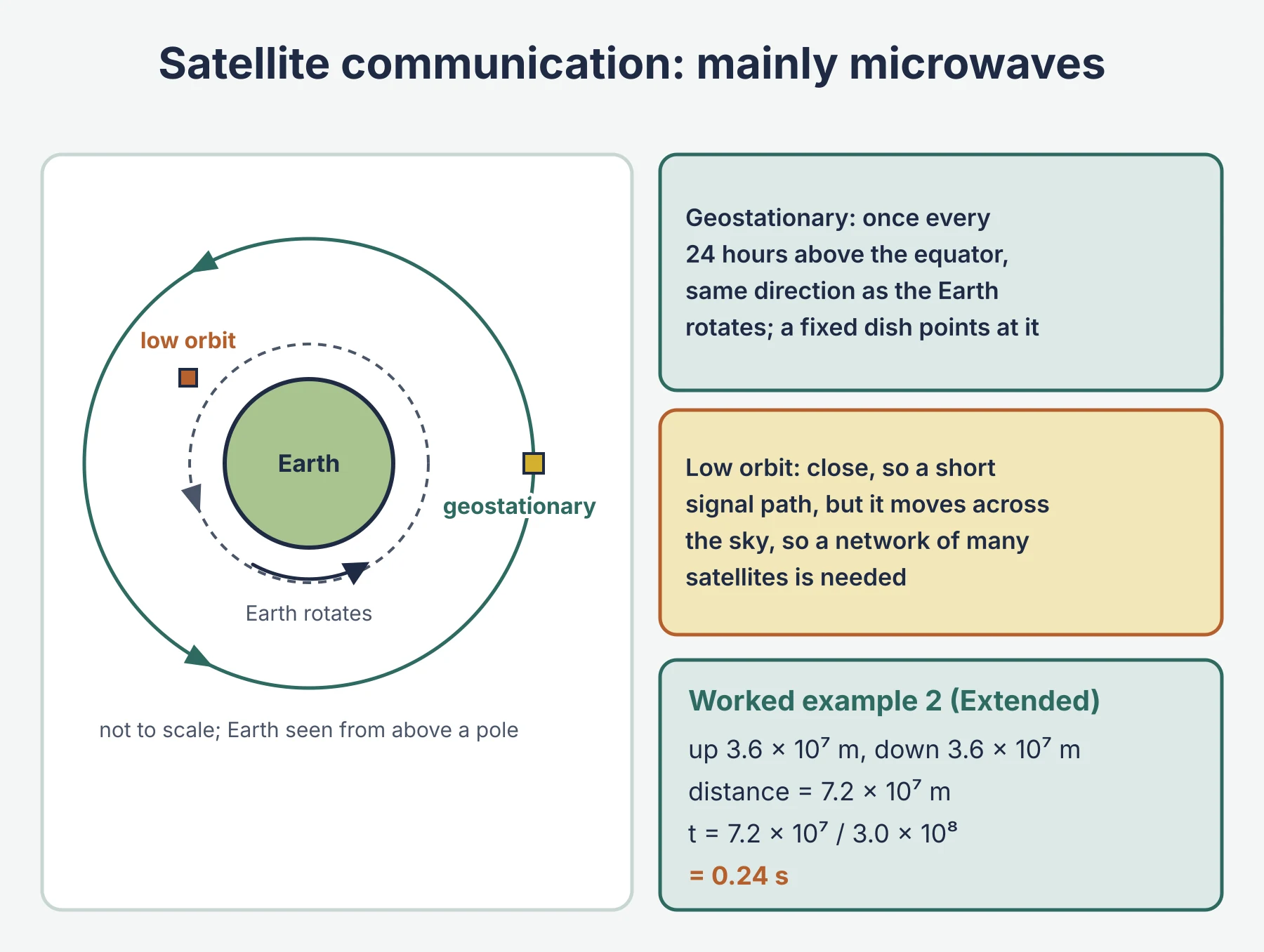
- Communication with artificial satellites is mainly by microwaves.
- Low orbit satellites: used by some satellite phones; close, so short signal paths; move across the sky, so many are needed.
- Geostationary satellites: used by some satellite phones and direct broadcast satellite television; orbit once in 24 hours above the equator, so they stay above one point and a fixed dish can be used.
Communication systems (Extended only)
- Mobile phones and wireless internet: microwaves, which penetrate some walls and need only a short aerial.
- Bluetooth: radio waves, which pass through walls but are weakened in doing so.
- Optical fibres (cable television, high-speed broadband): visible light or infrared, because glass is transparent to them and they carry high data rates.
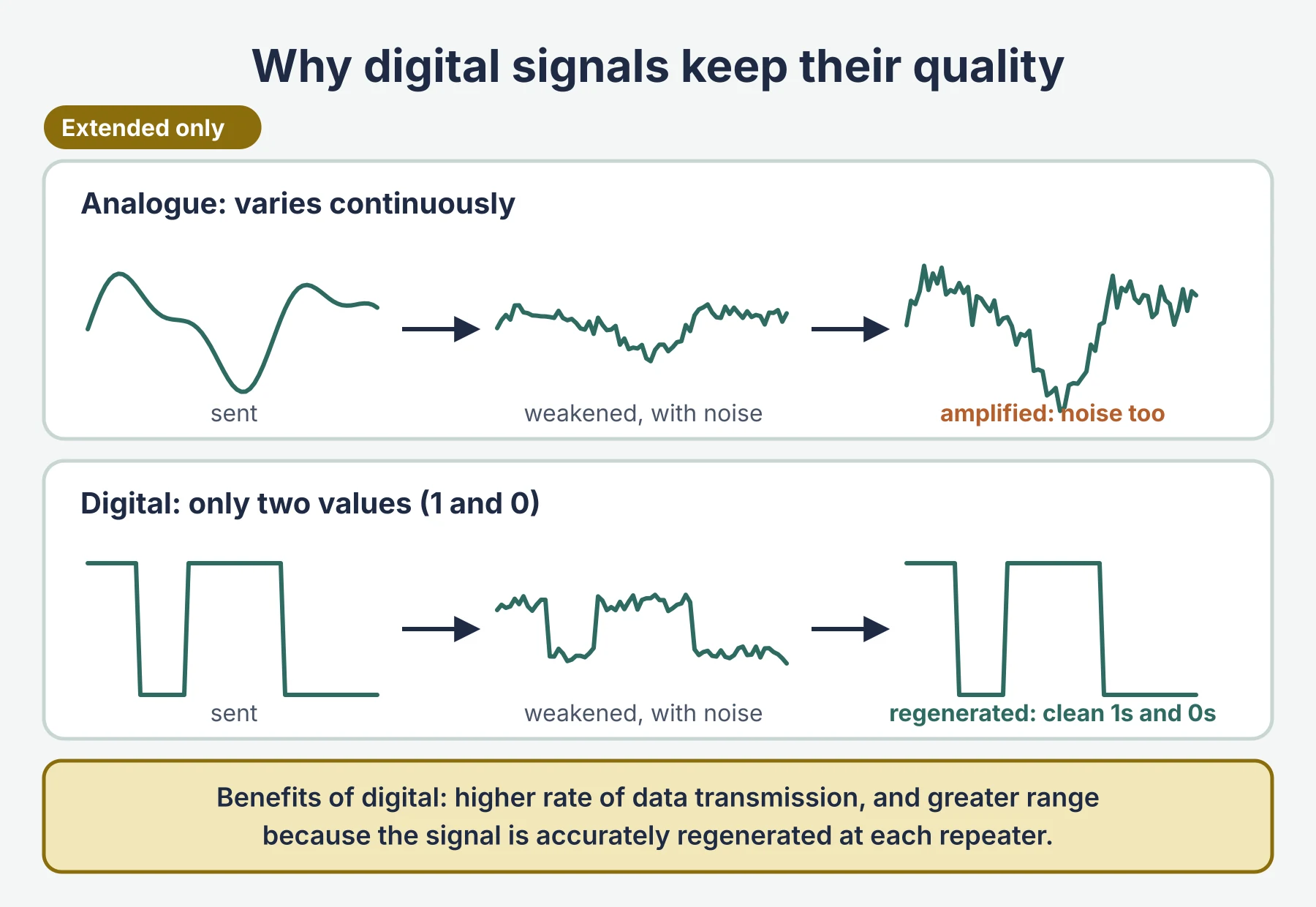
Digital and analogue (Extended only)
| Analogue | Digital | |
|---|---|---|
| Values | Any value in a continuous range | A few set values, usually two (0 and 1) |
| Noise over distance | Amplified along with the signal | Removed when the signal is regenerated |
| Data rate | Lower | Higher |
- A sound can be sent as either an analogue or a digital signal.
- Benefits of digital: increased rate of data transmission; increased range due to accurate signal regeneration.
Key terms
| Term | Meaning |
|---|---|
| Electromagnetic spectrum | The family of transverse waves from radio to gamma, all with the same speed in a vacuum |
| RFID | Radio frequency identification: tags read using radio waves |
| Geostationary satellite | Stays above the same point on the Earth’s surface |
| Low orbit satellite | Orbits close to the Earth and moves across the sky |
| Analogue signal (Extended only) | Varies continuously |
| Digital signal (Extended only) | Takes only a few discrete values |
| Regeneration (Extended only) | Restoring a weakened, noisy digital signal to its exact original values |
Exam traps
- Infrared is below visible light in frequency; ultraviolet is above it.
- “Gamma rays are faster” is wrong: every region has the same speed in a vacuum.
- The microwave hazard is internal heating, not cancer.
- The ultraviolet hazard is to surface cells and eyes.
- Satellites communicate mainly by microwaves, not radio waves.
- Bluetooth’s reason includes the weakening through walls.
- “Digital is better quality” is too vague; name regeneration or data rate.
Self-test
- Name the region between microwaves and visible light.
- List the regions in order of increasing wavelength.
- State how the speed of X-rays in a vacuum compares with that of radio waves.
- Give one use of ultraviolet radiation and one of its harmful effects.
- Why are X-rays used for scanning bones?
- State the region used for thermal imaging.
- State why a geostationary satellite suits satellite television.
- (Extended) State the speed of electromagnetic waves in a vacuum.
- (Extended) Find the wavelength of a 2.4 GHz Wi-Fi signal.
- (Extended) Find the frequency of X-rays of wavelength 1.0 × 10⁻¹⁰ m.
- (Extended) Why does Bluetooth use radio waves?
- (Extended) Give two benefits of digital signalling.
Answers
- Infrared.
- Gamma rays, X-rays, ultraviolet, visible light, infrared, microwaves, radio waves.
- The same.
- Security marking, detecting fake bank notes or sterilising water; damage to surface cells and eyes (skin cancer, eye conditions).
- They pass through soft tissue but are absorbed by bone.
- Infrared.
- It stays above the same point on the Earth, so a fixed dish can point at it.
- 3.0 × 10⁸ m/s.
- λ = 3.0 × 10⁸ ÷ 2.4 × 10⁹ = 0.125 m (12.5 cm).
- f = 3.0 × 10⁸ ÷ 1.0 × 10⁻¹⁰ = 3.0 × 10¹⁸ Hz.
- Radio waves pass through walls, but the signal is weakened, which suits short-range links.
- Higher data rate; greater range because the signal can be regenerated accurately.
Official syllabus
Cambridge International, Cambridge IGCSE Physics 0625 syllabus for examination in 2026, 2027 and 2028, Topic 3 Waves, section 3.3 Electromagnetic spectrum. Test yourself with the electromagnetic spectrum practice questions.
Related resources
-
Study guides
Cambridge IGCSE Physics (0625): General properties of waves
Study guide to Cambridge IGCSE Physics 0625 section 3.1: wave features, v = fλ, transverse and longitudinal waves, reflection, refraction and diffraction.
Physics · Cambridge · IGCSE
Read guide -
Practice questions
Cambridge IGCSE Physics (0625): General properties of waves – Practice Questions
Twelve original Cambridge IGCSE Physics 0625 questions on wave features, v = fλ, wave types, reflection, refraction and diffraction, with full answers.
Physics · Cambridge · IGCSE
Try questions -
Revision notes
Cambridge IGCSE Physics (0625): General properties of waves – Revision Notes
Revision notes for Cambridge IGCSE Physics 0625 section 3.1: wave features, v = fλ, transverse and longitudinal waves, ripple tank behaviours and a self-test.
Physics · Cambridge · IGCSE
Revise topic
Related articles
Get free revision emails (optional)
Occasional emails with practice questions, worked explanations and links to free resources for the qualification and subjects you choose. No spam, and you can unsubscribe from any email. The free tools on this site never need an email.