
Revision Notes
Cambridge IGCSE Physics (0625): General properties of waves – Revision Notes
Revision notes for Cambridge IGCSE Physics 0625 section 3.1: wave features, v = fλ, transverse and longitudinal waves, ripple tank behaviours and a self-test.
- Subject
- Physics
- Level
- IGCSE
- Topic
- Waves
- Author
- Marlbridge Academic Team
- Updated
- Reviewed by
- Iftikhar Azeemi (what this means)
Aligned to Cambridge IGCSE Physics (0625), For examination in 2026, 2027 and 2028. Official specification .
Syllabus page (what it covers and how it is assessed): Cambridge IGCSE Physics.
Syllabus points this page covers, with Core and Extended
0625
- 3.1 General properties of waves · Core and Extended
"Core and Extended" means part of that syllabus point is Extended only. The page's own tier notes say which part.
Found an error? Report a correction.
Need help with this topic? Request a free trial class for IGCSE Physics (0625).
These notes condense section 3.1, General properties of waves, of the Cambridge IGCSE Physics 0625 syllabus for examination in 2026, 2027 and 2028. Supplement content, marked Extended only, is examined on Papers 2 and 4. Worked examples are in the study guide on general properties of waves; the Waves revision notes cover the whole of Topic 3.
Core facts
- Waves transfer energy without transferring matter.
- Wave motion is shown by vibrations in ropes and springs, and by water waves in a ripple tank.
Wave features
| Feature | Definition |
|---|---|
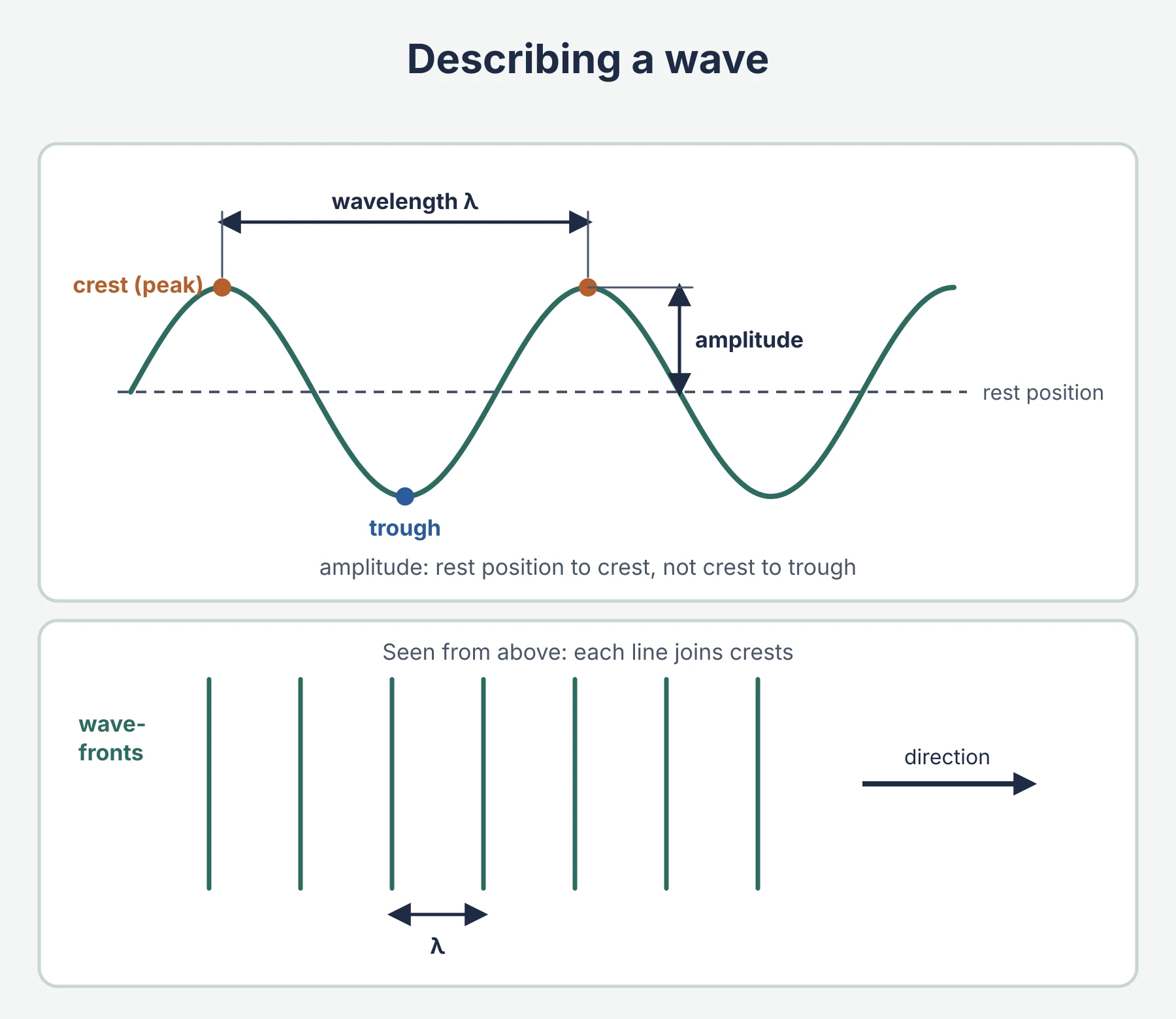
| Wavefront | line joining points on the same part of a wave (e.g. all of one crest) |
| Wavelength λ | distance between neighbouring crests (or neighbouring corresponding points) |
| Amplitude | maximum displacement from the rest position |
| Frequency f | number of waves per second; unit Hz |
| Crest (peak) / trough | highest / lowest points of a transverse wave |
| Wave speed v | distance travelled by the wave per second |
Amplitude is half the crest-to-trough height.
The wave equation
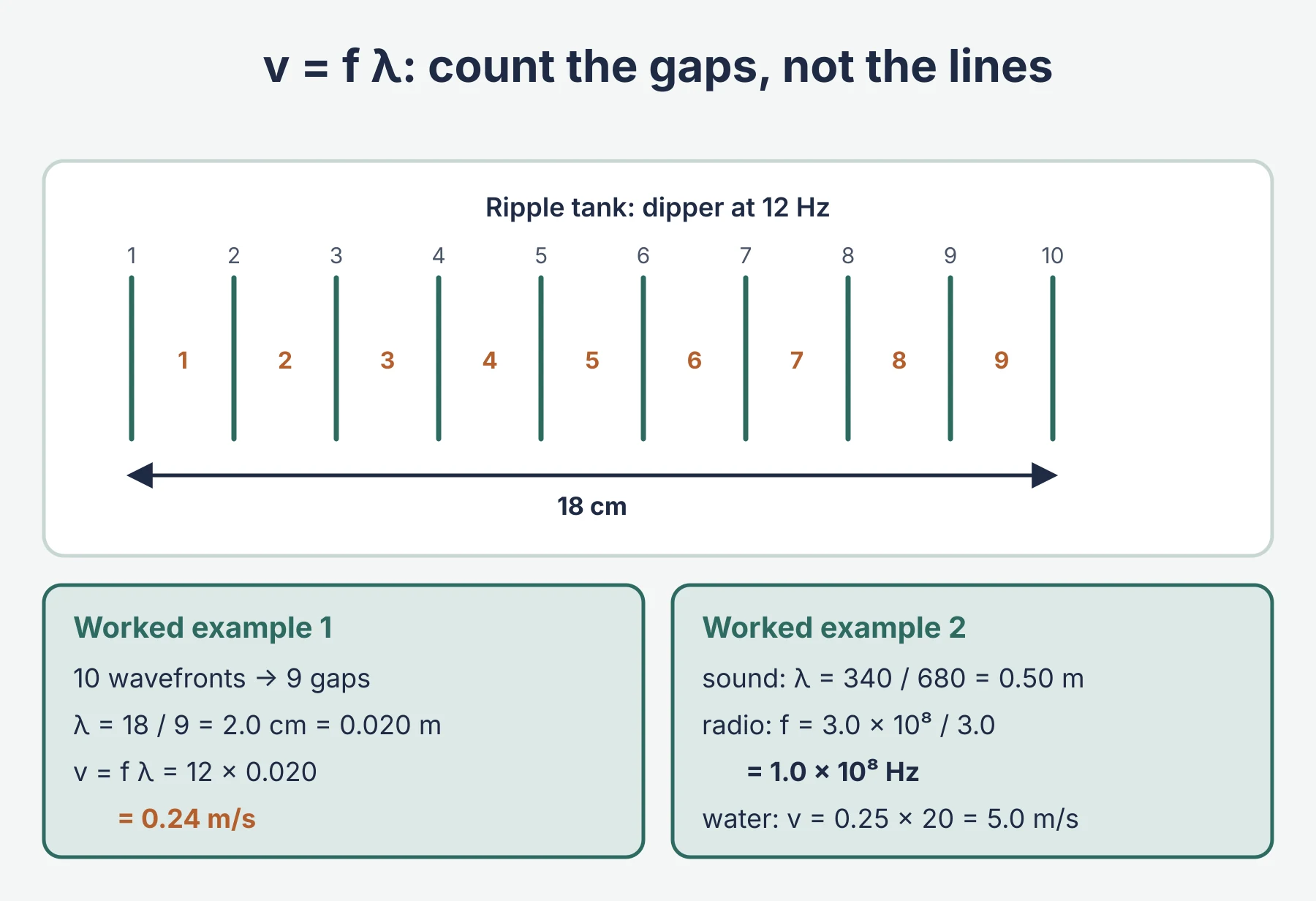
v = f λ (m/s = Hz × m)
| Find | Use |
|---|---|
| v | f × λ |
| f | v ÷ λ |
| λ | v ÷ f |
Prefixes: kHz = 10³ Hz; MHz = 10⁶ Hz; GHz = 10⁹ Hz; cm = 10⁻² m; mm = 10⁻³ m.
Counting: n wavefronts span (n − 1) wavelengths.
Worked reminders
- A boat bobs up and down 15 times in 60 s as waves pass: f = 15 ÷ 60 = 0.25 Hz. If the crests are 8.0 m apart, v = 0.25 × 8.0 = 2.0 m/s.
- A microwave signal has f = 2.4 GHz = 2.4 × 10⁹ Hz: λ = 3.0 × 10⁸ ÷ 2.4 × 10⁹ = 0.125 m (12.5 cm).
- Doubling the frequency of a wave in the same medium (same speed) halves its wavelength.
Two types of wave
| Transverse | Longitudinal | |
|---|---|---|
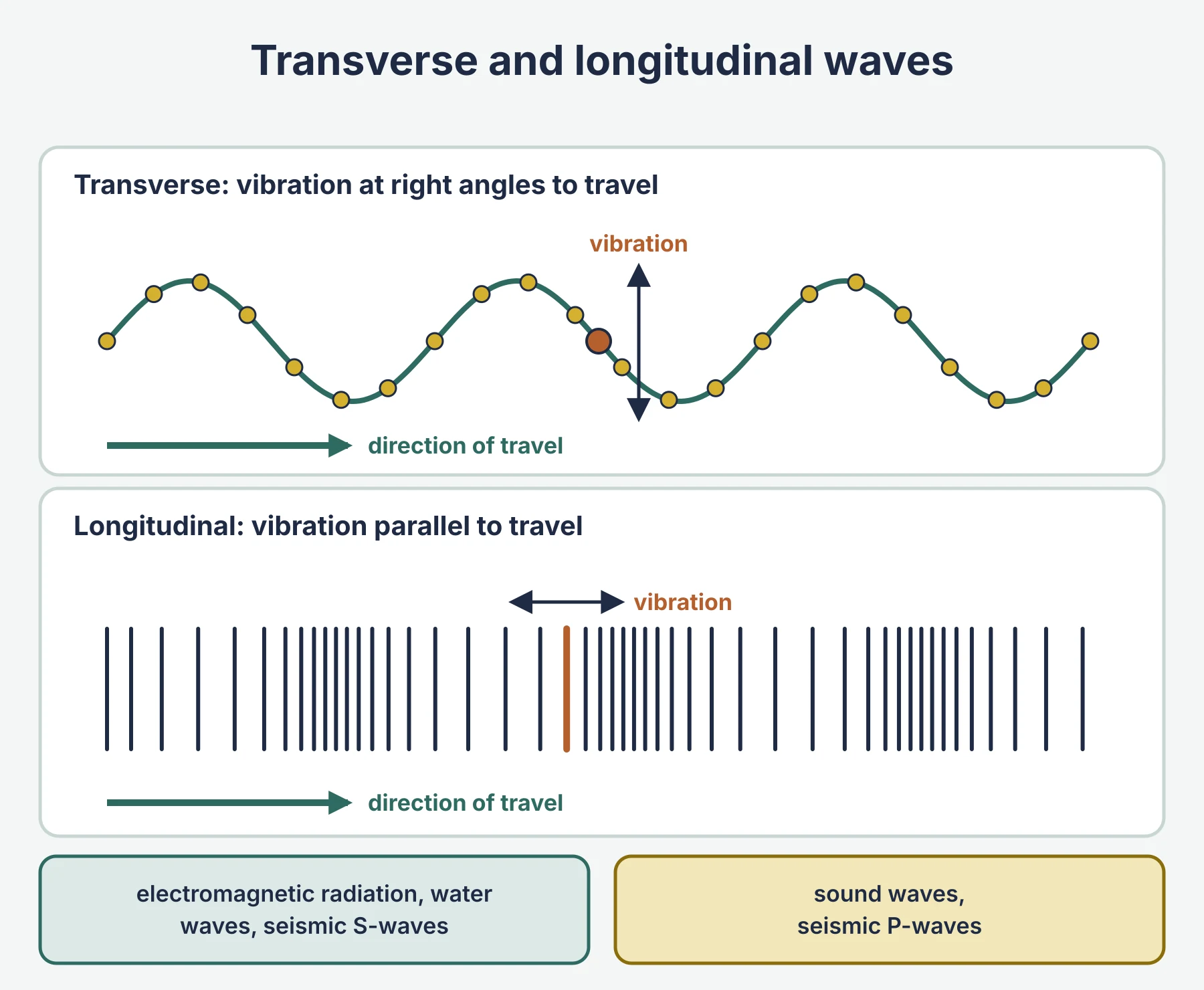
| Vibration | at right angles to propagation | parallel to propagation |
| Examples | electromagnetic radiation, water waves, seismic S-waves | sound, seismic P-waves |
Memory link: P-waves push and pull (longitudinal); S-waves shake sideways (transverse).
Wave behaviours
| Behaviour | Ripple tank set-up | Speed | Wavelength | Frequency | Direction |
|---|---|---|---|---|---|
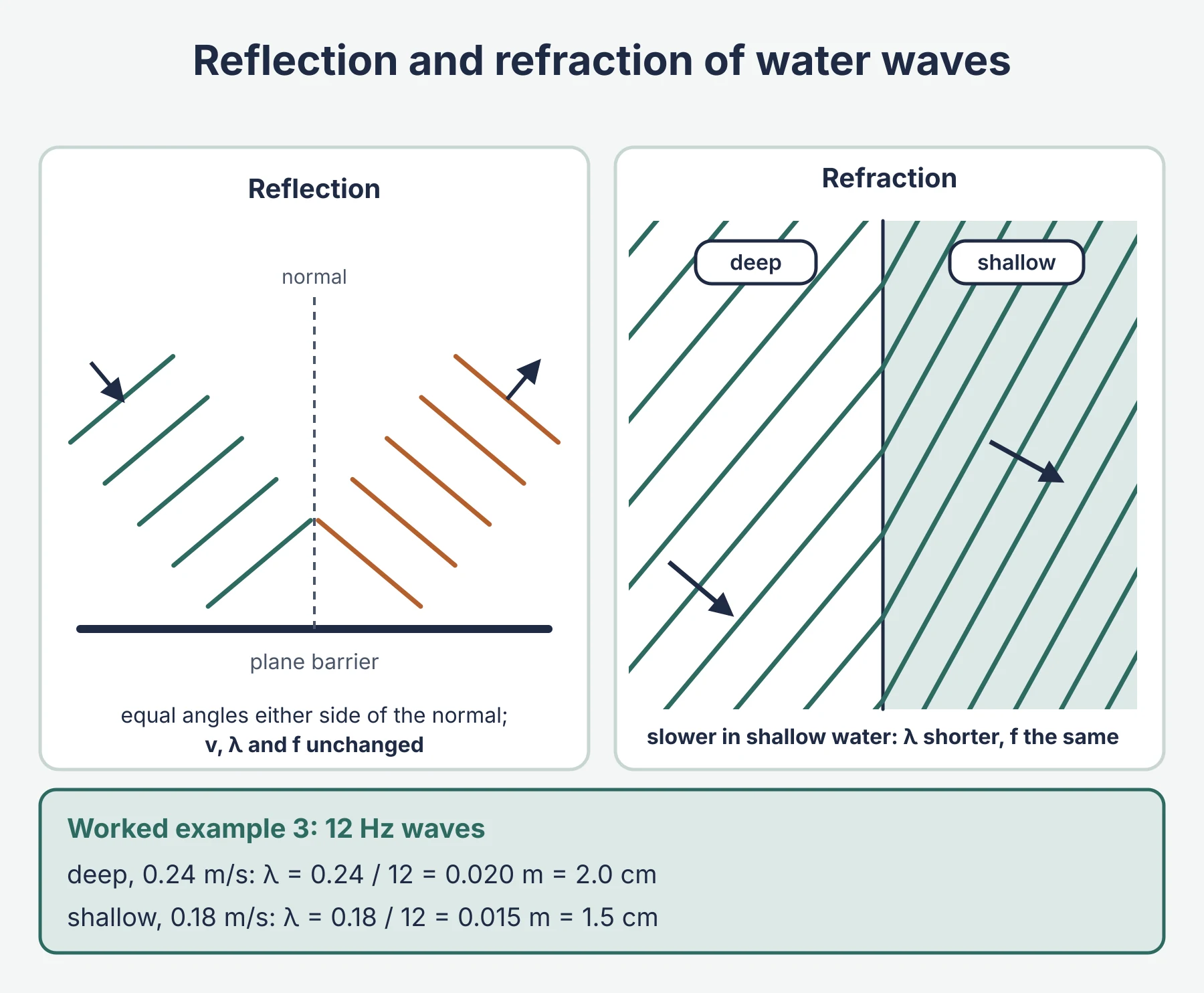
| Reflection | plane (straight) barrier | same | same | same | changes |
| Refraction | glass plate makes water shallower | decreases in shallow water | decreases | same | changes if waves hit the boundary at an angle |
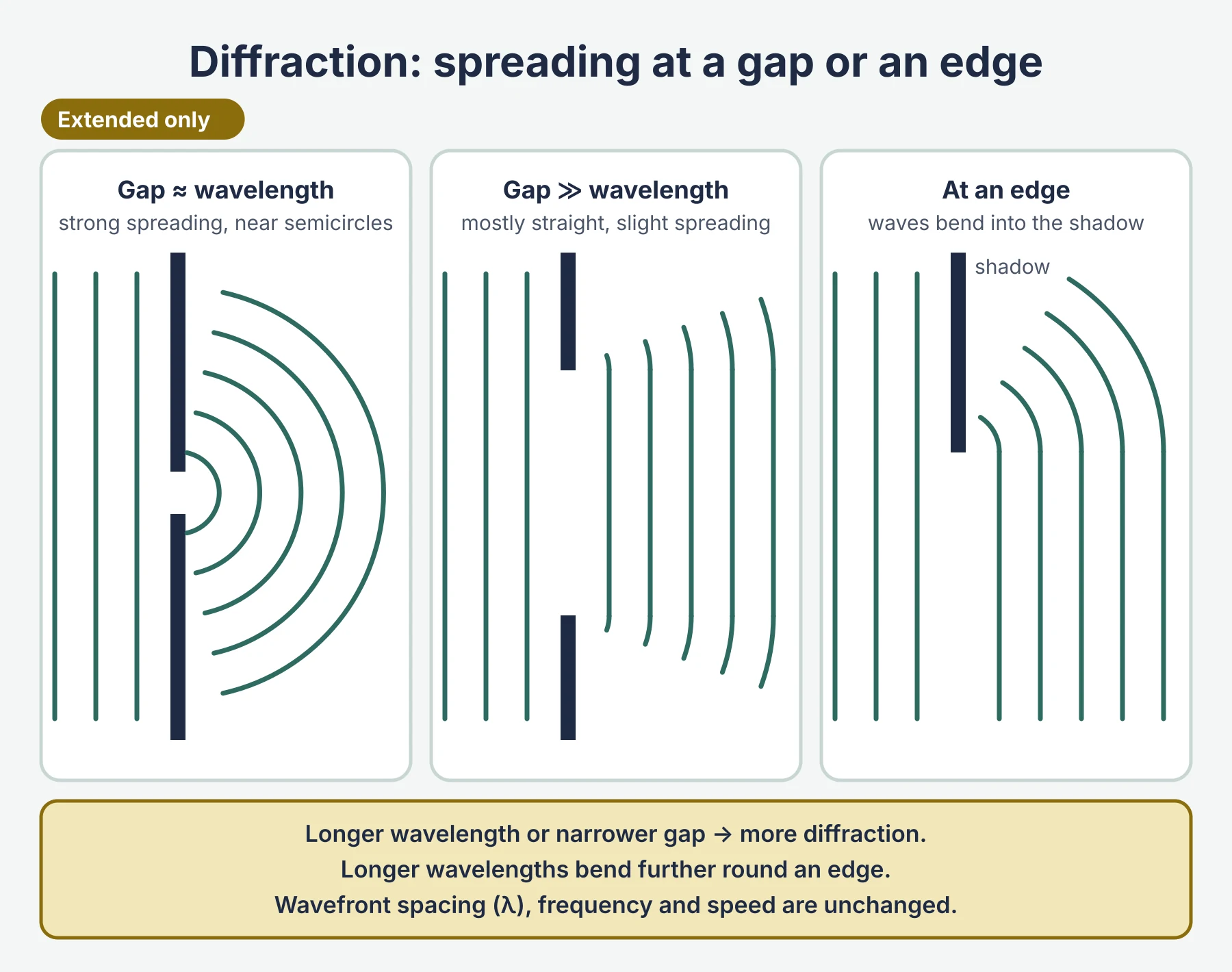
| Diffraction | gap between barriers, or edge of one barrier | same | same | same | waves spread out |
Diffraction details (Extended only)
- Gap ≈ wavelength → strong spreading (nearly semicircular wavefronts).
- Gap ≫ wavelength → little spreading; mostly straight through.
- Longer wavelength or narrower gap → more diffraction.
- At an edge, longer wavelengths bend further into the shadow region.
- Sound diffracts round doorways (wavelength comparable); light does not noticeably (wavelength tiny).
Key terms
| Term | Meaning |
|---|---|
| Propagation | Direction in which the wave travels and carries energy |
| Transverse wave | Vibration at right angles to the direction of propagation |
| Longitudinal wave | Vibration parallel to the direction of propagation |
| Reflection | Waves bouncing off a surface |
| Refraction | Change in direction (and wavelength) caused by a change in speed |
| Diffraction | Spreading of waves through a gap or round an edge |
| Ripple tank | Shallow tank of water with a vibrating dipper and a lamp to project wavefronts |
Exam traps
- Amplitude measured crest to trough: halve it.
- Wavelength from 10 wavefronts: divide by 9, not 10.
- Frequency never changes in refraction; wavelength does.
- Diffraction leaves the wavelength unchanged; keep wavefront spacing equal in drawings.
- Units: λ in m, f in Hz before using v = fλ.
- Sound is longitudinal; light and water waves are transverse.
- (Extended) A wider gap gives less diffraction.
Quick self-test
- State what a wave transfers from place to place.
- Define wavelength.
- A wave has a crest-to-trough height of 8.0 cm. State its amplitude.
- A wave has frequency 50 Hz and wavelength 4.0 m. Find its speed.
- A sound wave travels at 330 m/s with frequency 1.1 kHz. Find its wavelength.
- Twelve wavefronts span 33 cm. Find the wavelength.
- Name two transverse waves and one longitudinal wave.
- In a ripple tank, what happens to the wavelength when waves pass into shallower water?
- What happens to the frequency in question 8?
- Describe how to show diffraction at an edge in a ripple tank.
- (Extended) Waves of wavelength 1.0 cm pass through gaps of 1.0 cm and 10 cm. Which gap gives more diffraction?
- (Extended) Why can you hear, but not see, a person round the corner of a doorway?
Answers
- Energy (not matter).
- The distance between neighbouring crests (or neighbouring corresponding points).
- 4.0 cm.
- 50 × 4.0 = 200 m/s.
- 330 ÷ 1100 = 0.30 m.
- 33 ÷ 11 = 3.0 cm.
- Transverse: any two of light (electromagnetic waves), water waves, S-waves. Longitudinal: sound or P-waves.
- It decreases (waves slow down).
- It stays the same.
- Place a single straight barrier in the tank so that straight waves pass its end; the waves curve round into the region behind it.
- The 1.0 cm gap (same size as the wavelength).
- Sound has a wavelength comparable to the doorway, so it diffracts a lot; light’s wavelength is far smaller, so it barely diffracts.
Where to go next
Try the practice questions on general properties of waves, and use the Waves practice questions for mixed practice across Topic 3.
Related resources
-
Study guides
Cambridge IGCSE Physics (0625): Light
Study guide for Cambridge IGCSE Physics 0625 section 3.2 Light: plane mirrors, refraction, refractive index, thin lenses, ray diagrams and dispersion.
Physics · Cambridge · IGCSE
Read guide -
Practice questions
Cambridge IGCSE Physics (0625): Light – Practice Questions
Thirteen original Cambridge IGCSE Physics 0625 questions on light: mirrors, refraction, refractive index, optical fibres, lenses and dispersion, with answers.
Physics · Cambridge · IGCSE
Try questions -
Revision notes
Cambridge IGCSE Physics (0625): Light – Revision Notes
Revision notes for Cambridge IGCSE Physics 0625 section 3.2 Light: mirror images, refraction rules, refractive index, lens images, dispersion and a self-test.
Physics · Cambridge · IGCSE
Revise topic
Related articles
Get free revision emails (optional)
Occasional emails with practice questions, worked explanations and links to free resources for the qualification and subjects you choose. No spam, and you can unsubscribe from any email. The free tools on this site never need an email.