
Revision Notes
Cambridge IGCSE Physics (0625): Light – Revision Notes
Revision notes for Cambridge IGCSE Physics 0625 section 3.2 Light: mirror images, refraction rules, refractive index, lens images, dispersion and a self-test.
- Subject
- Physics
- Level
- IGCSE
- Topic
- Waves
- Author
- Marlbridge Academic Team
- Updated
- Reviewed by
- Iftikhar Azeemi (what this means)
Aligned to Cambridge IGCSE Physics (0625), For examination in 2026, 2027 and 2028. Official specification .
Syllabus page (what it covers and how it is assessed): Cambridge IGCSE Physics.
Syllabus points this page covers, with Core and Extended
0625
- 3.2 Light · Core and Extended
"Core and Extended" means part of that syllabus point is Extended only. The page's own tier notes say which part.
Found an error? Report a correction.
Need help with this topic? Request a free trial class for IGCSE Physics (0625).
These notes condense section 3.2 Light of the Cambridge IGCSE Physics 0625 syllabus (for examination in 2026, 2027 and 2028). Lines marked Extended only are Supplement content, examined on Papers 2 and 4. For explanations and worked examples, read the Light study guide.
Reflection (3.2.1)
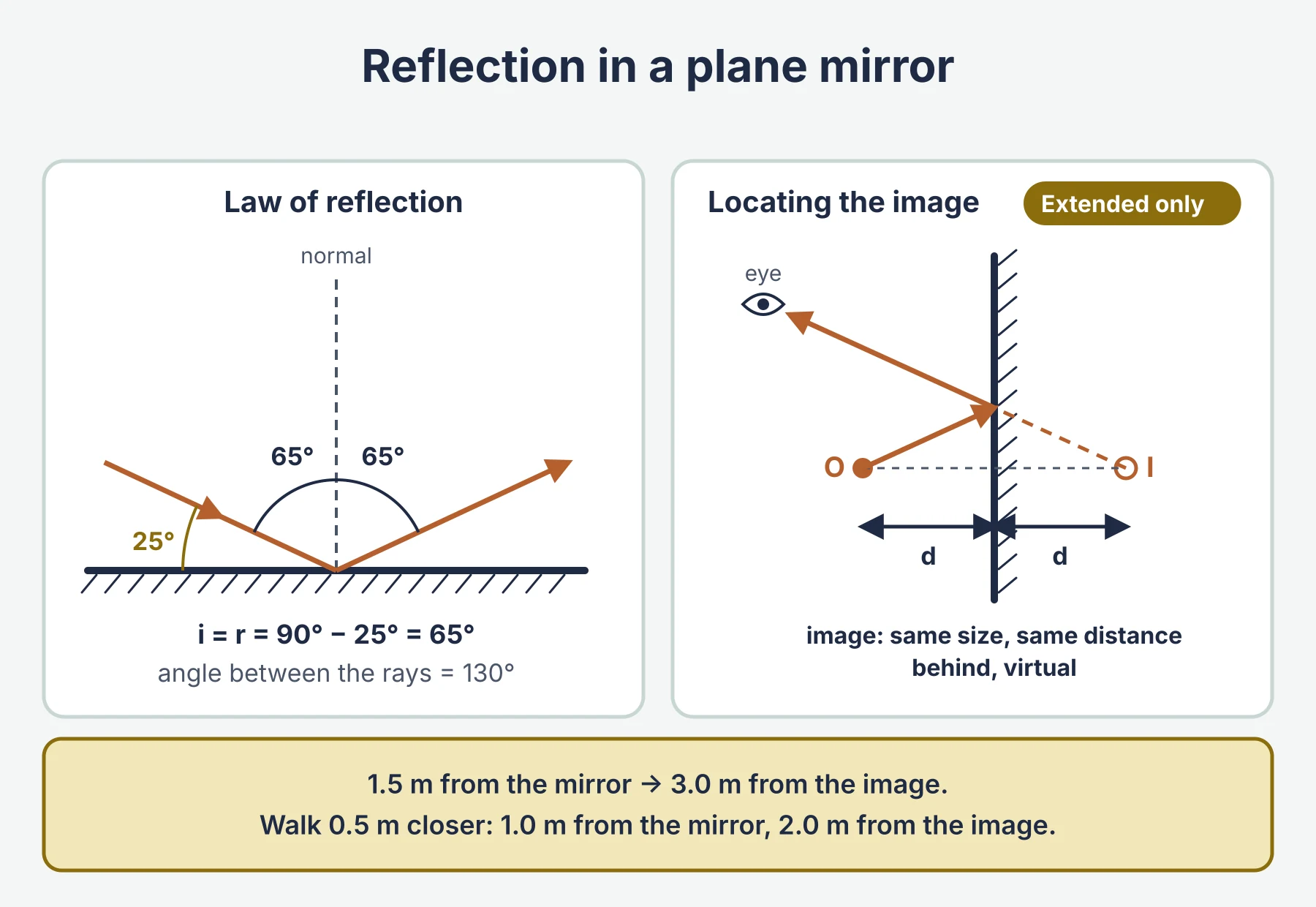
- Normal: line at 90° to the surface at the point where the ray strikes.
- Law of reflection: i = r, both measured from the normal.
- Angle given to the mirror surface? Angle from normal = 90° − that angle.
- Plane-mirror image: same size, same distance behind the mirror, virtual (cannot be projected on a screen), upright.
- Distance from object to its image = 2 × distance from object to mirror.
- Extended only: construct the image by drawing a perpendicular from the object to the mirror and marking the image the same distance behind; join image to eye with a dashed line behind the mirror and a solid line in front.
Refraction (3.2.2)
- Refraction is caused by a change of speed at a boundary.
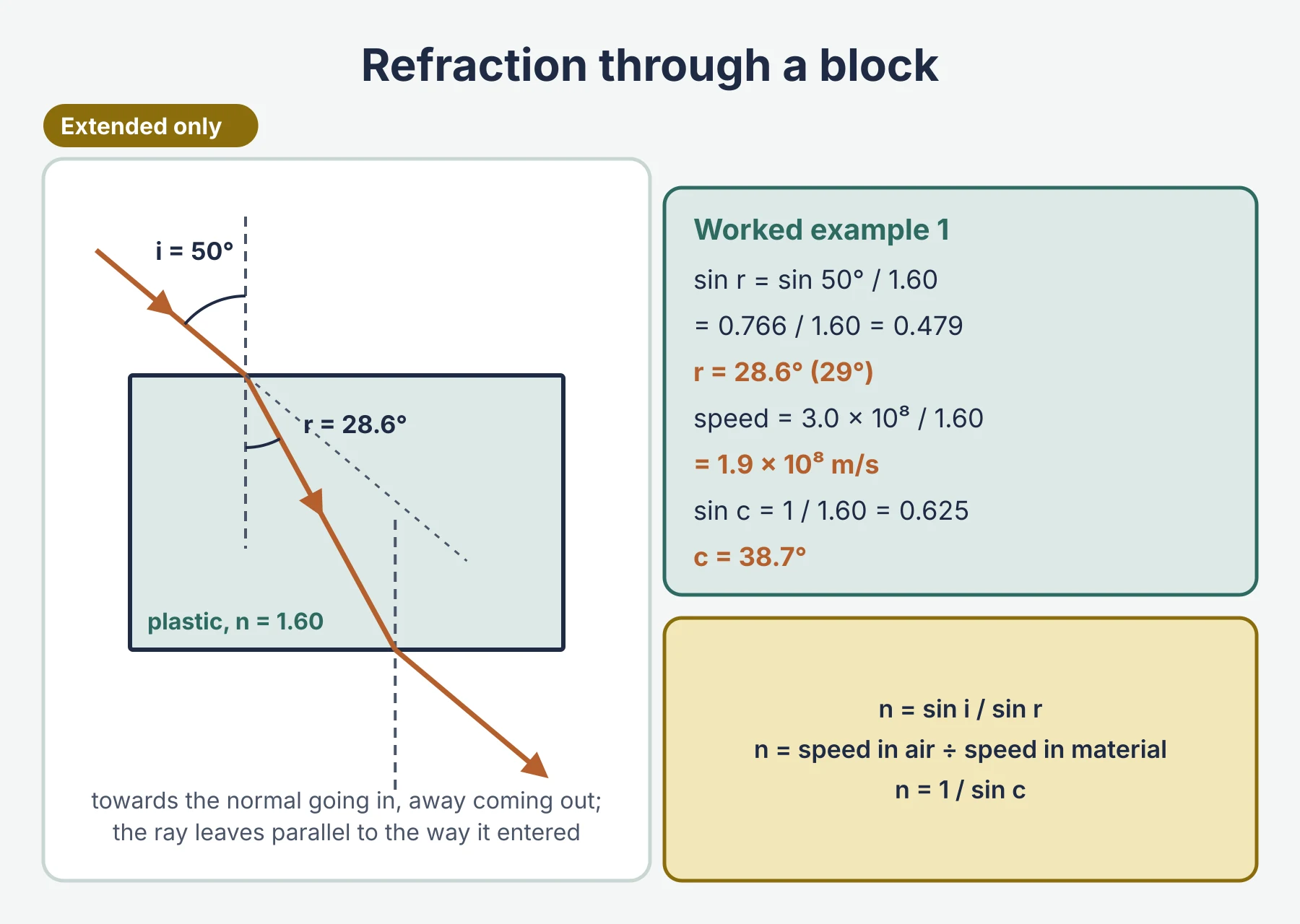
- Into a slower material (air → glass): bends towards the normal.
- Into a faster material (glass → air): bends away from the normal.
- Along the normal: speed changes, direction does not.
- Parallel-sided block: emerging ray is parallel to the incident ray, displaced sideways.
- Experiment: trace a ray-box ray through rectangular, triangular and semicircular blocks; mark rays with crosses; draw normals; measure angles with a protractor.
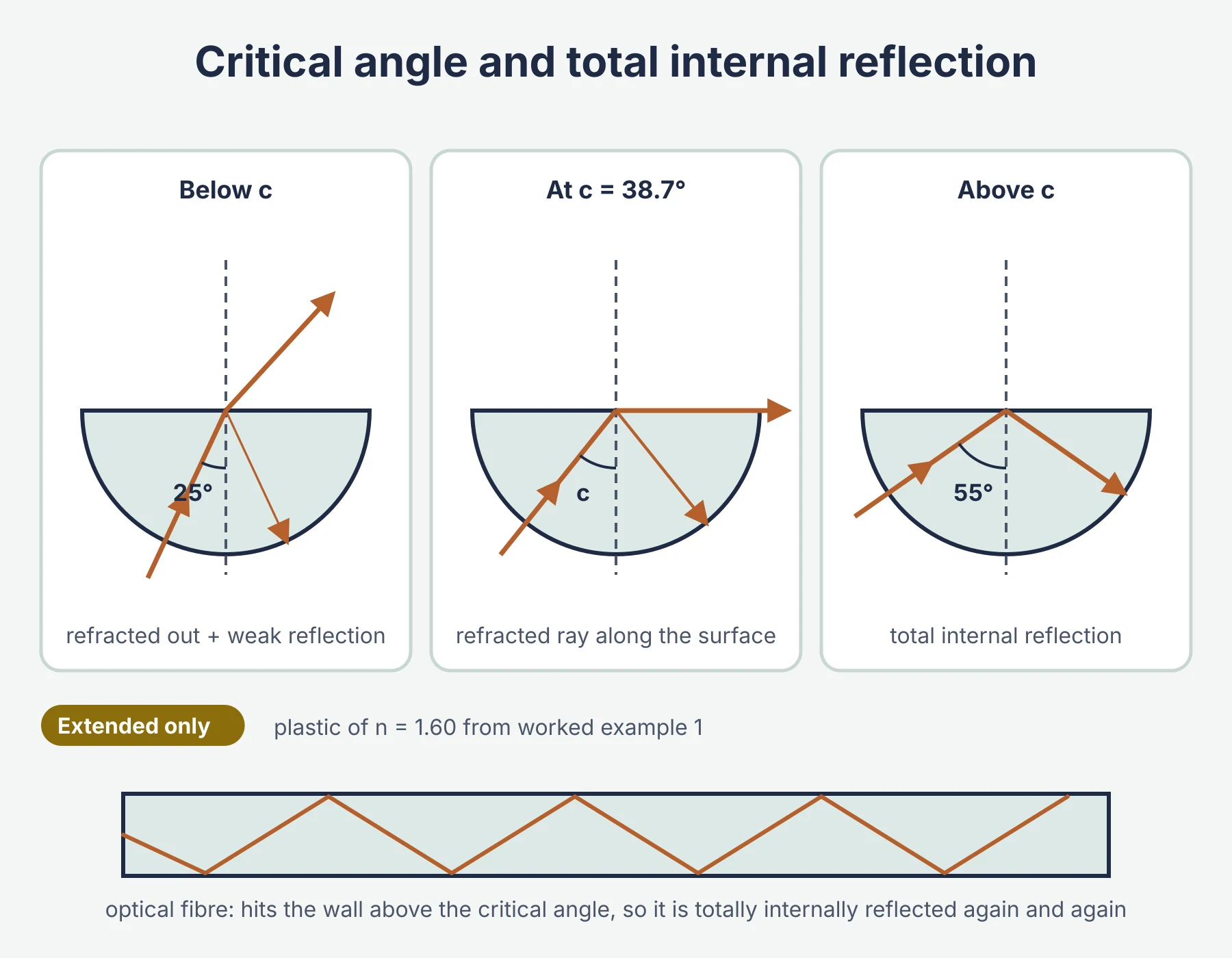
- Critical angle: angle of incidence in the denser material at which the angle of refraction is 90°.
- Total internal reflection (TIR): above the critical angle all light reflects back inside; no refracted ray.
- Conditions for TIR: light in the denser (slower) material and i greater than c.
- Everyday examples: optical fibres, endoscopes, prisms in periscopes and binoculars.
Extended only
| Equation | Use it when you know |
|---|---|
| n = speed in air ÷ speed in material | the two speeds |
| n = sin i / sin r | angles in air (i) and in the material (r) |
| n = 1 / sin c | the critical angle |
- n is greater than 1 for light entering a material from air. Larger n: more bending, smaller c, slower light.
- Optical fibres: light hits the fibre wall at more than c and is totally internally reflected along it; used to carry telecommunications signals as light pulses.
Thin lenses (3.2.3)
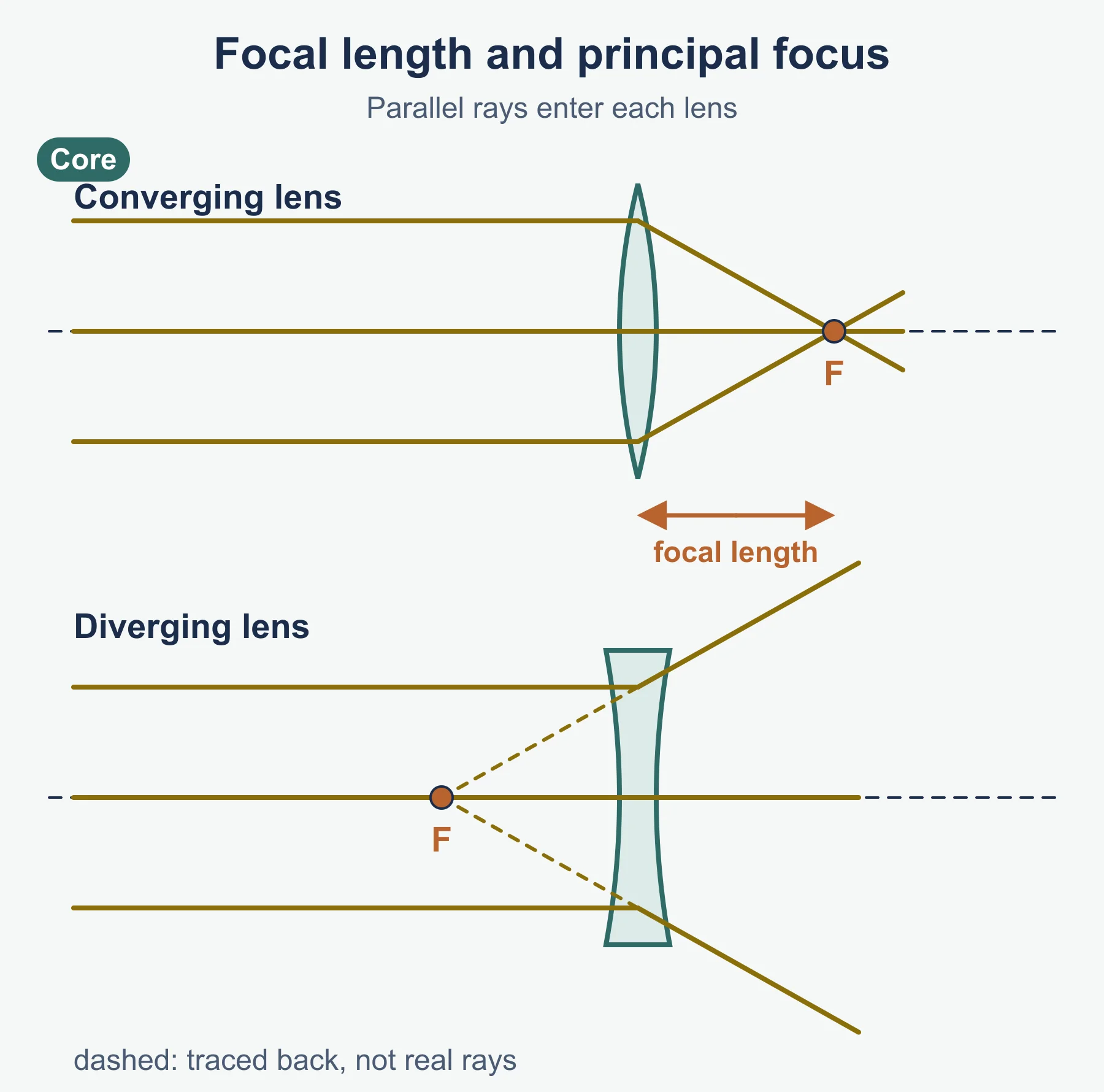
- Converging lens: parallel beam meets at the principal focus F.
- Diverging lens: parallel beam spreads out as if from a principal focus on the incoming side.
- Focal length: centre of lens to principal focus.
- Principal axis: line through the centre of the lens at right angles to it.
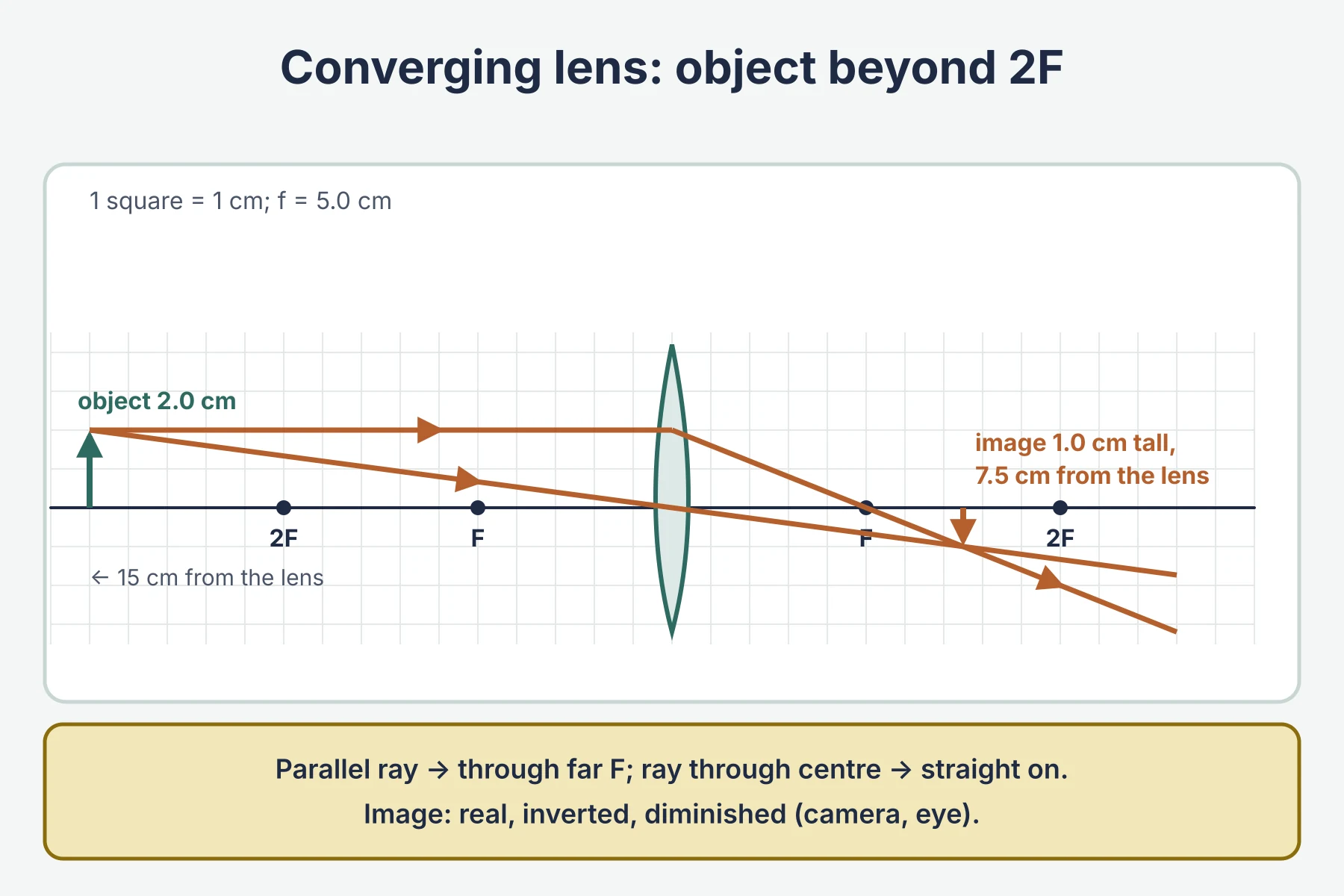
- Construction rays (converging): parallel ray → through far F; ray through centre → straight on; ray through near F → emerges parallel.
- Real image: rays actually cross; can be shown on a screen.
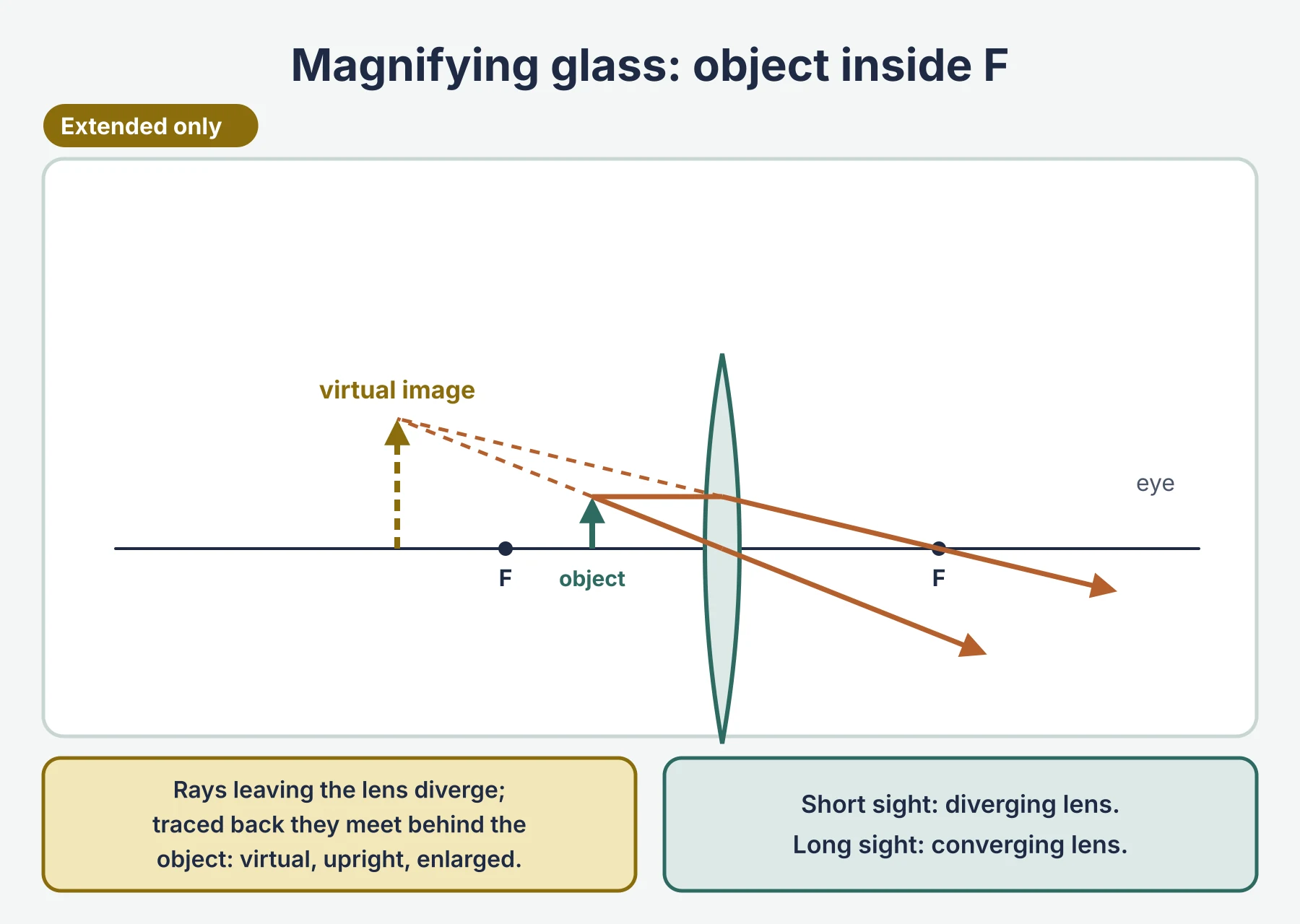
- Virtual image: rays only appear to come from it when extended backwards; cannot be shown on a screen.
| Object | Image (converging lens) |
|---|---|
| Beyond 2F | between F and 2F, real, inverted, diminished |
| At 2F | at 2F, real, inverted, same size |
| Between F and 2F | beyond 2F, real, inverted, enlarged |
| Inside F (Extended only) | same side as object, virtual, upright, enlarged |
- Extended only: magnifying glass = converging lens with the object inside F.
- Extended only: short sight (focus in front of retina) → diverging lens; long sight (focus behind retina) → converging lens.
Dispersion (3.2.4)
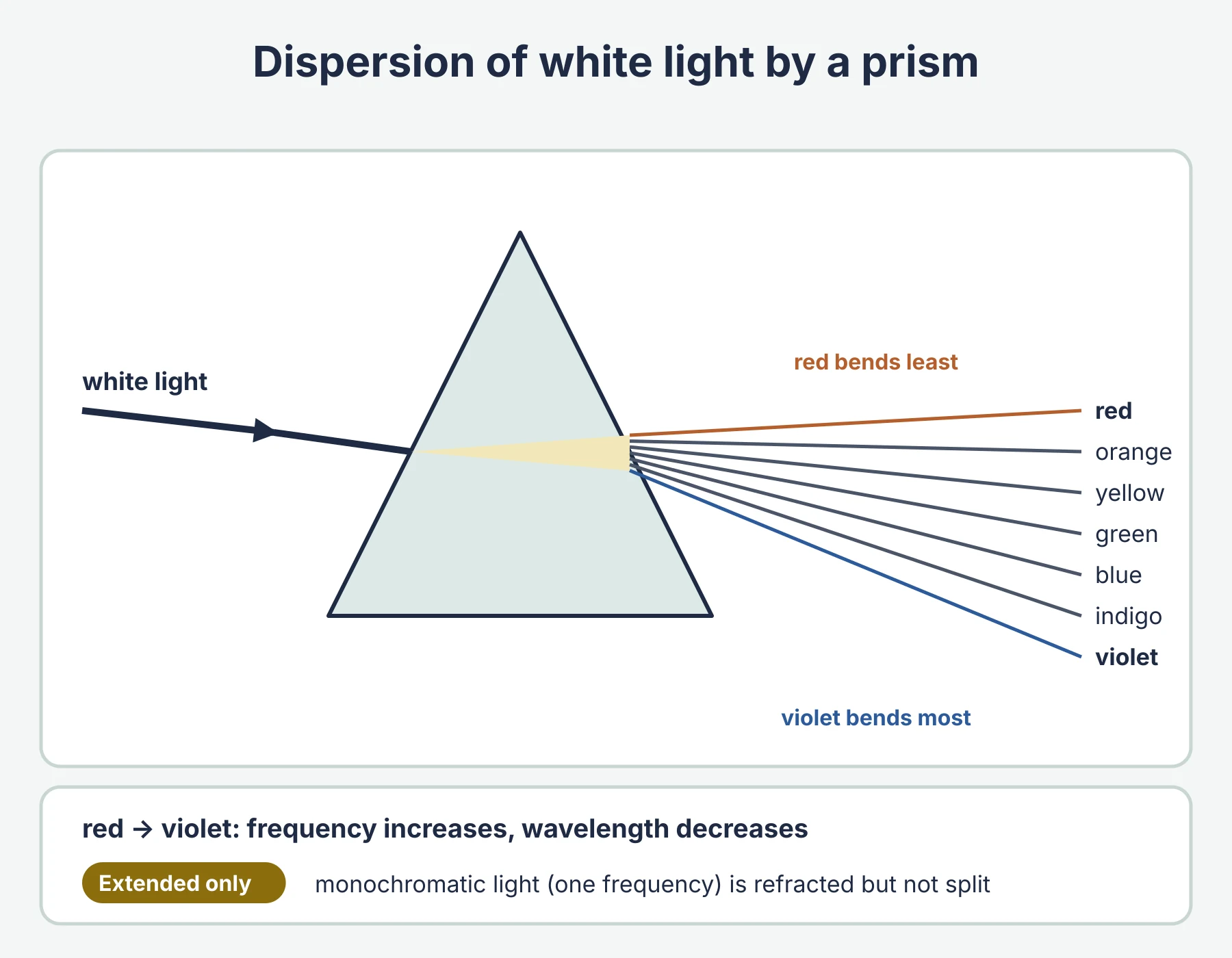
- A prism splits white light because each colour refracts by a different amount.
- Order: red, orange, yellow, green, blue, indigo, violet.
- Red → violet: frequency increases, wavelength decreases; violet refracts most.
- Extended only: monochromatic light has a single frequency.
Key terms
| Term | Meaning |
|---|---|
| Normal | Line at right angles to a surface where a ray meets it |
| Angle of incidence | Angle between incident ray and normal |
| Angle of refraction | Angle between refracted ray and normal |
| Critical angle | Angle of incidence giving an angle of refraction of 90° |
| Principal focus | Point where rays parallel to the principal axis meet after refraction by a converging lens |
| Focal length | Distance from the lens centre to the principal focus |
| Virtual image | Image formed where rays appear to come from; not on a screen |
| Dispersion | Splitting of white light into colours by refraction |
| Refractive index (Extended only) | Ratio of the speeds of a wave in two regions |
| Monochromatic (Extended only) | Light of a single frequency |
Exam traps
- Angles from the surface instead of the normal lose every mark that follows.
- TIR cannot happen when light travels from air into glass.
- “Beyond the critical angle some light still refracts out” is wrong: there is no refracted ray.
- n = sin i / sin r has the air angle on top; an answer below 1 means you inverted it.
- The principal focus definition needs both “parallel to the principal axis” and “after passing through the lens”.
- Image descriptions need all three describing words.
- A plane-mirror image is virtual, never real.
Self-test
- A ray hits a plane mirror at 34° to the mirror surface. State the angle of reflection.
- A candle is 40 cm in front of a plane mirror. How far is the candle from its image?
- State two conditions needed for total internal reflection.
- Light passes from glass into air at an angle of incidence of 20°. Does it bend towards or away from the normal?
- (Extended) Light travels at 2.25 × 10⁸ m/s in water. Find the refractive index of water (speed in air 3.0 × 10⁸ m/s).
- (Extended) For the water in Question 5, find the critical angle.
- (Extended) A ray in air at i = 35° refracts to r = 22° in a block. Find n.
- An object is between F and 2F of a converging lens. Describe the image.
- What is the difference between a real and a virtual image?
- Which colour of the spectrum has the longest wavelength, and which refracts most in a prism?
- (Extended) Which type of lens corrects short sight?
- (Extended) What is meant by monochromatic light?
Answers
- Angle of incidence = 90° − 34° = 56°, so the angle of reflection is 56°.
- The image is 40 cm behind the mirror, so 80 cm.
- Light travelling in the denser (slower) material towards a less dense one; angle of incidence greater than the critical angle.
- Away from the normal (it speeds up).
- n = 3.0 × 10⁸ ÷ 2.25 × 10⁸ = 1.33.
- sin c = 1 / n = 2.25 ÷ 3.0 = 0.75, so c = 48.6° (49°).
- n = sin 35° / sin 22° = 0.574 / 0.375 = 1.53.
- Beyond 2F on the other side; real, inverted, enlarged.
- A real image is where rays actually meet and can be shown on a screen; a virtual image is where rays only appear to come from and cannot.
- Red has the longest wavelength; violet refracts most.
- A diverging lens.
- Light of a single frequency.
Official syllabus
Cambridge International, Cambridge IGCSE Physics 0625 syllabus for examination in 2026, 2027 and 2028, Topic 3 Waves, section 3.2 Light. Practise with the Light practice questions.
Related resources
-
Study guides
Cambridge IGCSE Physics (0625): Sound
Study guide for Cambridge IGCSE Physics 0625 section 3.4 Sound: vibrations, longitudinal waves, measuring the speed of sound, pitch, loudness and ultrasound.
Physics · Cambridge · IGCSE
Read guide -
Practice questions
Cambridge IGCSE Physics (0625): Sound – Practice Questions
Thirteen original Cambridge IGCSE Physics 0625 sound questions: vibrations, pitch and loudness, speed of sound experiments, echoes and ultrasound, with answers.
Physics · Cambridge · IGCSE
Try questions -
Revision notes
Cambridge IGCSE Physics (0625): Sound – Revision Notes
Revision notes for Cambridge IGCSE Physics 0625 section 3.4 Sound: longitudinal waves, audible range, speed of sound, echoes, ultrasound and a self-test.
Physics · Cambridge · IGCSE
Revise topic
Related articles
Get free revision emails (optional)
Occasional emails with practice questions, worked explanations and links to free resources for the qualification and subjects you choose. No spam, and you can unsubscribe from any email. The free tools on this site never need an email.