
Study Guides
Cambridge IGCSE Physics (0625): Electromagnetic spectrum
Study guide for Cambridge IGCSE Physics 0625 section 3.3: the order of the EM spectrum, wave speed, uses, hazards, satellites and digital signals.
- Subject
- Physics
- Level
- IGCSE
- Topic
- Waves
- Author
- Marlbridge Academic Team
- Updated
- Reviewed by
- Iftikhar Azeemi (what this means)
Aligned to Cambridge IGCSE Physics (0625), For examination in 2026, 2027 and 2028. Official specification .
Syllabus page (what it covers and how it is assessed): Cambridge IGCSE Physics.
Syllabus points this page covers, with Core and Extended
0625
- 3.3 Electromagnetic spectrum · Core and Extended
"Core and Extended" means part of that syllabus point is Extended only. The page's own tier notes say which part.
Found an error? Report a correction.
Need help with this topic? Request a free trial class for IGCSE Physics (0625).
This guide covers one subtopic of the Cambridge IGCSE Physics 0625 syllabus (for examination in 2026, 2027 and 2028): 3.3 Electromagnetic spectrum. Core content is for every candidate; content marked Extended only is Supplement material, examined on Papers 2 and 4. The Waves study guide has the full table of uses and hazards for each region; this page explains how to reason with it, how to calculate with electromagnetic waves, and how communication systems choose their region.
What 3.3 asks you to do
| Core | Extended only |
|---|---|
| Know the main regions in order of frequency and of wavelength | Know the speed in a vacuum is 3.0 × 10⁸ m/s, and about the same in air |
| Know all electromagnetic waves travel at the same high speed in a vacuum | Mobile phones and wireless internet (microwaves), Bluetooth (radio waves) and optical fibres (visible light or infrared), with reasons |
| Describe typical uses of each region | The difference between digital and analogue signals |
| Describe harmful effects of excessive exposure | That sound can be sent as a digital or an analogue signal |
| Know that communication with satellites is mainly by microwaves; low orbit and geostationary satellites | The benefits of digital signalling |
The order, and why it matters
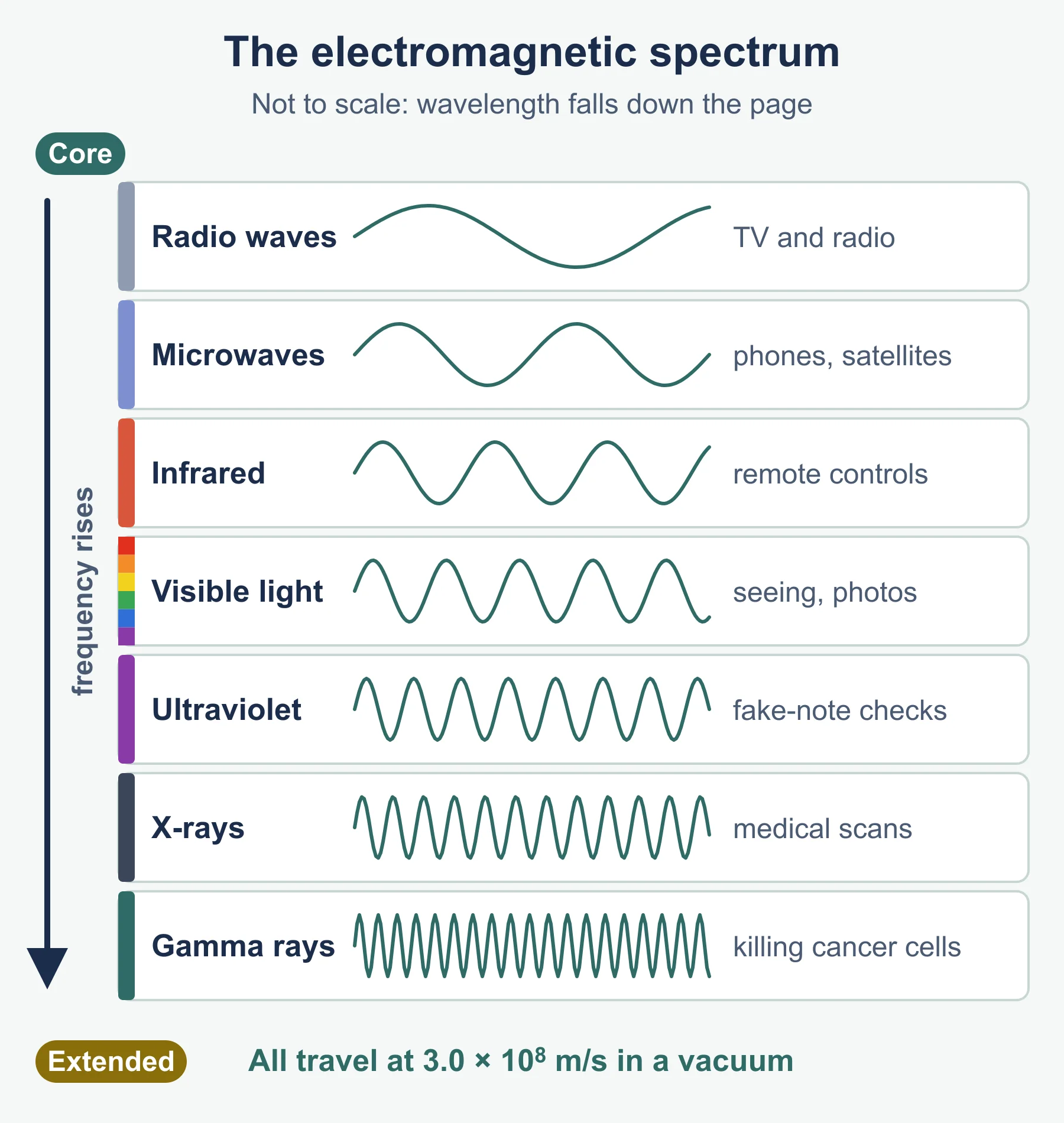
From lowest frequency (longest wavelength) to highest frequency (shortest wavelength):
radio waves → microwaves → infrared → visible light → ultraviolet → X-rays → gamma rays
Two facts follow from a single order. First, if you are asked for the order “of increasing wavelength”, simply reverse it: gamma first, radio last. Second, because all the regions travel at the same speed, frequency and wavelength must change in opposite directions (v = fλ with v fixed). Doubling the frequency halves the wavelength.
Within visible light, the same pattern holds: red is at the low-frequency end, next to infrared, and violet is at the high-frequency end, next to ultraviolet. The names “infrared” (below red) and “ultraviolet” (beyond violet) are a useful memory hook.
The regions have no sharp boundaries. What changes smoothly across the spectrum is the frequency, and with it how the radiation interacts with matter: high-frequency regions (ultraviolet, X-rays, gamma rays) carry enough energy to damage cells, which is why their hazards are the most serious.
Speed of electromagnetic waves
All electromagnetic waves are transverse and travel at the same speed in a vacuum. Extended only: that speed is 3.0 × 10⁸ m/s, and it is approximately the same in air. Combine this with the wave equation from section 3.1:
v = fλ, so λ = v / f and f = v / λ.
Worked example 1 (Extended)
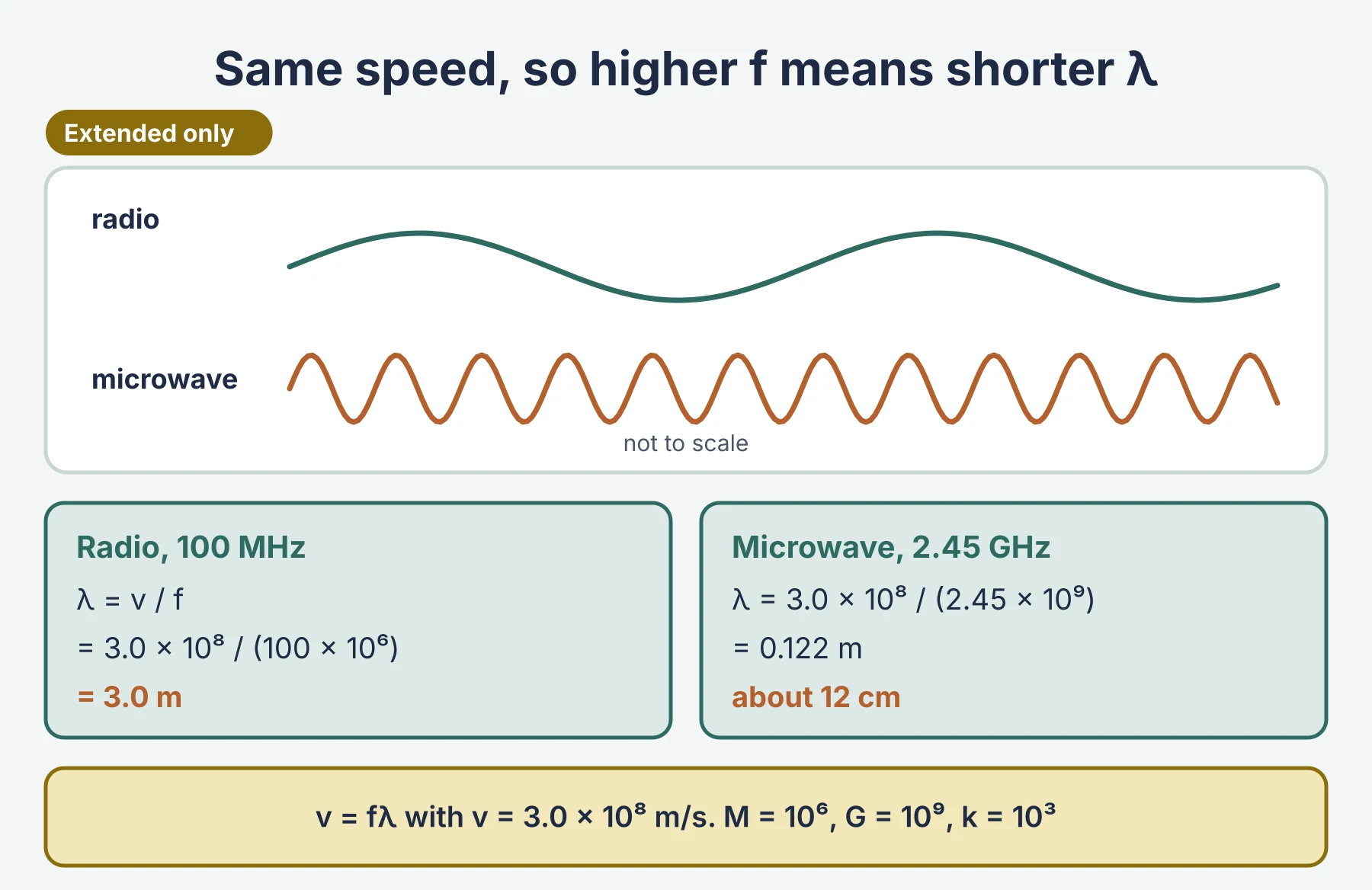
A radio station broadcasts at 100 MHz. A microwave oven uses microwaves of frequency 2.45 GHz. Find each wavelength.
radio:      λ = v / f = 3.0 × 10⁸ / (100 × 10⁶) = 3.0 m
microwave:  λ = 3.0 × 10⁸ / (2.45 × 10⁹) = 0.122 m   (about 12 cm)
Check: the microwave has the higher frequency, so it must have the shorter wavelength. Prefixes are where marks go: M (mega) = 10⁶, G (giga) = 10⁹, k (kilo) = 10³.
Worked example 2 (Extended)
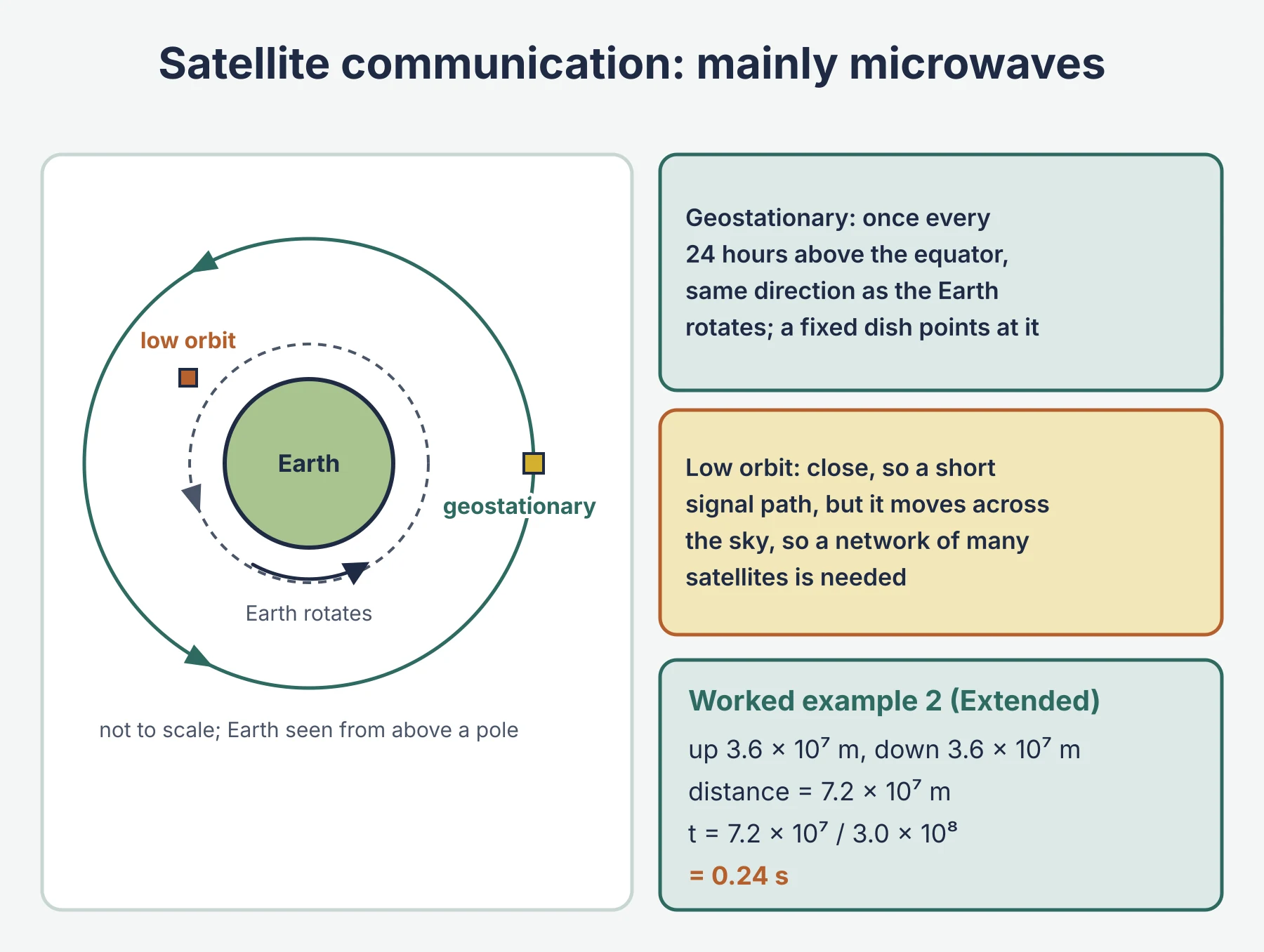
A geostationary satellite is 3.6 × 10⁷ m above a ground station. Calculate the time for a microwave signal to travel up to the satellite and back down to a second station the same distance away.
distance = 2 × 3.6 × 10⁷ = 7.2 × 10⁷ m
time = distance / speed = 7.2 × 10⁷ / 3.0 × 10⁸ = 0.24 s
This delay is one reason some satellite phones use low orbit satellites, which are much closer.
Uses: link each use to a property
Rather than memorising a list in isolation, connect each use to what the radiation does:
- Radio waves travel long distances and pass round obstacles: radio and television transmissions. Radio telescopes detect radio waves from space (astronomy). RFID tags (radio frequency identification) are read by radio waves without contact, for example in shop security tags and contactless cards.
- Microwaves are absorbed by water in food, heating it: microwave ovens. They also carry satellite television and mobile phone signals.
- Infrared is emitted by all warm objects and causes heating: electric grills, thermal imaging and intruder alarms (which detect the infrared from a person). Short-range communication such as television remote controllers, and optical fibres, also use it.
- Visible light is the region our eyes and cameras detect: vision, photography, illumination.
- Ultraviolet makes certain chemicals glow (fluoresce): security marking and detecting fake bank notes. It kills microorganisms: sterilising water.
- X-rays pass through soft tissue but are absorbed by bone and metal: medical scanning and airport security scanners.
- Gamma rays penetrate deeply and kill cells: sterilising food and medical equipment, and the detection and treatment of cancer.
Harmful effects of excessive exposure
| Region | Harmful effect named in the syllabus |
|---|---|
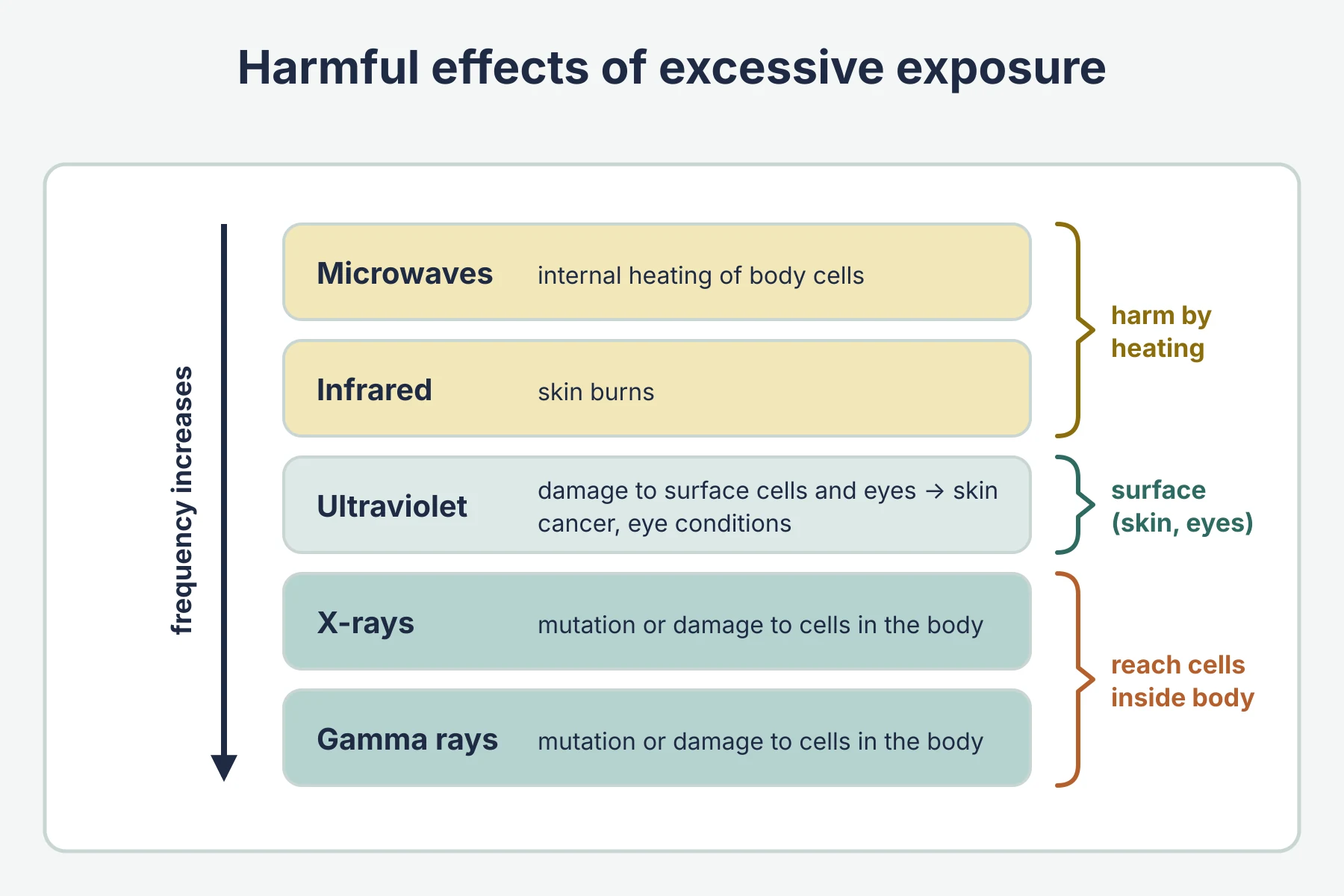
| Microwaves | Internal heating of body cells |
| Infrared | Skin burns |
| Ultraviolet | Damage to surface cells and eyes, leading to skin cancer and eye conditions |
| X-rays and gamma rays | Mutation or damage to cells in the body |
The pattern: infrared and microwaves harm by heating; ultraviolet, X-rays and gamma rays damage cells directly, and the more penetrating the radiation, the deeper the damage. Ultraviolet harms the surface (skin, eyes) because it is absorbed there; X-rays and gamma rays reach cells inside the body.
Satellites
Communication with artificial satellites is mainly by microwaves. Two kinds are named:
- Low orbit satellites are used by some satellite phones. They are close to the Earth, so signals travel a short distance, but each satellite moves across the sky, so a network of many satellites is needed.
- Geostationary satellites are used by other satellite phones and by direct broadcast satellite television. A geostationary satellite orbits once every 24 hours above the equator, in the same direction as the Earth rotates, so it stays above the same point on the surface and a fixed dish can point at it.
Communication systems (Extended only)
| System | Region | Reason given in the syllabus |
|---|---|---|
| Mobile phones, wireless internet | Microwaves | Penetrate some walls; need only a short aerial |
| Bluetooth | Radio waves | Pass through walls, but the signal is weakened |
| Cable television, high-speed broadband (optical fibres) | Visible light or infrared | Glass is transparent to them; short wavelengths carry high rates of data |
Note the subtle point about Bluetooth: weakening is part of the reason, not a drawback to ignore. Bluetooth is meant for short-range links between nearby devices.
Digital and analogue signals (Extended only)
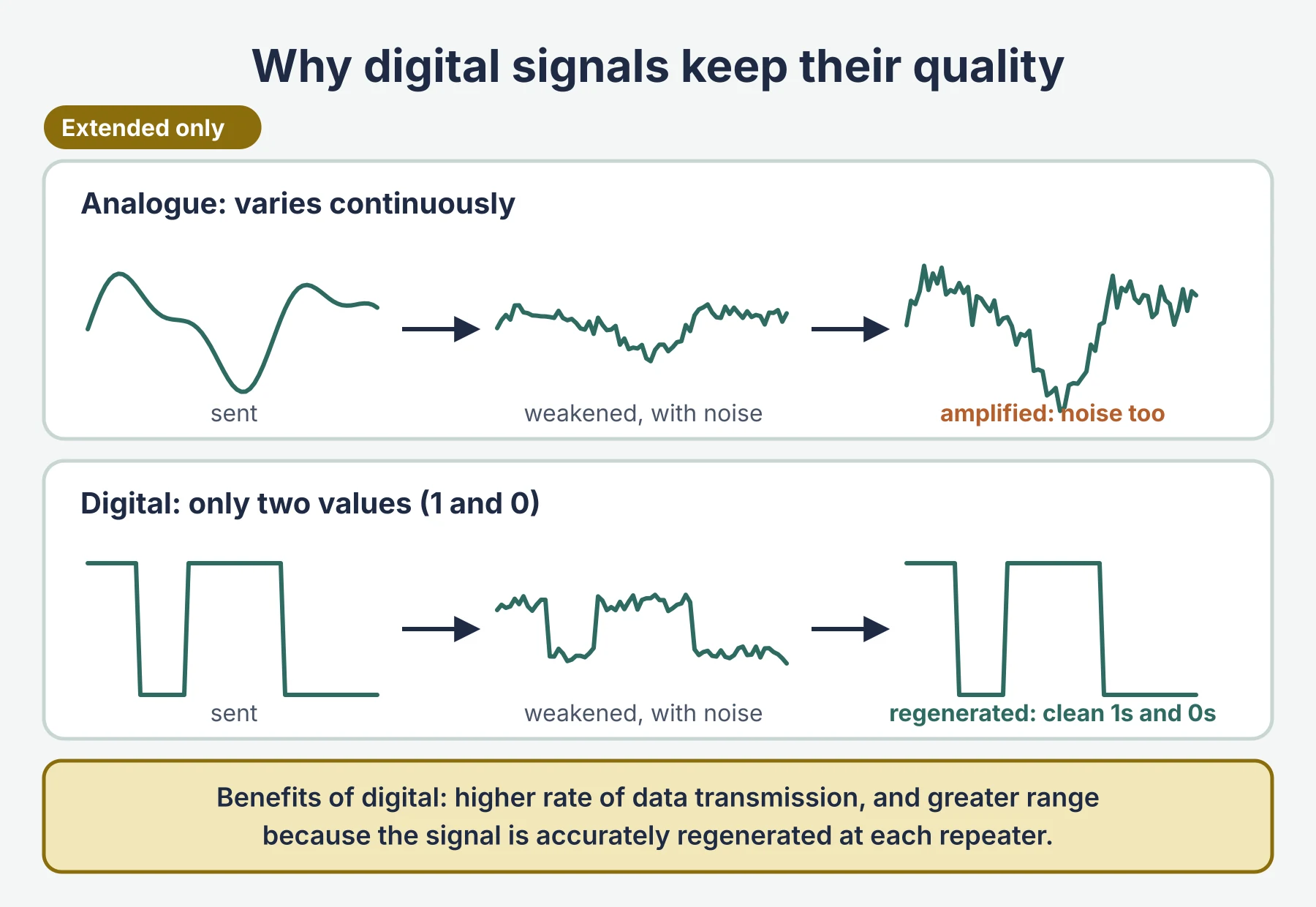
An analogue signal varies continuously and can take any value within a range. A digital signal has only a few set values, usually two (on/off, 1/0). A sound picked up by a microphone produces an analogue electrical signal; it can be sent as it is, or converted into digital form and sent as a stream of 1s and 0s.
Benefits of digital signalling:
- Increased rate of transmission of data: more information can be sent per second.
- Increased range due to accurate signal regeneration: every signal weakens and picks up noise as it travels. A digital signal can be regenerated at each repeater, restored to clean 1s and 0s, because the receiver only has to decide between two values. An analogue signal can only be amplified, which amplifies the noise with it, so its quality falls over distance.
An answer that says only “digital is clearer” will not score: name the regeneration and say why it removes noise.
Common mistakes
- Reversing the order, or placing infrared above visible light in frequency.
- Saying gamma rays travel faster than radio waves in a vacuum. All regions have the same speed.
- Forgetting the prefix in v = fλ (MHz and GHz).
- Saying satellites use radio waves “mainly”. The syllabus says microwaves.
- Describing a geostationary satellite as “not moving”. It moves, at the same rate as the Earth rotates.
- Giving “cancer” as the harm from microwaves. Their named effect is internal heating of body cells.
Exam technique
- State / Name: one region, one use or one effect; no explanation needed.
- Describe a use: say what the radiation does in that use, for example “X-rays pass through soft tissue but are absorbed by bone”.
- Explain why a region is used: link a property to the requirement.
- Suggest: apply the order to an unfamiliar case, for example a region between two named ones.
- Calculate: convert prefixes first, then use v = fλ with 3.0 × 10⁸ m/s.
Condense this with the electromagnetic spectrum revision notes and practise with the electromagnetic spectrum practice questions. The previous subtopic is Light and the next is Sound.
Official syllabus
Cambridge International, Cambridge IGCSE Physics 0625 syllabus for examination in 2026, 2027 and 2028, Topic 3 Waves, section 3.3 Electromagnetic spectrum.
Related resources
-
Practice questions
Cambridge IGCSE Physics (0625): Electromagnetic spectrum – Practice Questions
Twelve original Cambridge IGCSE Physics 0625 questions on the electromagnetic spectrum: order, uses, hazards, satellites and digital signals, with answers.
Physics · Cambridge · IGCSE
Try questions -
Revision notes
Cambridge IGCSE Physics (0625): Electromagnetic spectrum – Revision Notes
Revision notes for Cambridge IGCSE Physics 0625 section 3.3: spectrum order, uses and hazards, satellites, digital versus analogue signals, plus a self-test.
Physics · Cambridge · IGCSE
Revise topic -
Study guides
Cambridge IGCSE Physics (0625): General properties of waves
Study guide to Cambridge IGCSE Physics 0625 section 3.1: wave features, v = fλ, transverse and longitudinal waves, reflection, refraction and diffraction.
Physics · Cambridge · IGCSE
Read guide
Related articles
Get free revision emails (optional)
Occasional emails with practice questions, worked explanations and links to free resources for the qualification and subjects you choose. No spam, and you can unsubscribe from any email. The free tools on this site never need an email.