
Study Guides
Cambridge IGCSE Physics (0625): General properties of waves
Study guide to Cambridge IGCSE Physics 0625 section 3.1: wave features, v = fλ, transverse and longitudinal waves, reflection, refraction and diffraction.
- Subject
- Physics
- Level
- IGCSE
- Topic
- Waves
- Author
- Marlbridge Academic Team
- Updated
- Reviewed by
- Iftikhar Azeemi (what this means)
Aligned to Cambridge IGCSE Physics (0625), For examination in 2026, 2027 and 2028. Official specification .
Syllabus page (what it covers and how it is assessed): Cambridge IGCSE Physics.
Syllabus points this page covers, with Core and Extended
0625
- 3.1 General properties of waves · Core and Extended
"Core and Extended" means part of that syllabus point is Extended only. The page's own tier notes say which part.
Found an error? Report a correction.
Need help with this topic? Request a free trial class for IGCSE Physics (0625).
This guide teaches section 3.1, General properties of waves, of the Cambridge IGCSE Physics 0625 syllabus for examination in 2026, 2027 and 2028. Core statements 1 to 8 cover what waves are, their features, v = fλ, the two types of wave and the three wave behaviours. Supplement statements 9 and 10, on how wavelength and gap size affect diffraction, are examined only on Papers 2 and 4 and are labelled Extended only. The Waves study guide describes ropes, springs and the ripple tank set-up; this page goes further into the definitions, the calculations and what changes, and what does not, in each wave behaviour.
What the syllabus asks for
| Statement | Tier | Content |
|---|---|---|
| 1 | Core | Waves transfer energy without transferring matter |
| 2 | Core | Wave motion shown by ropes, springs and water waves |
| 3 | Core | Wavefront, wavelength, frequency, crest (peak), trough, amplitude and wave speed |
| 4 | Core | Recall and use v = fλ |
| 5 | Core | Transverse waves: vibration at right angles to propagation; electromagnetic radiation, water waves and seismic S-waves |
| 6 | Core | Longitudinal waves: vibration parallel to propagation; sound and seismic P-waves |
| 7 | Core | Reflection at a plane surface, refraction due to a change of speed, diffraction through a narrow gap |
| 8 | Core | Using a ripple tank to show reflection, refraction (change in depth), diffraction at a gap and at an edge |
| 9 | Extended only | How wavelength and gap size affect diffraction through a gap |
| 10 | Extended only | How wavelength affects diffraction at an edge |
Energy, not matter
A wave transfers energy from one place to another without transferring matter. A cork on a pond bobs up and down as ripples pass under it but ends up where it started; the energy of the wave moves outwards across the pond. A Mexican wave in a stadium is a good picture: the wave travels round, but each person only stands up and sits down.
Describing a wave
| Feature | Meaning | Unit |
|---|---|---|
| Crest (peak) | highest point of a transverse wave | – |
| Trough | lowest point | – |
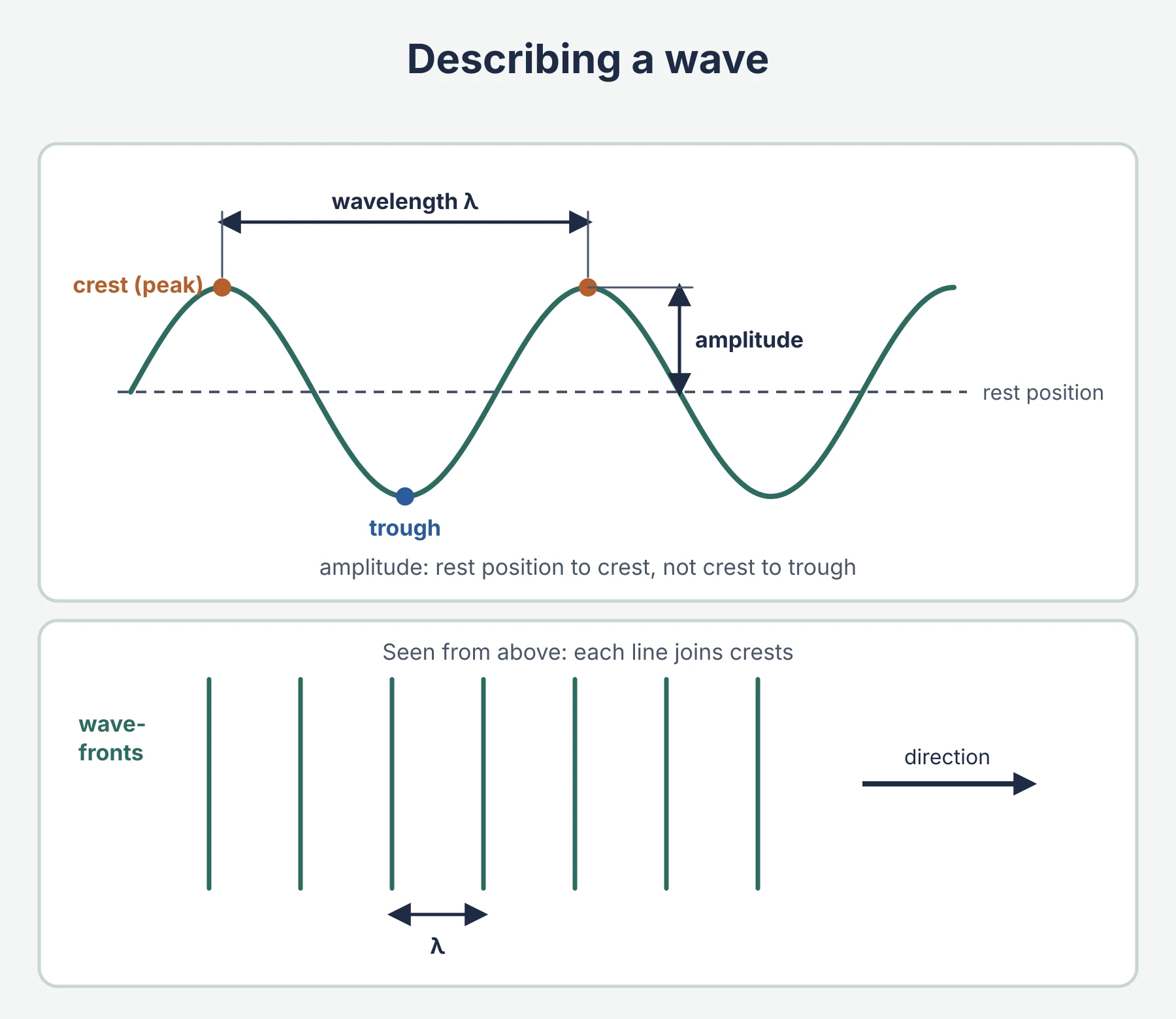
| Amplitude | maximum displacement from the rest (undisturbed) position: from the middle to a crest, not crest to trough | m |
| Wavelength, λ | distance between two neighbouring crests (or any two neighbouring corresponding points) | m |
| Frequency, f | number of waves passing a point (or produced by the source) per second | hertz, Hz |
| Wave speed, v | distance travelled by the wave per second | m/s |
| Wavefront | a line joining points on the same part of a wave, such as all the crests of a ripple | – |
On a wavefront diagram, the distance between neighbouring wavefronts is one wavelength.
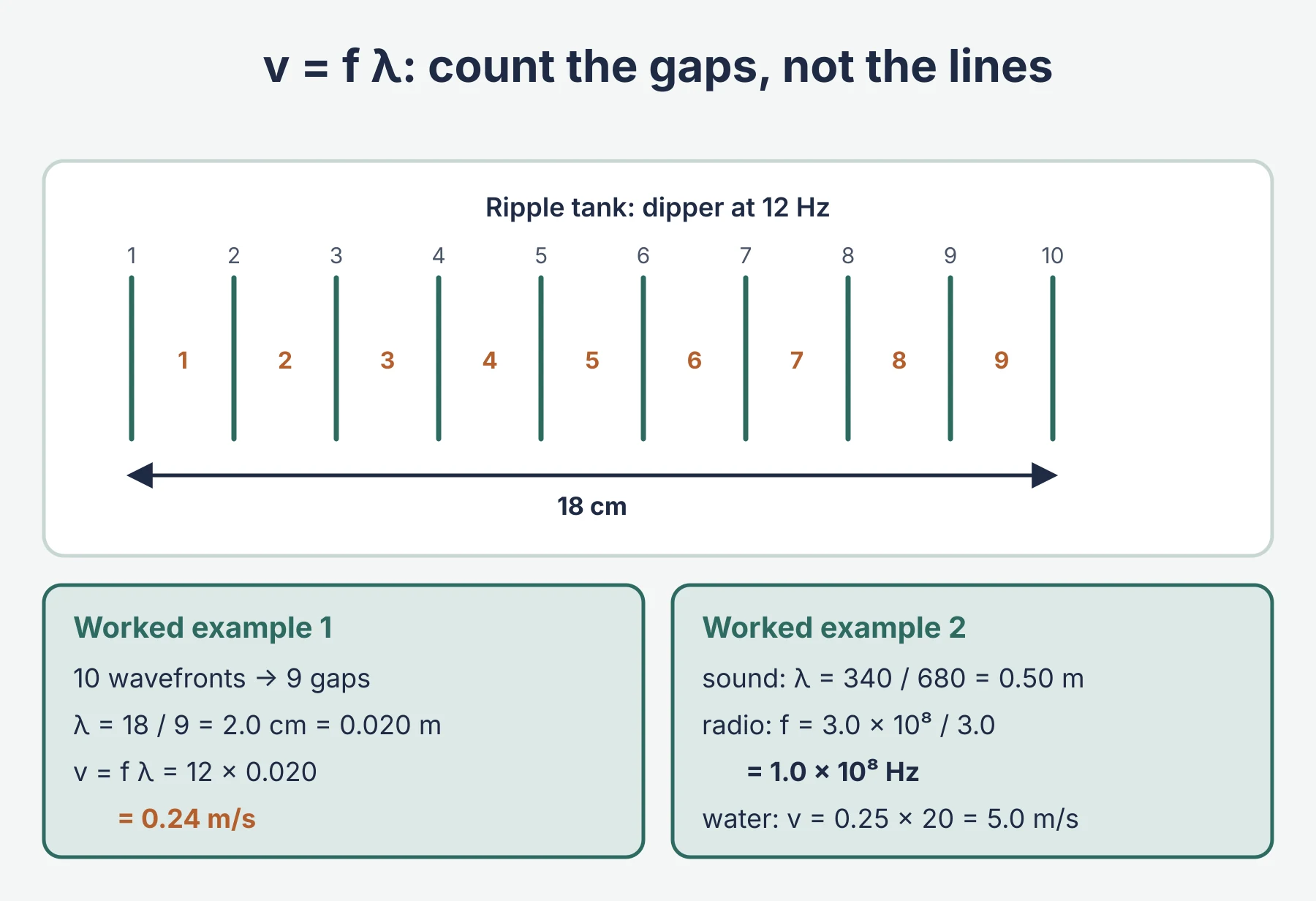
Counting carefully. If 10 wavefronts are spread over 18 cm, there are only 9 gaps between them, so λ = 18 ÷ 9 = 2.0 cm. If a source produces 5 complete waves in 2.0 s, f = 5 ÷ 2.0 = 2.5 Hz.
The wave equation
v = f λ        v in m/s,  f in Hz,  λ in m
f = v / λ      λ = v / f
Worked example 1 (ripple tank). Ten wavefronts span 18 cm on the screen below a ripple tank, and the dipper vibrates at 12 Hz. Find the wave speed.
λ = 18 cm / 9 = 2.0 cm = 0.020 m
v = f λ = 12 × 0.020 = 0.24 m/s
Worked example 2 (a range of waves).
sound, v = 340 m/s, f = 680 Hz:        λ = 340 / 680 = 0.50 m
radio, v = 3.0 × 10⁸ m/s, λ = 3.0 m:   f = 3.0 × 10⁸ / 3.0 = 1.0 × 10⁸ Hz
water, f = 0.25 Hz, λ = 20 m:          v = 0.25 × 20 = 5.0 m/s
Convert prefixes first: 1 kHz = 1000 Hz, 1 MHz = 10⁶ Hz, 1 cm = 0.01 m.
Transverse and longitudinal waves
| Transverse | Longitudinal | |
|---|---|---|
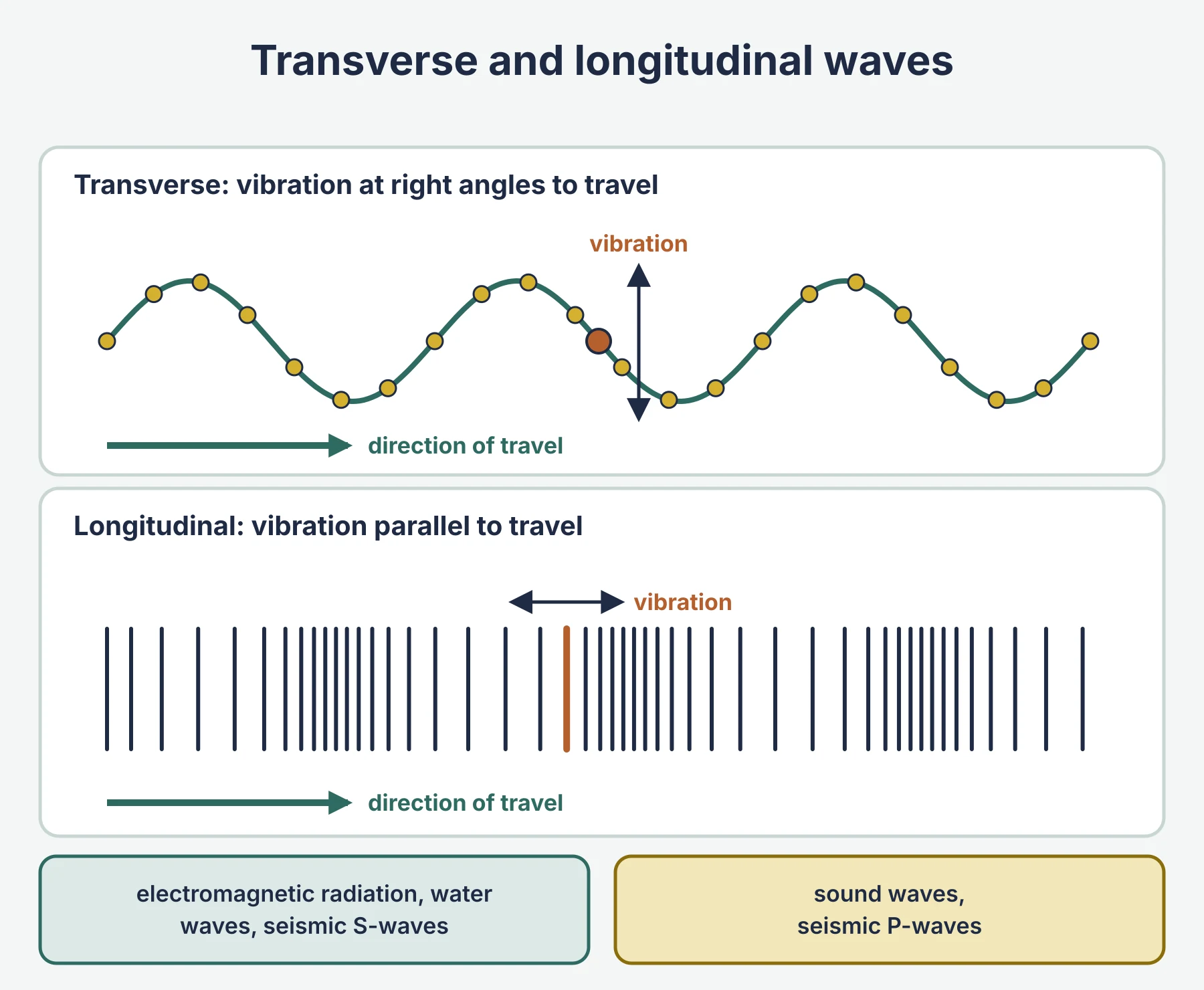
| Direction of vibration | at right angles to the direction the wave travels (propagation) | parallel to the direction of propagation |
| Modelled as this type | electromagnetic radiation, water waves, seismic S-waves (secondary) | sound waves, seismic P-waves (primary) |
| Shown on a spring by | moving the end from side to side | pushing and pulling the end along the spring |
A useful check: in a transverse wave the particles move across the wave’s path; in a longitudinal wave they move back and forth along it.
Reflection, refraction and diffraction
Reflection at a plane surface
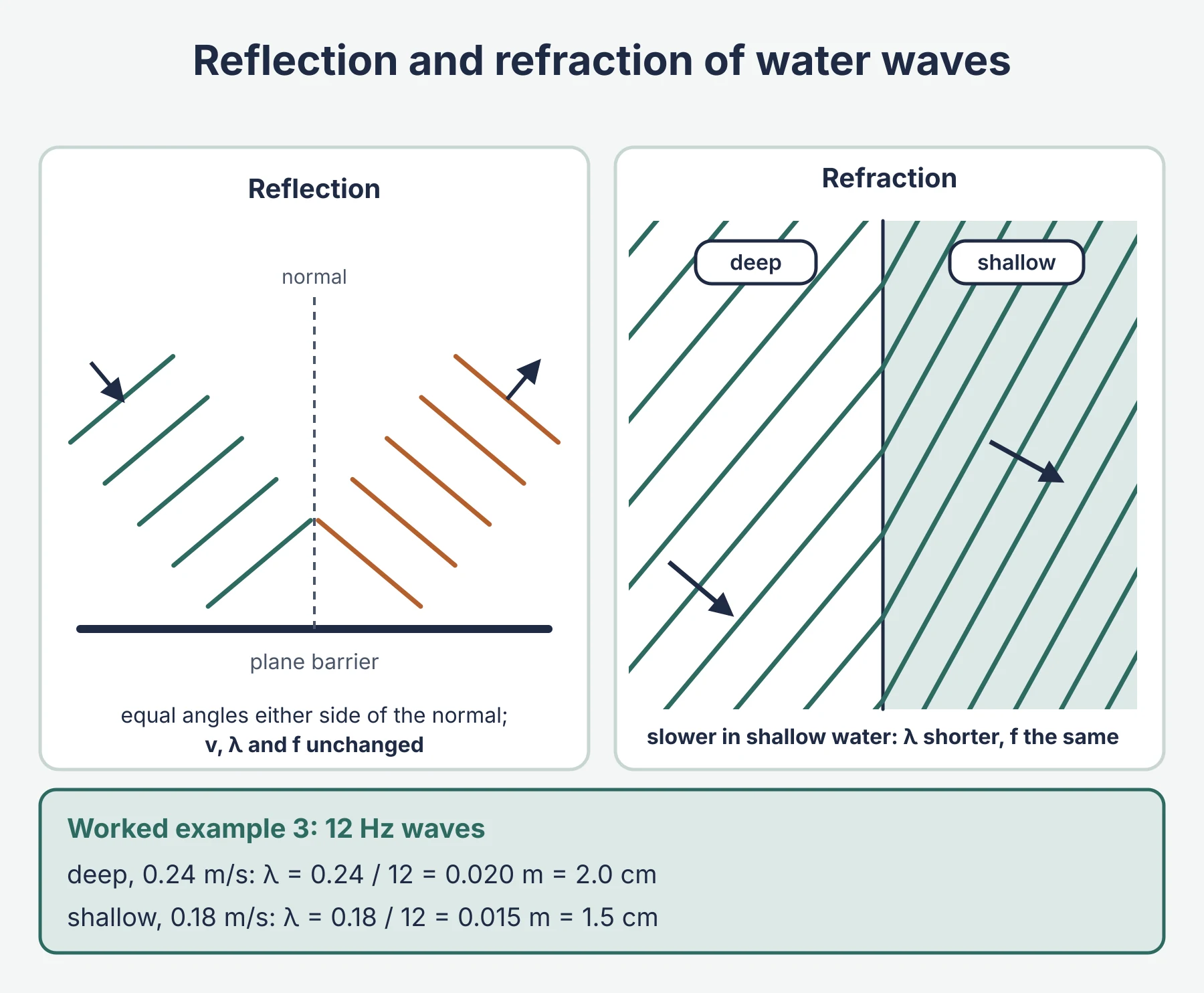
Waves bounce off a flat barrier. In a ripple tank, straight wavefronts hitting a straight barrier at an angle leave at the same angle on the other side of the normal. Speed, wavelength and frequency are all unchanged; only the direction changes.
Refraction due to a change of speed
When a wave enters a region where it travels at a different speed, it refracts. In a ripple tank, a glass or plastic plate makes part of the water shallower; waves travel more slowly in shallow water.
- The frequency does not change: it is set by the source.
- Because v = fλ and f is fixed, a lower speed means a shorter wavelength: the wavefronts are closer together over the shallow region.
- If the wavefronts meet the boundary at an angle, the change of speed also changes their direction. If they meet it head-on, they slow down and bunch up but do not change direction.
Worked example 3. Waves of frequency 12 Hz travel at 0.24 m/s in deep water and at 0.18 m/s in shallow water. Find the wavelength in each.
deep:     λ = 0.24 / 12 = 0.020 m = 2.0 cm
shallow:  λ = 0.18 / 12 = 0.015 m = 1.5 cm
Diffraction through a gap and at an edge
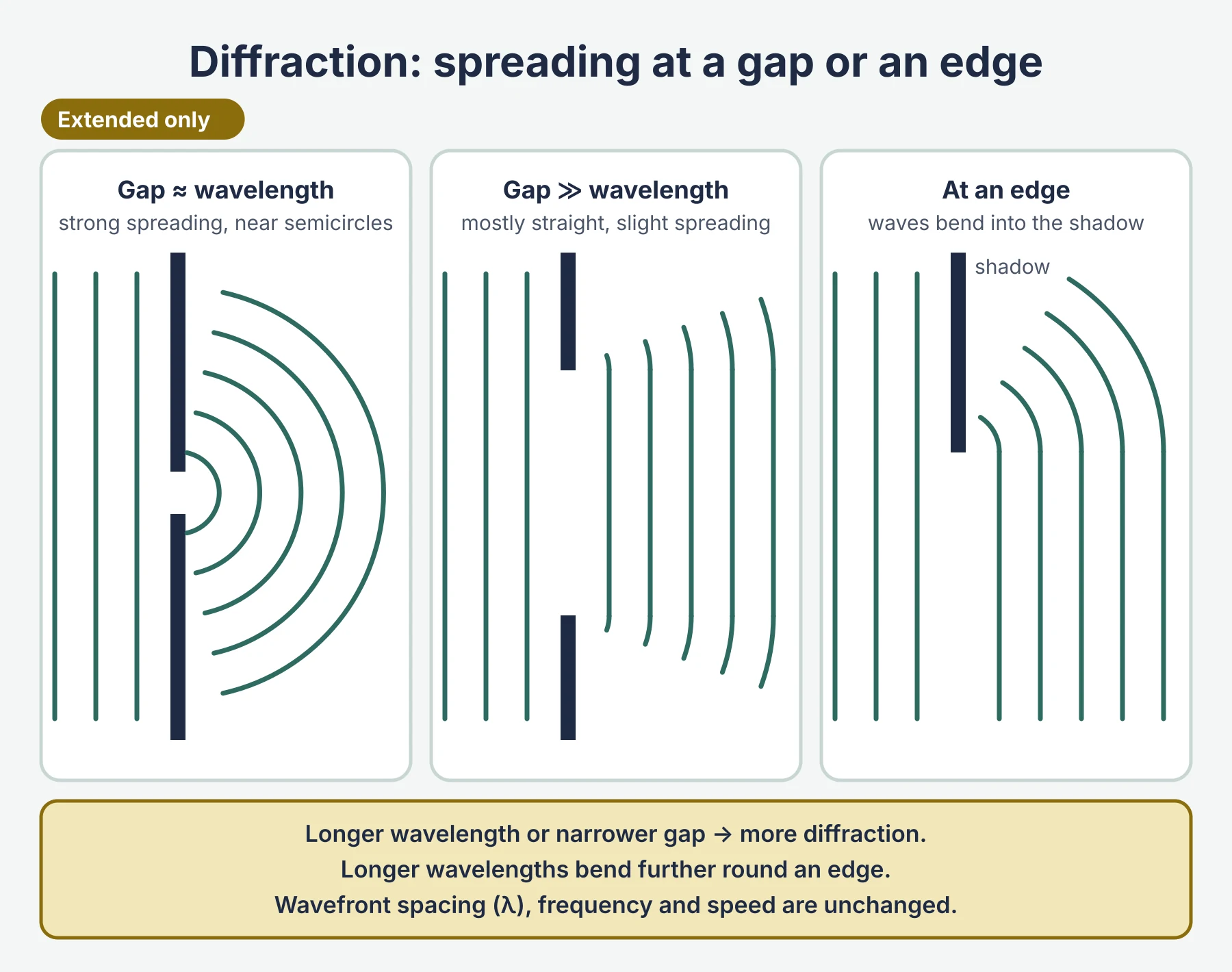
Diffraction is the spreading of waves as they pass through a gap or past the edge of an obstacle. In the ripple tank, straight waves passing through a gap between two barriers spread out on the far side; waves passing the end of a single barrier curve round into the region behind it. Wavelength, frequency and speed are unchanged by diffraction.
How wavelength and gap size matter (Extended only)
- Gap about the same size as the wavelength: the waves spread out strongly, emerging as nearly semicircular wavefronts.
- Gap much wider than the wavelength: the waves pass through mostly straight, with only slight spreading at the edges.
- For a given gap, a longer wavelength diffracts more; for a given wavelength, a narrower gap gives more diffraction.
- At an edge: longer wavelengths bend further round the edge into the “shadow” region than shorter wavelengths do.
Consequences: you can hear someone talking round the corner of a doorway, because sound wavelengths (around a metre) are comparable to the doorway, but you cannot see them, because light wavelengths are far smaller. Long-wavelength radio waves diffract round hills better than short-wavelength ones.
When drawing diffracted wavefronts, keep the spacing the same before and after the gap: diffraction does not change the wavelength.
Common mistakes
- Measuring amplitude from crest to trough (that is twice the amplitude).
- Counting wavefronts instead of the gaps between them when finding λ.
- Saying the frequency changes during refraction.
- Drawing wavefronts closer together (or further apart) after diffraction.
- Saying sound is transverse, or light is longitudinal.
- Leaving cm or kHz unconverted in v = fλ.
- (Extended) Saying a wider gap gives more diffraction.
Exam technique: command words
- State the meaning of a feature: use the table definitions with “neighbouring” for wavelength and “from the rest position” for amplitude.
- Describe a ripple tank demonstration: what you set up (plane barrier, glass plate, gap, edge), what you see, and what stays the same.
- Calculate: v = fλ with units in m, Hz and m/s.
- Draw wavefronts: use a ruler; keep spacing correct (equal for reflection and diffraction; closer in the slower region for refraction).
- Explain (Extended): compare the gap width with the wavelength in your answer.
Revise with the revision notes on general properties of waves and practise with the practice questions on general properties of waves. The same ideas are applied to light in the study guide on light and to sound in the study guide on sound.
Related resources
-
Practice questions
Cambridge IGCSE Physics (0625): General properties of waves – Practice Questions
Twelve original Cambridge IGCSE Physics 0625 questions on wave features, v = fλ, wave types, reflection, refraction and diffraction, with full answers.
Physics · Cambridge · IGCSE
Try questions -
Revision notes
Cambridge IGCSE Physics (0625): General properties of waves – Revision Notes
Revision notes for Cambridge IGCSE Physics 0625 section 3.1: wave features, v = fλ, transverse and longitudinal waves, ripple tank behaviours and a self-test.
Physics · Cambridge · IGCSE
Revise topic -
Study guides
Cambridge IGCSE Physics (0625): Light
Study guide for Cambridge IGCSE Physics 0625 section 3.2 Light: plane mirrors, refraction, refractive index, thin lenses, ray diagrams and dispersion.
Physics · Cambridge · IGCSE
Read guide
Related articles
Get free revision emails (optional)
Occasional emails with practice questions, worked explanations and links to free resources for the qualification and subjects you choose. No spam, and you can unsubscribe from any email. The free tools on this site never need an email.