
Revision Notes
Cambridge IGCSE Physics (0625): The nuclear model of the atom – Revision Notes
Revision notes for Cambridge IGCSE Physics 0625 section 5.1: atoms and ions, nuclide notation, isotopes, alpha scattering, fission and fusion, with a self-test.
- Subject
- Physics
- Level
- IGCSE
- Topic
- Nuclear physics
- Author
- Marlbridge Academic Team
- Updated
- Reviewed by
- Iftikhar Azeemi (what this means)
Aligned to Cambridge IGCSE Physics (0625), For examination in 2026, 2027 and 2028. Official specification .
Syllabus page (what it covers and how it is assessed): Cambridge IGCSE Physics.
Syllabus points this page covers, with Core and Extended
0625
- 5.1 The nuclear model of the atom · Core and Extended
"Core and Extended" means part of that syllabus point is Extended only. The page's own tier notes say which part.
Found an error? Report a correction.
Need help with this topic? Request a free trial class for IGCSE Physics (0625).
These notes condense section 5.1 The nuclear model of the atom of the Cambridge IGCSE Physics 0625 syllabus (for examination in 2026, 2027 and 2028). Lines marked Extended only are Supplement content, examined on Papers 2 and 4. For explanations and worked examples, read the nuclear model study guide.
5.1.1 The atom
- Small, positively charged nucleus at the centre.
- Negatively charged electrons in orbit around it.
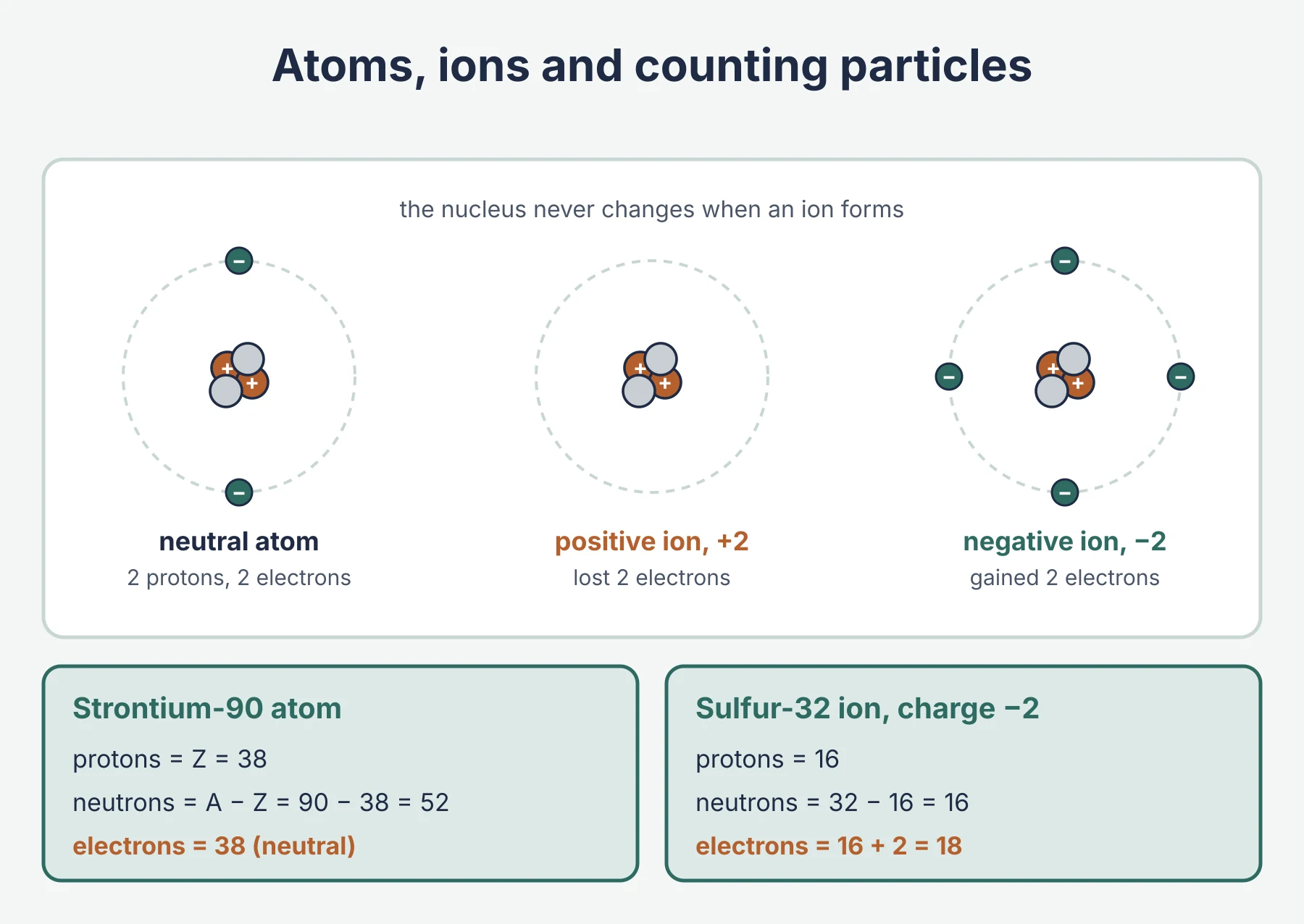
- Neutral atom: number of electrons = number of protons.
- Positive ion: atom has lost electrons.
- Negative ion: atom has gained electrons.
- Forming an ion never changes the nucleus.
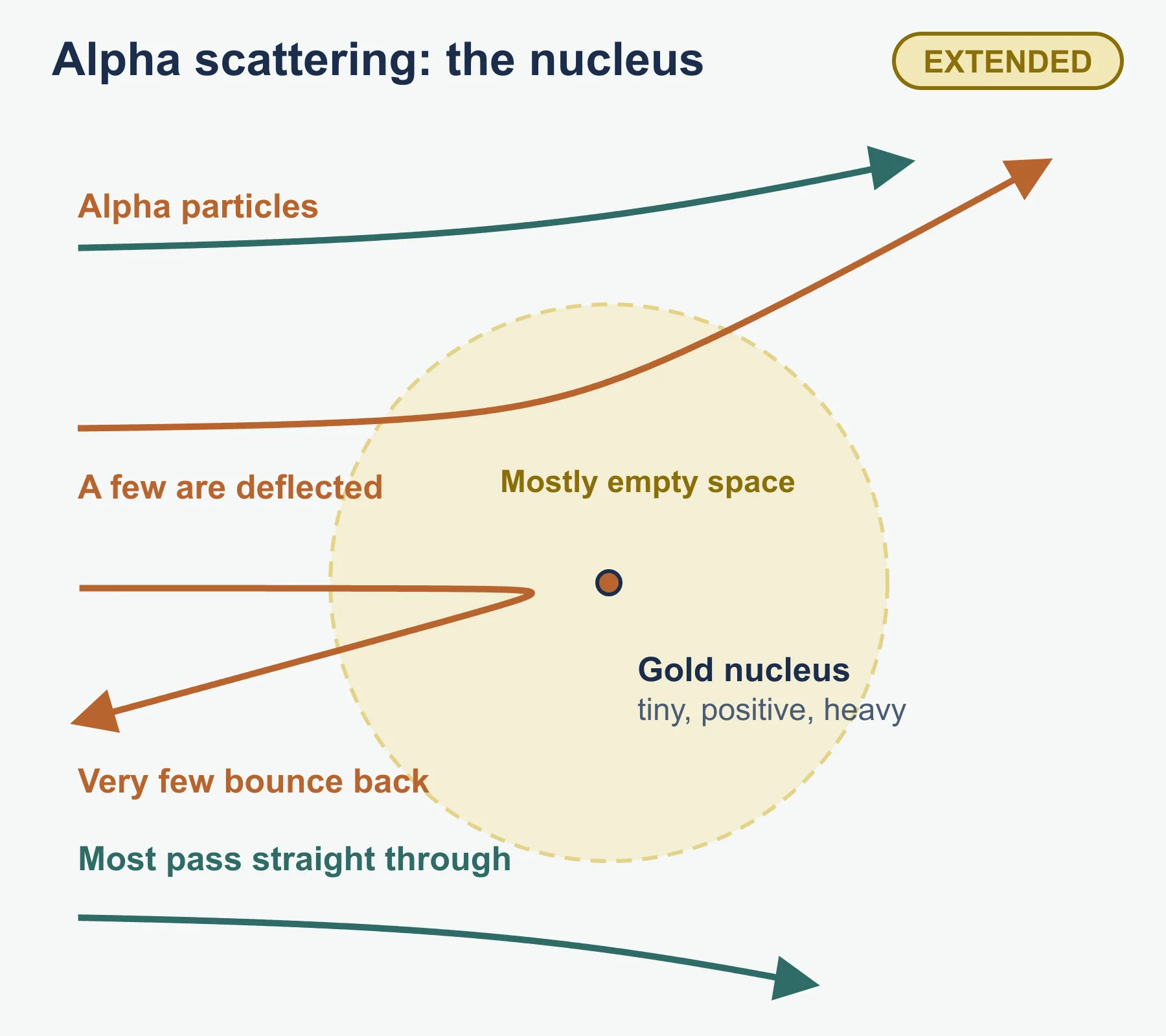
Alpha-particle scattering (Extended only)
| Observation | Evidence for |
|---|---|
| Most pass straight through or nearly so | Very small nucleus; atom mostly empty space |
| Some deflected through large angles | Nucleus is positively charged (repels positive alpha particles) |
| A very few bounce back | Nucleus contains most of the mass of the atom |
- Thin metal foil (for example gold) so particles pass through rather than being absorbed; vacuum so air does not stop them.
5.1.2 The nucleus
- Contains protons and neutrons (together called nucleons).
- Relative charges: proton +1, neutron 0, electron −1.
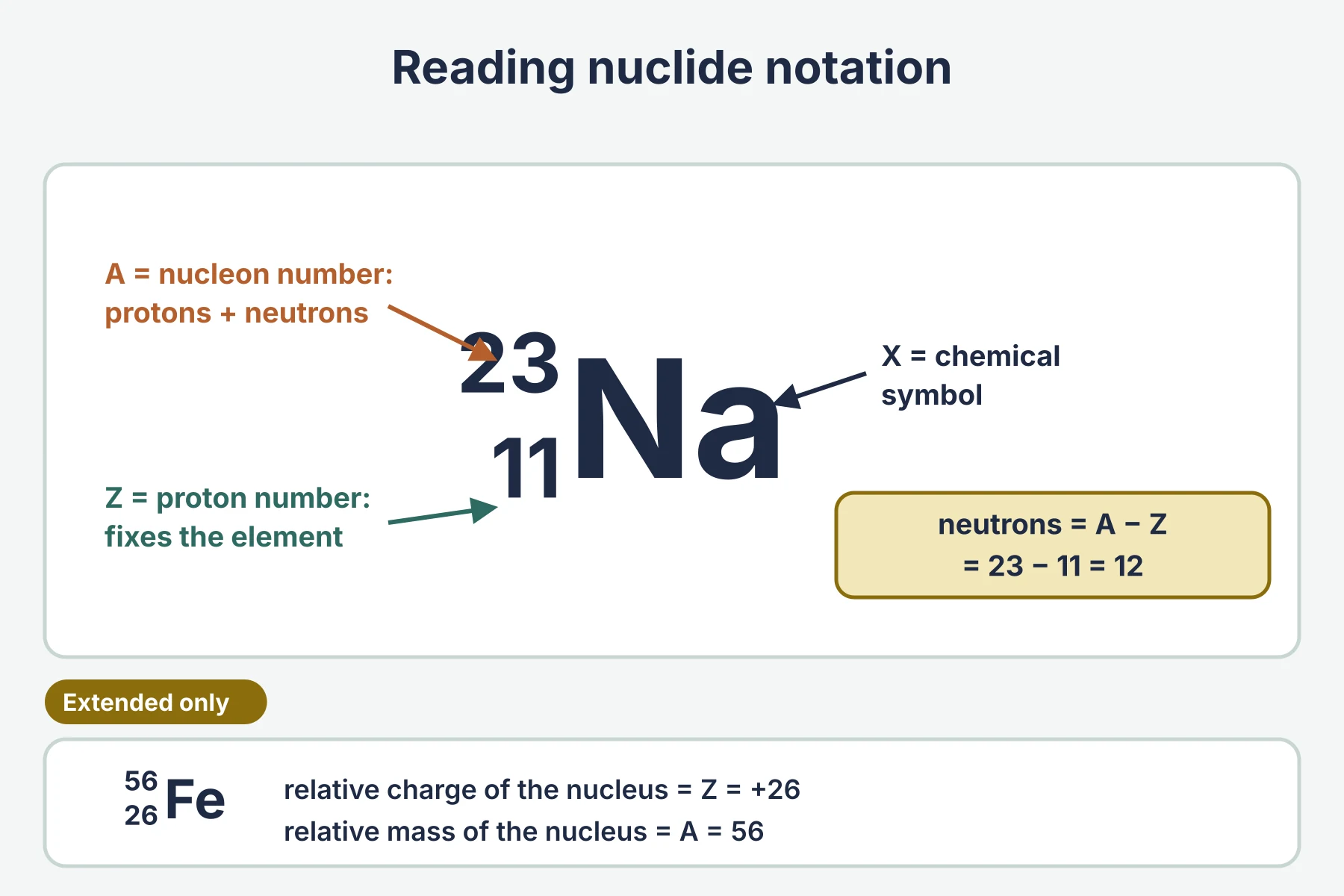
- Proton number (atomic number) Z: number of protons.
- Nucleon number (mass number) A: number of protons + neutrons.
- Neutrons = A − Z.
- Nuclide notation: ᴬ_Z X, with A at the top and Z at the bottom (for example ¹⁹₉F).
Counting table
| Quantity | Formula |
|---|---|
| Protons | Z |
| Neutrons | A − Z |
| Electrons, neutral atom | Z |
| Electrons, ion of charge +n | Z − n |
| Electrons, ion of charge −n | Z + n |
| Relative charge of nucleus (Extended only) | +Z |
| Relative mass of nucleus (Extended only) | A |
Isotopes
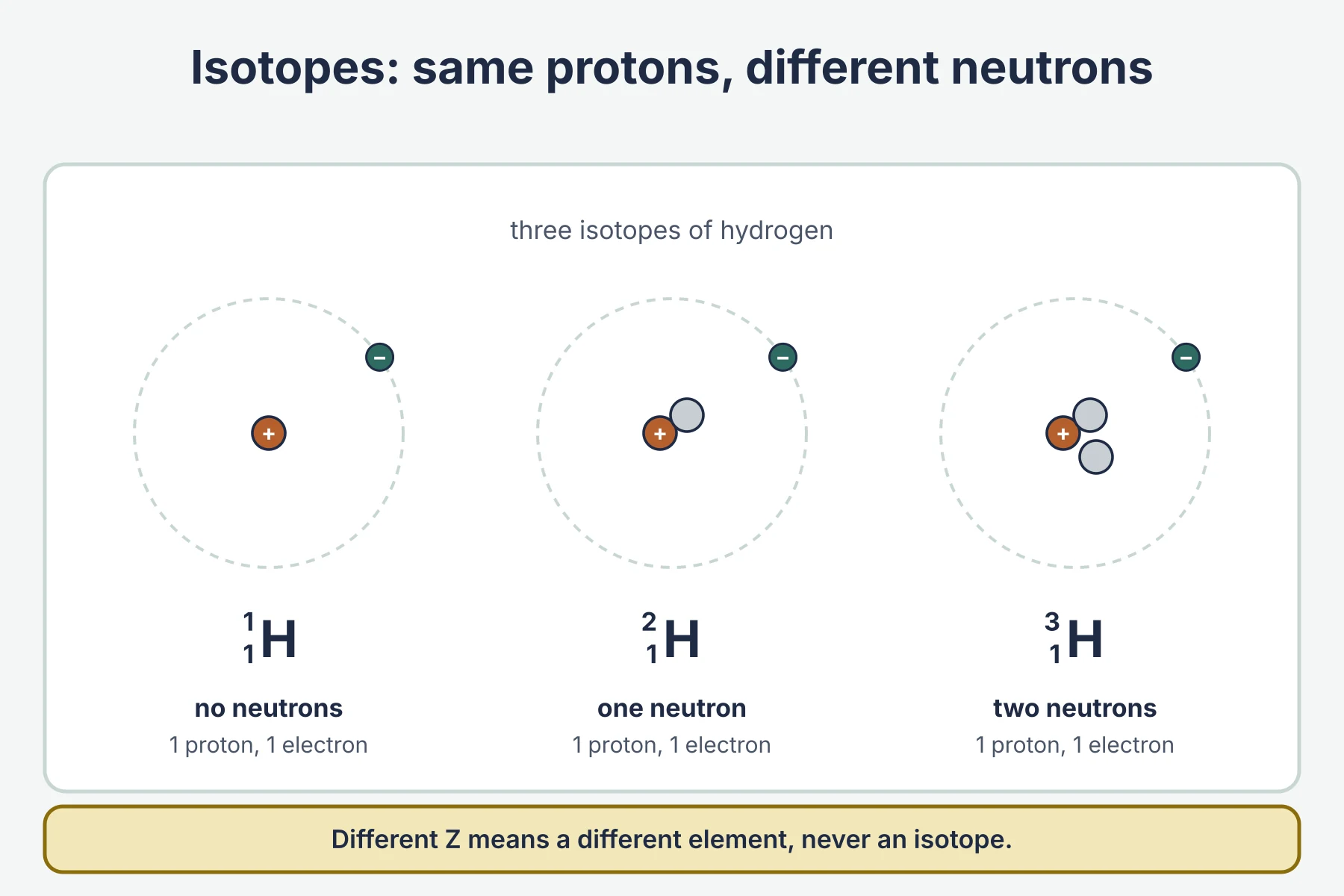
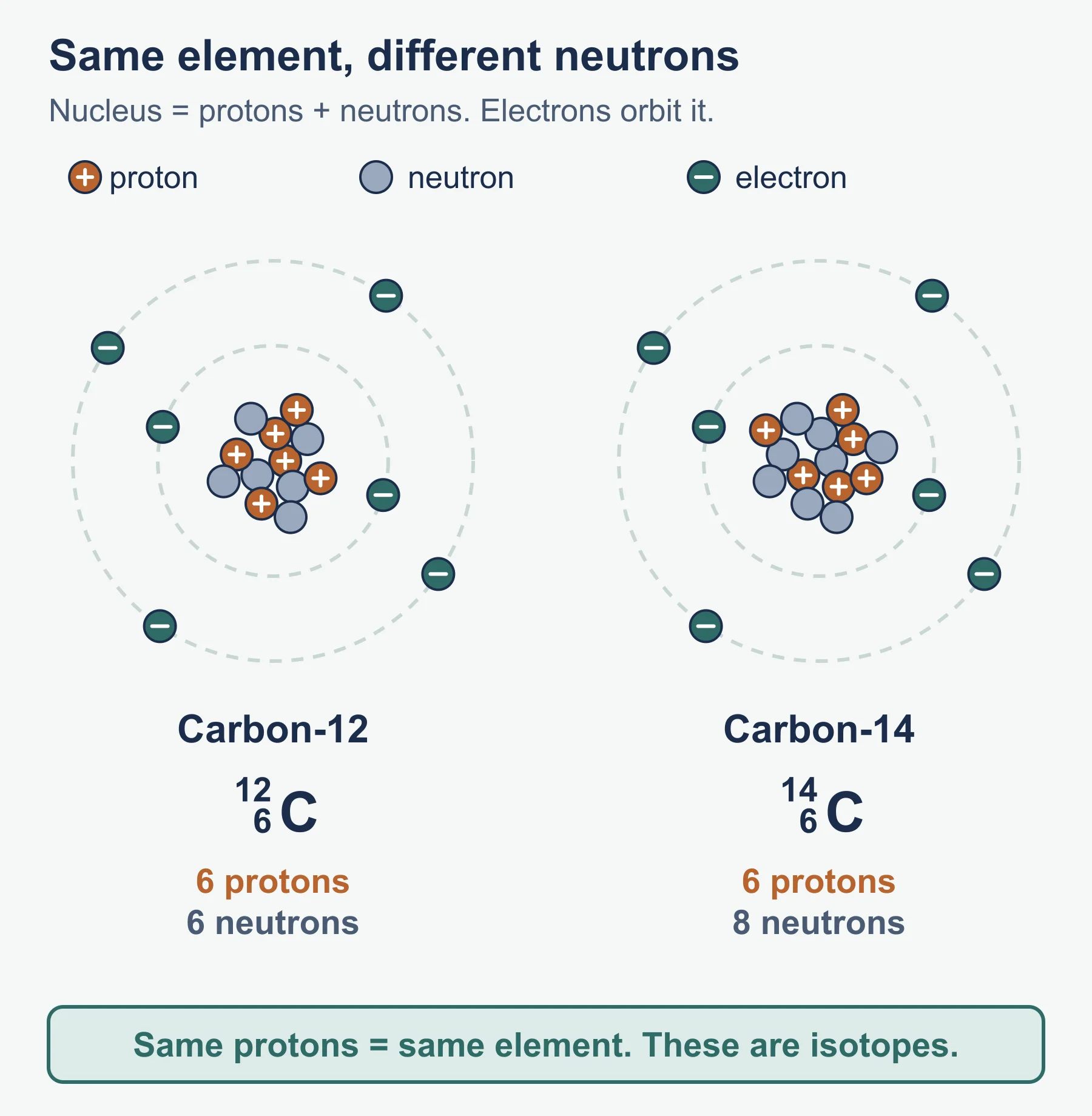
- Isotopes: atoms of the same element, same proton number, different numbers of neutrons.
- An element may have more than one isotope (hydrogen: ¹₁H, ²₁H, ³₁H).
- Different Z means a different element, not an isotope.
Fission and fusion (Extended only)
| Fission | Fusion | |
|---|---|---|
| Process | Splitting a large nucleus | Joining two light nuclei |
| Trigger | Usually absorbs a neutron first | Light nuclei collide and join |
| Extra products | 2 or 3 neutrons | Often a neutron |
| Mass | Products slightly less | Products slightly less |
| Energy | Released | Released |
Method in steps: balancing a nuclide equation
- Add the top numbers (A) on the left.
- Add the top numbers on the right; the totals must be equal.
- Repeat for the bottom numbers (Z).
- Use the difference to find a missing nucleus or the number of neutrons (¹₀n).
- Name the missing element from its Z, using a symbol you are given.
Examples
²³⁵₉₂U + ¹₀n → ¹⁴⁰₅₄Xe + ⁹⁴₃₈Sr + 2 ¹₀n
²₁H + ³₁H → ⁴₂He + ¹₀n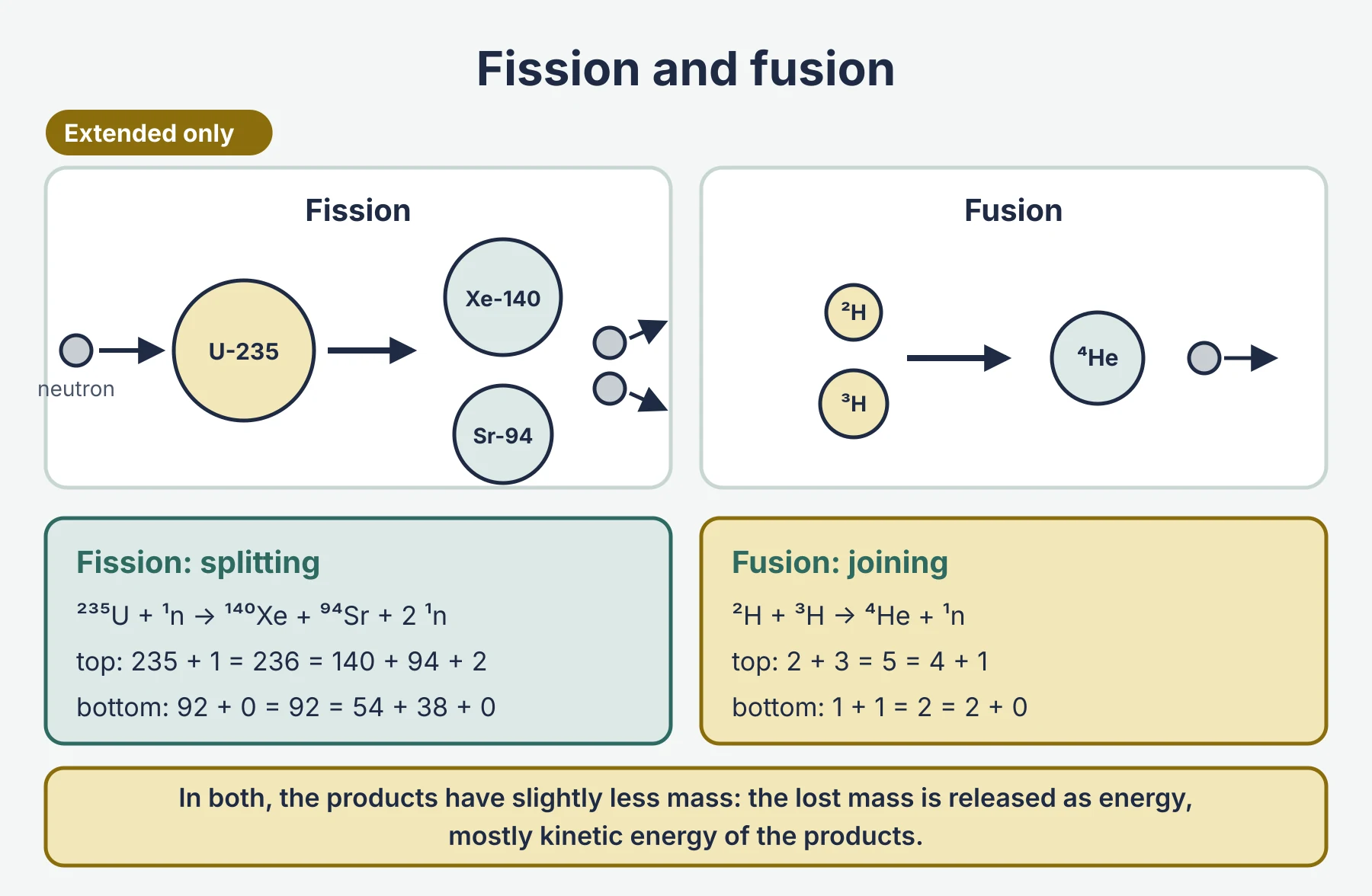
Must-know distinctions
- Isotope vs ion: isotopes differ in neutrons; ions differ from their atoms in electrons.
- Proton number vs nucleon number: Z counts protons only; A counts protons and neutrons.
- Atom vs nucleus: the nucleus is tiny but holds almost all the mass; the electrons occupy the space around it.
- Fission vs fusion (Extended only): splitting a heavy nucleus vs joining light ones; both release energy.
Key terms
| Term | Meaning |
|---|---|
| Nucleus | Small, dense, positive centre of the atom |
| Nucleon | A proton or a neutron |
| Proton number (Z) | Number of protons in the nucleus |
| Nucleon number (A) | Number of protons and neutrons in the nucleus |
| Ion | Atom that has lost or gained electrons |
| Isotope | Same element, different number of neutrons |
| Fission (Extended only) | Splitting of a nucleus |
| Fusion (Extended only) | Joining of nuclei |
Exam traps
- A on top, Z on the bottom.
- Isotopes differ in neutrons, not protons or electrons.
- Ions differ from atoms in electrons, not protons.
- Each alpha-scattering observation has its own conclusion.
- In fission and fusion the products have less mass; give no numbers.
- In an equation, a neutron is ¹₀n: A = 1, Z = 0.
Self-test
- Describe the structure of an atom.
- State the relative charges of a proton, a neutron and an electron.
- How many neutrons are in ⁶⁵₃₀Zn?
- An atom of ²⁷₁₃Al loses three electrons. State the charge on the ion and its number of electrons.
- An atom of ¹⁹₉F gains one electron. How many electrons does the ion have?
- Define nucleon number.
- What is meant by isotopes?
- ¹⁴₆C and ¹⁴₇N have the same nucleon number. Are they isotopes? Explain.
- (Extended) State the relative charge and relative mass of the nucleus ¹⁰⁷₄₇Ag.
- (Extended) Which alpha-scattering observation shows that the nucleus is very small?
- (Extended) In ²³⁵₉₂U + ¹₀n → ¹³⁷₅₅Cs + ⁹⁶₃₇Rb + x ¹₀n, find x.
- (Extended) State how the total mass changes in nuclear fusion and what this tells you about energy.
Answers
- A small, positive nucleus (protons and neutrons) with negative electrons orbiting it.
- +1, 0, −1.
- 65 − 30 = 35.
- Charge +3; 13 − 3 = 10 electrons.
- 9 + 1 = 10.
- The number of protons plus neutrons in a nucleus.
- Atoms of the same element (same proton number) with different numbers of neutrons.
- No: they have different proton numbers (6 and 7), so they are different elements.
- Relative charge +47; relative mass 107.
- Most alpha particles pass straight through.
- 236 − 137 − 96 = 3, so x = 3 (bottom row: 92 = 55 + 37).
- The mass decreases slightly; the lost mass is released as energy.
Official syllabus
Cambridge International, Cambridge IGCSE Physics 0625 syllabus for examination in 2026, 2027 and 2028, Topic 5 Nuclear physics, section 5.1 The nuclear model of the atom. Test yourself with the nuclear model practice questions.
Related resources
-
Study guides
Cambridge IGCSE Physics 0625: Nuclear physics – Study Guide
Study guide for Cambridge IGCSE Physics 0625 Topic 5: atomic structure, isotopes, fission and fusion, alpha, beta and gamma, half-life and safety.
Physics · Cambridge · IGCSE
Read guide -
Practice questions
Cambridge IGCSE Physics 0625: Nuclear physics – Practice Questions
Original Cambridge IGCSE Physics 0625 nuclear physics practice questions, Core and Extended: isotopes, alpha, beta and gamma, decay equations and half-life.
Physics · Cambridge · IGCSE
Try questions -
Revision notes
Cambridge IGCSE Physics 0625: Nuclear physics – Revision Notes
Revision notes for Cambridge IGCSE Physics 0625 nuclear physics: nuclide notation, decay equations, radiation properties, half-life steps and a self-test.
Physics · Cambridge · IGCSE
Revise topic
Related articles
Get free revision emails (optional)
Occasional emails with practice questions, worked explanations and links to free resources for the qualification and subjects you choose. No spam, and you can unsubscribe from any email. The free tools on this site never need an email.