
Study Guides
Cambridge IGCSE Physics (0625): Radioactivity
Study guide for Cambridge IGCSE Physics 0625 section 5.2: background radiation, alpha, beta and gamma, decay equations, half-life, uses and safety.
- Subject
- Physics
- Level
- IGCSE
- Topic
- Nuclear physics
- Author
- Marlbridge Academic Team
- Updated
- Reviewed by
- Iftikhar Azeemi (what this means)
Aligned to Cambridge IGCSE Physics (0625), For examination in 2026, 2027 and 2028. Official specification .
Syllabus page (what it covers and how it is assessed): Cambridge IGCSE Physics.
Syllabus points this page covers, with Core and Extended
0625
- 5.2 Radioactivity · Core and Extended
"Core and Extended" means part of that syllabus point is Extended only. The page's own tier notes say which part.
Found an error? Report a correction.
Need help with this topic? Request a free trial class for IGCSE Physics (0625).
This guide covers one subtopic of the Cambridge IGCSE Physics 0625 syllabus (for examination in 2026, 2027 and 2028): 5.2 Radioactivity, in five parts: detection, the three types of emission, radioactive decay, half-life and safety precautions. Core content is for every candidate; content marked Extended only is Supplement material, examined on Papers 2 and 4. The Nuclear physics study guide gives the full summary tables and worked half-life examples; this page focuses on the reasoning behind identifying radiation, choosing isotopes and handling data.
What 5.2 asks you to do
| Part | Core | Extended only |
|---|---|---|
| 5.2.1 Detection | Background radiation and its main sources; detector connected to a counter; count rate in counts/s or counts/minute | Corrected count rate using background measurements |
| 5.2.2 Emissions | Emission is spontaneous and random in direction; nature, relative ionising effect and penetrating ability of α, β, γ | Deflection in electric and magnetic fields; ionising effects explained by kinetic energy and charge |
| 5.2.3 Decay | Decay is a change in an unstable nucleus, spontaneous and random; α or β decay changes the element | Excess neutrons or too heavy; effect on the nucleus; neutron → proton + electron; decay equations |
| 5.2.4 Half-life | Definition; simple calculations from tables or decay curves (no background) | Half-life from data including background; choosing isotopes for uses |
| 5.2.5 Safety | Effects on living things; safe moving, use and storage | Precautions explained by time, distance and shielding |
Background radiation and count rate
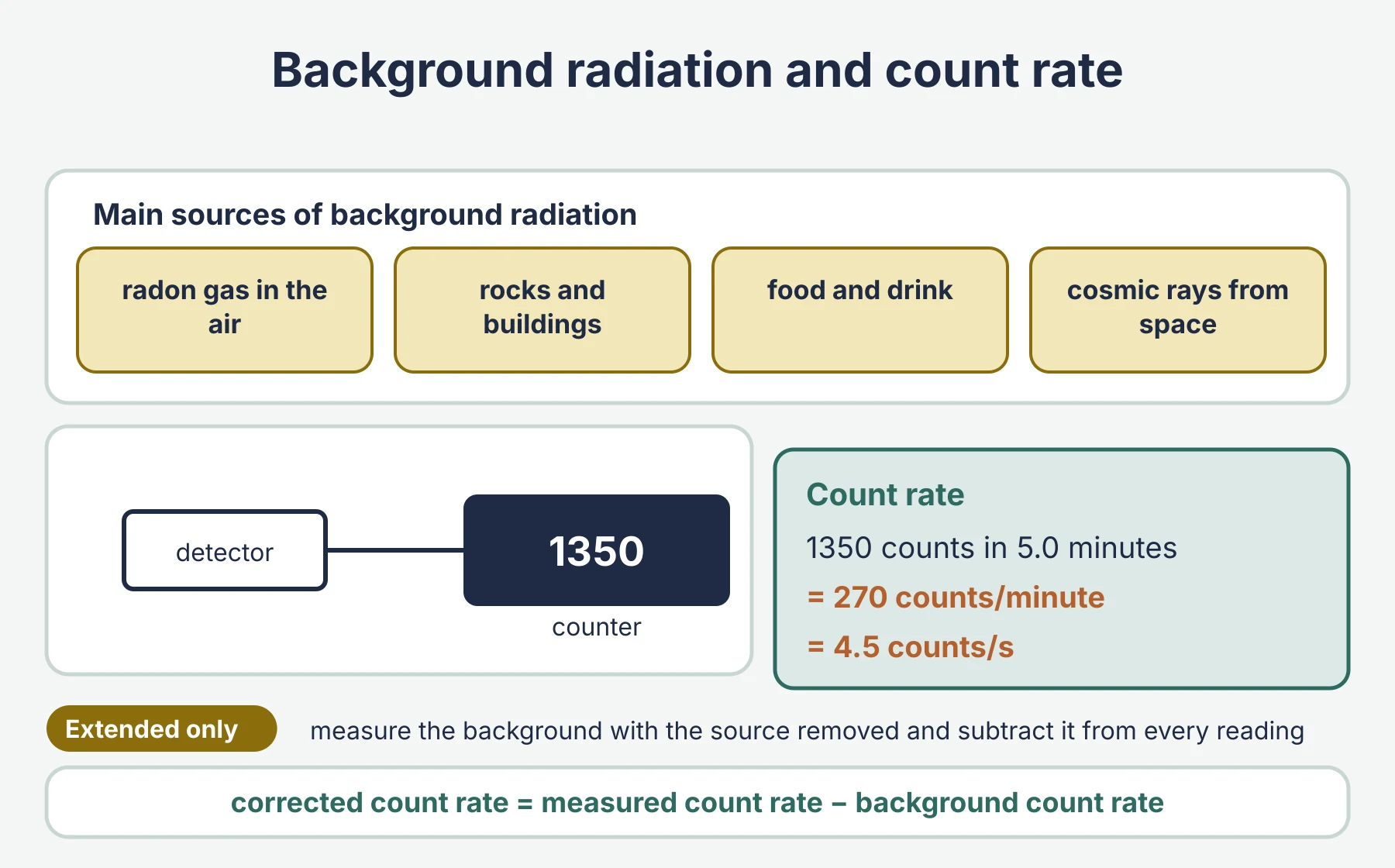
Background radiation is the ionising radiation present around us all the time. The sources that make a significant contribution are radon gas in the air, rocks and buildings, food and drink, and cosmic rays from space.
Radiation is measured with a detector connected to a counter. The count rate is the number of counts divided by the time: 1350 counts in 5.0 minutes is 270 counts/minute, or 4.5 counts/s.
Extended only. Measure the background count rate with the source removed (ideally over a long time, because emission is random) and subtract it from every reading to get the corrected count rate.
Identifying α, β and γ
| Alpha (α) | Beta (β) | Gamma (γ) | |
|---|---|---|---|
| Nature | Helium nucleus: 2 protons + 2 neutrons | Fast electron from the nucleus | Electromagnetic radiation |
| Relative ionising effect | Strongest | Medium | Weakest |
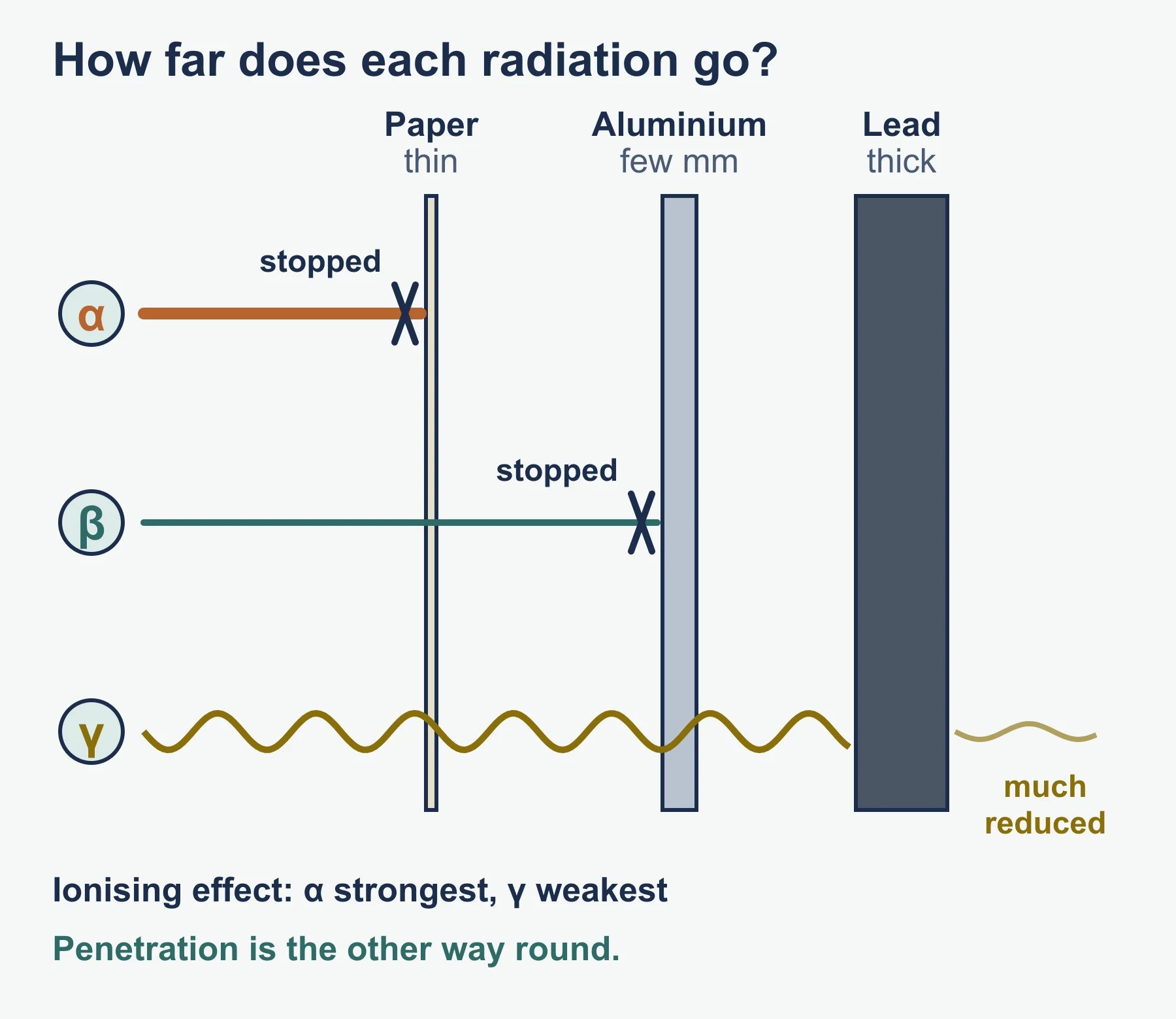
| Penetration | Stopped by paper or a few cm of air | Stopped by a few mm of aluminium | Reduced, not stopped, by thick lead or concrete |
Emission is spontaneous (it cannot be triggered or stopped by temperature or chemical changes) and random in direction.
Reading absorption data. Compare the count rate after each absorber with the one before:
- A large drop when paper is added → α is present.
- A further large drop when aluminium replaces the paper → β is present.
- A count still well above background after the aluminium, reduced by lead → γ is present.
- No change with paper → no α.
Explaining ionising effect (Extended only). Alpha particles have the largest charge (+2) and a large kinetic energy, and move relatively slowly, so they interact strongly with every atom they pass, ionise heavily and lose their energy in a short distance. That is also why they penetrate least. Gamma radiation is uncharged, so it interacts rarely, ionises least and penetrates furthest.
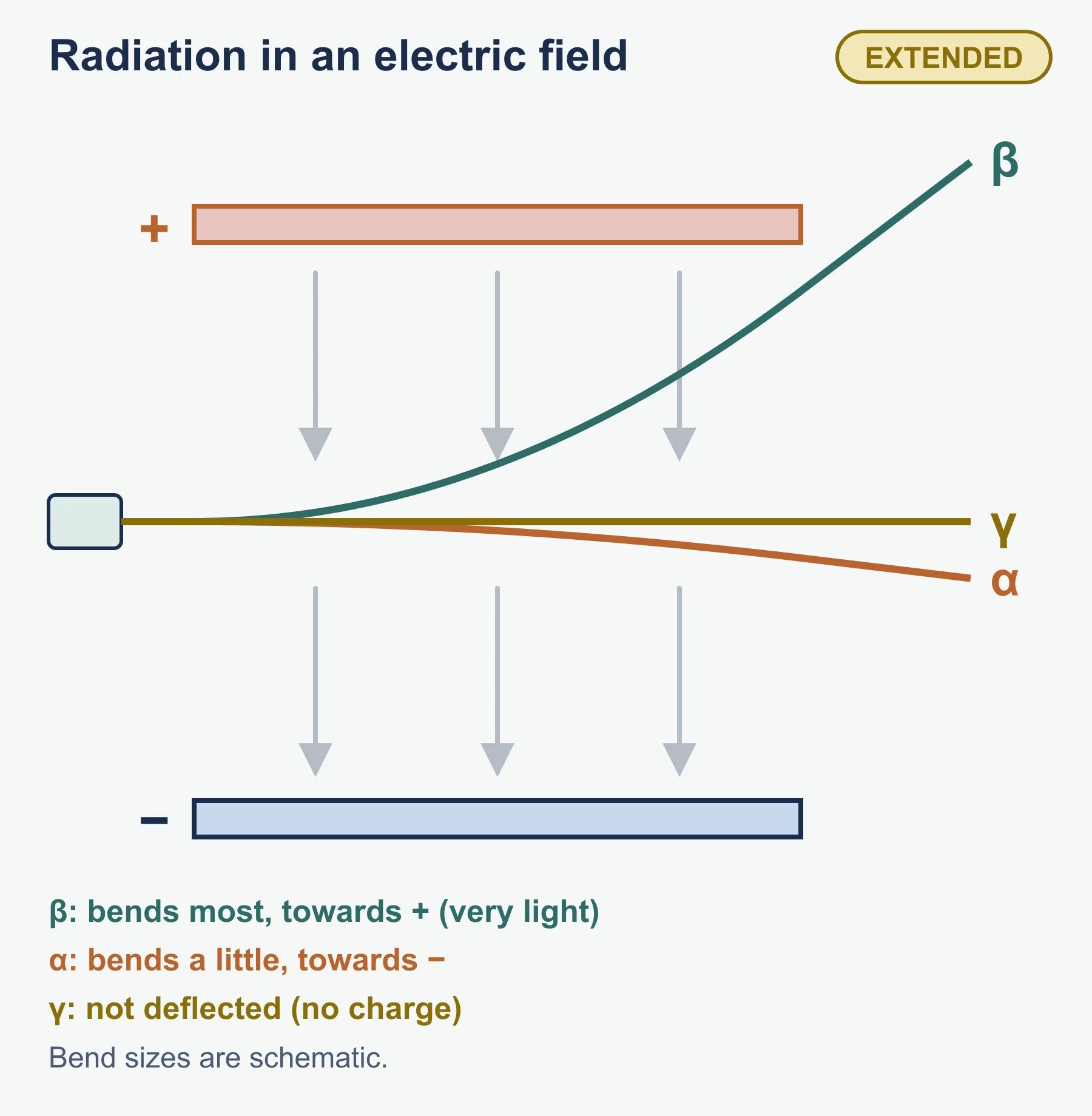
Deflection (Extended only). In an electric field, α bends towards the negative plate and β towards the positive plate; β bends more because its mass is far smaller. In a magnetic field at right angles to their motion, α and β curve in opposite directions (use Fleming’s left-hand rule, remembering β is negative), with β curving more. Gamma is not deflected by either field.
Radioactive decay
Radioactive decay is a change in an unstable nucleus that can result in the emission of α-particles, β-particles and/or γ-radiation. It is spontaneous and random: you cannot predict when a particular nucleus will decay. In α-decay or β-decay the nucleus becomes that of a different element; γ emission alone leaves the element unchanged.
Extended only. Isotopes may be unstable because the nucleus has too many neutrons and/or is too heavy. Decay makes the nucleus more stable. In β-decay a neutron changes into a proton and an electron; the electron is emitted, so the number of excess neutrons falls.
| Emission | Change in A | Change in Z | Symbol |
|---|---|---|---|
| α | −4 | −2 | ⁴₂He |
| β | 0 | +1 | ⁰₋₁e |
| γ | 0 | 0 | γ |
Worked example 1 (Extended)
Radon-222 (Z = 86) decays by α emission to polonium (Po). Strontium-90 (Z = 38) decays by β emission to yttrium (Y). Write the equations.
²²²₈₆Rn → ²¹⁸₈₄Po + ⁴₂He        top: 222 = 218 + 4;  bottom: 86 = 84 + 2
⁹⁰₃₈Sr  → ⁹⁰₃₉Y  + ⁰₋₁e         top: 90 = 90 + 0;    bottom: 38 = 39 + (−1)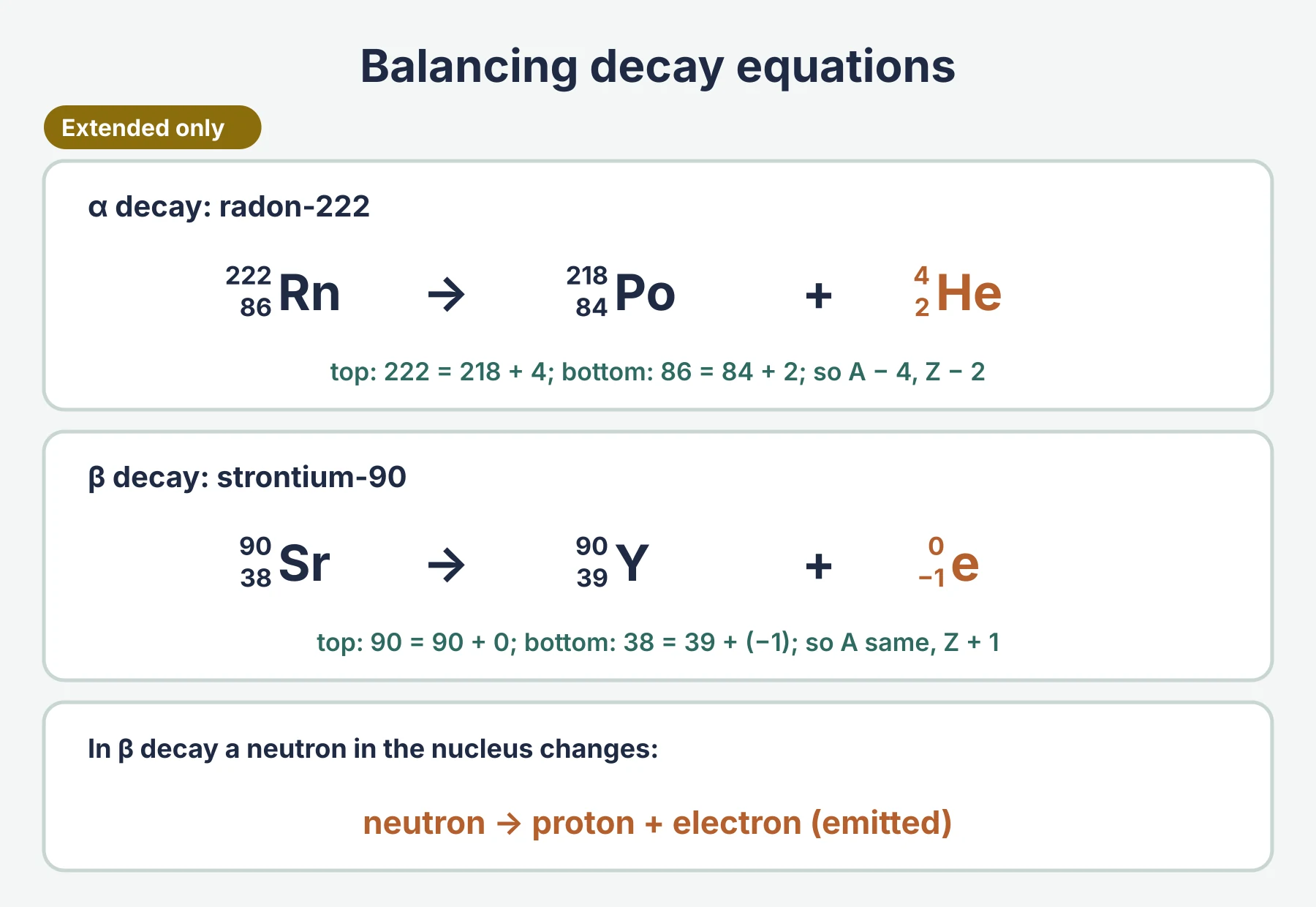
Half-life
The half-life of a particular isotope is the time taken for half the nuclei of that isotope in any sample to decay. Each half-life halves the count rate (and the number of undecayed nuclei), whatever the starting value.
Core method: count the halvings. A count rate falls from 1280 to 160 counts/minute in 15 minutes: 1280 → 640 → 320 → 160 is 3 half-lives, so the half-life is 15 ÷ 3 = 5.0 minutes. After n half-lives the fraction remaining is (1/2)ⁿ: after 4 half-lives, 1/16 remains.
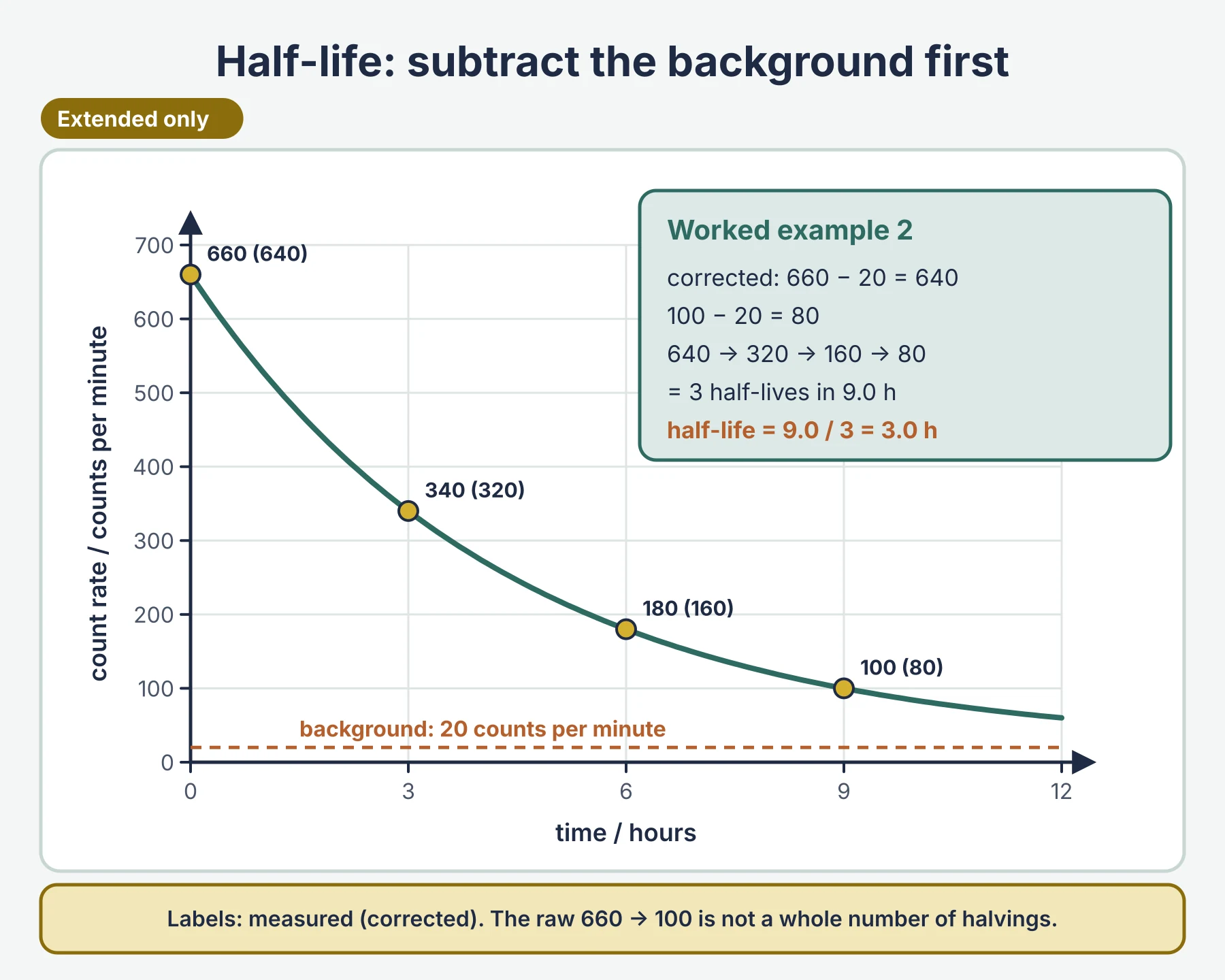
Worked example 2 (Extended)
A source gives 660 counts/minute; 9.0 hours later it gives 100 counts/minute. The background is 20 counts/minute. Find the half-life.
corrected: 660 − 20 = 640;  100 − 20 = 80
640 → 320 → 160 → 80  = 3 half-lives
half-life = 9.0 / 3 = 3.0 hours
Using the raw readings (660 to 100) gives 2.7 halvings and a wrong answer; this is exactly the trap the Supplement outcome tests. On a decay curve that levels off above zero, the level it approaches is the background.
Choosing an isotope (Extended only)
Every choice has two parts: the type of radiation (does it penetrate as far as needed, and is it absorbed where it should be?) and the half-life (long enough to do the job, short enough not to leave a lasting hazard where that matters).
| Use | Radiation | Half-life | Reason |
|---|---|---|---|
| Smoke alarm | α | Long (years) | Ionises the air in the detector but is stopped by the casing; long half-life gives a steady count for the alarm’s life |
| Irradiating food; sterilising equipment | γ | Long | Penetrates packaging to kill bacteria; source lasts |
| Thickness of paper or thin sheet | β | Long | Partly absorbed, so the count changes with thickness (α absorbed completely, γ barely at all) |
| Diagnosing cancer (tracer) | γ | Short (hours) | Detected outside the body; activity falls quickly, limiting the dose |
| Treating cancer | γ | Long (for an external source) | Penetrates to the tumour from beams aimed at it |
Americium-241, an α emitter with a half-life of about 430 years, is the usual smoke-alarm example.
Safety precautions
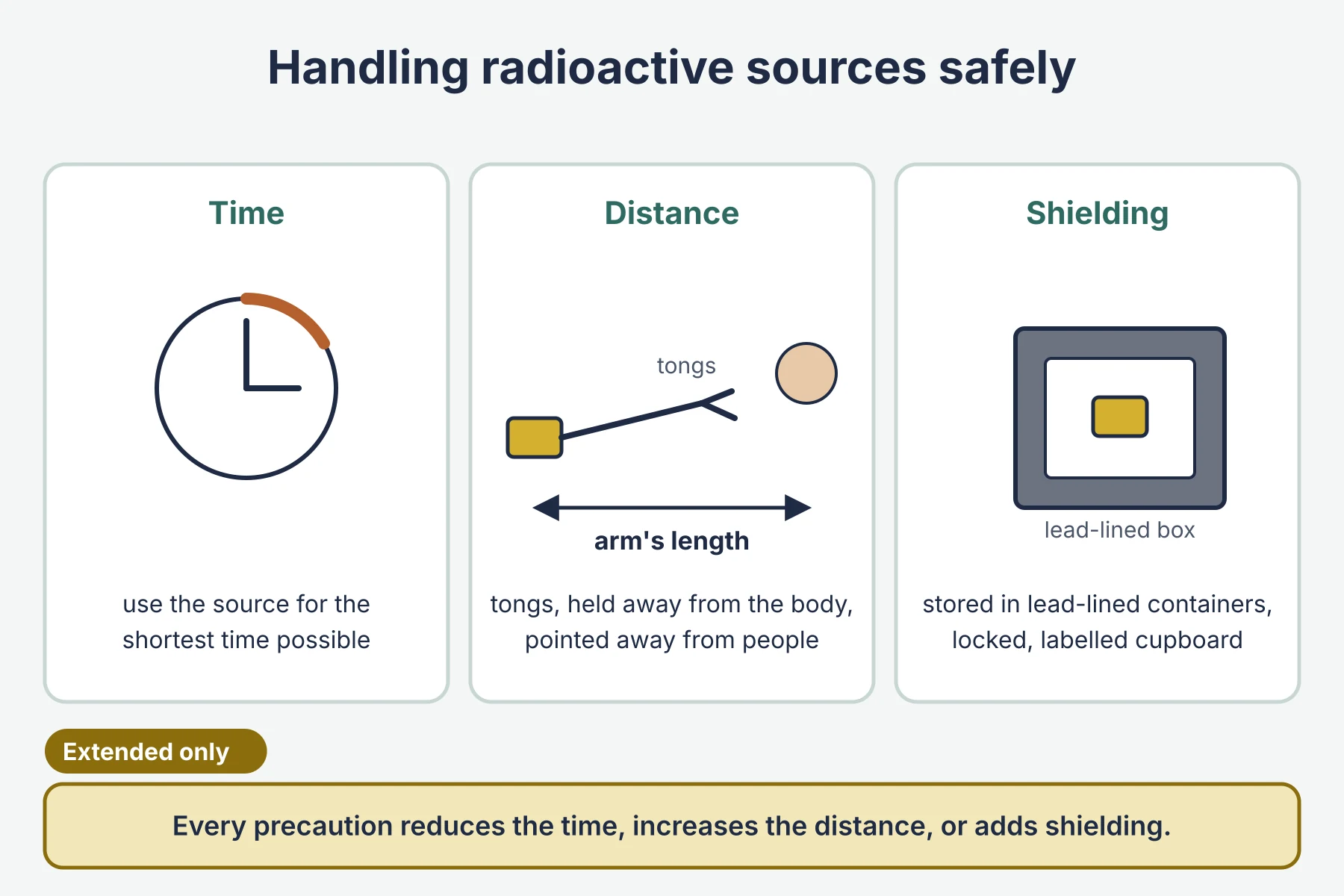
Ionising radiation can cause cell death, mutations and cancer. In schools and hospitals, sources are handled with tongs, held away from the body and pointed away from people, used for the shortest time possible, and stored in lead-lined containers in a locked, labelled cupboard.
Extended only. Every precaution reduces exposure in one of three ways: reducing the time of exposure, increasing the distance between source and living tissue, or using shielding to absorb the radiation. When asked to explain a precaution, name which of the three it uses.
Common mistakes
- Saying γ is stopped by lead; thick lead only reduces it.
- Saying a nucleus “decays faster when heated”.
- Defining half-life as half the time for the whole sample to decay.
- Halving the time instead of the count rate.
- Leaving background in the data for an Extended half-life calculation.
- Choosing an isotope by radiation type alone, without the half-life.
Exam technique
- State the nature of a radiation precisely: “helium nucleus”, “electron from the nucleus”, “electromagnetic radiation”.
- Deduce from absorption data: give a reason for including and for ruling out each type.
- Calculate half-life: show each halving, or read two points from a curve with construction lines.
- Explain a use: one point on radiation type, one on half-life.
- Explain a precaution (Extended): time, distance or shielding.
Condense this with the radioactivity revision notes and practise with the radioactivity practice questions. The previous subtopic is the nuclear model of the atom; Topic 6 begins with the Earth and the Solar System.
Official syllabus
Cambridge International, Cambridge IGCSE Physics 0625 syllabus for examination in 2026, 2027 and 2028, Topic 5 Nuclear physics, section 5.2 Radioactivity (5.2.1 to 5.2.5).
Related resources
-
Practice questions
Cambridge IGCSE Physics (0625): Radioactivity – Practice Questions
Thirteen original Cambridge IGCSE Physics 0625 radioactivity questions: background, absorption data, decay equations, half-life, uses and safety, with answers.
Physics · Cambridge · IGCSE
Try questions -
Revision notes
Cambridge IGCSE Physics (0625): Radioactivity – Revision Notes
Revision notes for Cambridge IGCSE Physics 0625 section 5.2: background, alpha, beta and gamma, decay equations, half-life, uses, safety and a self-test.
Physics · Cambridge · IGCSE
Revise topic -
Study guides
Cambridge IGCSE Physics (0625): The nuclear model of the atom
Study guide for Cambridge IGCSE Physics 0625 section 5.1: atomic structure, ions, alpha scattering, nuclide notation, isotopes, and fission and fusion.
Physics · Cambridge · IGCSE
Read guide
Related articles
Get free revision emails (optional)
Occasional emails with practice questions, worked explanations and links to free resources for the qualification and subjects you choose. No spam, and you can unsubscribe from any email. The free tools on this site never need an email.