
Study Guides
Cambridge IGCSE Physics (0625): The Earth and the Solar System
Study guide for Cambridge IGCSE Physics 0625 section 6.1: day and night, seasons, Moon phases, the planets, accretion, gravity, orbital speed and orbits.
- Subject
- Physics
- Level
- IGCSE
- Topic
- Space physics
- Author
- Marlbridge Academic Team
- Updated
- Reviewed by
- Iftikhar Azeemi (what this means)
Aligned to Cambridge IGCSE Physics (0625), For examination in 2026, 2027 and 2028. Official specification .
Syllabus page (what it covers and how it is assessed): Cambridge IGCSE Physics.
Syllabus points this page covers, with Core and Extended
0625
- 6.1 The Earth and the Solar System · Core and Extended
"Core and Extended" means part of that syllabus point is Extended only. The page's own tier notes say which part.
Found an error? Report a correction.
Need help with this topic? Request a free trial class for IGCSE Physics (0625).
This guide covers one subtopic of the Cambridge IGCSE Physics 0625 syllabus (for examination in 2026, 2027 and 2028): 6.1 The Earth and the Solar System, in two parts: the Earth (6.1.1) and the Solar System (6.1.2). Core content is for every candidate; content marked Extended only is Supplement material, examined on Papers 2 and 4. The Space physics study guide covers all of Topic 6 with worked examples for the Earth’s orbital speed and the Sun’s light; this page explains the observations in more depth and gives new calculations and data-handling practice.
What 6.1 asks you to do
| Part | Core | Extended only |
|---|---|---|
| 6.1.1 The Earth | Rotation on a tilted axis in about 24 hours: apparent daily motion of the Sun, day and night; orbit of the Sun in about 365 days: seasons; Moon’s orbit in about one month: phases | Average orbital speed v = 2πr / T |
| 6.1.2 The Solar System | Members: the Sun, eight planets in order, minor planets (dwarf planets, asteroids), moons, comets and natural satellites; inner rocky and outer gaseous planets, explained by an accretion model; gravitational field strength; light travel times; the Sun’s mass and gravitational attraction keep planets in orbit | Elliptical orbits; analysing planetary data; the Sun’s field and orbital speeds decrease with distance; faster when closer, explained by conservation of energy |
Three motions, three cycles
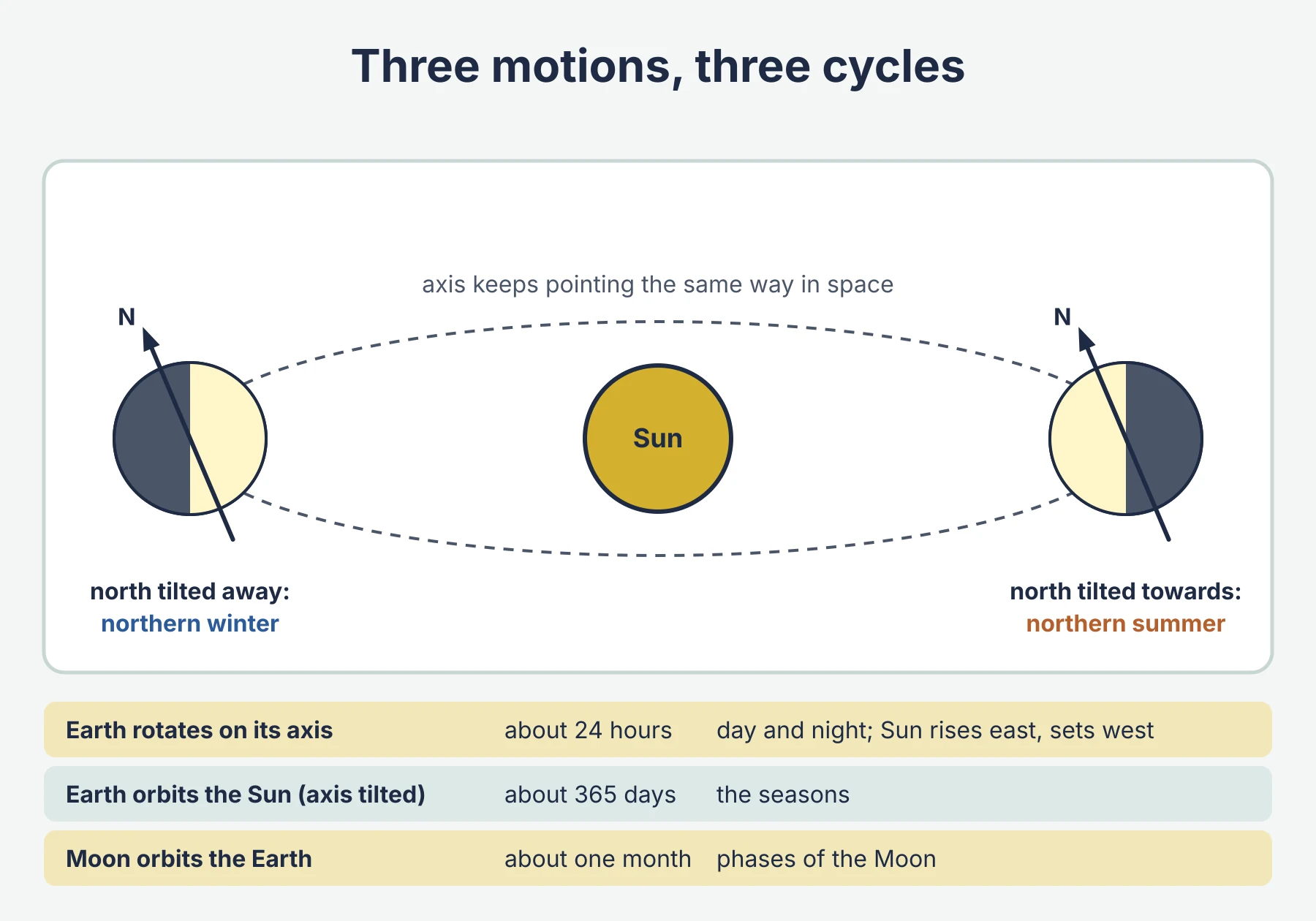
The key to 6.1.1 is matching each observation to the right motion:
| Motion | Time | Explains |
|---|---|---|
| Earth rotates on its axis | about 24 hours | Day and night; the Sun’s apparent daily path |
| Earth orbits the Sun (axis tilted) | about 365 days | The seasons |
| Moon orbits the Earth | about one month | The Moon’s cycle of phases |
Apparent daily motion of the Sun. The Earth rotates from west to east, so the Sun appears to move the other way across the sky: it rises in the east, climbs to its highest point around midday and sets in the west. The Sun is not moving round the Earth; we are turning beneath it. Day is when your side of the Earth faces the Sun; night is when it faces away.
Seasons. The Earth’s axis is tilted and stays pointing in the same direction in space as the Earth orbits. For part of the year the northern hemisphere is tilted towards the Sun: the Sun climbs higher in the sky, days are longer than nights, and sunlight strikes the ground more directly, delivering more energy to each square metre. That is summer in the north. Half an orbit later the north is tilted away: winter. The southern hemisphere has the opposite season at the same time, which is strong evidence that distance from the Sun is not the cause.
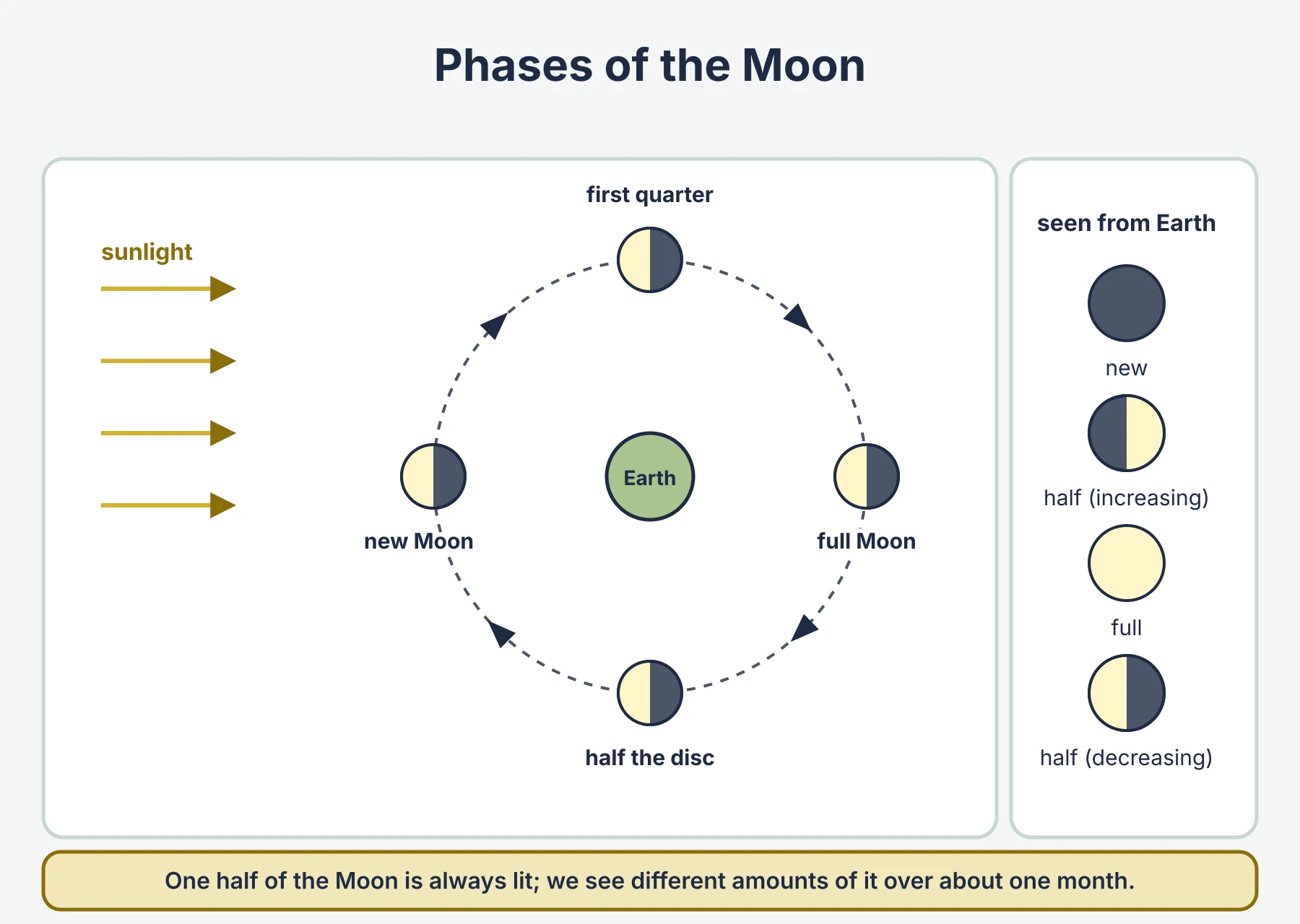
Phases of the Moon. The Moon does not produce light; it reflects sunlight. One half of the Moon is always lit by the Sun. As the Moon orbits the Earth, we see different amounts of the lit half: none at new Moon (the Moon lies roughly between Earth and Sun), half the disc at first quarter, all of it at full Moon (the Earth lies roughly between Sun and Moon), then decreasing again. The full cycle takes about one month.
Average orbital speed (Extended only)
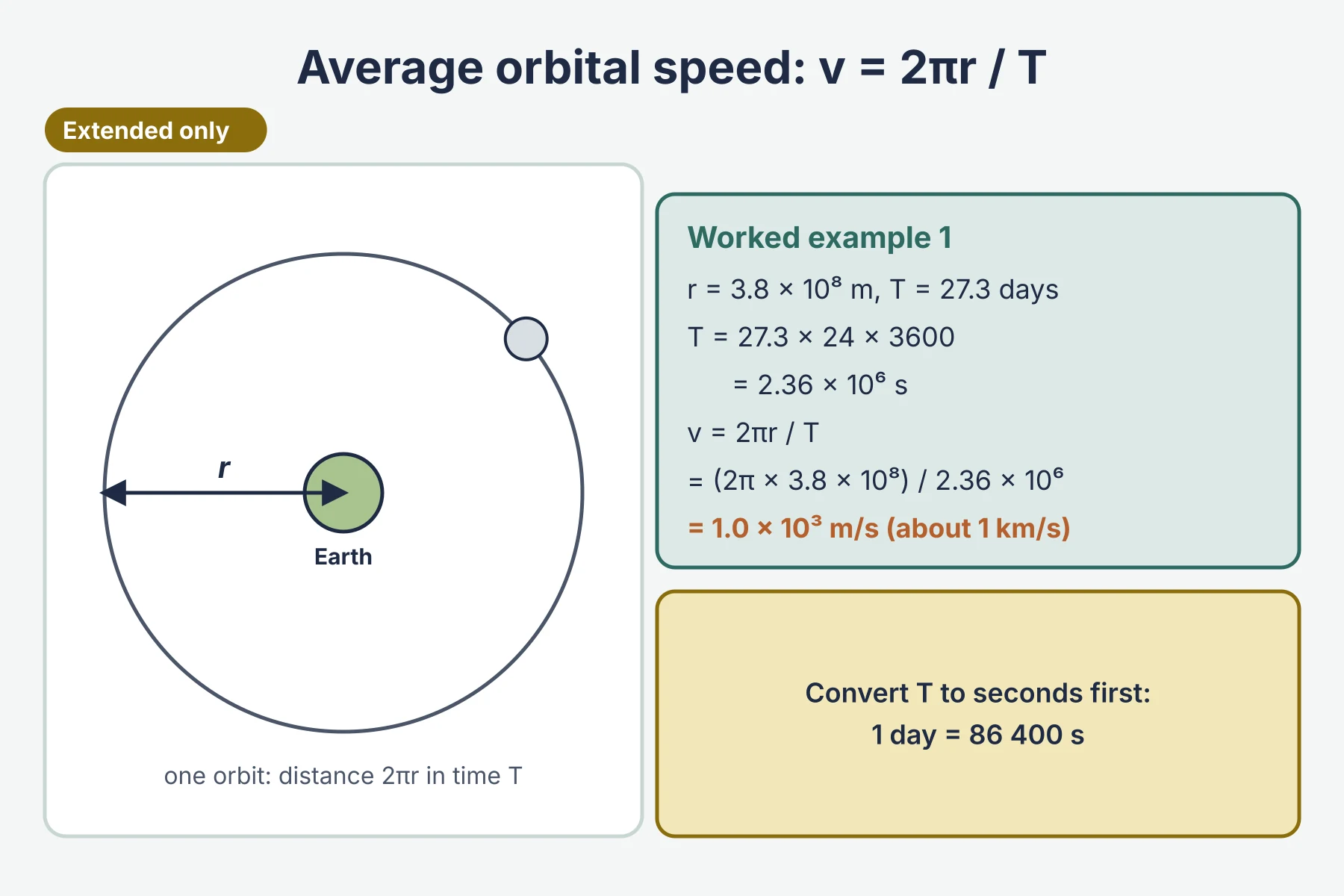
For a roughly circular orbit, the distance travelled in one orbit is the circumference, 2πr, so:
v = 2πr / T, where r is the average orbital radius and T is the orbital period.
Worked example 1 (Extended)
The Moon orbits the Earth at an average radius of 3.8 × 10⁸ m with a period of 27.3 days. Calculate its average orbital speed.
T = 27.3 × 24 × 3600 = 2.36 × 10⁶ s
v = 2πr / T = (2π × 3.8 × 10⁸) / 2.36 × 10⁶
v = 1.0 × 10³ m/s   (about 1 km/s)
The commonest error is leaving T in days, which gives an answer in metres per day. Convert first: 1 day = 86 400 s.
Members of the Solar System
The Solar System contains:
- one star, the Sun;
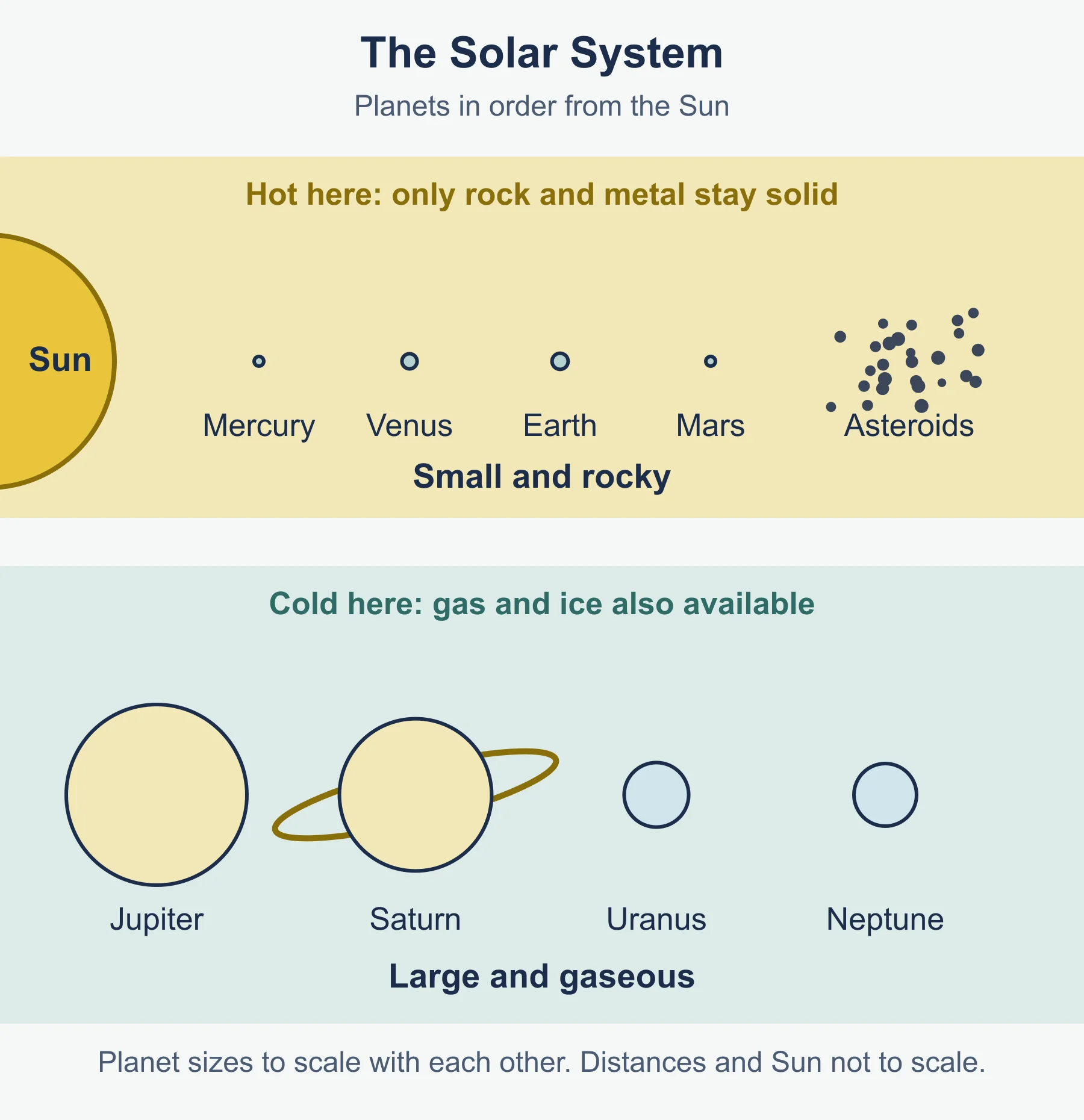
- eight planets, in order from the Sun: Mercury, Venus, Earth, Mars, Jupiter, Saturn, Uranus, Neptune;
- minor planets that orbit the Sun, including dwarf planets such as Pluto and asteroids in the asteroid belt (between Mars and Jupiter);
- moons, which orbit planets;
- smaller bodies, including comets and natural satellites.
The first four are small and rocky; the outer four are large and gaseous.
The accretion model
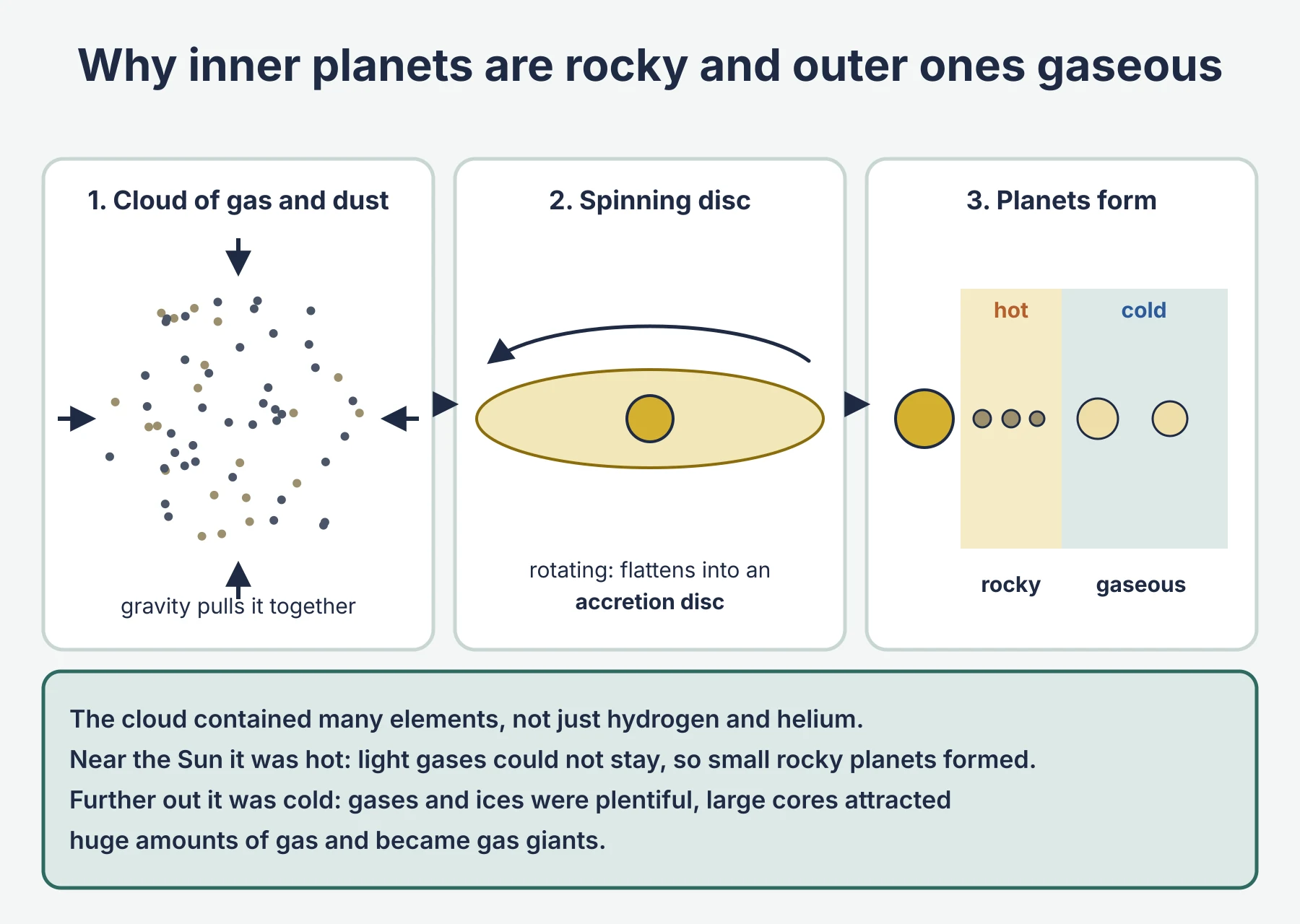
The syllabus asks you to explain the rocky–gaseous difference using an accretion model with three named features:
- Gravity: an interstellar cloud of gas and dust collapsed under its own gravitational attraction.
- Many elements: the cloud contained many elements, not just hydrogen and helium.
- Rotation and an accretion disc: the cloud was rotating, so it flattened into a spinning disc of material around the young Sun.
Near the Sun the disc was hot, so light gases could not remain; only rocky and metallic material came together, forming small, rocky planets. Further out it was cold, so gases (and ices) were plentiful; large cores formed and their strong gravity attracted huge amounts of gas, forming the gas giants.
Gravity in the Solar System
- The gravitational field strength at the surface of a planet depends on its mass: more massive planets have a stronger surface field.
- The field strength around a planet decreases as the distance from it increases.
- The Sun contains most of the mass of the Solar System, which is why the planets orbit the Sun.
- The force that keeps an object in orbit around the Sun is the gravitational attraction of the Sun.
Extended only. The strength of the Sun’s gravitational field decreases with distance, and so the orbital speeds of the planets decrease as their distance from the Sun increases. Outer planets move more slowly and have further to go, so their periods are much longer.
Worked example 2 (Extended)
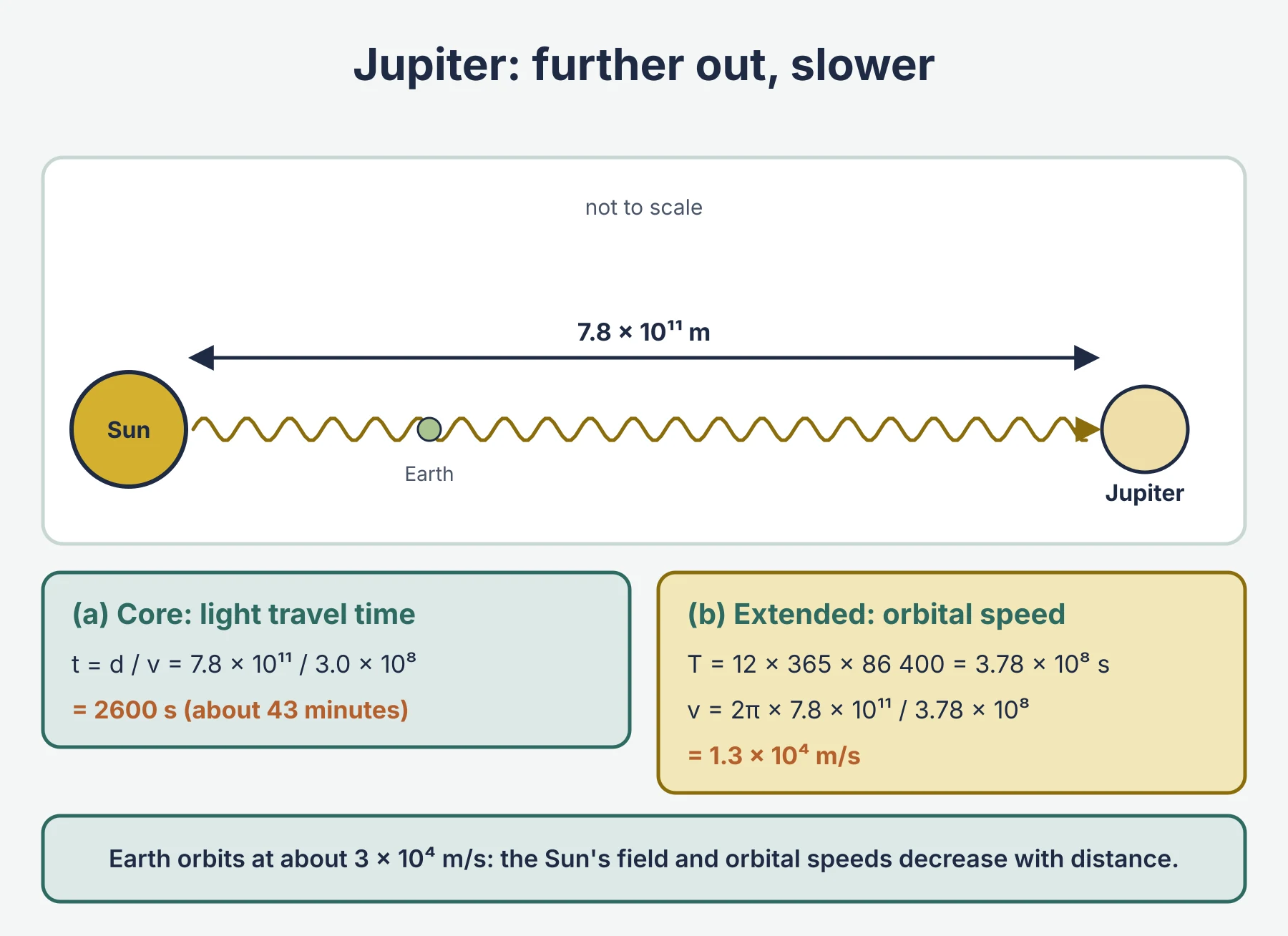
Jupiter orbits at an average radius of 7.8 × 10¹¹ m. Calculate (a) how long sunlight takes to reach Jupiter and (b) its orbital speed, given a period of 12 years. Speed of light = 3.0 × 10⁸ m/s.
(a) t = d / v = 7.8 × 10¹¹ / 3.0 × 10⁸ = 2600 s  (about 43 minutes)
(b) T = 12 × 365 × 86 400 = 3.78 × 10⁸ s
    v = 2π × 7.8 × 10¹¹ / 3.78 × 10⁸ = 1.3 × 10⁴ m/s
Part (a) is Core (light travel time); part (b) is Extended. Compare (b) with the Earth’s orbital speed of about 3 × 10⁴ m/s: the further planet is slower, as the Supplement statement predicts.
Elliptical orbits (Extended only)
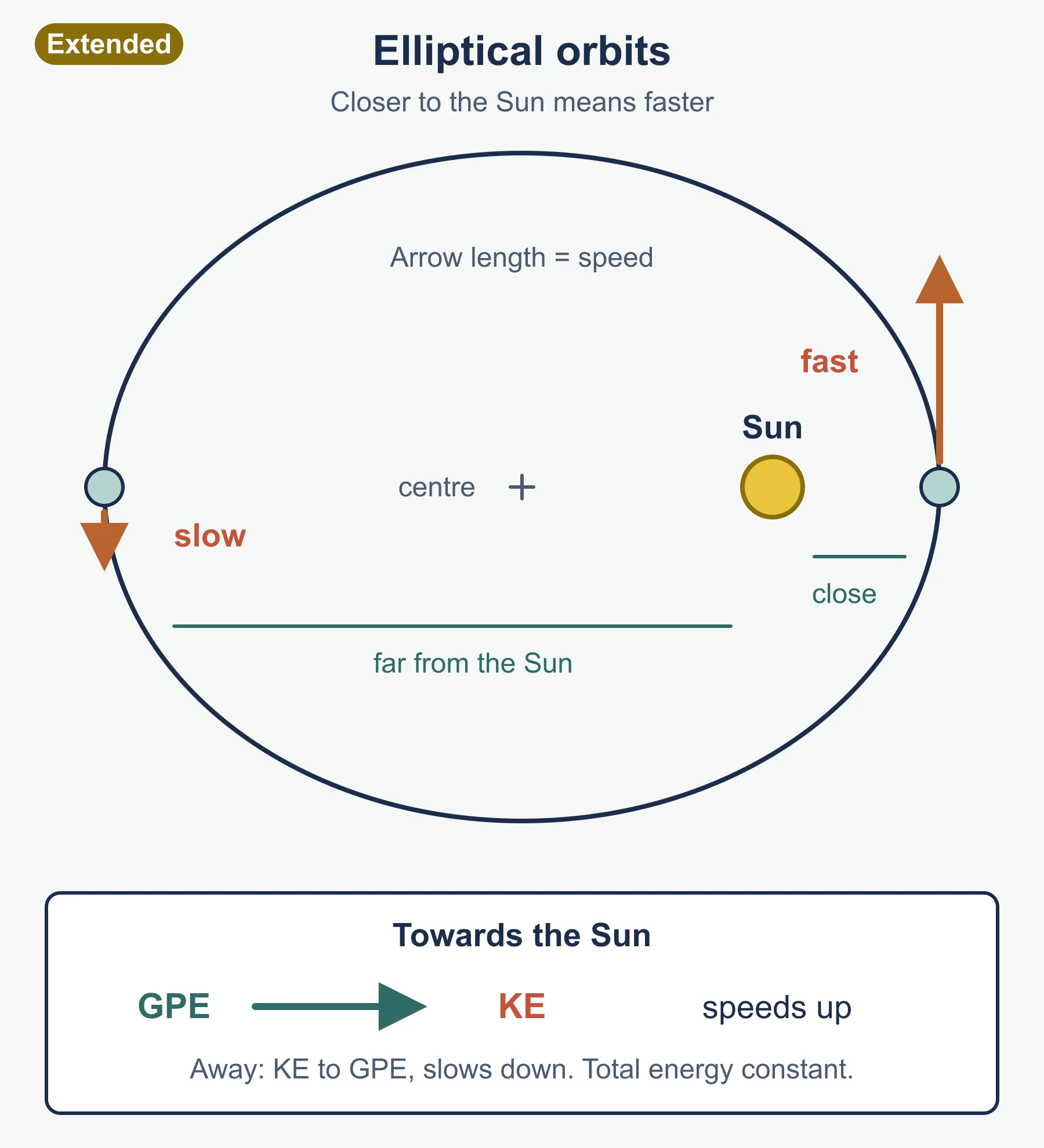
Planets, minor planets and comets have elliptical orbits. The Sun is not at the centre of an elliptical orbit, except when the orbit is approximately circular (as most planetary orbits nearly are). Comets have very stretched ellipses.
An object in an elliptical orbit travels faster when closer to the Sun. Explain this with conservation of energy: as it falls inwards towards the Sun, it loses gravitational potential energy and gains the same amount of kinetic energy, so it speeds up. As it moves away again, kinetic energy is converted back to gravitational potential energy and it slows down. Its total energy stays constant.
Analysing planetary data (Extended only)
You may be given a table of orbital distance, orbital duration, density, surface temperature and surface gravitational field strength. Useful patterns to look for:
- Larger orbital distance → longer orbital period (and lower orbital speed).
- High density (about 4–6 g/cm³) → rocky planet; low density (around 1 g/cm³ or below) → gaseous planet.
- Surface temperature generally falls with distance from the Sun.
- Surface field strength depends on mass, so a large gas giant can have a high value even with low density.
Always quote numbers from the table to support each statement, and state the trend in full (“as orbital distance increases, the period increases”).
Common mistakes
- Explaining seasons by the Earth being closer to the Sun in summer.
- Confusing rotation (day and night) with orbit (seasons).
- Explaining phases by the Earth’s shadow (that is an eclipse).
- Getting the planet order wrong, or calling Pluto a planet.
- Leaving days or years unconverted in v = 2πr / T.
- Saying the Sun sits at the centre of a comet’s orbit.
Exam technique
- Explain day and night or seasons: name the motion and the tilt where relevant.
- Describe the accretion model: use all three syllabus features (gravity, many elements, rotating disc), then hot near the Sun, cold far away.
- Calculate: convert to seconds and metres first; give the unit.
- Use the data: quote values and describe trends with both variables named.
- Explain speed changes in an ellipse: name both energy stores and say energy is conserved.
Condense this with the Earth and Solar System revision notes and practise with the Earth and Solar System practice questions. The next subtopic is stars and the Universe.
Official syllabus
Cambridge International, Cambridge IGCSE Physics 0625 syllabus for examination in 2026, 2027 and 2028, Topic 6 Space physics, section 6.1 The Earth and the Solar System (6.1.1 and 6.1.2).
Related resources
-
Practice questions
Cambridge IGCSE Physics (0625): The Earth and the Solar System – Practice Questions
Thirteen original Cambridge IGCSE Physics 0625 questions on day and night, seasons, Moon phases, the Solar System, orbital speed and planetary data.
Physics · Cambridge · IGCSE
Try questions -
Revision notes
Cambridge IGCSE Physics (0625): The Earth and the Solar System – Revision Notes
Revision notes for Cambridge IGCSE Physics 0625 section 6.1: Earth and Moon cycles, the planets, accretion, gravity, orbital speed and orbits, with a self-test.
Physics · Cambridge · IGCSE
Revise topic -
Study guides
Cambridge IGCSE Physics 0625: Space physics – Study Guide
Study guide for Cambridge IGCSE Physics 0625 space physics: the Earth, Solar System, orbits, star life cycles, redshift, CMBR and the Hubble constant.
Physics · Cambridge · IGCSE
Read guide
Related articles
Get free revision emails (optional)
Occasional emails with practice questions, worked explanations and links to free resources for the qualification and subjects you choose. No spam, and you can unsubscribe from any email. The free tools on this site never need an email.