
Revision Notes
Cambridge IGCSE Physics (0625): The Earth and the Solar System – Revision Notes
Revision notes for Cambridge IGCSE Physics 0625 section 6.1: Earth and Moon cycles, the planets, accretion, gravity, orbital speed and orbits, with a self-test.
- Subject
- Physics
- Level
- IGCSE
- Topic
- Space physics
- Author
- Marlbridge Academic Team
- Updated
- Reviewed by
- Iftikhar Azeemi (what this means)
Aligned to Cambridge IGCSE Physics (0625), For examination in 2026, 2027 and 2028. Official specification .
Syllabus page (what it covers and how it is assessed): Cambridge IGCSE Physics.
Syllabus points this page covers, with Core and Extended
0625
- 6.1 The Earth and the Solar System · Core and Extended
"Core and Extended" means part of that syllabus point is Extended only. The page's own tier notes say which part.
Found an error? Report a correction.
Need help with this topic? Request a free trial class for IGCSE Physics (0625).
These notes condense section 6.1 The Earth and the Solar System of the Cambridge IGCSE Physics 0625 syllabus (for examination in 2026, 2027 and 2028). Lines marked Extended only are Supplement content, examined on Papers 2 and 4. For explanations and worked examples, read the Earth and Solar System study guide.
Numbers to know
| Quantity | Value |
|---|---|
| Earth’s rotation | about 24 hours |
| Earth’s orbit of the Sun | about 365 days |
| Moon’s orbit of the Earth | about one month |
| 1 day | 86 400 s |
| Speed of light (use when given) | 3.0 × 10⁸ m/s |
6.1.1 The Earth
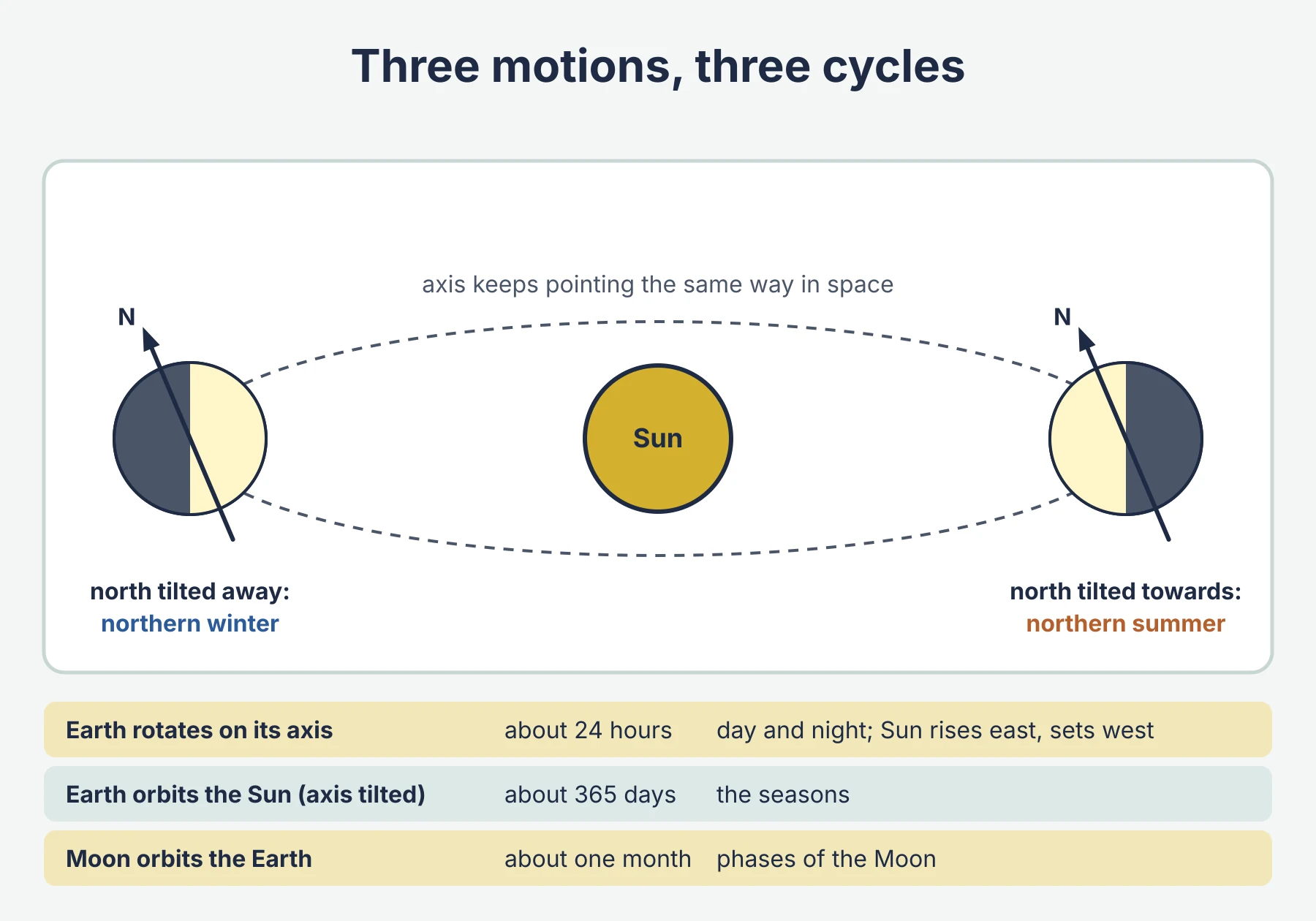
- Earth rotates on a tilted axis once in about 24 hours.
- Rotation → day and night, and the Sun’s apparent daily motion: rises in the east, highest around midday, sets in the west.
- Earth orbits the Sun in about 365 days; with the tilted axis, this gives the seasons.
- Hemisphere tilted towards the Sun: Sun higher, longer days, more energy per square metre → summer.
- The two hemispheres have opposite seasons at the same time.
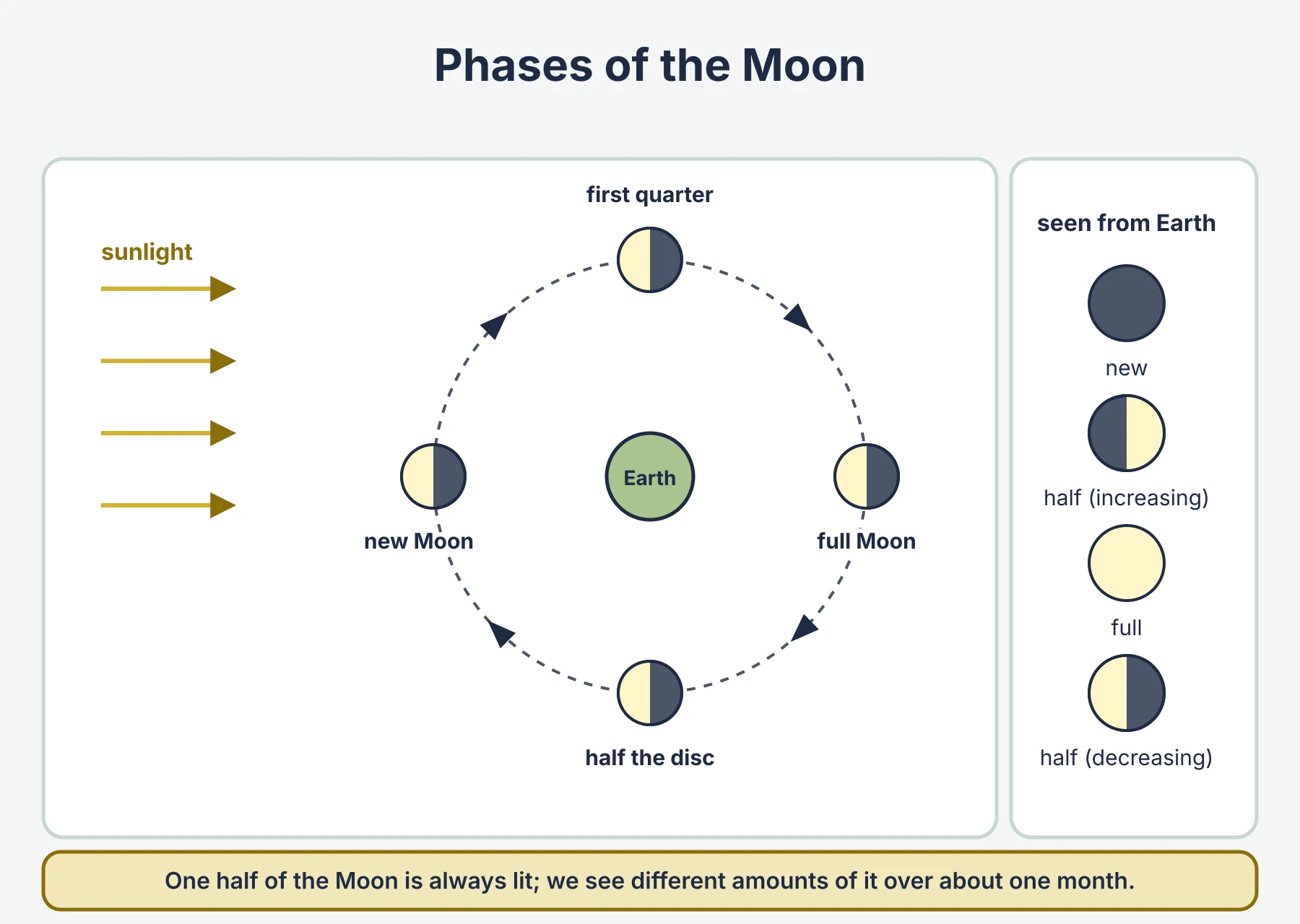
- Moon orbits the Earth in about a month; it reflects sunlight; half is always lit.
- We see different amounts of the lit half → phases (new, crescent, quarter, gibbous, full).
Extended only
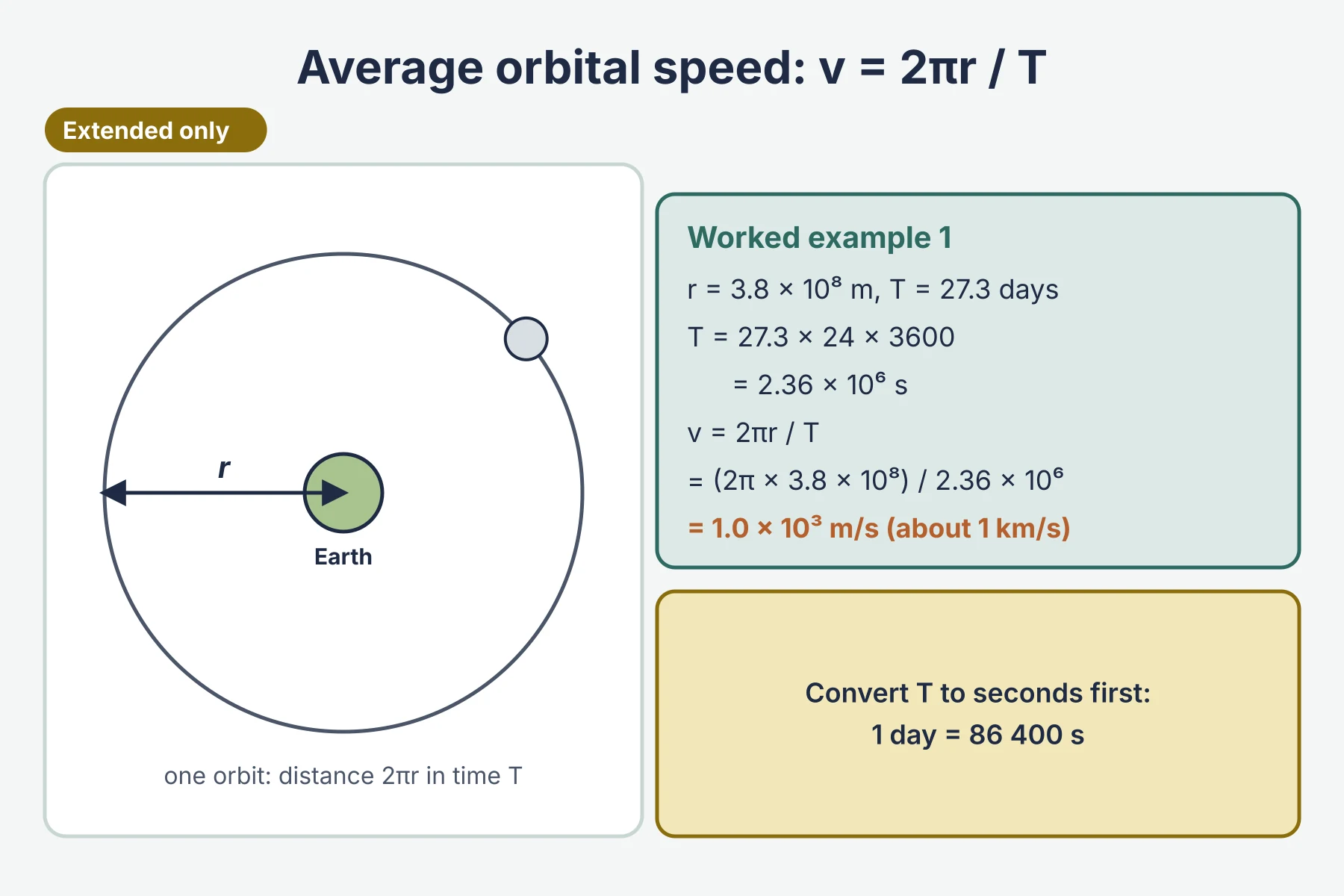
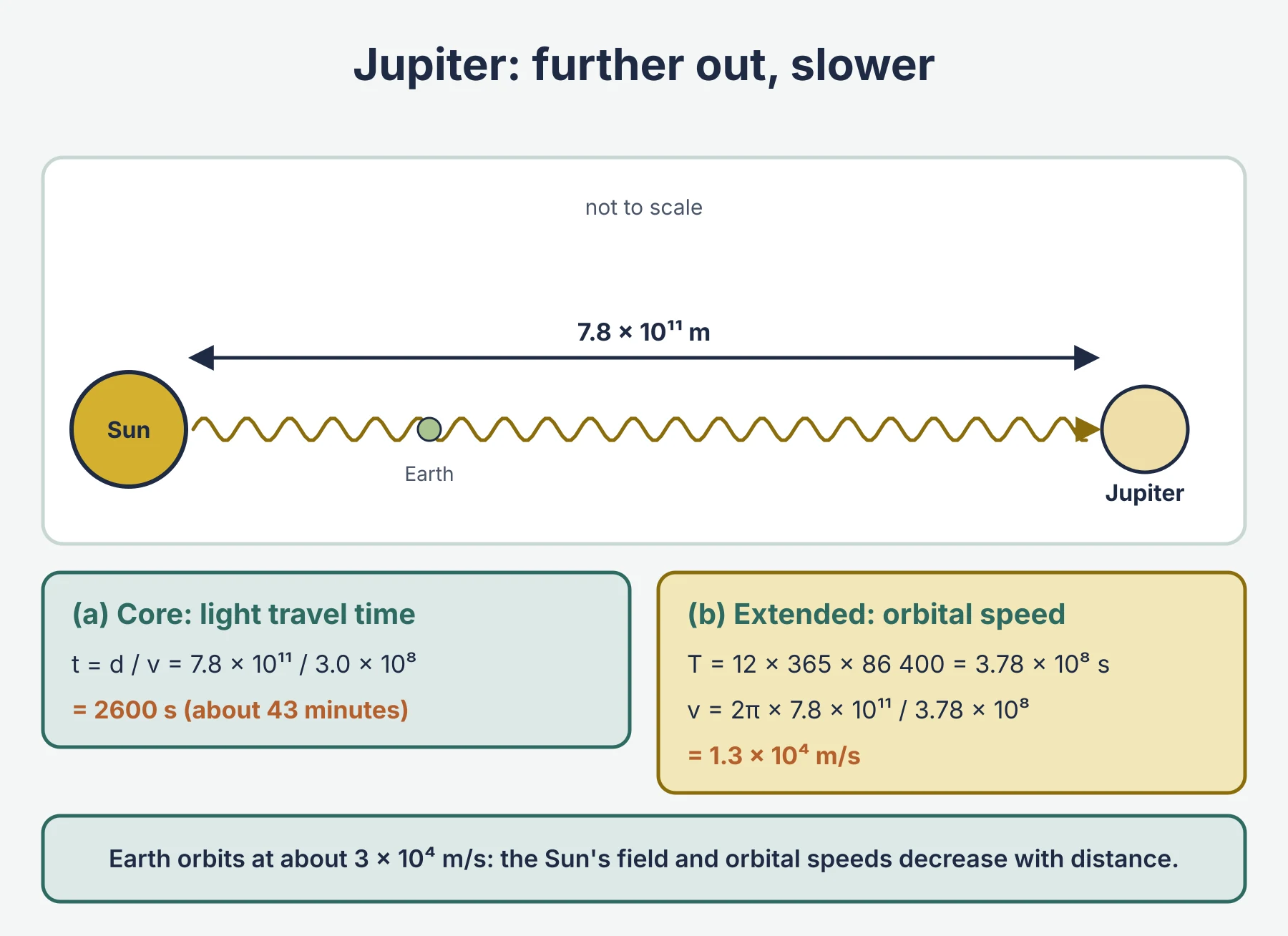
- Average orbital speed: v = 2πr / T (r = average orbital radius, T = period).
- Convert T to seconds: days × 86 400.
6.1.2 The Solar System
Members
- One star: the Sun.
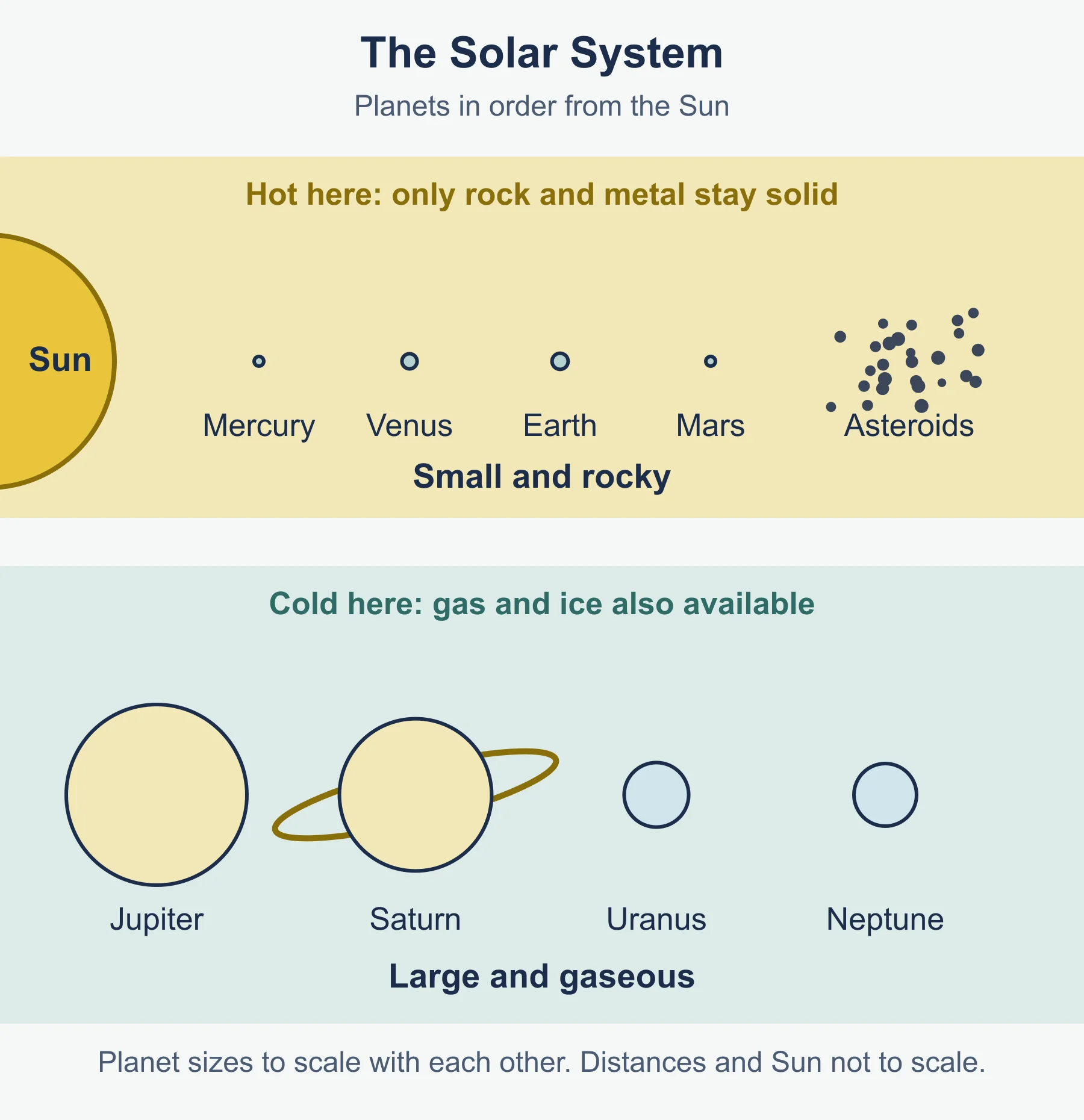
- Eight planets in order: Mercury, Venus, Earth, Mars, Jupiter, Saturn, Uranus, Neptune.
- Minor planets: dwarf planets (such as Pluto) and asteroids (asteroid belt, between Mars and Jupiter).
- Moons orbit planets.
- Smaller bodies: comets and natural satellites.
Method in steps: the accretion model
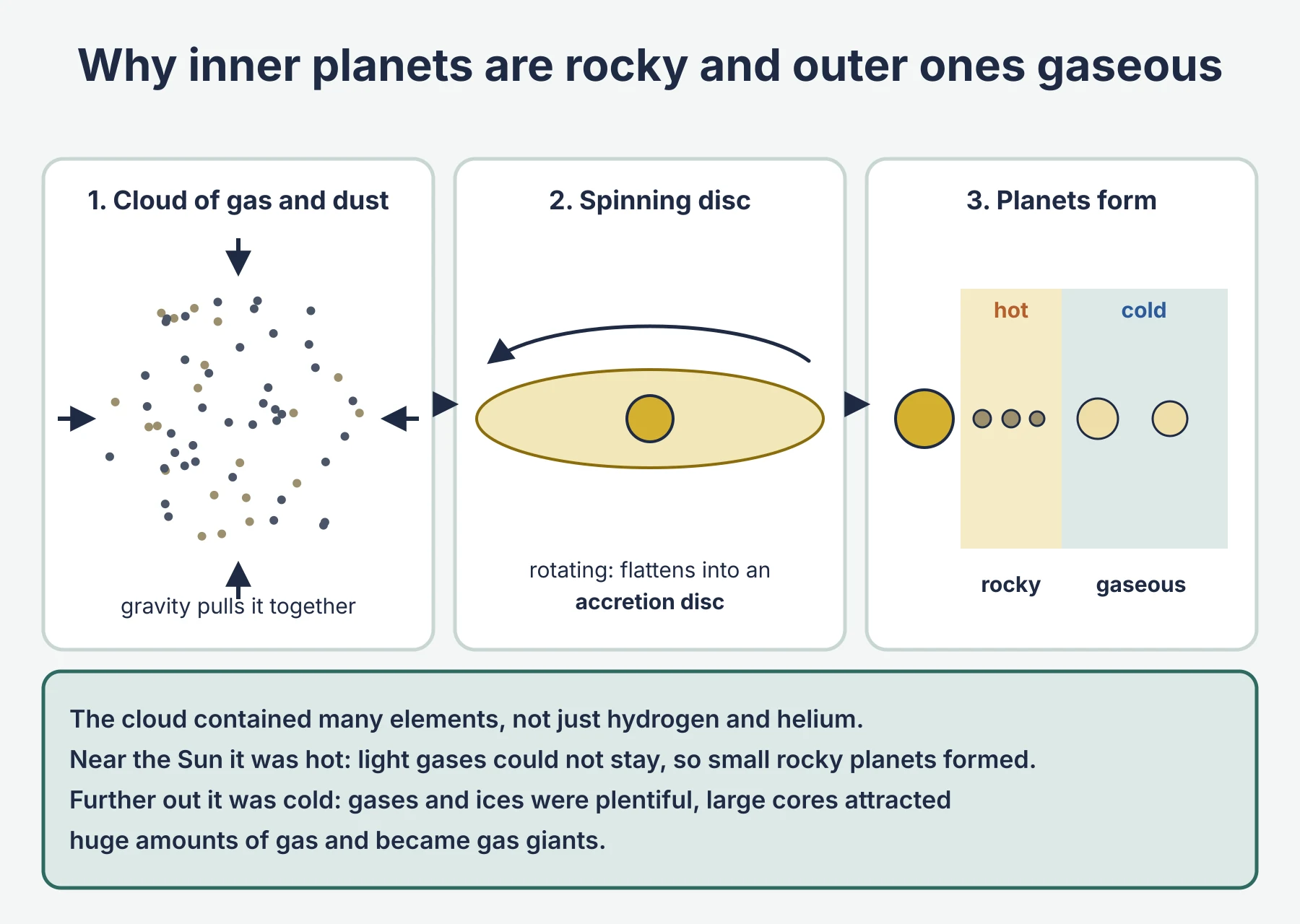
- An interstellar cloud of gas and dust, containing many elements, collapses under gravity.
- The cloud is rotating, so it flattens into an accretion disc around the forming Sun.
- Near the Sun: hot; only rocky and metallic material can collect → small, rocky inner planets.
- Far from the Sun: cold; gases are available; large cores attract much gas → large, gaseous outer planets.
Gravity
- Surface gravitational field strength depends on the planet’s mass.
- Field strength around a planet decreases with distance.
- The Sun has most of the mass of the Solar System, so planets orbit it.
- The gravitational attraction of the Sun keeps objects in orbit.
- Light travel time: t = distance ÷ speed of light.
Extended only
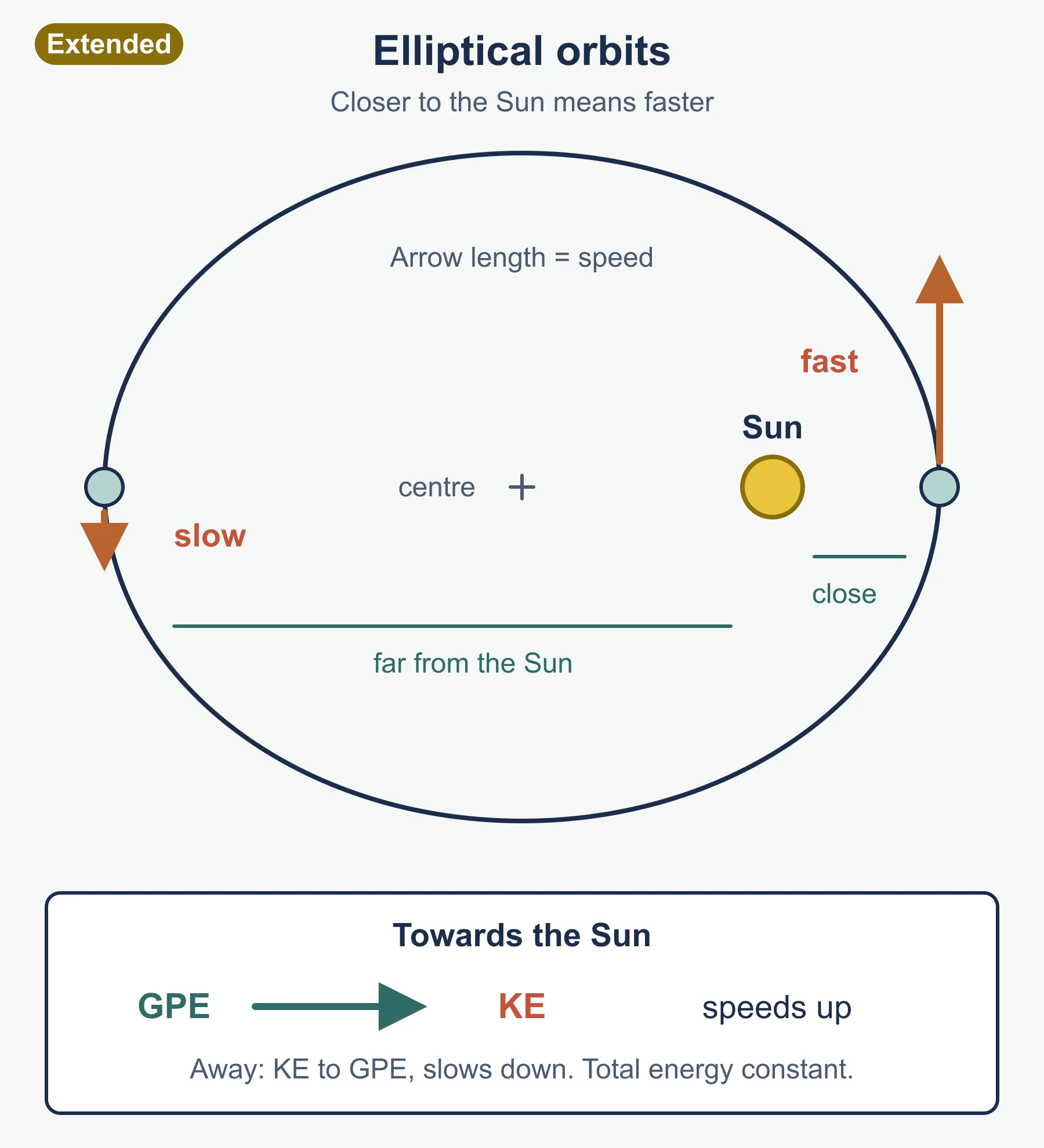
- Planets, minor planets and comets have elliptical orbits; the Sun is not at the centre unless the orbit is nearly circular.
- The Sun’s field weakens with distance; orbital speeds decrease with distance.
- In an ellipse the object is fastest closest to the Sun: GPE → KE moving in, KE → GPE moving out; total energy conserved.
- Data analysis: high density → rocky; larger distance → longer period, lower temperature.
Key terms
| Term | Meaning |
|---|---|
| Rotation | Spinning on an axis (Earth: about 24 hours) |
| Orbit | Path of one body around another |
| Orbital period | Time for one complete orbit |
| Dwarf planet | Minor planet such as Pluto |
| Asteroid | Small rocky body, many in the asteroid belt |
| Accretion disc | Rotating disc of gas and dust from which planets formed |
| Gravitational field strength | Force per unit mass due to gravity |
| Average orbital speed (Extended only) | 2πr / T |
Exam traps
- Seasons are caused by the tilt, not distance from the Sun.
- Day and night come from rotation; seasons from the orbit.
- Phases are not caused by the Earth’s shadow.
- Pluto is a dwarf planet.
- Convert days to seconds and million km to m before using v = 2πr / T.
- “Gravity is stronger near the Sun” alone does not explain the faster speed; name the energy transfer.
Self-test
- How long does the Earth take to rotate once?
- Explain why the Sun appears to rise in the east.
- Explain why the southern hemisphere has summer when the northern has winter.
- Why does the Moon show phases?
- List the planets in order from the Sun.
- Where is the asteroid belt?
- Name the three features of the accretion model in the syllabus.
- Planet P has more mass than planet Q. Which has the greater surface gravitational field strength?
- A radio signal travels 2.25 × 10¹¹ m from a probe near Mars. How long does it take, in minutes?
- (Extended) A moon orbits at 6.0 × 10⁸ m with a period of 20 days. Find its average orbital speed.
- (Extended) Where in its orbit is a comet slowest? Explain.
- (Extended) How do the orbital speeds of planets change with distance from the Sun?
Answers
- About 24 hours.
- The Earth rotates from west to east, so the Sun appears to move from east to west.
- Because of the tilted axis, when the north leans towards the Sun the south leans away from it.
- It reflects sunlight; half is always lit, and as it orbits we see different amounts of the lit half.
- Mercury, Venus, Earth, Mars, Jupiter, Saturn, Uranus, Neptune.
- Between Mars and Jupiter.
- Dependence on gravity; many elements in the cloud; rotation forming an accretion disc.
- P (greater mass).
- t = 2.25 × 10¹¹ ÷ 3.0 × 10⁸ = 750 s = 12.5 minutes.
- T = 20 × 86 400 = 1.728 × 10⁶ s; v = 2π × 6.0 × 10⁸ ÷ 1.728 × 10⁶ = 2.2 × 10³ m/s.
- Furthest from the Sun: it has converted the most kinetic energy into gravitational potential energy.
- They decrease as distance increases.
Official syllabus
Cambridge International, Cambridge IGCSE Physics 0625 syllabus for examination in 2026, 2027 and 2028, Topic 6 Space physics, section 6.1 The Earth and the Solar System. Test yourself with the Earth and Solar System practice questions.
Related resources
-
Study guides
Cambridge IGCSE Physics 0625: Space physics – Study Guide
Study guide for Cambridge IGCSE Physics 0625 space physics: the Earth, Solar System, orbits, star life cycles, redshift, CMBR and the Hubble constant.
Physics · Cambridge · IGCSE
Read guide -
Practice questions
Cambridge IGCSE Physics 0625: Space physics – Practice Questions
Thirteen original Cambridge IGCSE Physics 0625 space physics questions, Core and Extended, with fully worked mark-by-mark answers and examiner tips.
Physics · Cambridge · IGCSE
Try questions -
Revision notes
Cambridge IGCSE Physics 0625: Space physics – Revision Notes
Condensed Cambridge IGCSE Physics 0625 space physics revision notes: key facts, equations, star life cycle, Hubble constant and a quick self-test.
Physics · Cambridge · IGCSE
Revise topic
Related articles
Get free revision emails (optional)
Occasional emails with practice questions, worked explanations and links to free resources for the qualification and subjects you choose. No spam, and you can unsubscribe from any email. The free tools on this site never need an email.