
Study Guides
Cambridge IGCSE Physics (0625): Stars and the Universe
Study guide for Cambridge IGCSE Physics 0625 section 6.2: the Sun as a star, light-years, the life cycle of stars, redshift, CMBR and the Hubble constant.
- Subject
- Physics
- Level
- IGCSE
- Topic
- Space physics
- Author
- Marlbridge Academic Team
- Updated
- Reviewed by
- Iftikhar Azeemi (what this means)
Aligned to Cambridge IGCSE Physics (0625), For examination in 2026, 2027 and 2028. Official specification .
Syllabus page (what it covers and how it is assessed): Cambridge IGCSE Physics.
Syllabus points this page covers, with Core and Extended
0625
- 6.2 Stars and the Universe · Core and Extended
"Core and Extended" means part of that syllabus point is Extended only. The page's own tier notes say which part.
Found an error? Report a correction.
Need help with this topic? Request a free trial class for IGCSE Physics (0625).
This guide covers one subtopic of the Cambridge IGCSE Physics 0625 syllabus (for examination in 2026, 2027 and 2028): 6.2 Stars and the Universe, in three parts: the Sun as a star (6.2.1), stars (6.2.2) and the Universe (6.2.3). Core content is for every candidate; content marked Extended only is Supplement material, examined on Papers 2 and 4. The Space physics study guide summarises all of Topic 6 and works one Hubble-constant example; this page goes further into the reasoning behind the life cycle and the evidence for the Big Bang, with new calculations.
What 6.2 asks you to do
| Part | Core | Extended only |
|---|---|---|
| 6.2.1 The Sun | A medium-sized star, mostly hydrogen and helium, radiating mostly infrared, visible and ultraviolet | Stars are powered by nuclear reactions; in stable stars, fusion of hydrogen into helium |
| 6.2.2 Stars | Galaxies contain many billions of stars; the Sun is in the Milky Way; other stars are much further away than the Sun; the light-year | 1 light-year = 9.5 × 10¹⁵ m; the life cycle of a star |
| 6.2.3 The Universe | The Milky Way is one of many billions of galaxies; its diameter is about 100 000 light-years; redshift; distant galaxies are redshifted; evidence for expansion and the Big Bang Theory | CMBR; speed from redshift; distance from supernova brightness; H₀ = v/d, value 2.2 × 10⁻¹⁸ per second; d/v = 1/H₀ as the age of the Universe |
The Sun as a star
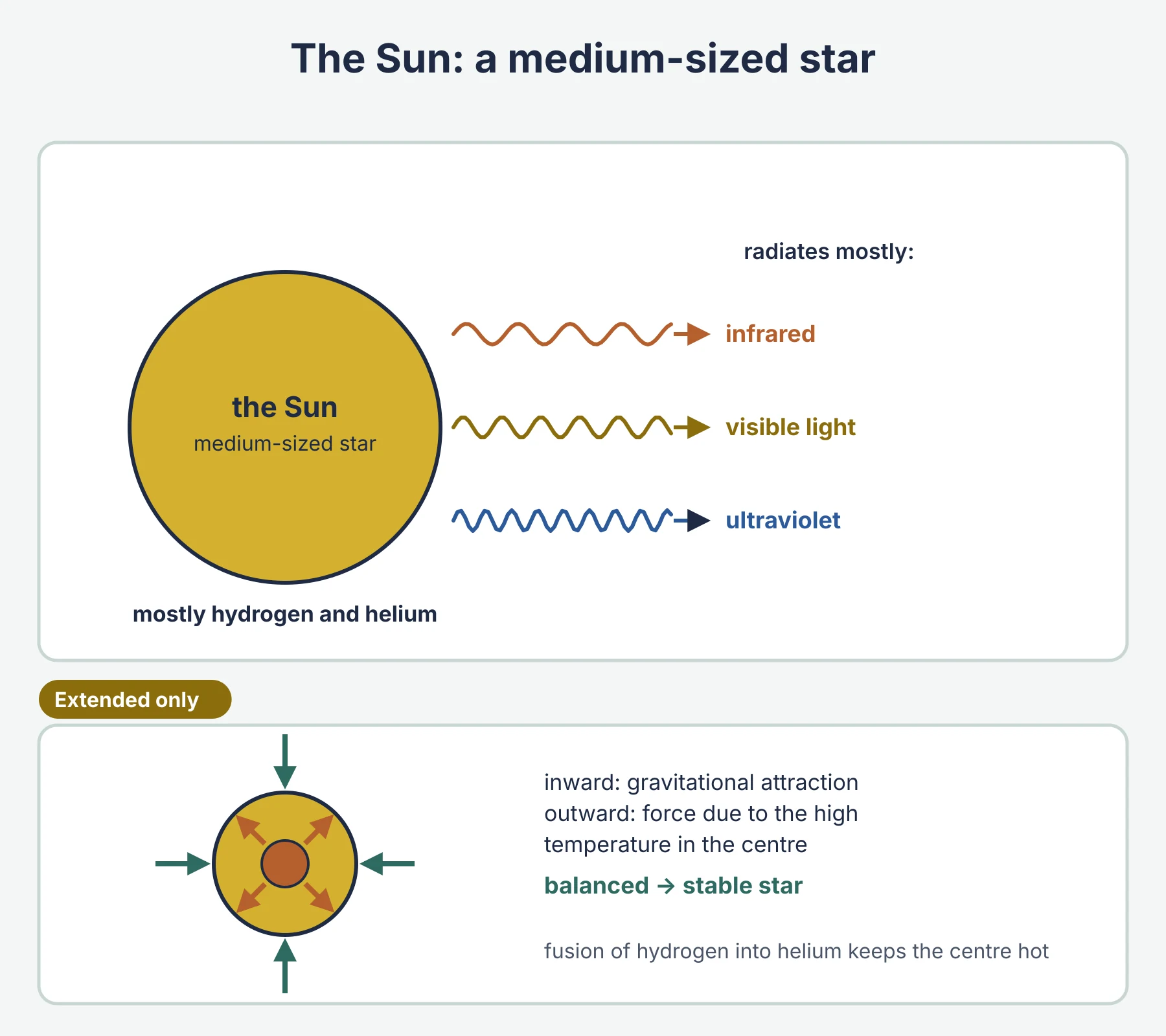
The Sun is a star of medium size, consisting mostly of hydrogen and helium. It radiates most of its energy in three regions of the electromagnetic spectrum: infrared, visible light and ultraviolet. All three are needed for the mark.
Extended only. Stars are powered by nuclear reactions that release energy. In stable stars these reactions are the fusion of hydrogen into helium. This links directly to fusion in Topic 5: light nuclei join, the products have slightly less mass, and the difference is released as energy.
Scale: galaxies and light-years
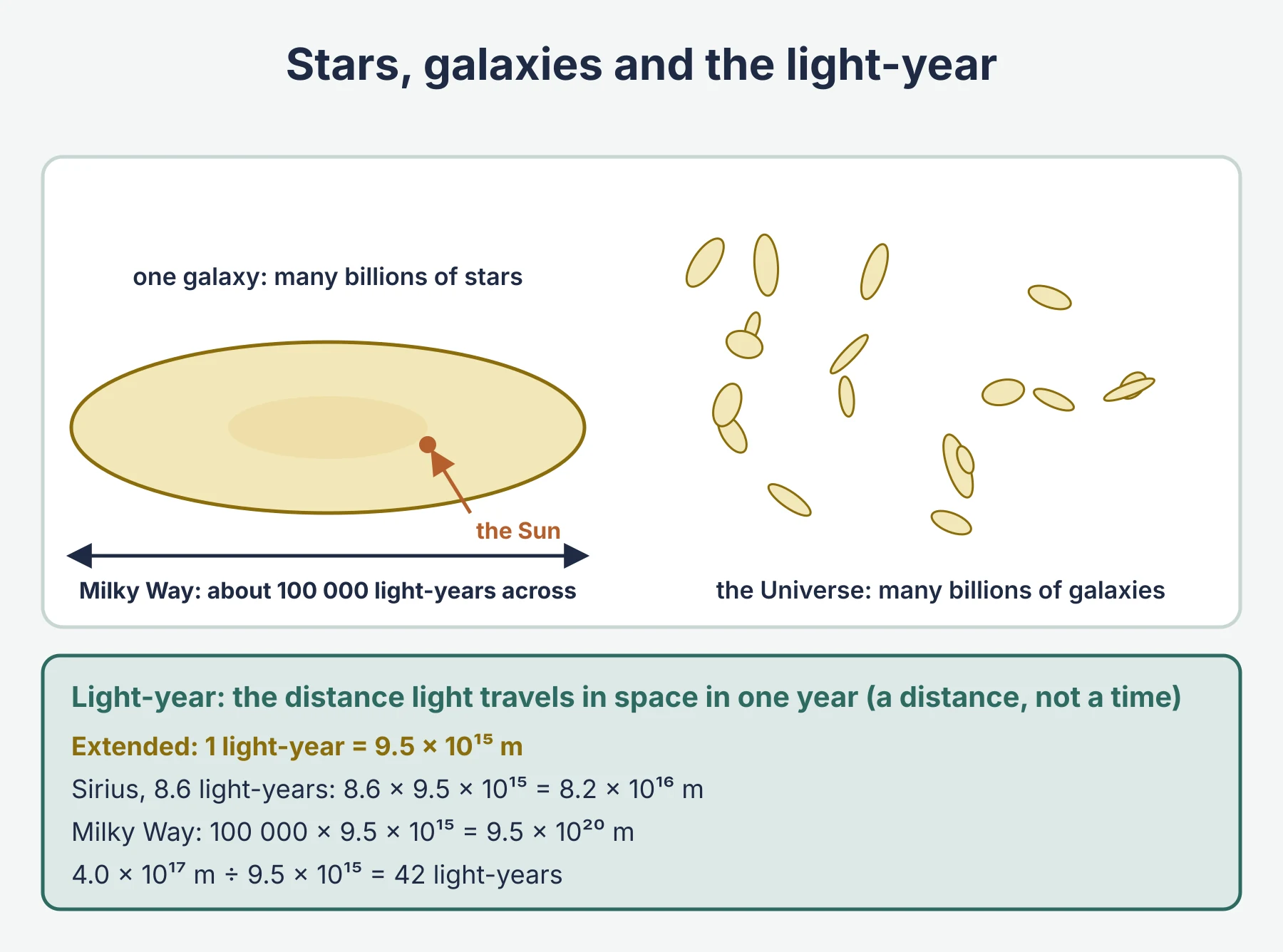
- A galaxy is made up of many billions of stars.
- The Sun is one star in the galaxy called the Milky Way.
- The other stars of the Milky Way are much further away from the Earth than the Sun is.
- The Milky Way is one of many billions of galaxies making up the Universe; its diameter is about 100 000 light-years.
A light-year is the distance travelled in (the vacuum of) space by light in one year. It is a distance, not a time. Extended only: 1 light-year = 9.5 × 10¹⁵ m.
Useful conversions:
- Sirius, 8.6 light-years away: 8.6 × 9.5 × 10¹⁵ = 8.2 × 10¹⁶ m.
- The Milky Way’s diameter: 100 000 × 9.5 × 10¹⁵ = 9.5 × 10²⁰ m. Light takes about 100 000 years to cross it.
- An object 4.0 × 10¹⁷ m away: 4.0 × 10¹⁷ ÷ 9.5 × 10¹⁵ = 42 light-years.
Light from a star 8.6 light-years away left it 8.6 years ago, so we see the star as it was then. This is why looking further away means looking further back in time.
The life cycle of a star (Extended only)
The syllabus gives the stages in a fixed sequence. Learn the reasoning, not just the names:
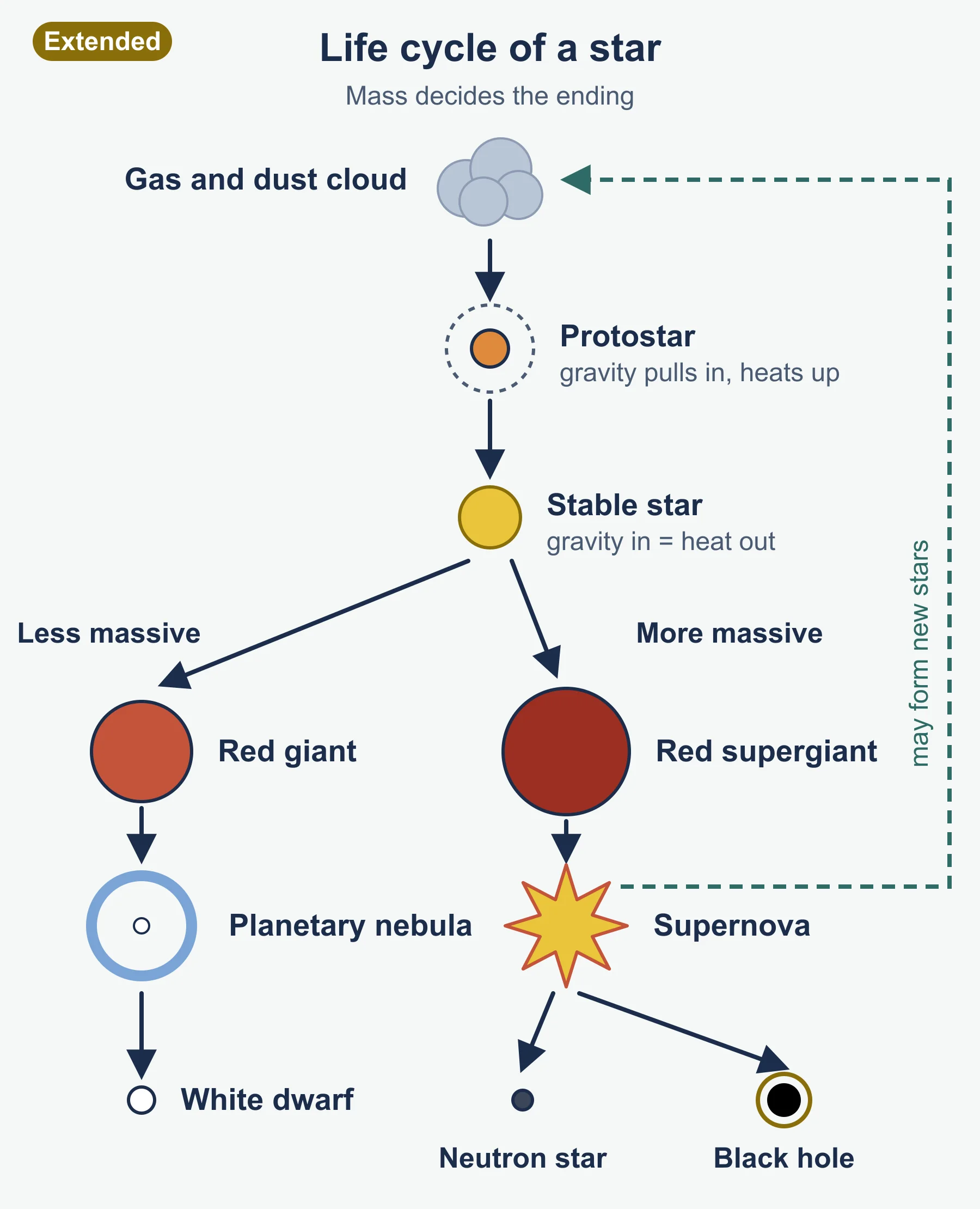
- A star forms from an interstellar cloud of gas and dust containing hydrogen.
- A protostar is the cloud collapsing and increasing in temperature because of its own internal gravitational attraction.
- It becomes a stable star when the inward force of gravitational attraction is balanced by an outward force due to the high temperature in the centre. Fusion of hydrogen into helium keeps the centre hot.
- All stars eventually run out of hydrogen as fuel for the reaction.
- When most of the hydrogen in the centre has been converted to helium, most stars expand to form red giants; more massive stars expand to form red supergiants.
- Less massive star: the red giant forms a planetary nebula with a white dwarf star at its centre.
- More massive star: the red supergiant explodes as a supernova, forming a nebula containing hydrogen and new heavier elements, leaving a neutron star or a black hole at its centre.
- The nebula from a supernova may form new stars with orbiting planets.
The branch point is mass. The Sun, a medium-sized star, follows the red giant → planetary nebula → white dwarf path. Step 8 explains why planets like the Earth contain heavy elements: they were made in earlier stars and scattered by supernovae.
Annotated model answer. Explain why a stable star neither collapses nor expands. [2]
“Gravitational attraction pulls the star’s matter inwards. The high temperature at the centre produces an outward force. In a stable star these two forces are balanced.”
Why this scores: it names both forces with their directions and uses the word “balanced”. Mentioning only gravity, or saying the forces “cancel out the fusion”, loses marks.
Redshift and the expanding Universe
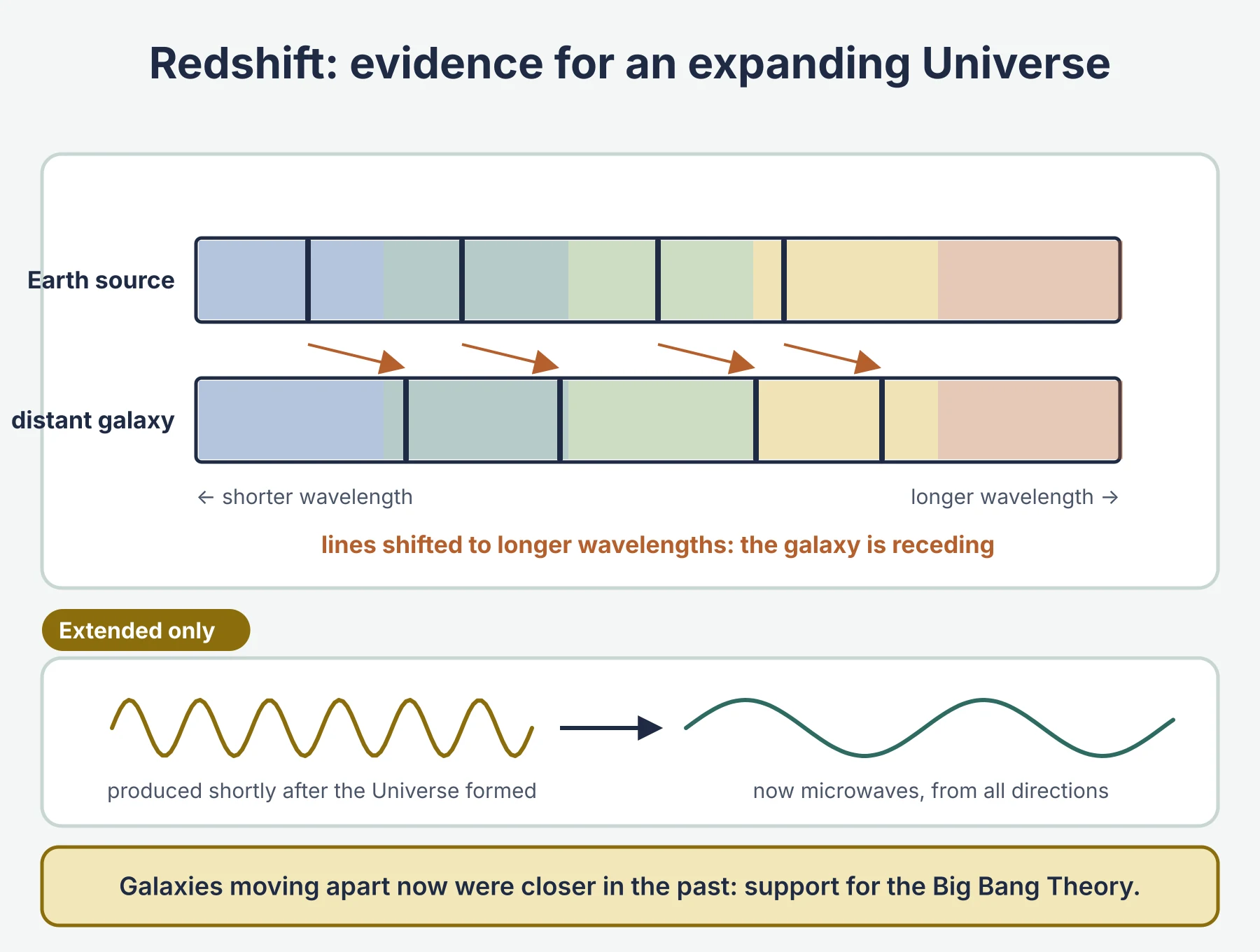
Redshift is an increase in the observed wavelength of electromagnetic radiation emitted from receding stars and galaxies. Light from distant galaxies appears redshifted compared with light emitted on the Earth: the pattern of lines in their spectra is shifted towards longer wavelengths.
Redshift in the light from distant galaxies is evidence that the Universe is expanding, and it supports the Big Bang Theory: if galaxies are moving apart now, they were closer together in the past, and all the matter in the Universe was once at a single point.
Extended only. Cosmic microwave background radiation (CMBR). Microwave radiation of a specific frequency is observed at all points in space around us. It was produced shortly after the Universe was formed and has been expanded into the microwave region as the Universe expanded, stretching its wavelength. This is further evidence for the Big Bang.
The Hubble constant (Extended only)
- The speed v at which a galaxy moves away is found from the change in wavelength of its starlight due to redshift.
- The distance d of a far galaxy is found from the brightness of a supernova in that galaxy.
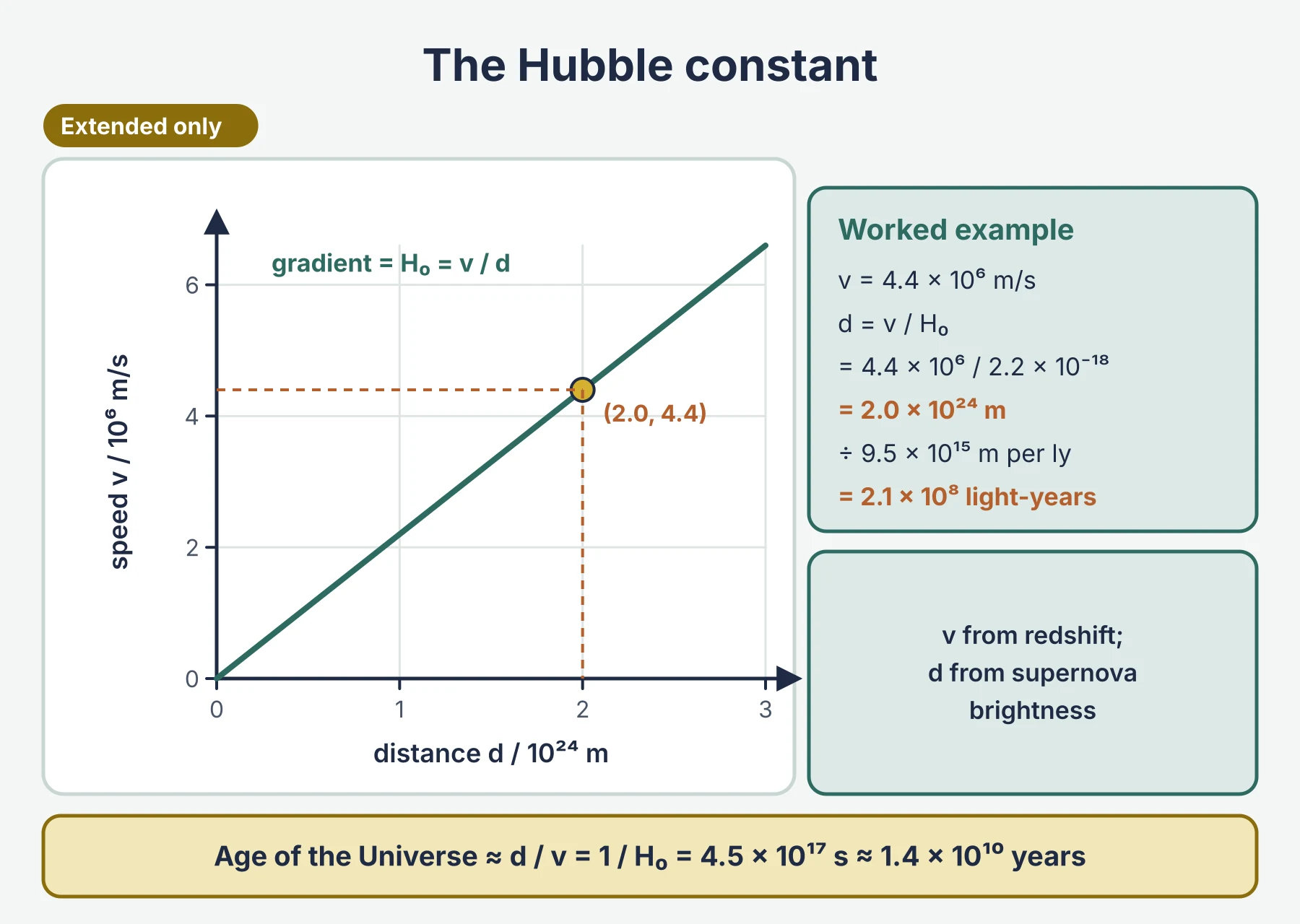
- The Hubble constant is the ratio of the speed at which a galaxy moves away from the Earth to its distance from the Earth: H₀ = v / d. Current estimate: H₀ = 2.2 × 10⁻¹⁸ per second.
- d / v = 1 / H₀ is an estimate of the age of the Universe: it is the time taken for a galaxy to travel distance d at speed v from a single starting point.
Worked example (Extended)
A galaxy is observed to recede at 4.4 × 10⁶ m/s. Calculate its distance in metres and in light-years.
d = v / H₀ = 4.4 × 10⁶ / 2.2 × 10⁻¹⁸ = 2.0 × 10²⁴ m
in light-years: 2.0 × 10²⁴ / 9.5 × 10¹⁵ = 2.1 × 10⁸ light-years
Every galaxy gives the same value of d/v, because v is proportional to d. That shared value, 1/H₀ = 4.5 × 10¹⁷ s, is about 1.4 × 10¹⁰ years.
Common mistakes
- Calling a light-year a unit of time.
- Naming only one or two of the Sun’s three main radiation regions.
- Sending the Sun to a supernova, or a massive star to a white dwarf.
- Describing redshift as light “turning red” or galaxies “becoming red”.
- Saying the CMBR “is from the Sun” or “is microwaves from galaxies”.
- Using H₀ without converting light-years to metres, or confusing v/d with d/v.
Exam technique
- State: short facts such as “hydrogen and helium” or “about 100 000 light-years”.
- Describe the life cycle: give the stages in order and branch clearly on mass.
- Explain stability: two forces, their directions, balanced.
- Explain what redshift shows: expansion, then the Big Bang link.
- Calculate: write H₀ = v/d, rearrange, substitute in SI units, and convert to light-years or years only at the end.
Condense this with the stars and the Universe revision notes and practise with the stars and the Universe practice questions. The previous subtopic is the Earth and the Solar System.
Official syllabus
Cambridge International, Cambridge IGCSE Physics 0625 syllabus for examination in 2026, 2027 and 2028, Topic 6 Space physics, section 6.2 Stars and the Universe (6.2.1 to 6.2.3).
Related resources
-
Practice questions
Cambridge IGCSE Physics (0625): Stars and the Universe – Practice Questions
Thirteen original Cambridge IGCSE Physics 0625 questions on the Sun, light-years, star life cycles, redshift, CMBR and the Hubble constant, with full answers.
Physics · Cambridge · IGCSE
Try questions -
Revision notes
Cambridge IGCSE Physics (0625): Stars and the Universe – Revision Notes
Revision notes for Cambridge IGCSE Physics 0625 section 6.2: the Sun, galaxies, light-years, the life cycle of stars, redshift, CMBR, H₀ and a self-test.
Physics · Cambridge · IGCSE
Revise topic -
Study guides
Cambridge IGCSE Physics (0625): The Earth and the Solar System
Study guide for Cambridge IGCSE Physics 0625 section 6.1: day and night, seasons, Moon phases, the planets, accretion, gravity, orbital speed and orbits.
Physics · Cambridge · IGCSE
Read guide
Related articles
Get free revision emails (optional)
Occasional emails with practice questions, worked explanations and links to free resources for the qualification and subjects you choose. No spam, and you can unsubscribe from any email. The free tools on this site never need an email.