
Revision Notes
Cambridge IGCSE Physics (0625): Stars and the Universe – Revision Notes
Revision notes for Cambridge IGCSE Physics 0625 section 6.2: the Sun, galaxies, light-years, the life cycle of stars, redshift, CMBR, H₀ and a self-test.
- Subject
- Physics
- Level
- IGCSE
- Topic
- Space physics
- Author
- Marlbridge Academic Team
- Updated
- Reviewed by
- Iftikhar Azeemi (what this means)
Aligned to Cambridge IGCSE Physics (0625), For examination in 2026, 2027 and 2028. Official specification .
Syllabus page (what it covers and how it is assessed): Cambridge IGCSE Physics.
Syllabus points this page covers, with Core and Extended
0625
- 6.2 Stars and the Universe · Core and Extended
"Core and Extended" means part of that syllabus point is Extended only. The page's own tier notes say which part.
Found an error? Report a correction.
Need help with this topic? Request a free trial class for IGCSE Physics (0625).
These notes condense section 6.2 Stars and the Universe of the Cambridge IGCSE Physics 0625 syllabus (for examination in 2026, 2027 and 2028). Lines marked Extended only are Supplement content, examined on Papers 2 and 4. For explanations and worked examples, read the stars and the Universe study guide.
Numbers to know
| Quantity | Value | Tier |
|---|---|---|
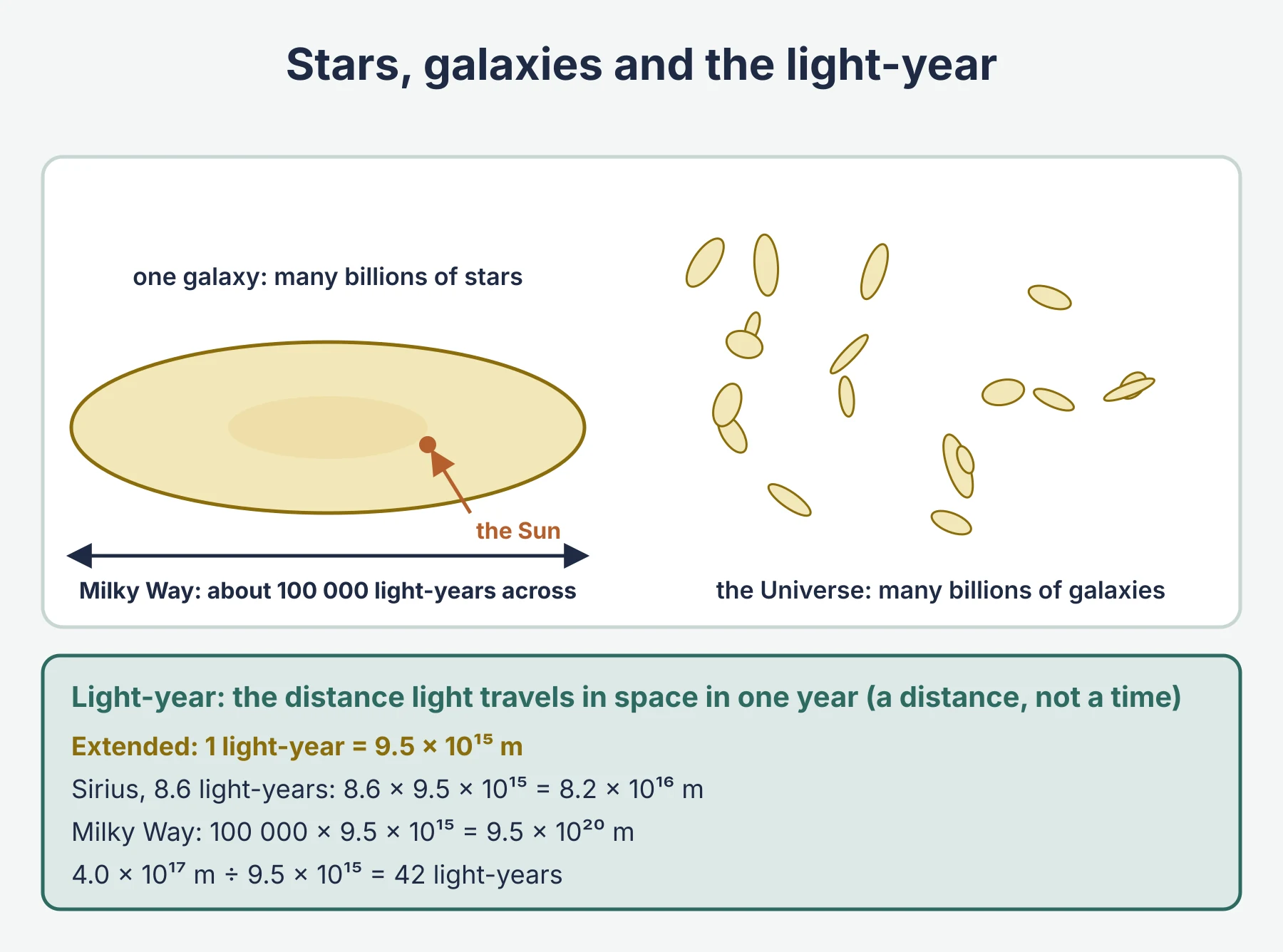
| Diameter of the Milky Way | about 100 000 light-years | Core |
| 1 light-year | 9.5 × 10¹⁵ m | Extended only |
| Hubble constant H₀ | 2.2 × 10⁻¹⁸ per second | Extended only |
| Age of the Universe, 1/H₀ | about 4.5 × 10¹⁷ s (about 1.4 × 10¹⁰ years) | Extended only |
6.2.1 The Sun as a star
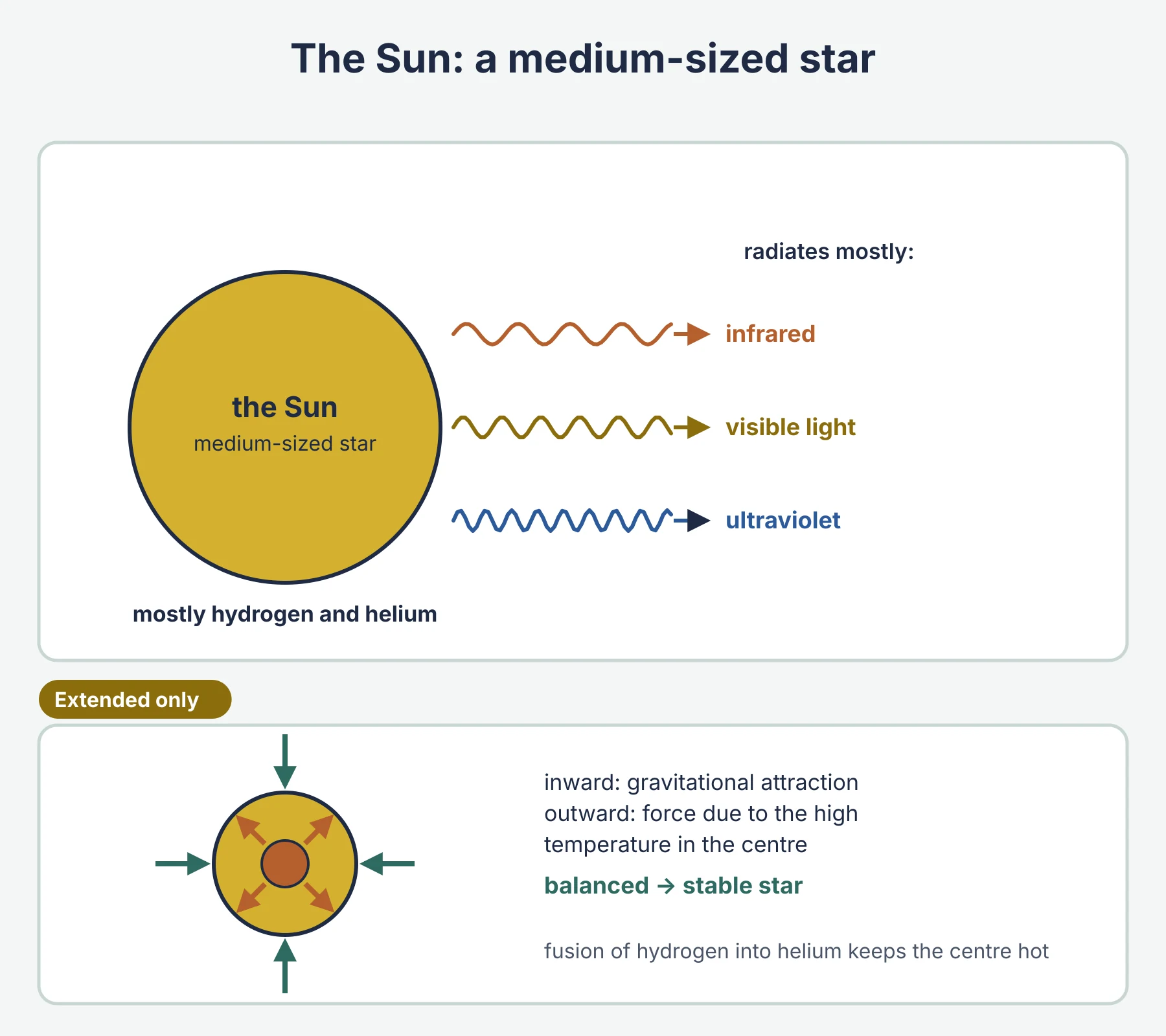
- A star of medium size.
- Mostly hydrogen and helium.
- Radiates most energy as infrared, visible light and ultraviolet.
- Extended only: powered by nuclear reactions; in stable stars, fusion of hydrogen into helium.
6.2.2 Stars
- A galaxy is many billions of stars.
- The Sun is in the Milky Way.
- Other Milky Way stars are much further from the Earth than the Sun is.
- Light-year: distance travelled by light in (the vacuum of) space in one year.
Life cycle (Extended only)
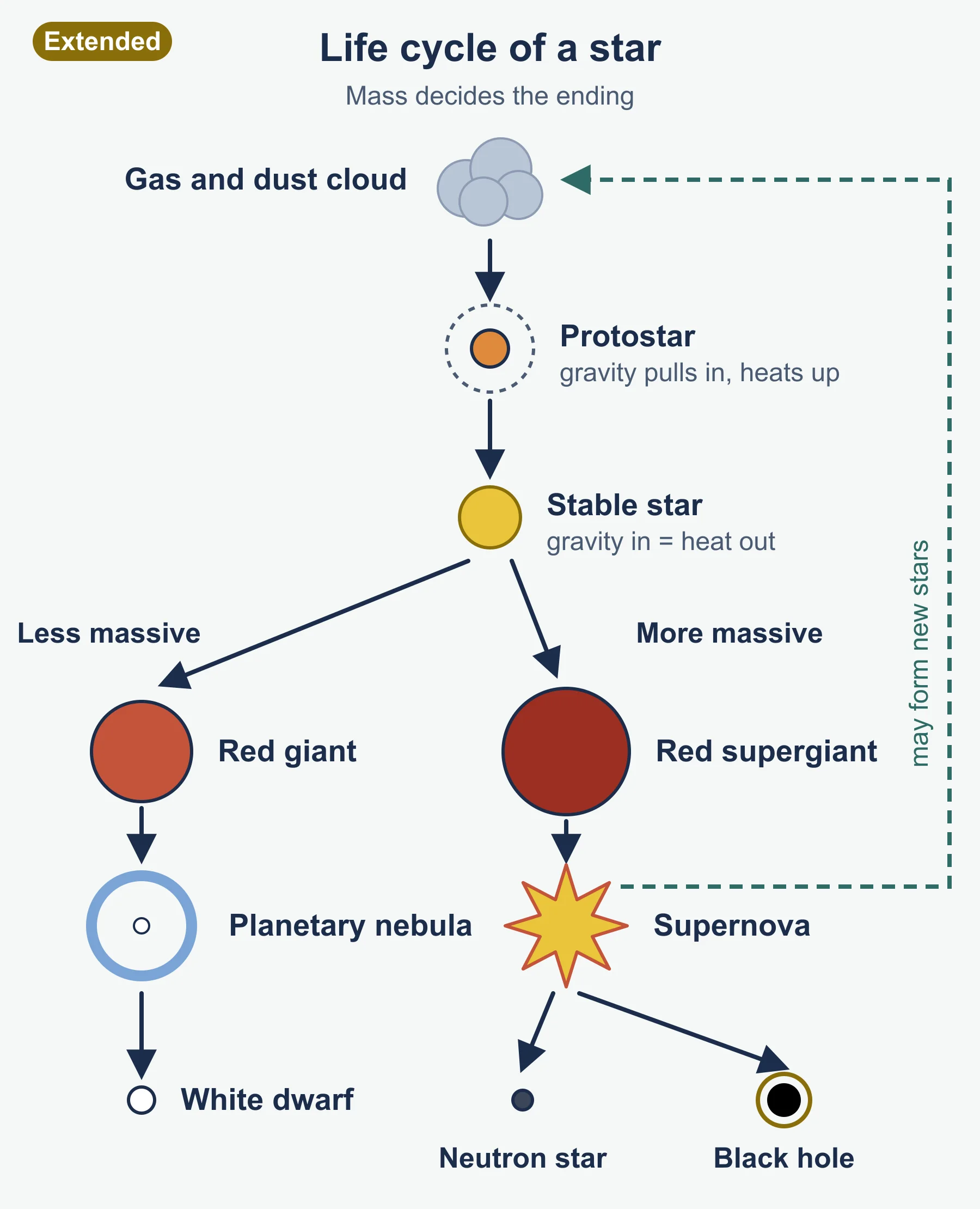
| Stage | Key idea |
|---|---|
| Interstellar cloud | Gas and dust containing hydrogen |
| Protostar | Cloud collapses under its own gravity and heats up |
| Stable star | Inward gravity balanced by outward force due to high central temperature |
| Hydrogen runs out | All stars eventually; most central hydrogen now helium |
| Red giant (most stars) | → planetary nebula + white dwarf |
| Red supergiant (more massive stars) | → supernova → nebula with hydrogen and new heavier elements + neutron star or black hole |
| New generation | Supernova nebula may form new stars with orbiting planets |
6.2.3 The Universe
- The Milky Way is one of many billions of galaxies.
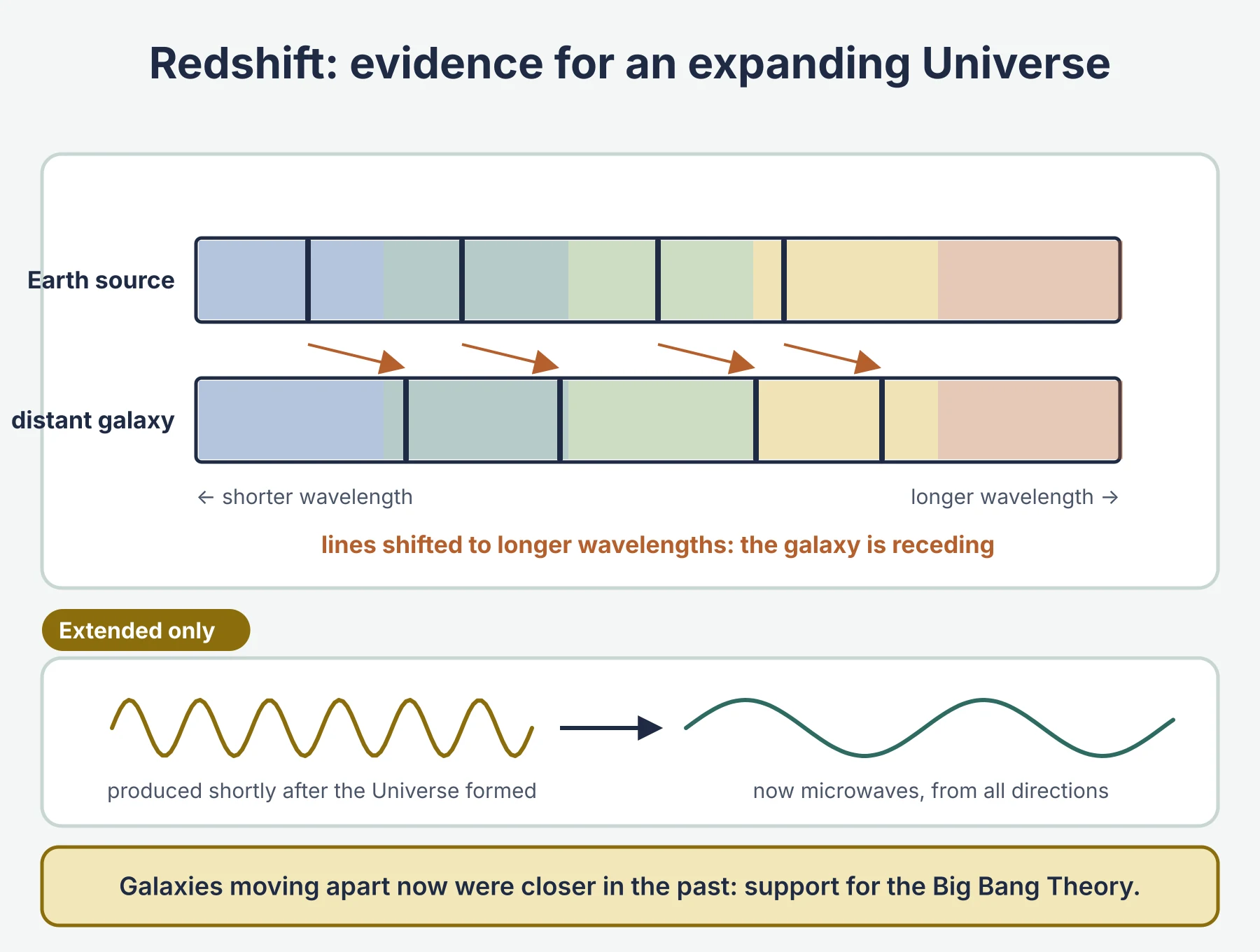
- Redshift: increase in the observed wavelength of electromagnetic radiation from receding stars and galaxies.
- Light from distant galaxies is redshifted compared with light emitted on the Earth.
- Redshift is evidence that the Universe is expanding and supports the Big Bang Theory.
Extended only
- CMBR: microwave radiation of a specific frequency observed at all points in space; produced shortly after the Universe formed; stretched into the microwave region as the Universe expanded.
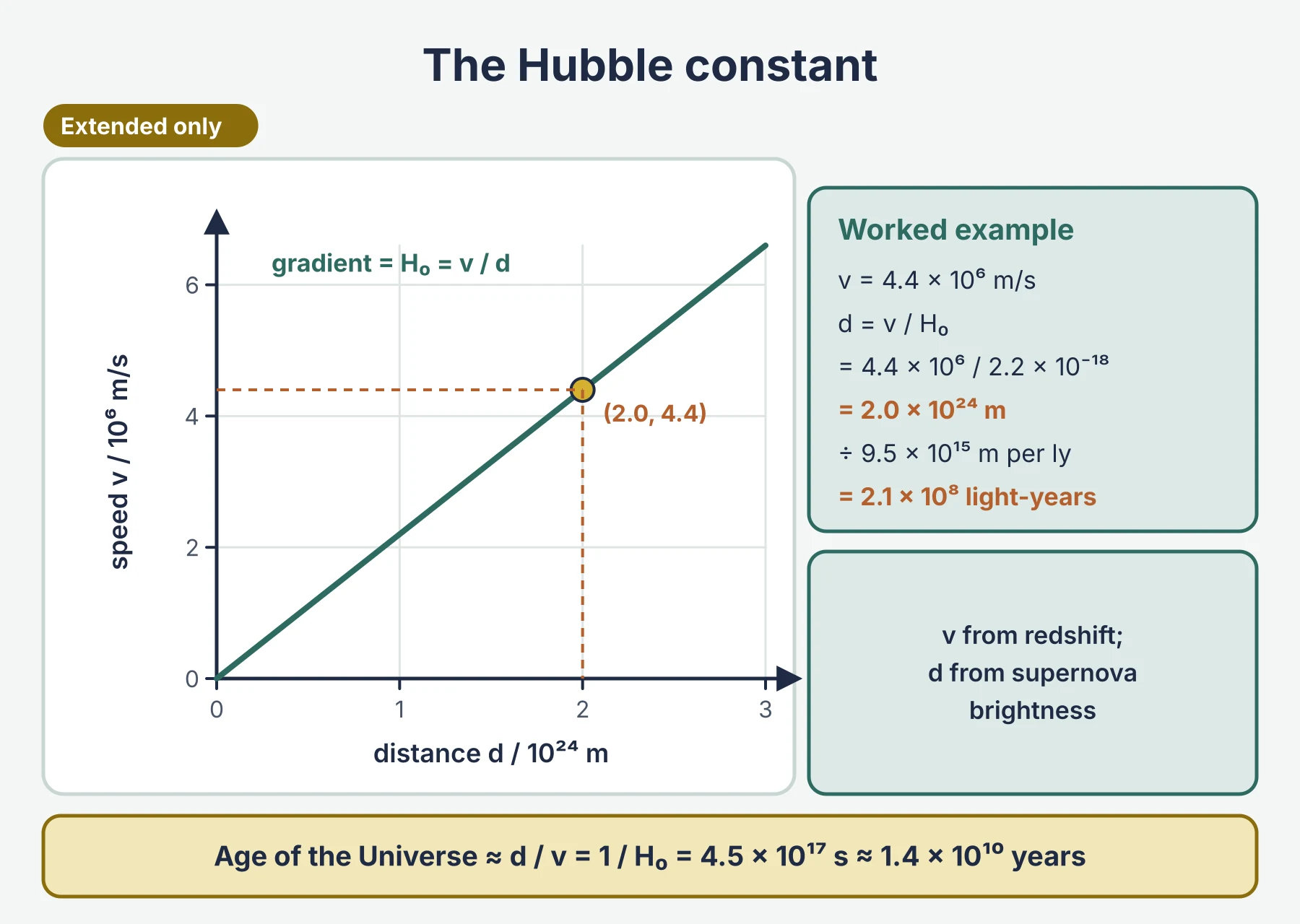
- Speed of recession v: from the change in wavelength (redshift).
- Distance d of a far galaxy: from the brightness of a supernova in it.
- H₀ = v / d (ratio of recession speed to distance).
- d / v = 1 / H₀: an estimate of the age of the Universe; evidence that all matter was once at a single point.
Method in steps: Hubble calculation (Extended only)
- Convert distances to metres (light-years × 9.5 × 10¹⁵).
- Use v = H₀ × d or d = v / H₀.
- For age: 1 / H₀ in seconds, then ÷ (365 × 86 400) for years.
- Give answers to 2 significant figures, matching the data.
Key terms
| Term | Meaning |
|---|---|
| Galaxy | Many billions of stars held together by gravity |
| Milky Way | The galaxy containing the Sun |
| Light-year | Distance light travels in space in one year |
| Redshift | Increase in observed wavelength from a receding source |
| Big Bang Theory | The Universe began from a single point and has expanded since |
| Protostar (Extended only) | Collapsing, heating cloud before fusion starts |
| CMBR (Extended only) | Microwave radiation from all directions, left from the early Universe |
| Hubble constant (Extended only) | Recession speed ÷ distance for a galaxy |
Exam traps
- A light-year is a distance.
- All three regions (IR, visible, UV) for the Sun’s radiation.
- A stable star needs both forces and the word balanced.
- Massive stars → supergiant → supernova; less massive → giant → white dwarf.
- Redshift is an increase in wavelength, not a change of colour.
- CMBR was stretched into the microwave region by expansion.
Self-test
- Name the two elements that make up most of the Sun.
- What is a galaxy?
- Define a light-year.
- State the approximate diameter of the Milky Way.
- What is redshift?
- What does the redshift of distant galaxies show about the Universe?
- (Extended) Convert 8.6 light-years into metres.
- (Extended) What nuclear reaction powers a stable star?
- (Extended) What forms at the end of the life of a star much more massive than the Sun?
- (Extended) State how the distance to a far galaxy is measured.
- (Extended) A galaxy is 4.75 × 10²³ m away. Calculate its recession speed.
- (Extended) Why is the CMBR now in the microwave region?
Answers
- Hydrogen and helium.
- A collection of many billions of stars.
- The distance travelled by light in (the vacuum of) space in one year.
- About 100 000 light-years.
- An increase in the observed wavelength of radiation from receding stars and galaxies.
- It is expanding (supporting the Big Bang Theory).
- 8.6 × 9.5 × 10¹⁵ = 8.2 × 10¹⁶ m.
- Fusion of hydrogen into helium.
- A red supergiant explodes as a supernova, leaving a neutron star or black hole.
- From the brightness of a supernova in that galaxy.
- v = H₀d = 2.2 × 10⁻¹⁸ × 4.75 × 10²³ = 1.0 × 10⁶ m/s.
- It was produced shortly after the Universe formed, and the expansion of the Universe stretched it into the microwave region.
Official syllabus
Cambridge International, Cambridge IGCSE Physics 0625 syllabus for examination in 2026, 2027 and 2028, Topic 6 Space physics, section 6.2 Stars and the Universe. Test yourself with the stars and the Universe practice questions.
Related resources
-
Study guides
Cambridge IGCSE Physics (0625): The Earth and the Solar System
Study guide for Cambridge IGCSE Physics 0625 section 6.1: day and night, seasons, Moon phases, the planets, accretion, gravity, orbital speed and orbits.
Physics · Cambridge · IGCSE
Read guide -
Practice questions
Cambridge IGCSE Physics (0625): The Earth and the Solar System – Practice Questions
Thirteen original Cambridge IGCSE Physics 0625 questions on day and night, seasons, Moon phases, the Solar System, orbital speed and planetary data.
Physics · Cambridge · IGCSE
Try questions -
Revision notes
Cambridge IGCSE Physics (0625): The Earth and the Solar System – Revision Notes
Revision notes for Cambridge IGCSE Physics 0625 section 6.1: Earth and Moon cycles, the planets, accretion, gravity, orbital speed and orbits, with a self-test.
Physics · Cambridge · IGCSE
Revise topic
Related articles
Get free revision emails (optional)
Occasional emails with practice questions, worked explanations and links to free resources for the qualification and subjects you choose. No spam, and you can unsubscribe from any email. The free tools on this site never need an email.