
Revision Notes
Cambridge IGCSE Physics (0625): Radioactivity – Revision Notes
Revision notes for Cambridge IGCSE Physics 0625 section 5.2: background, alpha, beta and gamma, decay equations, half-life, uses, safety and a self-test.
- Subject
- Physics
- Level
- IGCSE
- Topic
- Nuclear physics
- Author
- Marlbridge Academic Team
- Updated
- Reviewed by
- Iftikhar Azeemi (what this means)
Aligned to Cambridge IGCSE Physics (0625), For examination in 2026, 2027 and 2028. Official specification .
Syllabus page (what it covers and how it is assessed): Cambridge IGCSE Physics.
Syllabus points this page covers, with Core and Extended
0625
- 5.2 Radioactivity · Core and Extended
"Core and Extended" means part of that syllabus point is Extended only. The page's own tier notes say which part.
Found an error? Report a correction.
Need help with this topic? Request a free trial class for IGCSE Physics (0625).
These notes condense section 5.2 Radioactivity of the Cambridge IGCSE Physics 0625 syllabus (for examination in 2026, 2027 and 2028). Lines marked Extended only are Supplement content, examined on Papers 2 and 4. For explanations and worked examples, read the radioactivity study guide.
5.2.1 Detection
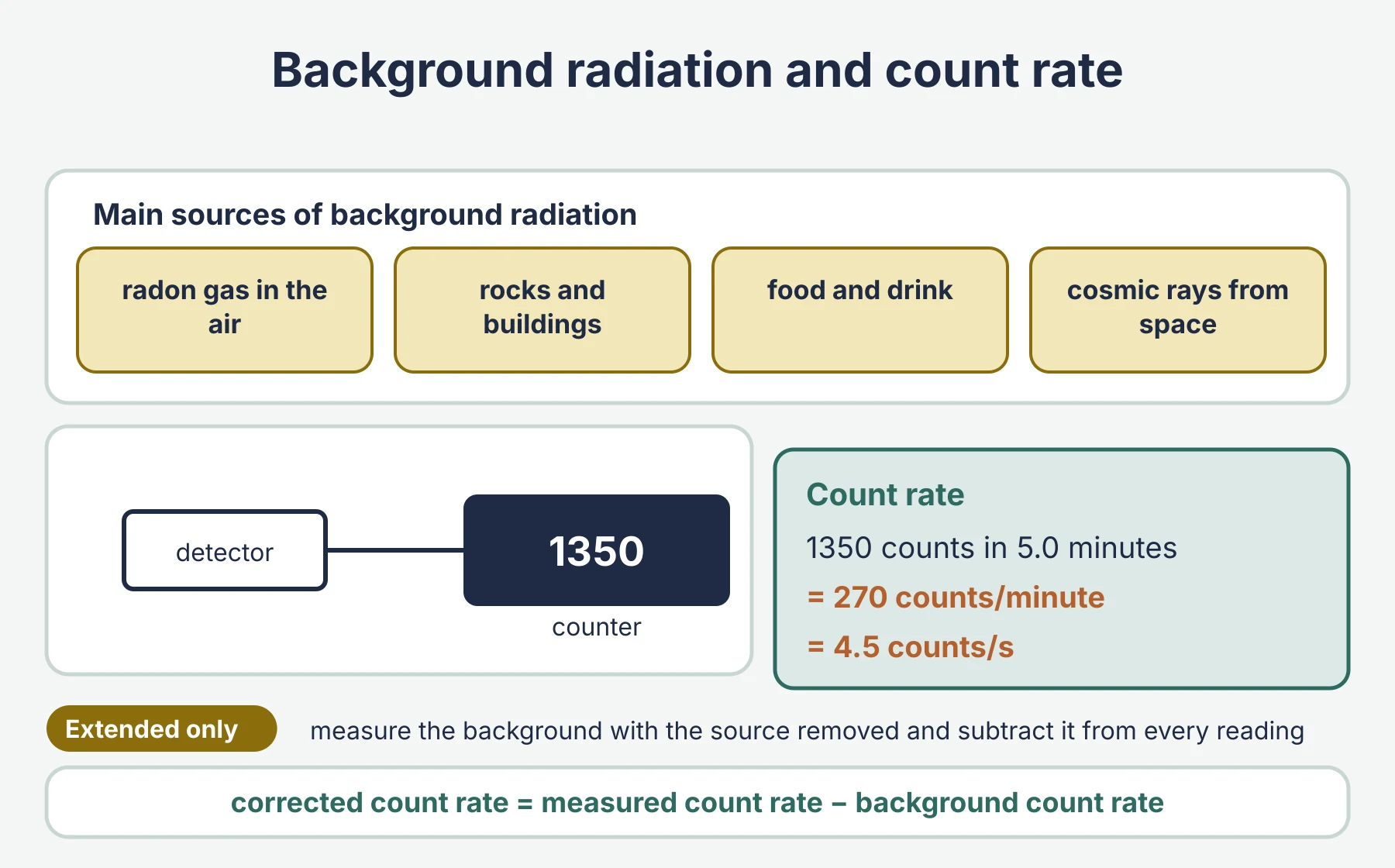
- Background radiation: ionising radiation always present.
- Main sources: radon gas (air), rocks and buildings, food and drink, cosmic rays.
- Measured with a detector connected to a counter.
- Count rate = counts ÷ time, in counts/s or counts/minute.
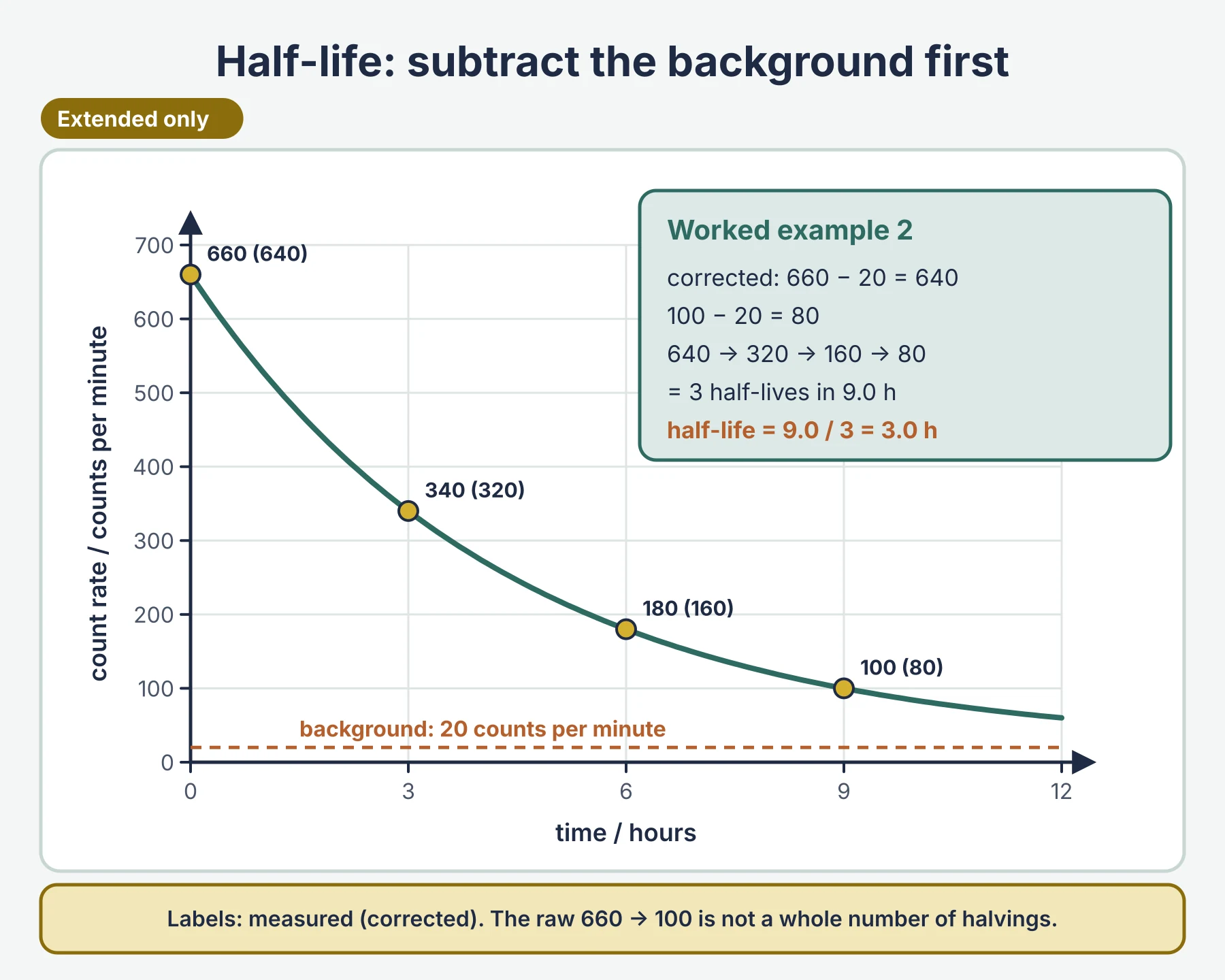
- Extended only: corrected count rate = measured count rate − background count rate.
5.2.2 The three emissions
- Emission is spontaneous and random in direction.
| α | β | γ | |
|---|---|---|---|
| Nature | Helium nucleus (2p + 2n) | Electron from nucleus | Electromagnetic radiation |
| Charge | +2 | −1 | 0 |
| Ionising | Most | Medium | Least |
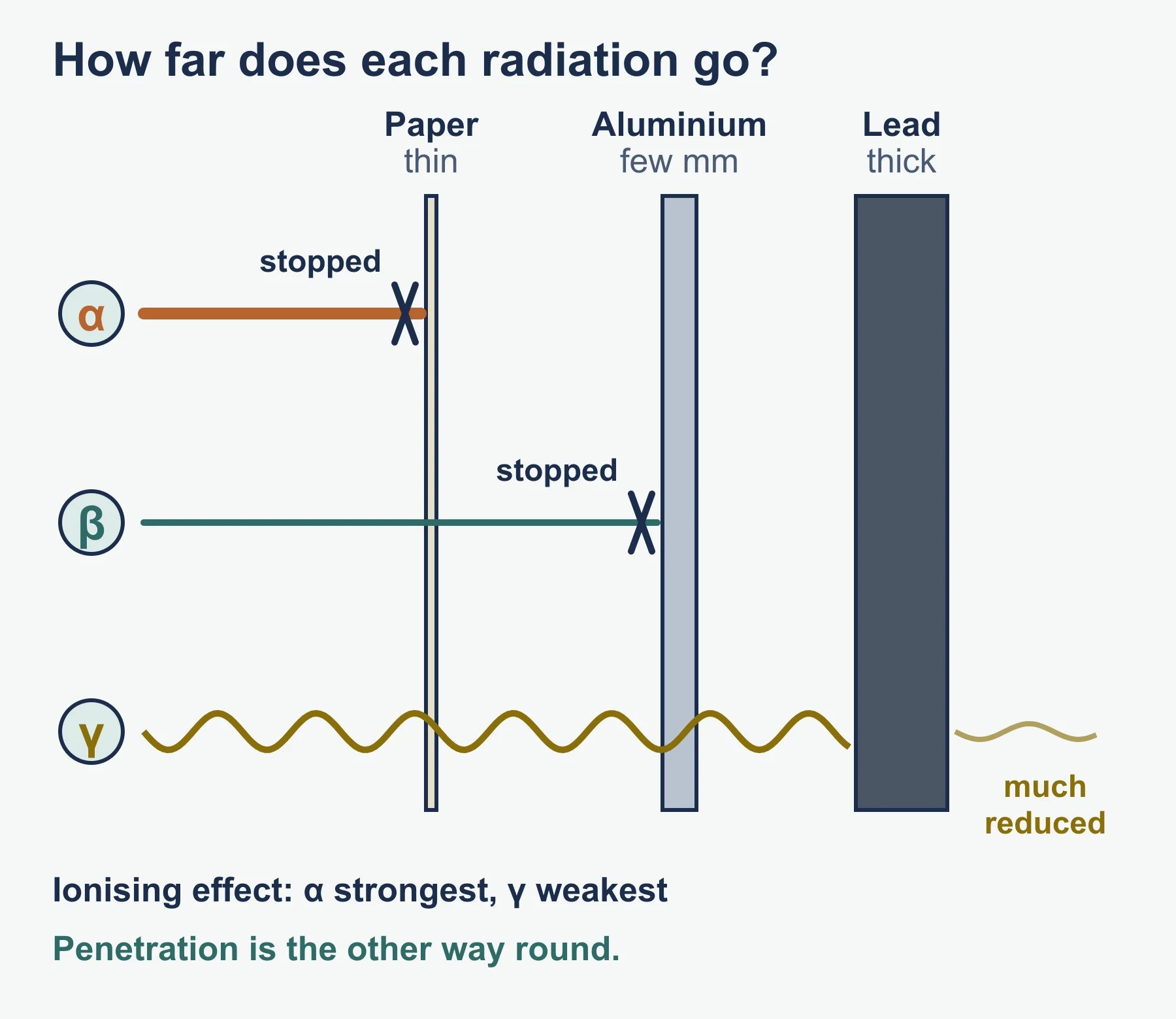
| Penetration | Least (paper) | Medium (few mm aluminium) | Most (reduced by thick lead) |
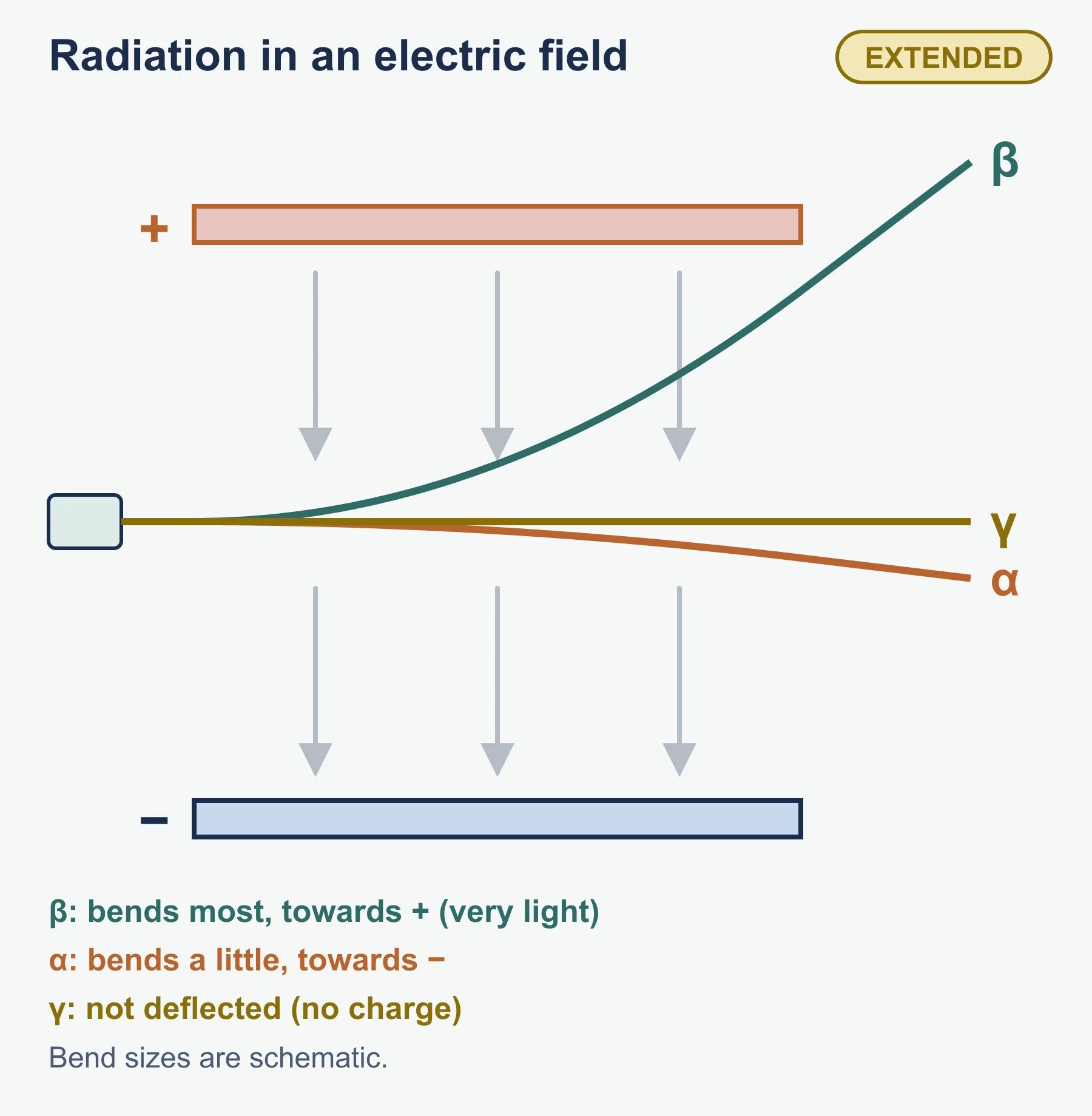
| Electric field (Extended only) | Towards − plate, small bend | Towards + plate, larger bend | Undeflected |
| Magnetic field (Extended only) | Curves one way | Curves the other way, more | Undeflected |
- Extended only: α ionises most because of its large charge and large kinetic energy.
- β always means β⁻ in this syllabus.
5.2.3 Radioactive decay
- A change in an unstable nucleus; emits α and/or β and/or γ; spontaneous and random.
- α or β decay → nucleus becomes a different element.
- Extended only: unstable because of excess neutrons and/or too heavy.
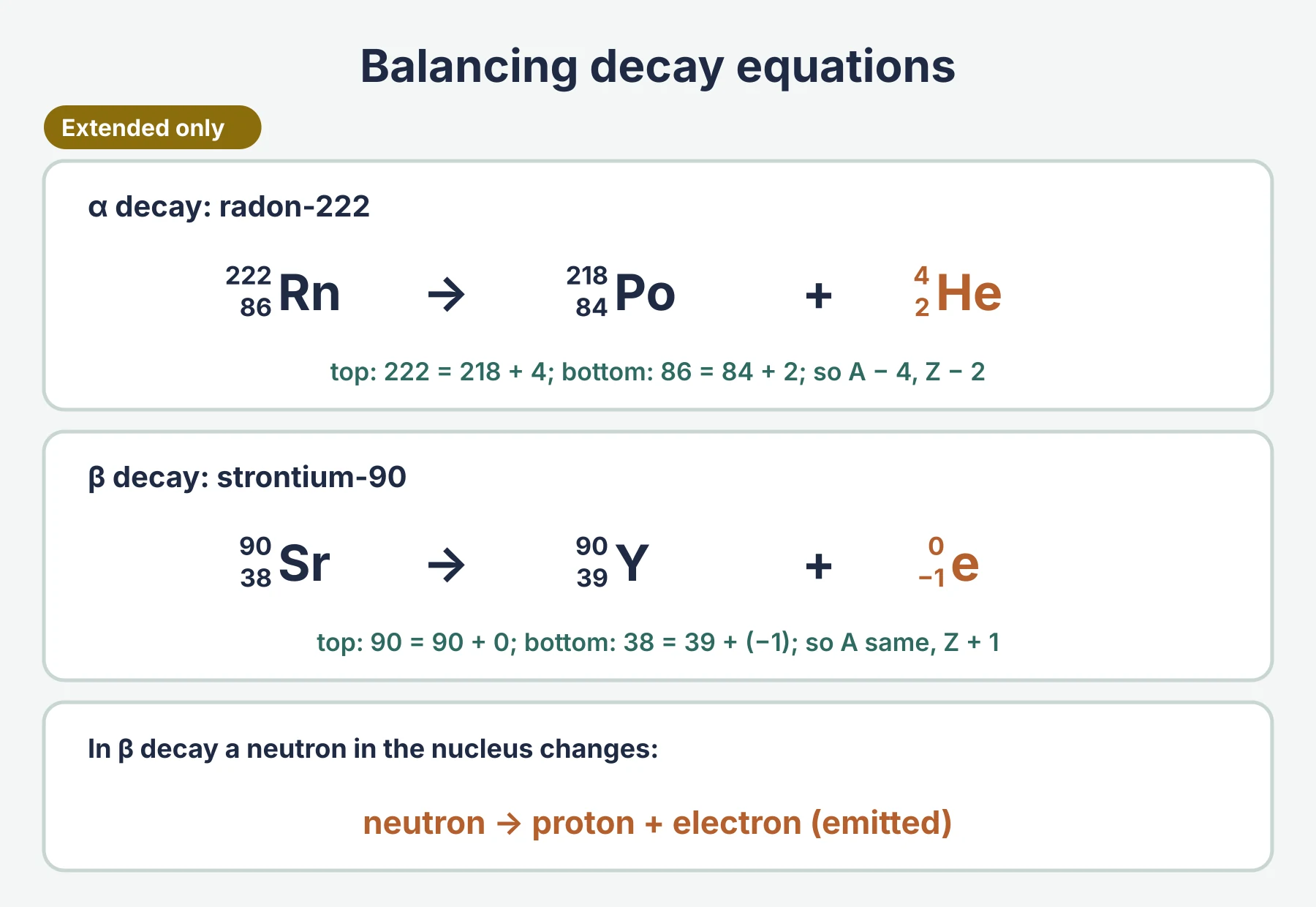
- Extended only: decay increases stability; β-decay: neutron → proton + electron.
Method in steps: decay equation (Extended only)
- Parent nuclide on the left.
- Emitted particle on the right: ⁴₂He, ⁰₋₁e or γ.
- Daughter: α → A − 4, Z − 2; β → A same, Z + 1; γ → no change.
- Check top and bottom rows balance.
- Name the daughter from its Z.
5.2.4 Half-life
- Half-life: time for half the nuclei of a particular isotope in any sample to decay.
- Fraction left after n half-lives: (1/2)ⁿ.
- Core calculations: no background.
- Extended only: subtract background first, then find the half-life.
Method in steps: from a decay curve
- Read a starting count rate.
- Find where it has halved; read the time.
- Repeat from another starting point; average.
- Draw construction lines on the graph.
Uses (Extended only)
| Use | Radiation | Half-life |
|---|---|---|
| Smoke alarm | α | Long |
| Irradiating food | γ | Long |
| Sterilising equipment | γ | Long |
| Thickness of paper | β | Long |
| Cancer diagnosis | γ | Short |
| Cancer treatment | γ | Long (external source) |
- Justify every choice with penetration/absorption and half-life.
5.2.5 Safety
- Effects: cell death, mutations, cancer.
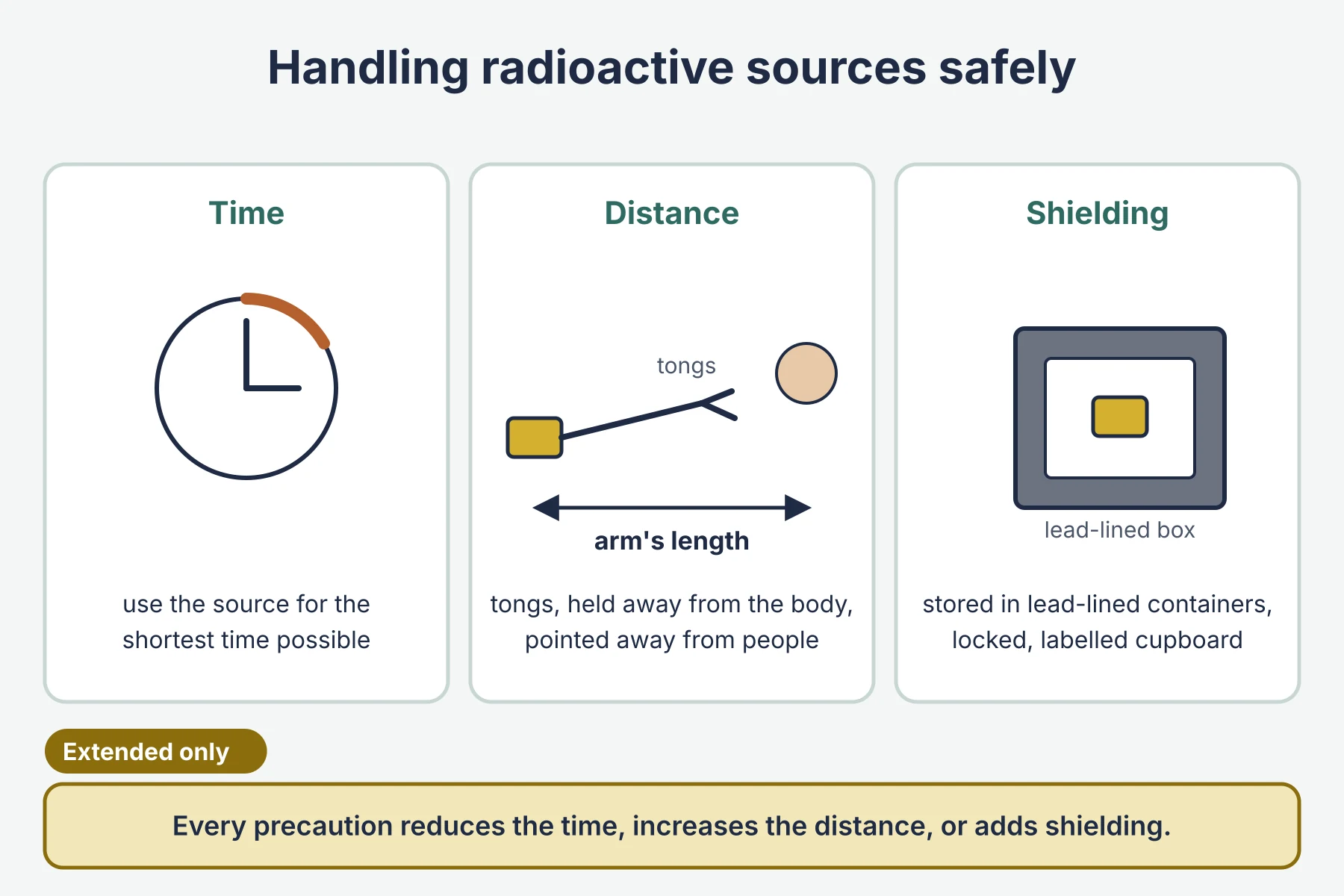
- Handling: tongs, at arm’s length, pointed away from people, short use, lead-lined box, locked and labelled store.
- Extended only: reduce time, increase distance, use shielding.
Must-know distinctions
- Ionising vs penetrating: α ionises most and penetrates least; γ is the reverse.
- Spontaneous vs random: spontaneous means conditions such as temperature do not affect it; random means no one can predict which nucleus decays next.
- Count rate vs corrected count rate (Extended only): the corrected value has the background removed.
- α or β decay vs γ emission: α and β change the element; γ changes only the energy of the nucleus.
Key terms
| Term | Meaning |
|---|---|
| Background radiation | Ionising radiation always present from natural and artificial sources |
| Count rate | Counts per second or per minute |
| Spontaneous | Not affected by external conditions |
| Random | Cannot predict which nucleus decays or when |
| Half-life | Time for half the nuclei of an isotope in a sample to decay |
| Corrected count rate (Extended only) | Count rate with background subtracted |
Exam traps
- γ is reduced, not stopped, by lead.
- β bends more than α in a field.
- Half-life halves the count rate, not the time.
- Extended data with background: subtract it before halving.
- In β-decay, Z goes up by 1 and A stays the same.
- A use needs both radiation type and half-life.
Self-test
- Name four main sources of background radiation.
- A counter records 900 counts in 3.0 minutes. Find the count rate in counts/s.
- Which radiation is stopped by a sheet of paper?
- Which radiation is the most penetrating?
- What happens to the element when a nucleus emits a β-particle?
- Define half-life.
- A sample’s count rate falls from 800 to 50 counts/minute in 16 hours. Find the half-life.
- (Extended) A reading of 245 counts/minute includes a background of 25 counts/minute. Find the corrected count rate.
- (Extended) Write the equation for the β-decay of ⁹⁰₃₈Sr to yttrium (Y).
- (Extended) Describe the change inside a nucleus during β-decay.
- (Extended) Why is a γ-emitter with a short half-life chosen as a medical tracer?
- (Extended) Explain why tongs reduce a technician’s exposure.
Answers
- Radon gas, rocks and buildings, food and drink, cosmic rays.
- 900 ÷ 180 = 5.0 counts/s.
- Alpha.
- Gamma.
- It becomes a different element (Z increases by 1).
- The time taken for half the nuclei of a particular isotope in any sample to decay.
- 800 → 400 → 200 → 100 → 50 is 4 half-lives; 16 ÷ 4 = 4.0 hours.
- 245 − 25 = 220 counts/minute.
- ⁹⁰₃₈Sr → ⁹⁰₃₉Y + ⁰₋₁e.
- A neutron changes into a proton and an electron; the electron is emitted.
- γ passes out of the body to the detector; the short half-life means the activity falls quickly, limiting the dose.
- They increase the distance between the source and the hands.
Official syllabus
Cambridge International, Cambridge IGCSE Physics 0625 syllabus for examination in 2026, 2027 and 2028, Topic 5 Nuclear physics, section 5.2 Radioactivity. Test yourself with the radioactivity practice questions.
Related resources
-
Study guides
Cambridge IGCSE Physics (0625): The nuclear model of the atom
Study guide for Cambridge IGCSE Physics 0625 section 5.1: atomic structure, ions, alpha scattering, nuclide notation, isotopes, and fission and fusion.
Physics · Cambridge · IGCSE
Read guide -
Practice questions
Cambridge IGCSE Physics (0625): The nuclear model of the atom – Practice Questions
Thirteen original Cambridge IGCSE Physics 0625 questions on atoms, ions, nuclide notation, isotopes, alpha scattering, fission and fusion, with answers.
Physics · Cambridge · IGCSE
Try questions -
Revision notes
Cambridge IGCSE Physics (0625): The nuclear model of the atom – Revision Notes
Revision notes for Cambridge IGCSE Physics 0625 section 5.1: atoms and ions, nuclide notation, isotopes, alpha scattering, fission and fusion, with a self-test.
Physics · Cambridge · IGCSE
Revise topic
Related articles
Get free revision emails (optional)
Occasional emails with practice questions, worked explanations and links to free resources for the qualification and subjects you choose. No spam, and you can unsubscribe from any email. The free tools on this site never need an email.