
Revision Notes
Cambridge IGCSE Sociology (0495): Social stratification and inequality – How has globalisation affected inequalities between societies? – Revision Notes
Revision notes for Cambridge IGCSE Sociology 0495 key question 3.3: migration, TNCs, climate change, pollution, urbanisation, and theories of global inequality.
- Subject
- Sociology
- Level
- IGCSE
- Topic
- Paper 1 – Research Methods, Identity and Inequality
- Author
- Marlbridge Academic Team
- Updated
- Reviewed by
- Naqiya Yousaf (what this means)
Aligned to Cambridge IGCSE Sociology (0495), 2025-2027. Official specification .
Syllabus page (what it covers and how it is assessed): Cambridge IGCSE Sociology.
Syllabus points this page covers
0495
- 3.3 Social stratification and inequality – How has globalisation affected inequalities between societies?
Found an error? Report a correction.
Need help with this topic? Request a free trial class for IGCSE Sociology (0495).
Key question 3.3 of Cambridge IGCSE Sociology (0495) asks How has globalisation affected inequalities between societies? In short: globalisation links societies through trade, migration and technology, but on unequal terms. Migration brings gains and losses to both sending and receiving societies; ecological issues — the actions of transnational companies, climate change, pollution and urbanisation — fall hardest on poorer societies; and Marxist, colonial and feminist explanations show wealth and power flowing towards richer countries and men.
Full explanations and case studies are in the study guide for key question 3.3.
Syllabus coverage
0495 syllabus 2025–2027, 3.3:
- 3.3.1 Migration: immigration/emigration; push and pull factors; increasing cultural diversity; economic consequences; negative perceptions of migrants.
- 3.3.2 Global ecological issues: influence of transnational companies; climate change; pollution; urbanisation.
- 3.3.3 Explanations: Marxist views of capitalist exploitation; colonialism; feminist ideas of patriarchy.
Key terms
| Term | Definition |
|---|---|
| Globalisation | Growing interconnection of societies through trade, migration, media and technology |
| Immigration | Moving into a country to live |
| Emigration | Leaving a country to live elsewhere |
| Push factor | A condition that drives people to leave |
| Pull factor | An attraction that draws people to a place |
| Intervening obstacles | Barriers between origin and destination, such as cost or border rules (Lee, 1966) |
| Remittances | Money migrants send to family in their home country |
| Brain drain | Loss of skilled workers from a country through emigration |
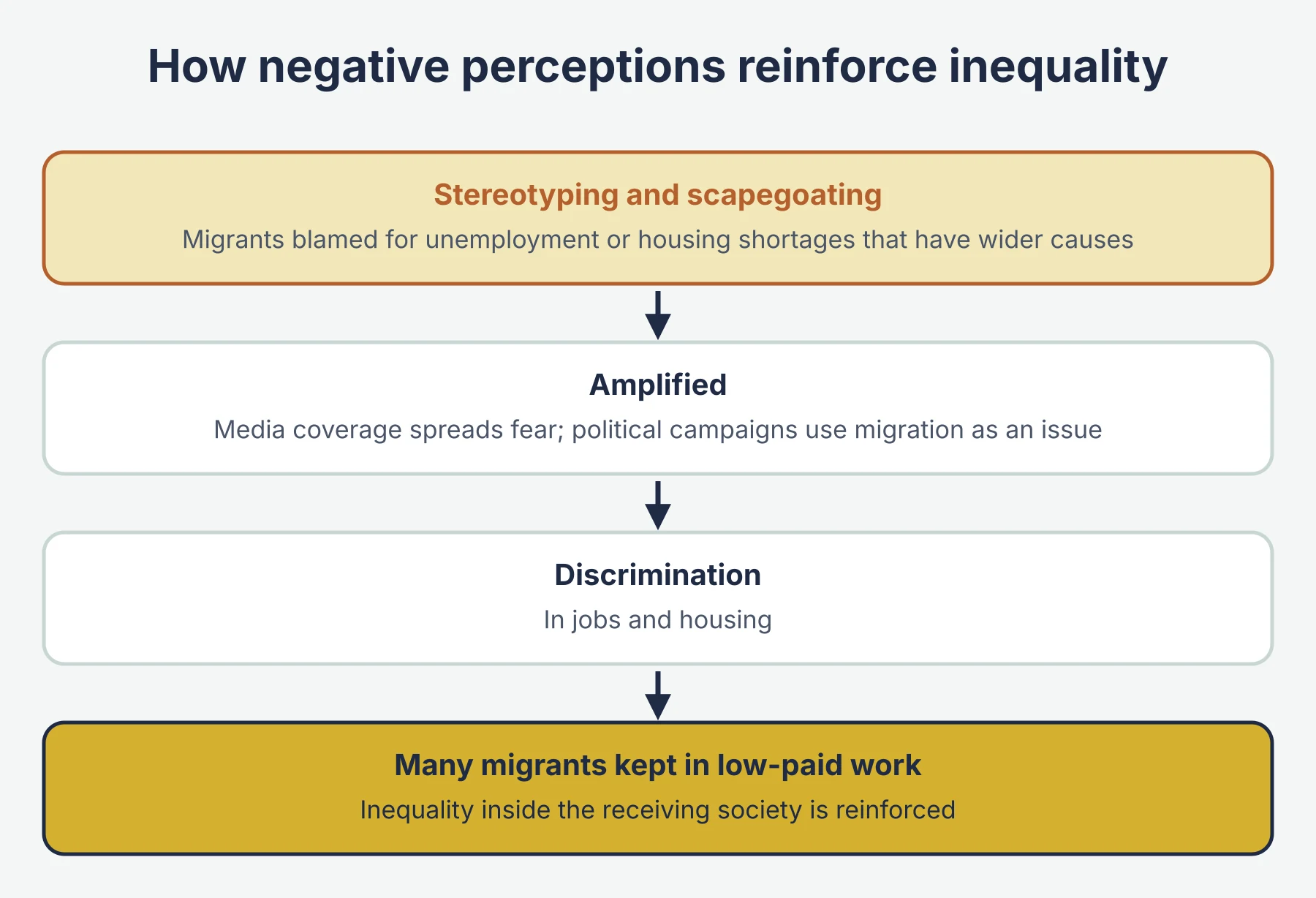
| Scapegoating | Blaming a group for problems with wider causes |
| Transnational company (TNC) | A company operating in several countries |
| Informal settlement | Housing built without legal tenure or planning, often lacking services |
| Dependency theory | View that rich countries develop by exploiting poor ones (Frank) |
| Core and periphery | Rich industrial states versus poorer suppliers of raw materials and labour (Wallerstein) |
| Neo-colonialism | Continued economic control of former colonies through trade and debt |
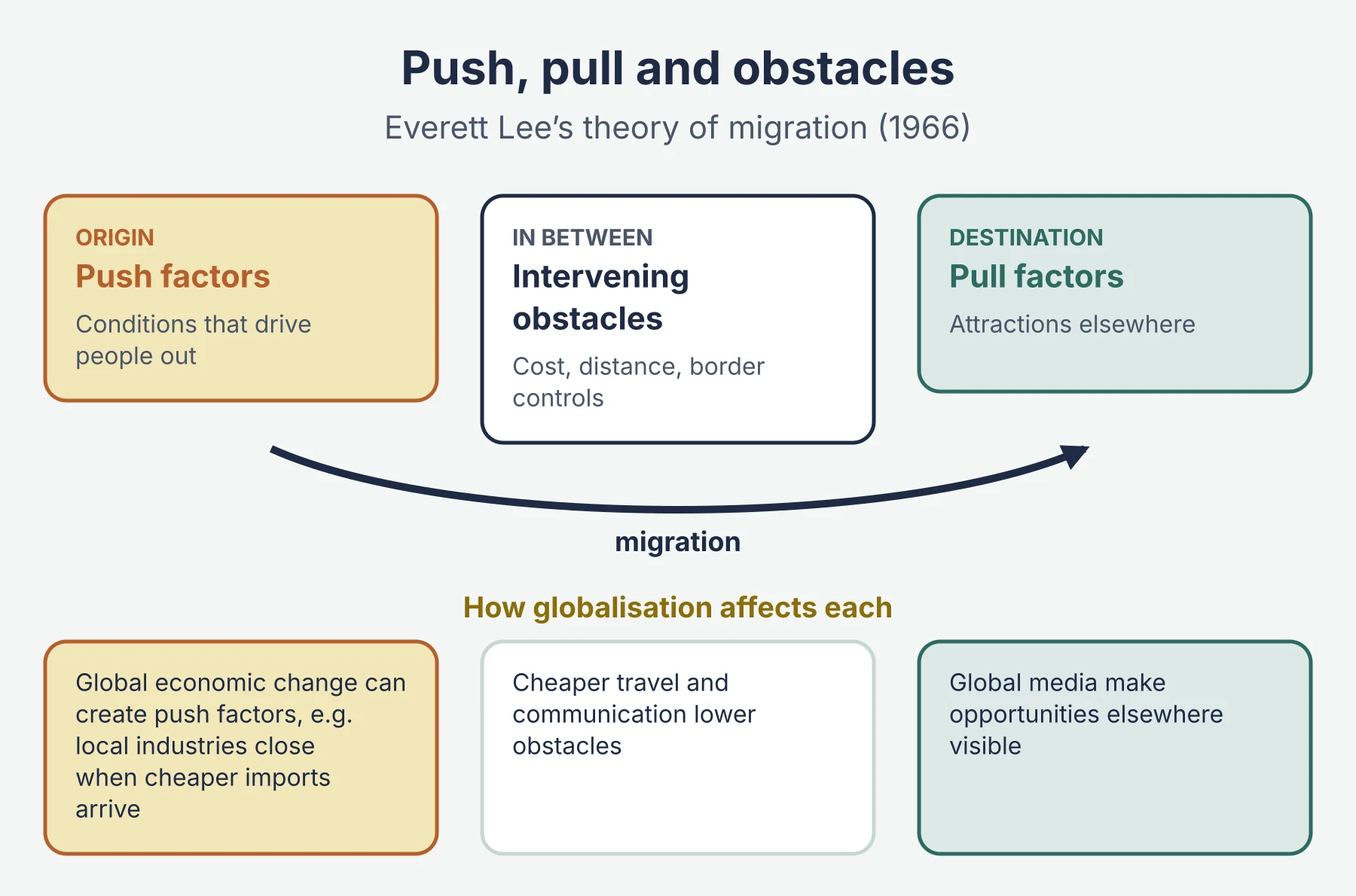
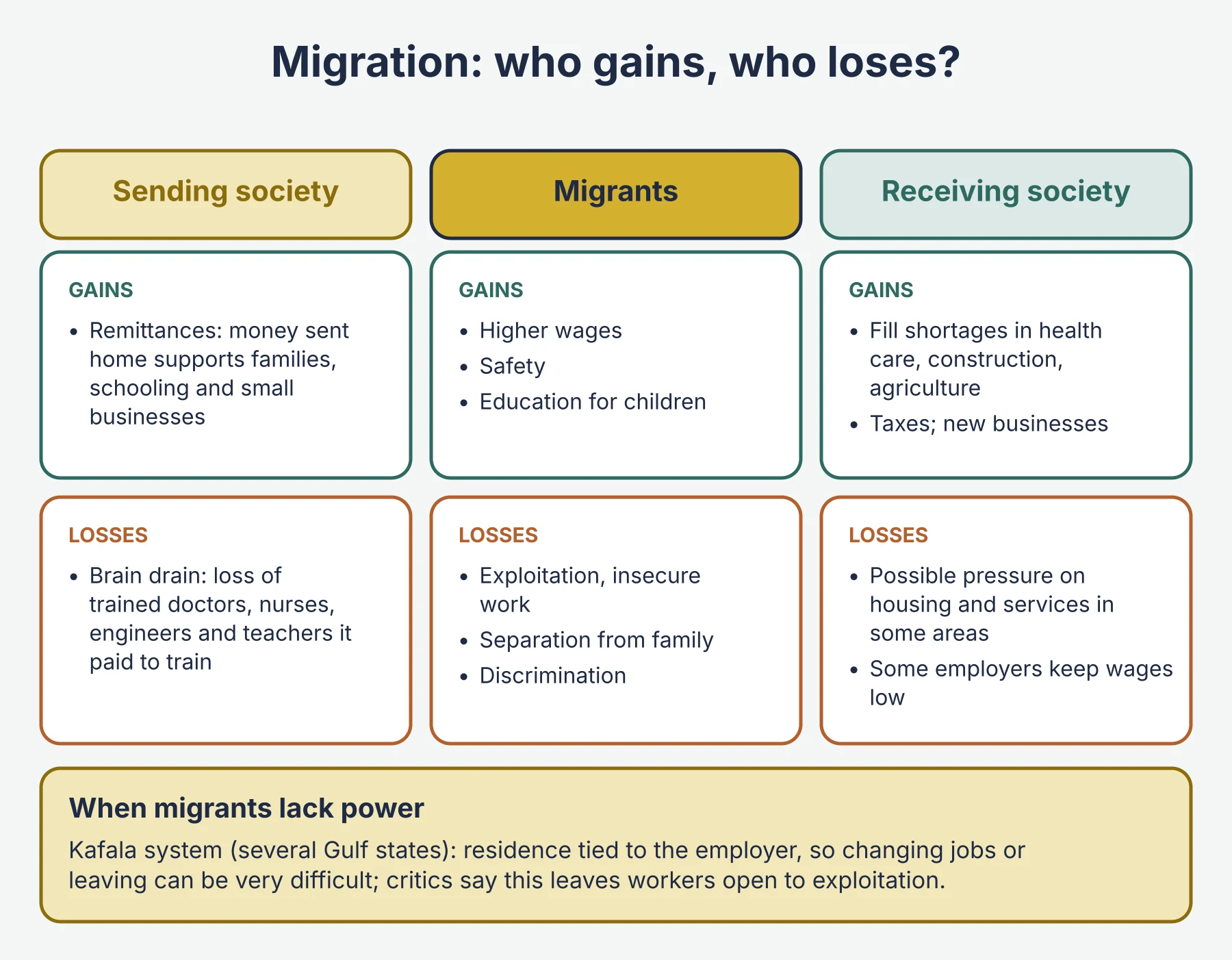
Migration: gains and losses
- Receiving society: + workers for shortages, taxes, new businesses, cultural diversity; − claimed pressure on housing and services; some employers use migrants to keep wages low.
- Sending society: + remittances fund families, schooling and businesses; − brain drain of doctors, nurses, engineers.
- Migrants: + higher wages, safety, opportunity; − exploitation (for example under the kafala sponsorship system in some Gulf states), discrimination, separation from family.
- Negative perceptions: stereotyping, scapegoating, media amplification → discrimination → migrants concentrated in low-paid work.
- Example of diversity: Empire Windrush, 1948, symbol of post-war Caribbean migration to Britain.
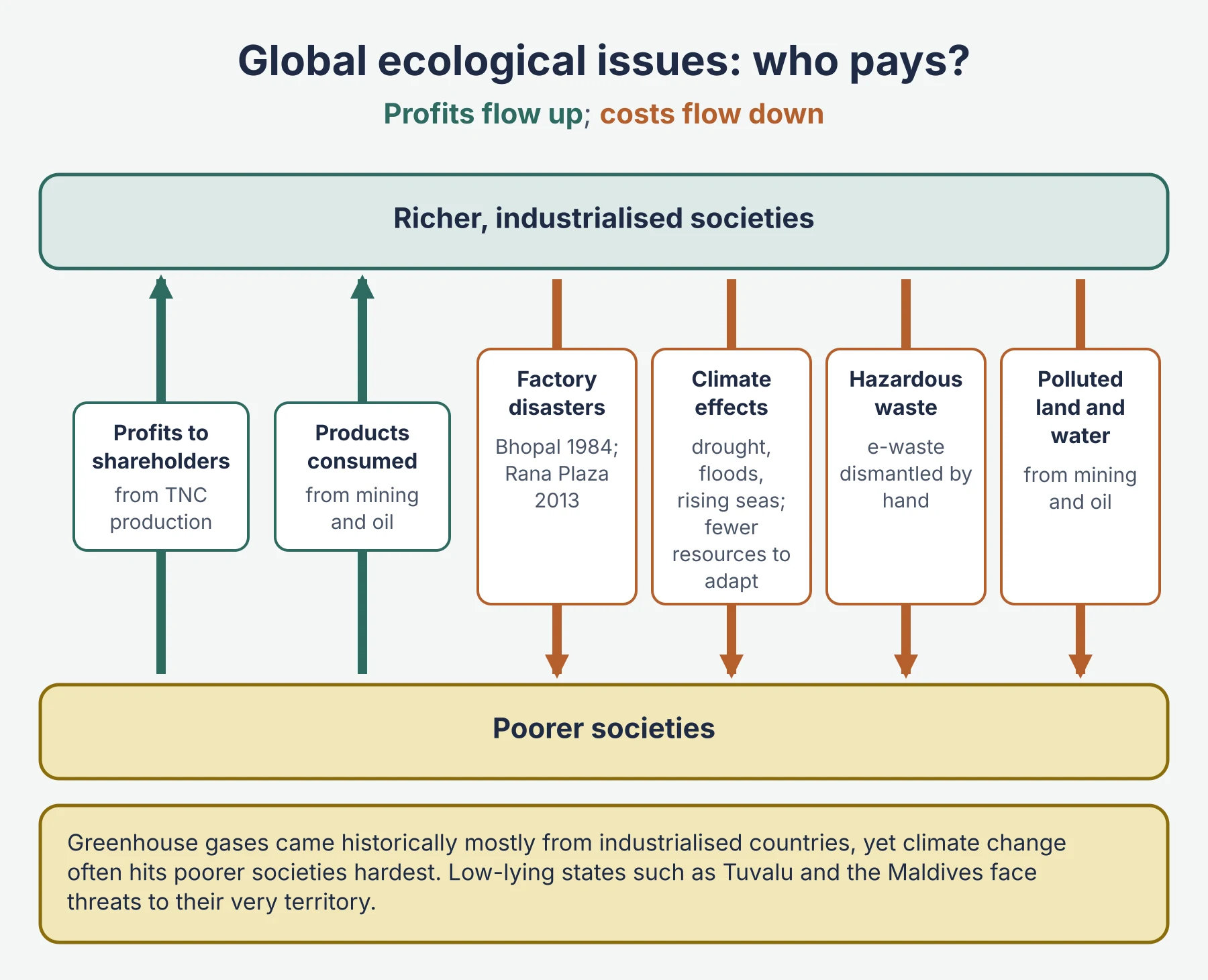
Ecological issues: case studies
| Issue | Case or example | Inequality point |
|---|---|---|
| TNCs | Bhopal gas leak, India, 1984 (Union Carbide subsidiary) | Thousands killed; victims in a poorer society bore the cost |
| TNCs and supply chains | Rana Plaza collapse, Bangladesh, 2013; more than 1,100 garment workers killed | Profits flow to global brands; risks stay with low-paid workers |
| Climate change | Tuvalu, the Maldives and other low-lying islands | Least responsible for emissions, most threatened |
| Climate policy | Paris Agreement, 2015 | Disputes over who pays for damage and adaptation |
| Pollution | Hazardous and electronic waste shipped to poorer countries | Health costs moved down the global hierarchy |
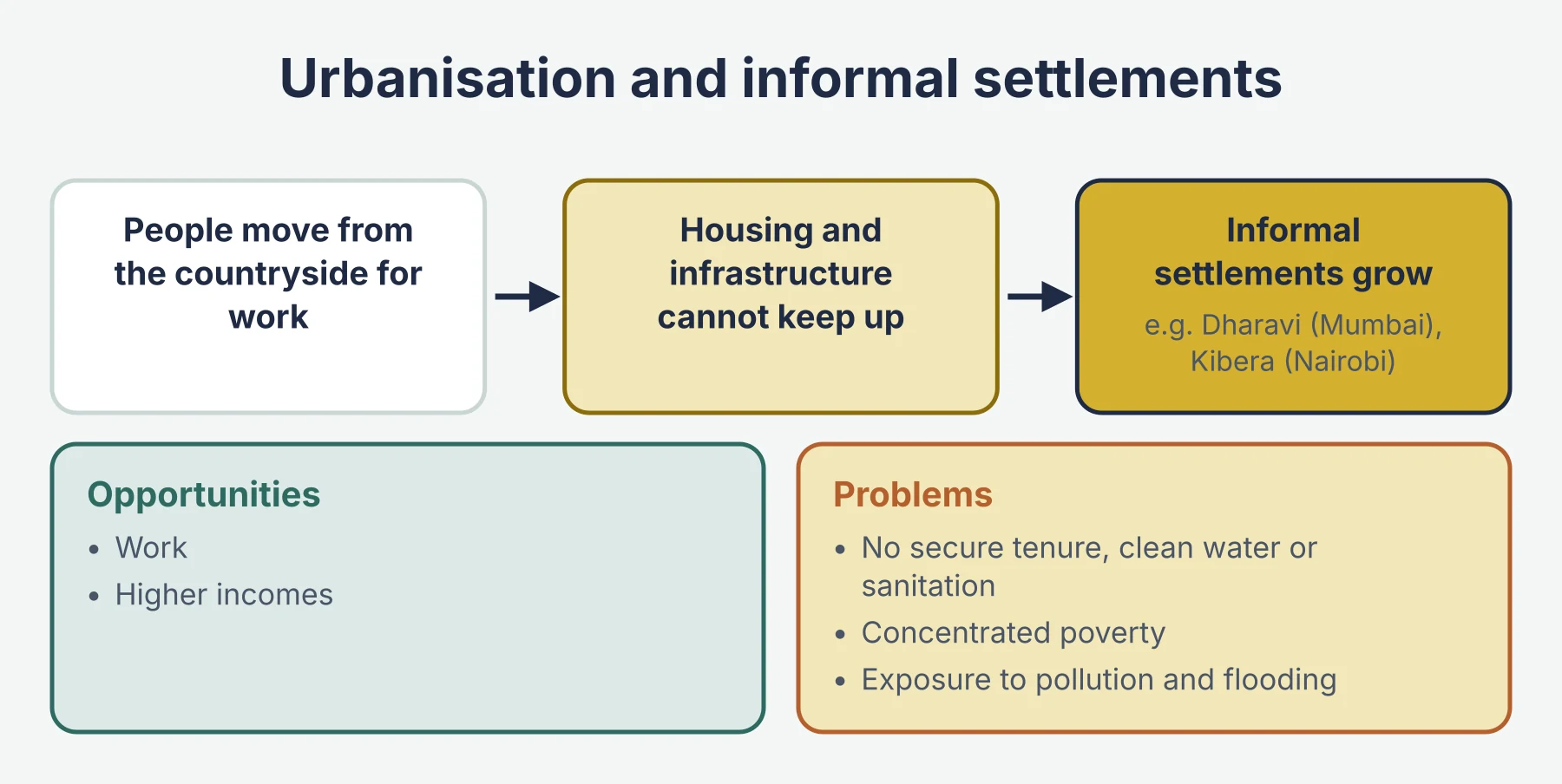
| Urbanisation | Dharavi (Mumbai), Kibera (Nairobi) | Rapid city growth outpaces housing, water and sanitation |
Explanations recall
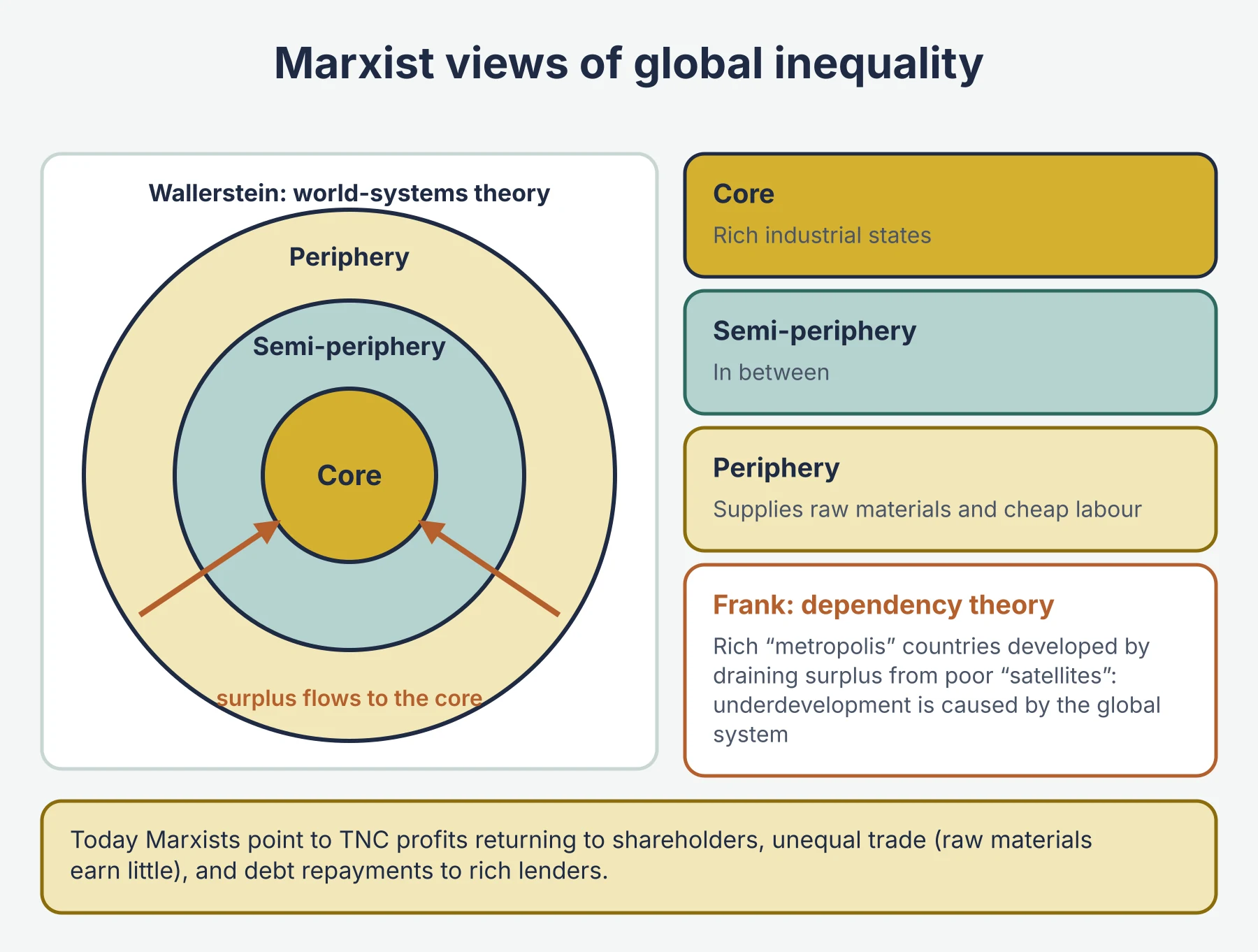
- Marxist: global capitalism moves surplus from poor to rich. Frank — metropolis and satellite; underdevelopment is caused by the system. Wallerstein — core, semi-periphery, periphery. Unequal trade, TNC profits and debt.
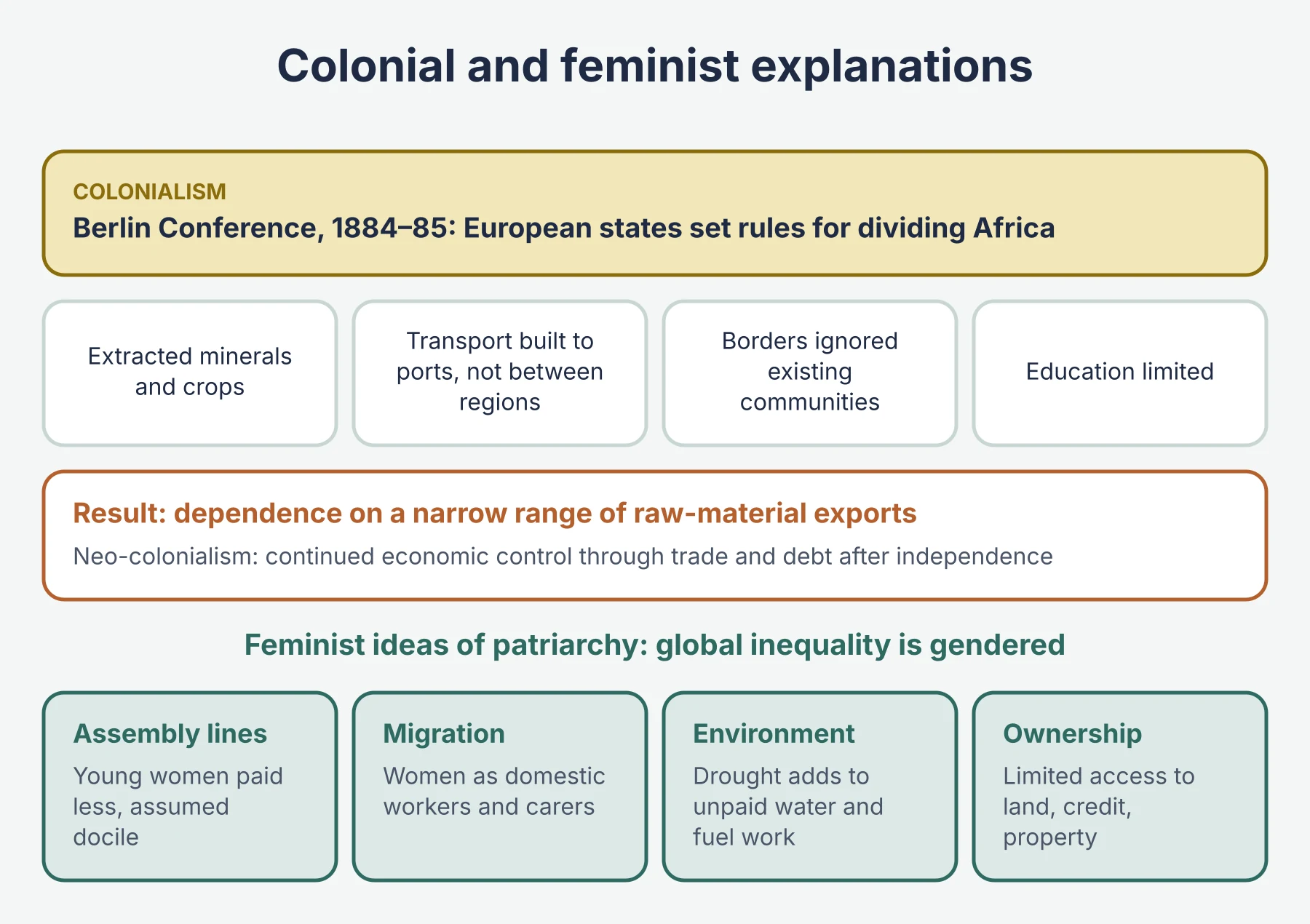
- Colonialism: extraction of resources, export-oriented infrastructure, arbitrary borders (Berlin Conference, 1884–85), limited education; continued as neo-colonialism.
- Feminist: women’s low-paid work on global assembly lines; migrant women as domestic and care workers; extra unpaid work from environmental damage; limited ownership of land and credit.
Exam traps
- Show effects on both sending and receiving societies.
- Globalisation’s effects are mixed — avoid one-sided answers.
- Keep climate answers sociological: who is affected and why unequally.
- Colonialism ≠ neo-colonialism.
- Use a named case (Bhopal, Rana Plaza) to develop TNC points.
Worked example: a 6-mark “explain” answer
Explain three ways urbanisation may affect inequality in poorer societies. (practice)
- Informal settlements — housing cannot keep pace with migration from rural areas, so many live without secure tenure, water or sanitation, as in Kibera.
- Health risks — overcrowding and pollution increase disease, widening health gaps between rich and poor city residents.
- Opportunity — cities offer jobs and higher wages than rural areas, so some migrants and their families escape poverty, while others remain in insecure informal work.
Self-test
- Define globalisation.
- Give two push factors and two pull factors.
- What are intervening obstacles?
- What are remittances?
- What is brain drain, and which society does it harm?
- Give one reason migrants may be scapegoated.
- What happened at Rana Plaza in 2013?
- Why do low-lying island states illustrate global inequality?
- What did Andre Gunder Frank argue?
- Name Wallerstein’s three zones.
- Give one lasting effect of colonialism on former colonies.
- Give one feminist explanation of global inequality.
Answers
- The growing interconnection of societies through trade, migration, media and technology.
- Push: poverty, conflict, persecution, disaster. Pull: jobs, higher wages, safety, education.
- Barriers between origin and destination, such as cost, distance and border controls.
- Money migrants send to family in their home country.
- Loss of skilled workers through emigration; it harms the sending society.
- They may be blamed for unemployment or housing shortages that have wider causes.
- A building housing garment factories collapsed near Dhaka, killing more than 1,100 workers.
- They produced few emissions but face the greatest threat from rising sea levels.
- That rich metropolis countries developed by draining surplus from poor satellite countries.
- Core, semi-periphery, periphery.
- Economies dependent on exporting a narrow range of raw materials; arbitrary borders; limited education.
- Women’s low-paid labour on global assembly lines, or women’s limited ownership of land and credit.
Related pages: globalisation and global inequality practice questions | reducing inequality and globalisation revision notes
Related resources
-
Practice questions
Cambridge IGCSE Sociology: Positivism, Interpretivism and Research Choices — Practice Questions (0495)
Original Cambridge IGCSE Sociology 0495 Question 1 style practice on positivism, interpretivism, triangulation and evaluating research, with full answers.
Sociology · Cambridge · IGCSE
Try questions -
Revision notes
Cambridge IGCSE Sociology: Positivism, Interpretivism and Research Choices — Revision Notes (0495)
Revision notes for Cambridge IGCSE Sociology 0495 key question 1.1: positivism, interpretivism, triangulation, longitudinal studies and judging research.
Sociology · Cambridge · IGCSE
Revise topic -
Study guides
Cambridge IGCSE Sociology: Reducing Inequality and Global Inequality (0495)
Cambridge IGCSE Sociology 0495 key questions 3.2 and 3.3: laws, welfare states and NGOs against inequality, their critics, and global inequality.
Sociology · Cambridge · IGCSE
Read guide
Related articles
Get free revision emails (optional)
Occasional emails with practice questions, worked explanations and links to free resources for the qualification and subjects you choose. No spam, and you can unsubscribe from any email. The free tools on this site never need an email.