
Study Guides
Cambridge IGCSE Sociology (0495): Social stratification and inequality – How has globalisation affected inequalities between societies?
Cambridge IGCSE Sociology 0495 key question 3.3: migration, transnational companies, climate change, pollution, urbanisation and theories of inequality.
- Subject
- Sociology
- Level
- IGCSE
- Topic
- Paper 1 – Research Methods, Identity and Inequality
- Author
- Marlbridge Academic Team
- Updated
- Reviewed by
- Naqiya Yousaf (what this means)
Aligned to Cambridge IGCSE Sociology (0495), 2025-2027. Official specification .
Syllabus page (what it covers and how it is assessed): Cambridge IGCSE Sociology.
Syllabus points this page covers
0495
- 3.3 Social stratification and inequality – How has globalisation affected inequalities between societies?
Found an error? Report a correction.
Need help with this topic? Request a free trial class for IGCSE Sociology (0495).
Key question 3.3 of Cambridge IGCSE Sociology (0495) asks How has globalisation affected inequalities between societies? Globalisation is the growing interconnection of the world’s societies through trade, investment, migration, media and technology. The syllabus asks you to examine three things: how migration affects sending and receiving societies, how global ecological issues fall unequally on different societies, and how Marxist, colonial and feminist explanations account for global inequality.
A combined overview of 3.2 and 3.3 is in the reducing inequality and global inequality guide; this guide treats 3.3 in more depth with different case studies.
Syllabus coverage
Cambridge IGCSE Sociology 0495, syllabus for 2025, 2026 and 2027, 3.3 How has globalisation affected inequalities between societies?
- 3.3.1 The impact of migration on societies: immigration/emigration; push and pull factors; increasing cultural diversity; economic consequences; negative perceptions of migrants.
- 3.3.2 The impact of global ecological issues on societies: the influence of transnational companies; climate change; pollution; urbanisation.
- 3.3.3 Sociological explanations for global inequalities: Marxist views of capitalist exploitation; colonialism; feminist ideas of patriarchy.
Migration (3.3.1)
Immigration, emigration and push–pull factors
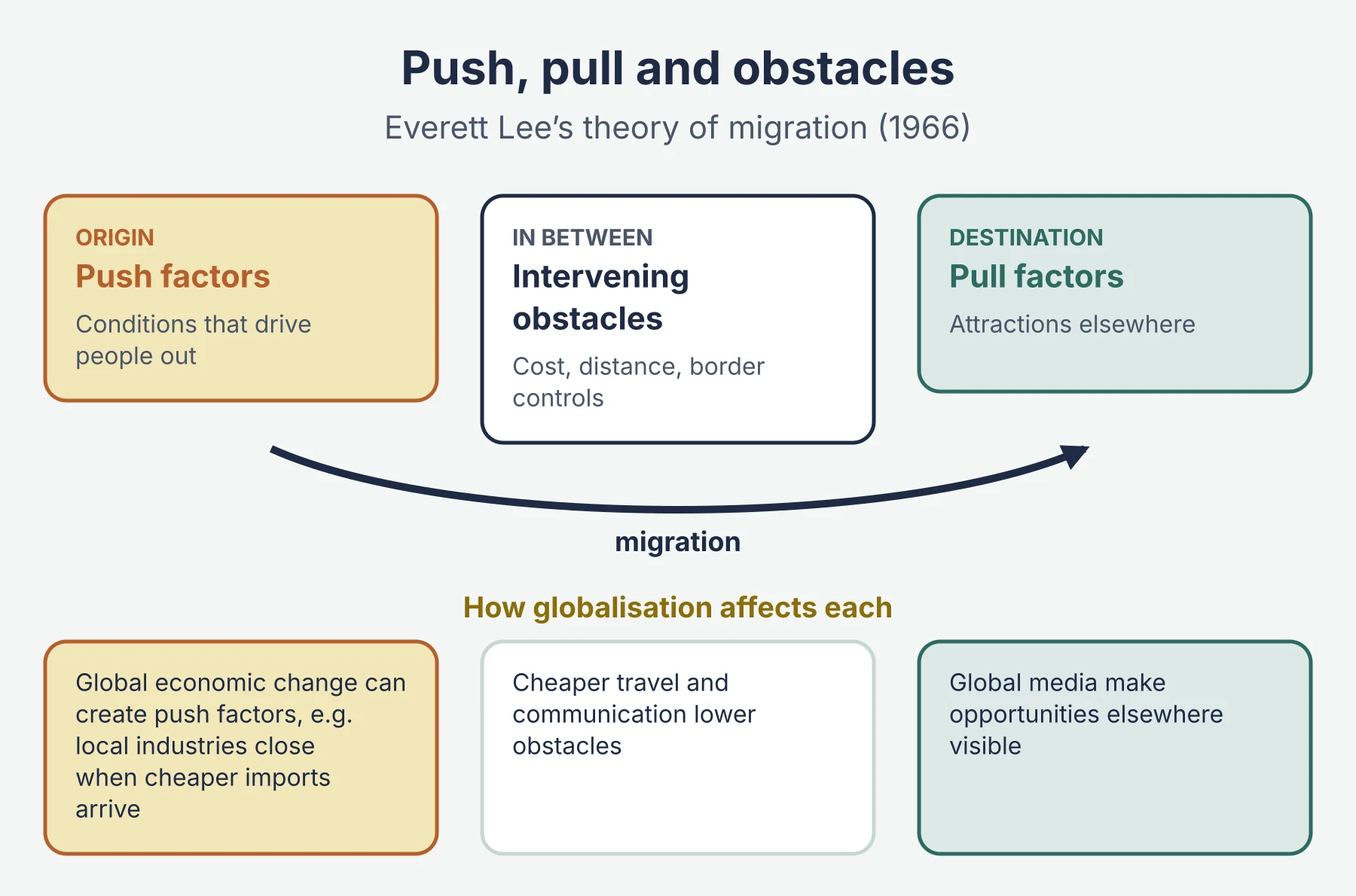
Immigration is moving into a country to live; emigration is leaving one. The geographer Everett Lee’s theory of migration (1966) is the source of the familiar idea of push factors (conditions that drive people out) and pull factors (attractions elsewhere), with intervening obstacles such as cost, distance and border controls in between.
Globalisation affects all three. Cheaper travel and communication lower obstacles; global media make opportunities elsewhere visible; and global economic change can create push factors, for example when local industries close because cheaper imports arrive.
Economic consequences: who gains, who loses?
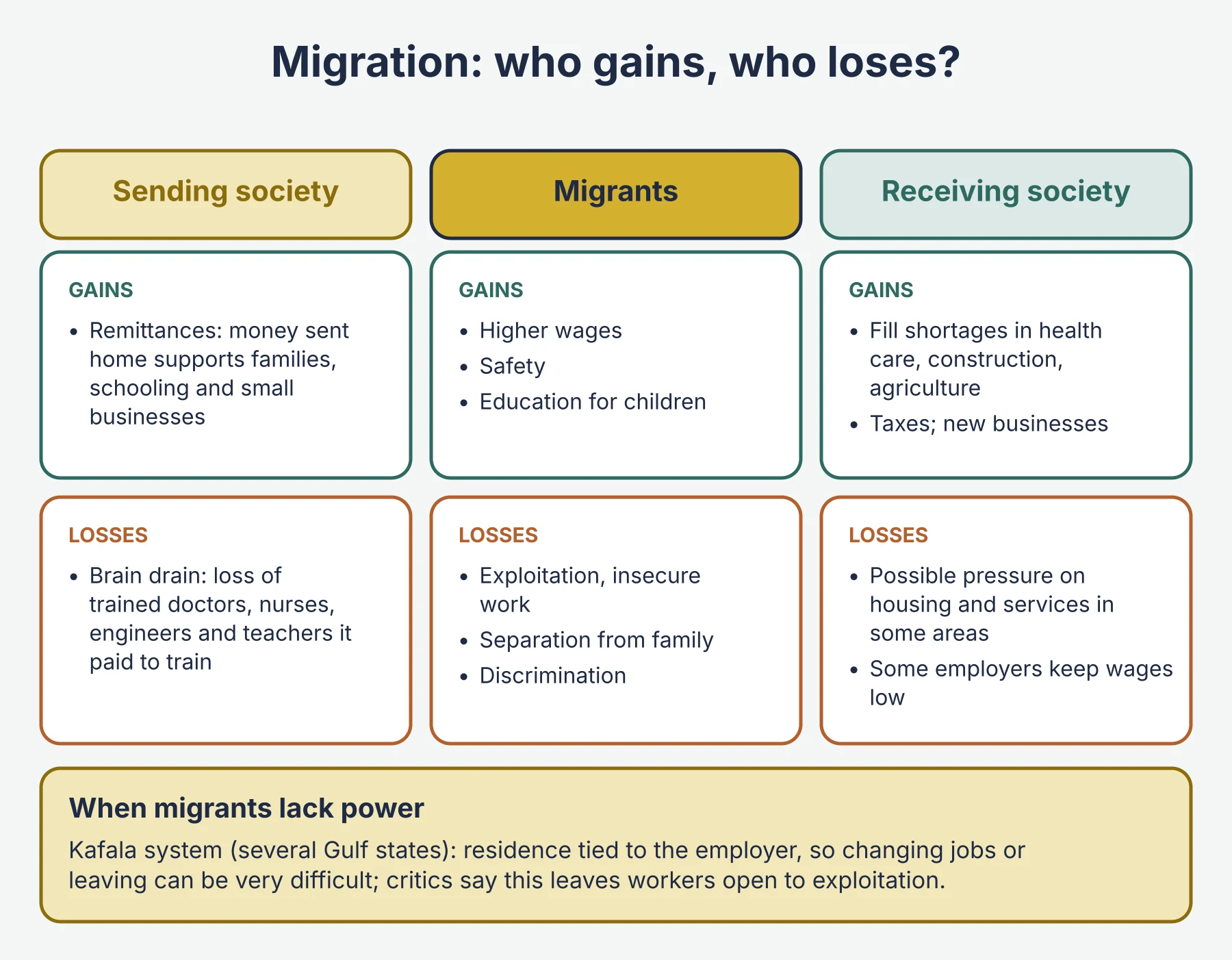
| Gains | Losses | |
|---|---|---|
| Receiving society | Workers fill shortages in sectors such as health care, construction and agriculture; migrants pay taxes; new businesses | Possible pressure on housing and services in some areas; some employers use migrant labour to keep wages low |
| Sending society | Remittances — money migrants send home — support families, schooling and small businesses | Brain drain — loss of trained doctors, nurses, engineers and teachers whose training the sending country paid for |
| Migrants themselves | Higher wages, safety, education for children | Exploitation, insecure work, separation from family, discrimination |
An example of how migrants can lack power is the kafala sponsorship system used in several Gulf states, under which a migrant worker’s legal residence is tied to their employer. Critics, including human rights organisations, argue it leaves workers open to exploitation because changing jobs or leaving can be very difficult.
Increasing cultural diversity
Migration makes receiving societies more culturally diverse — languages, religions, foods and festivals multiply. In Britain, the arrival of the ship Empire Windrush in 1948, carrying passengers from the Caribbean, is often used to mark the start of large-scale post-war migration from Commonwealth countries. Diversity can enrich societies but may also produce tension.
Negative perceptions of migrants
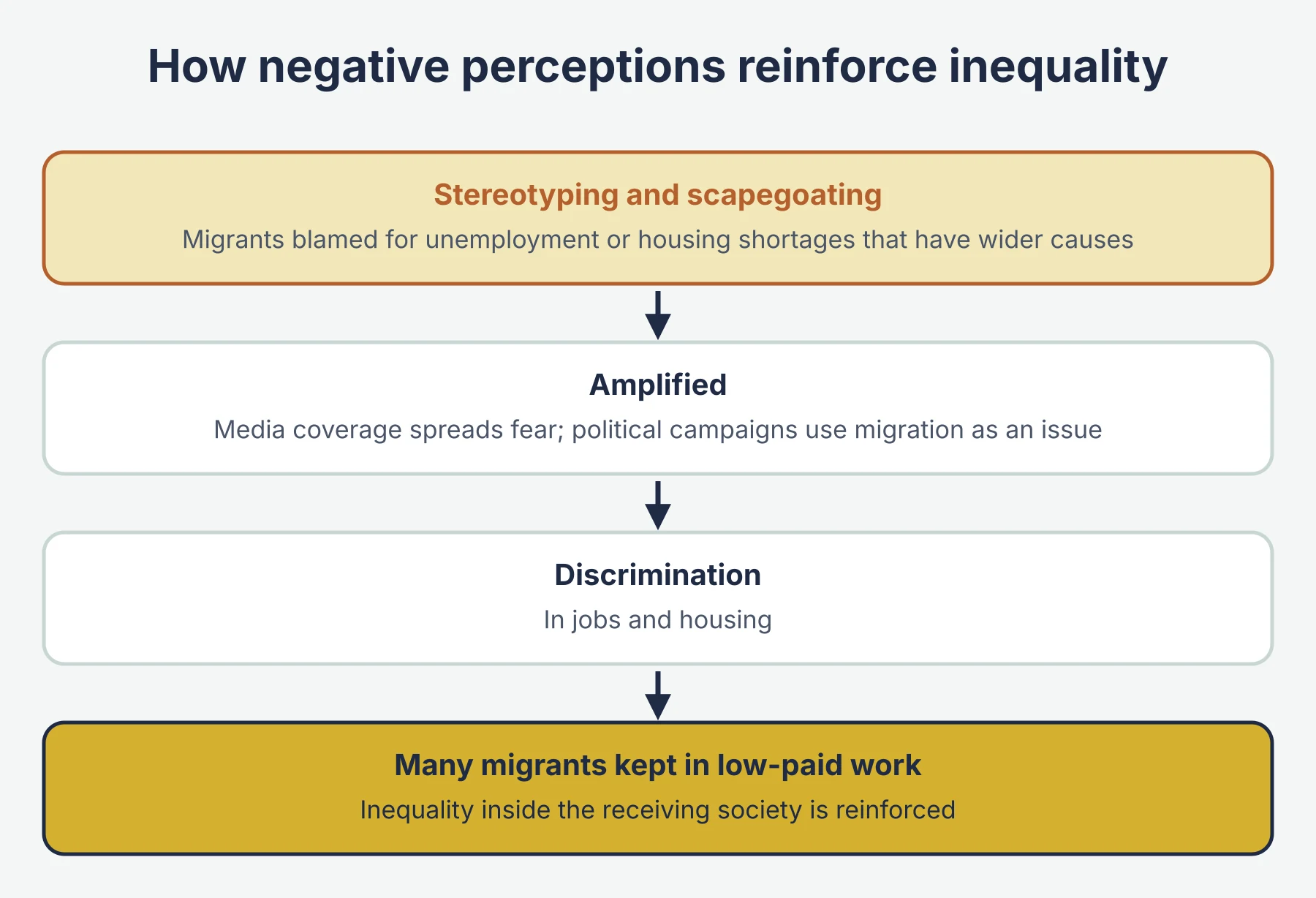
Migrants are often stereotyped and scapegoated — blamed for problems such as unemployment or housing shortages that have wider causes. Media coverage can amplify fear, and political campaigns may use migration as an issue. Negative perceptions feed discrimination in jobs and housing, which keeps many migrants in low-paid work and reinforces inequality inside the receiving society.
Global ecological issues (3.3.2)
Transnational companies (TNCs)
TNCs are companies operating in many countries. They bring investment, jobs and technology, but critics argue they move production to wherever wages and environmental rules are lowest.
- Bhopal, India, 1984 — a gas leak at a pesticide plant owned by a subsidiary of the US company Union Carbide killed thousands of people and injured many more; campaigners argue victims waited years for limited compensation.
- Rana Plaza, Bangladesh, 2013 — the collapse of a building housing garment factories that supplied global clothing brands killed more than 1,100 workers, drawing attention to unsafe conditions in global supply chains.
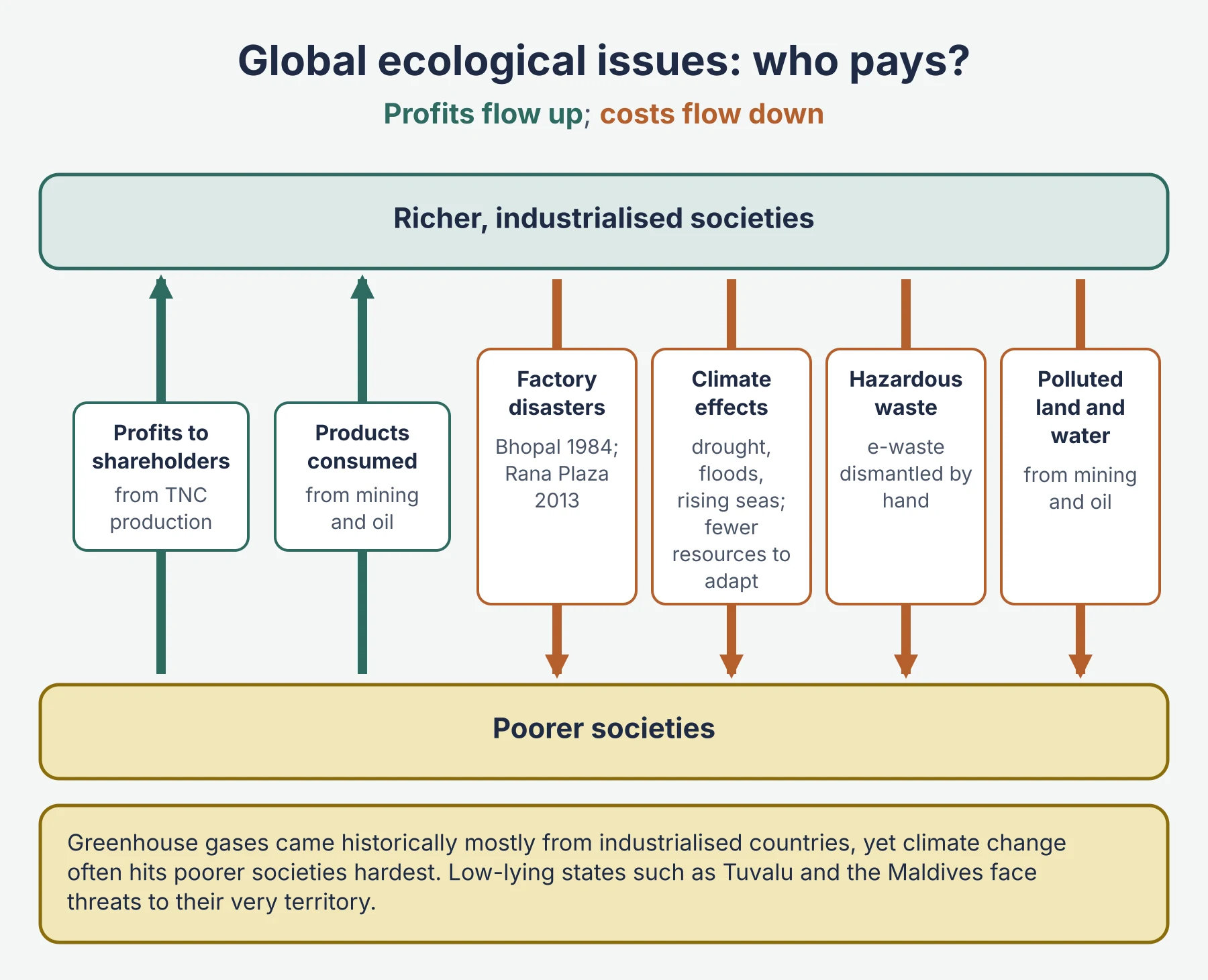
These cases show how the costs of global production can fall on workers in poorer societies while profits flow to shareholders elsewhere.
Climate change
Climate change is driven mainly by greenhouse gases from burning fossil fuels, historically produced mostly by industrialised countries. Yet its effects — drought, floods, storms, crop failure, rising sea levels — often hit hardest in poorer societies that have fewer resources to adapt. Low-lying island states such as Tuvalu and the Maldives face threats to their very territory. The Paris Agreement (2015) committed countries to limiting global warming, but debates continue over how far richer countries should pay for the damage and adaptation needed elsewhere.
Pollution
Pollution often moves down the global hierarchy. Hazardous waste, including discarded electronics, has been shipped from richer to poorer countries, where it may be dismantled by hand without protection. Mining and oil extraction can poison water and land used by local communities, while the products are consumed far away.
Urbanisation
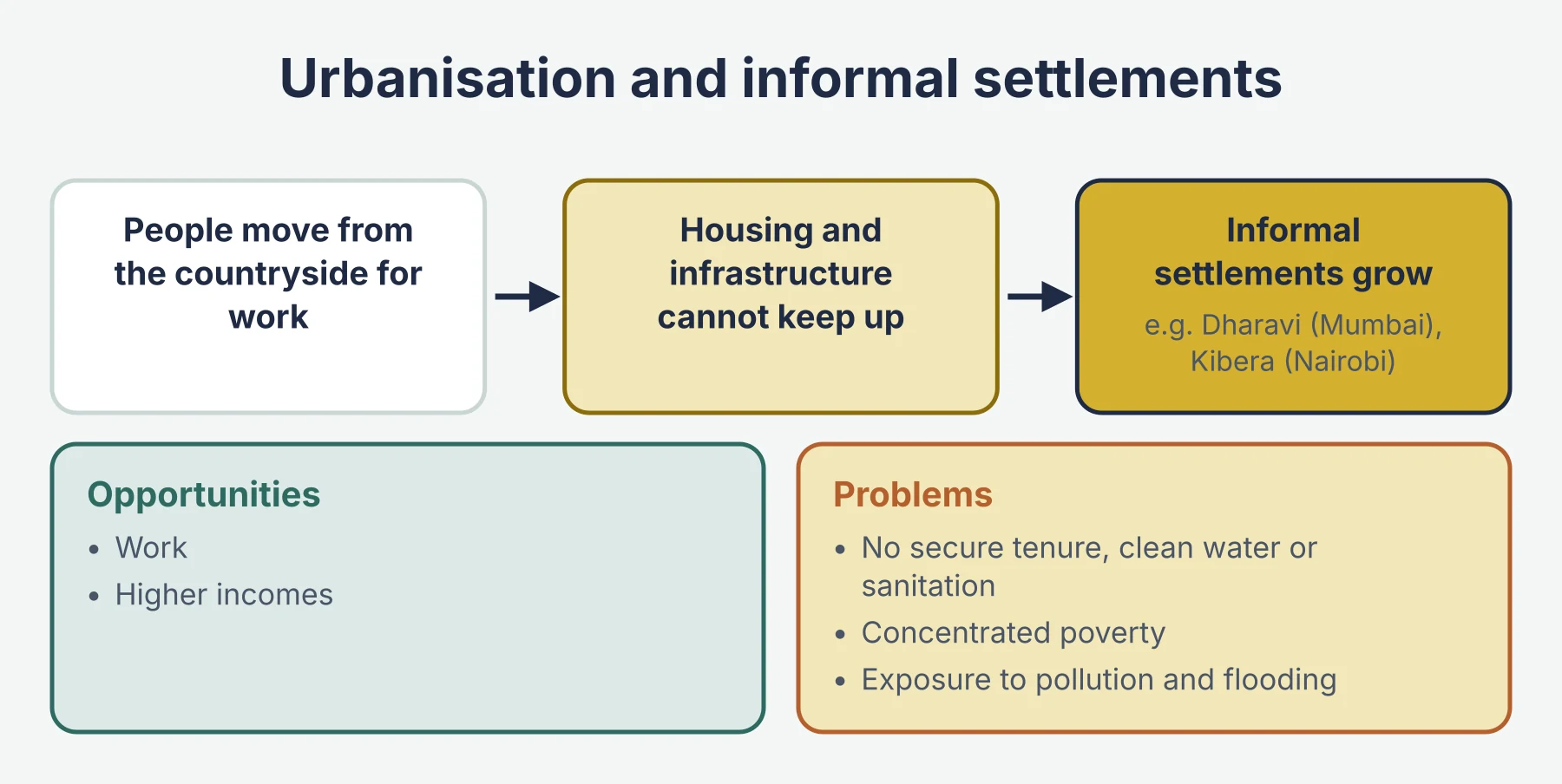
Globalisation speeds the growth of cities as people move from the countryside for work. Where housing and infrastructure cannot keep up, informal settlements grow — Dharavi in Mumbai and Kibera in Nairobi are well-known examples — often without secure tenure, clean water or sanitation. Urban growth can bring opportunity and higher incomes, but also concentrates poverty and exposure to pollution and flooding.
Explaining global inequality (3.3.3)
Marxist views of capitalist exploitation
Marxists see global inequality as the result of capitalism operating on a world scale.
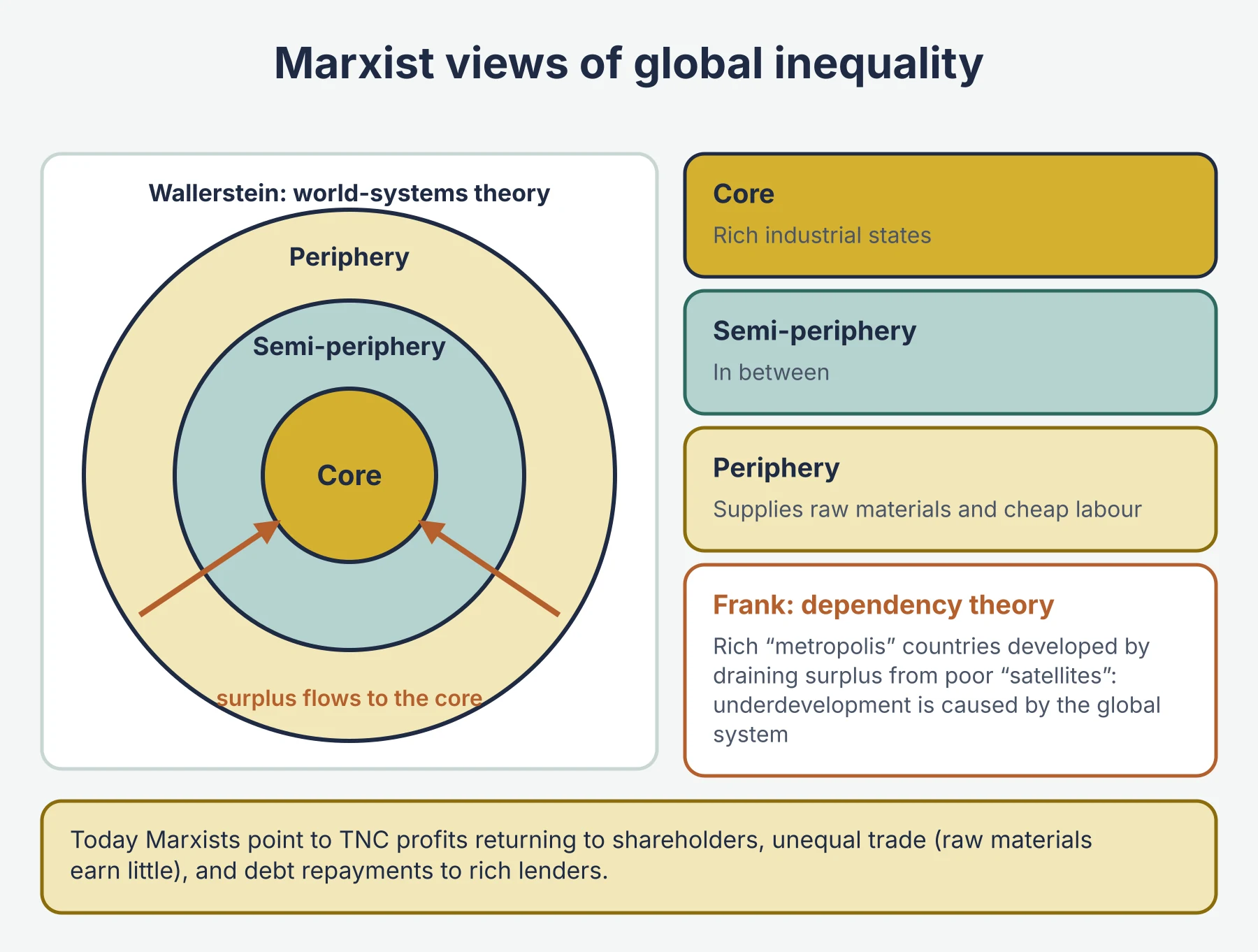
- Dependency theory — Andre Gunder Frank argued that rich “metropolis” countries developed by draining surplus from poor “satellite” countries, so underdevelopment is caused by the global system rather than being an early stage of development.
- World-systems theory — Immanuel Wallerstein divided the world into a core of rich industrial states, a periphery supplying raw materials and cheap labour, and a semi-periphery in between.
- Today, Marxists point to TNC profits flowing back to shareholders, unequal trade in which raw materials earn little compared with finished goods, and debt repayments from poor countries to rich lenders.
Colonialism
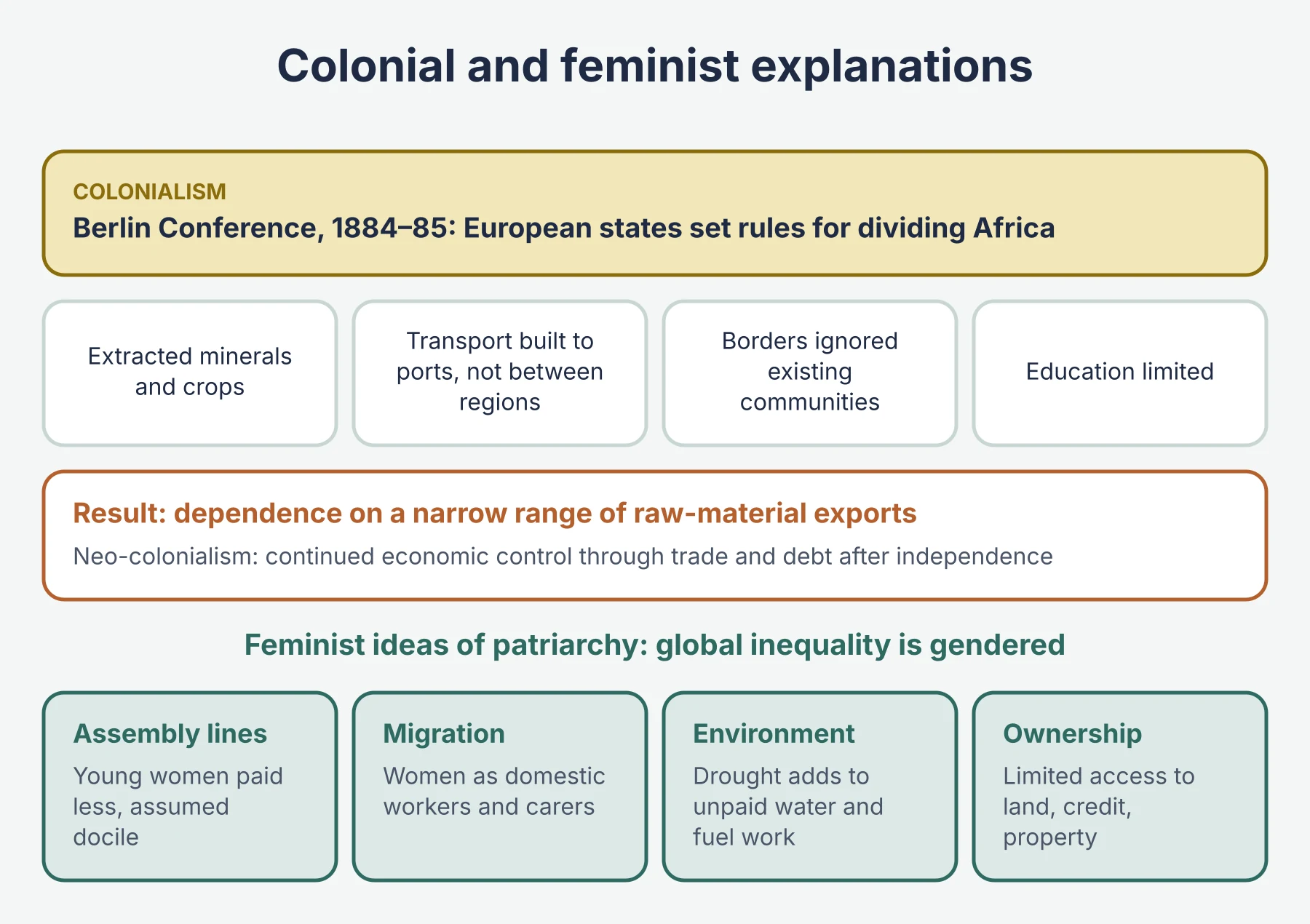
European powers colonised much of Africa, Asia and the Americas; at the Berlin Conference of 1884–85 European states set rules for dividing Africa among themselves. Colonial rule extracted minerals and crops, built transport to move goods to ports rather than to connect regions, drew borders that ignored existing communities, and limited education. Many former colonies were left dependent on exporting a narrow range of raw materials, a pattern that critics call neo-colonialism when it continues through trade and debt after independence.
Feminist ideas of patriarchy
Feminists argue that global inequality is also gendered:
- Global assembly lines — factories in export zones often employ young women because they can be paid less and are assumed to be docile, as the Rana Plaza workforce illustrates.
- Migration — many women migrate as domestic workers or carers, filling gaps in richer households while their own children are cared for by relatives at home.
- Environmental burden — where women are responsible for collecting water, fuel and food, droughts and deforestation add directly to their unpaid work.
- Ownership — women’s limited access to land, credit and property in many societies keeps them poorer than men.
Worked example: Question 3(e)-style “discuss”
Discuss the impact of transnational companies on inequalities between societies.
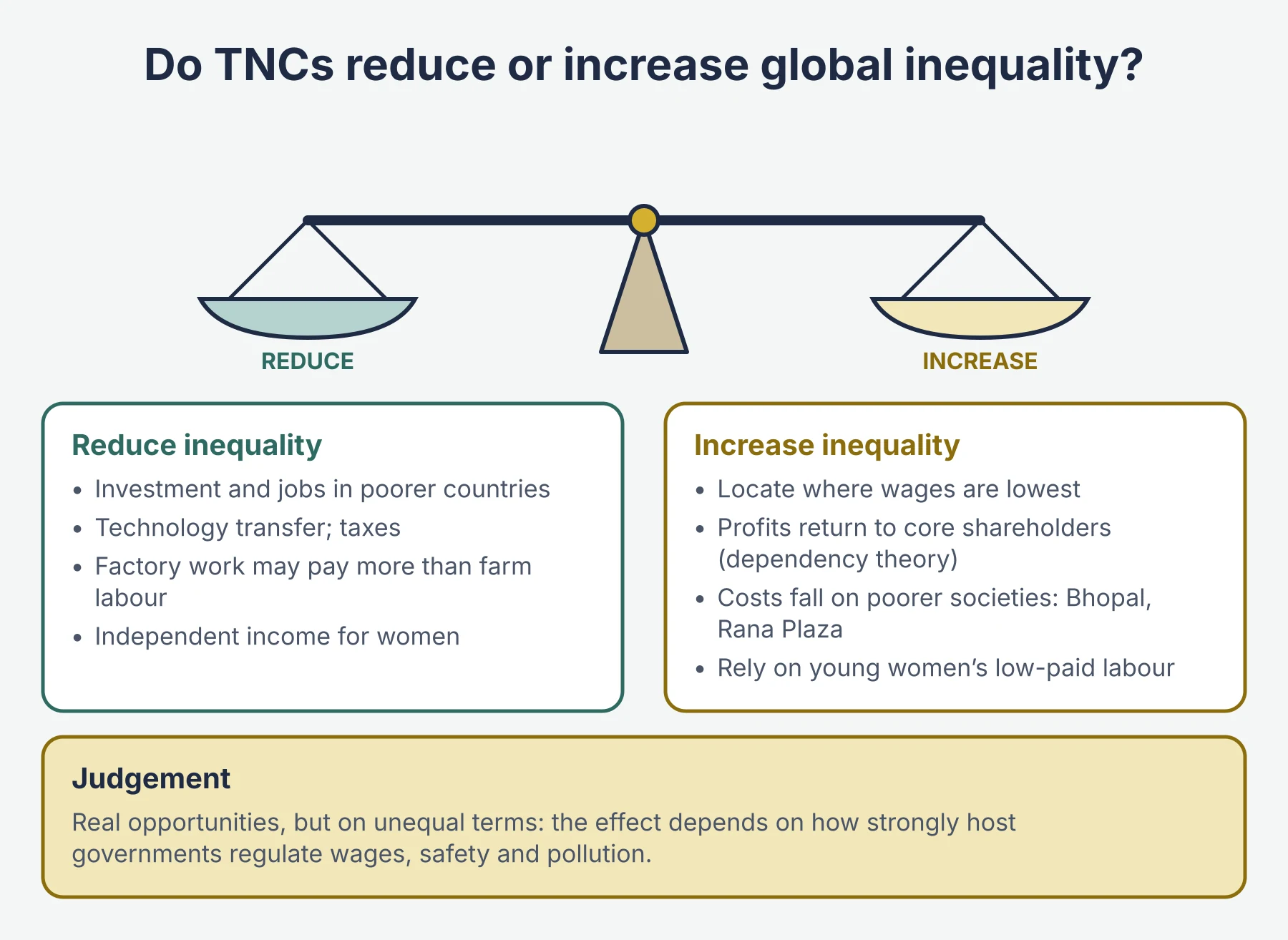
TNCs can reduce inequality between societies by investing in poorer countries, creating jobs, transferring technology and paying taxes. Factory work may pay more than farm labour and give women an independent income.
However, Marxists argue TNCs increase inequality: they locate where wages are lowest, and profits return to shareholders in richer core countries, as dependency theory suggests. Disasters such as Bhopal (1984) and Rana Plaza (2013) show how the human and environmental costs of production fall on poorer societies. Feminists add that TNCs often rely on young women’s low-paid labour.
Overall, TNCs bring real opportunities but on unequal terms; their effect depends on how strongly host governments regulate wages, safety and pollution.
Common mistakes
- Writing about migration only from the receiving country’s point of view.
- Treating globalisation as wholly good or wholly bad; the syllabus asks about its effects, which are mixed.
- Describing climate change scientifically instead of sociologically — focus on who is affected and why that is unequal.
- Confusing colonialism (direct political rule) with neo-colonialism (continued economic control).
Exam technique
- Explain — name the process, show the mechanism, give a case study.
- Discuss — consider effects on different societies and groups.
- Evaluate — weigh evidence that globalisation increases inequality against evidence that it reduces it, and judge.
Revise with the globalisation and global inequality revision notes and practise with the globalisation and global inequality practice questions. Attempts to reduce inequality within societies are covered in the study guide for key question 3.2.
Related resources
-
Practice questions
Cambridge IGCSE Sociology (0495): Social stratification and inequality – How has globalisation affected inequalities between societies? – Practice Questions
Original Cambridge IGCSE Sociology 0495 practice on key question 3.3: migration, climate change, pollution and Marxist and feminist views of global inequality.
Sociology · Cambridge · IGCSE
Try questions -
Revision notes
Cambridge IGCSE Sociology (0495): Social stratification and inequality – How has globalisation affected inequalities between societies? – Revision Notes
Revision notes for Cambridge IGCSE Sociology 0495 key question 3.3: migration, TNCs, climate change, pollution, urbanisation, and theories of global inequality.
Sociology · Cambridge · IGCSE
Revise topic -
Practice questions
Cambridge IGCSE Sociology: Positivism, Interpretivism and Research Choices — Practice Questions (0495)
Original Cambridge IGCSE Sociology 0495 Question 1 style practice on positivism, interpretivism, triangulation and evaluating research, with full answers.
Sociology · Cambridge · IGCSE
Try questions
Related articles
Get free revision emails (optional)
Occasional emails with practice questions, worked explanations and links to free resources for the qualification and subjects you choose. No spam, and you can unsubscribe from any email. The free tools on this site never need an email.