
Study Guides
Cambridge IGCSE Sociology (0495): Social stratification and inequality – What attempts have been made to reduce social inequalities?
Cambridge IGCSE Sociology 0495 key question 3.2 in depth: equality laws, welfare states, NGOs and New Right, Marxist and feminist judgements of their success.
- Subject
- Sociology
- Level
- IGCSE
- Topic
- Paper 1 – Research Methods, Identity and Inequality
- Author
- Marlbridge Academic Team
- Updated
- Reviewed by
- Naqiya Yousaf (what this means)
Aligned to Cambridge IGCSE Sociology (0495), 2025-2027. Official specification .
Syllabus page (what it covers and how it is assessed): Cambridge IGCSE Sociology.
Syllabus points this page covers
0495
- 3.2 Social stratification and inequality – What attempts have been made to reduce social inequalities?
Found an error? Report a correction.
Need help with this topic? Request a free trial class for IGCSE Sociology (0495).
Key question 3.2 of Cambridge IGCSE Sociology (0495) asks What attempts have been made to reduce social inequalities? The syllabus names three kinds of attempt — legislation within societies, welfare states, and the global work of non-governmental organisations (NGOs) — and then asks how successful they have been, using New Right, Marxist and feminist views. Strong answers explain how each measure is meant to reduce inequality, give a real example, and then weigh the evidence of success.
The reducing inequality and global inequality guide gives a combined overview of 3.2 and 3.3; this guide focuses on 3.2 alone and uses different examples.
Syllabus coverage
Cambridge IGCSE Sociology 0495, syllabus for 2025, 2026 and 2027, 3.2 What attempts have been made to reduce social inequalities?
- 3.2.1 The use of legislation within societies to reduce inequality, e.g. progressive taxation; the redistribution of wealth through benefits; a minimum wage; equal opportunities laws; other government measures.
- 3.2.2 The development and impact of welfare states on life chances: free and/or universal education; unemployment benefits; pensions; low-cost housing; free healthcare; universal basic income.
- 3.2.3 The global work of NGOs to reduce inequalities: reducing poverty; providing medical assistance; promoting business; improving education.
- 3.2.4 Sociological views of the success of attempts to reduce social inequalities: New Right criticisms of the welfare state/underclass; the culture of poverty and the dependency culture; Marxist criticisms of the welfare state; criticisms of NGOs; feminist criticisms of equality legislation.
Legislation (3.2.1)
Progressive taxation and redistribution
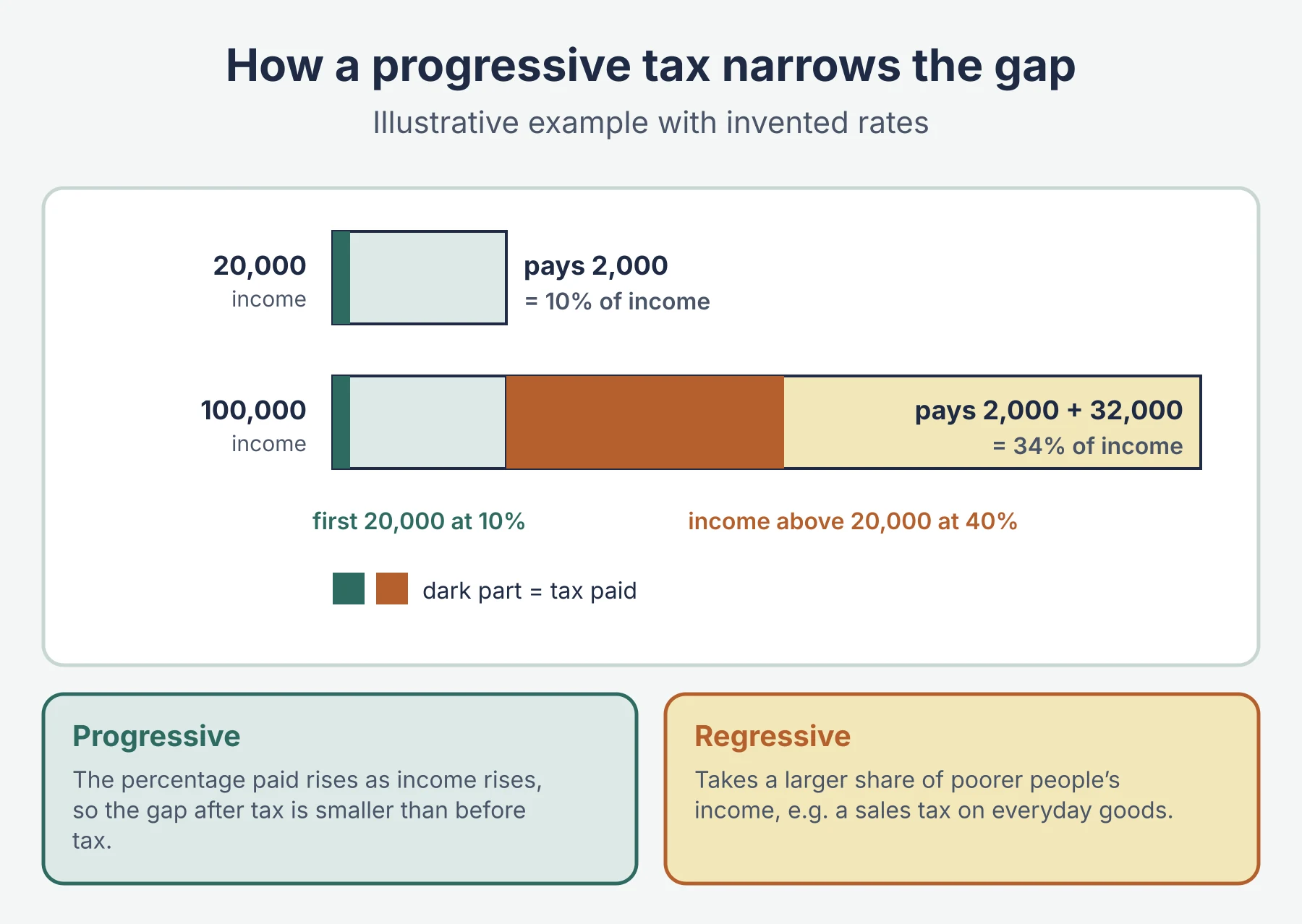
A tax is progressive when the percentage paid rises as income rises; regressive taxes take a larger share of poorer people’s income — a sales tax on everyday goods is the usual example, because poorer households spend more of what they earn.
Illustrative example (invented rates): suppose income up to 20,000 is taxed at 10% and income above that at 40%. A person earning 20,000 pays 2,000 (10% of income). A person earning 100,000 pays 2,000 on the first 20,000 plus 32,000 on the remaining 80,000 — 34,000, or 34% of income. The gap after tax is smaller than before tax.
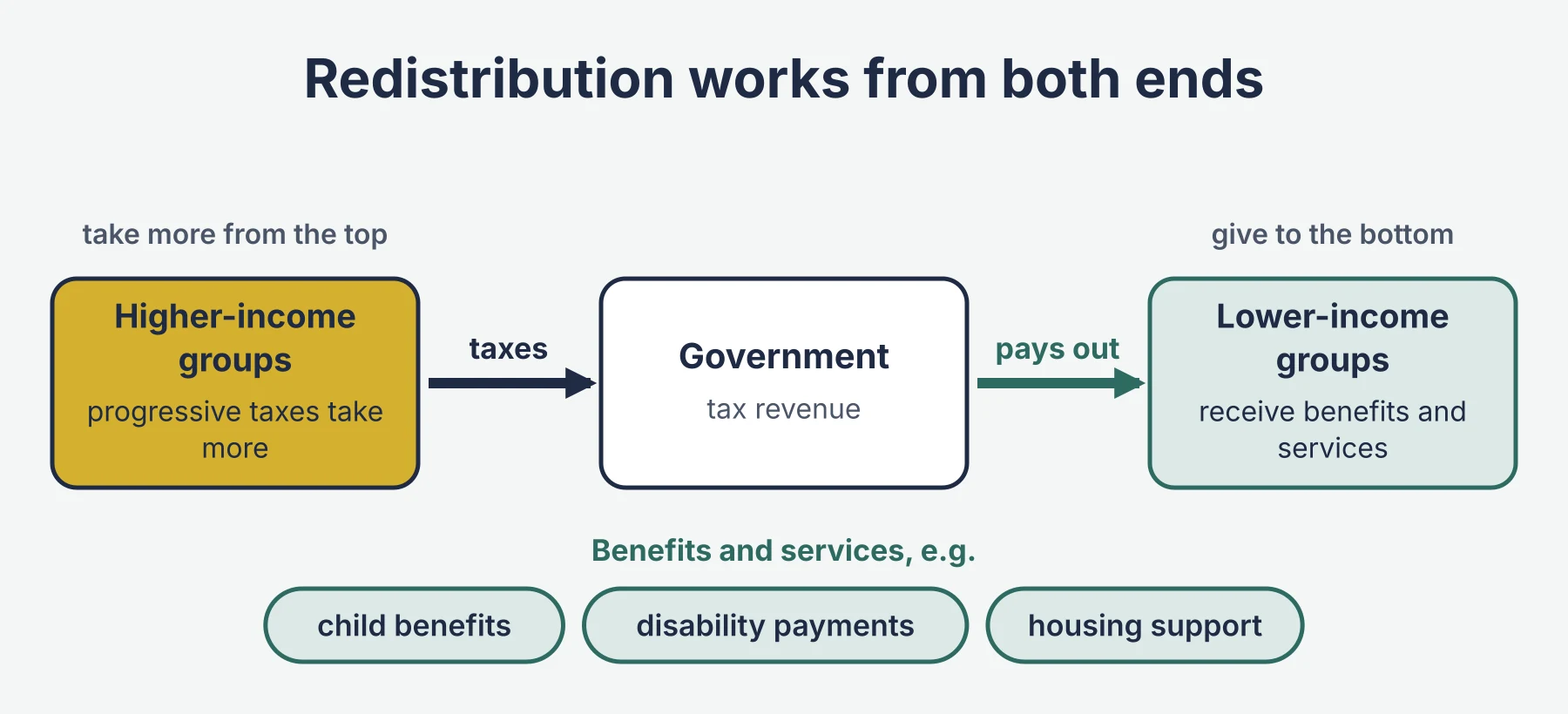
Redistribution happens when revenue from taxes is paid out as benefits or services to lower- income groups — child benefits, disability payments, housing support. Redistribution works through both sides: taking more from the top and giving to the bottom.
Minimum wage
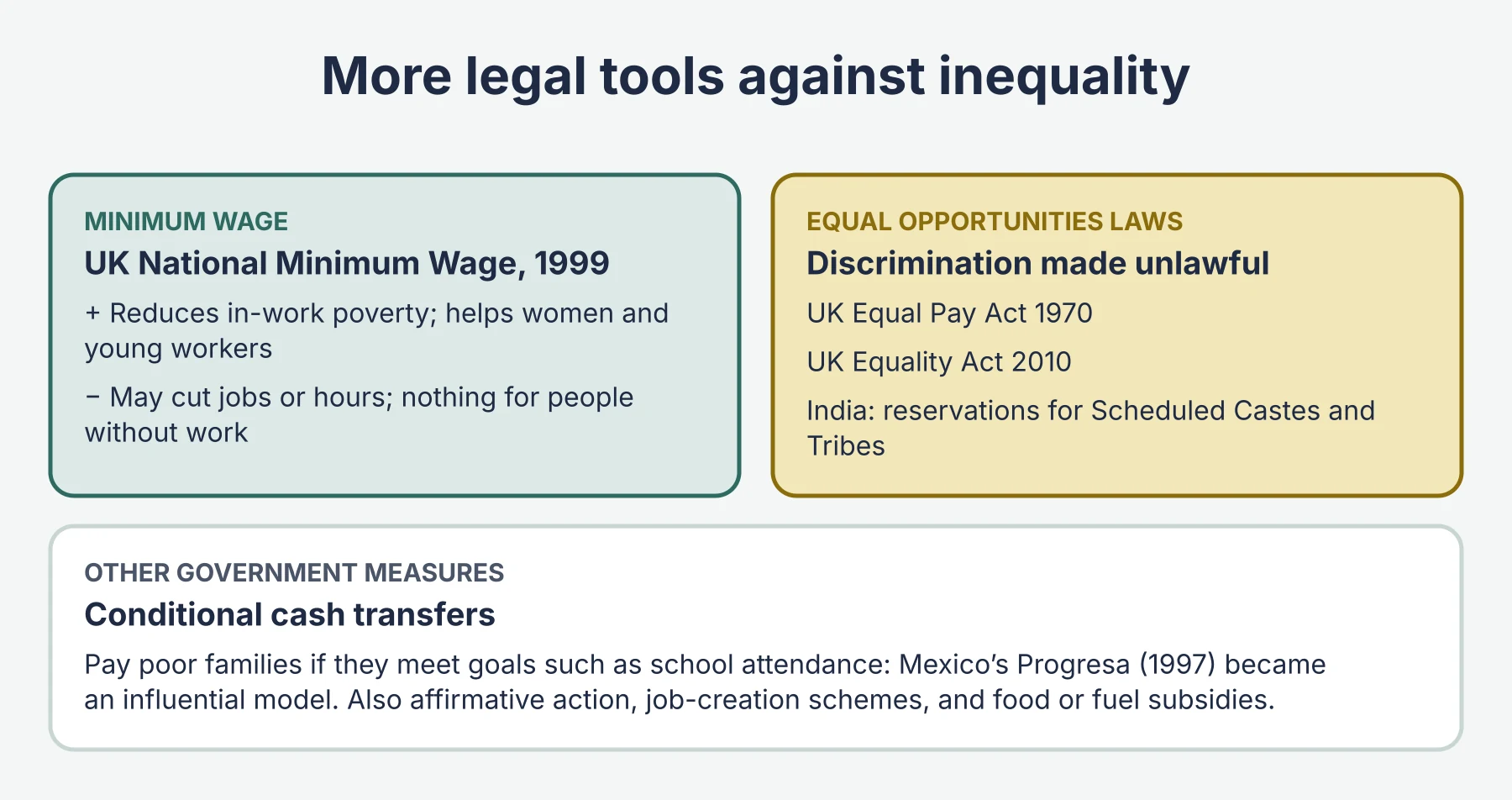
A minimum wage sets the lowest hourly pay employers may legally offer. The United Kingdom introduced a National Minimum Wage in 1999. Supporters argue it reduces in-work poverty and narrows pay gaps, especially for women and young workers, who are over-represented in low-paid jobs. Critics argue it may lead some employers to cut jobs or hours, and that it does nothing for people without work.
Equal opportunities laws
These make discrimination unlawful. In Britain, the Equal Pay Act 1970 required equal pay for men and women doing the same work, and the Equality Act 2010 brought protections against discrimination by sex, race, disability, age, religion and other characteristics into one law. In India, the constitution provides reservations — reserved places in education, government jobs and legislatures — for Scheduled Castes and Scheduled Tribes.
Other government measures
Conditional cash transfers pay poor families on condition that they meet goals such as school attendance; Mexico’s Progresa programme, launched in 1997, became an influential model. Affirmative action, job-creation schemes and subsidies for food or fuel are other examples.
Welfare states (3.2.2)
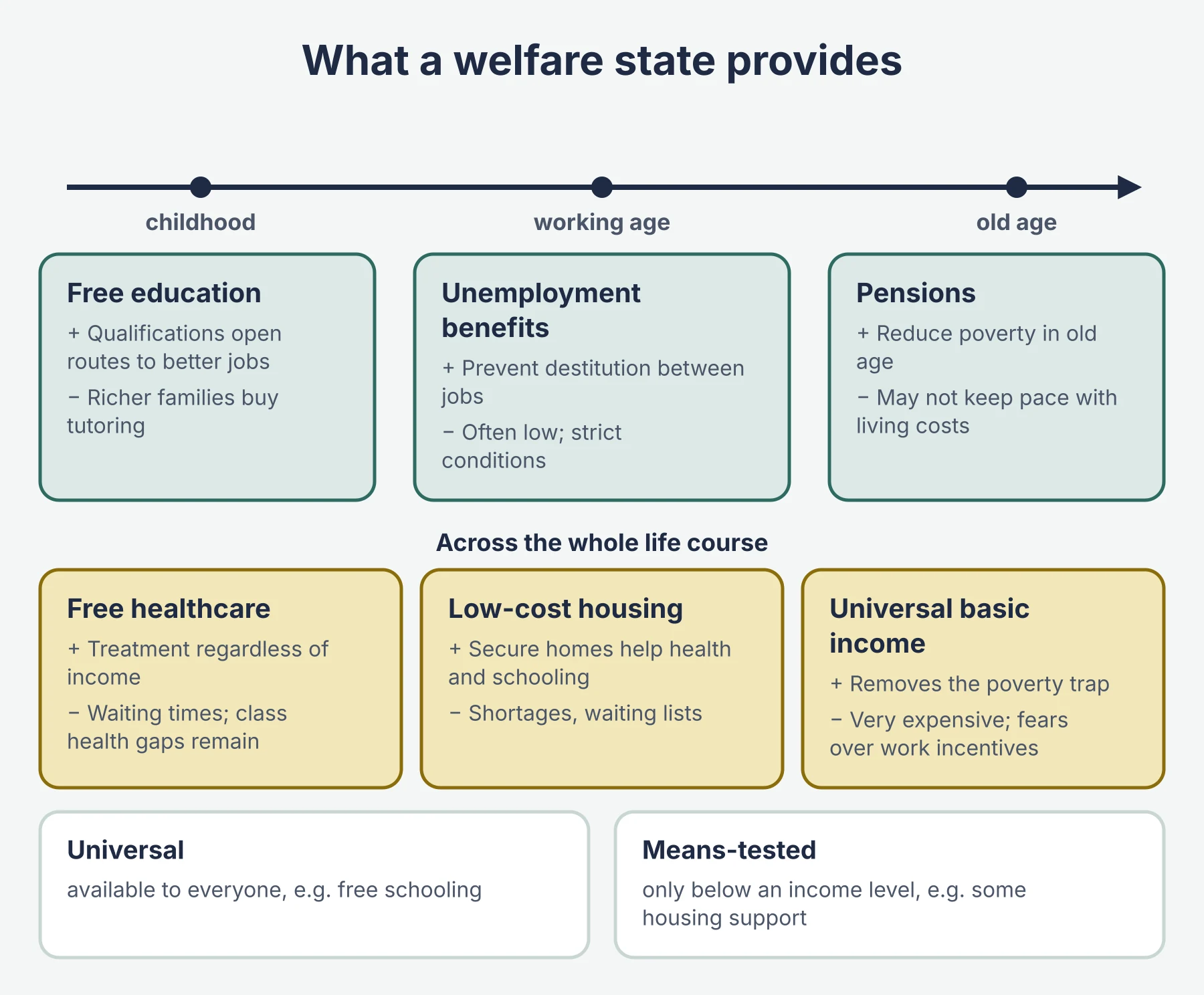
A welfare state is one in which the government takes responsibility for protecting citizens’ basic well-being. Provision may be universal (available to everyone, such as free schooling) or means-tested (only for those below an income level, such as some housing support).
| Provision | How it can improve life chances | Limits |
|---|---|---|
| Free and/or universal education | Qualifications open routes to better jobs, supporting social mobility | Richer families still buy extra advantages such as tutoring |
| Unemployment benefits | Prevent destitution between jobs | Often set low; may carry strict conditions |
| Pensions | Reduce poverty in old age | Value may not keep pace with living costs |
| Low-cost housing | Secure homes improve health and children’s schooling | Shortages and long waiting lists |
| Free healthcare | Treatment regardless of income, raising life expectancy | Waiting times; health gaps by class remain |
| Universal basic income | A regular unconditional payment to all, removing the poverty trap created by benefit withdrawal | Very expensive; critics fear reduced work incentives |
The Alaska Permanent Fund Dividend, paid each year since 1982 to almost every resident of the US state of Alaska from oil revenues, is often cited as the closest long-running example of a universal, unconditional payment, though it is far too small to live on.
Welfare states differ greatly. The Nordic countries are often described as having generous, universal systems funded by high taxes; many other countries rely more on means-tested support, families and charities.
NGOs (3.2.3)
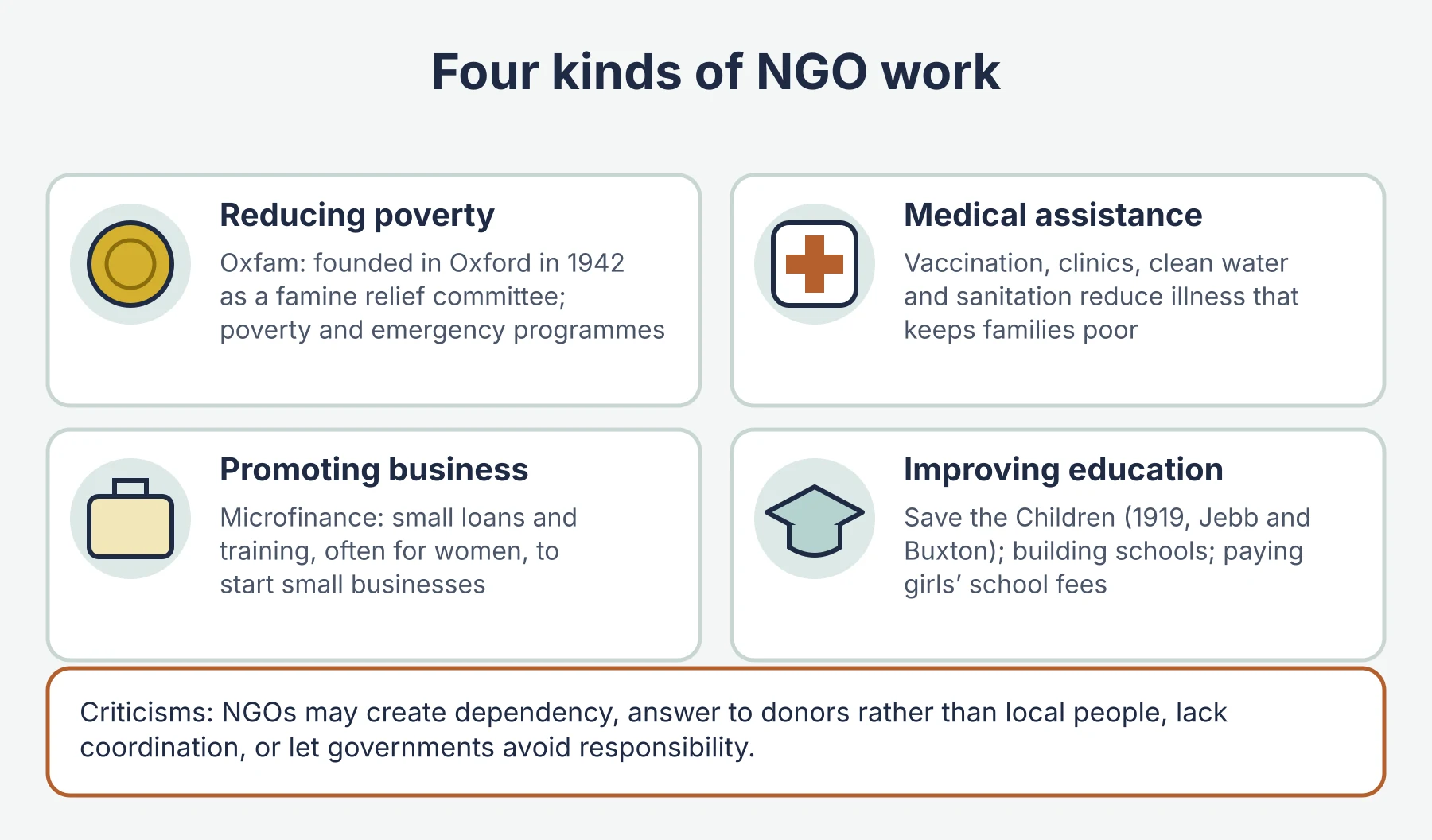
NGOs are non-profit organisations independent of government. The syllabus names four kinds of work:
- Reducing poverty — Oxfam, founded in Oxford in 1942 as a famine relief committee, now runs poverty-reduction and emergency programmes in many countries.
- Providing medical assistance — vaccination, clinics, clean water and sanitation projects reduce illness that keeps families poor.
- Promoting business — microfinance offers small loans and training so that people, often women, can start small businesses.
- Improving education — Save the Children, founded in Britain in 1919 by Eglantyne Jebb and Dorothy Buxton, works on children’s education and protection; other NGOs build schools or pay girls’ school fees.
How successful have these attempts been? (3.2.4)
| View | Argument | Response |
|---|---|---|
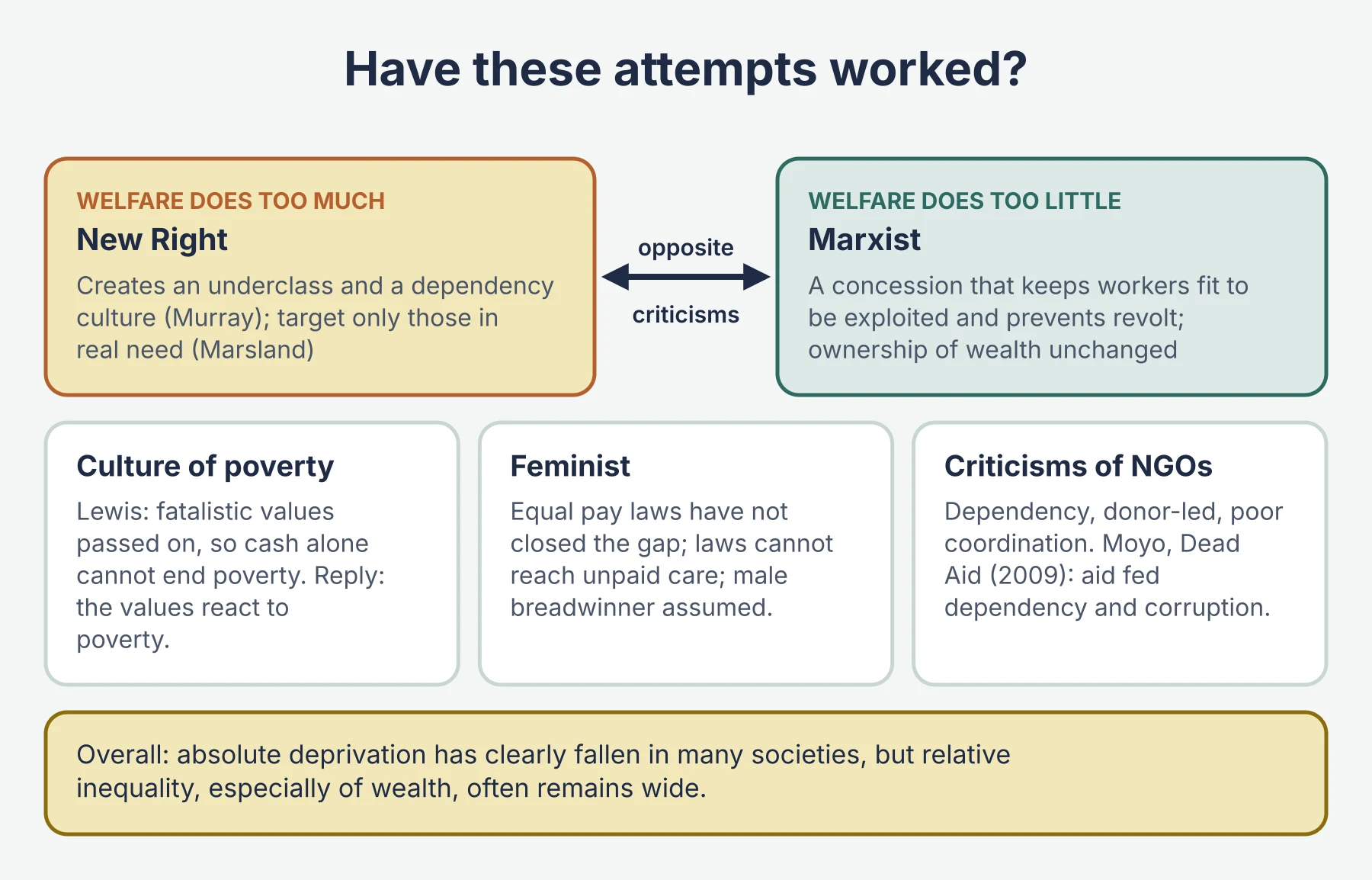
| New Right | Generous welfare discourages work and marriage and creates an underclass dependent on benefits (Charles Murray); David Marsland argued universal benefits encourage dependency and should be targeted only at those in real need | Most people on benefits want to work; unemployment is often caused by lack of jobs, not attitudes |
| Culture of poverty | Oscar Lewis argued poor communities develop fatalistic values passed between generations, so cash alone cannot end poverty | Critics argue the values are a reaction to poverty, not its cause |
| Dependency culture | People come to expect the state to provide and lose self-reliance | Evidence that many people move in and out of benefits rather than staying on them |
| Marxist | The welfare state is a concession that keeps workers healthy and educated enough to be exploited and prevents revolt; it softens capitalism without changing ownership of wealth | Welfare has brought real gains in health, education and longevity |
| Criticisms of NGOs | They may create dependency, answer to donors rather than local people, lack coordination, or let governments avoid responsibility; economist Dambisa Moyo’s Dead Aid (2009) argued that large-scale foreign aid to African governments had fed dependency and corruption | Many NGOs now work through local partners and focus on self-help |
| Feminist | Equal pay laws have not closed the gender pay gap; laws cannot reach unpaid care and domestic work; early welfare states assumed a male breadwinner and treated women as dependants | Equality laws have opened many occupations to women and given legal routes to challenge discrimination |
Overall evaluation. Measures have clearly reduced absolute deprivation in many societies — fewer people lack education or healthcare — but relative inequality, especially of wealth, often remains wide. Success depends on what is measured and which group is considered.
Worked example: Question 3(f)-style evaluation
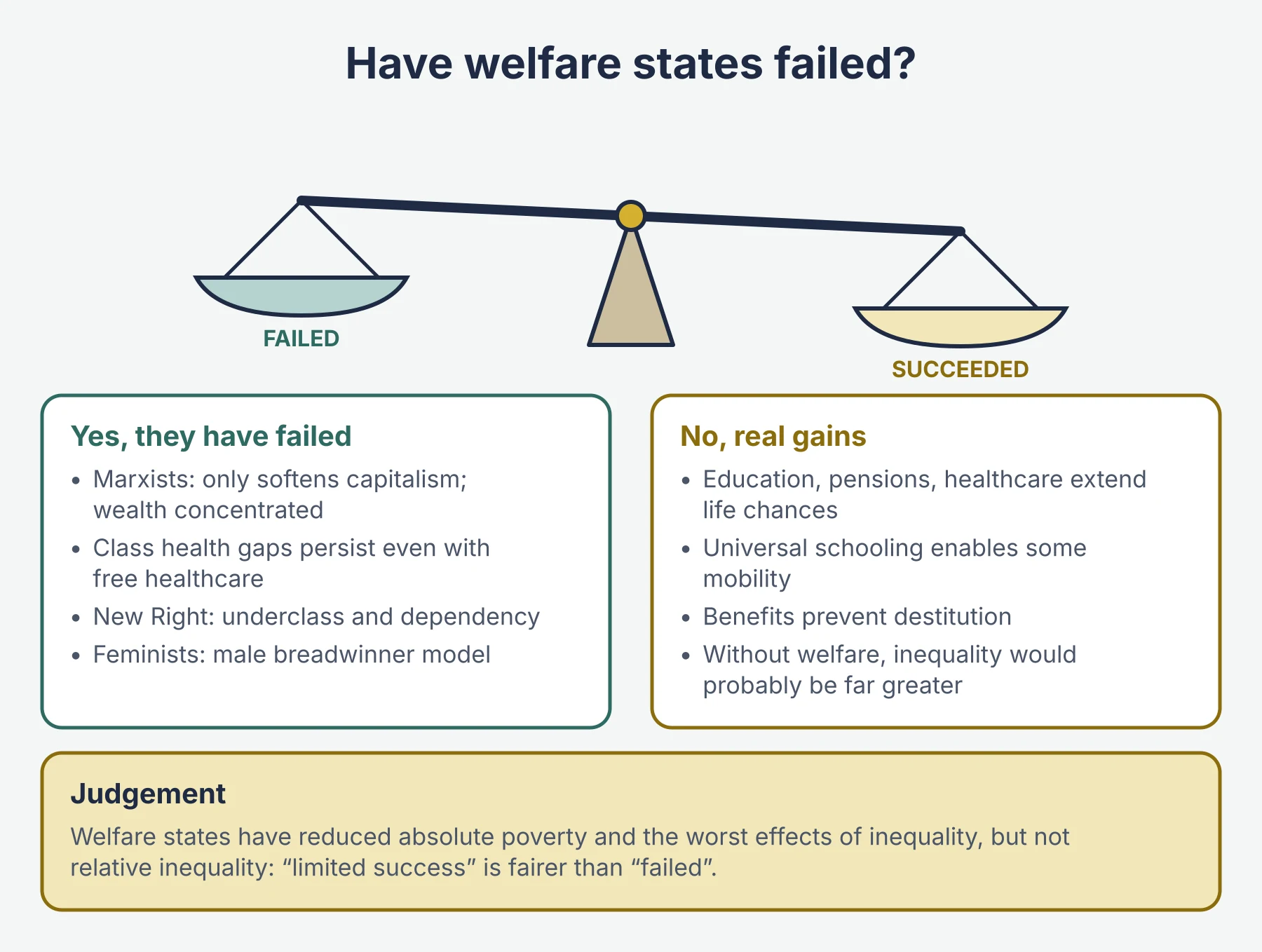
Evaluate the view that welfare states have failed to reduce social inequality.
For: Marxists argue welfare only softens capitalism; wealth stays concentrated, and class gaps in health persist even where healthcare is free. The New Right argue welfare creates an underclass and dependency culture, trapping people. Feminists argue welfare systems assumed a male breadwinner, leaving women financially dependent.
Against: free education, pensions and healthcare have extended life chances to groups who once had none; universal schooling enables some upward mobility; benefits prevent destitution during unemployment, illness and old age. Without welfare, inequality would probably be far greater.
Judgement: welfare states have reduced the worst effects of inequality and absolute poverty, but have not removed relative inequality. “Failed” is too strong; “limited success” is fairer.
Common mistakes
- Defining progressive tax as “the rich pay more”. In money terms almost every tax takes more from the rich; progressive means a higher percentage.
- Mixing up New Right and Marxist criticisms: the New Right think welfare does too much, Marxists that it does too little.
- Describing NGOs as government bodies.
- Ignoring the evaluation part of 3.2.4 — the syllabus asks whether attempts have succeeded.
Exam technique
- Explain how a measure reduces inequality: describe the measure, the mechanism, and the group it helps.
- Discuss criticisms by naming the perspective and its argument, then responding.
- Evaluate using both absolute and relative measures of success, then judge.
Revise with the reducing social inequalities revision notes and practise with the reducing social inequalities practice questions. What stratification is is covered in the study guide for key question 3.1.
Related resources
-
Practice questions
Cambridge IGCSE Sociology (0495): Social stratification and inequality – What attempts have been made to reduce social inequalities? – Practice Questions
Original Cambridge IGCSE Sociology 0495 practice on key question 3.2: tax, minimum wage, welfare, NGOs, the underclass and the culture of poverty, with answers.
Sociology · Cambridge · IGCSE
Try questions -
Revision notes
Cambridge IGCSE Sociology (0495): Social stratification and inequality – What attempts have been made to reduce social inequalities? – Revision Notes
Revision notes for Cambridge IGCSE Sociology 0495 key question 3.2: tax, minimum wage, equality laws, welfare, NGOs and the debates about whether they work.
Sociology · Cambridge · IGCSE
Revise topic -
Study guides
Cambridge IGCSE Sociology (0495): Social stratification and inequality – How has globalisation affected inequalities between societies?
Cambridge IGCSE Sociology 0495 key question 3.3: migration, transnational companies, climate change, pollution, urbanisation and theories of inequality.
Sociology · Cambridge · IGCSE
Read guide
Related articles
Get free revision emails (optional)
Occasional emails with practice questions, worked explanations and links to free resources for the qualification and subjects you choose. No spam, and you can unsubscribe from any email. The free tools on this site never need an email.