
Revision Notes
Cambridge IGCSE Sociology (0495): Social stratification and inequality – What attempts have been made to reduce social inequalities? – Revision Notes
Revision notes for Cambridge IGCSE Sociology 0495 key question 3.2: tax, minimum wage, equality laws, welfare, NGOs and the debates about whether they work.
- Subject
- Sociology
- Level
- IGCSE
- Topic
- Paper 1 – Research Methods, Identity and Inequality
- Author
- Marlbridge Academic Team
- Updated
- Reviewed by
- Naqiya Yousaf (what this means)
Aligned to Cambridge IGCSE Sociology (0495), 2025-2027. Official specification .
Syllabus page (what it covers and how it is assessed): Cambridge IGCSE Sociology.
Syllabus points this page covers
0495
- 3.2 Social stratification and inequality – What attempts have been made to reduce social inequalities?
Found an error? Report a correction.
Need help with this topic? Request a free trial class for IGCSE Sociology (0495).
Key question 3.2 of Cambridge IGCSE Sociology (0495) asks What attempts have been made to reduce social inequalities? In short: governments pass laws (progressive tax, benefits, minimum wages, equal opportunities laws and other measures), build welfare states (education, benefits, pensions, housing, healthcare, possibly universal basic income), and NGOs work globally on poverty, health, business and education. Sociologists disagree about success: the New Right say welfare does too much, Marxists that it does too little, feminists that equality laws leave patriarchy intact.
Full explanations and examples are in the study guide for key question 3.2.
Syllabus coverage
0495 syllabus 2025–2027, 3.2:
- 3.2.1 Legislation: progressive taxation; redistribution of wealth through benefits; minimum wage; equal opportunities laws; other government measures.
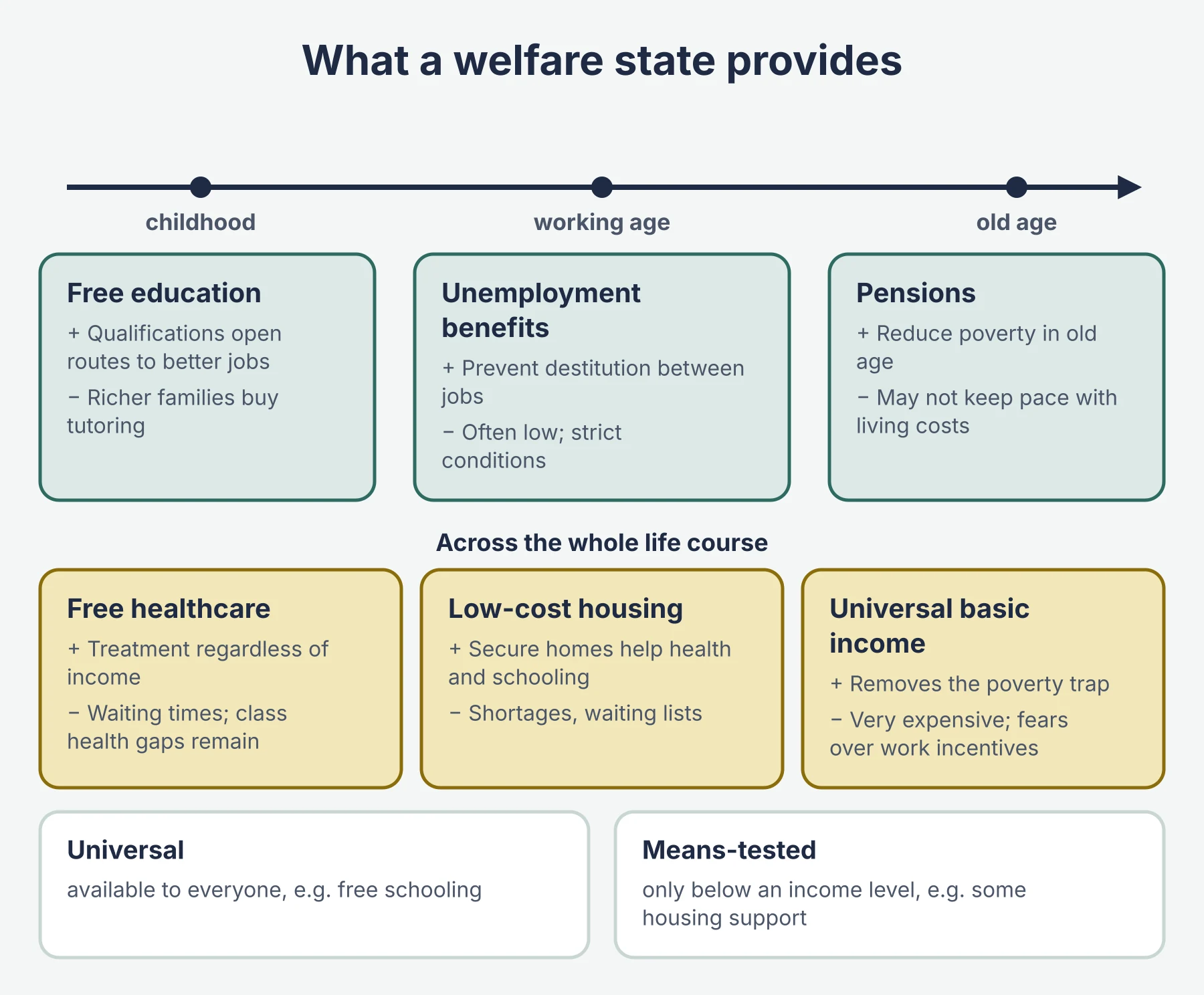
- 3.2.2 Welfare states: free and/or universal education; unemployment benefits; pensions; low-cost housing; free healthcare; universal basic income.
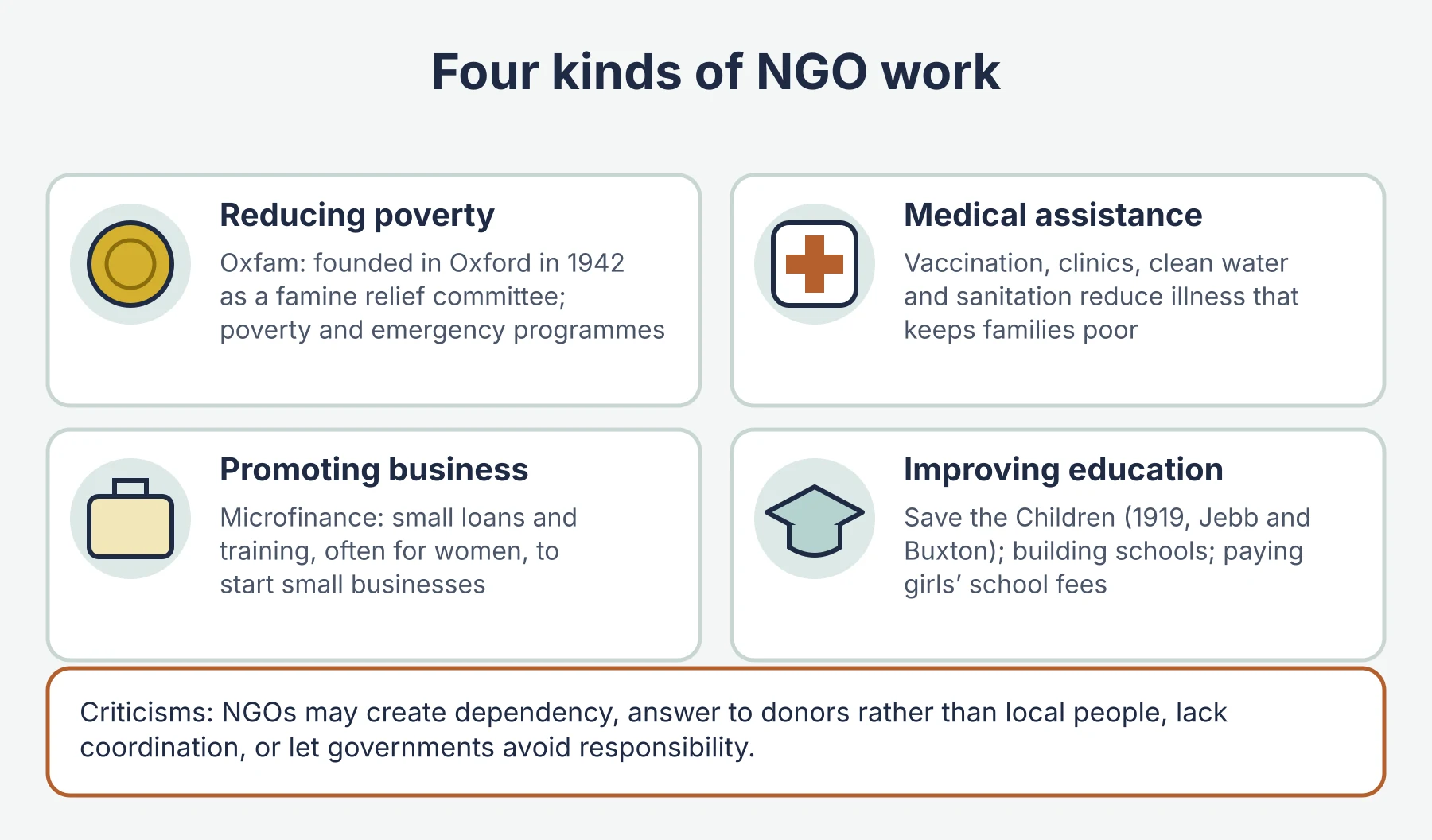
- 3.2.3 NGOs: reducing poverty; providing medical assistance; promoting business; improving education.
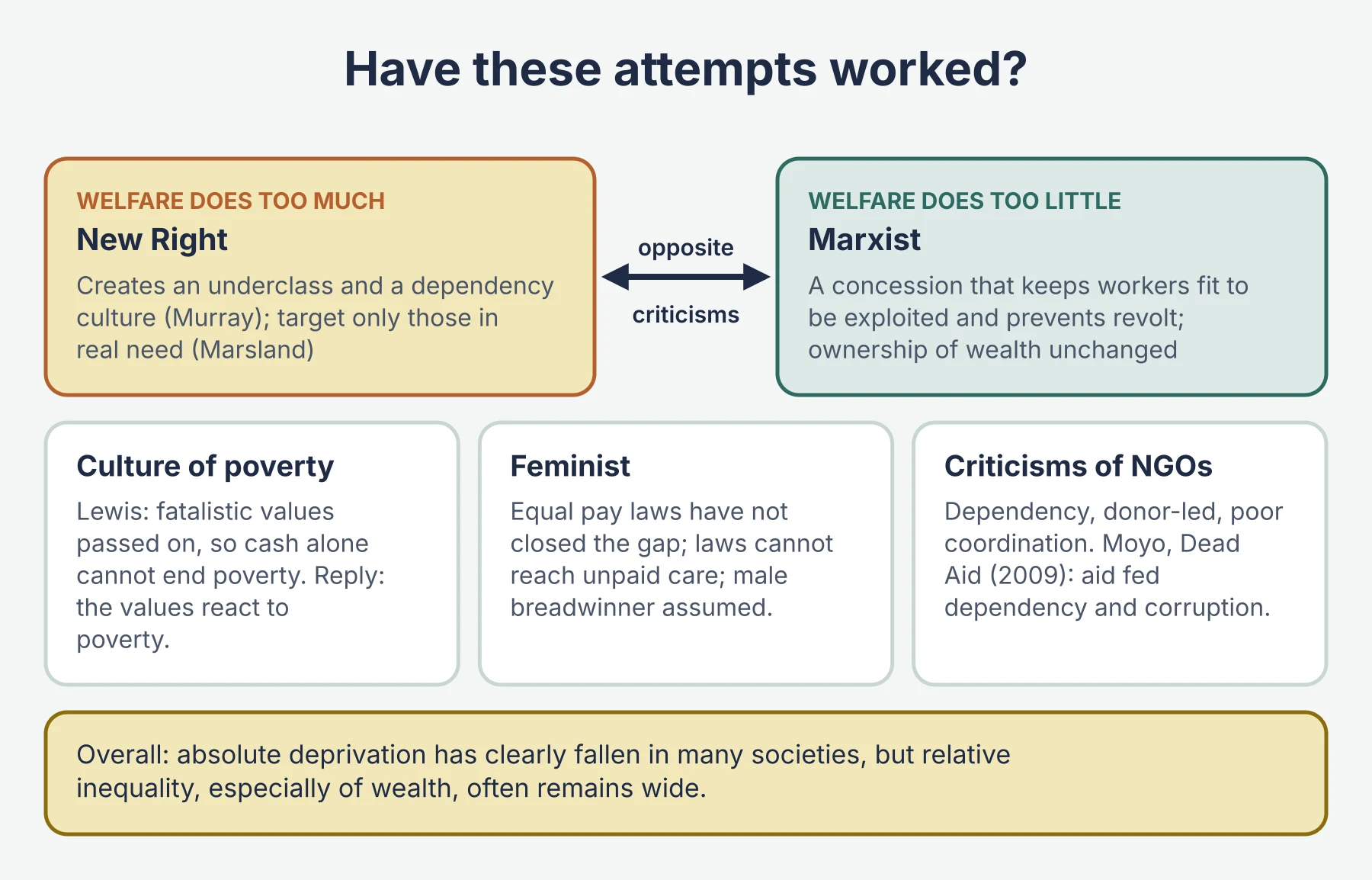
- 3.2.4 Views of success: New Right/underclass; culture of poverty and dependency culture; Marxist criticisms; criticisms of NGOs; feminist criticisms of equality legislation.
Key terms
| Term | Definition |
|---|---|
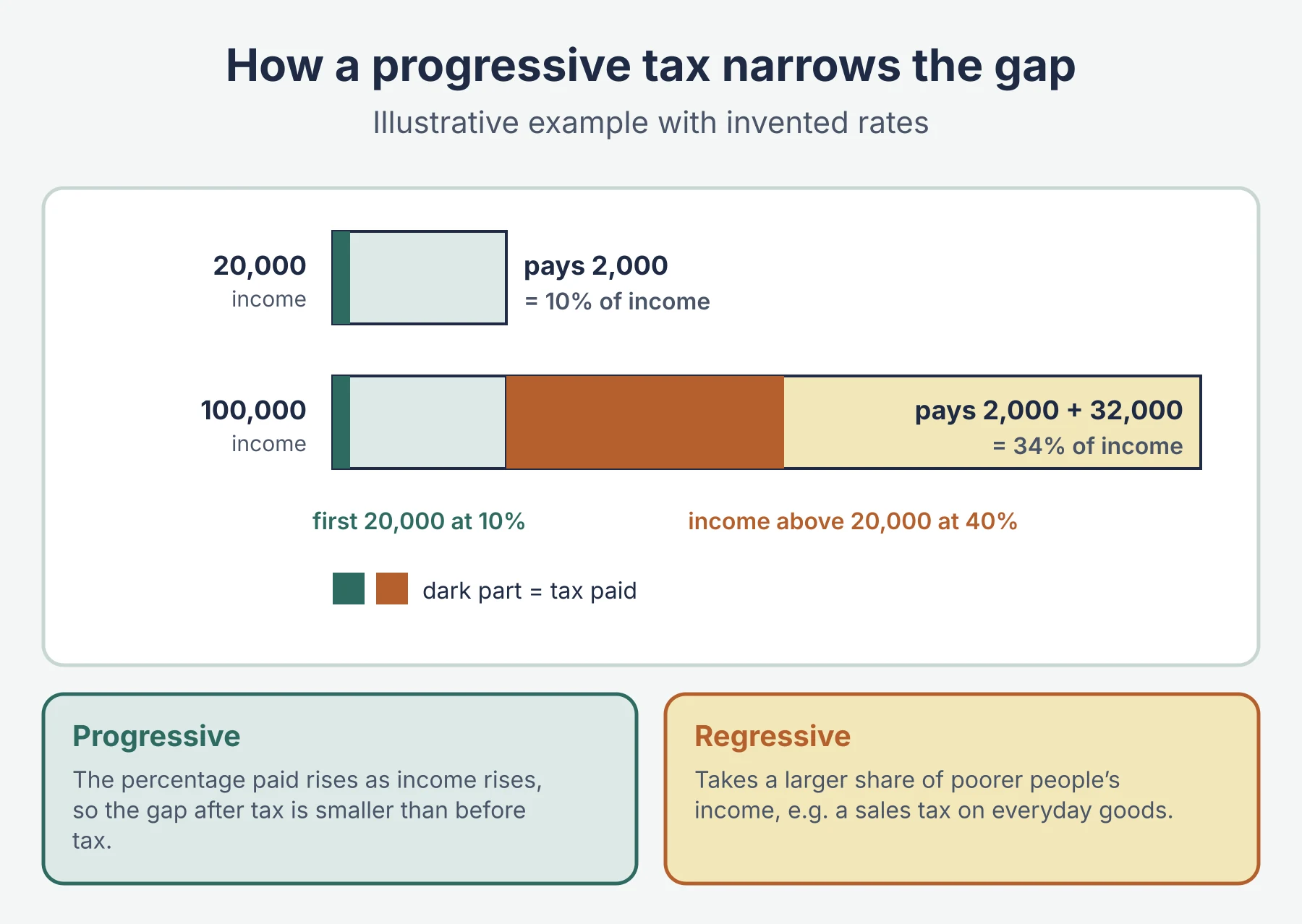
| Progressive tax | A tax taking a higher percentage of income as income rises |
| Regressive tax | A tax taking a higher percentage of poorer people’s income, e.g. sales tax |
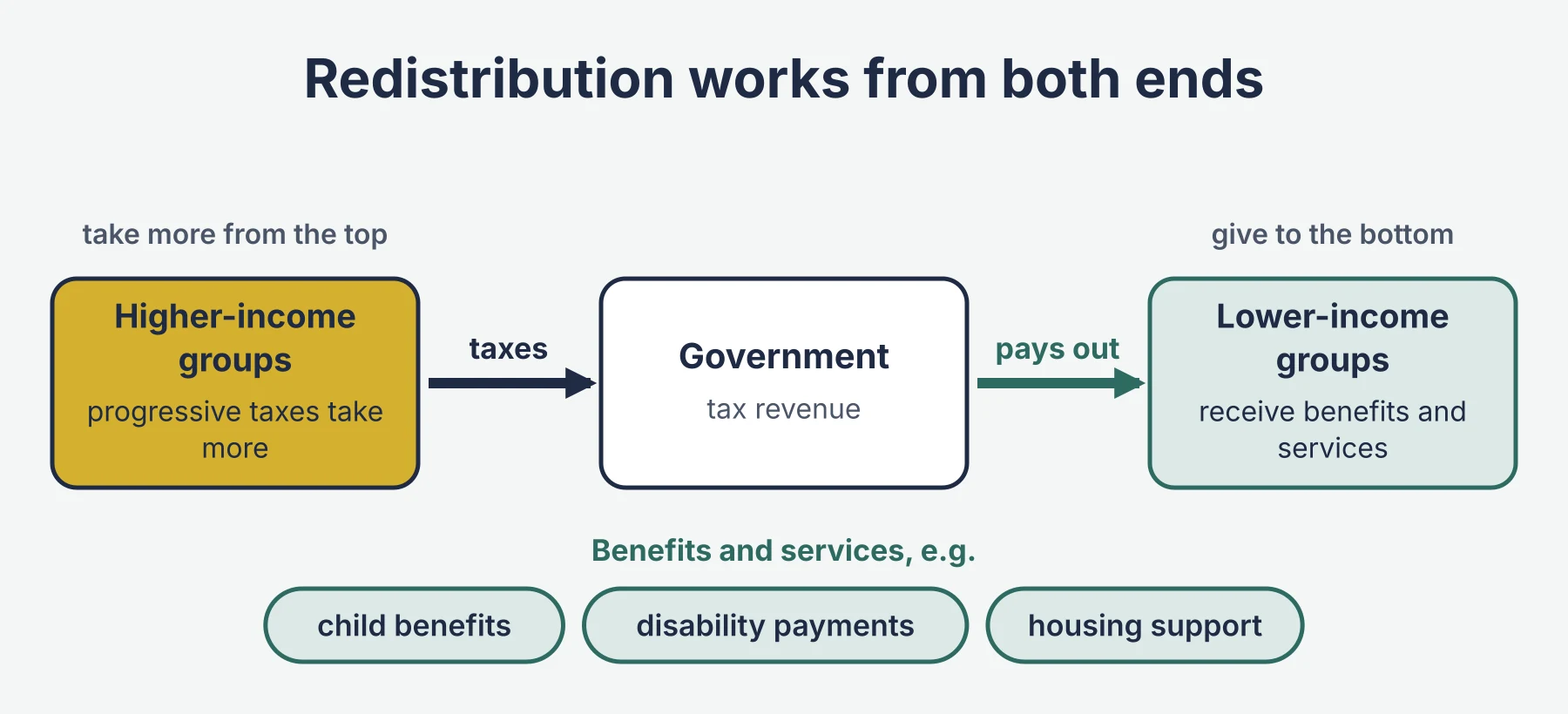
| Redistribution | Moving resources from richer to poorer groups through tax and benefits |
| Minimum wage | The lowest hourly pay employers may legally offer |
| Equal opportunities laws | Laws making discrimination by sex, race, disability, age and so on unlawful |
| Conditional cash transfer | Payments to poor families on condition they meet goals such as school attendance |
| Welfare state | A system in which the state protects citizens’ basic well-being |
| Universal benefit | Available to everyone regardless of income |
| Means-tested benefit | Available only to people below an income or savings level |
| Universal basic income | A regular, unconditional payment to every citizen |
| NGO | A non-profit organisation independent of government |
| Microfinance | Small loans and financial services for people without access to banks |
| Underclass | New Right term for a group said to depend on welfare and live outside mainstream values |
| Dependency culture | The idea that people come to rely on benefits and lose self-reliance |
Examples to quote
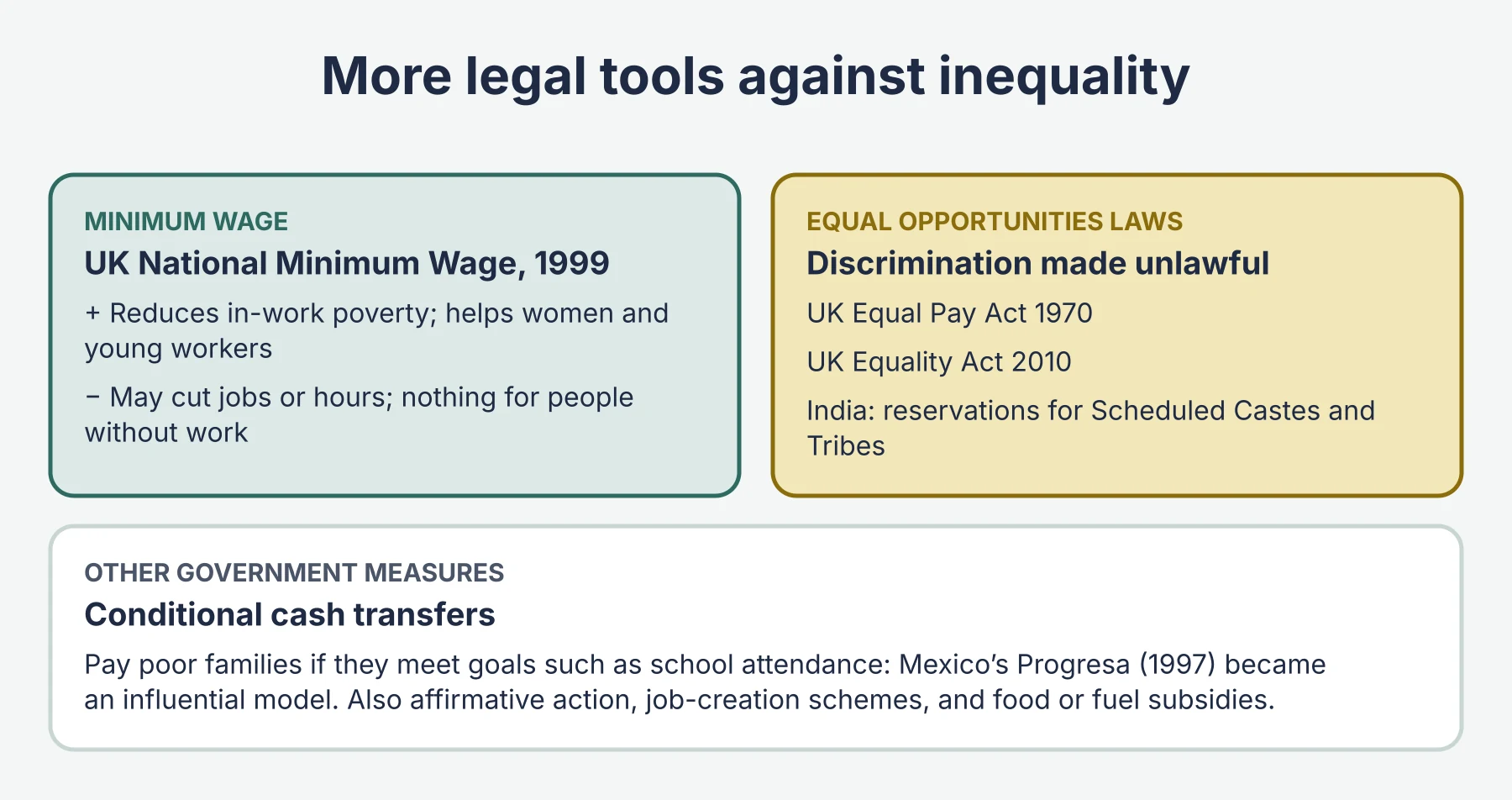
- Minimum wage: UK National Minimum Wage, 1999.
- Equality laws: UK Equal Pay Act 1970; Equality Act 2010; India’s constitutional reservations for Scheduled Castes and Scheduled Tribes.
- Cash transfers: Mexico’s Progresa, 1997.
- Near-universal payment: Alaska Permanent Fund Dividend, since 1982.
- NGOs: Oxfam (1942); Save the Children (1919).
How each measure works
- Progressive tax narrows gaps after tax; funds services.
- Benefits raise the incomes of the poorest.
- Minimum wage reduces in-work poverty; helps groups over-represented in low pay (women, young workers).
- Equal opportunities laws give legal routes to challenge discrimination.
- Welfare services improve life chances regardless of income: schooling, healthcare, housing, pensions.
- UBI removes the poverty trap because the payment is not withdrawn when people earn.
- NGOs reach people governments fail to reach; microfinance builds income.
The debate on success
| Perspective | Verdict | Key names |
|---|---|---|
| New Right | Welfare does too much — dependency, underclass | Murray; Marsland |
| Culture of poverty | Poverty persists because of values passed down | Lewis |
| Marxist | Welfare does too little — softens capitalism, prevents revolt | — |
| NGO critics | Dependency, donor-led, may let governments off the hook | Moyo, Dead Aid (2009), on foreign aid |
| Feminist | Equality laws have not closed the pay gap or reached unpaid care; welfare assumed a male breadwinner | — |
Balance: absolute deprivation has fallen in many societies; relative and wealth inequality often remain wide.
Exam traps
- Progressive tax is about the percentage paid, not the amount.
- New Right and Marxists both criticise welfare but from opposite directions.
- NGOs are not part of government.
- Universal ≠ means-tested.
- Always add a judgement on success — 3.2.4 is about evaluation.
Worked example: a 6-mark “explain” answer
Explain three ways a minimum wage may reduce social inequality. (practice)
- Raising the lowest pay — employers cannot pay below the legal rate, so the poorest workers’ incomes rise, narrowing the gap with higher earners.
- Reducing in-work poverty — families with working adults are less likely to need to rely on benefits or debt.
- Narrowing the gender pay gap — women are over-represented in low-paid jobs, so a minimum wage raises their pay relative to men’s.
Self-test
- What makes a tax progressive?
- Give one example of a regressive tax.
- When was the UK National Minimum Wage introduced?
- What is a conditional cash transfer?
- Distinguish universal and means-tested benefits.
- How can a universal basic income remove the poverty trap?
- Name the four kinds of NGO work in the syllabus.
- What is microfinance?
- What is the New Right’s main criticism of the welfare state?
- What is the Marxist criticism of the welfare state?
- Give one feminist criticism of equality legislation.
- Give one criticism of NGOs.
Answers
- The percentage of income paid in tax rises as income rises.
- A sales tax on everyday goods.
-
- A payment to poor families on condition they meet goals such as children’s school attendance.
- Universal benefits go to everyone; means-tested benefits only to those below an income level.
- It is paid to everyone and not withdrawn when people earn more, so working always raises income.
- Reducing poverty, providing medical assistance, promoting business, improving education.
- Small loans and financial services for people without access to banks, often to start a business.
- Generous welfare creates dependency and an underclass.
- It only softens capitalism, keeping workers fit to be exploited and preventing revolt, without changing who owns wealth.
- The gender pay gap persists; laws cannot reach unpaid domestic and care work.
- Any one: creates dependency; accountable to donors not local people; lets governments avoid responsibility; too small to change structural causes.
Related pages: reducing social inequalities practice questions | reducing inequality and globalisation revision notes
Related resources
-
Study guides
Cambridge IGCSE Sociology (0495): Social stratification and inequality – How has globalisation affected inequalities between societies?
Cambridge IGCSE Sociology 0495 key question 3.3: migration, transnational companies, climate change, pollution, urbanisation and theories of inequality.
Sociology · Cambridge · IGCSE
Read guide -
Practice questions
Cambridge IGCSE Sociology (0495): Social stratification and inequality – How has globalisation affected inequalities between societies? – Practice Questions
Original Cambridge IGCSE Sociology 0495 practice on key question 3.3: migration, climate change, pollution and Marxist and feminist views of global inequality.
Sociology · Cambridge · IGCSE
Try questions -
Revision notes
Cambridge IGCSE Sociology (0495): Social stratification and inequality – How has globalisation affected inequalities between societies? – Revision Notes
Revision notes for Cambridge IGCSE Sociology 0495 key question 3.3: migration, TNCs, climate change, pollution, urbanisation, and theories of global inequality.
Sociology · Cambridge · IGCSE
Revise topic
Related articles
Get free revision emails (optional)
Occasional emails with practice questions, worked explanations and links to free resources for the qualification and subjects you choose. No spam, and you can unsubscribe from any email. The free tools on this site never need an email.