
Revision Notes
Cambridge IGCSE Sociology (0495): Social stratification and inequality – What is social stratification? – Revision Notes
Revision notes for Cambridge IGCSE Sociology 0495 key question 3.1: open and closed systems, poverty, mobility, life chances, intersectionality and theories.
- Subject
- Sociology
- Level
- IGCSE
- Topic
- Paper 1 – Research Methods, Identity and Inequality
- Author
- Marlbridge Academic Team
- Updated
- Reviewed by
- Naqiya Yousaf (what this means)
Aligned to Cambridge IGCSE Sociology (0495), 2025-2027. Official specification .
Syllabus page (what it covers and how it is assessed): Cambridge IGCSE Sociology.
Syllabus points this page covers
0495
- 3.1 Social stratification and inequality – What is social stratification?
Found an error? Report a correction.
Need help with this topic? Request a free trial class for IGCSE Sociology (0495).
Key question 3.1 of Cambridge IGCSE Sociology (0495) asks What is social stratification? In short: stratification is the structured, lasting division of society into unequal layers. Closed systems such as caste and slavery fix position at birth; open class systems allow mobility through achievement. Age, gender, ethnicity and class shape life chances in education, employment, health, housing and life expectancy, and these inequalities intersect. Labelling theory and Marxism offer competing explanations.
Full explanations are in the social stratification study guide.
Syllabus coverage
0495 syllabus 2025–2027, 3.1:
- 3.1.1 Open and closed societies: achieved and ascribed status; poverty and wealth; power; social mobility; meritocracy; modern slavery; the caste system.
- 3.1.2 Life chances by age, gender, ethnicity and social class in education, employment, health, housing and life expectancy.
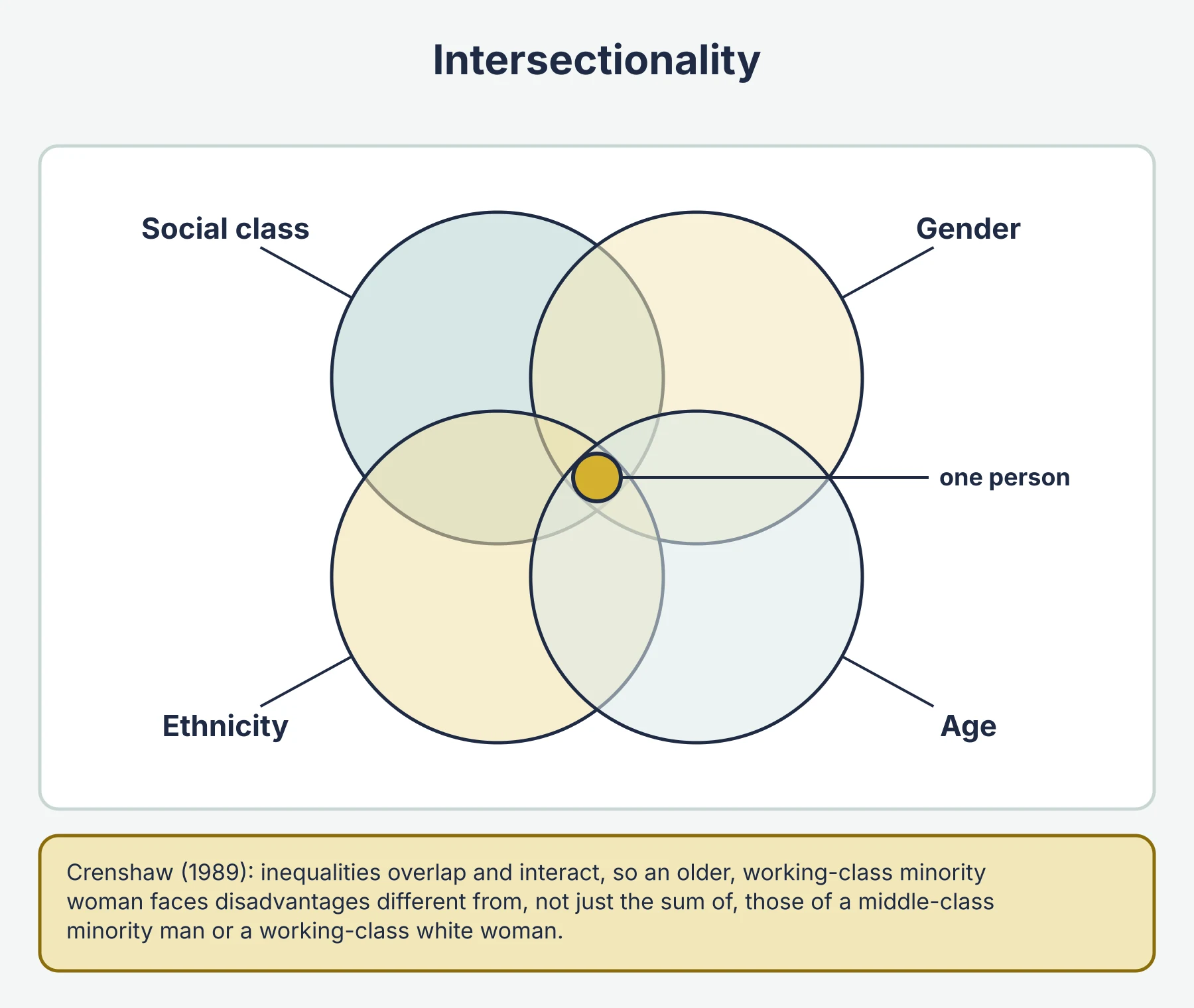
- 3.1.3 Intersectionality of age, ethnicity, gender and social class.
- 3.1.4 Labelling theory (stereotypes, master status, self-fulfilling prophecy); Marxism (exploitation of the proletariat, ideological control, poverty trap, reserve army of labour).
Key terms
| Term | Definition |
|---|---|
| Social stratification | Structured inequality between layers of society, passed between generations |
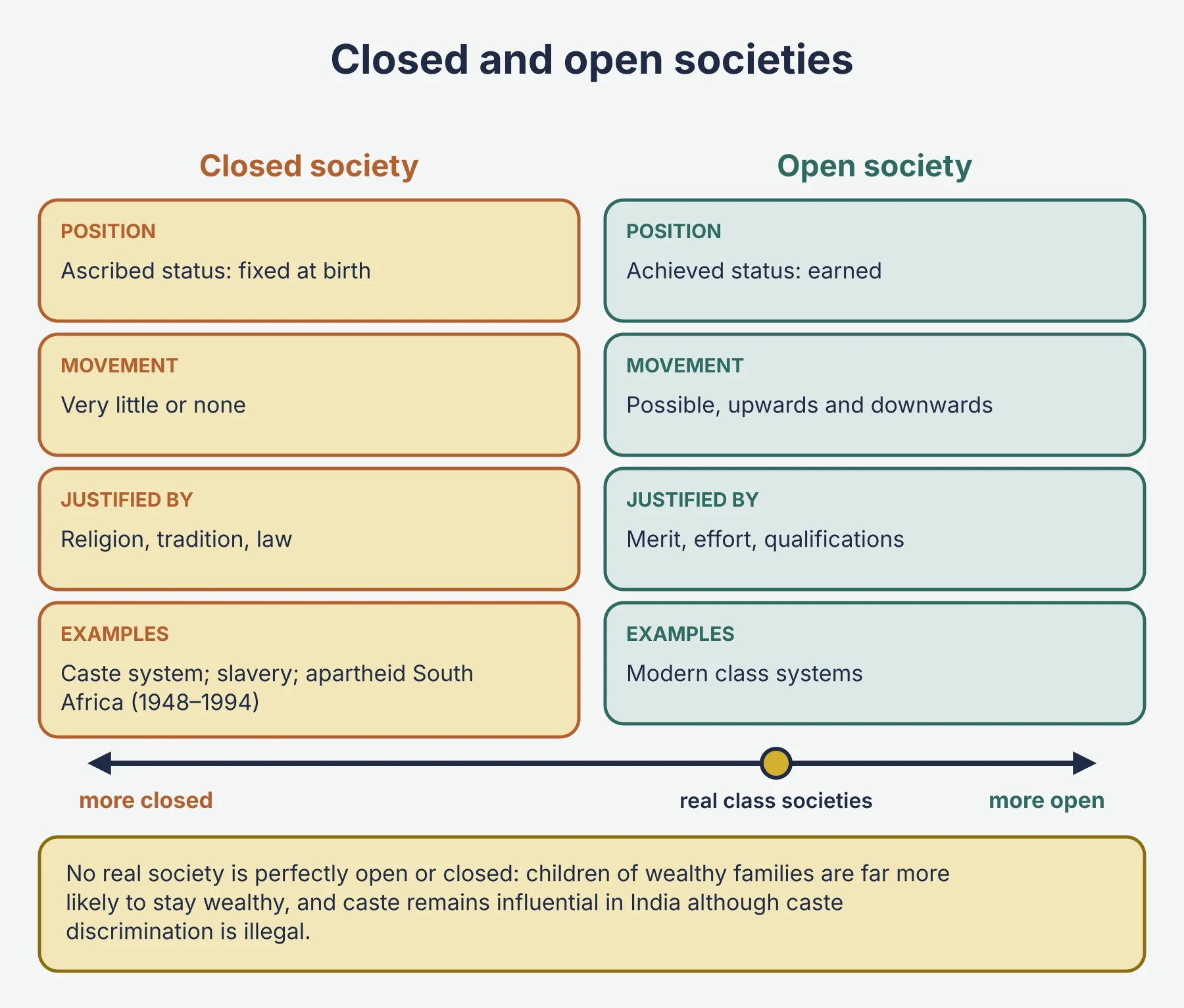
| Closed society | Position fixed by ascribed status, with little or no mobility |
| Open society | Position can be achieved; mobility is possible |
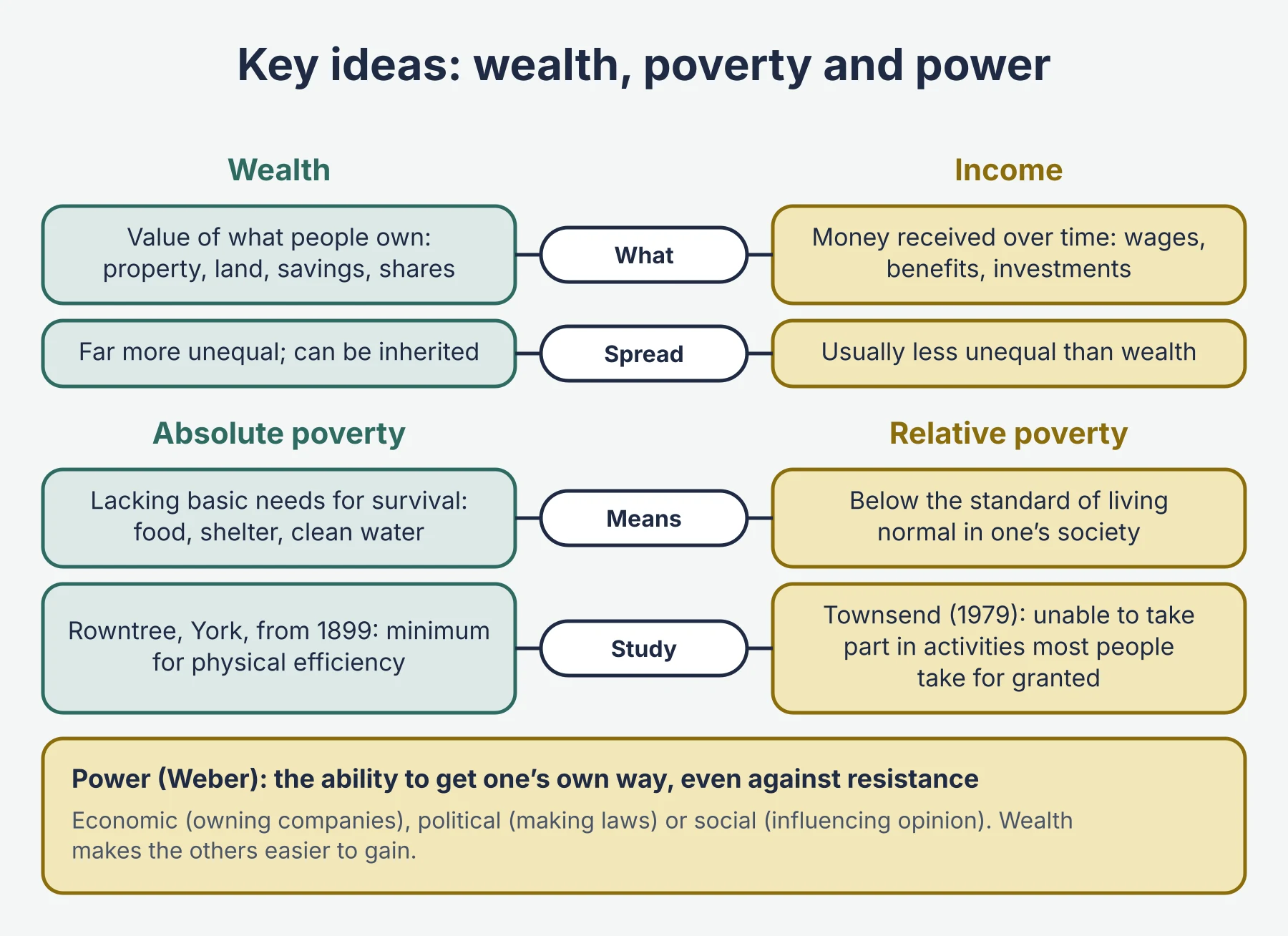
| Wealth | The value of assets owned — property, land, savings, shares |
| Income | Money received over time from wages, benefits or investments |
| Absolute poverty | Lacking the basic necessities for survival |
| Relative poverty | Falling below the normal living standard of one’s society (Townsend, 1979) |
| Power | The ability to get one’s own way even against resistance (Weber) |
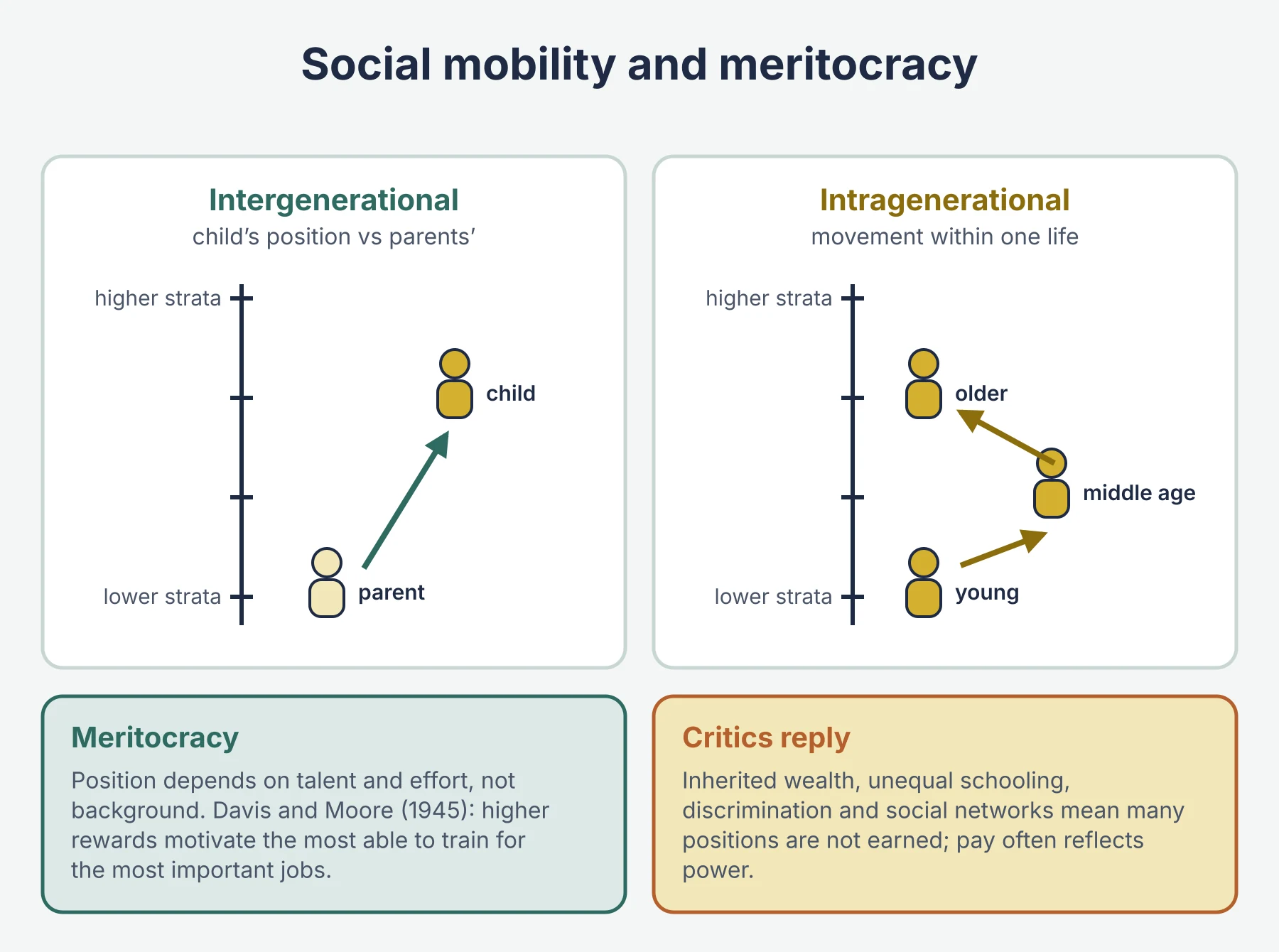
| Intergenerational mobility | Change in position compared with one’s parents |
| Intragenerational mobility | Change in position during one’s own life |
| Meritocracy | A system where position depends on talent and effort |
| Modern slavery | Illegal control of people for exploitation: forced labour, debt bondage, trafficking |
| Endogamy | Marrying within one’s own group, as in caste |
| Life chances | The chances of gaining things valued in society, such as good health and housing |
| Intersectionality | How overlapping inequalities interact in individuals’ lives (Crenshaw, 1989) |
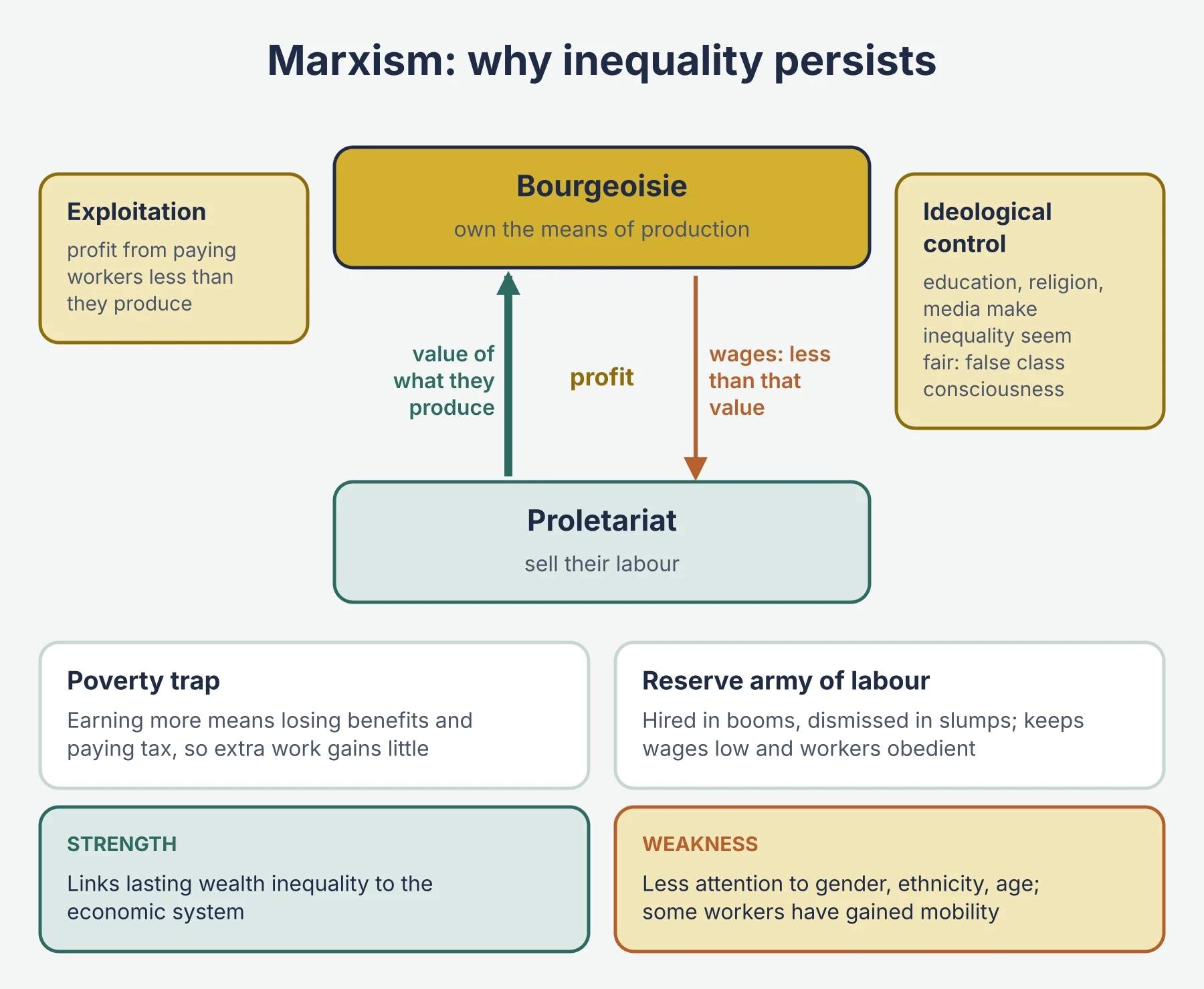
| Reserve army of labour | A pool of unemployed or insecure workers that keeps wages down |
Closed systems recall
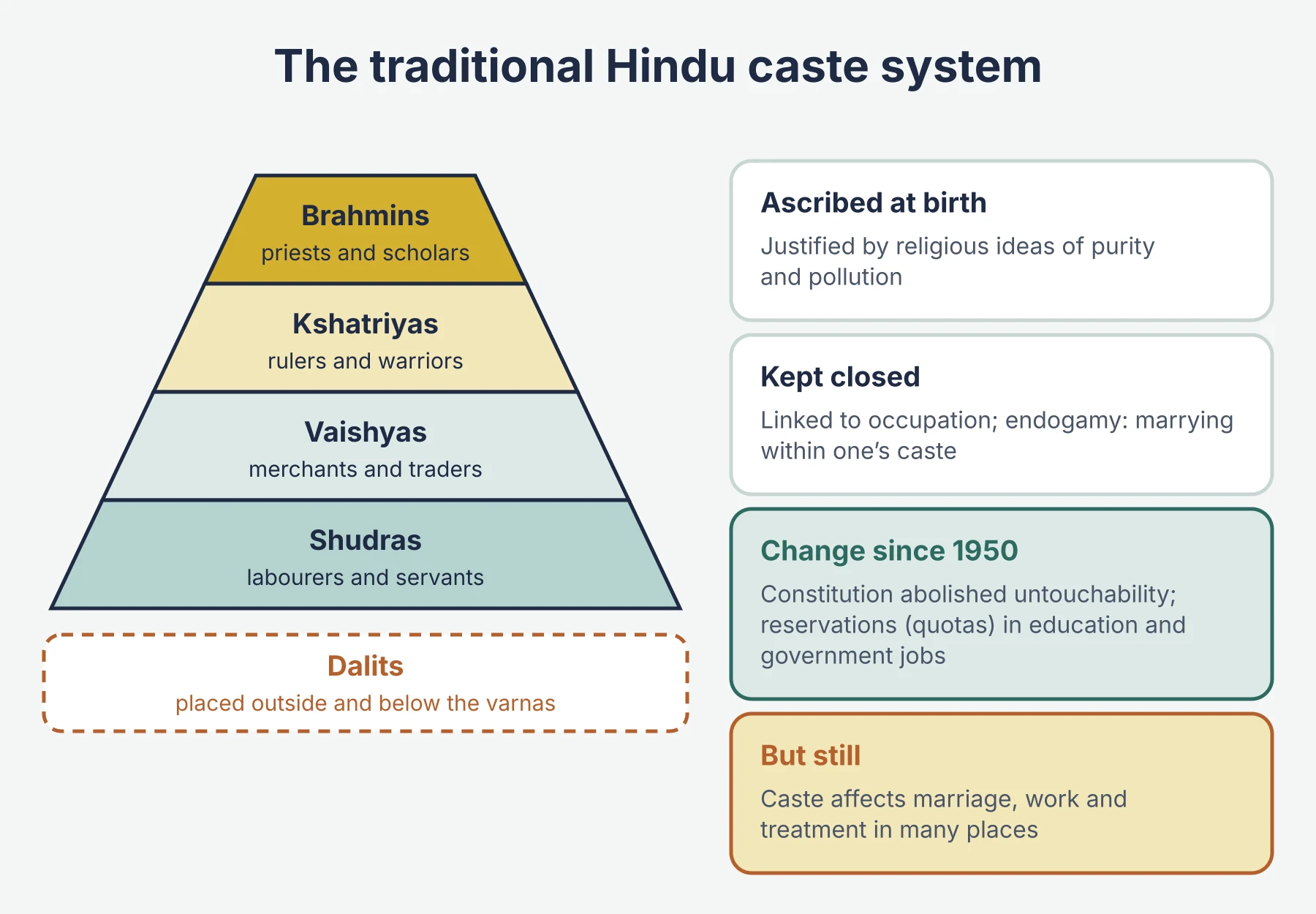
- Caste: four varnas — Brahmins, Kshatriyas, Vaishyas, Shudras — with Dalits outside; ascribed at birth; purity and pollution; endogamy; linked to occupation. Untouchability abolished by India’s constitution (in force 1950); reservations in education and government jobs; caste still influences marriage and work.
- Modern slavery: forced labour, debt bondage, trafficking, forced marriage, domestic servitude; illegal and hidden; UK Modern Slavery Act 2015.
- Apartheid South Africa (1948–1994): legal racial classification determined where people could live, work and study.
Open systems recall
- Class based mainly on occupation, income and wealth.
- Mobility: upward or downward; inter- or intragenerational.
- Meritocracy debate: Davis and Moore (1945) — rewards attract the most able to important jobs; critics — inheritance, unequal schooling, discrimination and networks limit merit.
Life chances: one-line reasons
- Class: less money → poorer housing, diet and health; material and cultural deprivation in education; less secure work. Black Report (1980), Marmot Review (2010): class gradient in health.
- Gender: pay gap, glass ceiling, segregation, unpaid care; women tend to live longer.
- Ethnicity: discrimination in jobs and housing; links with poverty; varies greatly by group.
- Age: young people face insecure work and housing costs; older people face ageism and poverty in old age where pensions are low.
Theories at a glance
| Labelling theory | Marxism | |
|---|---|---|
| Level | Micro (interaction) | Macro (structure) |
| Cause of inequality | Labels from powerful people shape treatment and self-image | Capitalist ownership and exploitation |
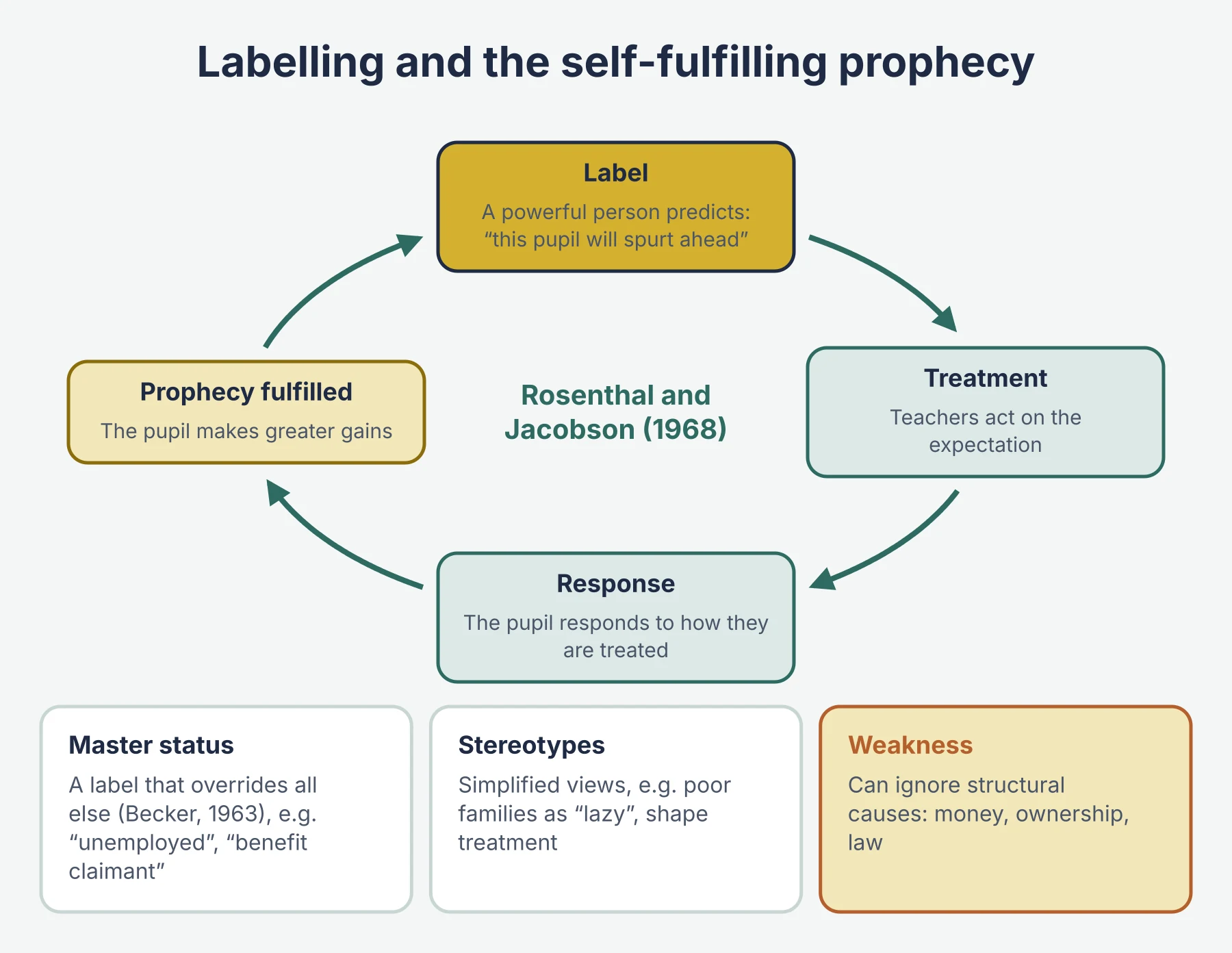
| Key concepts | Stereotypes; master status (Becker, 1963); self-fulfilling prophecy (Rosenthal and Jacobson, 1968) | Exploitation of the proletariat; ideological control; poverty trap; reserve army of labour |
| Criticism | Ignores structural causes of labels | Underplays gender, ethnicity, age and real mobility |
Exam traps
- Income ≠ wealth.
- Stratification is not any difference — it must be structured and lasting.
- Ascribed status can still matter in “open” societies.
- Intersectionality is about interaction, not simple addition.
- When explaining life chances, name the group, the area and the reason.
Worked example: a 6-mark “explain” answer
Explain three features of the caste system. (practice)
- Ascribed status — caste is fixed at birth, so a person cannot move to another caste through effort or education.
- Endogamy — people are expected to marry within their own caste, which keeps the boundaries between castes intact across generations.
- Purity and pollution — religious ideas rank castes by ritual purity, justifying the inequality and restricting contact between higher castes and Dalits.
Self-test
- Define social stratification.
- Give two differences between open and closed societies.
- What is the difference between income and wealth?
- Distinguish absolute and relative poverty.
- What is intergenerational mobility?
- What did Davis and Moore argue?
- Name the four varnas of the caste system.
- Give two forms of modern slavery.
- Give one way gender affects life chances in employment.
- What does intersectionality mean?
- Explain master status.
- What is the poverty trap?
Answers
- Structured inequality dividing society into unequal layers that persist across generations.
- Any two: closed uses ascribed status, open uses achieved; closed allows little mobility, open allows mobility; closed is justified by religion or law, open by merit.
- Income is money received over time; wealth is the value of assets owned.
- Absolute: lacking basic needs for survival. Relative: below the normal standard of one’s society.
- A change in a person’s position compared with their parents’.
- Stratification is functional because higher rewards motivate the most able to fill the most important jobs.
- Brahmins, Kshatriyas, Vaishyas, Shudras.
- Any two: forced labour, debt bondage, human trafficking, forced marriage, domestic servitude.
- The gender pay gap, the glass ceiling, or concentration in lower-paid occupations.
- That inequalities of class, gender, ethnicity and age overlap and interact in individuals’ lives.
- A label that overrides all other characteristics in how others see a person.
- A situation where extra earnings lead to lost benefits and higher tax, so people gain little from working more and remain poor.
Related pages: social stratification practice questions | Paper 1 revision notes
Related resources
-
Study guides
Cambridge IGCSE Sociology (0495): Social stratification and inequality – What attempts have been made to reduce social inequalities?
Cambridge IGCSE Sociology 0495 key question 3.2 in depth: equality laws, welfare states, NGOs and New Right, Marxist and feminist judgements of their success.
Sociology · Cambridge · IGCSE
Read guide -
Practice questions
Cambridge IGCSE Sociology (0495): Social stratification and inequality – What attempts have been made to reduce social inequalities? – Practice Questions
Original Cambridge IGCSE Sociology 0495 practice on key question 3.2: tax, minimum wage, welfare, NGOs, the underclass and the culture of poverty, with answers.
Sociology · Cambridge · IGCSE
Try questions -
Revision notes
Cambridge IGCSE Sociology (0495): Social stratification and inequality – What attempts have been made to reduce social inequalities? – Revision Notes
Revision notes for Cambridge IGCSE Sociology 0495 key question 3.2: tax, minimum wage, equality laws, welfare, NGOs and the debates about whether they work.
Sociology · Cambridge · IGCSE
Revise topic
Related articles
Get free revision emails (optional)
Occasional emails with practice questions, worked explanations and links to free resources for the qualification and subjects you choose. No spam, and you can unsubscribe from any email. The free tools on this site never need an email.