
Study Guides
Cambridge IGCSE Sociology (0495): Social stratification and inequality – What is social stratification?
Cambridge IGCSE Sociology 0495 key question 3.1: open and closed societies, caste, slavery, mobility, life chances, intersectionality, labelling and Marxism.
- Subject
- Sociology
- Level
- IGCSE
- Topic
- Paper 1 – Research Methods, Identity and Inequality
- Author
- Marlbridge Academic Team
- Updated
- Reviewed by
- Naqiya Yousaf (what this means)
Aligned to Cambridge IGCSE Sociology (0495), 2025-2027. Official specification .
Syllabus page (what it covers and how it is assessed): Cambridge IGCSE Sociology.
Syllabus points this page covers
0495
- 3.1 Social stratification and inequality – What is social stratification?
Found an error? Report a correction.
Need help with this topic? Request a free trial class for IGCSE Sociology (0495).
Key question 3.1 of Cambridge IGCSE Sociology (0495) asks What is social stratification? Stratification is the division of a society into layers (strata) of people with unequal access to wealth, power and prestige, where the inequality is built into the structure of society and passed from one generation to the next. The syllabus asks you to compare open and closed systems, explain how age, gender, ethnicity and social class affect life chances, use the idea of intersectionality, and apply labelling theory and Marxism to inequality.
The Paper 1 overview guide summarises the whole topic; this guide covers 3.1 in depth.
Syllabus coverage
Cambridge IGCSE Sociology 0495, syllabus for 2025, 2026 and 2027, 3.1 What is social stratification?
- 3.1.1 Social stratification in open and closed societies: achieved and ascribed status; poverty and wealth; power; social mobility; meritocracy; modern slavery; the caste system.
- 3.1.2 Differences in life chances affected by age, gender, ethnicity and social class: life chances in education, employment, health, housing and life expectancy.
- 3.1.3 The intersectionality of age, ethnicity, gender and social class in understanding the impact of inequality on individuals.
- 3.1.4 Sociological theories on social inequality: labelling theory, e.g. stereotypes, master status, self-fulfilling prophecy; Marxism, e.g. exploitation of the proletariat, ideological control, poverty trap, reserve army of labour.
Open and closed societies (3.1.1)
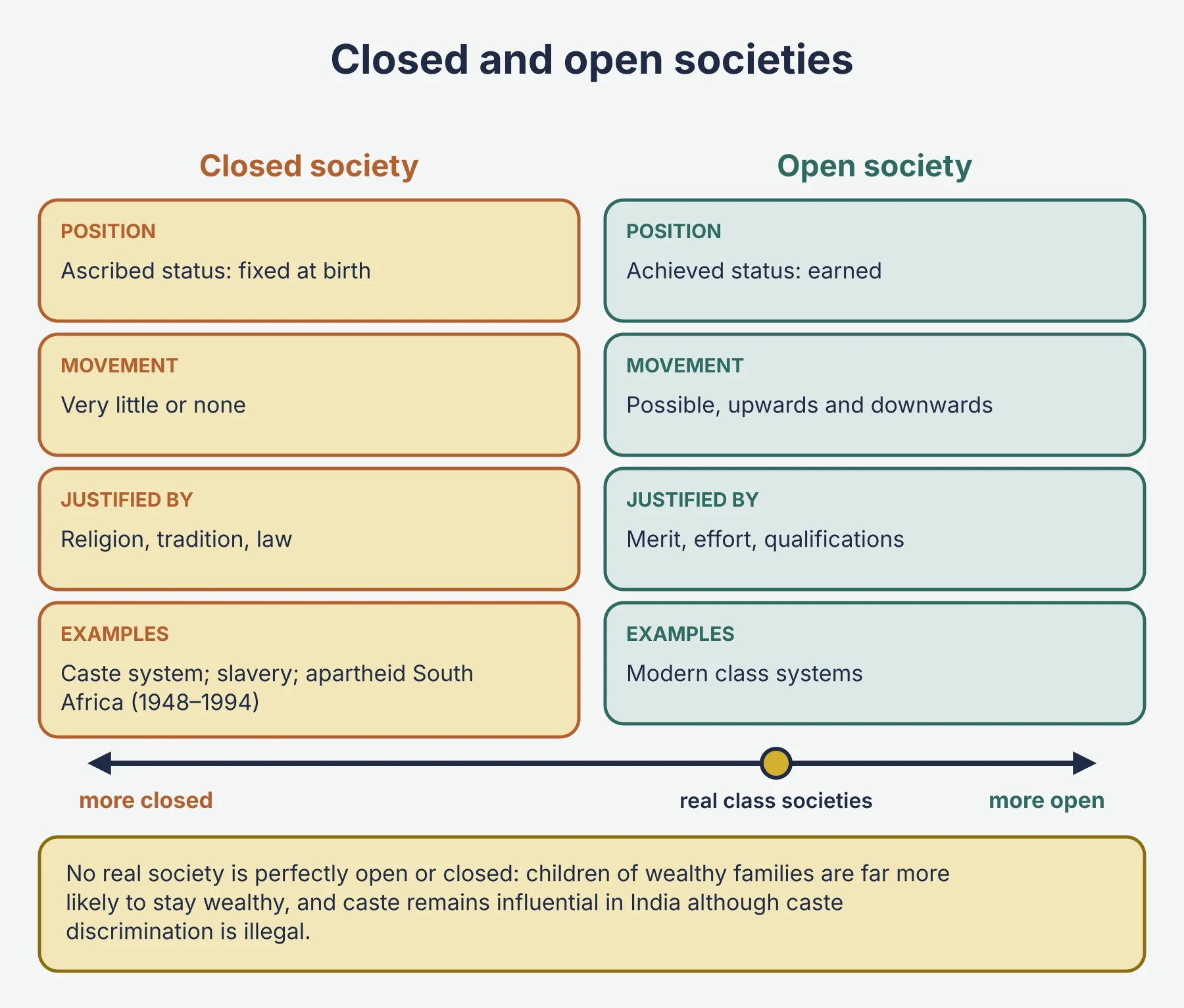
| Closed society | Open society | |
|---|---|---|
| Basis of position | Ascribed status — fixed at birth | Achieved status — earned |
| Movement between strata | Very little or none | Possible, upwards and downwards |
| Justification | Religion, tradition, law | Merit, effort, qualifications |
| Examples | Caste system; slavery; apartheid South Africa (1948–1994) | Modern class systems |
No real society is perfectly open or perfectly closed. Class societies claim openness, yet children of wealthy families are far more likely to stay wealthy; caste remains influential in India even though caste discrimination is illegal.
The caste system
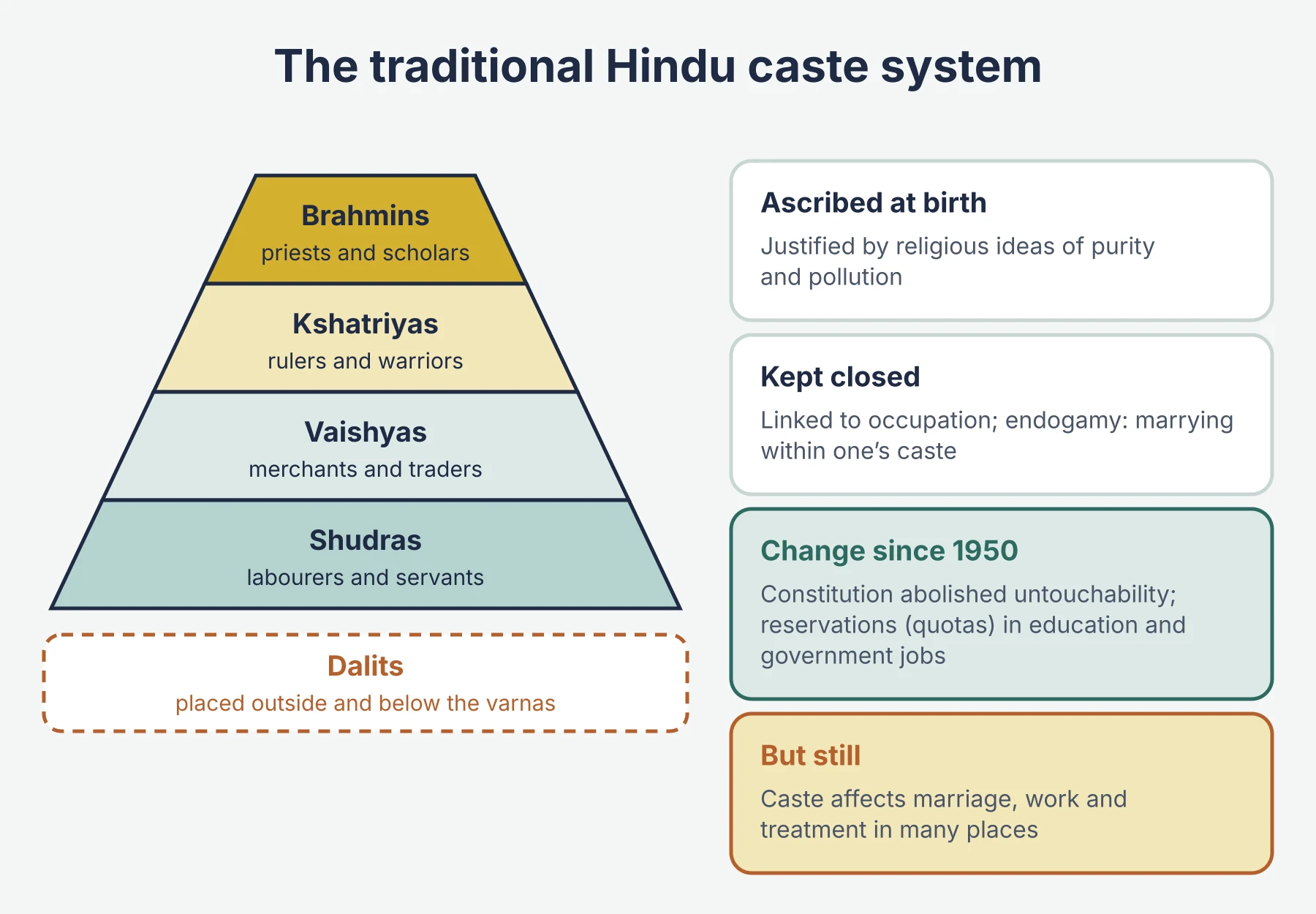
The traditional Hindu caste system ranked people into four varnas — Brahmins (priests and scholars), Kshatriyas (rulers and warriors), Vaishyas (merchants and traders) and Shudras (labourers and servants) — with Dalits (formerly called “untouchables”) placed outside and below them. Position was ascribed at birth and justified by religious ideas of purity and pollution. Caste was traditionally linked to occupation and maintained by endogamy (marrying within one’s caste). India’s constitution, in force from 1950, abolished untouchability, and reservations (quotas) in education and government jobs aim to reduce caste inequality — yet caste still affects marriage, work and treatment in many places.
Modern slavery
Modern slavery is the illegal control of people for exploitation, through forced labour, debt bondage (people forced to work off a loan that can never be repaid), human trafficking, forced marriage and domestic servitude. Unlike historical slavery, it is not legal anywhere, so it is hidden. It shows extreme closure: victims cannot leave and have no power over their work or lives. The UK’s Modern Slavery Act 2015 is one example of legislation against it.
Poverty, wealth and power
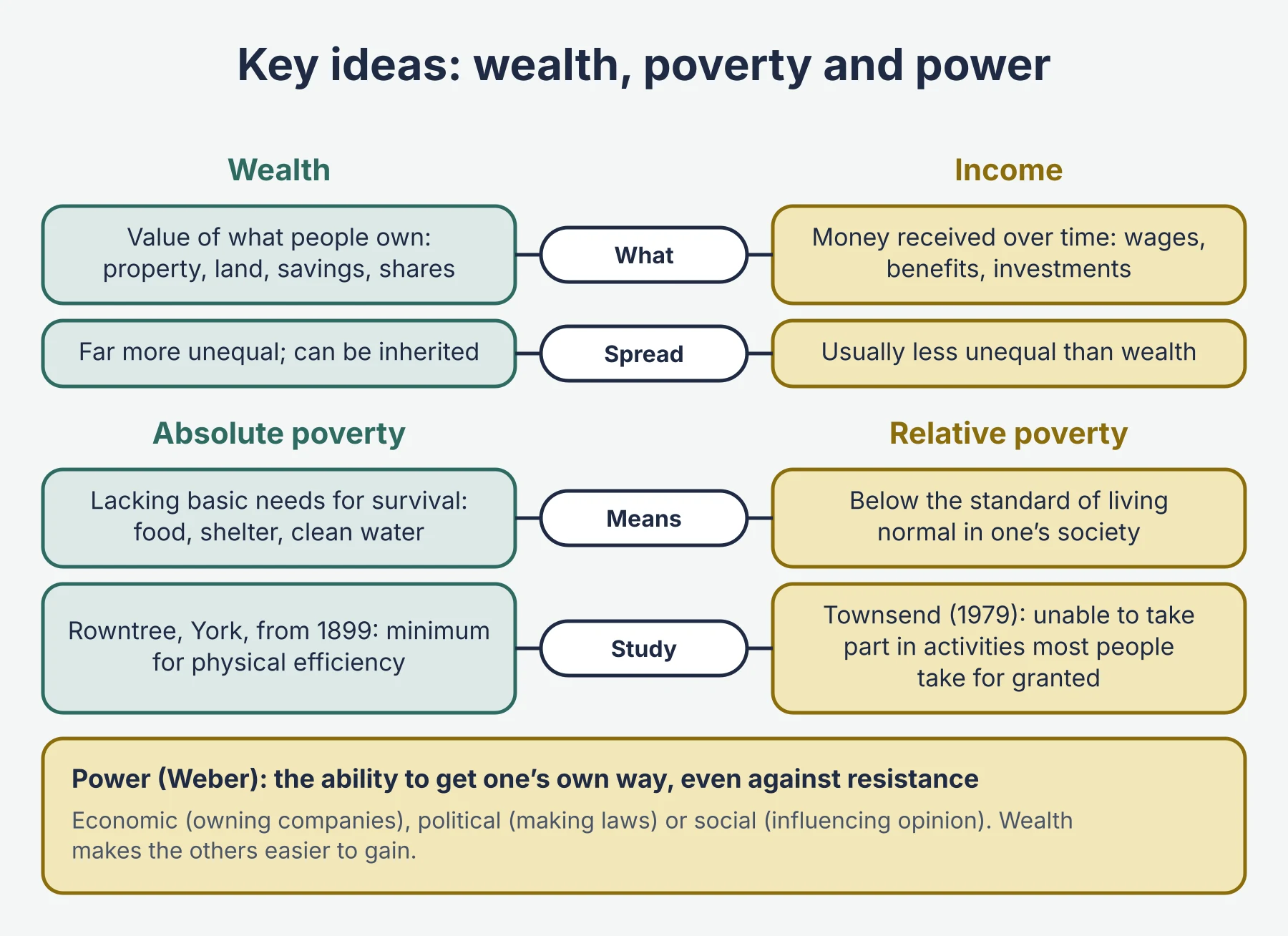
- Wealth is the value of what people own — property, land, savings, shares — and can be inherited. Income is money received over time from wages, benefits or investments. Wealth is usually far more unequally distributed than income, and inheritance helps keep strata closed.
- Absolute poverty means lacking the basic needs for survival: food, shelter, clean water. Seebohm Rowntree’s studies of York, beginning in 1899, measured poverty against a minimum needed for physical efficiency. Relative poverty means falling below the standard of living normal in one’s society; Peter Townsend’s Poverty in the United Kingdom (1979) defined it as being unable to take part in the activities and customs most people take for granted.
- Power is the ability to get one’s own way, even against resistance — a definition associated with Max Weber. Power may be economic (owning companies), political (making laws) or social (influencing opinion), and those with wealth usually find it easier to gain the others.
Social mobility and meritocracy
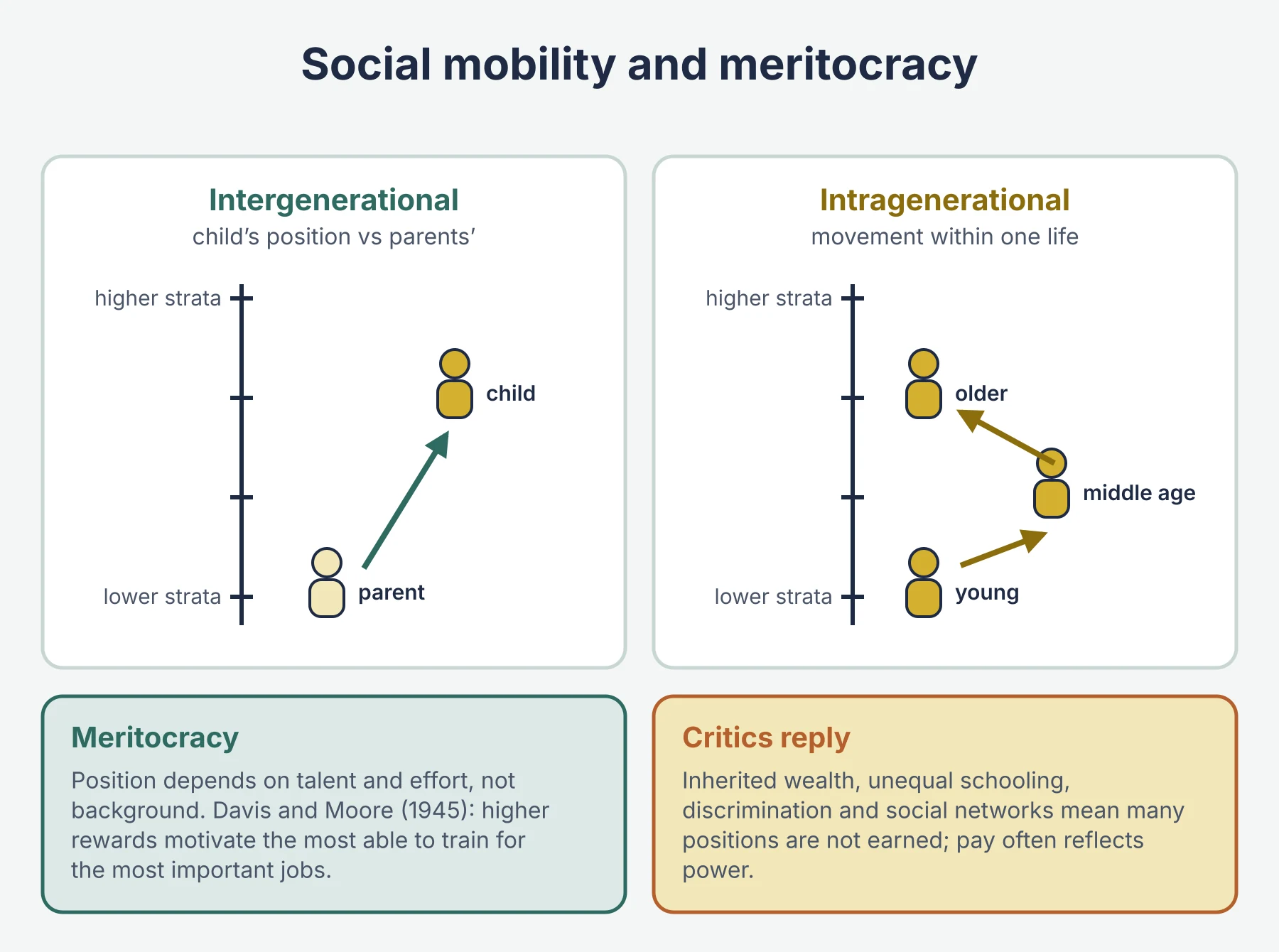
Social mobility is movement between strata. Intergenerational mobility compares a person’s position with their parents’; intragenerational mobility is movement within one person’s life. Mobility can be upward or downward.
A meritocracy is a society where position depends on talent and effort rather than background. Functionalists Kingsley Davis and Wilbert Moore (1945) argued that stratification is functional: higher rewards motivate the most able people to train for the most important jobs. Critics reply that inherited wealth, unequal schooling, discrimination and social networks mean many positions are not earned on merit, and that pay often reflects power rather than importance. (The word “meritocracy” was popularised by Michael Young’s satirical book The Rise of the Meritocracy, 1958.)
Life chances (3.1.2)
Life chances are a person’s chances of gaining the things valued in their society. The syllabus names five areas. The table shows the kinds of difference sociologists investigate; actual patterns vary between societies, so use local evidence where you can.
| Area | Social class | Gender | Ethnicity | Age |
|---|---|---|---|---|
| Education | Material and cultural deprivation affect achievement | Subject choices remain gendered in many places | Some minority groups face labelling or language barriers | Access to adult education varies |
| Employment | Manual work is often less secure and lower paid | Gender pay gap; glass ceiling; segregation | Discrimination in recruitment | Young and older workers face age discrimination |
| Health | Lower classes tend to have worse health | Women live longer on average in most countries but may have more years of ill health | Some minorities have poorer health linked to poverty and discrimination | Health declines with age; care varies |
| Housing | Poorer families more likely to rent, live in overcrowded or damp homes | Lone mothers more likely to face housing poverty | Discrimination by landlords; concentration in poorer areas | Young people may struggle to afford homes |
| Life expectancy | Shorter for poorer groups | Generally longer for women | Varies with income and access to care | — |
The Black Report (1980) in Britain showed a clear class gradient in health and death rates, and the Marmot Review (2010) argued that health improves step by step with every rise in social position.
Intersectionality (3.1.3)
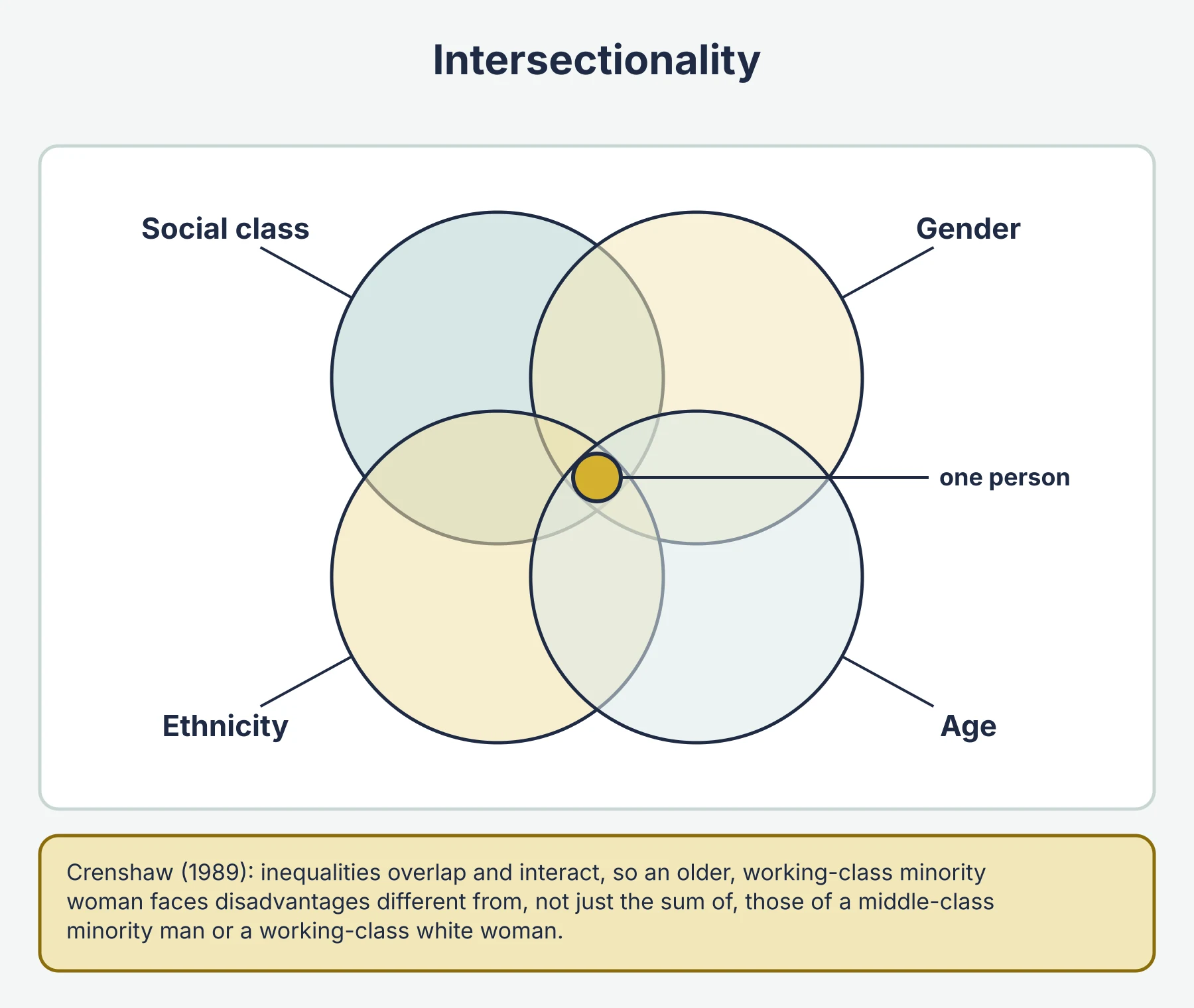
Intersectionality, a term introduced by the American legal scholar Kimberlé Crenshaw in 1989, means that inequalities of class, gender, ethnicity and age overlap and interact, so a person’s experience cannot be understood by looking at one in isolation. An older, working-class woman from an ethnic minority may face disadvantages in employment that are different from — not just the sum of — those faced by a middle-class minority man or a working-class white woman. Intersectionality warns against generalising about “women” or “the working class” as if each group shared one experience.
Theories of inequality (3.1.4)
Labelling theory
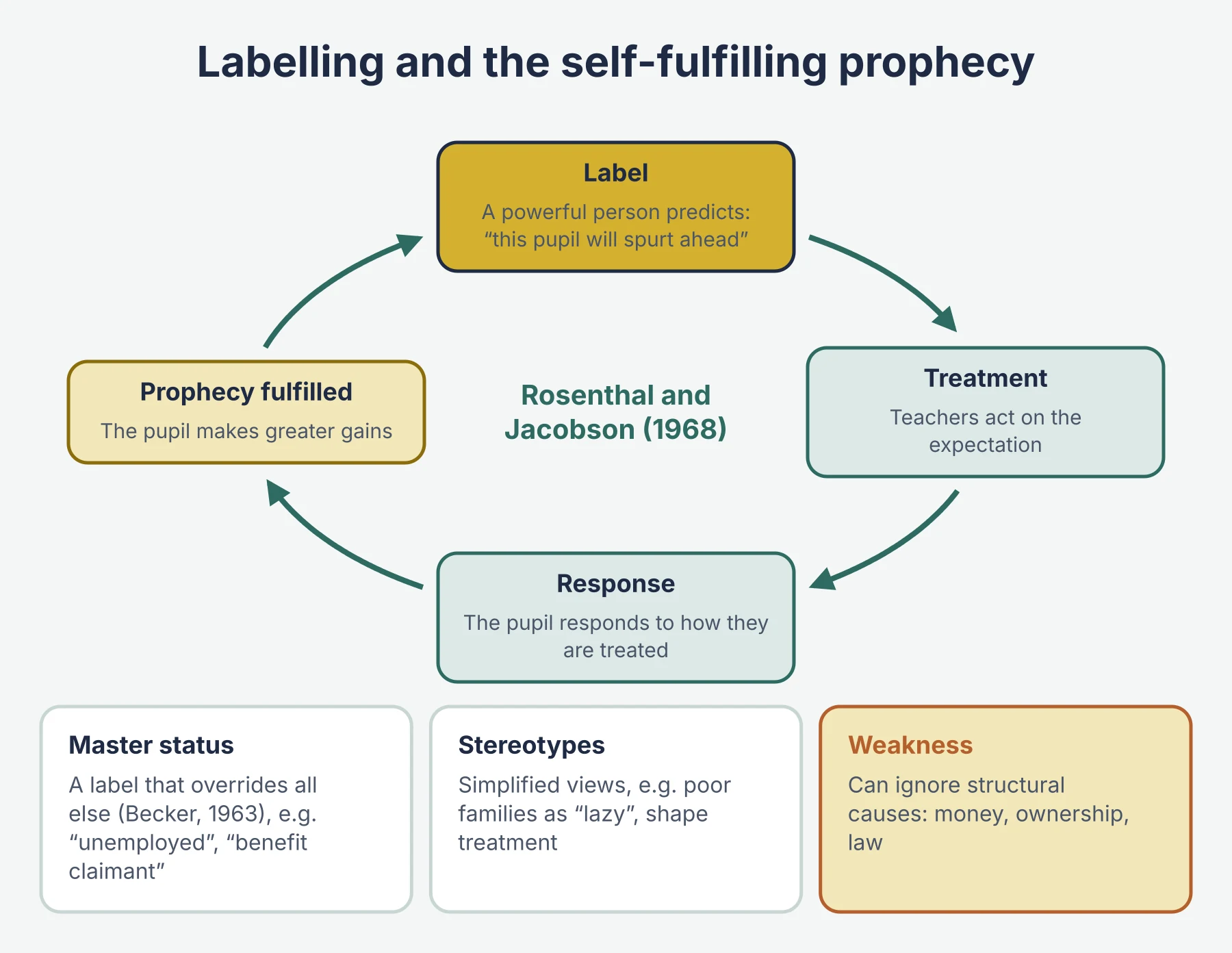
Labelling theory (an interactionist approach) asks how the judgements of powerful people, such as teachers, employers, police and the media, help create inequality.
- Stereotypes — simplified views of groups, such as poor families being “lazy”, shape how people are treated.
- Master status — a label that overrides all other characteristics. Howard Becker (Outsiders, 1963) showed how a deviant label can become the main way others see a person. Being labelled “unemployed” or “a benefit claimant” can work the same way.
- Self-fulfilling prophecy — a prediction that comes true because people act on it. Robert Rosenthal and Lenore Jacobson’s Pygmalion in the Classroom (1968) told teachers that some randomly chosen pupils would “spurt” ahead; many of those pupils made greater gains, suggesting teacher expectations influenced results.
Strength: explains how inequality is reproduced in everyday interaction. Weakness: can ignore the structural causes — money, ownership, law — that produce the labels in the first place.
Marxism
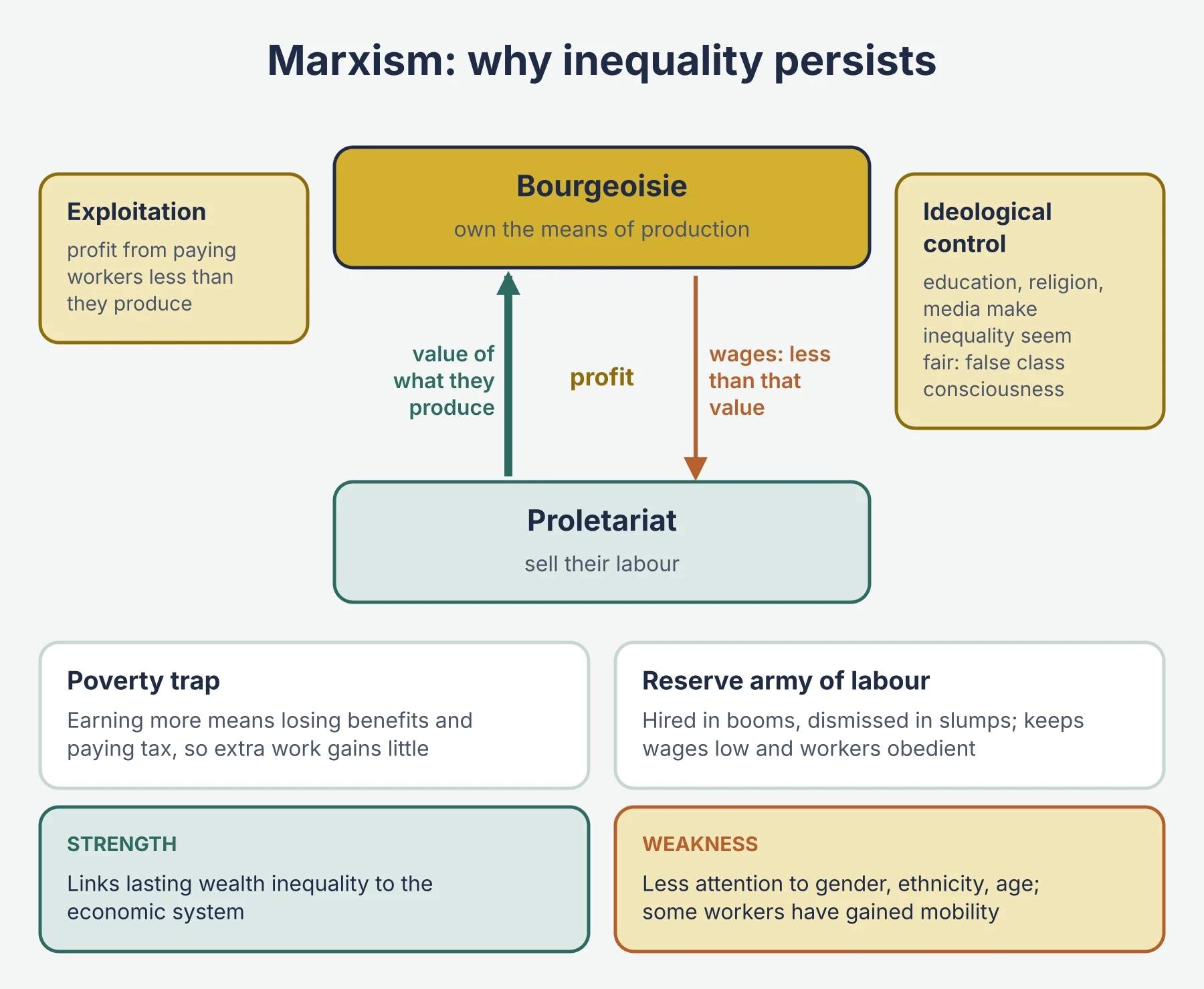
- Exploitation of the proletariat — Karl Marx argued that capitalists (the bourgeoisie) own the means of production and profit by paying workers (the proletariat) less than the value of what they produce.
- Ideological control — ideas spread through education, religion and media make inequality seem natural or fair, producing false class consciousness.
- Poverty trap — when earning more leads to losing benefits and paying tax, so people gain little from extra work and remain poor.
- Reserve army of labour — a pool of unemployed or insecure workers who can be hired in boom times and dismissed in slumps; their presence keeps wages low and workers obedient.
Strength: explains the persistence of wealth inequality and links it to the economic system. Weakness: gives less attention to gender, ethnicity and age; some workers have gained considerable mobility and living standards under capitalism.
Worked example: Question 3(e)-style “discuss”
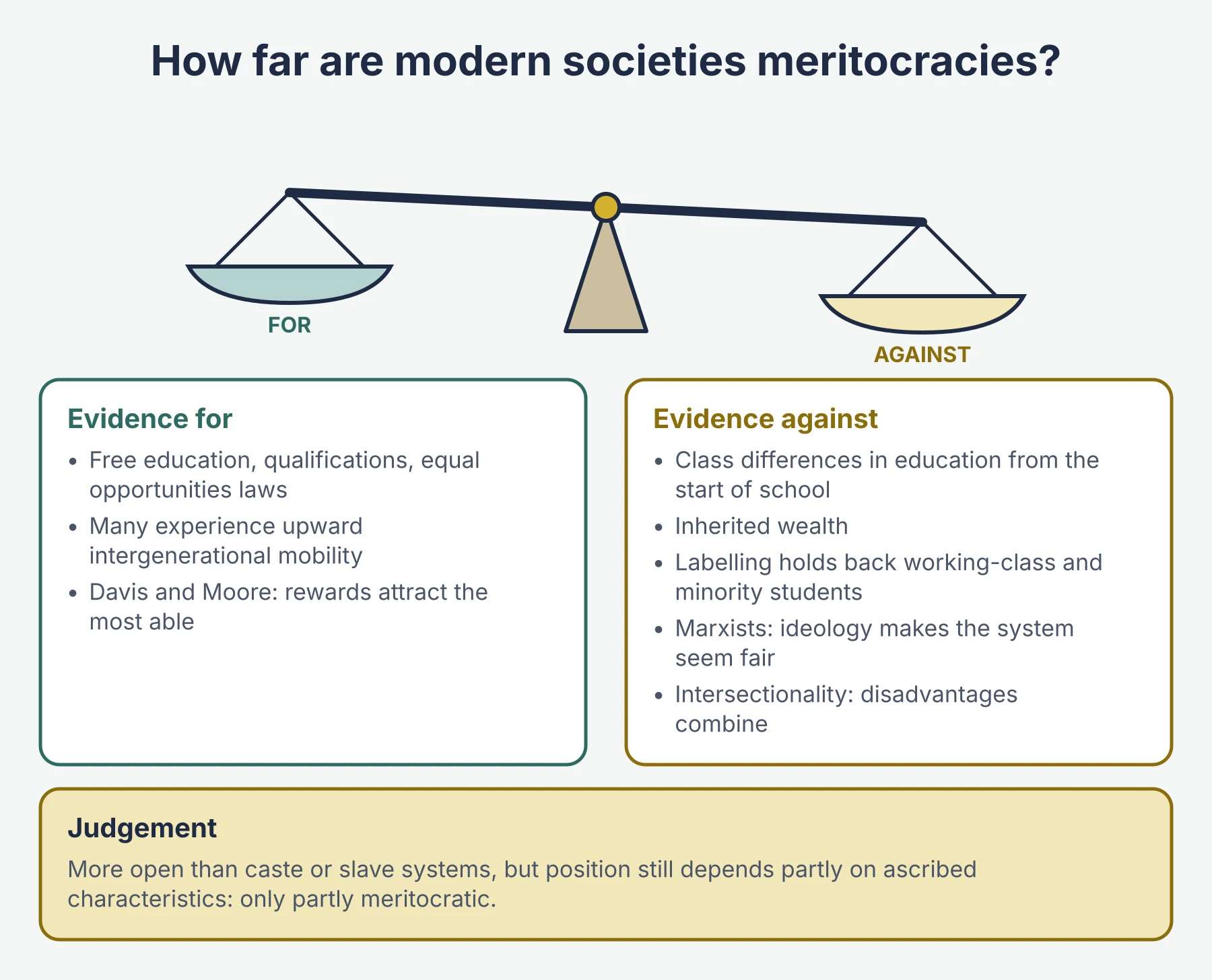
Discuss how far modern societies are meritocracies.
Evidence for meritocracy: free education, qualifications and equal opportunities laws allow people from poorer backgrounds to achieve high positions, and many people do experience upward intergenerational mobility. Davis and Moore argue rewards attract the most able people to important roles.
Evidence against: life chances in education differ by class from the start of school; inherited wealth gives advantages that have nothing to do with merit; labelling and self-fulfilling prophecies can hold back working-class and minority students; Marxists argue ideology persuades people that the system is fair when it protects the bourgeoisie. Intersectionality shows that disadvantages can combine, making mobility far harder for some groups.
Judgement: most modern societies are more open than caste or slave systems, but position still depends partly on ascribed characteristics, so they are only partly meritocratic.
Common mistakes
- Using “stratification” to mean any difference. It means structured, persistent inequality between groups.
- Confusing income with wealth.
- Describing the caste system only in the past tense — its effects continue.
- Listing life chances without specifying which group and which area.
- Treating intersectionality as “adding up” disadvantages rather than showing how they interact.
Exam technique
- Define terms such as meritocracy or master status in one precise sentence plus an example.
- Explain differences in life chances: name the group, the area and the reason.
- Discuss and evaluate with theory: labelling for interaction, Marxism for structure.
Revise with the social stratification revision notes and practise with the social stratification practice questions. Attempts to reduce inequality follow in the study guide for key question 3.2.
Related resources
-
Practice questions
Cambridge IGCSE Sociology (0495): Social stratification and inequality – What is social stratification? – Practice Questions
Original Cambridge IGCSE Sociology 0495 practice on key question 3.1: mobility, life chances, intersectionality, labelling and Marxism, with answers.
Sociology · Cambridge · IGCSE
Try questions -
Revision notes
Cambridge IGCSE Sociology (0495): Social stratification and inequality – What is social stratification? – Revision Notes
Revision notes for Cambridge IGCSE Sociology 0495 key question 3.1: open and closed systems, poverty, mobility, life chances, intersectionality and theories.
Sociology · Cambridge · IGCSE
Revise topic -
Study guides
Cambridge IGCSE Sociology (0495): Social stratification and inequality – What attempts have been made to reduce social inequalities?
Cambridge IGCSE Sociology 0495 key question 3.2 in depth: equality laws, welfare states, NGOs and New Right, Marxist and feminist judgements of their success.
Sociology · Cambridge · IGCSE
Read guide
Related articles
Get free revision emails (optional)
Occasional emails with practice questions, worked explanations and links to free resources for the qualification and subjects you choose. No spam, and you can unsubscribe from any email. The free tools on this site never need an email.