
Revision Notes
Cambridge IGCSE Sociology (0495): Identity: self and society – What influences our social identity? – Revision Notes
Revision notes for Cambridge IGCSE Sociology 0495 key question 2.3: age, gender, ethnicity and class, the digital self, globalisation and postmodern choice.
- Subject
- Sociology
- Level
- IGCSE
- Topic
- Paper 1 – Research Methods, Identity and Inequality
- Author
- Marlbridge Academic Team
- Updated
- Reviewed by
- Naqiya Yousaf (what this means)
Aligned to Cambridge IGCSE Sociology (0495), 2025-2027. Official specification .
Syllabus page (what it covers and how it is assessed): Cambridge IGCSE Sociology.
Syllabus points this page covers
0495
- 2.3 Identity: self and society – What influences our social identity?
Found an error? Report a correction.
Need help with this topic? Request a free trial class for IGCSE Sociology (0495).
Key question 2.3 of Cambridge IGCSE Sociology (0495) asks What influences our social identity? In short: social identity is shaped by four key aspects — age, gender, ethnicity and social class — whose meaning differs between societies; by the digital self built on social networks; by globalisation, which can make identities more alike, mix them or make people defend them; and, according to postmodernists, increasingly by personal choice through consumption and lifestyle.
Full explanations and examples are in the what influences our social identity study guide.
Syllabus coverage
0495 syllabus 2025–2027, 2.3:
- 2.3.1 Age, gender, ethnicity, social class; impact of each on individuals and social groups in different societies.
- 2.3.2 Positive and negative impacts of social networks, social media and virtual communities on identity.
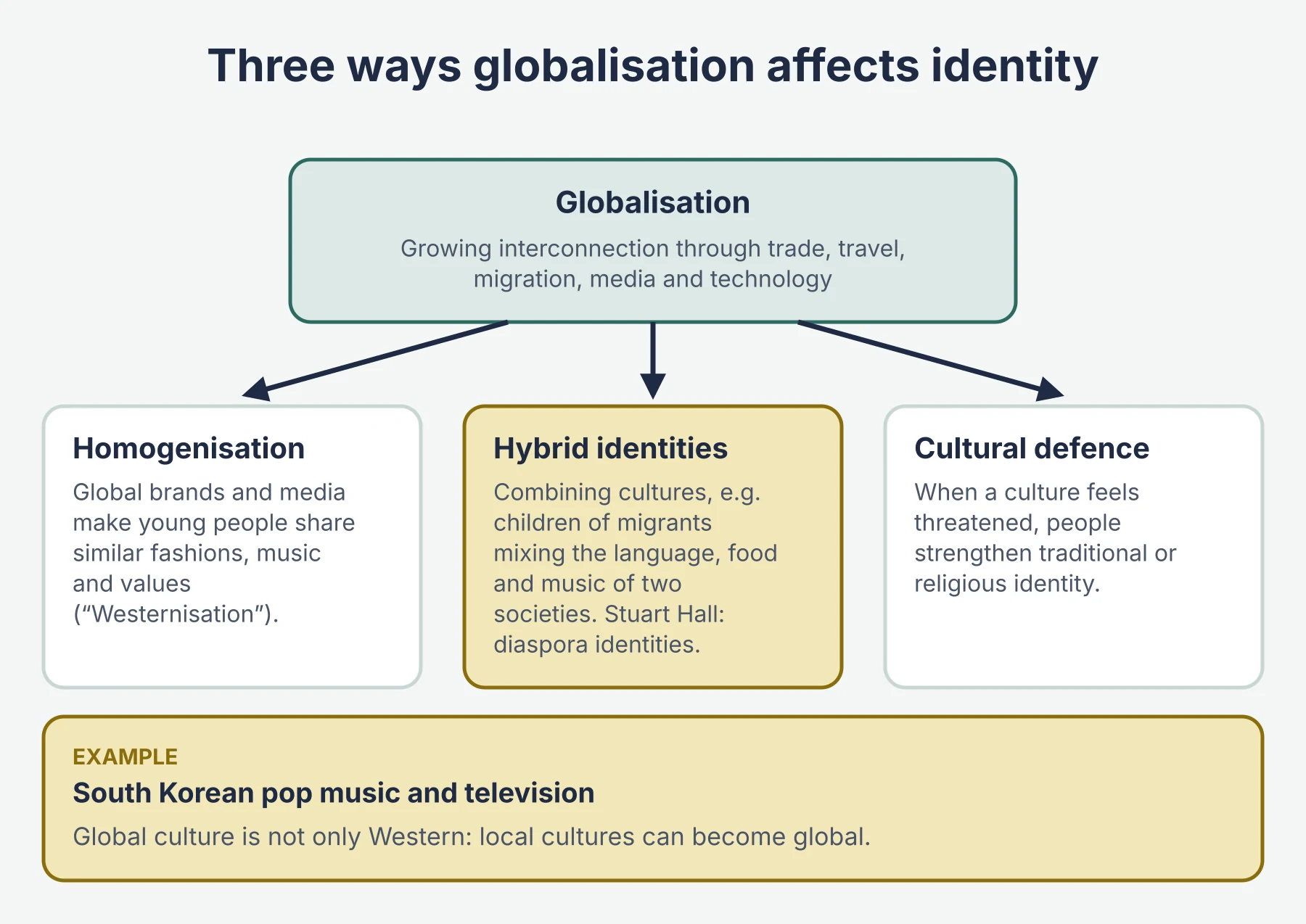
- 2.3.3 (a) Globalisation’s influence on identities, e.g. cultural defence, hybrid identities, homogenisation; (b) positive and negative impacts of cultural diversity, multiculturalism and global culture.
- 2.3.4 Postmodernist views of identity as chosen rather than given: digital identities; consumption patterns and lifestyle in a “pick and mix” society.
Key terms
| Term | Definition |
|---|---|
| Social identity | How we see ourselves and are seen by others because of the groups we belong to |
| Ageism | Prejudice or discrimination on the basis of age |
| Gender identity | A sense of oneself as masculine, feminine or otherwise, learned through socialisation |
| Ethnicity | Shared culture — language, religion, customs, history — that marks a group as distinct |
| Social class | A group sharing a similar economic position, based on occupation, income and wealth |
| Virtual community | A group whose members interact mainly online around shared interests |
| Cultural defence | Strengthening a traditional or religious identity when a culture feels threatened |
| Homogenisation | Identities around the world becoming more similar |
| Hybrid identity | A new identity combining elements of more than one culture |
| Multiculturalism | A society, or policy, in which different cultural groups keep their identities while sharing citizenship |
| Global culture | Products, media and ideas shared across many societies |
| Pick and mix identity | Postmodern idea that people assemble identity from choices of consumption and lifestyle |
The four key aspects: impact on individuals and groups
| Aspect | Impact on individuals | Impact on groups and variation between societies |
|---|---|---|
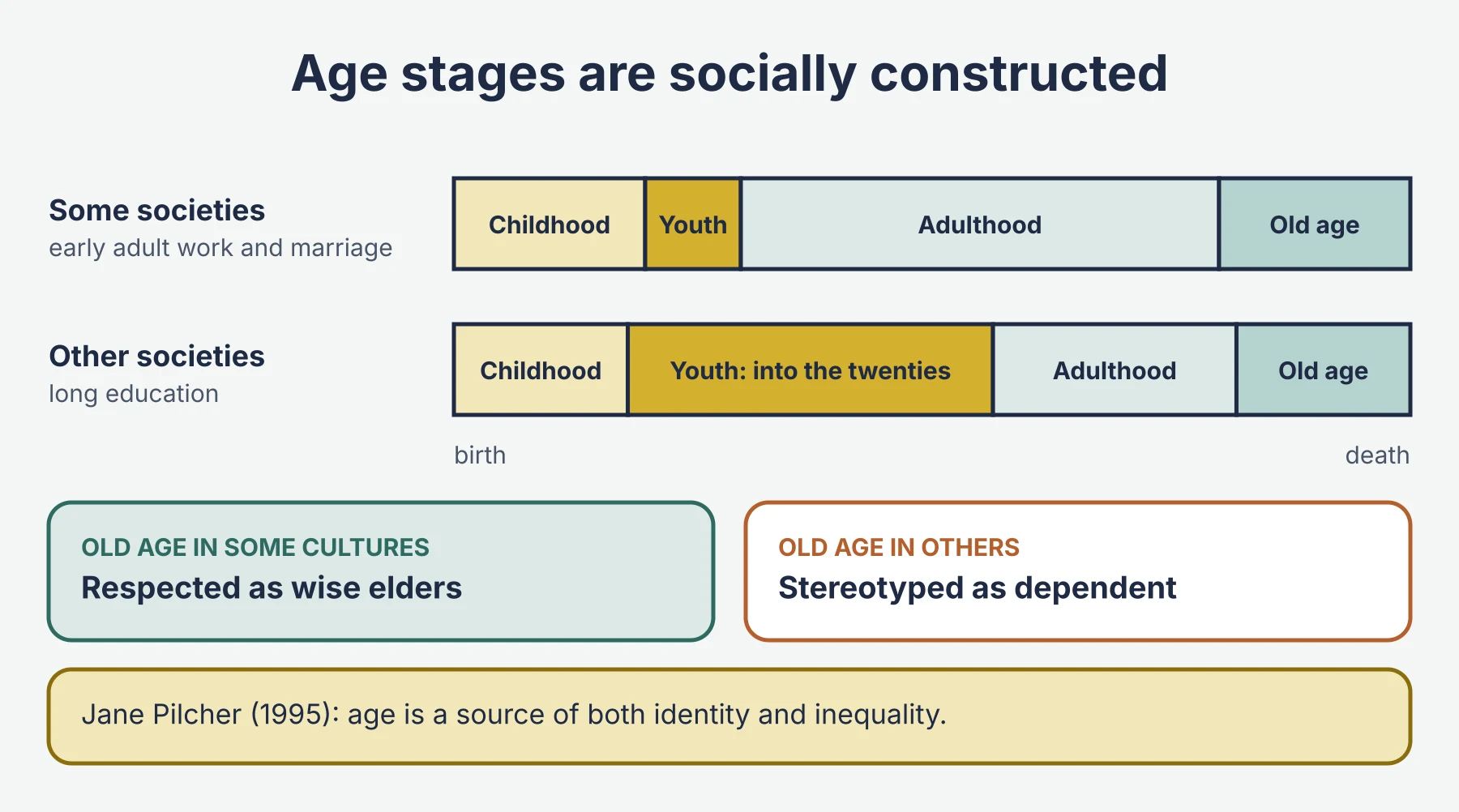
| Age | Expectations of behaviour at each life stage; ageism towards young and old | Life stages are socially constructed: the age of leaving school, marrying or retiring varies widely between societies |
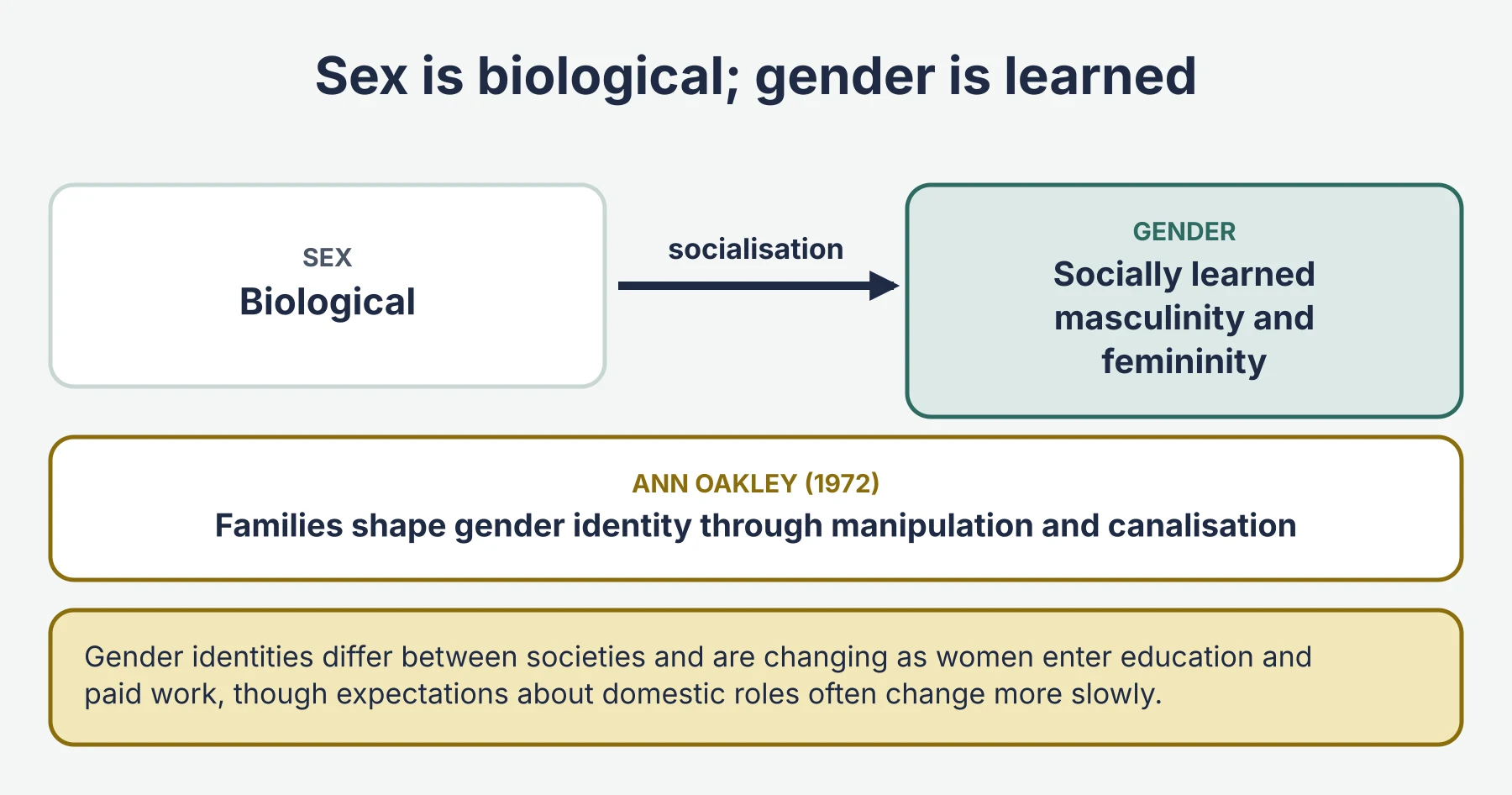
| Gender | Shapes appearance, interests, career choices and emotional expression | Gender norms differ between societies and are changing as women’s education and employment grow |
| Ethnicity | Language, religion, food and festivals give a sense of belonging | Minority groups may strengthen identity in response to discrimination; identity may be hyphenated (for example “British-Indian”) |
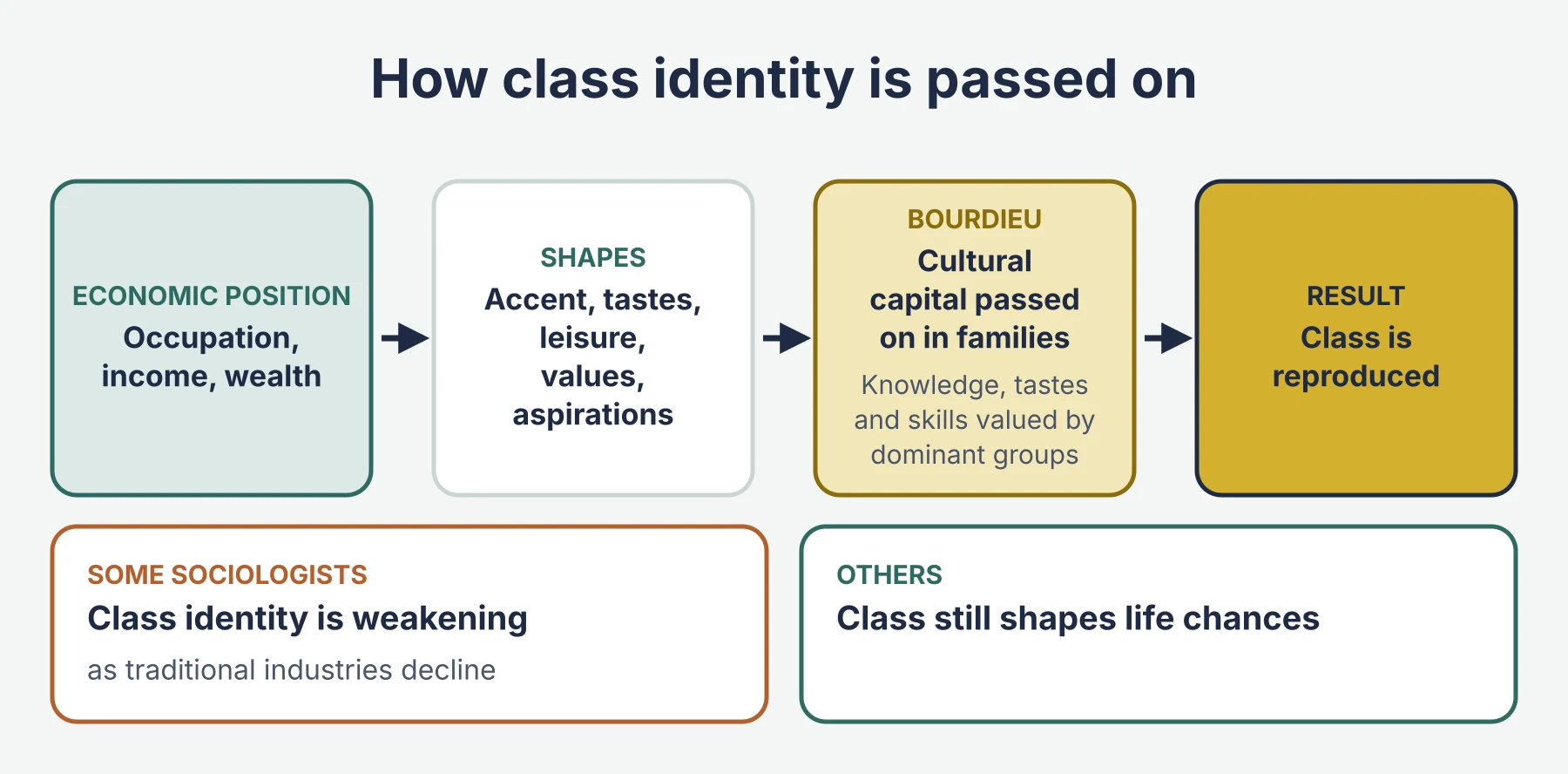
| Social class | Influences accent, tastes, leisure, aspirations | Class may be marked by cultural capital (Bourdieu); some argue class identity is weakening as traditional industries close |
The digital self: quick balance
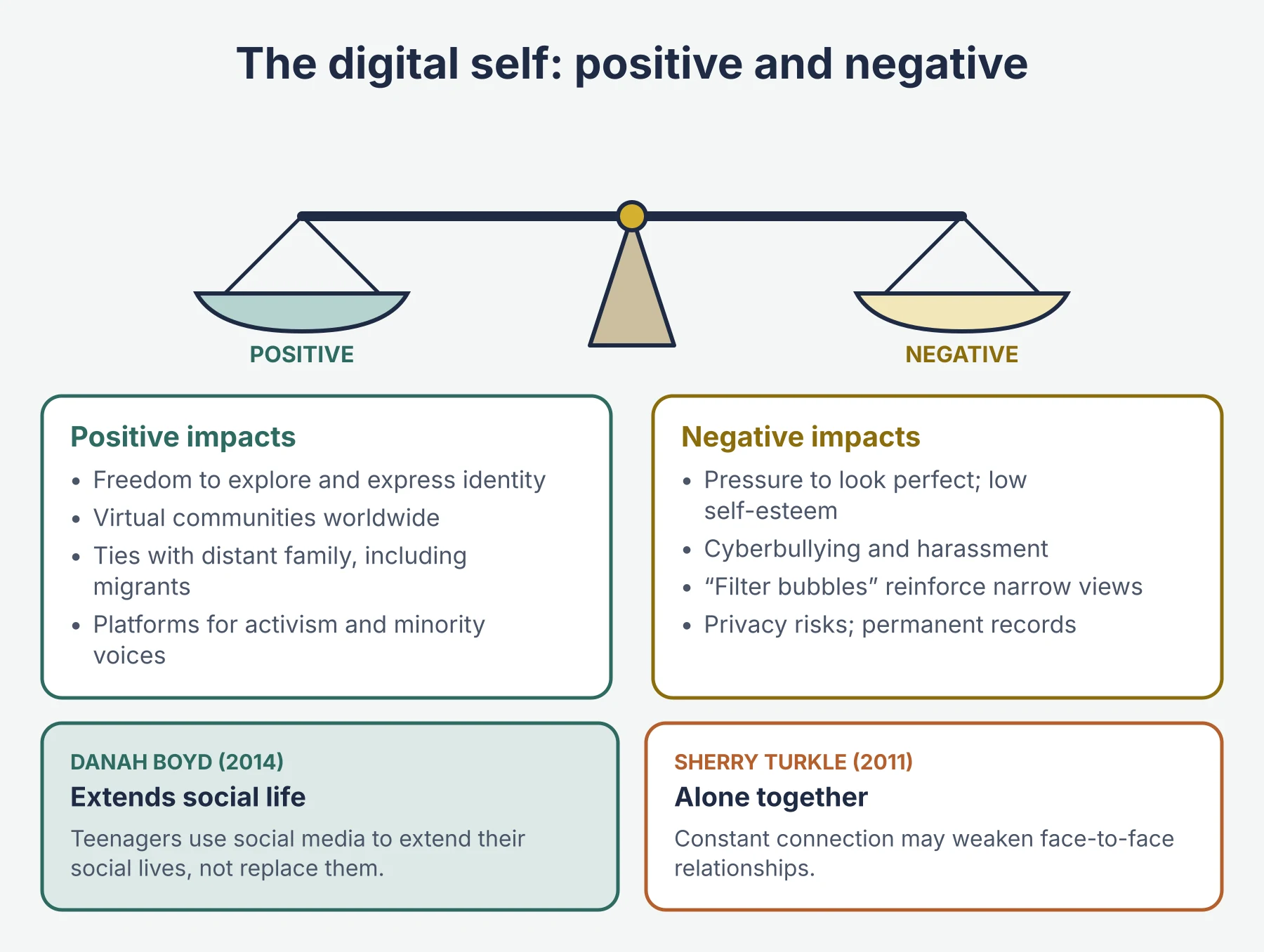
Positive: freedom to express and explore identity; support networks for minorities and people with rare interests or conditions; staying close to family across distance; a platform for activism.
Negative: pressure to present an idealised self; comparison and low self-esteem; cyberbullying; privacy risks; algorithms that narrow what users see.
Evidence to name: boyd (2014) — teenagers use social media to extend their social lives; Turkle (2011) — constant connection may weaken face-to-face relationships.
Globalisation: three influences, three impacts
Influences (2.3.3 a):
- Homogenisation — global brands, platforms and media spread similar tastes; George Ritzer’s idea of “McDonaldization” (1993) describes the spread of standardised products and ways of organising.
- Hybridity — new mixed identities, such as young people combining the music and language of their parents’ culture with those of the country they grew up in.
- Cultural defence — Steve Bruce used this term for religion becoming a focus of identity when a group’s culture is under threat; it also applies to reviving local languages and traditions.
Impacts (2.3.3 b):
| Positive impact on identity | Negative impact on identity | |
|---|---|---|
| Cultural diversity | Wider choice of foods, languages, beliefs | Tension, prejudice, feeling that one’s culture is threatened |
| Multiculturalism | Recognition of minority identities | Critics argue it can weaken a shared national identity |
| Global culture | Global connections and shared youth culture | Local languages and traditions may decline |
Postmodernism (2.3.4)
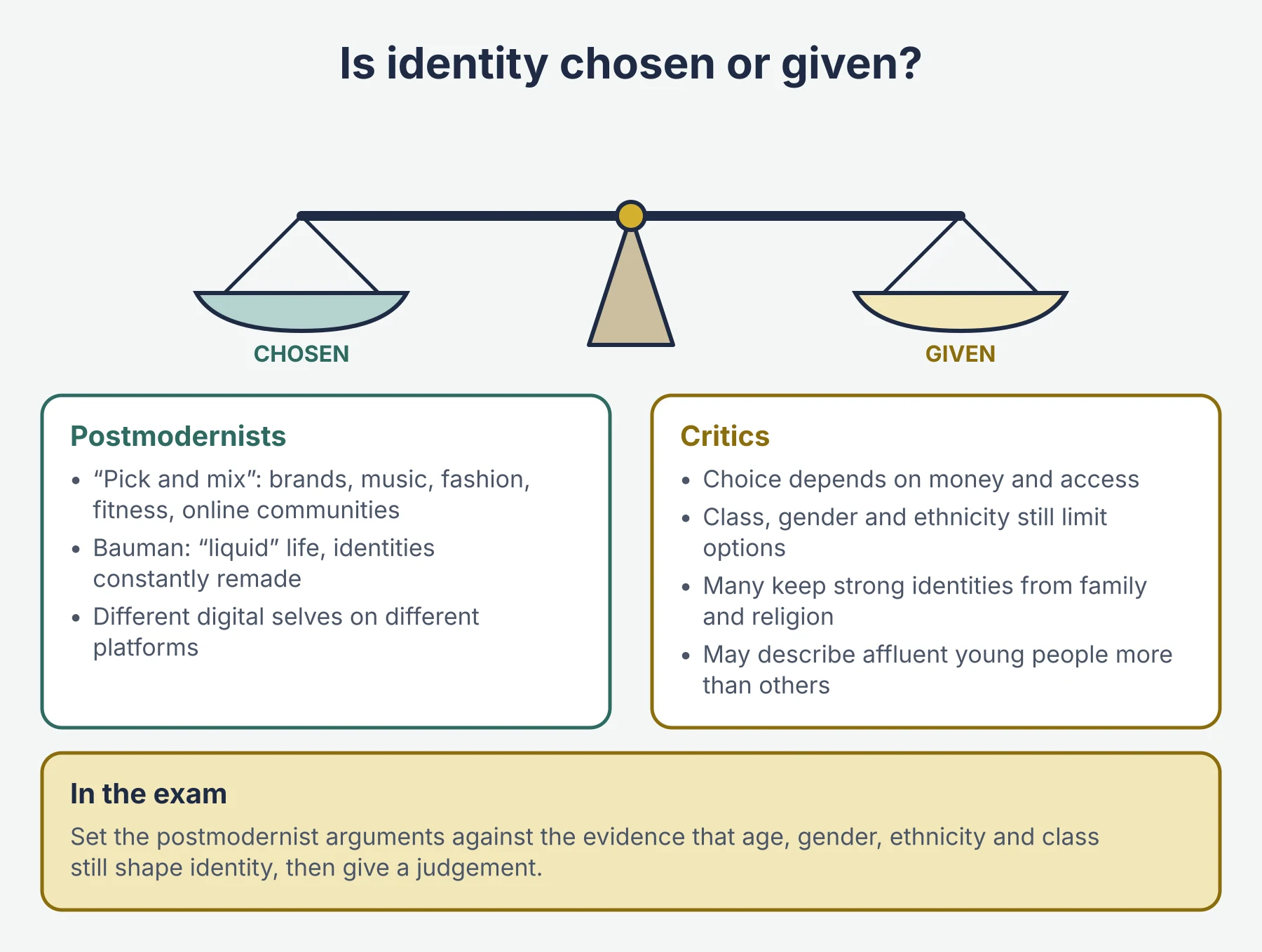
- Identity is chosen, not given: people “pick and mix” from brands, music, fashion, sport, diet and online communities.
- Digital identities allow different selves on different platforms.
- Bauman: identities are “liquid”, constantly remade.
- Criticisms: choice depends on money; class, gender, ethnicity and age still constrain people; many keep strong inherited religious and family identities; the view fits affluent young urban people best.
Exam traps
- Describing an aspect of identity without explaining its impact or how it varies between societies — both are named in 2.3.1.
- Treating globalisation as only Westernisation; non-Western culture also spreads globally.
- Confusing hybrid (mixing) with homogenised (becoming the same).
- Giving only negatives of social media; the syllabus asks for positive and negative impacts.
- Evaluating postmodernism without saying who is able to choose.
Worked example: a 6-mark “explain” answer
Explain three ways ethnicity may influence a person’s identity. (practice)
- Language — speaking a community language at home and in places of worship connects a person to their ethnic group and marks them as part of it.
- Religion and festivals — shared rituals and celebrations reinforce belonging and pass identity to the next generation.
- Experiences of discrimination — being treated as different can strengthen a group’s sense of shared identity, a form of cultural defence.
Self-test
- Define social identity.
- Why is age described as socially constructed?
- Give one way gender identity is changing in many societies.
- What is cultural capital?
- Give two positive impacts of virtual communities on identity.
- What did Turkle warn about constant connection?
- What is the difference between homogenisation and hybridity?
- What did Bruce mean by cultural defence?
- Give one negative impact of global culture on identity.
- What is meant by a “pick and mix” society?
- Give two criticisms of the postmodern view of identity.
- What does “liquid” identity mean in Bauman’s work?
Answers
- How we see ourselves and are seen by others because of the groups we belong to.
- The meaning and expectations of each life stage vary between societies and over time.
- Women’s growing participation in education and paid work; men taking a larger part in childcare.
- Knowledge, tastes and skills valued by dominant groups and passed on in families (Bourdieu).
- Any two: support from people with shared interests; freedom to explore identity; contact across distance; a voice for minorities.
- That it may weaken face-to-face relationships.
- Homogenisation means identities becoming the same; hybridity means new mixed identities.
- Religion or tradition becoming a stronger focus of identity when a group’s culture feels threatened.
- Decline of local languages and traditions.
- A society in which people choose identities from a range of consumer and lifestyle options.
- Any two: choice depends on money; class, gender, ethnicity still constrain; inherited identities remain strong.
- Identity that is fluid and constantly changing rather than fixed.
Related pages: social identity practice questions for key question 2.3 | social control and social identity revision notes
Related resources
-
Study guides
Cambridge IGCSE Sociology (0495): Social stratification and inequality – What is social stratification?
Cambridge IGCSE Sociology 0495 key question 3.1: open and closed societies, caste, slavery, mobility, life chances, intersectionality, labelling and Marxism.
Sociology · Cambridge · IGCSE
Read guide -
Practice questions
Cambridge IGCSE Sociology (0495): Social stratification and inequality – What is social stratification? – Practice Questions
Original Cambridge IGCSE Sociology 0495 practice on key question 3.1: mobility, life chances, intersectionality, labelling and Marxism, with answers.
Sociology · Cambridge · IGCSE
Try questions -
Revision notes
Cambridge IGCSE Sociology (0495): Social stratification and inequality – What is social stratification? – Revision Notes
Revision notes for Cambridge IGCSE Sociology 0495 key question 3.1: open and closed systems, poverty, mobility, life chances, intersectionality and theories.
Sociology · Cambridge · IGCSE
Revise topic
Related articles
Get free revision emails (optional)
Occasional emails with practice questions, worked explanations and links to free resources for the qualification and subjects you choose. No spam, and you can unsubscribe from any email. The free tools on this site never need an email.