
Study Guides
Cambridge O Level Chemistry: Atoms, elements and compounds (5070)
A full study guide to elements, compounds and mixtures, atomic structure, electronic configuration and isotopes for Cambridge O Level Chemistry 5070.
- Subject
- Chemistry
- Level
- O LEVELS
- Topic
- Atoms, elements and compounds
- Author
- Marlbridge Academic Team
- Updated
- Reviewed by
- Farhat ul Ain Sehgal (what this means)
Aligned to Cambridge O Level Chemistry (5070), 2026-2028. Official specification .
Syllabus page (what it covers and how it is assessed): Cambridge O Level Chemistry.
Syllabus points this page covers
5070
- 2.1 Elements, compounds and mixtures
- 2.2 Atomic structure and the Periodic Table
- 2.3 Isotopes
Found an error? Report a correction.
Need help with this topic? Request a free trial class for O Level Chemistry (5070).
This study guide follows the Cambridge O Level Chemistry 5070 syllabus for examination in 2026, 2027 and 2028. It covers sections 2.1, 2.2 and 2.3 under the heading Atoms, elements and compounds: elements, compounds and mixtures; atomic structure and the Periodic Table; and isotopes. Every outcome in those three sections is taught here, in the syllabus’s own wording where possible.
Use it with the Atomic Structure revision notes, the Atomic Structure practice questions, the Cambridge O Level Chemistry hub, the printable checklist and the free 10-minute diagnostics. The examples below are new ones, so they do not repeat the examples in those pages.
What this unit covers
| Section | What you must be able to do |
|---|---|
| 2.1 | Describe the differences between elements, compounds and mixtures |
| 2.2 (1-2) | Describe the structure of the atom; state the relative charges and masses of a proton, a neutron and an electron |
| 2.2 (3-4) | Define proton number and mass number, also called atomic number and nucleon number |
| 2.2 (5) | Work out electronic configurations, for example 2,8,3, of elements and ions for proton numbers 1 to 20 |
| 2.2 (6) | State three links between configuration and the Periodic Table: full outer shell in Group VIII, outer electrons equal group number (Groups I to VII), occupied shells equal period number |
| 2.3 (1-2) | Define isotopes; state why isotopes of one element have the same chemical properties |
| 2.3 (3) | Interpret and use symbols for atoms and ions |
| 2.3 (4) | Find the relative atomic mass of an element using its isotopes’ masses and abundances |
2.1 Elements, compounds and mixtures
The syllabus asks you to describe the differences between the three. The useful way to learn them is to ask three questions about any sample: what is it made of, how is it joined, and how can it be split?
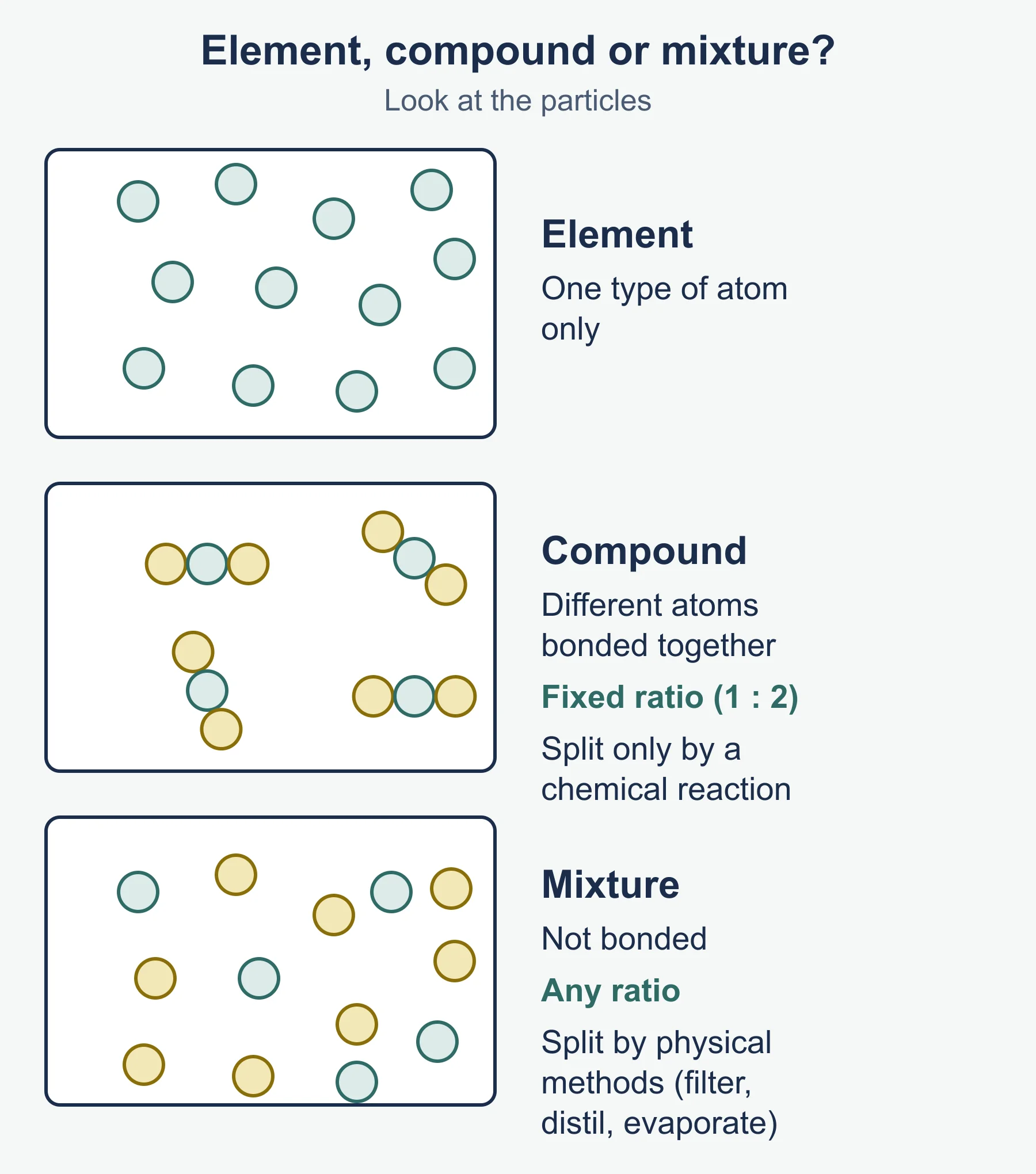
- Element. Made of one kind of atom only. No chemical reaction can split it into simpler substances. Oxygen, iron and neon are elements.
- Compound. Made of two or more different elements chemically bonded together. The atoms are present in a fixed ratio, and the compound has its own properties, which differ from those of the elements in it. Separating the elements needs a chemical reaction.
- Mixture. Two or more substances that are not chemically bonded. The proportions can vary, each substance keeps its own properties, and the parts can be separated by physical methods.
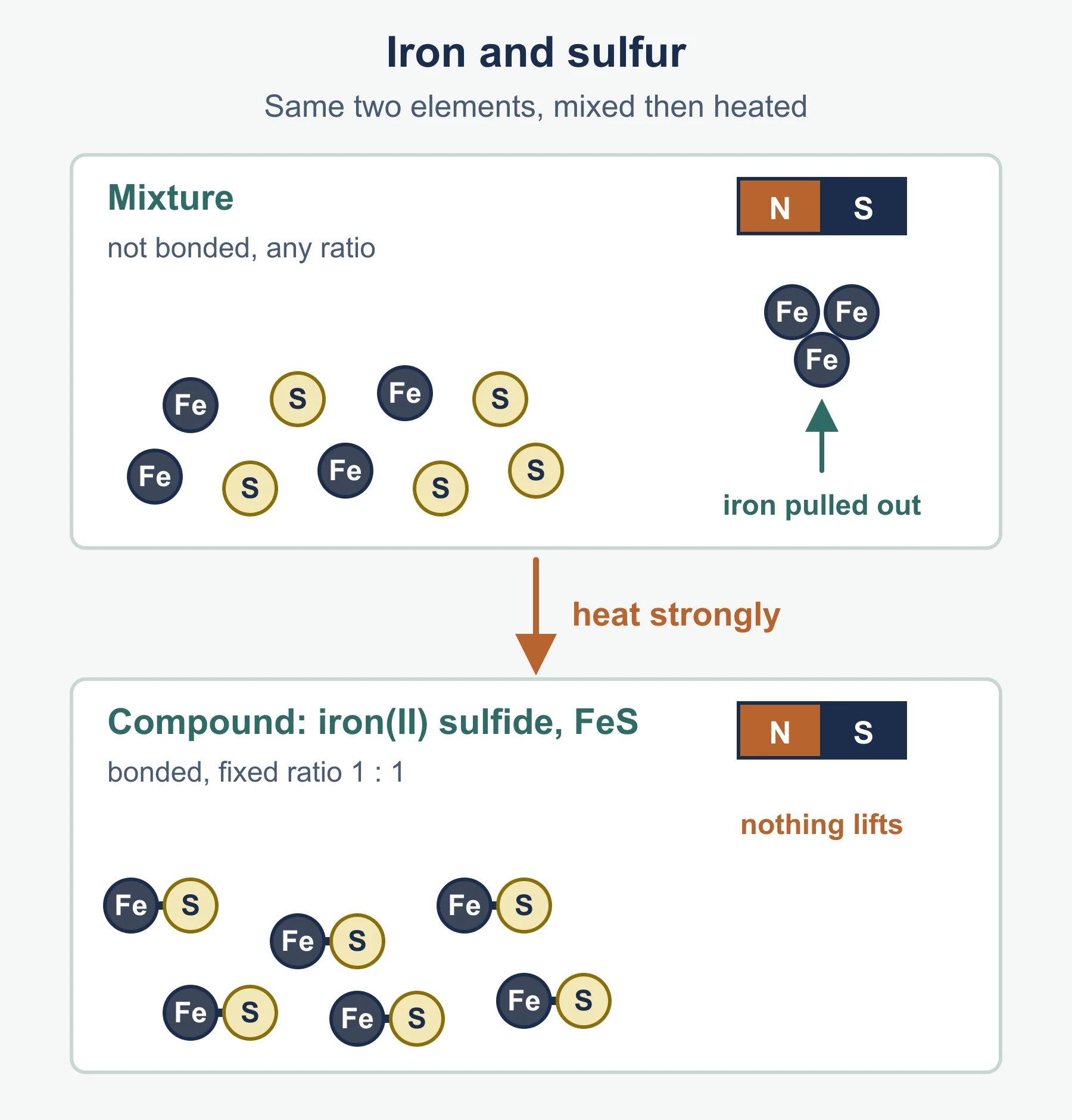
Here is one situation that shows all three. Take iron filings and sulfur powder. Stir them together: you have a mixture. A magnet pulls the iron out, so a physical method separates it, and you can use any proportions you like. Now heat the same two elements strongly. They react to form iron(II) sulfide, a compound. The magnet no longer lifts anything out, because the iron atoms are now bonded to sulfur atoms. The ratio of iron to sulfur atoms in the compound is fixed.
| Feature | Element | Compound | Mixture |
|---|---|---|---|
| Kinds of atom | One | Two or more, bonded | Two or more substances, not bonded |
| Proportions | Not applicable | Fixed ratio | Any ratio |
| Properties | Its own | New, different from its elements | Those of the parts |
| Separation | Cannot be split chemically into simpler substances | Chemical reaction needed | Physical methods |
Air is a good test of whether you have understood. It contains nitrogen and oxygen molecules, but they are not bonded to each other, and the proportions can change slightly from place to place. So air is a mixture, even though nitrogen and oxygen are each elements. Carbon dioxide in the same air is a compound, because its carbon and oxygen atoms are bonded in the ratio 1 to 2.
2.2 Atomic structure and the Periodic Table
The nuclear atom
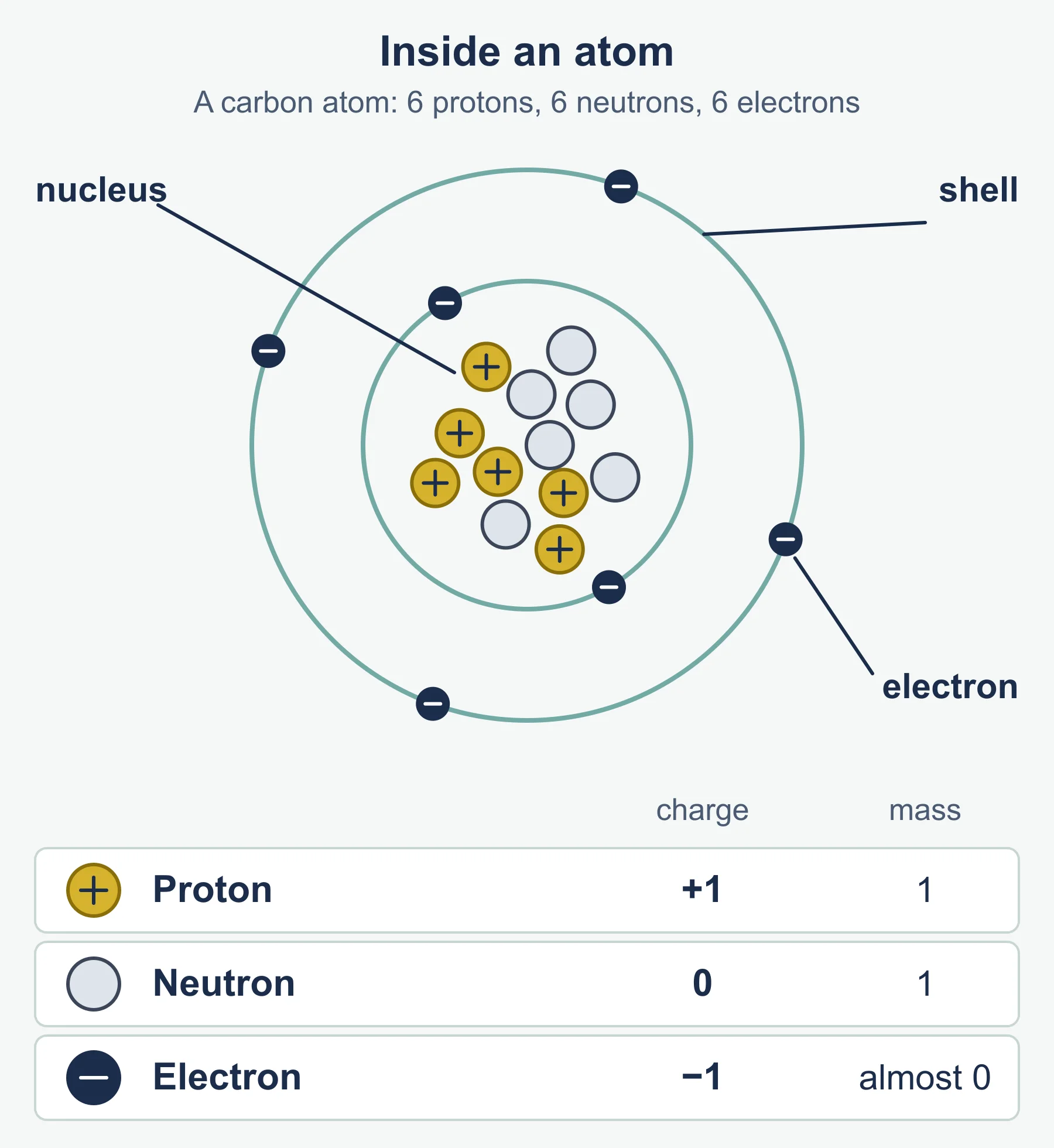
At the centre of an atom is a tiny nucleus built from protons and neutrons. Surrounding it, electrons occupy shells. Almost all of the atom’s mass is in the nucleus, because electrons are so light.
| Particle | Charge (relative) | Mass (relative) |
|---|---|---|
| Proton | +1 | 1 |
| Neutron | 0 | 1 |
| Electron | -1 | negligible |
The syllabus asks you to state these values, so learn the table exactly. The charges on a proton and an electron are equal in size and opposite in sign. So an atom containing the same number of each carries no net charge.
Proton number and mass number
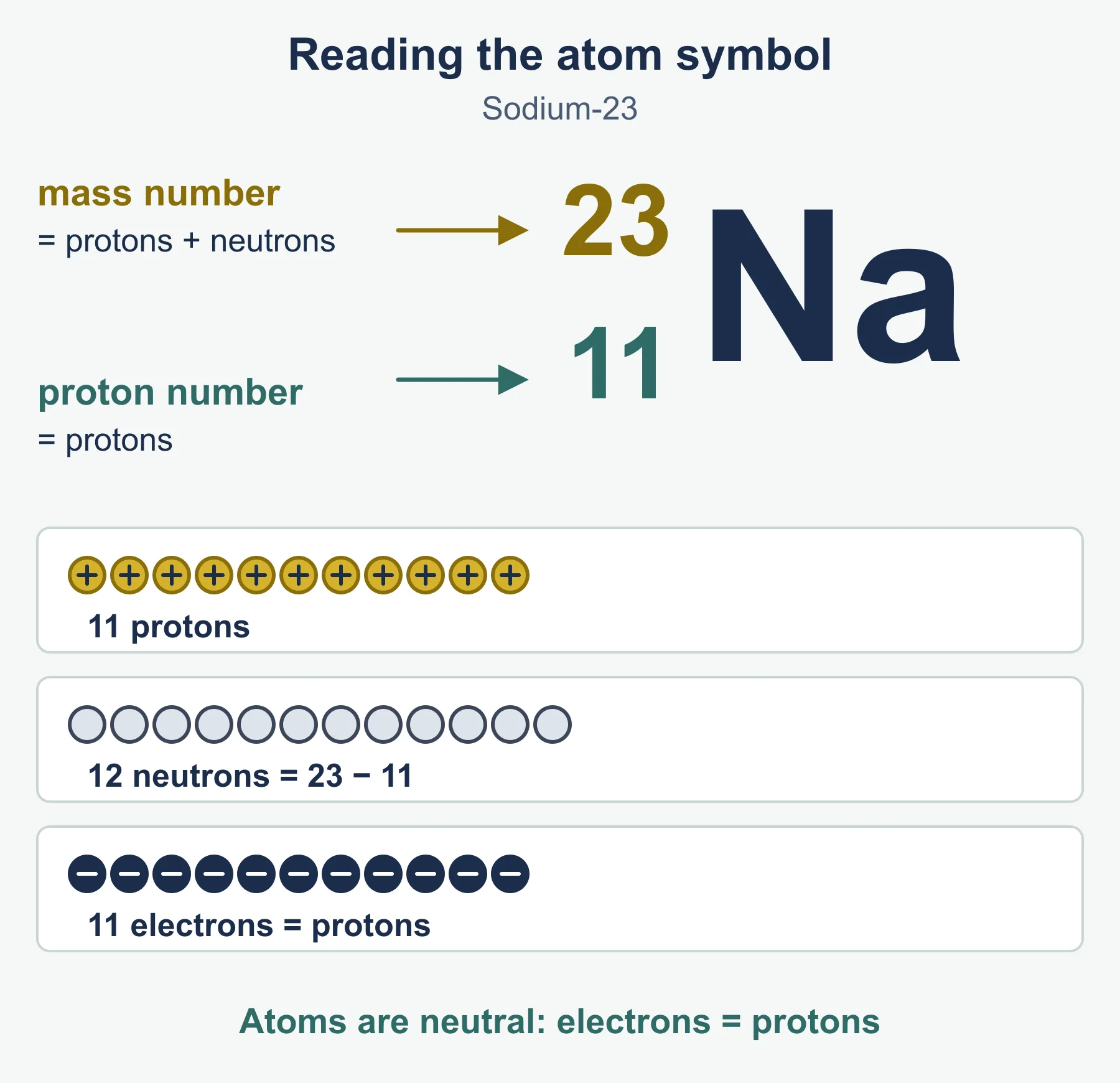
- Proton number (atomic number): how many protons sit in an atom’s nucleus. It fixes which element the atom belongs to.
- Mass number (nucleon number): protons plus neutrons together, counted across the whole nucleus.
From these, for an atom: electrons = protons, and neutrons = mass number - proton number.
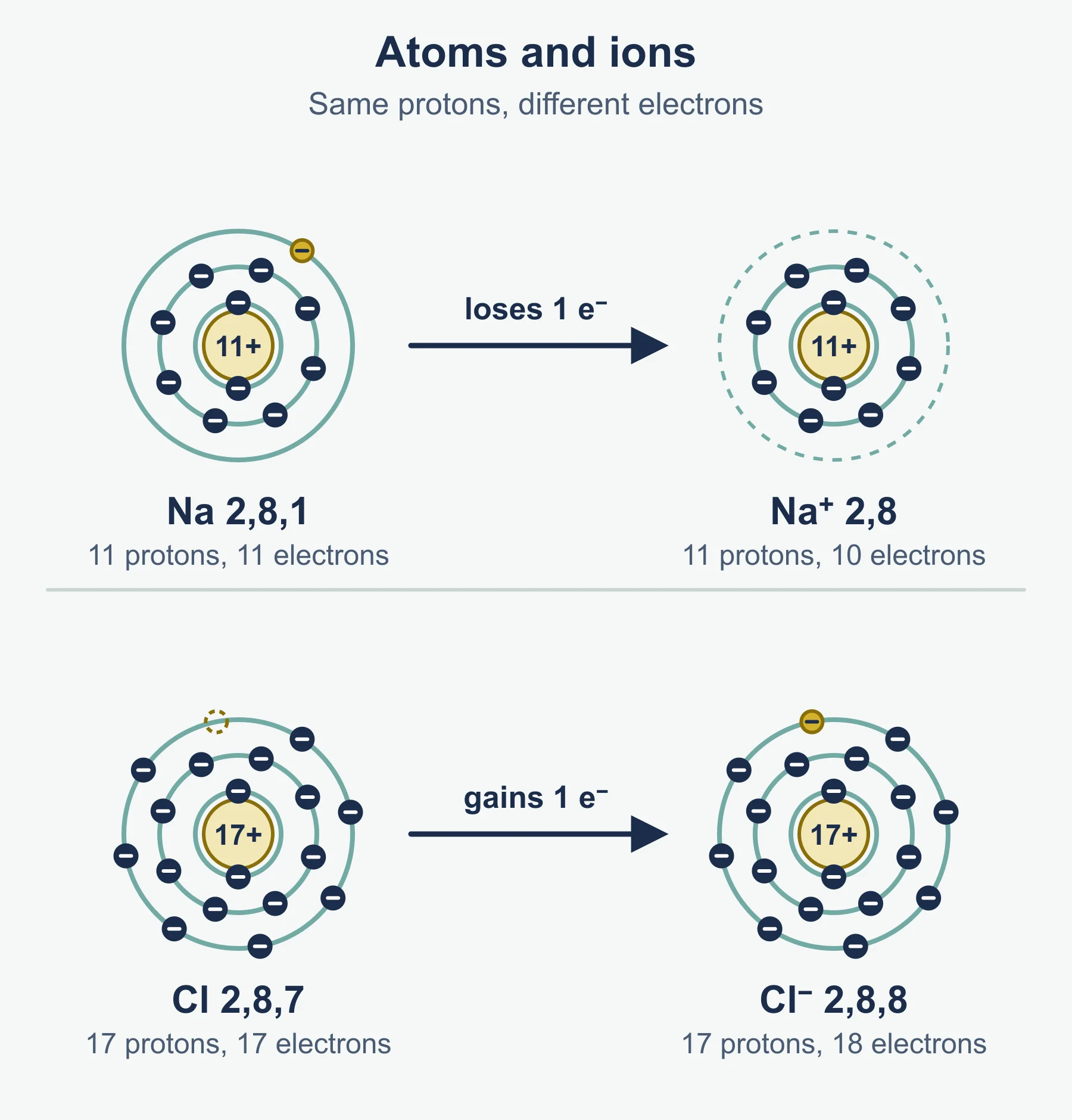
When an atom becomes an ion, its nucleus stays the same and only the electron count changes. Losing electrons gives a positive ion; gaining them gives a negative ion.
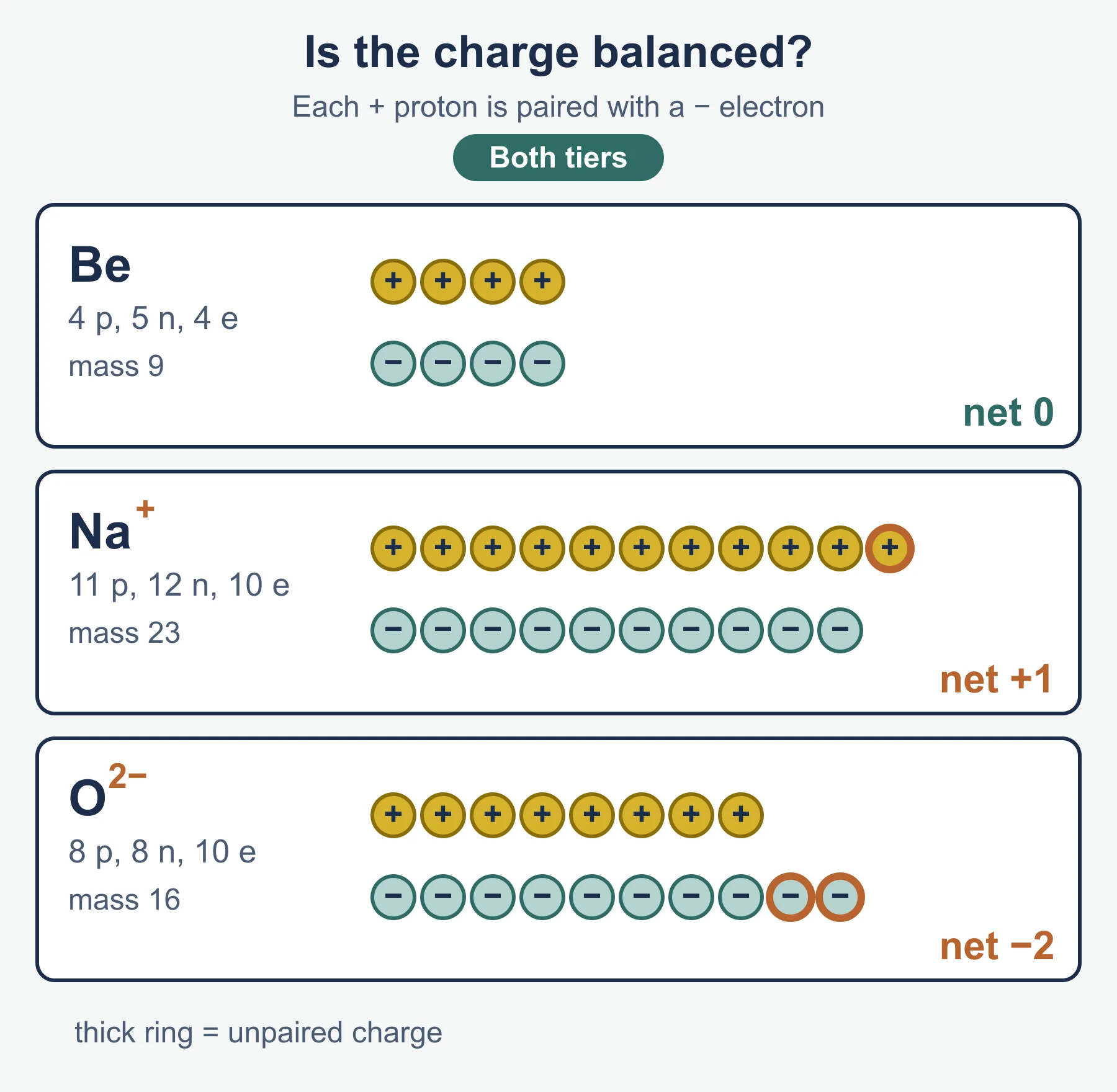
Worked example 1. Work out how many protons, neutrons and electrons each of these particles contains.
| Particle | Protons | Neutrons | Electrons |
|---|---|---|---|
| beryllium atom, mass number 9, proton number 4 | 4 | 9 - 4 = 5 | 4 |
| sodium ion Na⁺, mass number 23, proton number 11 | 11 | 23 - 11 = 12 | 11 - 1 = 10 |
| oxide ion O²⁻, mass number 16, proton number 8 | 8 | 16 - 8 = 8 | 8 + 2 = 10 |
Check the charge each time: the sodium ion has 11 positive charges and 10 negative ones, a net +1. The oxide ion has 8 positive and 10 negative, a net -2.
Electronic configuration, proton numbers 1 to 20
Electrons fill the shell closest to the nucleus first. For proton numbers 1 to 20, the pattern is:
- the first shell holds a maximum of 2
- the second holds a maximum of 8
- the third also holds 8 here, and after that the next electrons start the fourth shell
- potassium and calcium put their last 1 or 2 electrons in the fourth shell
The syllabus writes configurations as a list of numbers, for example 2,8,3. Work along the shells, giving each its maximum before starting the next.
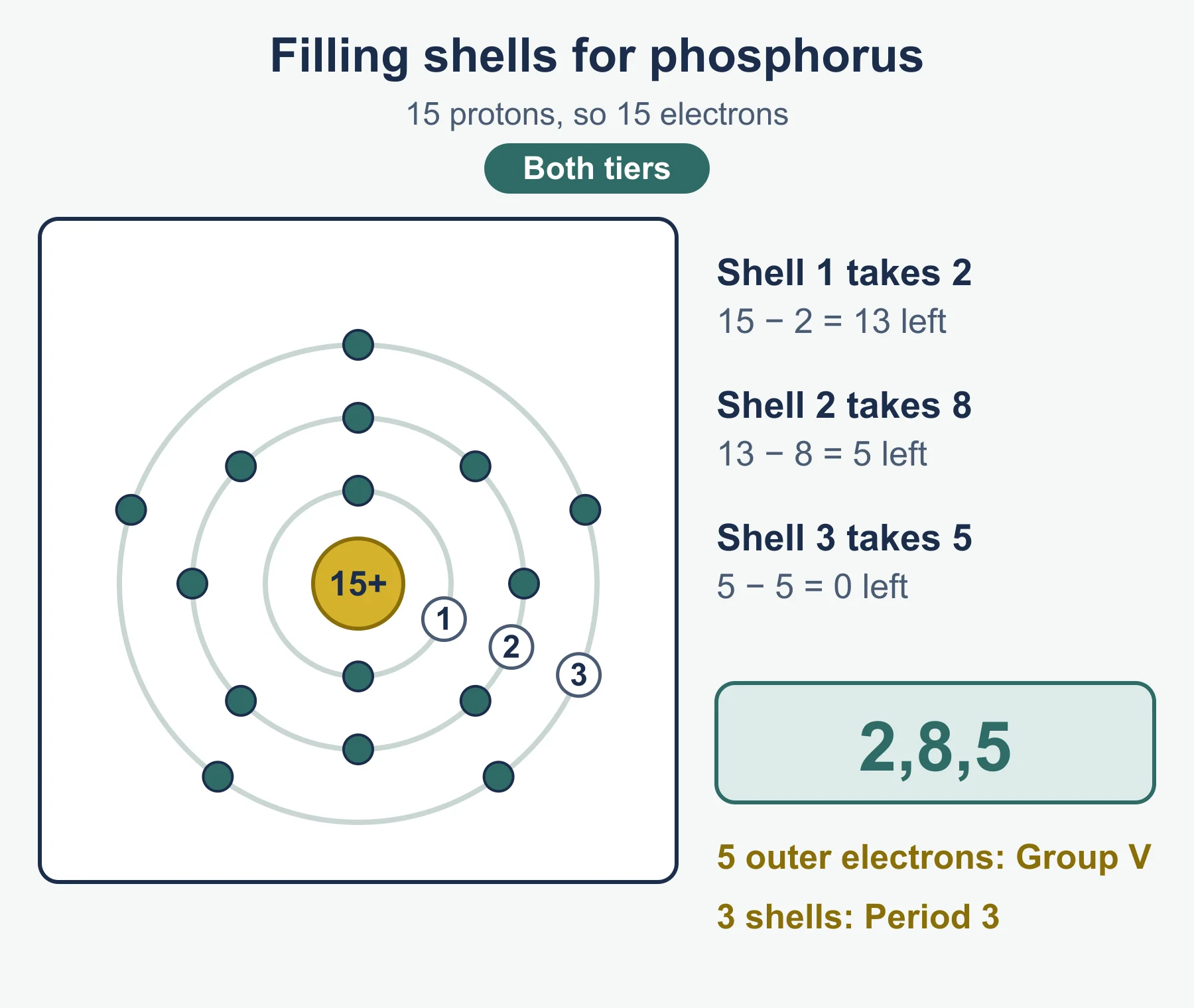
Worked example 2. Write the configuration of an atom of phosphorus (proton number 15).
Shell 1 takes 2    ->  13 electrons left
Shell 2 takes 8    ->   5 electrons left
Shell 3 takes 5    ->   0 left
The configuration is 2,8,5.
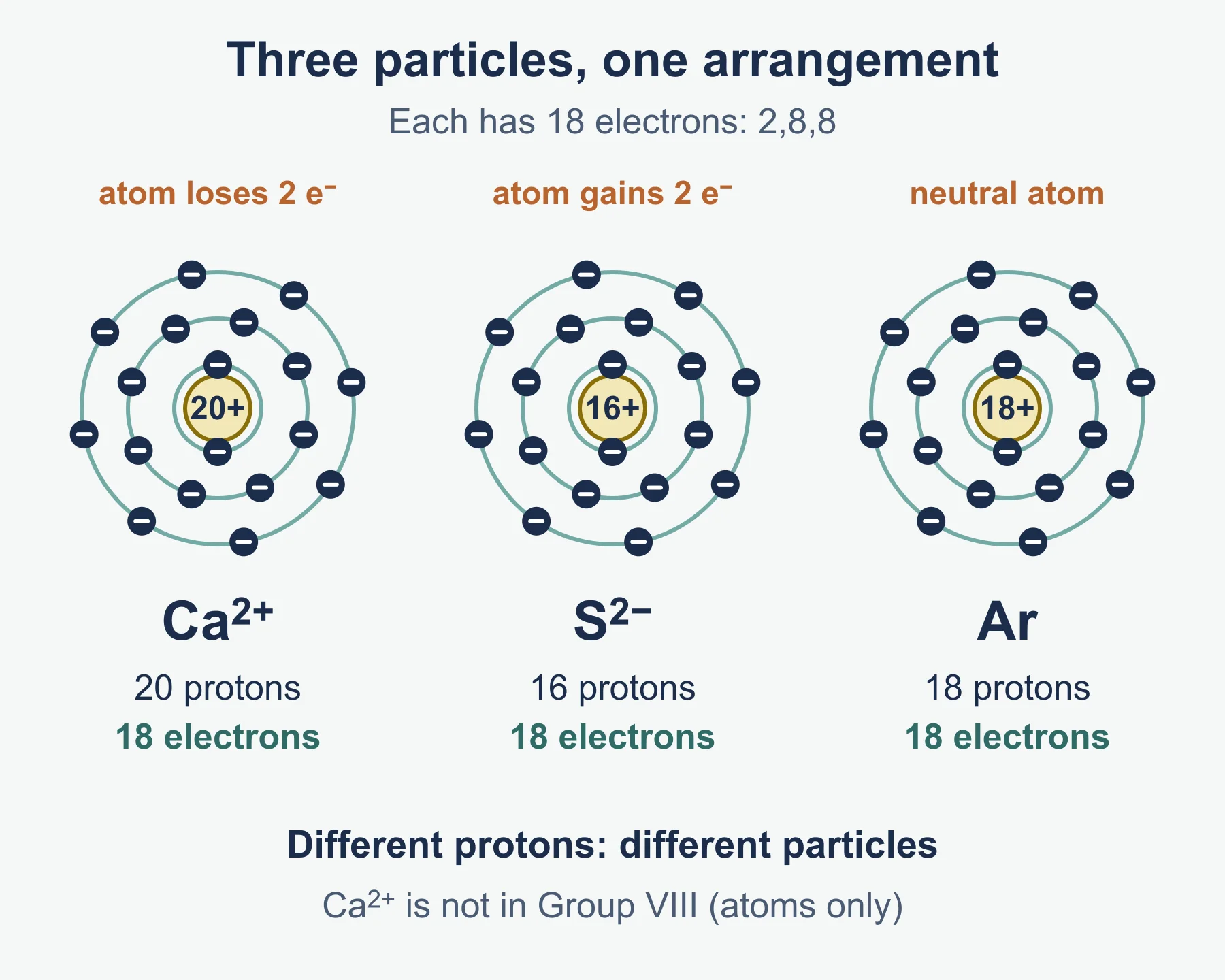
Worked example 3 (ions). Write the configuration of the calcium ion Ca²⁺ and the sulfide ion S²⁻.
- A calcium atom (proton number 20) is 2,8,8,2. The 2+ ion has lost two electrons, so it has 18: 2,8,8.
- A sulfur atom (proton number 16) is 2,8,6. The 2- ion has gained two electrons, so it has 18: 2,8,8.
Two different ions end up with the same arrangement as the noble gas argon (proton number 18, configuration 2,8,8). Their proton numbers differ, so they are still different particles. Always fill in the shells for the actual number of electrons the particle has, not the proton number of the element.
Linking configuration to the Periodic Table
Three facts link configuration to position.
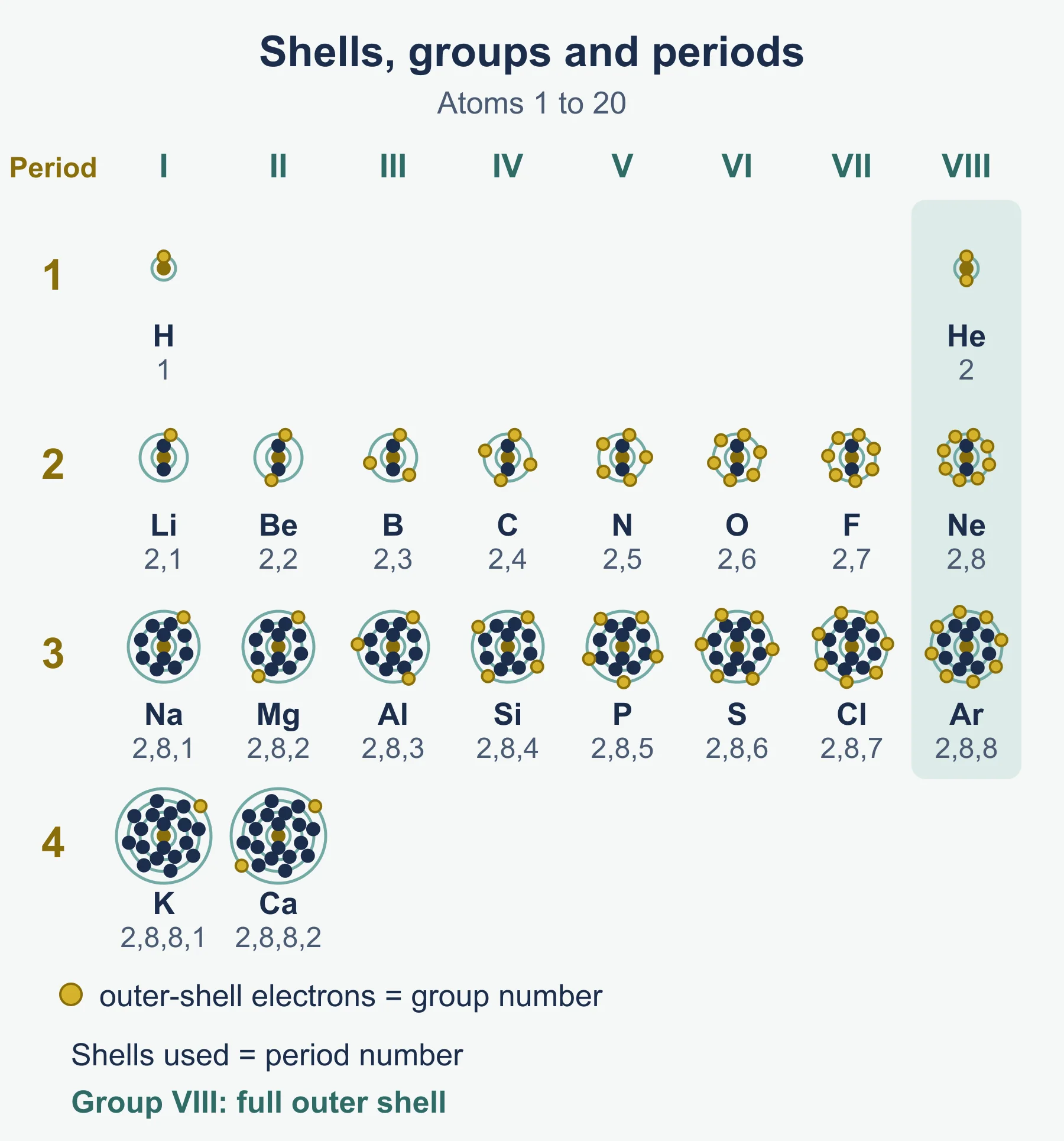
- The noble gases in Group VIII have a complete outer shell. Neon is 2,8 and argon is 2,8,8. Helium, 2, is also full because the first shell holds only 2.
- Outer-shell electrons match the group number, for Groups I to VII. Phosphorus, 2,8,5, has 5 outer electrons, so it is in Group V.
- Occupied shells match the period number. Phosphorus has three occupied shells, so it is in Period 3.
| Atom | Configuration | Group | Period |
|---|---|---|---|
| Lithium | 2,1 | I | 2 |
| Oxygen | 2,6 | VI | 2 |
| Aluminium | 2,8,3 | III | 3 |
| Argon | 2,8,8 | VIII | 3 |
| Calcium | 2,8,8,2 | II | 4 |
These rules apply to atoms, not ions. The Ca²⁺ ion has configuration 2,8,8 but it is not in Group VIII. A common slip is to read the group of an ion from its charged configuration.
2.3 Isotopes
Definition
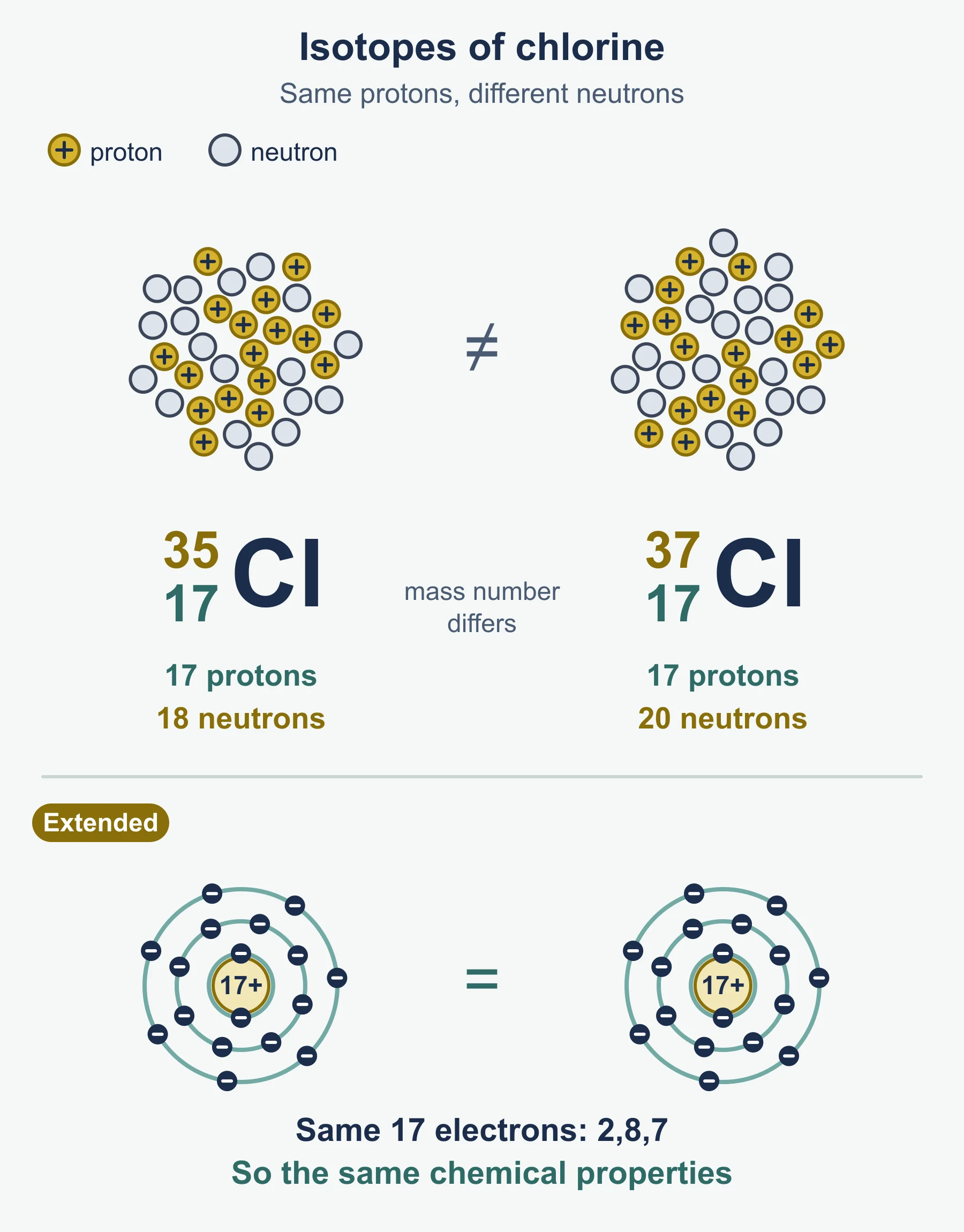
Isotopes are atoms of one element that share a proton number but differ in neutron number. Same protons means same element. Different neutrons means different mass numbers.
Boron has two common isotopes. Both have 5 protons. One has 5 neutrons (mass number 10) and the other has 6 neutrons (mass number 11).
Why the chemistry is the same
State the reason in full. Every isotope of an element behaves the same chemically because each has an identical electron count, so the electronic configuration is identical. Chemical reactions involve electrons, and neutrons play no part. A good answer names all three links: protons are equal, so electrons are equal, so configuration is equal.
Symbols for atoms and ions
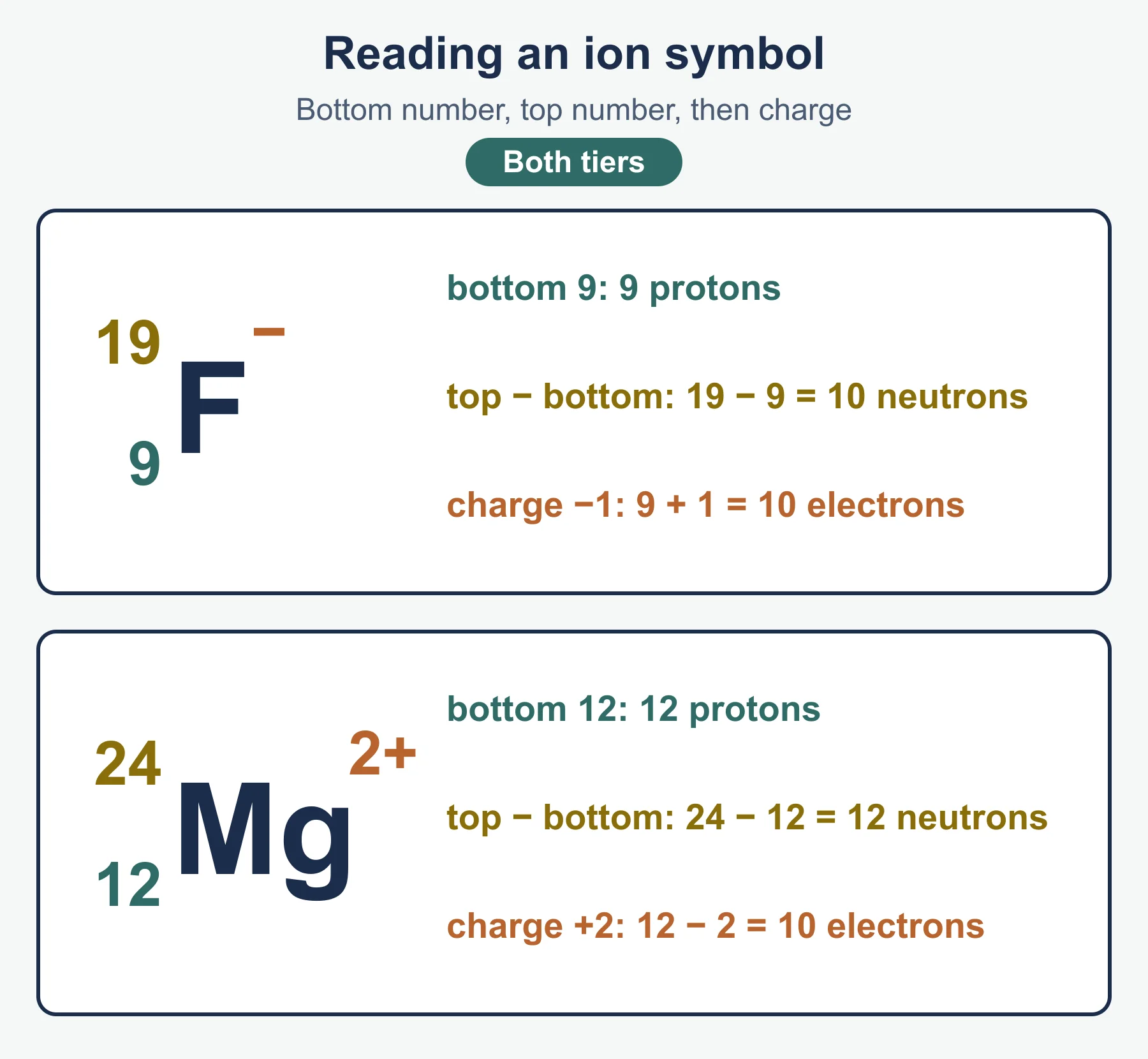
The syllabus asks you to interpret and use symbols such as the one for carbon-12 and the chloride ion. The mass number goes at the top left, the proton number at the bottom left and the charge, if any, at the top right.
| Symbol | Meaning | Protons | Neutrons | Electrons |
|---|---|---|---|---|
| ¹⁰₅B | boron atom, mass number 10 | 5 | 5 | 5 |
| ¹¹₅B | boron atom, mass number 11 | 5 | 6 | 5 |
| ¹⁹₉F⁻ | fluoride ion | 9 | 10 | 10 |
| ²⁴₁₂Mg²⁺ | magnesium ion | 12 | 12 | 10 |
Read a symbol in this order: bottom number gives protons, top minus bottom gives neutrons, then the charge tells you how far the electron count moves from the proton count.
To write a symbol from a description, check you have the numbers the right way round. “An atom with 8 protons and 10 neutrons” has proton number 8 and mass number 8 + 10 = 18, so the symbol is ¹⁸₈O.
Calculating relative atomic mass from isotopes
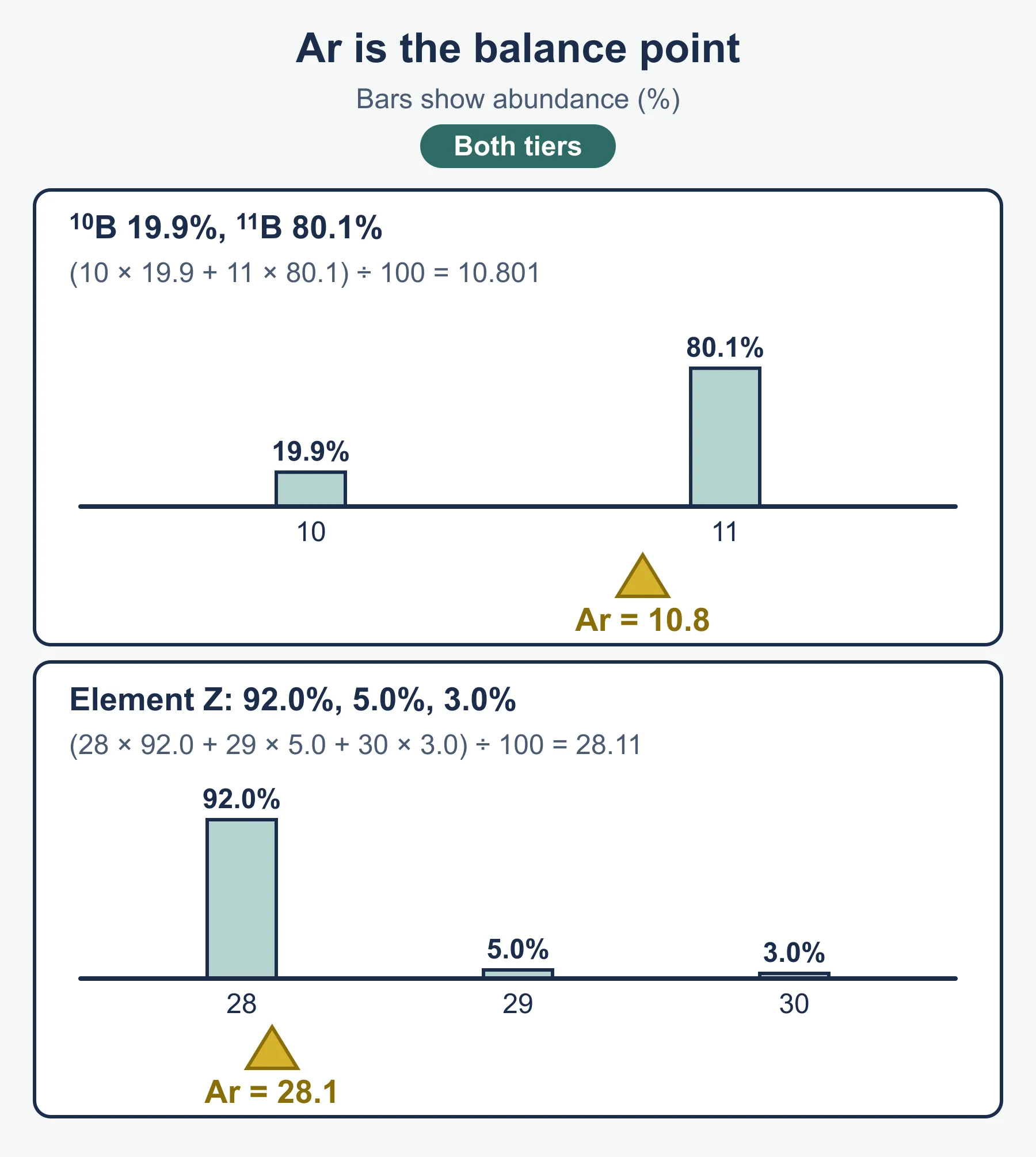
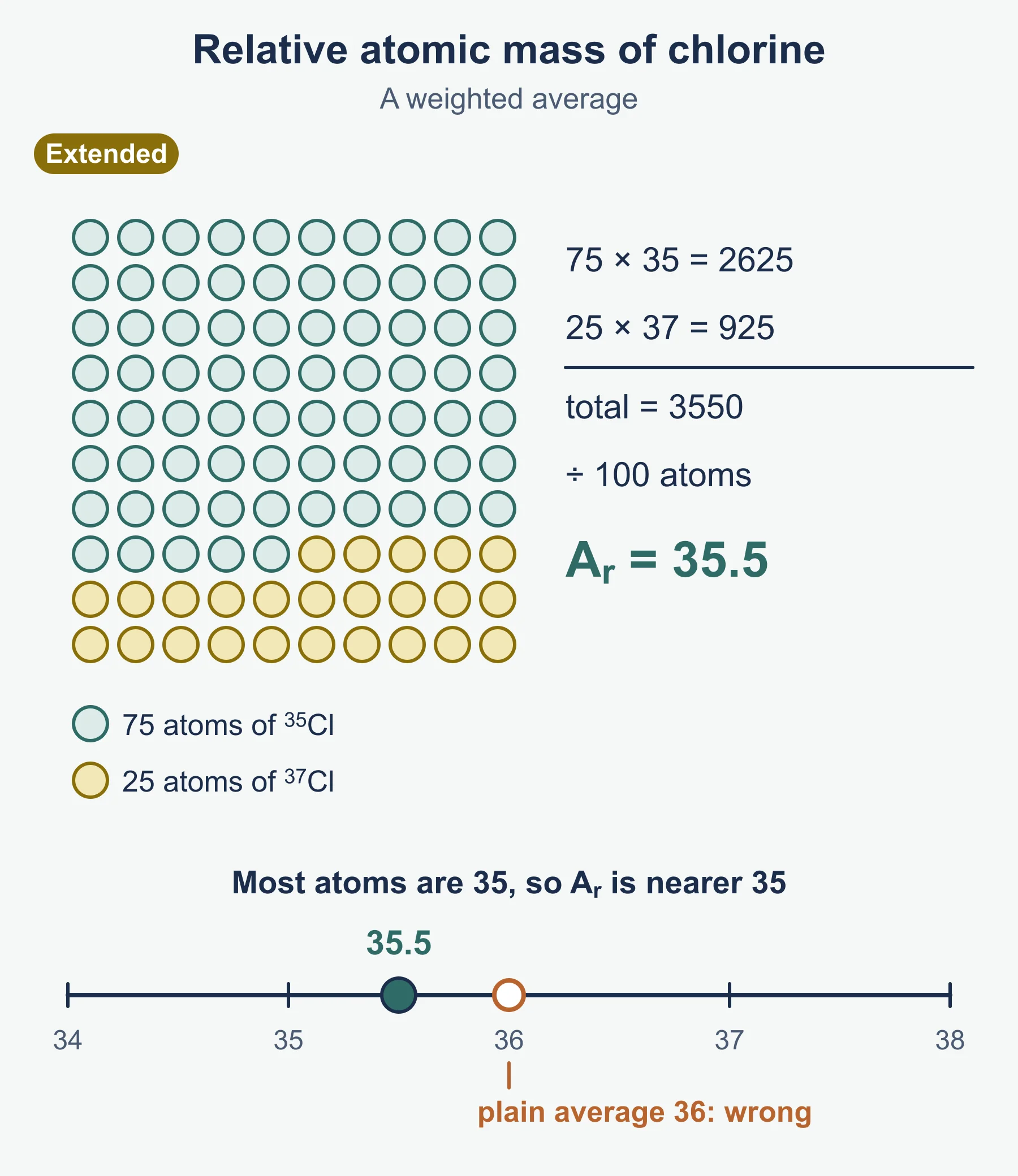
The relative atomic mass, Ar, of an element is a weighted average of the relative masses of its isotopes, using their abundances as weights. The syllabus outcome is to calculate it from the relative masses and abundances.
Ar = (mass1 x abundance1 + mass2 x abundance2 + ...) / total abundanceIf abundances are given as percentages, the abundances add up to 100.
Worked example 4 (two isotopes). Boron is 19.9% ¹⁰B and 80.1% ¹¹B.
Ar = (10 x 19.9 + 11 x 80.1) / 100
   = (199 + 881.1) / 100
   = 1080.1 / 100
   = 10.801
To one decimal place, Ar = 10.8. The answer sits close to 11 because most atoms are the heavier isotope.
Worked example 5 (three isotopes). An element Z has isotopes of mass 28, 29 and 30 with abundances 92.0%, 5.0% and 3.0%.
Check: 92.0 + 5.0 + 3.0 = 100.0
Ar = (28 x 92.0 + 29 x 5.0 + 30 x 3.0) / 100
   = (2576 + 145 + 90) / 100
   = 2811 / 100
   = 28.11
Ar = 28.1 (to one decimal place). Always check the abundances add to 100 before you start. If a question gives one abundance missing, subtract from 100 first.
Quick sense check. Ar must lie between the lightest and heaviest isotope masses, and it moves towards the more abundant one. If your answer is outside that range, you have divided or weighted incorrectly. A simple average of the masses is only right when the abundances are equal.
Common errors
- Mixing up the two numbers. Proton number is the smaller number at the bottom of the symbol. Mass number is the larger number at the top.
- Using the proton number to fill shells for an ion. Fill shells with the number of electrons the ion has.
- Calling air or seawater a compound. If the proportions can vary and the parts are not bonded, it is a mixture.
- Reading a group number from an ion. Group and period rules refer to the neutral atom.
- Forgetting that Group VIII includes helium, 2. A full outer shell for helium means 2 electrons, not 8.
- Writing “different number of protons” in an isotope definition. Isotopes differ in neutrons only.
- Not weighting by abundance. A plain average is wrong unless the isotopes are equally abundant.
- Dividing by the number of isotopes instead of 100. With percentages, divide by 100.
Next steps
Work through the Atomic Structure practice questions, then use the revision notes for recall. Check the printable checklist and the Cambridge O Level Chemistry hub. To see where you stand, try the free 10-minute diagnostics.
Frequently asked questions
Which syllabus sections does this Cambridge O Level 5070 guide cover? It covers sections 2.1, 2.2 and 2.3 of the Cambridge O Level Chemistry 5070 syllabus for examination in 2026, 2027 and 2028: elements, compounds and mixtures, atomic structure, and isotopes.
Is air a compound or a mixture? Air is a mixture. Its proportions can vary and its parts are not chemically bonded together, so it is not a compound; the same applies to seawater.
How many electrons are in the outer shell of helium? Helium is in Group VIII but has only 2 electrons, which is a full outer shell for the first shell. It does not have 8 outer electrons.
How do you fill electron shells for an ion? Use the number of electrons the ion actually has, not the proton number. Group and period rules refer to the neutral atom, not the ion.
Official syllabus
Cambridge O Level Chemistry 5070 syllabus for examination in 2026, 2027 and 2028, published by Cambridge International. Sections 2.1, 2.2 and 2.3.
Get free revision emails (optional)
Occasional emails with practice questions, worked explanations and links to free resources for the qualification and subjects you choose. No spam, and you can unsubscribe from any email. The free tools on this site never need an email.
Related resources
-
Study guides
Ionic, Covalent and Metallic Bonding
Ionic, covalent, giant covalent and metallic bonding for Cambridge IGCSE 0620 and O Level 5070, with structure explaining properties throughout.
Chemistry · Cambridge · IGCSE, O Level
Read guide -
Practice questions
Ionic, Covalent and Metallic Bonding: Practice Questions
Original exam-style practice questions with full worked answers on bonding types, structures and properties.
Chemistry · Cambridge · IGCSE, O Level
Try questions -
Revision notes
Ionic, Covalent and Metallic Bonding: Revision Notes
Condensed Cambridge IGCSE 0620 and O Level 5070 revision notes on ionic, covalent, giant covalent and metallic bonding, with property tables and exam traps.
Chemistry · Cambridge · IGCSE, O Level
Revise topic
Related articles
-
study skills
How to revise for a science examination
Most science revision fails because it rereads notes instead of retrieving them. A practical method for revising physics, chemistry and biology in the weeks before a paper.
14 July 2026
-
teaching
A Level tuition in Dubai: Cambridge or Pearson Edexcel International A Level?
Schools in Dubai and Abu Dhabi teach either Cambridge International AS & A Level or Pearson Edexcel International A Level. How the two are structured, why it matters for tuition, and how online classes from Lahore work.
9 October 2026
Studying this with a teacher
Working through Chemistry O LEVELS?
This page is free and stays free. If you would rather be taught it, Marlbridge runs Chemistry classes one-to-one and in small groups of up to 15, online in your own time zone. The first trial class is free. WhatsApp replies within an hour (8am–11pm Pakistan time, every day); email the same day.
Cambridge Chemistry teachers at Marlbridge

