
Revision Notes
Cambridge O Level Commerce (7100): Communication – Revision Notes
Recall notes for Cambridge O Level Commerce 7100 sub-topic 2.6: four types of communication, eight methods and the six factors for choosing a method.
- Subject
- Commerce
- Level
- O LEVELS
- Topic
- Topic 2 – Commercial Operations
- Author
- Marlbridge Academic Team
- Updated
- Reviewed by
- Salman Ahmad (what this means)
Aligned to Cambridge O Level Commerce (7100), 2026-2028. Official specification .
Syllabus page (what it covers and how it is assessed): Cambridge O Level Commerce.
Syllabus points this page covers
7100
- 2.6 Communication
Found an error? Report a correction.
Need help with this topic? Request a free trial class for O Level Commerce (7100).
Condensed notes for sub-topic 2.6 Communication in Cambridge O Level Commerce (7100). The communication study guide works through a full method-selection example.
Three lists to know
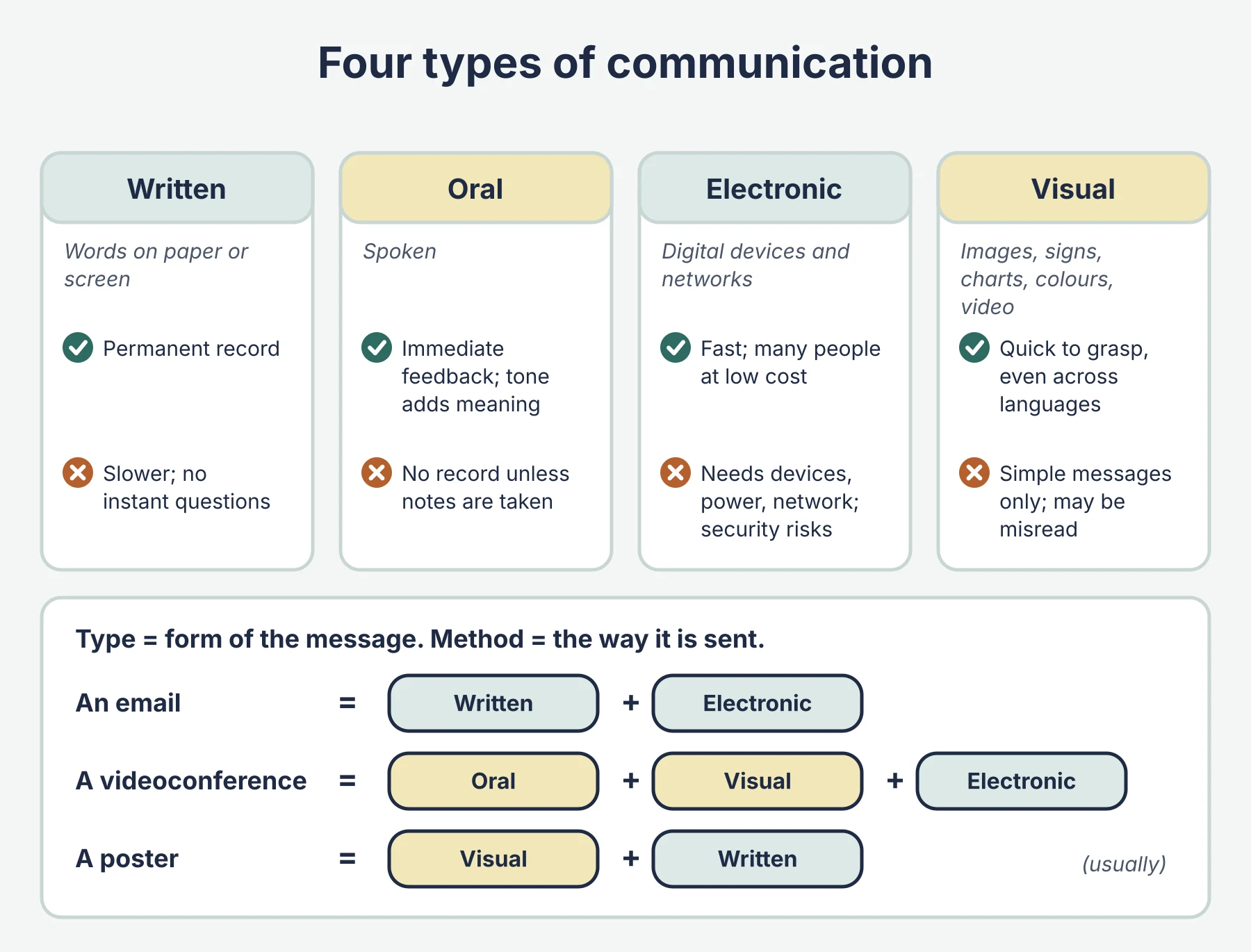
- Types (4): written, oral, electronic, visual.
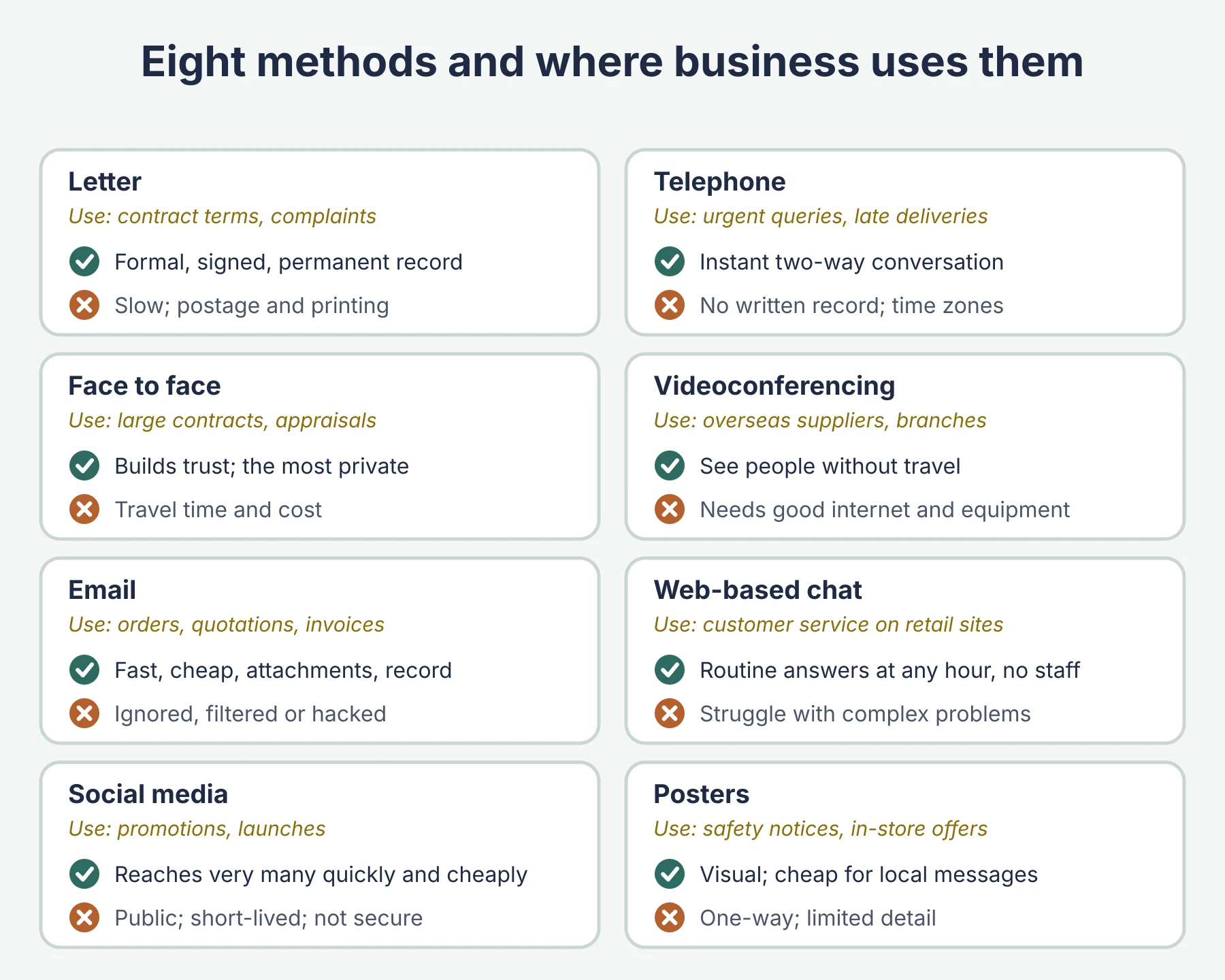
- Methods (8): letter, telephone, face to face, videoconferencing, email, web-based chat (including chatbots), social media, posters.
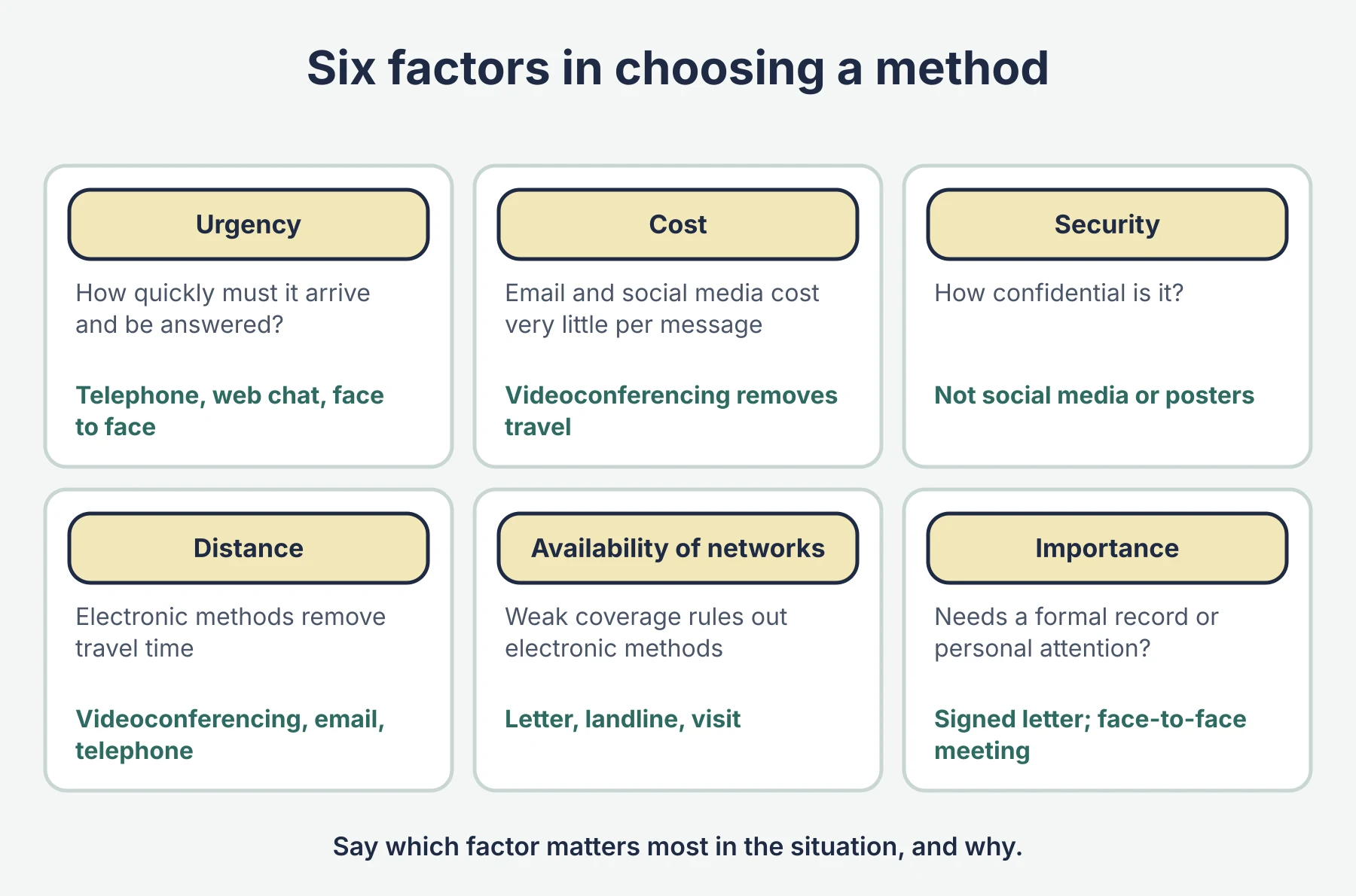
- Factors (6): urgency, cost, security, distance, availability of networks, importance of the message.
Key terms
| Term | Meaning |
|---|---|
| Written communication | Message set down in words, on paper or screen |
| Oral communication | Spoken message |
| Electronic communication | Message sent through digital devices and networks |
| Visual communication | Message conveyed through images, signs, charts, colour or video |
| Videoconferencing | Live meeting with sound and pictures over the internet |
| Web-based chat | Typed conversation in a window on a website |
| Chatbot | Computer program that answers typed questions automatically |
| Feedback | The receiver’s response, showing the message was understood |
| Permanent record | A copy of the message that can be checked later |
Methods mapped to types
| Method | Type(s) |
|---|---|
| Letter | Written |
| Telephone | Oral (and electronic for mobile and internet calls) |
| Face to face | Oral (with body language) |
| Videoconferencing | Oral, visual, electronic |
| Written, electronic | |
| Web-based chat and chatbots | Written, electronic |
| Social media | Electronic, often written and visual |
| Posters | Visual, usually written |
Best and worst of each method
- Letter: formal record / slow and costly.
- Telephone: instant reply / no record.
- Face to face: trust, privacy, body language / travel time and cost.
- Videoconferencing: meet without travel / needs strong internet.
- Email: fast, cheap, attachments / hacking, may be ignored.
- Web chat and chatbots: instant, 24-hour answers / weak on complex problems.
- Social media: huge, cheap reach / public and not secure.
- Posters: seen by passers-by / one-way, little detail.
Factor → method quick links
| Factor | Usually favours | Usually rules out |
|---|---|---|
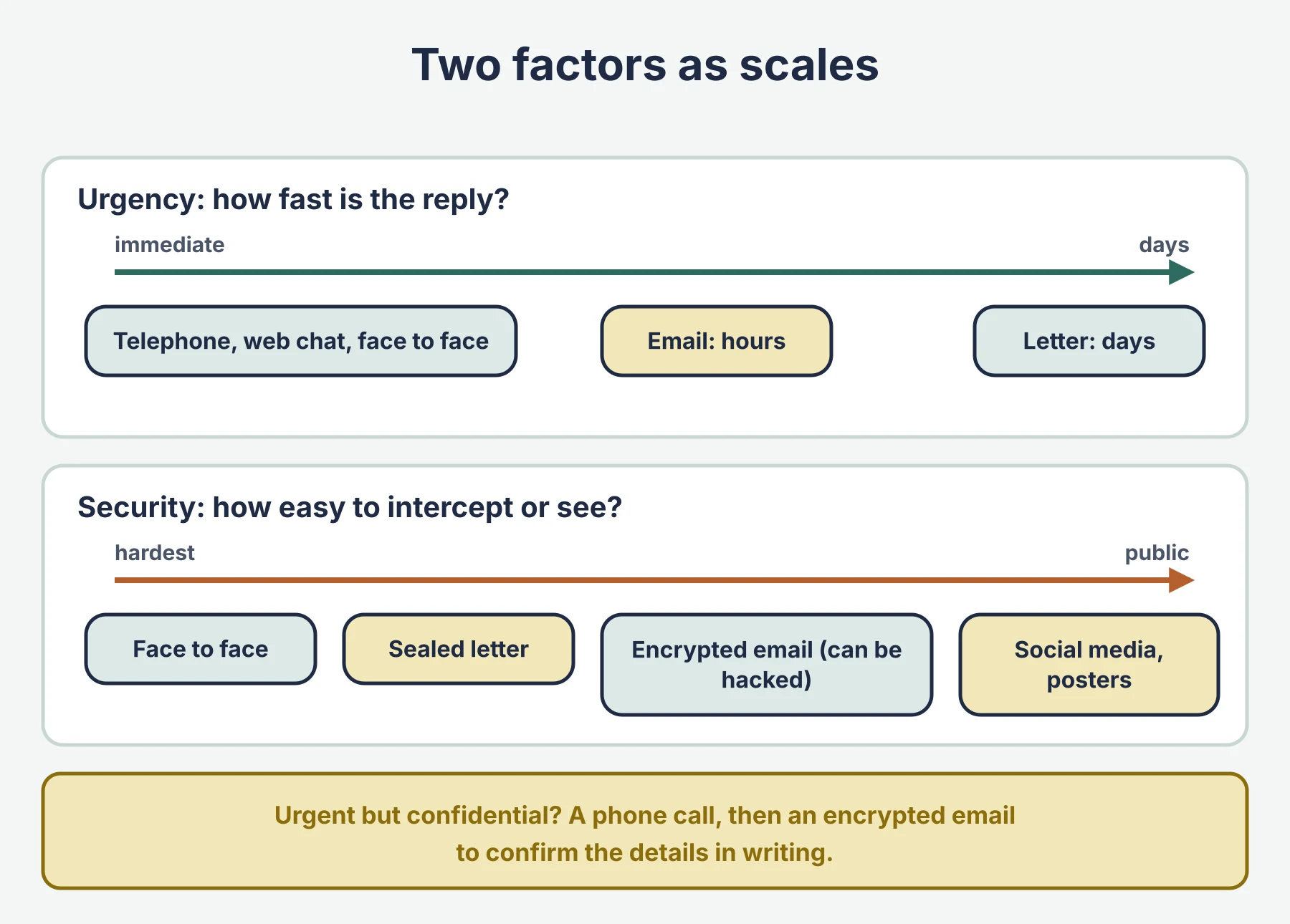
| Urgency | Telephone, web chat, face to face | Letter |
| Cost | Email, social media | Travel for face-to-face meetings |
| Security | Face to face, sealed letter, encrypted email | Social media, posters |
| Distance | Email, telephone, videoconferencing | Face to face |
| Availability of networks (weak) | Letter, landline, face to face | Videoconferencing, social media |
| Importance of the message | Signed letter, face to face | Social media, posters |
Building an appropriateness answer
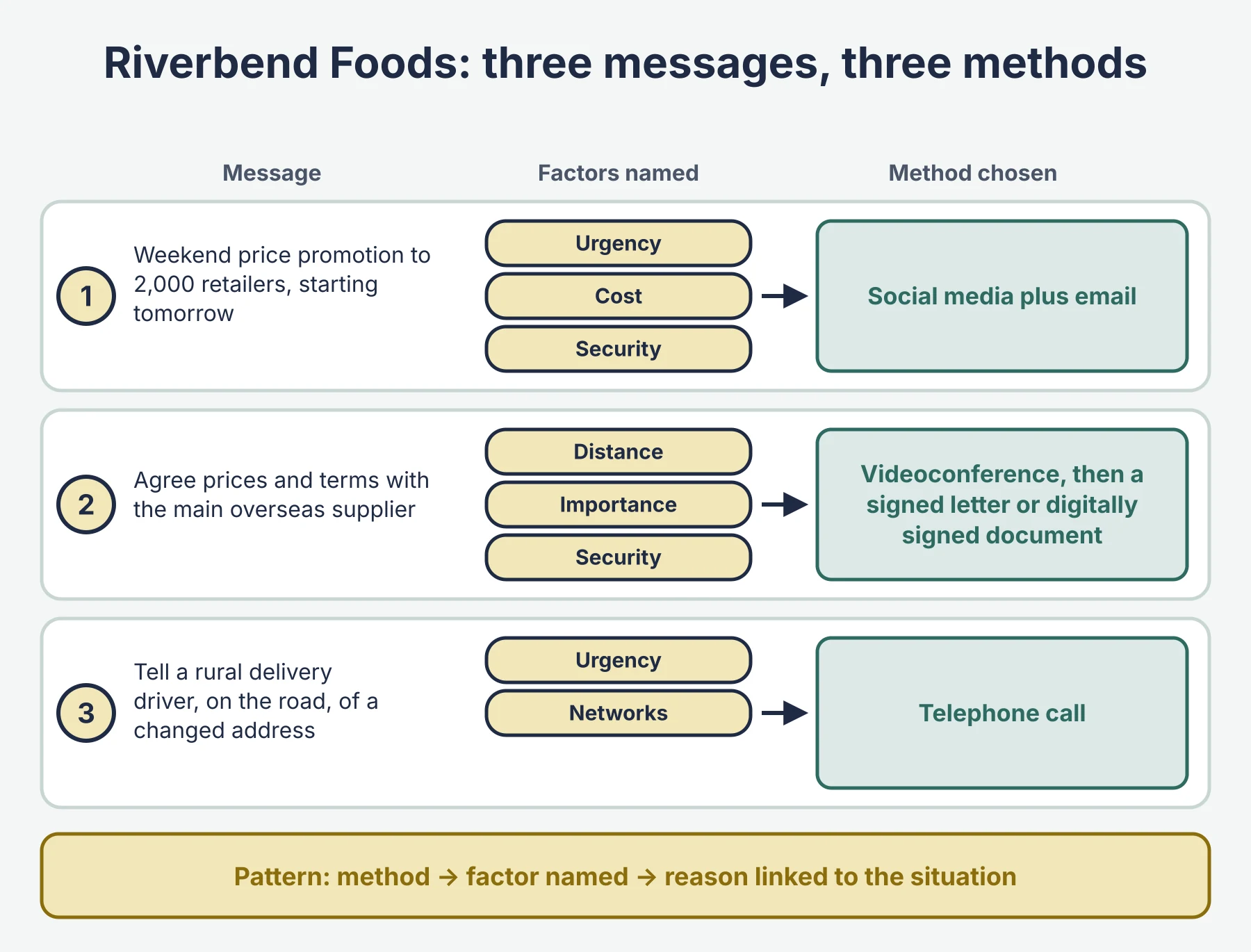
Method → factor → reason from the situation → acceptable drawback. Example (invented): “A videoconference suits the meeting with the overseas supplier because distance makes travel expensive, and both sides can see the samples on screen; the risk of a weak connection is acceptable because both offices have fast internet.”
Exam traps
- Type versus method: “electronic” is a type; “email” is a method.
- One method, several types: videoconferencing is oral, visual and electronic.
- Chatbots are not human: they suit routine questions only.
- Public channels are not secure: never recommend social media for confidential terms.
- Read the case for network clues: remote areas or power cuts change the best choice.
- Factors conflict: say which matters most in the case.
Self-test
- Name the four types of communication in the syllabus.
- What is the difference between a type and a method of communication?
- Give two types of communication that apply to email.
- Give one advantage and one disadvantage of a letter.
- Why is face-to-face communication considered secure?
- What is a chatbot, and what is its main limitation?
- Give one advantage of videoconferencing over face-to-face meetings.
- Why might social media be unsuitable for dealing with a customer’s complaint about a delivery?
- Which method best suits informing customers in a shop about a special offer on one aisle?
- Which factor would most affect the choice of method in a village with no internet coverage?
- A manager must tell a supplier immediately that an order must be cancelled. Which method is most appropriate, and why?
- Name the six factors that affect the choice of communication method.
Self-test answers
- Written, oral, electronic and visual.
- A type is the form of the message (such as written); a method is how it is sent (such as email).
- Written and electronic.
- Advantage: formal permanent record (or works without internet). Disadvantage: slow (or printing and postage costs).
- There is no copy travelling over a network or through the post that could be intercepted.
- A computer program that answers typed questions automatically; it cannot deal well with complex or unusual problems.
- No travel time or cost (or people in several countries can meet at once).
- The complaint becomes public, which may damage the business’s reputation, and personal details should not be shared openly.
- A poster (or point-of-sale sign), because it is visual and seen by everyone passing.
- Availability of networks.
- A telephone call, because it is urgent and gives an immediate reply; it could be confirmed by email for a written record.
- Urgency, cost, security, distance, availability of networks and importance of the message.
Frequently asked questions
Do I need other methods such as text messages? The syllabus names eight methods, so build answers around those; any other method should only be used where a question invites it.
Can I recommend two methods together? Yes, if the question allows it and you explain why the combination suits the situation, such as a call followed by a confirming email.
Apply these notes in the communication practice questions.
Official syllabus
Cambridge O Level Commerce (7100) syllabus for 2026, 2027 and 2028, sub-topic 2.6: official syllabus PDF.
Related resources
-
Revision notes
Cambridge O Level Commerce: Commercial Operations — Revision Notes (7100)
Recall notes for Cambridge O Level Commerce 7100 Topic 2: enterprise types, multinationals, franchises, outsourcing, retail, wholesale and communication.
Commerce · Cambridge · O Level
Revise topic -
Study guides
Cambridge O Level Commerce (7100): Outsourcing
Cambridge O Level Commerce 7100 sub-topic 2.2 in depth: the growth of outsourcing through contract manufacturing and contract logistics, with a costed example.
Commerce · Cambridge · O Level
Read guide -
Practice questions
Cambridge O Level Commerce (7100): Outsourcing – Practice Questions
Thirteen original questions with full answers on Cambridge O Level Commerce 7100 sub-topic 2.2: contract manufacturing, contract logistics, outsourcing.
Commerce · Cambridge · O Level
Try questions
Get free revision emails (optional)
Occasional emails with practice questions, worked explanations and links to free resources for the qualification and subjects you choose. No spam, and you can unsubscribe from any email. The free tools on this site never need an email.