
Study Guides
Cambridge O Level Commerce (7100): Outsourcing
Cambridge O Level Commerce 7100 sub-topic 2.2 in depth: the growth of outsourcing through contract manufacturing and contract logistics, with a costed example.
- Subject
- Commerce
- Level
- O LEVELS
- Topic
- Topic 2 – Commercial Operations
- Author
- Marlbridge Academic Team
- Updated
- Reviewed by
- Salman Ahmad (what this means)
Aligned to Cambridge O Level Commerce (7100), 2026-2028. Official specification .
Syllabus page (what it covers and how it is assessed): Cambridge O Level Commerce.
Syllabus points this page covers
7100
- 2.2 Outsourcing
Found an error? Report a correction.
Need help with this topic? Request a free trial class for O Level Commerce (7100).
Sub-topic 2.2 of Cambridge O Level Commerce (7100) has a single content statement: “the growth of outsourcing: contract manufacturing and logistics” (2.2.1). It is short on the page but connects to two other parts of the course: the meaning and benefits of outsourced production in 1.2.2, and the logistics elements in 1.1.2 and Topic 4. Questions on it usually describe a business deciding whether to hand work to another firm, so you need to explain both forms of outsourcing clearly and judge them in context.
The outsourcing, wholesaling and communication overview gives a summary. This guide adds the detail and a costed example.
What outsourcing means
Outsourcing is when a business pays another business to carry out an activity it could do itself. The business that outsources is often called the client; the firm doing the work is the contractor or provider. In 1.2.2 you met the comparison with in-house production, where the business uses its own staff and equipment. Sub-topic 2.2 asks why outsourcing has grown, using the two areas the syllabus names.
Contract manufacturing
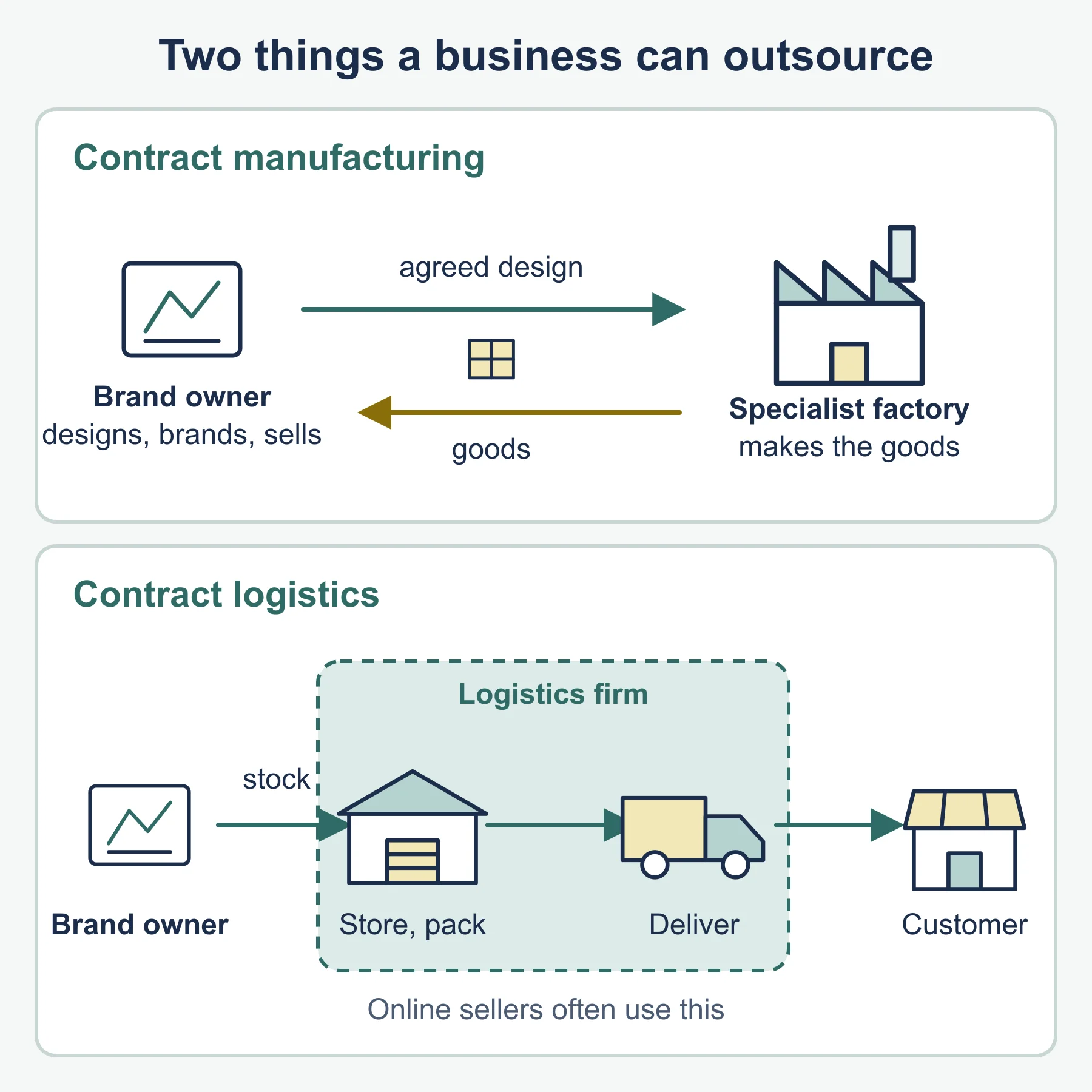
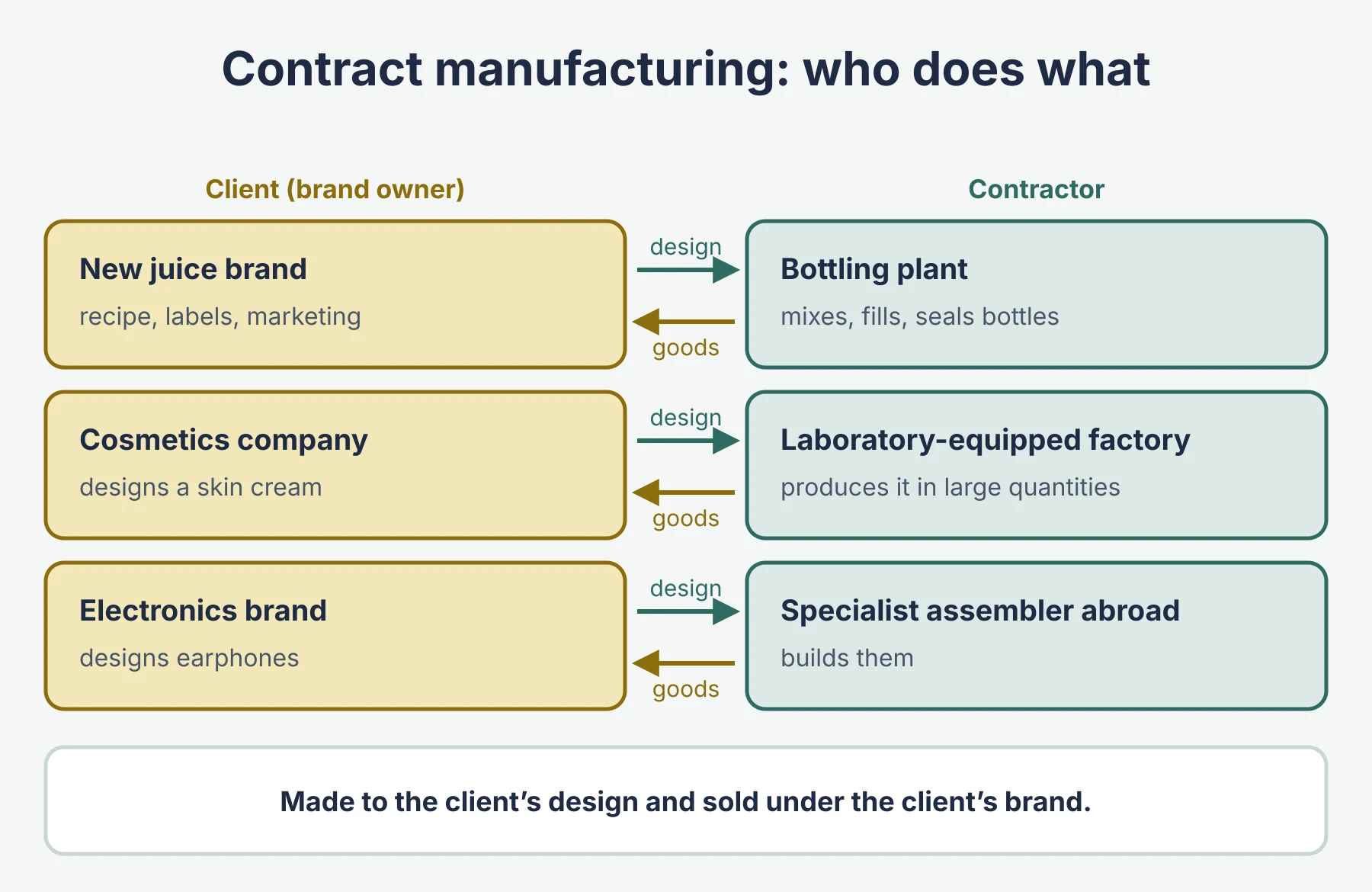
Contract manufacturing means a business pays another firm to make its products, or parts of them, to the client’s own design and specification. The product is usually sold under the client’s brand, so customers may never know who made it.
Typical arrangements:
- A new juice brand creates the recipe, labels and marketing, while a bottling plant mixes, fills and seals the bottles.
- A cosmetics company designs a skin cream and pays a laboratory-equipped factory to produce it in large quantities.
- An electronics brand designs a set of earphones and pays a specialist assembler in another country to build them.
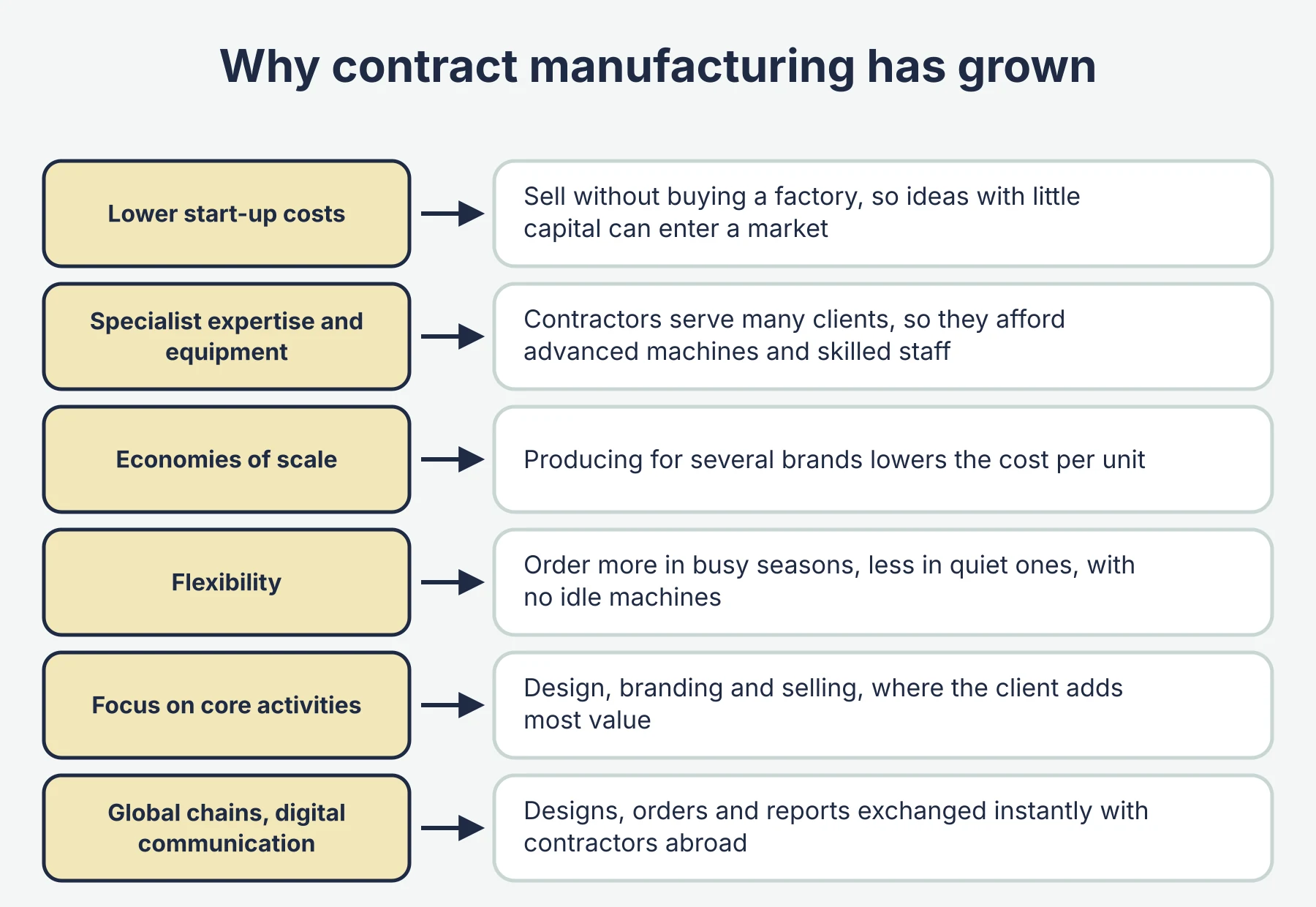
Why contract manufacturing has grown:
- Lower start-up costs. A new brand can sell products without buying a factory, so entrepreneurs with good ideas but little capital can enter a market.
- Specialist expertise and equipment. Contract manufacturers serve many clients, so they can afford advanced machinery and skilled staff that one small client could not.
- Economies of scale. Producing for several brands at once lowers the cost per unit.
- Flexibility. The client can order more in busy seasons and less in quiet ones, without paying for idle machines.
- Focus on core activities. The client concentrates on design, branding and selling, where it adds most value.
- Global supply chains and digital communication. Designs, orders and quality reports can be exchanged instantly, so a contractor in another country is easy to manage.
Contract logistics
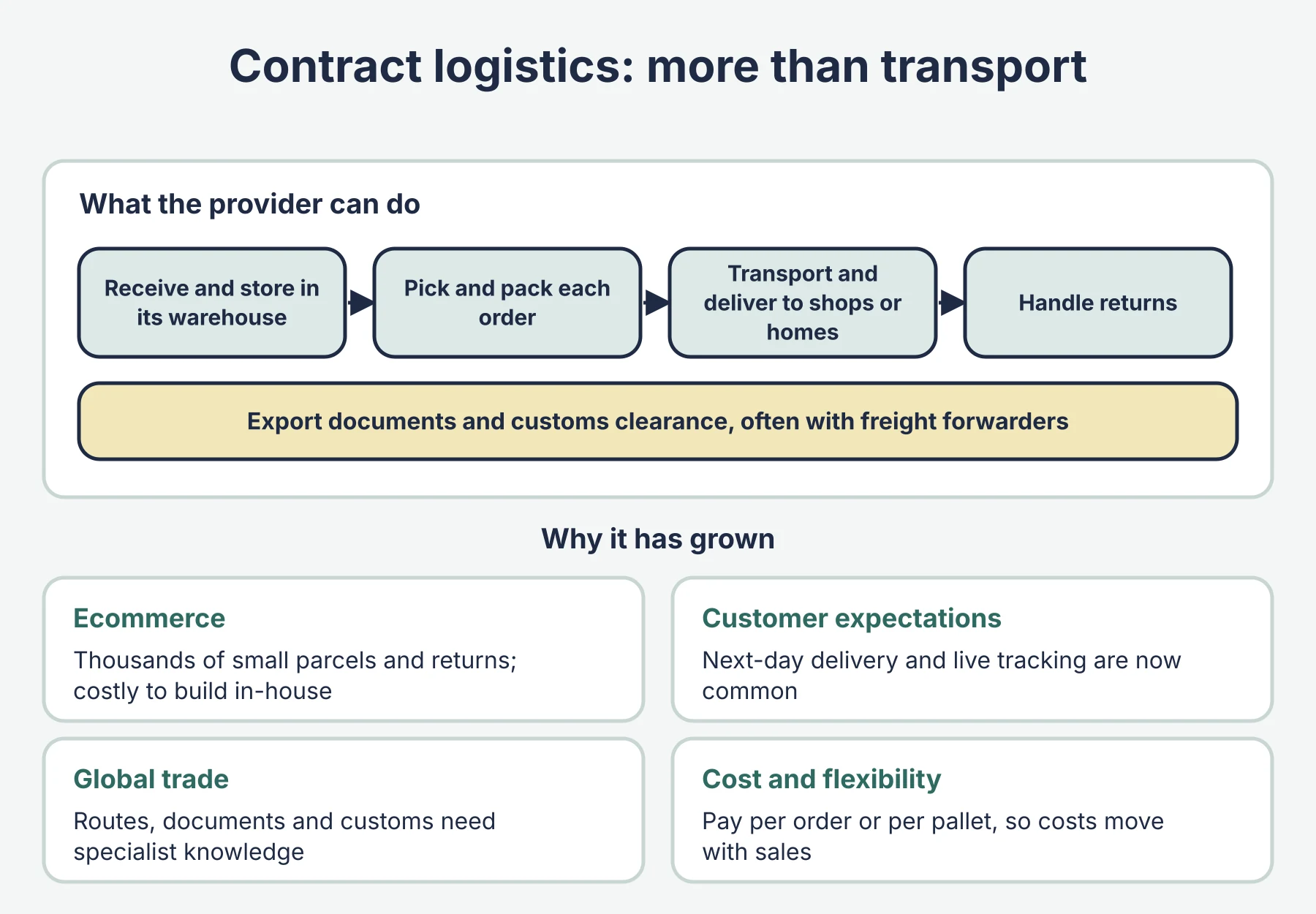
Contract logistics means a business pays a specialist logistics firm to manage the storage and movement of its goods. Services can include:
- receiving goods from suppliers and storing them in the provider’s warehouse;
- picking and packing individual customer orders;
- transport and delivery to shops or to customers’ homes;
- handling returned goods;
- arranging export documents and customs clearance, often working with freight forwarders.
Why contract logistics has grown:
- Ecommerce. Online sellers must deliver thousands of small parcels quickly and accept returns. Building that capability in-house is expensive, so many sellers use providers that already have warehouses, vehicles and tracking systems.
- Customer expectations. Next-day delivery and live tracking are now common, and specialists can meet these standards more cheaply.
- Global trade. Moving goods across borders needs knowledge of routes, documents and customs that a logistics specialist already has.
- Cost and flexibility. The client pays per order or per pallet stored, so costs rise and fall with sales.
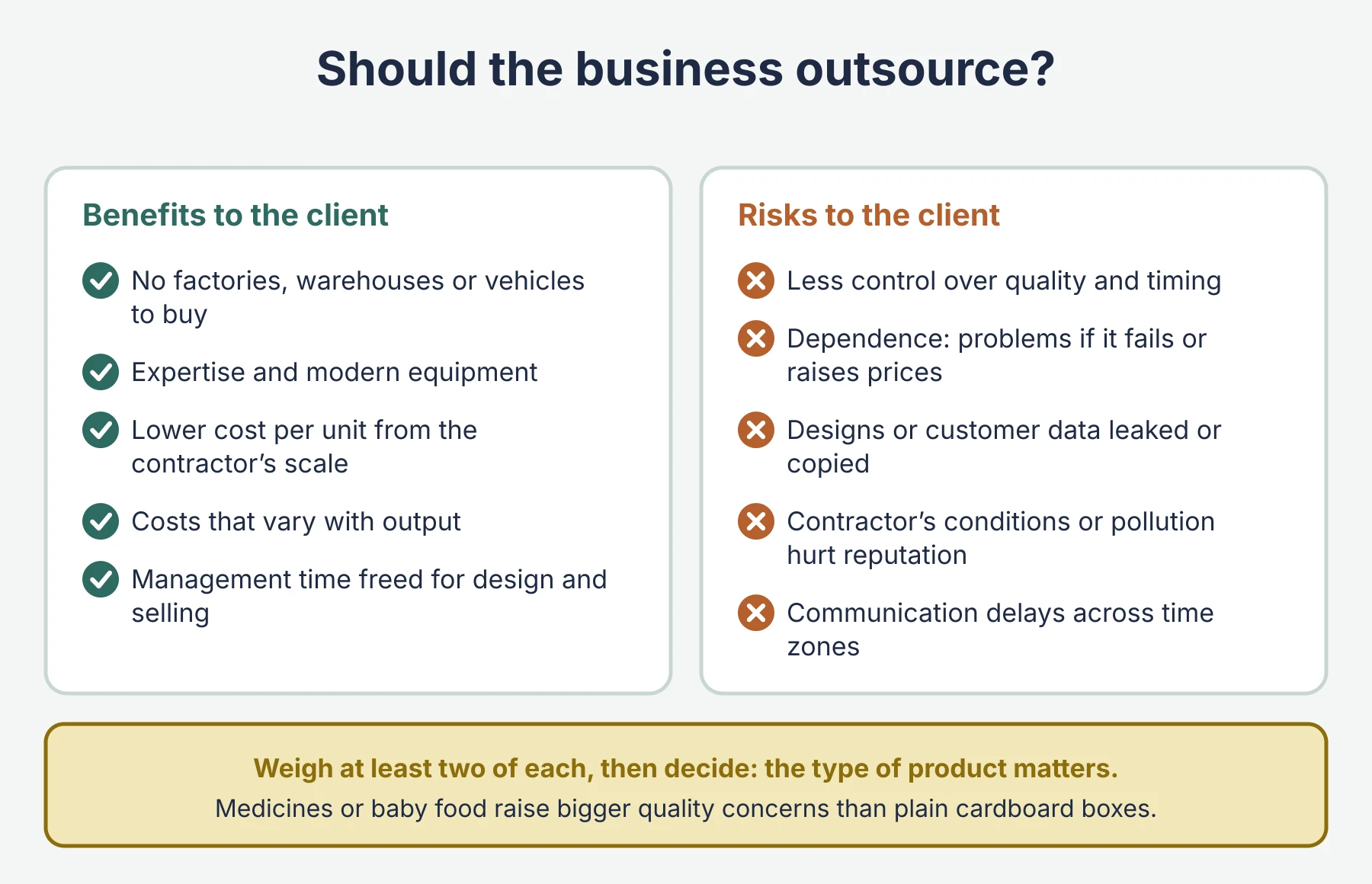
Benefits and risks to judge
| Benefits to the client | Risks to the client |
|---|---|
| No need to buy factories, warehouses or vehicles | Less control over quality and timing |
| Access to expertise and modern equipment | Dependence on the contractor; problems if it fails or raises prices |
| Lower cost per unit through the contractor’s scale | Designs or customer data may be leaked or copied |
| Costs that vary with output | Contractor’s poor working conditions or pollution can damage the client’s reputation |
| Management time freed for design and selling | Communication delays, especially across time zones |
These connect directly to 1.2.2, where the syllabus names control on quality and information as benefits of in-house production and accessing expertise and cost savings as benefits of outsourcing.
Worked example: should an online seller outsource logistics?
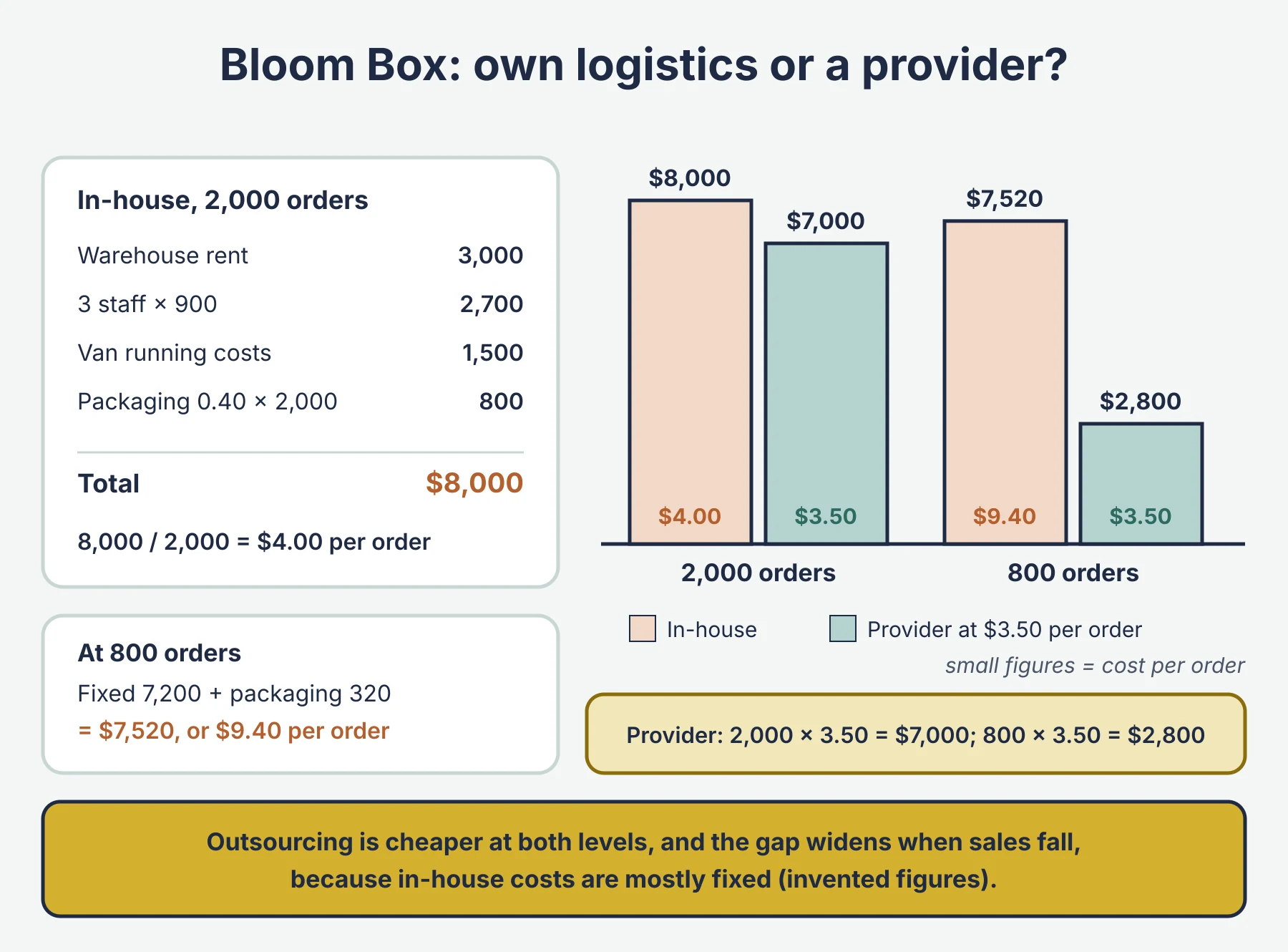
All figures are invented for practice. Bloom Box sells gift boxes online and ships an average of 2,000 orders a month. It compares doing its own logistics with using a contract logistics provider charging $3.50 per order, including storage, packing and delivery.
| In-house monthly cost | Amount |
|---|---|
| Warehouse rent | $3,000 |
| Three packing staff at $900 each | $2,700 |
| Delivery van running costs | $1,500 |
| Packaging at $0.40 x 2,000 orders | $800 |
| Total | $8,000 |
- In-house cost per order = $8,000 / 2,000 = $4.00.
- Contract logistics cost = 2,000 x $3.50 = $7,000, saving $1,000 a month.
Now suppose sales fall to 800 orders in a quiet month. Rent, staff and van costs stay at $7,200, and packaging falls to 800 x $0.40 = $320, so in-house costs are $7,520, or $7,520 / 800 = $9.40 per order. The provider would charge 800 x $3.50 = $2,800.
Interpretation. Outsourcing is cheaper at both levels, and the gap widens when sales are low, because in-house costs are mostly fixed. Before deciding, Bloom Box should also weigh control: its gift boxes are judged on presentation, so it would need the provider to agree packing standards and allow inspections.
How to answer outsourcing questions
- Explain why outsourcing has grown: name the area (contract manufacturing or contract logistics), give the reason for growth, and link it to a business.
- Discuss or assess whether a business should outsource: weigh at least two benefits against two risks, then decide, saying what the decision depends on (for example, how important quality control is for that product).
- Calculate: when figures are given, compare total cost or cost per unit and comment on what the result means.
Common mistakes
- Defining outsourcing as “moving production abroad”. Outsourcing can be to a firm in the same town; moving to another country is not required.
- Confusing contract manufacturing with a franchise. A franchisee runs its own outlet under the franchisor’s brand; a contract manufacturer only makes goods for the client.
- Treating contract logistics as “just transport”. It also covers storage, packing, returns and documentation.
- Listing benefits only, when the question asks whether the business should outsource.
- Ignoring the type of product. Outsourcing medicines or baby food raises bigger quality concerns than outsourcing plain cardboard boxes.
Frequently asked questions
Is outsourcing the same as buying components from a supplier? Not quite. Buying standard parts off the shelf is ordinary purchasing; contract manufacturing means the contractor makes goods to the client’s own design and specification.
Does contract logistics replace freight forwarders? No. A logistics provider may manage storage and delivery itself and still use a freight forwarder to arrange international shipments and customs documents.
Practise this sub-topic
Revise with the outsourcing revision notes, then try the outsourcing practice questions. In-house and outsourced production is introduced in the production study guide.
Official syllabus
Cambridge O Level Commerce (7100) syllabus for 2026, 2027 and 2028, sub-topic 2.2 Outsourcing: official syllabus PDF.
Related resources
-
Revision notes
Cambridge O Level Commerce: Commercial Operations — Revision Notes (7100)
Recall notes for Cambridge O Level Commerce 7100 Topic 2: enterprise types, multinationals, franchises, outsourcing, retail, wholesale and communication.
Commerce · Cambridge · O Level
Revise topic -
Practice questions
Cambridge O Level Commerce (7100): Outsourcing – Practice Questions
Thirteen original questions with full answers on Cambridge O Level Commerce 7100 sub-topic 2.2: contract manufacturing, contract logistics, outsourcing.
Commerce · Cambridge · O Level
Try questions -
Revision notes
Cambridge O Level Commerce (7100): Outsourcing – Revision Notes
Recall notes for Cambridge O Level Commerce 7100 sub-topic 2.2: contract manufacturing, contract logistics, why outsourcing grew, benefits and risks.
Commerce · Cambridge · O Level
Revise topic
Get free revision emails (optional)
Occasional emails with practice questions, worked explanations and links to free resources for the qualification and subjects you choose. No spam, and you can unsubscribe from any email. The free tools on this site never need an email.