
Revision Notes
Cambridge O Level Commerce (7100): Outsourcing – Revision Notes
Recall notes for Cambridge O Level Commerce 7100 sub-topic 2.2: contract manufacturing, contract logistics, why outsourcing grew, benefits and risks.
- Subject
- Commerce
- Level
- O LEVELS
- Topic
- Topic 2 – Commercial Operations
- Author
- Marlbridge Academic Team
- Updated
- Reviewed by
- Salman Ahmad (what this means)
Aligned to Cambridge O Level Commerce (7100), 2026-2028. Official specification .
Syllabus page (what it covers and how it is assessed): Cambridge O Level Commerce.
Syllabus points this page covers
7100
- 2.2 Outsourcing
Found an error? Report a correction.
Need help with this topic? Request a free trial class for O Level Commerce (7100).
Condensed notes for sub-topic 2.2 Outsourcing in Cambridge O Level Commerce (7100). The syllabus statement is: “the growth of outsourcing: contract manufacturing and logistics”. For explanations and a costed example, see the outsourcing study guide.
Key terms
| Term | Meaning |
|---|---|
| Outsourcing | Paying another business to carry out an activity the business could do itself |
| In-house | Carrying out the activity with the business’s own staff, premises and equipment |
| Client | The business that outsources the work |
| Contractor (provider) | The business paid to do the work |
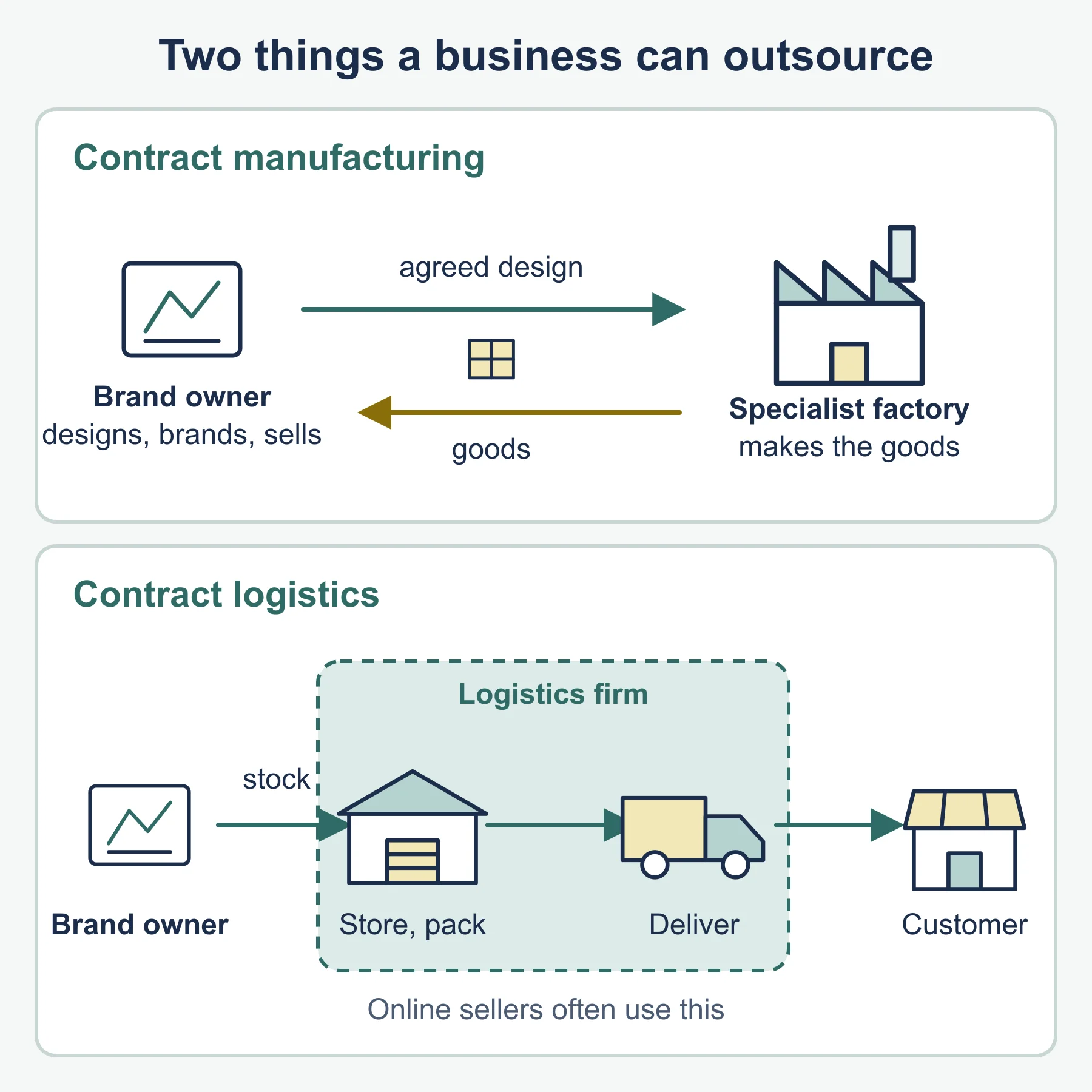
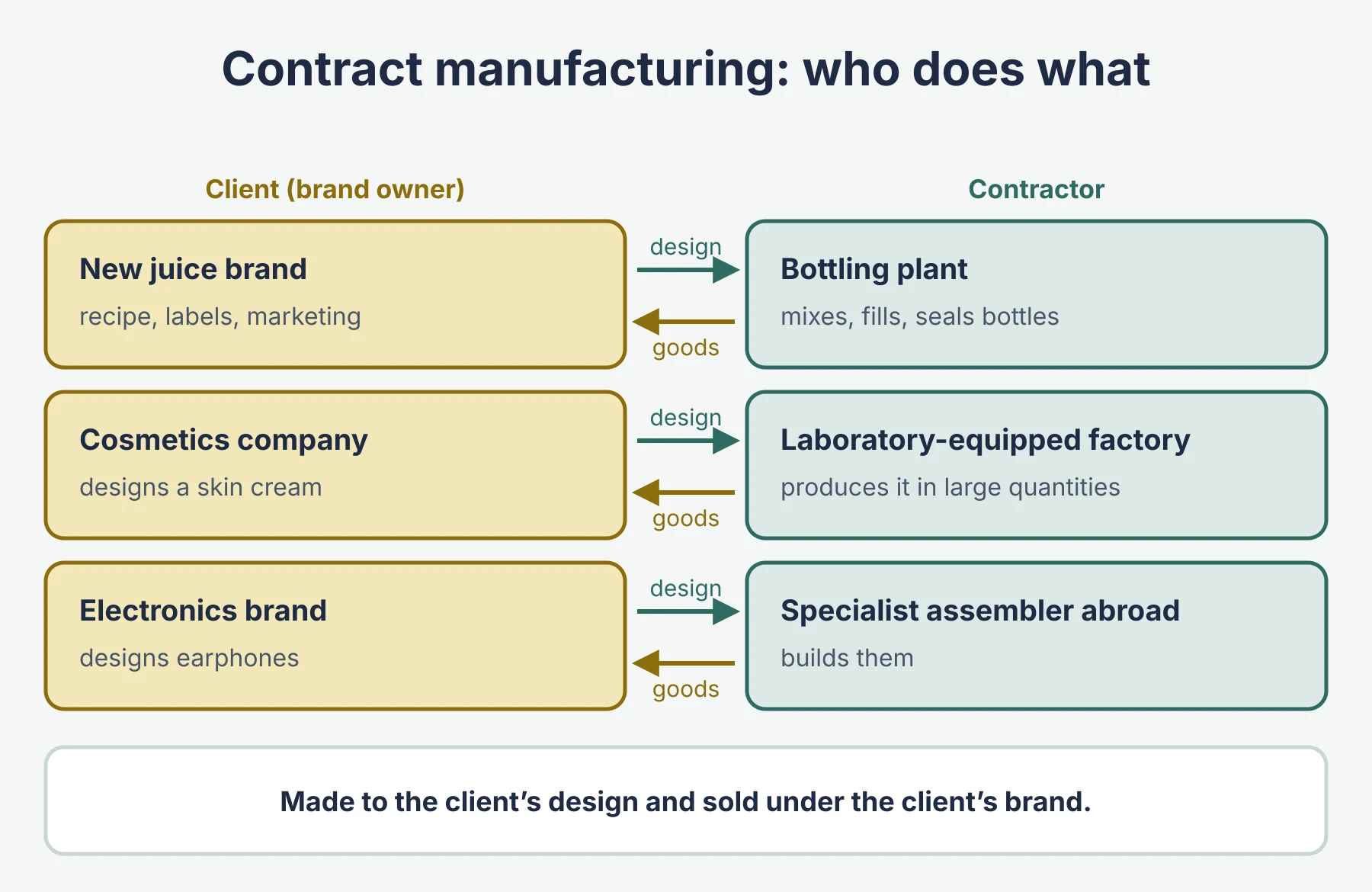
| Contract manufacturing | Paying another firm to make products, or parts, to the client’s design and specification, usually sold under the client’s brand |
| Contract logistics | Paying a specialist to manage storage and movement of goods: warehousing, picking and packing, delivery, returns and documents |
| Fixed cost | A cost that does not change with output, such as warehouse rent |
| Variable cost | A cost that rises and falls with output, such as a fee per order |
The two growth areas
Contract manufacturing
- What it is: the contractor makes; the client designs, brands and sells.
- Examples: a bottling plant filling a new juice brand’s drinks; an assembler building earphones designed by an electronics brand.
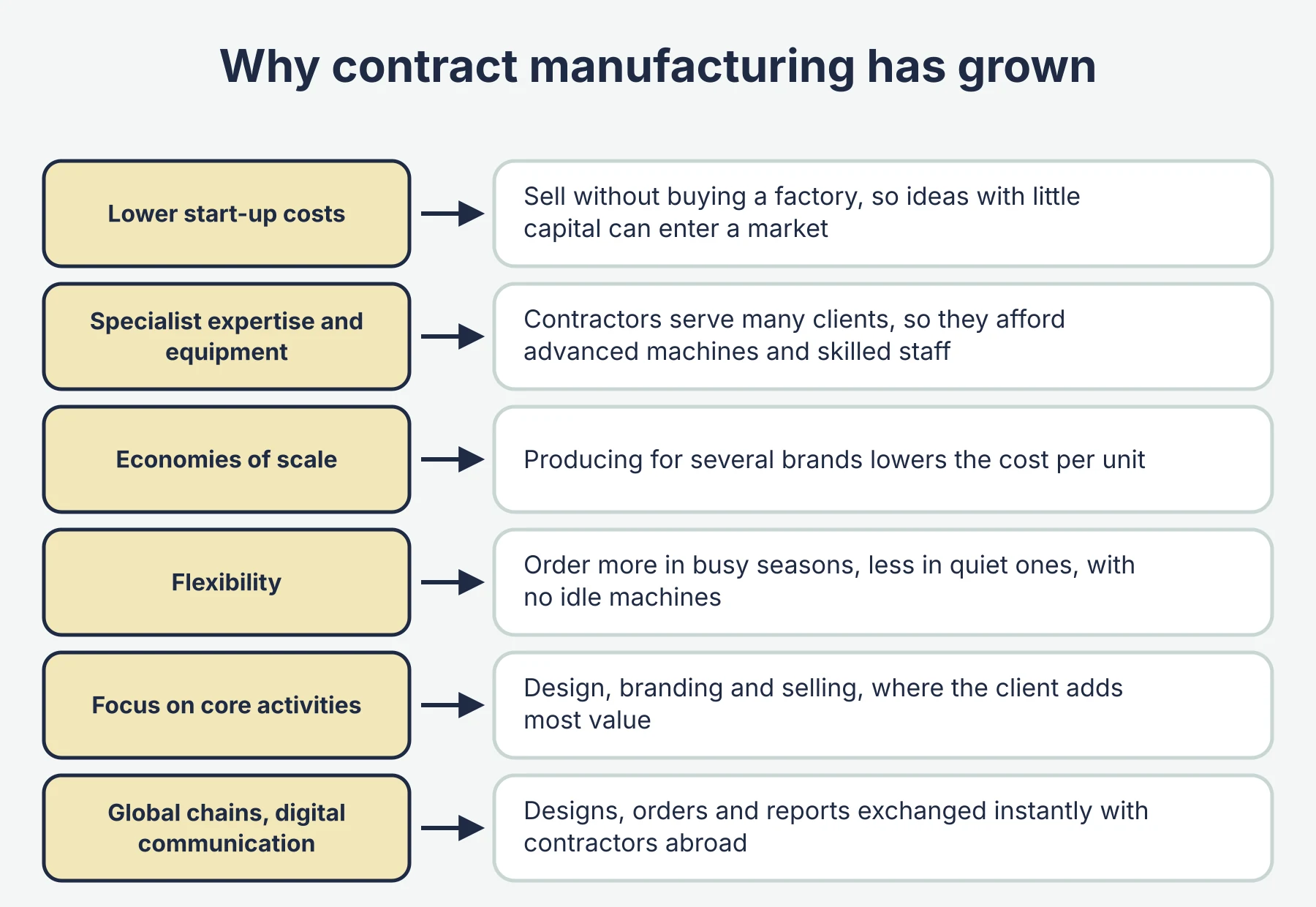
- Why it has grown: low start-up costs for new brands; specialist machinery and skills; economies of scale; flexibility of output; focus on core activities; easier management through digital communication and global supply chains.
Contract logistics
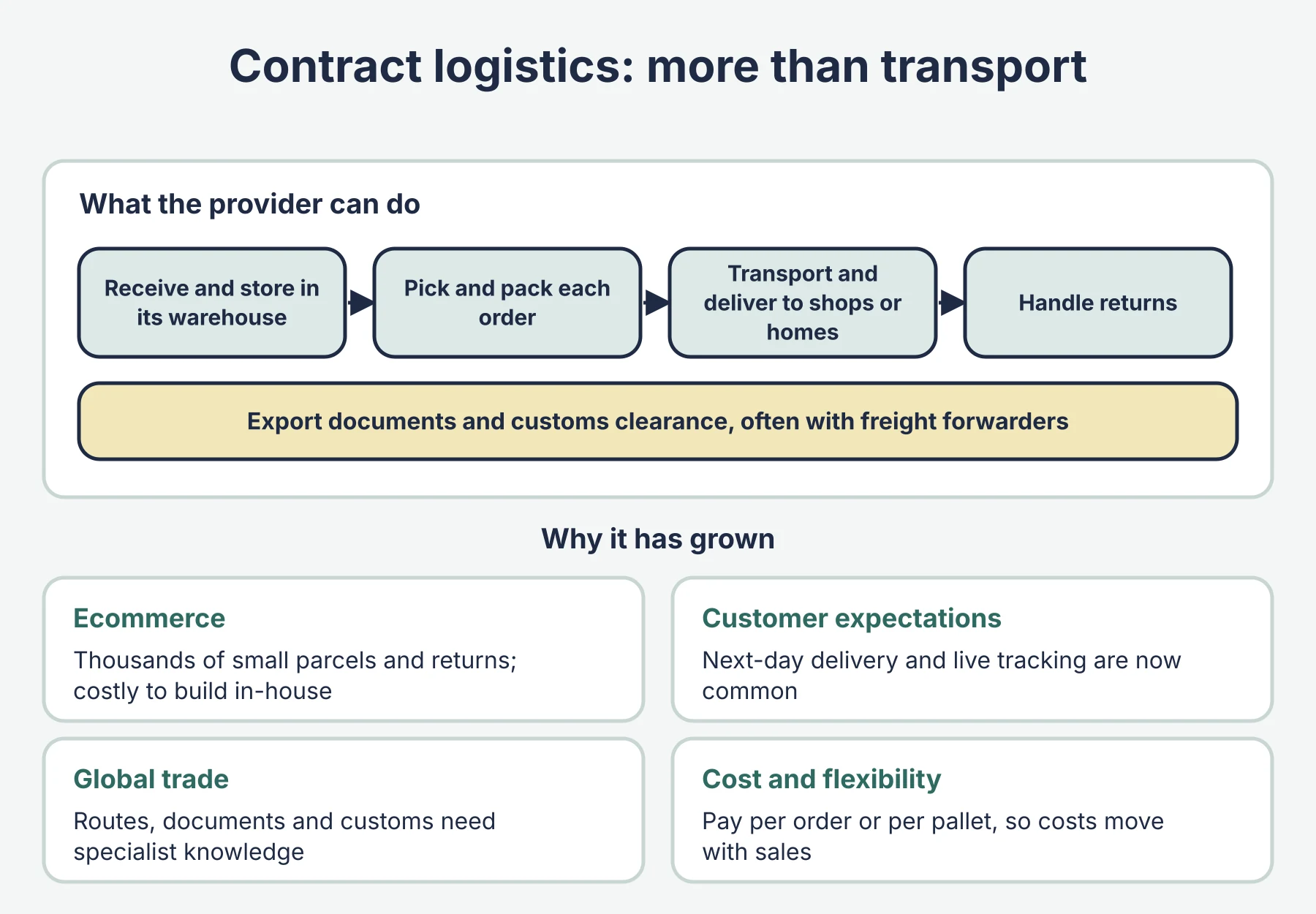
- What it is: a provider stores, packs, moves and delivers the client’s goods, and may handle returns and export paperwork.
- Why it has grown: the rise of ecommerce and parcel deliveries; customer expectations of fast delivery and tracking; complex cross-border trade; costs that rise and fall with sales.
Benefits versus risks
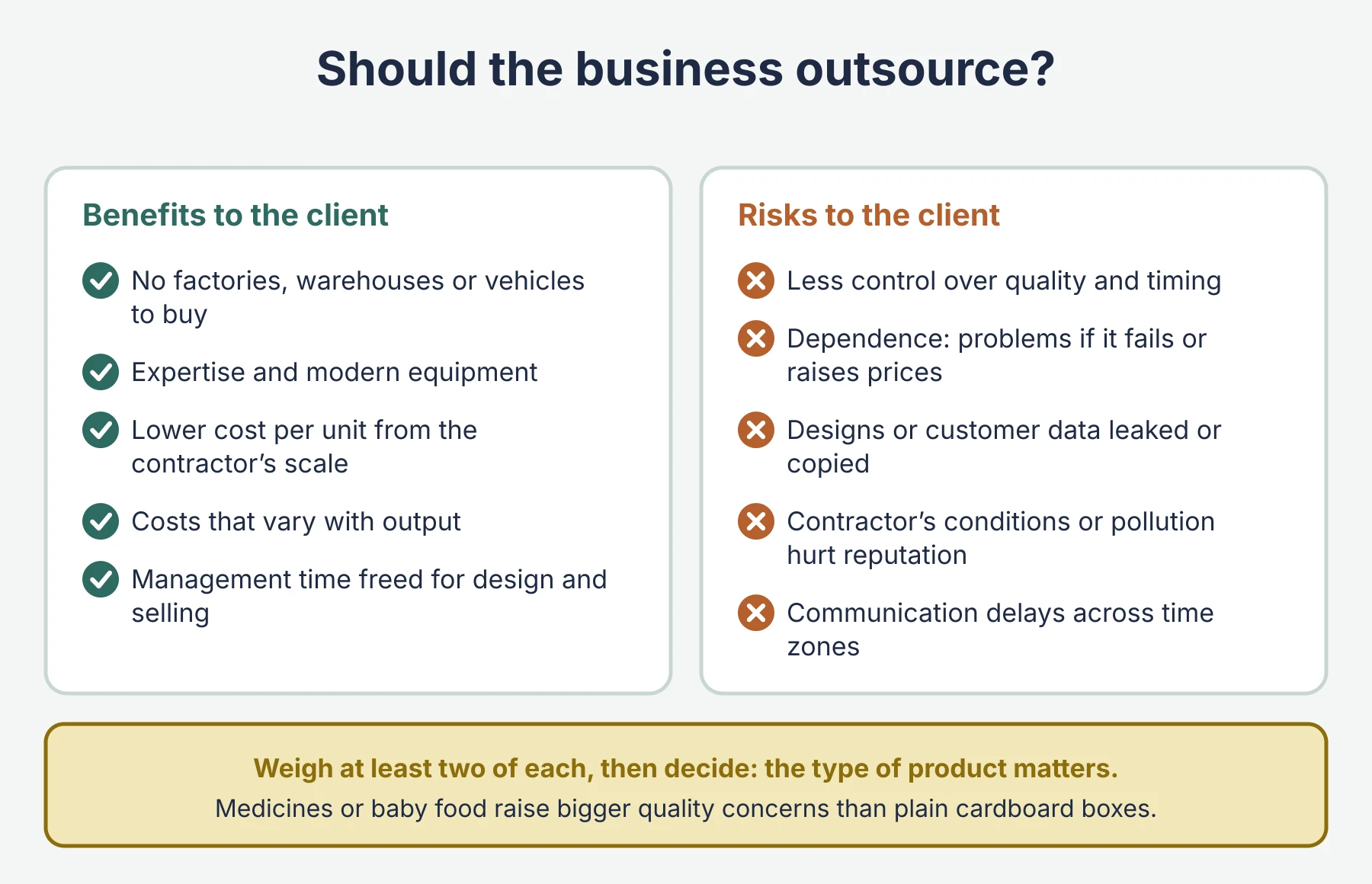
| Benefits | Risks |
|---|---|
| No factory, warehouse or vehicles to buy | Less control over quality and timing |
| Specialist expertise and equipment | Dependence on one contractor |
| Lower cost per unit | Leak or copying of designs and data |
| Costs vary with output | Reputation damage from contractor’s conduct |
| Managers focus on design and selling | Slower communication across distance and time zones |
Link to 1.2.2: in-house wins on control on quality and information; outsourcing wins on accessing expertise and cost savings.
Calculation pattern
When a question gives figures:
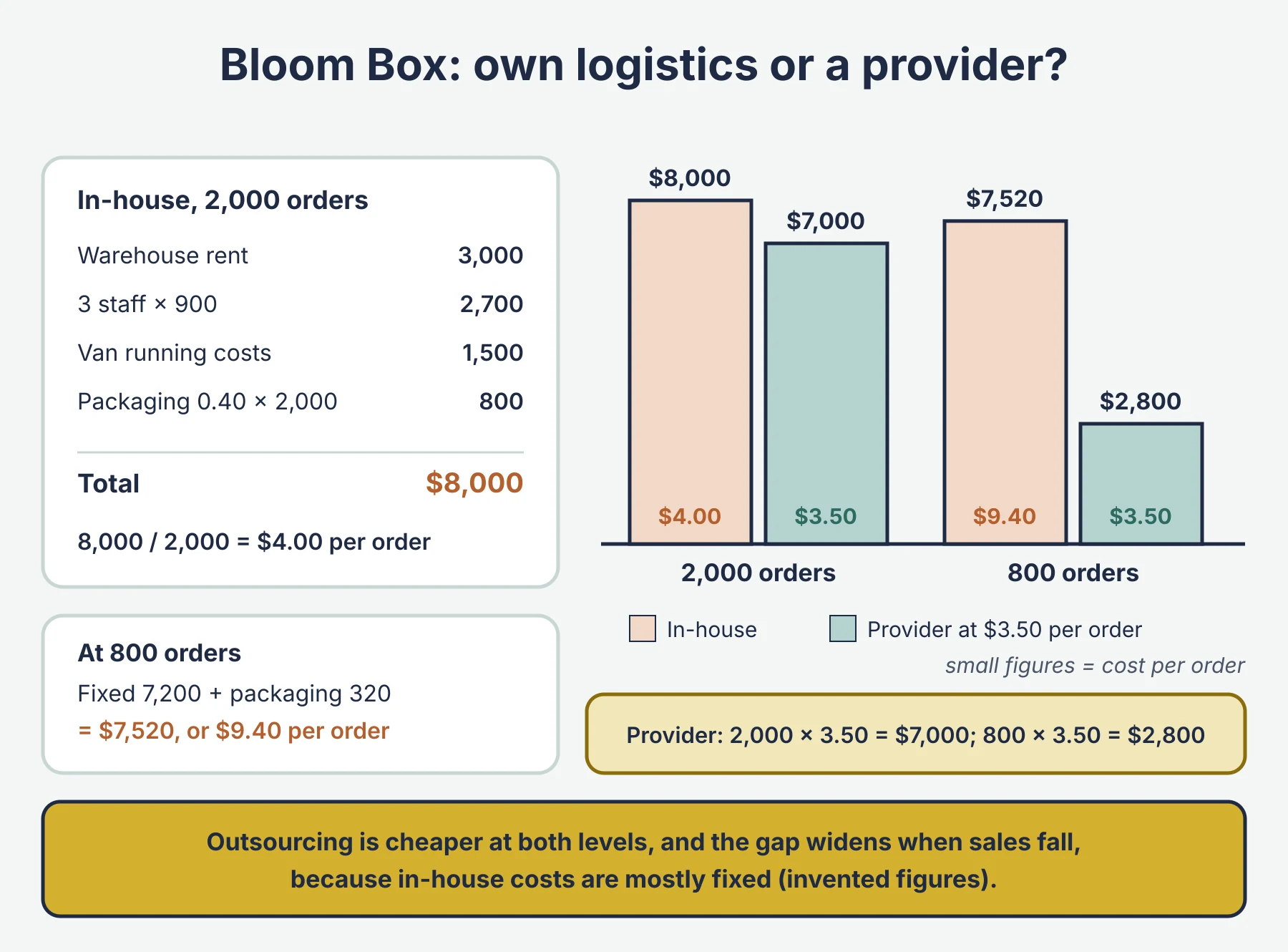
- Add in-house costs (rent, wages, vehicles, packaging) for the period.
- Multiply the provider’s charge by the number of units or orders.
- Compare totals, or divide each total by units for cost per unit.
- Comment: fixed in-house costs make outsourcing relatively cheaper when output is low.
Invented example: in-house costs $6,000 for 1,500 orders = $4.00 per order; provider charges $3.20 per order = $4,800, so outsourcing saves $1,200.
Exam traps
- Outsourcing is not the same as moving abroad. The contractor can be in the same country.
- Contract manufacturing is not a franchise. No outlet or brand licence is involved; the contractor only produces.
- Contract logistics is more than transport. Storage, packing, returns and documents are included.
- Balance is needed. “Should the business outsource?” requires benefits, risks and a decision.
- Fit the product. Quality control matters most for food, medicines and premium goods.
Self-test
- Define outsourcing.
- Name the two areas of outsourcing growth stated in the syllabus.
- Define contract manufacturing.
- State three services a contract logistics provider may offer.
- Explain why ecommerce has increased the use of contract logistics.
- Give two reasons why contract manufacturing has grown.
- State one benefit of in-house production named in the syllabus.
- State one benefit of outsourced production named in the syllabus.
- Give two risks of outsourcing for a client.
- Why might a small new brand prefer contract manufacturing to building a factory?
- A provider charges $2.75 per order. How much does it charge for 1,200 orders?
- In-house logistics cost $5,400 a month for 1,200 orders. What is the in-house cost per order, and which option is cheaper compared with the provider in Question 11?
Self-test answers
- Paying another business to carry out an activity the business could do itself.
- Contract manufacturing and logistics.
- Paying another firm to make products, or parts of them, to the client’s own design and specification.
- Any three: warehousing; picking and packing orders; transport and delivery; handling returns; export documents and customs clearance.
- Online sellers must deliver many small parcels quickly and handle returns; providers already have warehouses, vehicles and tracking, so it is cheaper than building this in-house.
- Any two: lower start-up costs; access to specialist machinery and skills; economies of scale; flexible output; focus on core activities; easier management through digital communication.
- Control on quality, or control on information.
- Accessing expertise, or cost savings.
- Any two: less control over quality or timing; dependence on the contractor; leaked designs or data; reputation damage; communication delays.
- It avoids the large cost of buying premises and machinery, so it can launch with little capital and use the contractor’s expertise.
- 1,200 x $2.75 = $3,300.
- $5,400 / 1,200 = $4.50 per order; the provider ($2.75 per order, $3,300 in total) is cheaper by $2,100 a month.
Frequently asked questions
Is outsourcing always cheaper? No. A provider’s charges may exceed in-house costs when output is high and the business already owns its premises and equipment; this is why figures should be compared.
Where else does outsourcing appear in the course? The meaning and benefits of in-house and outsourced production are in 1.2.2, and logistics elements are in 1.1.2 and Topic 4.
Try the outsourcing practice questions, and revisit 1.2.2 in the production revision notes.
Official syllabus
Cambridge O Level Commerce (7100) syllabus for 2026, 2027 and 2028, sub-topic 2.2: official syllabus PDF.
Related resources
-
Revision notes
Cambridge O Level Commerce: Commercial Operations — Revision Notes (7100)
Recall notes for Cambridge O Level Commerce 7100 Topic 2: enterprise types, multinationals, franchises, outsourcing, retail, wholesale and communication.
Commerce · Cambridge · O Level
Revise topic -
Study guides
Cambridge O Level Commerce (7100): Retailing
Cambridge O Level Commerce 7100 sub-topic 2.3 in depth: ten types of retailer, why small shops survive, selling techniques, digital retail trends and ecommerce.
Commerce · Cambridge · O Level
Read guide -
Practice questions
Cambridge O Level Commerce (7100): Retailing – Practice Questions
Thirteen original questions with full answers on Cambridge O Level Commerce 7100 sub-topic 2.3: retailer types, selling techniques, digital trends, ecommerce.
Commerce · Cambridge · O Level
Try questions
Get free revision emails (optional)
Occasional emails with practice questions, worked explanations and links to free resources for the qualification and subjects you choose. No spam, and you can unsubscribe from any email. The free tools on this site never need an email.