
Revision Notes
Cambridge O Level Commerce (7100): Production – Revision Notes
Recall notes for Cambridge O Level Commerce 7100 sub-topic 1.2: sectors, specialisation, in-house and outsourced production, agents, factors, EDI and costs.
- Subject
- Commerce
- Level
- O LEVELS
- Topic
- Topic 1 – Commerce and Production
- Author
- Marlbridge Academic Team
- Updated
- Reviewed by
- Salman Ahmad (what this means)
Aligned to Cambridge O Level Commerce (7100), 2026-2028. Official specification .
Syllabus page (what it covers and how it is assessed): Cambridge O Level Commerce.
Syllabus points this page covers
7100
- 1.2 Production
Found an error? Report a correction.
Need help with this topic? Request a free trial class for O Level Commerce (7100).
Condensed notes for sub-topic 1.2 Production in Cambridge O Level Commerce (7100). The production study guide has the full explanations and a worked cost calculation.
Six parts to recall
- Sectors of production and specialisation (1.2.1)
- In-house and outsourced production (1.2.2)
- Global and domestic supply chains (1.2.3)
- Intermediaries: wholesaler, retailer, agent, factor (1.2.4)
- Digital technology: automation and EDI (1.2.5)
- Ten named costs and simple calculations (1.2.6)
Key terms
| Term | Meaning |
|---|---|
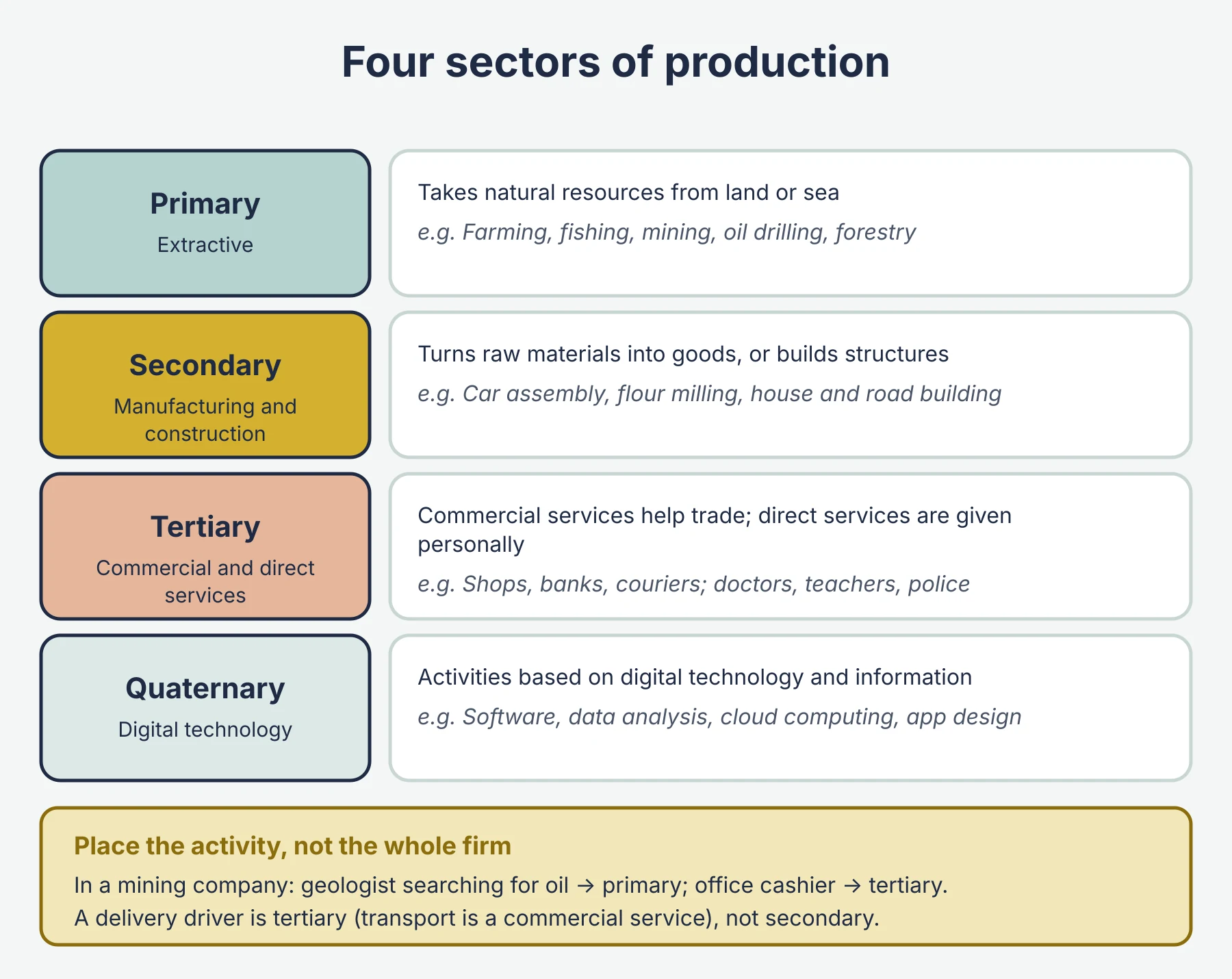
| Primary (extractive) | Taking natural resources from land or sea |
| Secondary | Manufacturing goods and construction |
| Tertiary | Services: commercial services (support trade) and direct services (given personally) |
| Quaternary | Activities based on digital technology and information |
| Specialisation | Concentrating on one product or one part of a process |
| In-house production | The business makes the product with its own staff and equipment |
| Outsourced production | The business pays another firm to make the product or do the task |
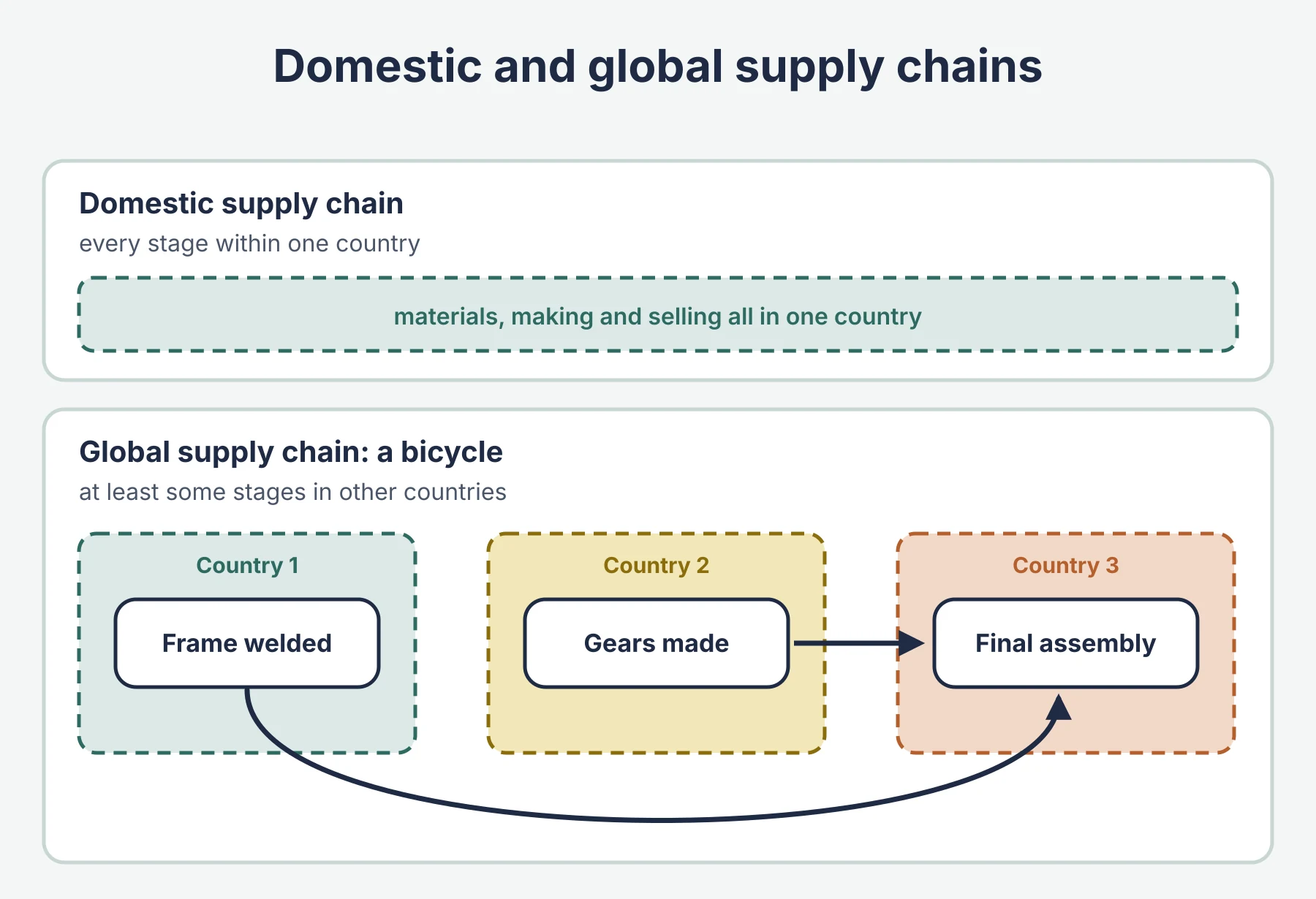
| Domestic supply chain | All stages within one country |
| Global supply chain | Some stages take place in other countries |
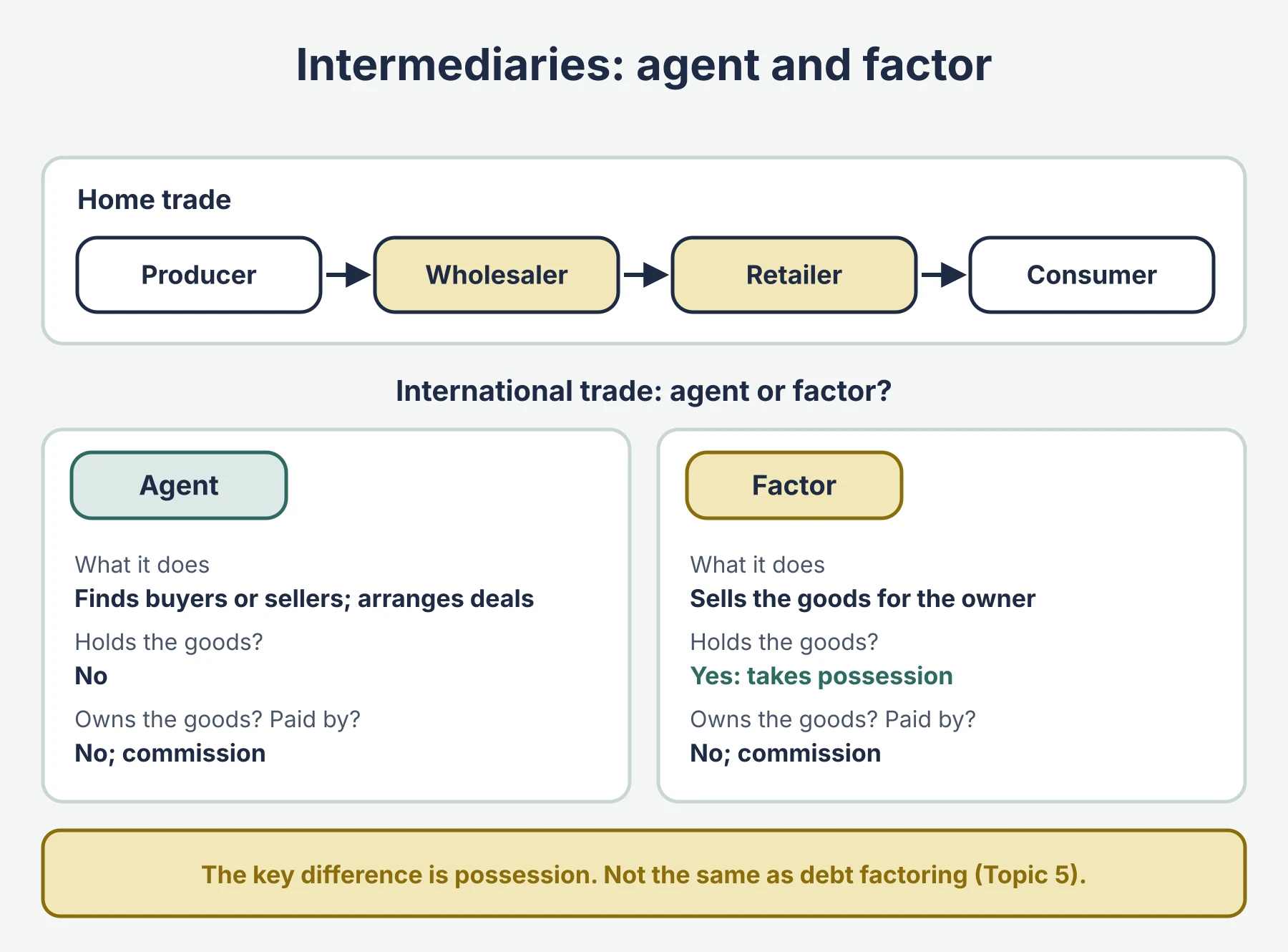
| Agent | Arranges international deals for a principal; does not own or hold the goods; earns commission |
| Factor | Holds the goods and sells them for the owner; earns commission; does not become owner |
| Automation | Machines such as robots doing tasks with little human input |
| EDI | Electronic data interchange: computer-to-computer exchange of business documents with suppliers |
| Inventory cost | The cost of buying and holding stock |
| Utilities | Electricity, gas and water |
Sector sorting rules
- Ask what the activity is, not what the company sells.
- Transport, retailing, banking, insurance, warehousing and advertising are tertiary commercial services.
- Teachers, doctors, hairdressers and police give tertiary direct services.
- App development, data analysis and cloud services are quaternary.
- Construction is secondary, even though nothing is “manufactured”.
Specialisation: advantage and disadvantage per context
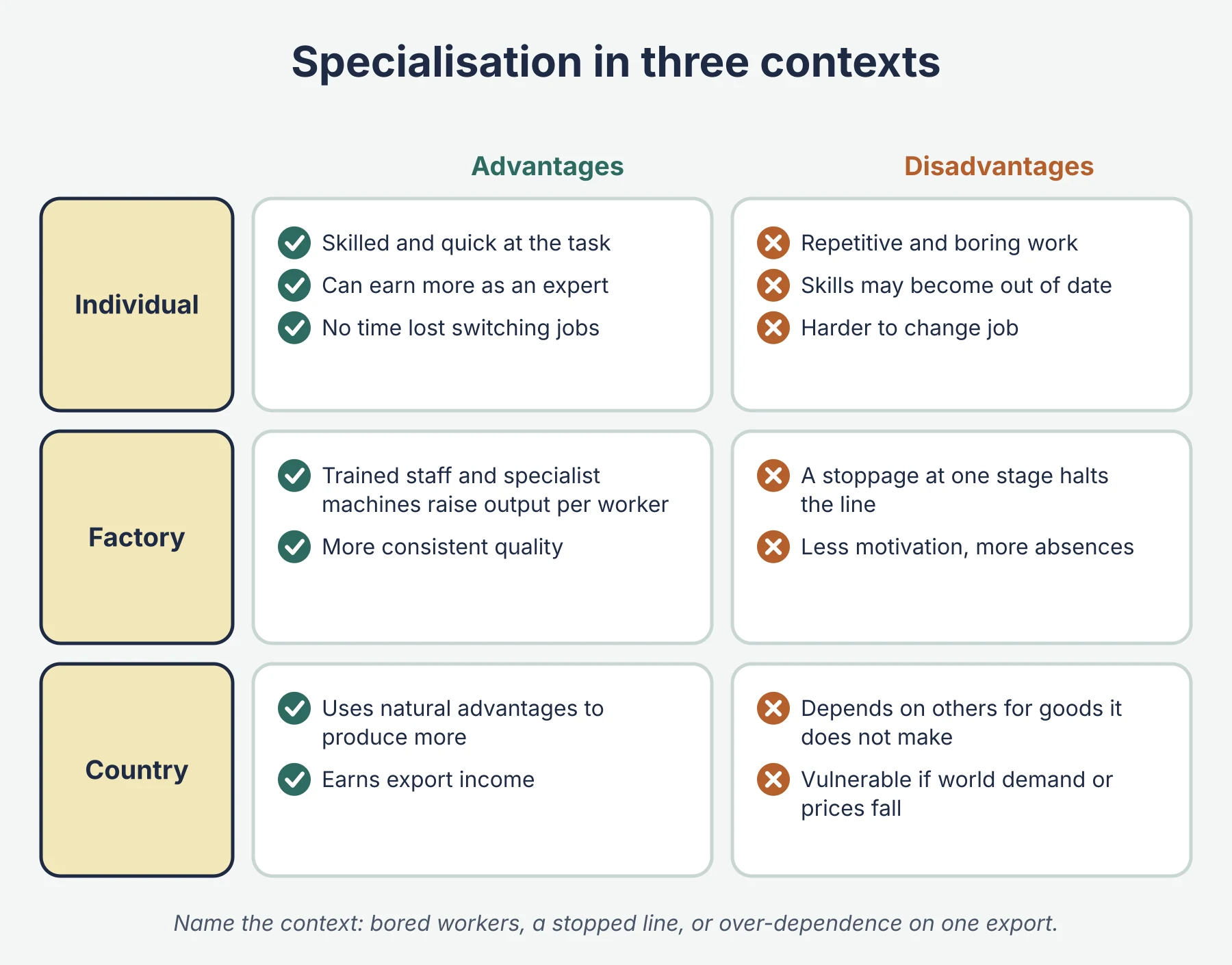
- Individual: greater skill and speed / boredom and narrow skills.
- Factory: higher output per worker and consistent quality / one stoppage halts the whole line.
- Country: uses natural advantages and earns exports / depends on imports and on world demand for its main product.
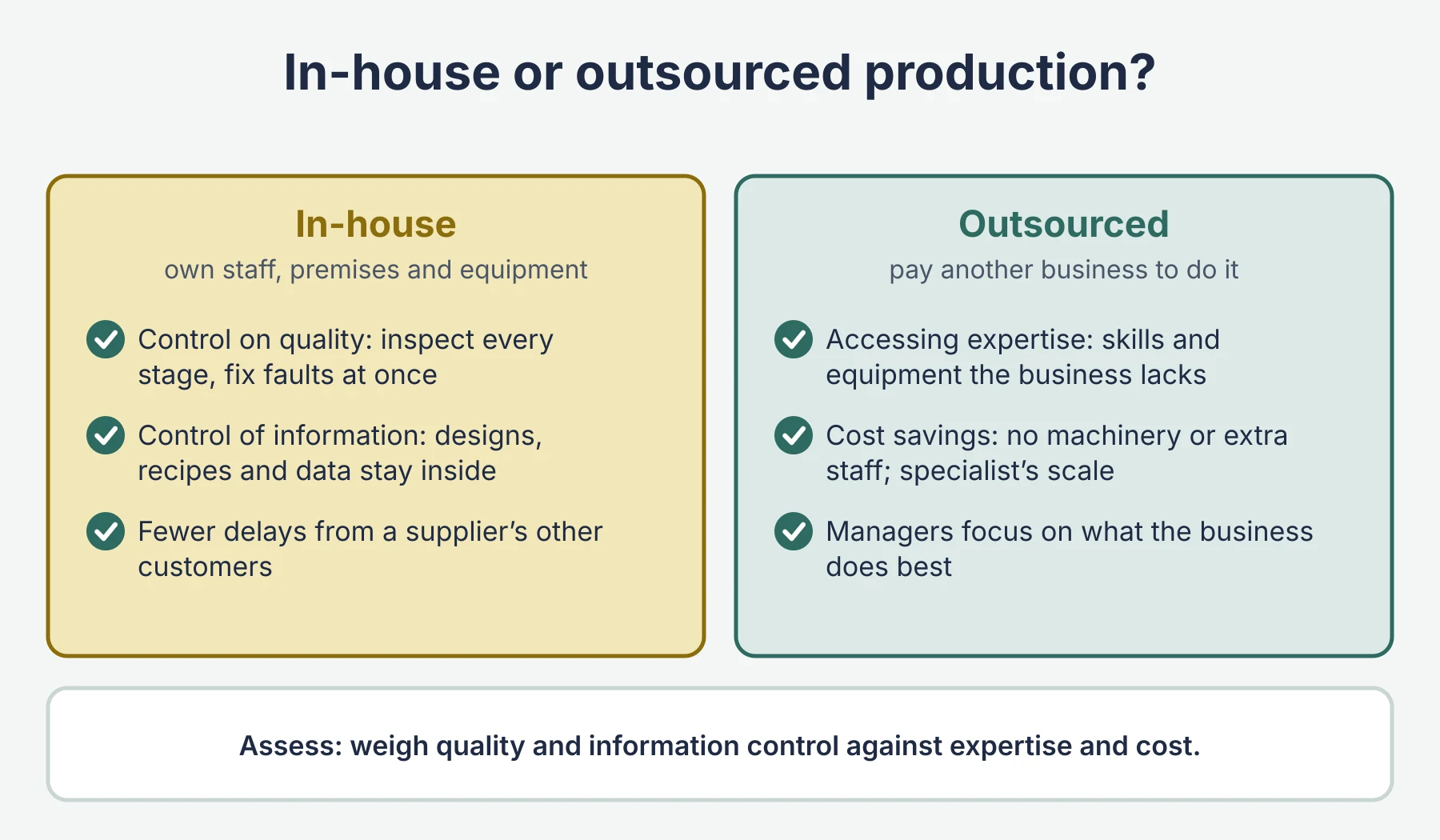
In-house versus outsourced: the syllabus examples
| In-house wins on | Outsourced wins on |
|---|---|
| Control on quality | Accessing expertise |
| Control on information (designs, data) | Cost savings (no machinery or extra staff) |
| Reliability of timing | Freedom to focus on core activities |
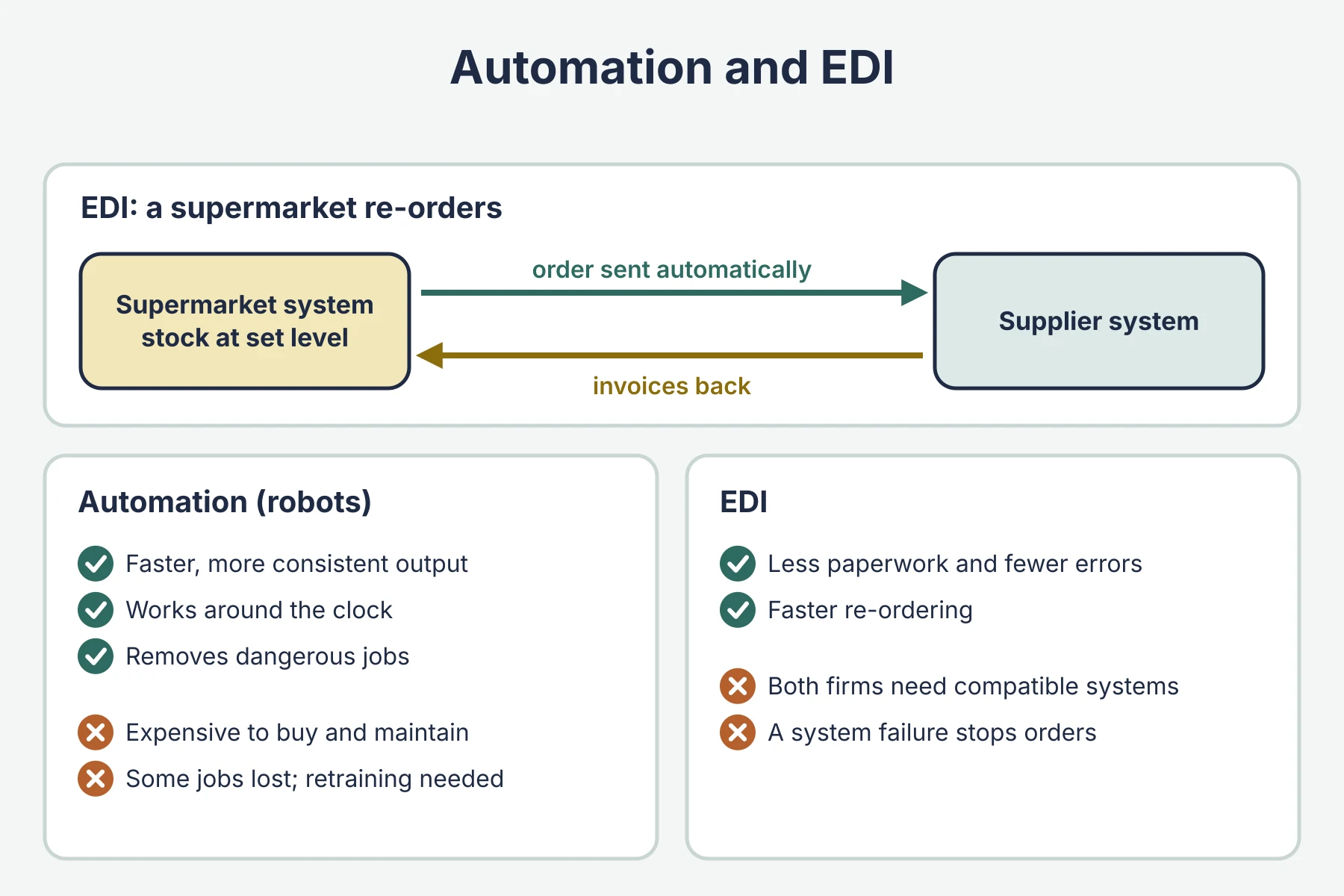
Digital technology effects
| Technology | Positive effects | Negative effects |
|---|---|---|
| Automation (robotics) | Faster, consistent output; 24-hour working; safer for staff | High purchase and repair costs; job losses; retraining needed |
| EDI with suppliers | Automatic re-ordering; less paperwork; fewer errors | Both firms need compatible systems; a failure stops orders |
The ten named costs
Advertising, bank charges, commission, customs duties, inventory, labour, packaging, transport, utilities, warehousing.
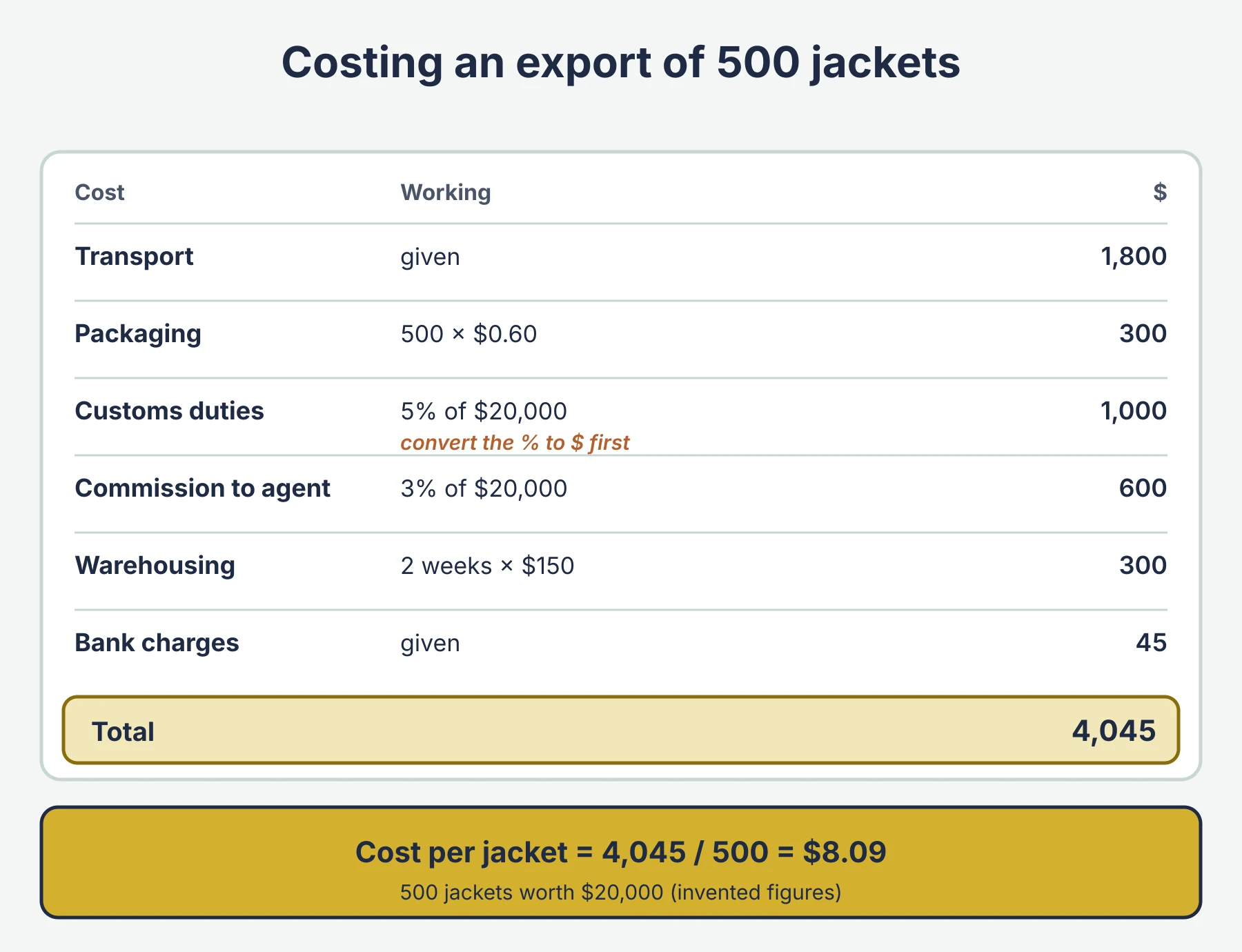
Calculation checklist
- Convert percentages into dollar amounts first (for example 4% of $15,000 = $600).
- Multiply quantity by unit cost for items like packaging (for example 300 boxes x $1.20 = $360).
- Add every line and show the addition.
- If asked for cost per unit, divide the total by the number of units.
Exam traps
- Factor ≠ debt factoring: in 1.2 a factor is an international trade intermediary holding goods; debt factoring (Topic 5) is selling debts for cash.
- Agent never owns the goods, and neither does the factor; only the factor has possession.
- Global supply chain needs at least one stage abroad, not just a foreign customer.
- Specialisation questions name a context; answer for that context only.
- Quaternary is digital technology in this syllabus, so do not leave it out of a “four sectors” answer.
Self-test
- State the sector of production for: (a) a quarry; (b) a bridge builder; (c) a nurse; (d) a firm writing payroll software.
- What is the difference between commercial services and direct services?
- Define specialisation.
- Give one disadvantage of specialisation for a country.
- State two benefits of in-house production named in the syllabus.
- State two benefits of outsourced production named in the syllabus.
- What makes a supply chain global?
- What is the main difference between an agent and a factor?
- Give one advantage of EDI for a supermarket.
- Name five of the ten costs listed in the syllabus.
- Customs duty is 8% on goods worth $12,500. Calculate the duty.
- A consignment has costs of transport $900, packaging $150 and commission $250. It contains 200 units. Calculate the cost per unit.
Self-test answers
- (a) Primary; (b) secondary (construction); (c) tertiary (direct service); (d) quaternary.
- Commercial services help trade take place (such as banking or transport); direct services are given personally to consumers (such as teaching).
- Concentrating on producing one product, or one part of a production process.
- Dependence on other countries for goods it does not make, or loss of income if world demand for its main product falls.
- Control on quality and control on information.
- Accessing expertise and cost savings.
- At least some stages of production or sourcing take place in other countries.
- A factor takes possession of the goods and sells them; an agent arranges deals without holding the goods.
- Stock is re-ordered automatically when it falls to a set level, with less paperwork and fewer errors.
- Any five: advertising, bank charges, commission, customs duties, inventory, labour, packaging, transport, utilities, warehousing.
- 8% x $12,500 = $1,000.
- Total = $900 + $150 + $250 = $1,300; $1,300 / 200 = $6.50 per unit.
Frequently asked questions
Do I need to know examples of quaternary activities? The syllabus describes quaternary activities as digital technology, so one or two clear examples such as software development or data analysis are enough.
Is “labour” a cost of trade or of production? Both. The syllabus lists the ten costs together because they arise across trade, commerce and production.
Test yourself with the production practice questions, and revise sub-topic 1.1 with the trade and commerce revision notes.
Official syllabus
Cambridge O Level Commerce (7100) syllabus for 2026, 2027 and 2028, sub-topic 1.2: official syllabus PDF.
Related resources
-
Revision notes
Cambridge O Level Commerce: Commercial Operations — Revision Notes (7100)
Recall notes for Cambridge O Level Commerce 7100 Topic 2: enterprise types, multinationals, franchises, outsourcing, retail, wholesale and communication.
Commerce · Cambridge · O Level
Revise topic -
Study guides
Cambridge O Level Commerce (7100): Trade and commerce
Cambridge O Level Commerce 7100 sub-topic 1.1 in depth: trade versus commerce, home and international trade, aids to trade, logistics and types of commerce.
Commerce · Cambridge · O Level
Read guide -
Practice questions
Cambridge O Level Commerce (7100): Trade and commerce – Practice Questions
Twelve original questions with mark-scheme answers on Cambridge O Level Commerce 7100 sub-topic 1.1: trade, aids to trade, logistics and types of commerce.
Commerce · Cambridge · O Level
Try questions
Get free revision emails (optional)
Occasional emails with practice questions, worked explanations and links to free resources for the qualification and subjects you choose. No spam, and you can unsubscribe from any email. The free tools on this site never need an email.