
Study Guides
Cambridge O Level Commerce (7100): Production
Cambridge O Level Commerce 7100 sub-topic 1.2 in depth: sectors, specialisation, in-house or outsourced production, intermediaries, technology and costs.
- Subject
- Commerce
- Level
- O LEVELS
- Topic
- Topic 1 – Commerce and Production
- Author
- Marlbridge Academic Team
- Updated
- Reviewed by
- Salman Ahmad (what this means)
Aligned to Cambridge O Level Commerce (7100), 2026-2028. Official specification .
Syllabus page (what it covers and how it is assessed): Cambridge O Level Commerce.
Syllabus points this page covers
7100
- 1.2 Production
Found an error? Report a correction.
Need help with this topic? Request a free trial class for O Level Commerce (7100).
Sub-topic 1.2 of Cambridge O Level Commerce (7100) explains how goods and services are produced and what it costs to get them to market. It has six parts, from the sectors of production (1.2.1) to calculating the costs involved in trade, commerce and production (1.2.6). It is the most varied sub-topic in Topic 1, and the one most likely to include a simple calculation.
The Commerce and Production overview summarises the whole topic. This guide goes deeper into 1.2, with new examples and a full cost calculation.
What the specification asks for
| Section | Content statements |
|---|---|
| 1.2.1 Sectors of production and specialisation | Features of primary, secondary, tertiary and quaternary activities; meaning of specialisation; its advantages and disadvantages for an individual, factory and country |
| 1.2.2 In-house and outsourced production | Meanings; benefits of in-house (including control on quality and information); benefits of outsourced (including accessing expertise and cost savings) |
| 1.2.3 Global supply chains | Meaning of a global and a domestic supply chain |
| 1.2.4 Intermediaries in a supply chain | Home trade: wholesaler and retailer. International trade: agent and factor |
| 1.2.5 Effects of digital technology | Automation, for example robotics; digital communication with suppliers, for example EDI |
| 1.2.6 Costs | Ten named types of cost; simple calculations in given situations |
The four sectors and their features
| Sector | Feature | Examples |
|---|---|---|
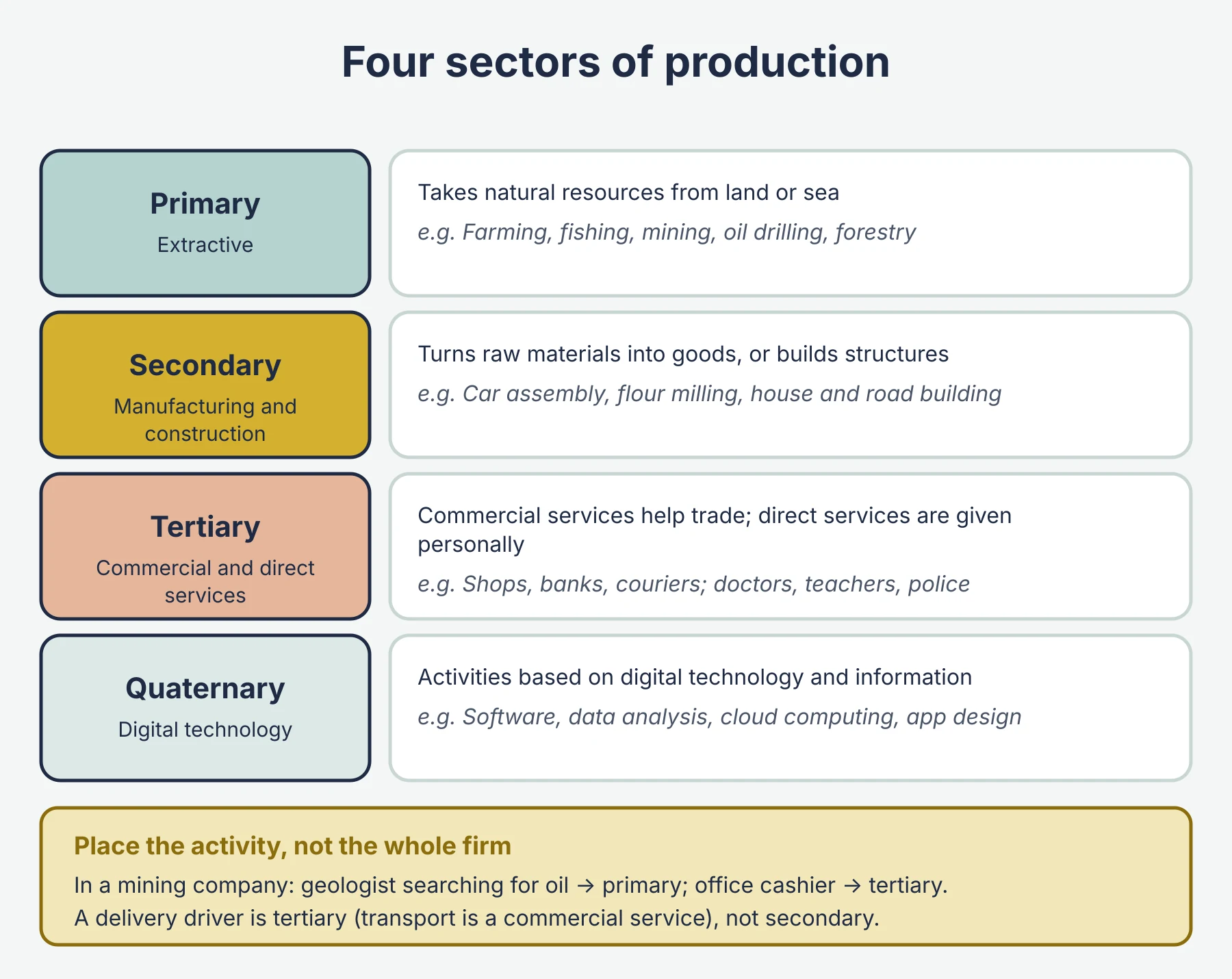
| Primary (extractive) | Takes natural resources from land or sea | Farming, fishing, mining, oil drilling, forestry |
| Secondary | Turns raw materials into finished goods (manufacturing) or builds structures (construction) | Car assembly, flour milling, house building, road building |
| Tertiary | Provides services rather than goods. Commercial services help trade (retailing, wholesaling, banking, insurance, transport); direct services are given personally to consumers | Doctors, teachers, hairdressers, police (direct); shops, banks, couriers (commercial) |
| Quaternary | Activities based on digital technology and information | Software development, data analysis, cloud computing, app design |
To place an activity, ask what the worker actually does. A geologist searching for oil works for a mining company, but a cashier in that company’s office is providing a service. In exam answers, place the activity named in the question, not the whole firm.
Specialisation in three contexts
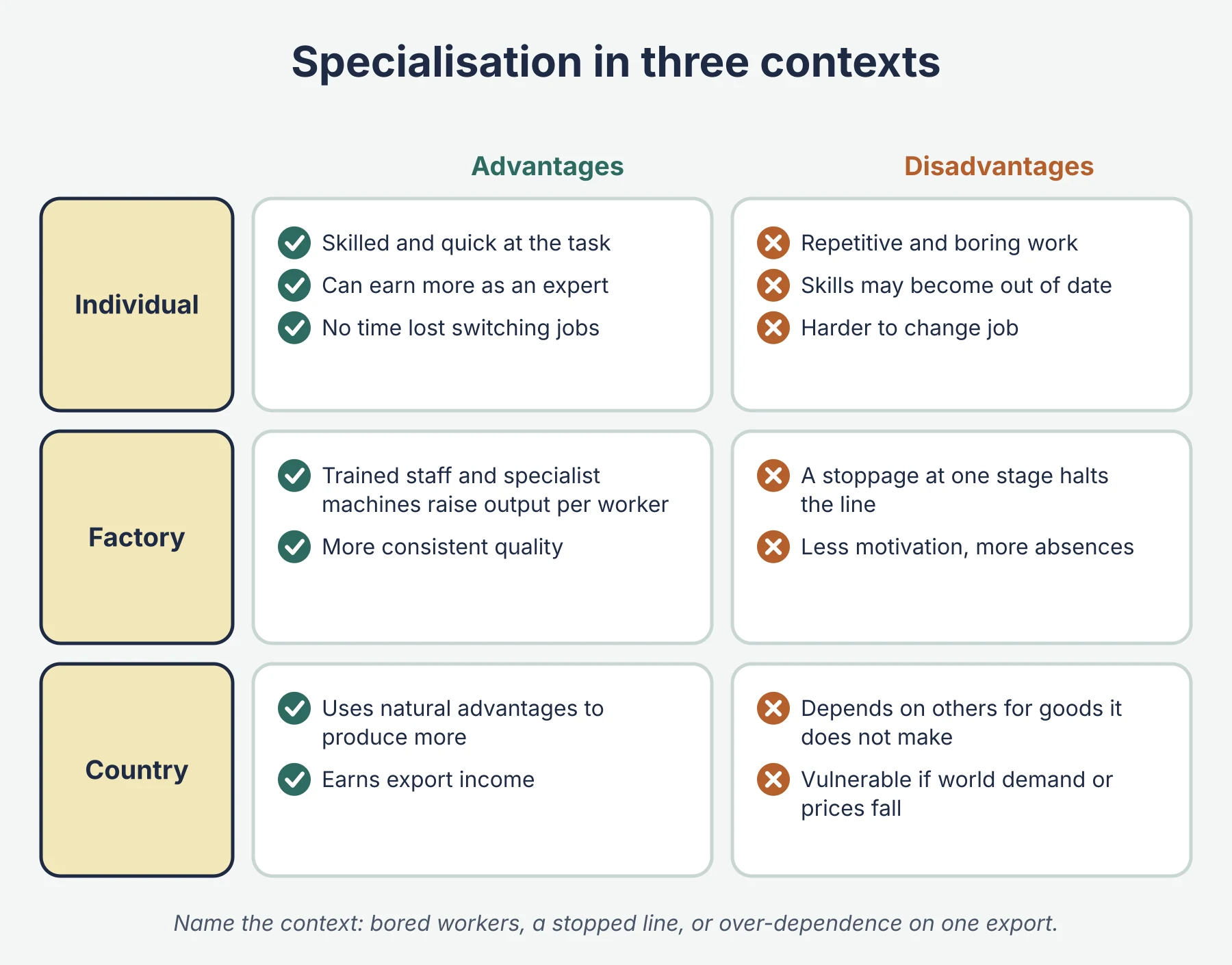
Specialisation means concentrating on producing one product, or on one part of a production process, instead of trying to make everything.
| Context | Advantages | Disadvantages |
|---|---|---|
| Individual (a worker) | Becomes skilled and quick at the task; can earn more as an expert; saves time switching between jobs | Work becomes repetitive and boring; skills may become out of date; finds it harder to change job if the task disappears |
| Factory | Each stage done by trained staff and specialist machinery, so output per worker rises; quality is more consistent | A stoppage at one stage halts the whole line; workers may lose motivation, increasing absences |
| Country | Uses its natural advantages (climate, minerals, skills) to produce more; earns export income | Depends on other countries for goods it does not make; vulnerable if world demand or prices for its main product fall |
An exam answer gains by naming the context. “Workers become bored” is a disadvantage for an individual; “the whole line stops when one stage breaks down” is a factory disadvantage; “over-dependence on one export” is a country disadvantage.
In-house or outsourced production?
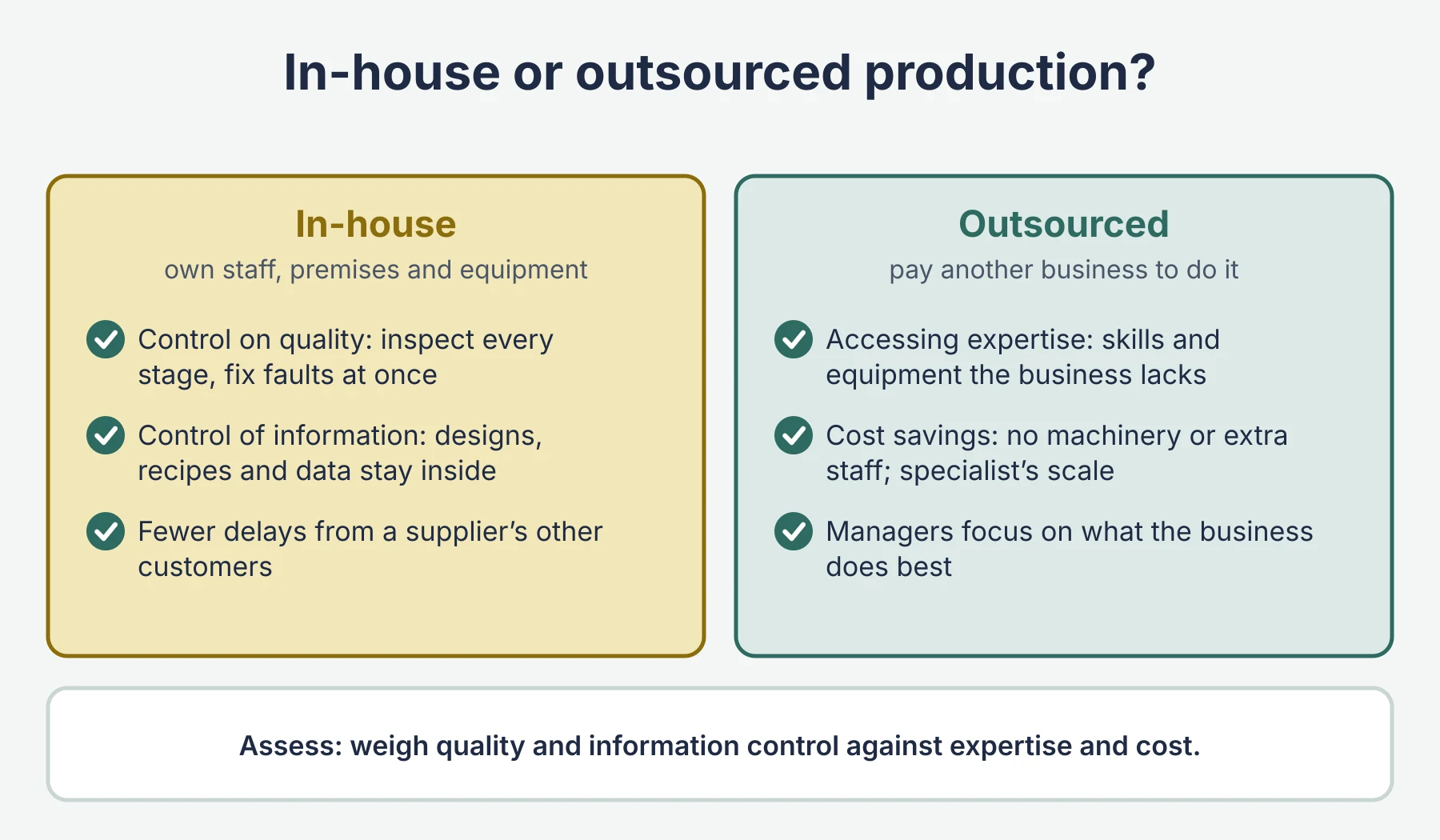
In-house production means the business makes the product, or carries out the activity, using its own staff, premises and equipment. Outsourced production means it pays another business to do it.
Benefits of in-house over outsourced:
- Control on quality: managers can inspect every stage and correct faults at once.
- Control of information: designs, recipes and customer data stay inside the business, reducing the risk that a rival copies them.
- Fewer delays caused by a supplier’s other customers.
Benefits of outsourced over in-house:
- Accessing expertise: a specialist firm may have skills and equipment the business lacks.
- Cost savings: no need to buy machinery or employ extra staff; the specialist may produce more cheaply because it works at a large scale.
- Managers can concentrate on what the business does best, such as design or selling.
Sub-topic 2.2 later looks at why outsourcing has grown; see the outsourcing study guide.
Global and domestic supply chains
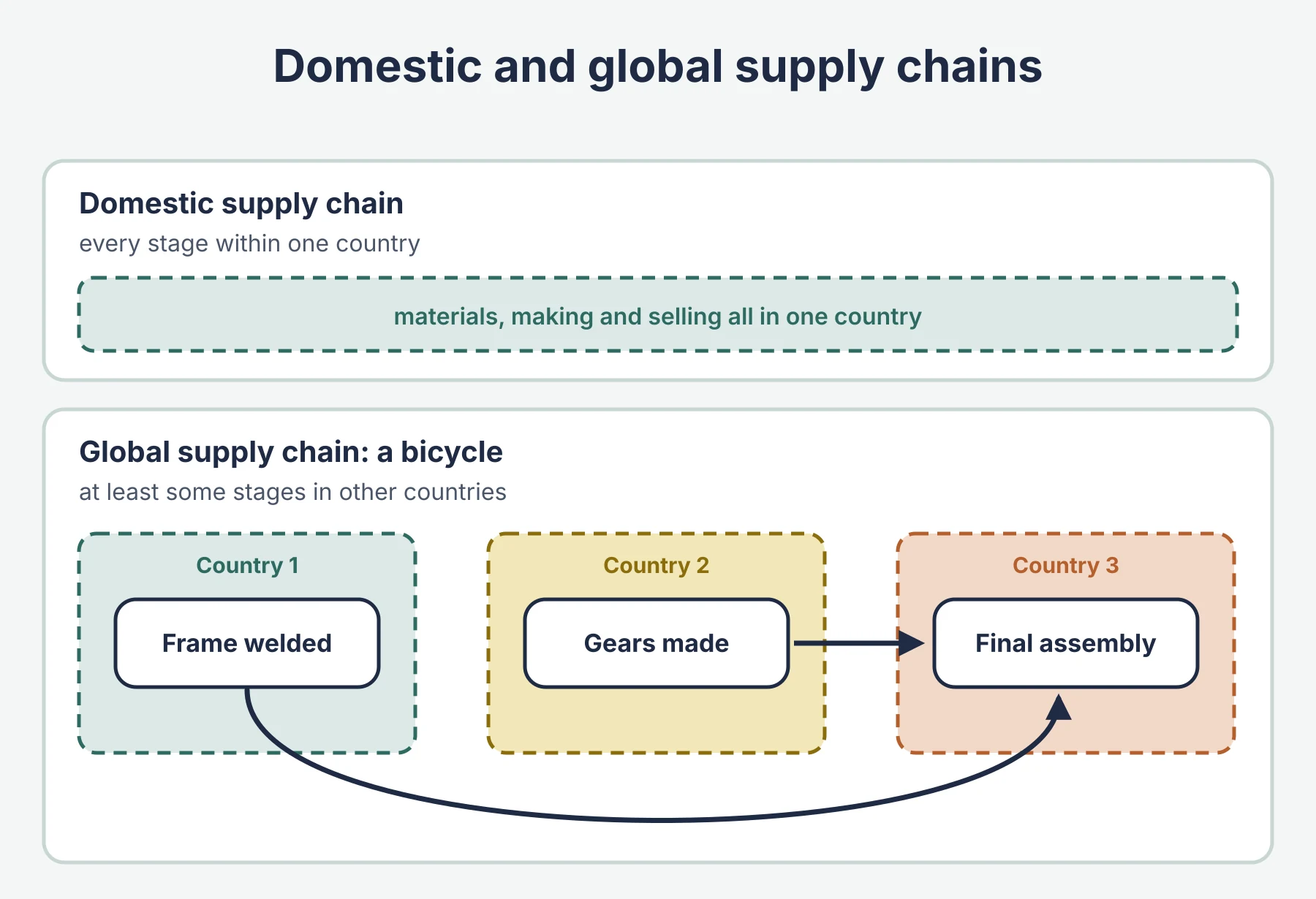
A supply chain is the sequence of businesses and activities that turn raw materials into a product in the customer’s hands. In a domestic supply chain every stage takes place within one country. In a global supply chain at least some stages, such as sourcing materials, making components or assembly, take place in other countries. A bicycle with a frame welded in one country, gears from another and final assembly in a third has a global supply chain.
Intermediaries
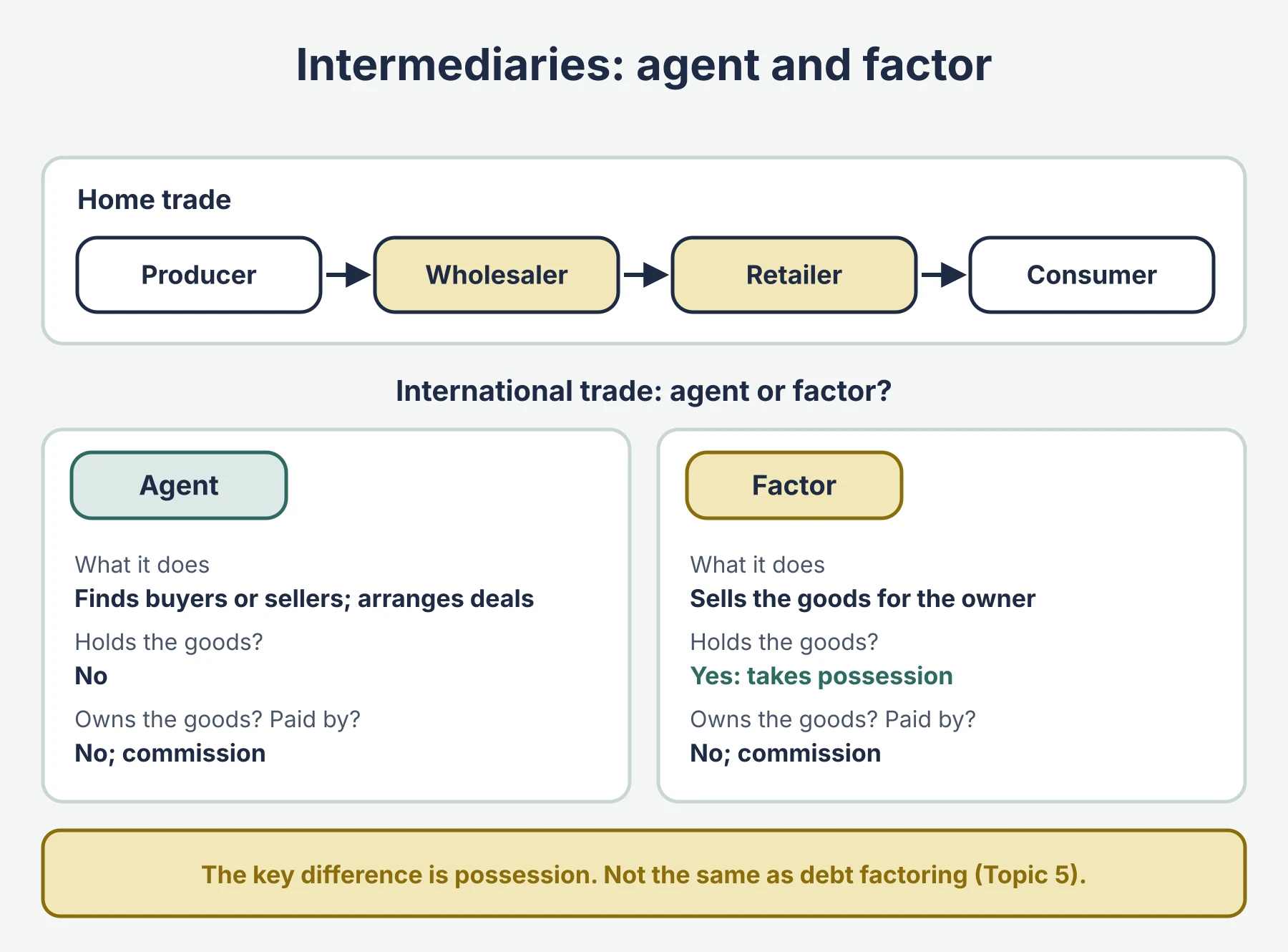
An intermediary stands between producer and consumer.
- Wholesaler (home trade): buys in bulk from producers and sells smaller quantities to retailers.
- Retailer (home trade): sells to the final consumer.
- Agent (international trade): finds buyers or sellers and arranges deals on behalf of another business (the principal). The agent does not own the goods and is paid a commission.
- Factor (international trade): takes possession of the goods and sells them on behalf of the owner, also for a commission, but without becoming the owner.
The key difference between agent and factor is possession: the factor holds the goods; the agent does not.
Digital technology and production
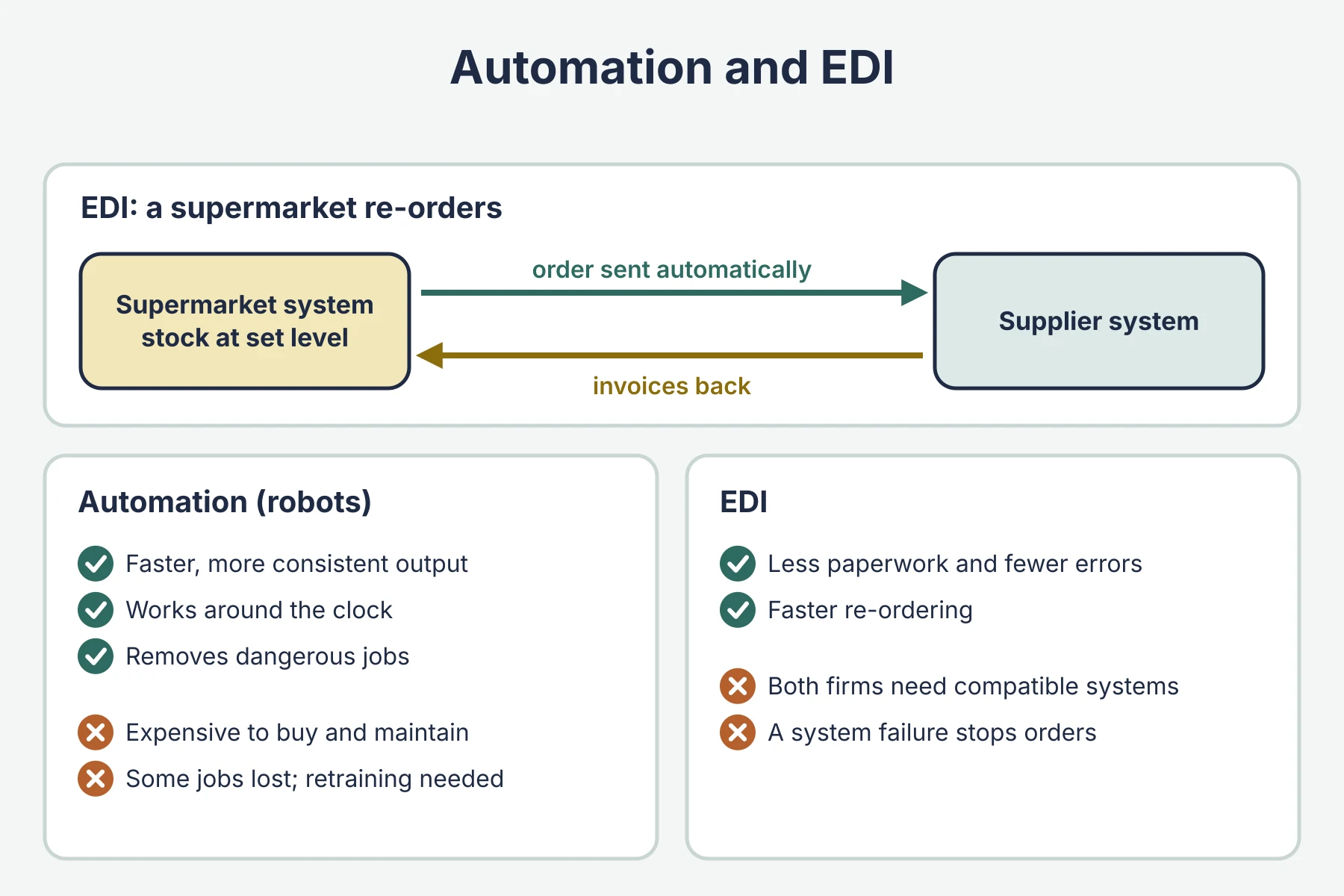
Automation uses machines, such as robots, to carry out tasks with little human involvement. Output becomes faster and more consistent, robots can work around the clock, and dangerous jobs can be removed from workers. Against this, machines are expensive to buy and maintain, some jobs are lost, and remaining workers need retraining.
Electronic data interchange (EDI) is the computer-to-computer exchange of business documents, such as orders and invoices, in a standard format. A supermarket’s system can send a new order to a supplier automatically when stock falls to a set level. EDI cuts paperwork and errors and speeds up re-ordering, but both firms need compatible systems, and a system failure can stop orders flowing.
Costs of trade, commerce and production
The syllabus names ten costs: advertising, bank charges, commission, customs duties, inventory, labour, packaging, transport, utilities and warehousing. Inventory is the cost of buying and holding stock; utilities are electricity, gas and water.
Worked example: costing an export consignment
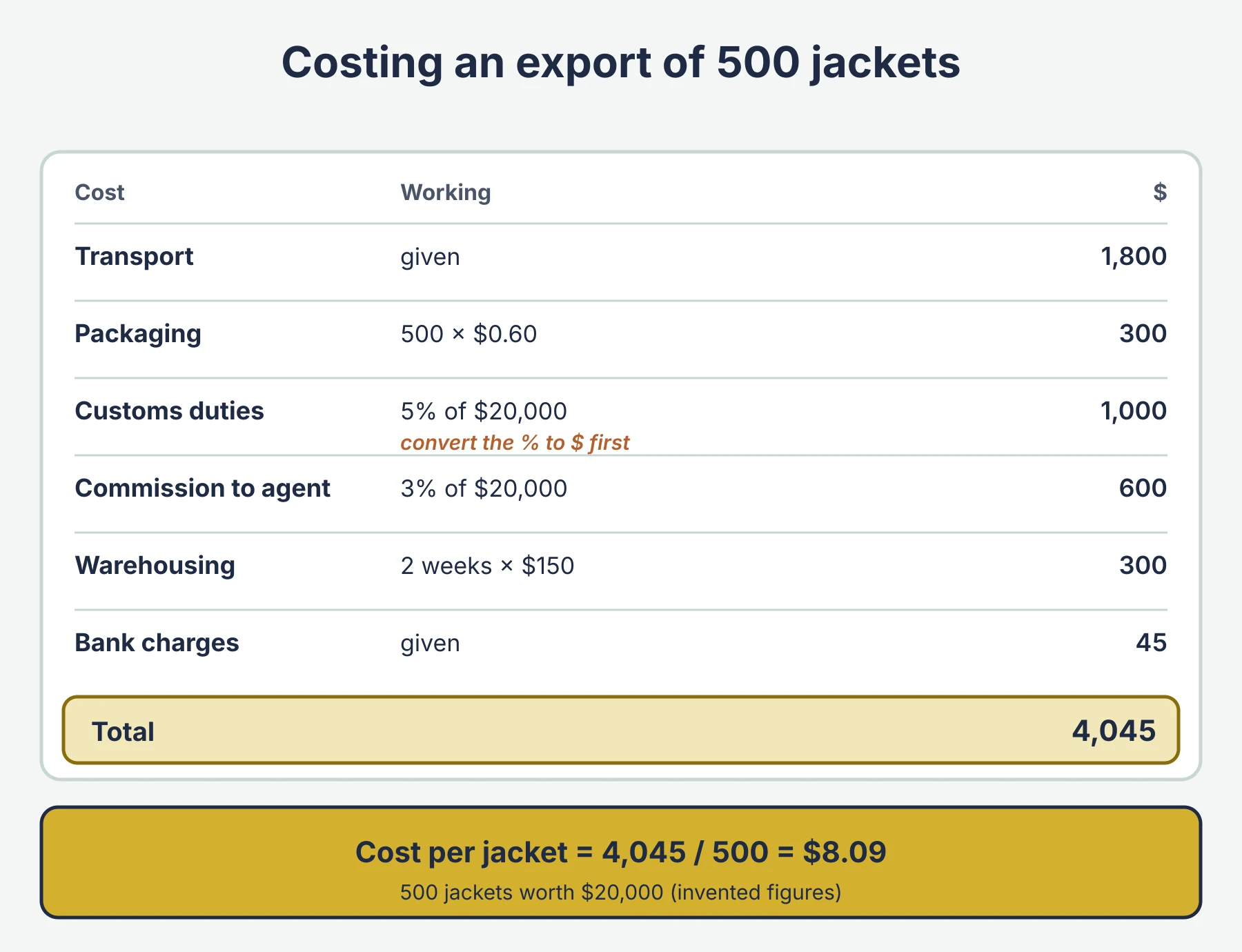
All figures are invented for practice. A firm exports 500 jackets with a total value of $20,000. Its costs for the consignment are:
| Cost | Working | Amount |
|---|---|---|
| Transport | Given | $1,800 |
| Packaging | 500 x $0.60 | $300 |
| Customs duties | 5% of $20,000 | $1,000 |
| Commission to an overseas agent | 3% of $20,000 | $600 |
| Warehousing | 2 weeks x $150 | $300 |
| Bank charges | Given | $45 |
| Total | 1,800 + 300 + 1,000 + 600 + 300 + 45 | $4,045 |
Cost per jacket = $4,045 / 500 = $8.09.
Method points: convert each percentage to an amount before adding; keep the units ($) on every line; show the addition so that a slip in one line does not lose all the marks.
Common mistakes
- Placing a delivery driver in the secondary sector because they carry manufactured goods; transport is a tertiary commercial service.
- Calling software design tertiary when the question expects the quaternary sector for digital technology.
- Giving general advantages of specialisation when the question names one context.
- Confusing the international factor with debt factoring, a source of finance in Topic 5.
- Saying an agent buys the goods: an agent arranges sales but does not own them.
- Adding a percentage (such as “5%”) to dollar amounts instead of converting it first.
Exam technique
- Identify the sector: name it and give the feature that places the activity there.
- Explain a benefit of outsourcing: state the benefit and say how it helps the business described.
- Calculate: set out each line of working, as in the table above.
- Assess whether to produce in-house: weigh quality and information control against expertise and cost, then decide for the scenario.
Practise this sub-topic
Use the production revision notes for quick recall, then the production practice questions, which include two cost calculations. Sub-topic 1.1 is in the trade and commerce study guide.
Official syllabus
Cambridge O Level Commerce (7100) syllabus for 2026, 2027 and 2028, sub-topic 1.2 Production: official syllabus PDF.
Related resources
-
Revision notes
Cambridge O Level Commerce: Commercial Operations — Revision Notes (7100)
Recall notes for Cambridge O Level Commerce 7100 Topic 2: enterprise types, multinationals, franchises, outsourcing, retail, wholesale and communication.
Commerce · Cambridge · O Level
Revise topic -
Practice questions
Cambridge O Level Commerce (7100): Production – Practice Questions
Thirteen original questions with mark-scheme answers on Cambridge O Level Commerce 7100 sub-topic 1.2: sectors, specialisation, outsourcing and cost sums.
Commerce · Cambridge · O Level
Try questions -
Revision notes
Cambridge O Level Commerce (7100): Production – Revision Notes
Recall notes for Cambridge O Level Commerce 7100 sub-topic 1.2: sectors, specialisation, in-house and outsourced production, agents, factors, EDI and costs.
Commerce · Cambridge · O Level
Revise topic
Get free revision emails (optional)
Occasional emails with practice questions, worked explanations and links to free resources for the qualification and subjects you choose. No spam, and you can unsubscribe from any email. The free tools on this site never need an email.